
RENAL PHYSIOLOGY Kidneys Reddish brown paired structures lie
RENAL PHYSIOLOGY
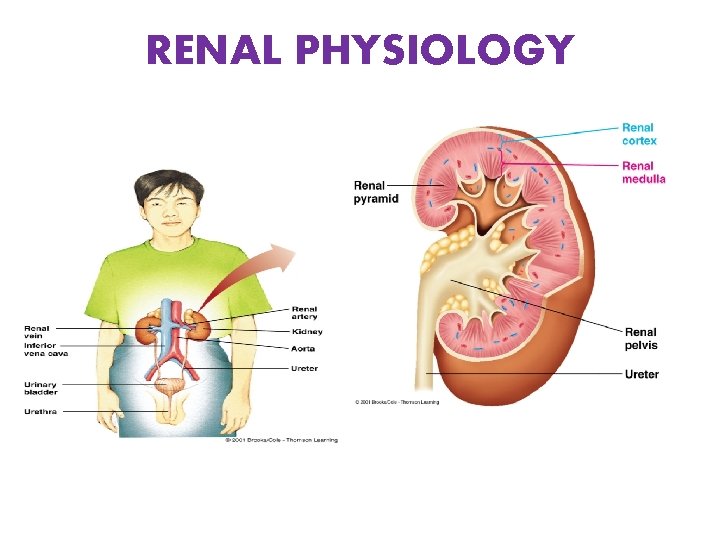
• Kidneys: • Reddish brown paired structures, lie along the posterior abdominal wall on either side of vertebral column. • Each kidney is bean shaped. • The right kidney is slightly on a lower level than the left one. • Kidneys are well protected by padding of fat which surrounds them. • Each kidney is enclosed in a thin, tough, fibrous, whitish capsule. • Outer surface is convex, while inner is concave. • In the concave depression there is an opening called hillus renalis through which blood vessels, nerves, lymphatics enter or leave kidney.
• Inside the kidney the hillus expands into central cavity called renal sinus. • Renal sinus contains major & minor calyces, renal pelvis, nerves and blood vessels. • L. S. of Kidney: • Two distinct regions… • 1. Cortex: Outer ( Uriniferous tubules / nephrons) • 2. Medulla : Inner (renal pyramids/ collecting & discharging tubules) • The base of each pyramid is in contact with the cortex & apex is papilla, projects into the sac-like cavity of the kidney the pelvis. • Pelvis consist of several cap-like structures called calyces. • Pelvis intern leads into a long narrow tube ureter.
• The ureters of each kidney empty into urinary bladder. • Histologically the cortical part of the kidney is made-up of large number of tiny filters called nephrons or uriniferous tubules. • Nephrons are the structural and functional units of kidney. • Each kidney is said to have one million such units. • Bowman in 1842 studied the anatomy of the nephrons (Bowman’s capsule)
• Nephron: • Each nephron consists of a small, cup-shaped structure called Bowman’s capsule. From the capsule a tiny tubule comes out and takes twisted course called the proximal convoluted tubule, then dips down to form a wide Henle’s loop, whose ascending limb forms a second tubular coil called the distal convoluted tubule which enters a large straight tube called the collecting tubule. The collecting tubule receives the tubules of many nephrons. The collecting tubule carries the urine towards the pelvis.
• In the cavity of Bowman’s capsule is a network of capillaries called the glomerulus. An afferent arteriole from a branch of renal artery forms the glomerulus. The capillaries forming the glomerulus at the exit of Bowman’s capsule. Unite to form an efferent arteriole which goes towards the proximal convoluted tubule and forms another network of capillaries, peritubular capillaries around the proximal convoluted tubule, the loop of Henle and the distal convoluted tubule. These capillaries then form venules which join together to form the branch of the renal vein which removes the venous blood of the kidney.
• The afferent arterioles, glomeruli and efferent arterioles contain arterial blood. It should be noted that efferent arterioles have smaller diameters than afferent arterioles. This increases the pressure in the glomerular capillaries, which is important for the process of urine formation.
• It is to be noted formation of urine always takes place in the uriniferous tubules or nephrons where as the collecting tubules do not take any part in the urine formation but they simply convey the urine to the pelvis via pyramids for removal.
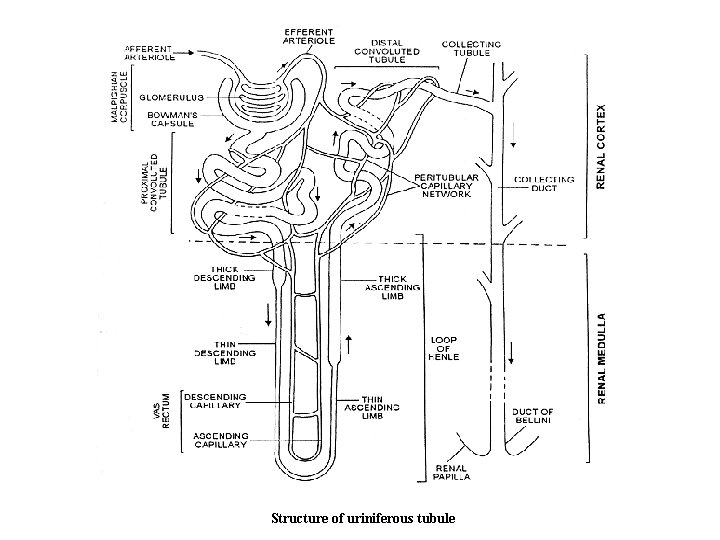
Structure of uriniferous tubule

- Slides: 10