
RENAL PATHOLOGY RAPID PROGRESSIVE GLOMERULONEPHRITIS CHRONIC KIDNEY DISEASE


- Slides: 20
RENAL PATHOLOGY RAPID PROGRESSIVE GLOMERULONEPHRITIS CHRONIC KIDNEY DISEASE APRIL 2020 REFERENCE: ROBBINS & COTRAN PATHOLOGY AND RUBIN’S PATHOLOGY
OBJECTIVES FOR PATHOLOGY LECTURES 5 & 6: NEPHROTIC AND NEPHRITIC SYNDROME AND RAPID PROGRESSIVE GLOMERULONEPHRITIS, CHRONIC KIDNEY DISEASE, At the end of the activity (2 lectures) the students will be able to: • • Recognize the five major renal glomerular syndromes. Describe the main differential pathological diagnosis for each syndrome. Perform a clinico-pathological correlation. Describe the patterns of injury of each syndrome. Key Outlines: • • The nephrotic syndrome: (Minimal change, FSGS, membranous, diabetes). • • • Asymptomatic Hematuria: Ig. A Nephropathy. The nephritic syndrome: (Acute post streptococcal Glomerulonephritis GN, Lupus nephritis). Rapidly progressive GN: (Crescentic GN) The Chronic Renal Failure.
OUTLINE FOR LECTURE 6 • Clinical manifestation of kidney disease • Rapidly progressive GN: (Crescentic GN) • • • Introduction Light microscopy Type III The Chronic Renal Failure. • • Introduction Common causes Clinical features Light microscopy
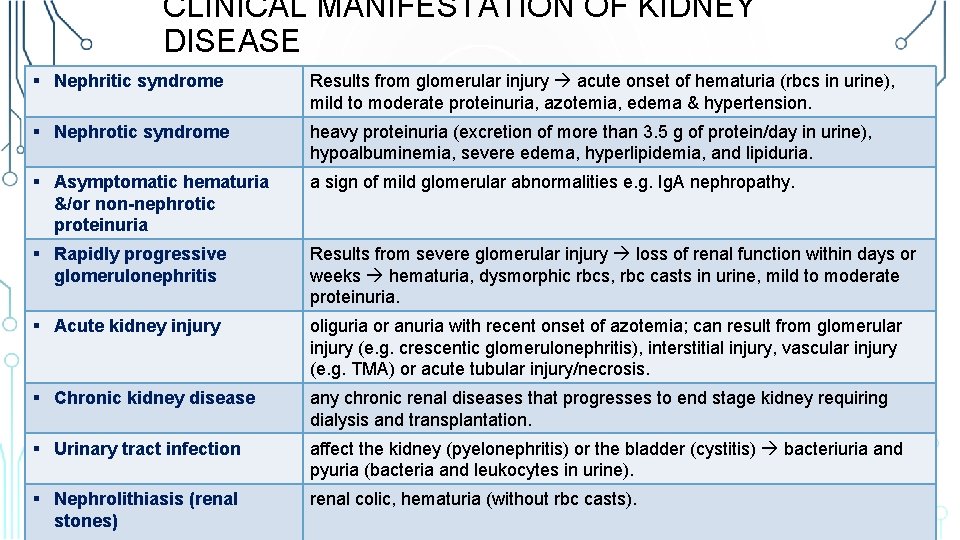
CLINICAL MANIFESTATION OF KIDNEY DISEASE § Nephritic syndrome Results from glomerular injury acute onset of hematuria (rbcs in urine), mild to moderate proteinuria, azotemia, edema & hypertension. § Nephrotic syndrome heavy proteinuria (excretion of more than 3. 5 g of protein/day in urine), hypoalbuminemia, severe edema, hyperlipidemia, and lipiduria. § Asymptomatic hematuria &/or non-nephrotic proteinuria a sign of mild glomerular abnormalities e. g. Ig. A nephropathy. § Rapidly progressive glomerulonephritis Results from severe glomerular injury loss of renal function within days or weeks hematuria, dysmorphic rbcs, rbc casts in urine, mild to moderate proteinuria. § Acute kidney injury oliguria or anuria with recent onset of azotemia; can result from glomerular injury (e. g. crescentic glomerulonephritis), interstitial injury, vascular injury (e. g. TMA) or acute tubular injury/necrosis. § Chronic kidney disease any chronic renal diseases that progresses to end stage kidney requiring dialysis and transplantation. § Urinary tract infection affect the kidney (pyelonephritis) or the bladder (cystitis) bacteriuria and pyuria (bacteria and leukocytes in urine). § Nephrolithiasis (renal stones) renal colic, hematuria (without rbc casts).
RAPID PROGRESSIVE GLOMERULONEPHRITIS (RPGN) ALSO CALLED AS CRESCENTIC GLOMERULONEPHRITIS (CRGN)
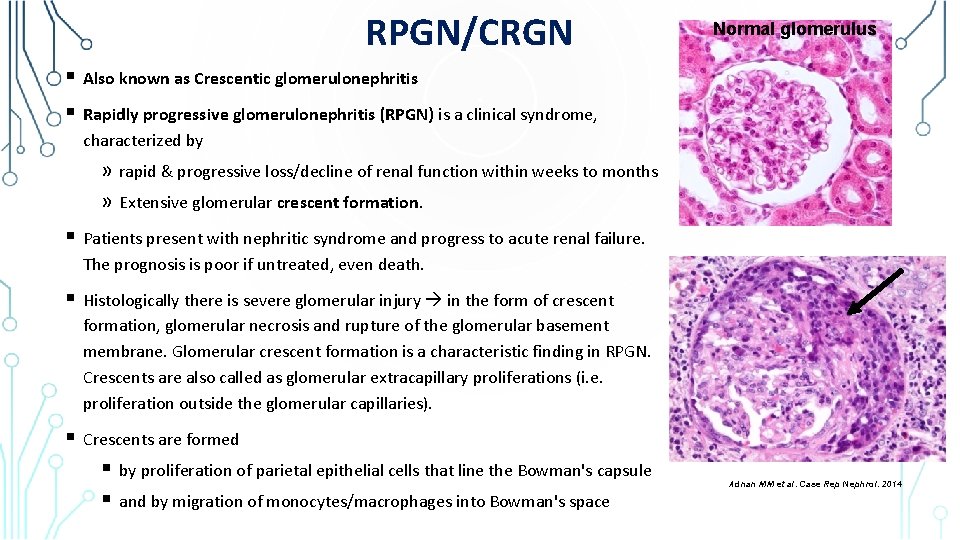
RPGN/CRGN § Also known as Crescentic glomerulonephritis § Rapidly progressive glomerulonephritis (RPGN) is a clinical syndrome, characterized by Normal glomerulus » rapid & progressive loss/decline of renal function within weeks to months » Extensive glomerular crescent formation. § Patients present with nephritic syndrome and progress to acute renal failure. The prognosis is poor if untreated, even death. § Histologically there is severe glomerular injury in the form of crescent formation, glomerular necrosis and rupture of the glomerular basement membrane. Glomerular crescent formation is a characteristic finding in RPGN. Crescents are also called as glomerular extracapillary proliferations (i. e. proliferation outside the glomerular capillaries). § Crescents are formed § § by proliferation of parietal epithelial cells that line the Bowman's capsule and by migration of monocytes/macrophages into Bowman's space Adnan MM et al. Case Rep Nephrol. 2014
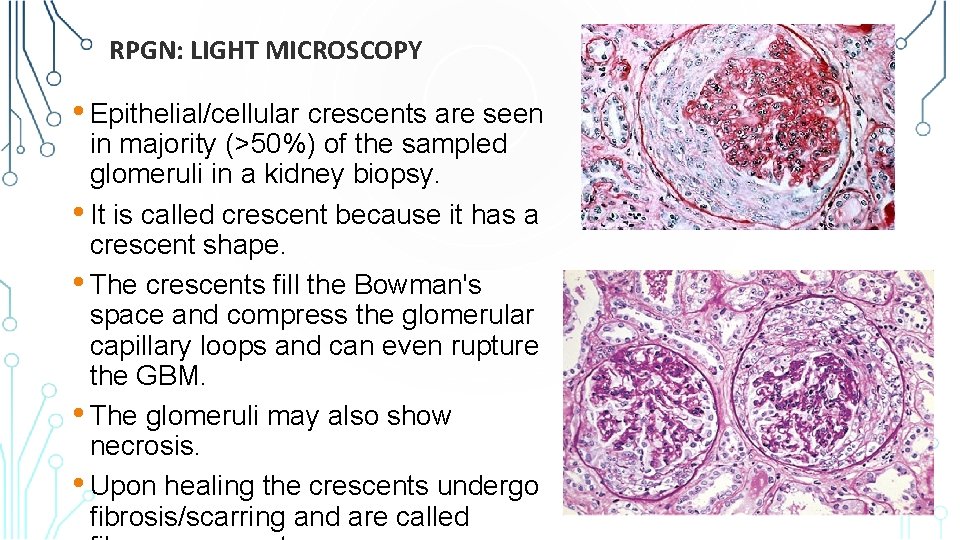
RPGN: LIGHT MICROSCOPY • Epithelial/cellular crescents are seen in majority (>50%) of the sampled glomeruli in a kidney biopsy. • It is called crescent because it has a crescent shape. • The crescents fill the Bowman's space and compress the glomerular capillary loops and can even rupture the GBM. • The glomeruli may also show necrosis. • Upon healing the crescents undergo fibrosis/scarring and are called
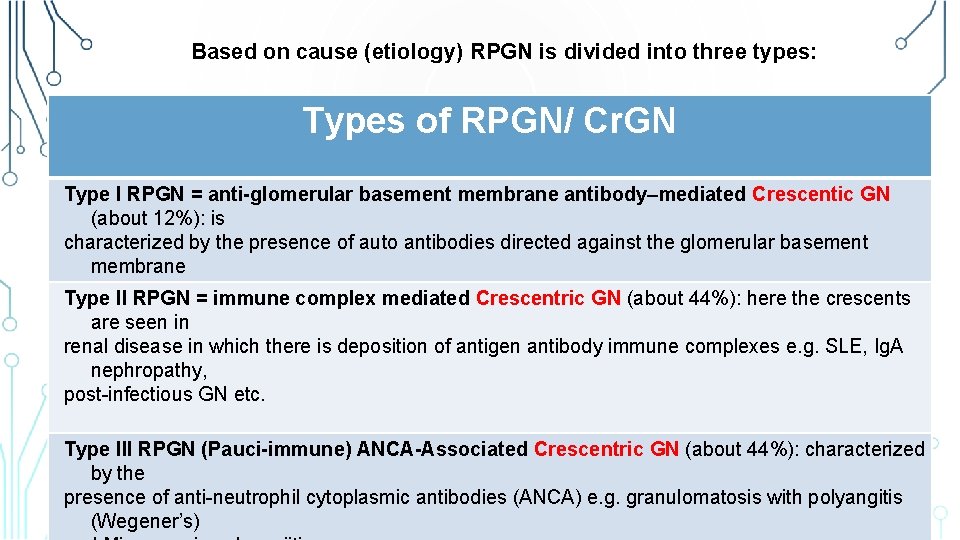
Based on cause (etiology) RPGN is divided into three types: Types of RPGN/ Cr. GN Type I RPGN = anti-glomerular basement membrane antibody–mediated Crescentic GN (about 12%): is characterized by the presence of auto antibodies directed against the glomerular basement membrane Type II RPGN = immune complex mediated Crescentric GN (about 44%): here the crescents are seen in renal disease in which there is deposition of antigen antibody immune complexes e. g. SLE, Ig. A nephropathy, post-infectious GN etc. Type III RPGN (Pauci-immune) ANCA-Associated Crescentric GN (about 44%): characterized by the presence of anti-neutrophil cytoplasmic antibodies (ANCA) e. g. granulomatosis with polyangitis (Wegener’s)
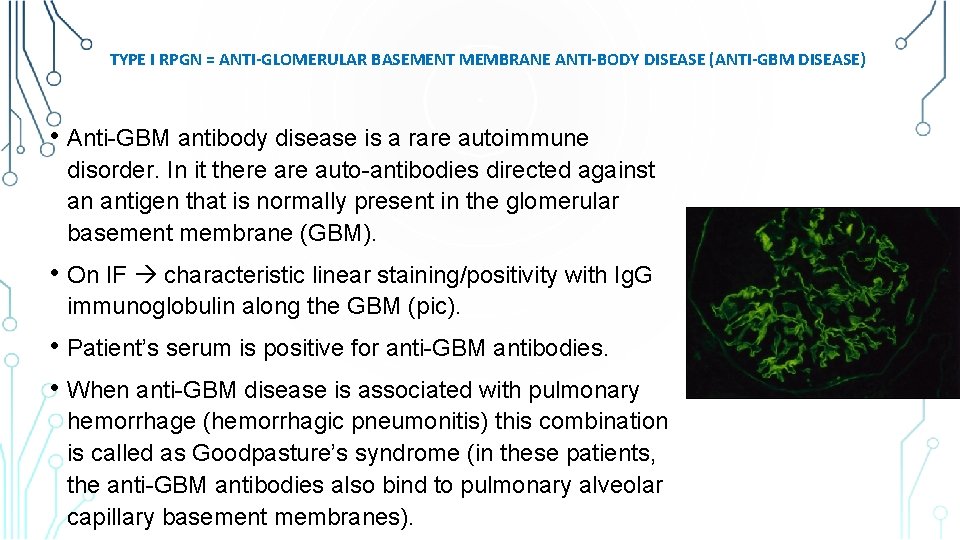
TYPE I RPGN = ANTI-GLOMERULAR BASEMENT MEMBRANE ANTI-BODY DISEASE (ANTI-GBM DISEASE) • Anti-GBM antibody disease is a rare autoimmune disorder. In it there auto-antibodies directed against an antigen that is normally present in the glomerular basement membrane (GBM). • On IF characteristic linear staining/positivity with Ig. G immunoglobulin along the GBM (pic). • Patient’s serum is positive for anti-GBM antibodies. • When anti-GBM disease is associated with pulmonary hemorrhage (hemorrhagic pneumonitis) this combination is called as Goodpasture’s syndrome (in these patients, the anti-GBM antibodies also bind to pulmonary alveolar capillary basement membranes).
TYPE II RPGN = IMMUNE COMPLEX MEDIATED CRESCENTRIC GLOMERULONEPHRITIS • It results from any immune complex mediated renal diseases in which there is deposition of antigen antibody immune complexes in the glomeruli. The crescents represent a more aggressive form of various immune complex mediated GNs, e. g. : • poststreptococcal GN, • Lupus nephritis (in systemic lupus erythematosus) • Ig. A nephropathy and Henoch-Schönlein purpura. • Etc. • A consistent finding in this form of GN is that: • on IF study there is positivity with various immunoglobulins and/or complements • and on EM study there are electron dense immune deposits.
TYPE III RPGN = PAUCI-IMMUNE ANCA-ASSOCIATED GN • It is called in pauci-immune GN because there is ü no anti-GBM antibody ü & no immune complex deposition (so IF is negative/almost negative and there are no deposits on EM). • Most patients have circulating antineutrophil cytoplasmic autoantibodies (ANCAs) in the blood. ANCA are autoantibodies that target antigens present in neutrophil cytoplasm. • ANCA causes abnormal activation of neutrophil. As a result: » there is adhesion of the neutrophils to endothelial cells lining the capillaries (esp. glomerular capillaries) » Neutrophils release injurious products that promote endothelial injury, vascular inflammation (vasculitis and fibrinoid necrosis of arteries and arterioles) and crescentic GN. • Pauci-immune cresentric GN is associated with systemic Note: RPGN type I and II are ANCA negative. diseases like » granulomatosis with polyangitis (formerly called Wegener’s Granulomatosis) c. ANCA positive » microscopic polyangiitis p. ANCA positive.
RPGN/ CRGN: CLINICAL FEATURES • Present as rapid & progressive loss/decline of renal function within weeks to months, usually as nephritic syndrome that progresses to acute renal failure (marked oliguria and azotemia). • Proteinuria sometimes approaching nephrotic range may occur. • Timely diagnosis is important. • Treatment: Type I and Type III RPGN respond well to plasmapheresis (it removes pathogenic antibodies from the circulation), steroids and cytotoxic agents. Type II RPGN does not respond well to plasmapheresis, the original underlying disease needs to be treated. • Some patients require long-term dialysis or transplantation.
CHRONIC RENAL FAILURE (CRF) OR CHRONIC KIDNEY DISEASE (CKD)
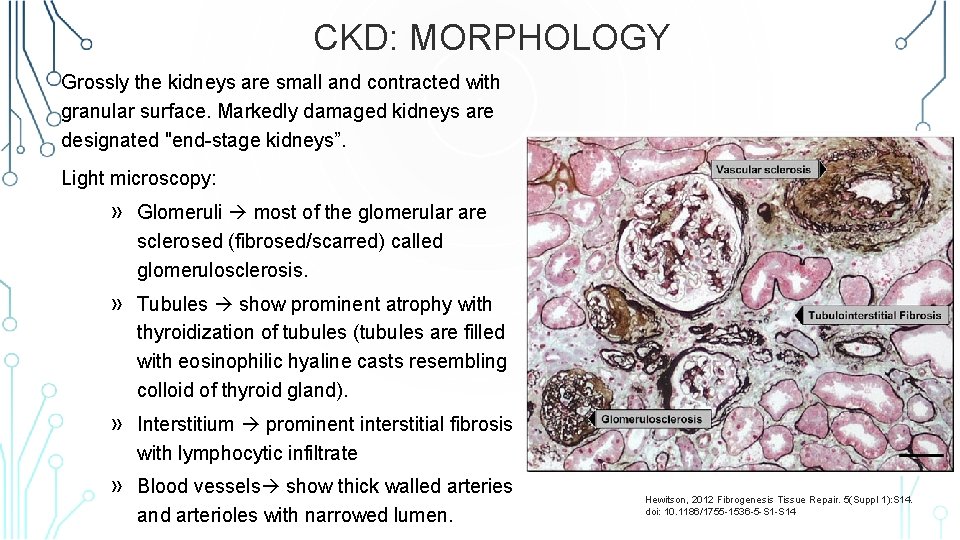
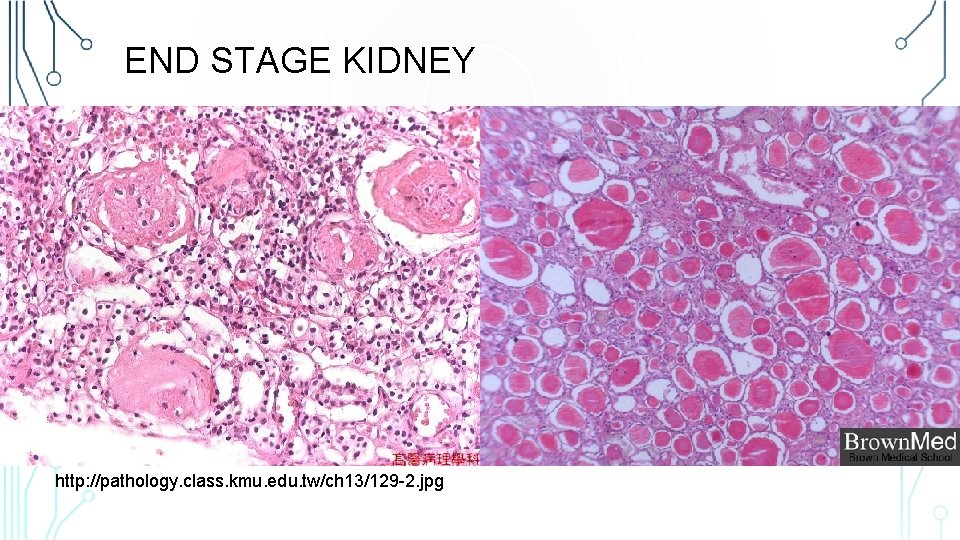
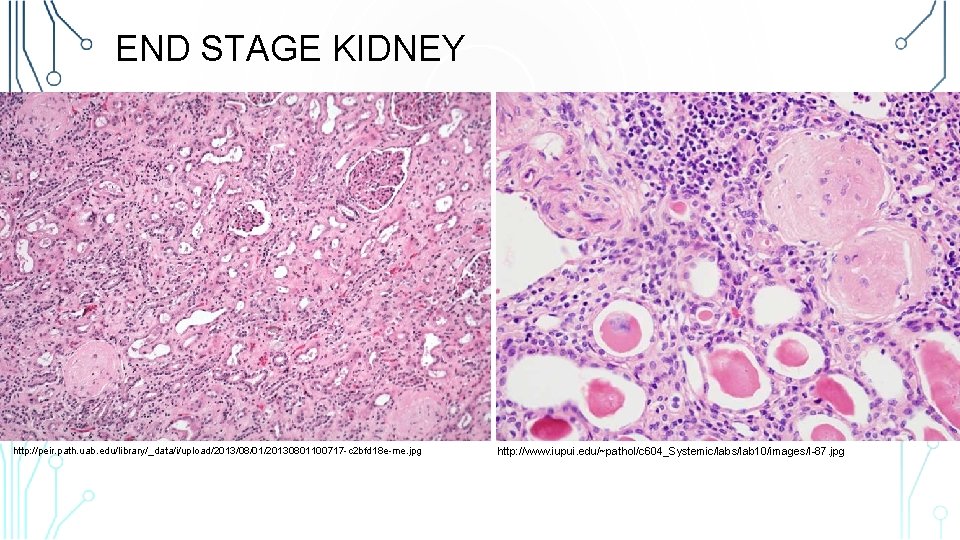
CHRONIC RENAL FAILURE (CRF)/ CHRONIC KIDNEY DISEASE (CKD) • Chronic kidney disease describes the slow or gradual loss of kidney function. • CKD can be the consequence of irreversible acute disease or progressive slow scarring in any type of chronic renal disease. • The end result is end stage kidney disease. • In end-stage kidney there is scarring of all 4 renal compartments: glomerular sclerosis, tubular atrophy, interstitial fibrosis and arteriosclerosis, regardless of the primary/original site of injury. • The prognosis is poor. Patients need with dialysis or transplantation otherwise death from uremia will results. • Dialysis and kidney transplantation allow long-term survival.
CRF/CKD: COMMON CAUSES • Chronic glomerulonephritis like RPGN, membranous GN, membranoproliferative GN, FSGS, Ig. A nephropathy, etc. • Diabetic Nephropathy • Hypertension • Reflux nephropathy in children • Polycystic kidney disease • Kidney infections & obstructions • Others
CRF/CKD: CLINICAL FEATURES In the early stages of chronic kidney failure few signs or symptoms. Chronic kidney failure may not become apparent until your kidney function is significantly impaired. Some patients are oliguric and some patients are not oliguric. Gradual rise in BUN and serum creatinine. High levels of urea in the blood can result in: • Azotemia (increased urea and creatinine) • Acidosis, hyperkalemia, Hypokalemia (due to failure of kidney to activate Vit D). • Abnormal fluid volume changes in urine output e. g. initially increased urine output and later decreased urine output. The sodium and water retention can lead to volume overload and congestive cardiac failure. • Low levels of calcium renal osteodystrophy • Anemia due to decreased erythropoietin. • Hypertension due to excess renin production. • Etc.
CKD: MORPHOLOGY Grossly the kidneys are small and contracted with granular surface. Markedly damaged kidneys are designated "end-stage kidneys”. Light microscopy: » Glomeruli most of the glomerular are sclerosed (fibrosed/scarred) called glomerulosclerosis. » Tubules show prominent atrophy with thyroidization of tubules (tubules are filled with eosinophilic hyaline casts resembling colloid of thyroid gland). » Interstitium prominent interstitial fibrosis with lymphocytic infiltrate » Blood vessels show thick walled arteries and arterioles with narrowed lumen. Hewitson, 2012 Fibrogenesis Tissue Repair. 5(Suppl 1): S 14. doi: 10. 1186/1755 -1536 -5 -S 14
END STAGE KIDNEY http: //pathology. class. kmu. edu. tw/ch 13/129 -2. jpg
END STAGE KIDNEY http: //peir. path. uab. edu/library/_data/i/upload/2013/08/01/20130801100717 -c 2 bfd 18 e-me. jpg http: //www. iupui. edu/~pathol/c 604_Systemic/labs/lab 10/images/I-87. jpg
END