
Renal Medicine A Comparison of APD vs CAPD




- Slides: 24
Renal Medicine A Comparison of APD vs CAPD on Patient Outcomes Badve S, Hawley CM, Mudge DW, Rosman JB, Brown FG, Johnson DW David Johnson Princess Alexandra Hospital Brisbane, Australia
? CAPD
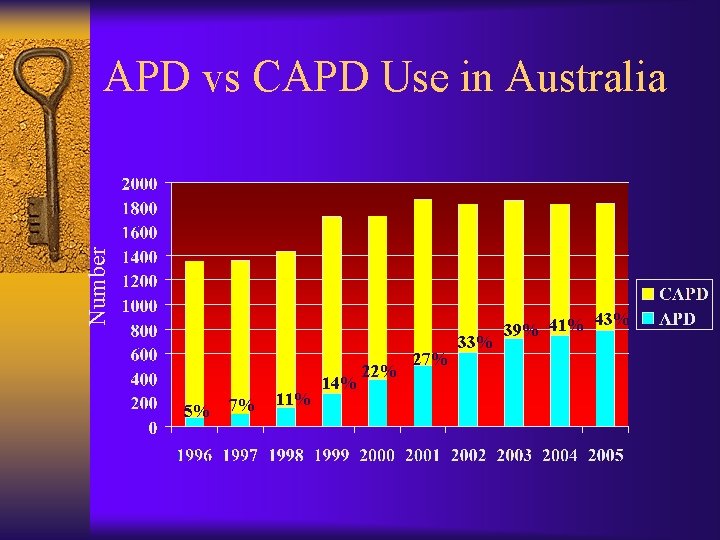
Number APD vs CAPD Use in Australia 5% 7% 11% 14% 22% 27% 33% 43% 39% 41%
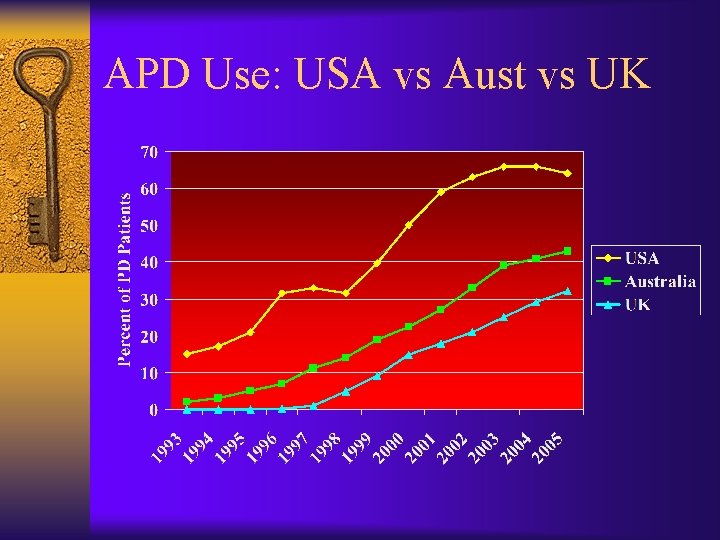
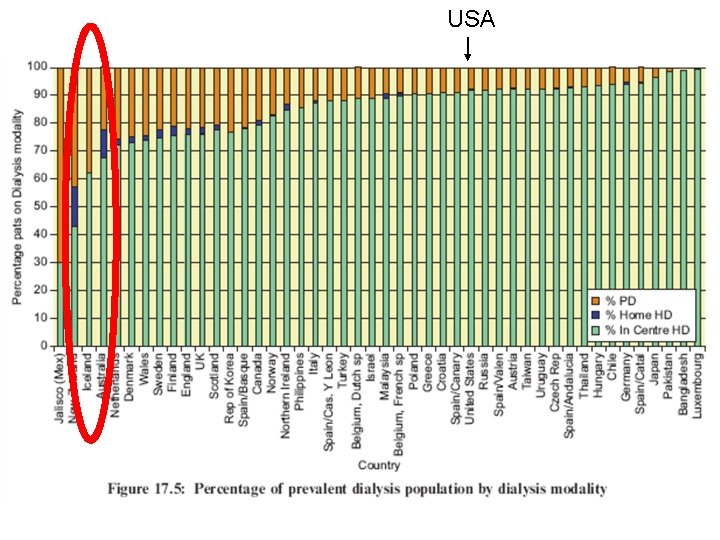
APD Use: USA vs Aust vs UK
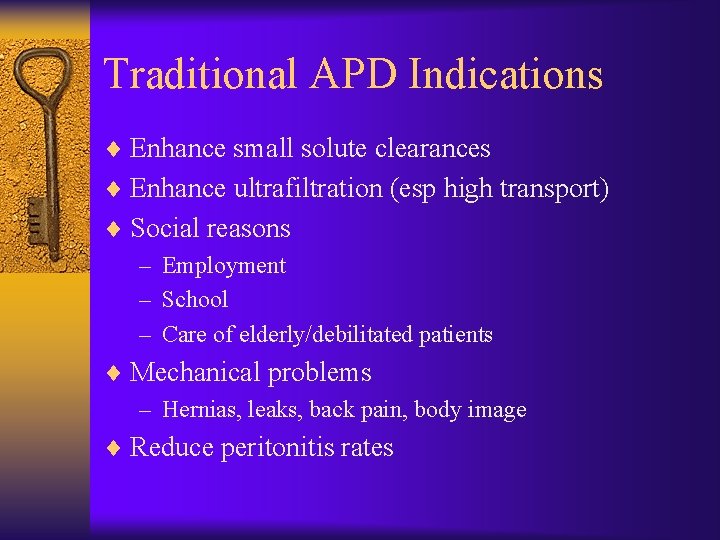
Traditional APD Indications ¨ Enhance small solute clearances ¨ Enhance ultrafiltration (esp high transport) ¨ Social reasons – Employment – School – Care of elderly/debilitated patients ¨ Mechanical problems – Hernias, leaks, back pain, body image ¨ Reduce peritonitis rates
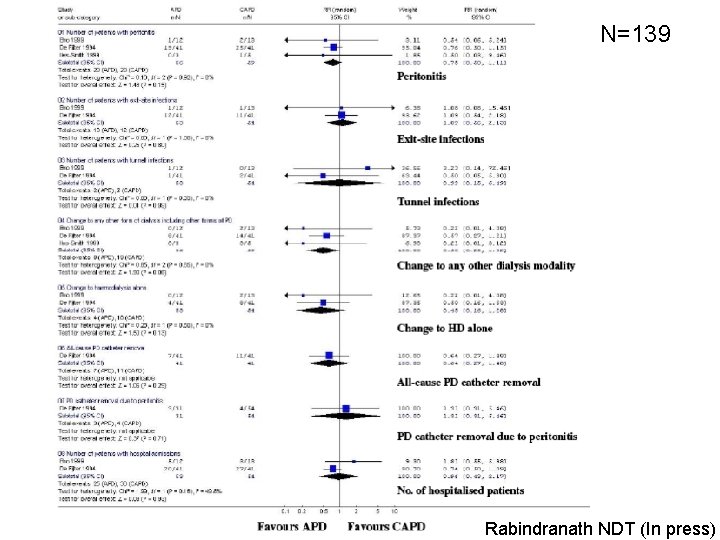
N=139 Rabindranath NDT (In press)
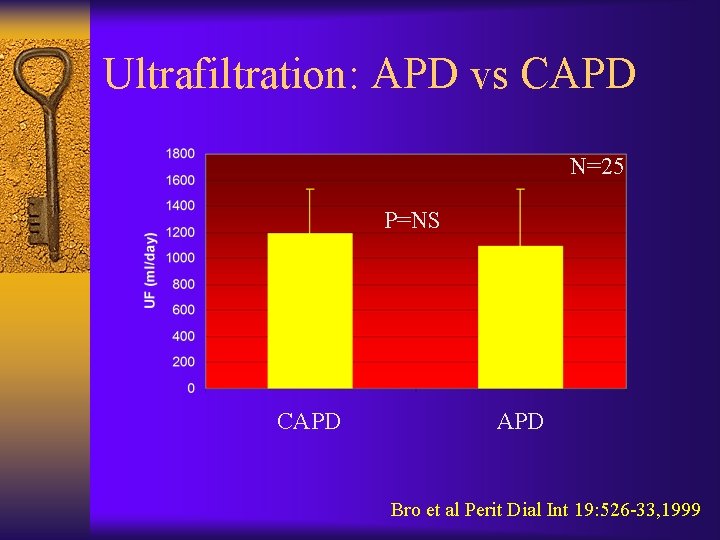
Ultrafiltration: APD vs CAPD N=25 P=NS CAPD Bro et al Perit Dial Int 19: 526 -33, 1999
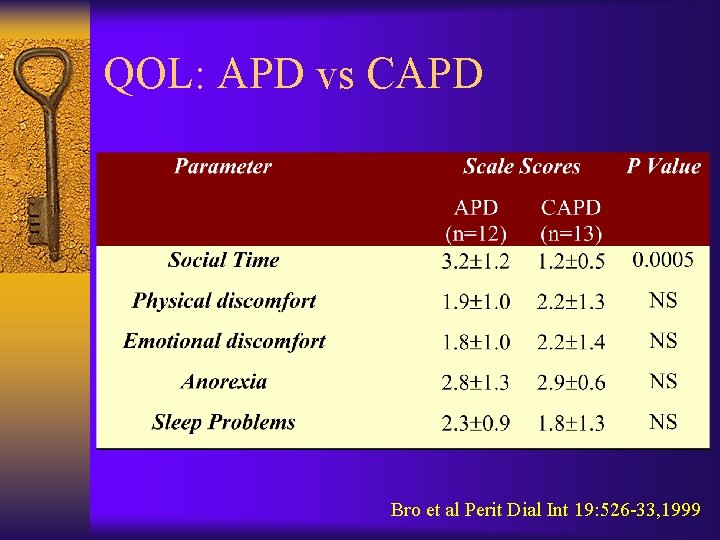
QOL: APD vs CAPD Bro et al Perit Dial Int 19: 526 -33, 1999
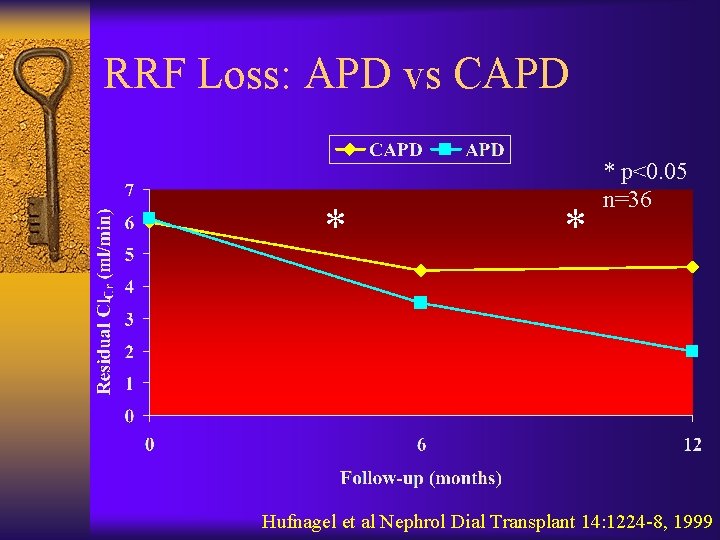
RRF Loss: APD vs CAPD * * * p<0. 05 n=36 Hufnagel et al Nephrol Dial Transplant 14: 1224 -8, 1999
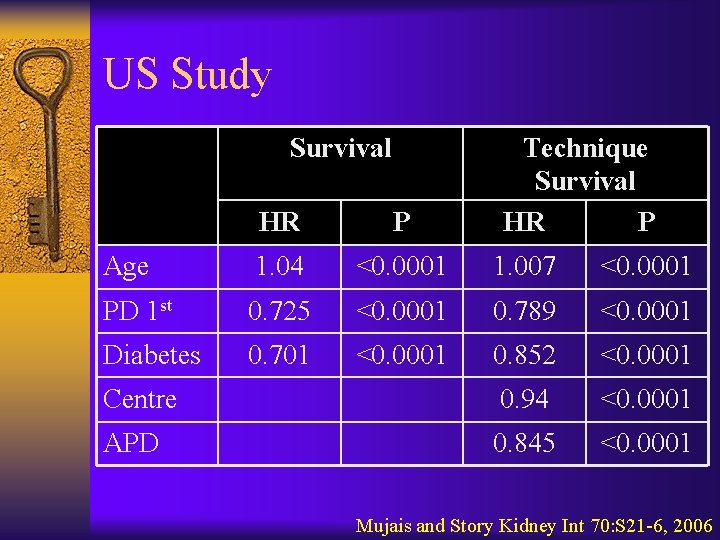
US Study Survival Technique Survival HR P Age 1. 04 <0. 0001 1. 007 <0. 0001 PD 1 st 0. 725 <0. 0001 0. 789 <0. 0001 Diabetes 0. 701 <0. 0001 0. 852 <0. 0001 Centre 0. 94 <0. 0001 APD 0. 845 <0. 0001 Mujais and Story Kidney Int 70: S 21 -6, 2006
USA
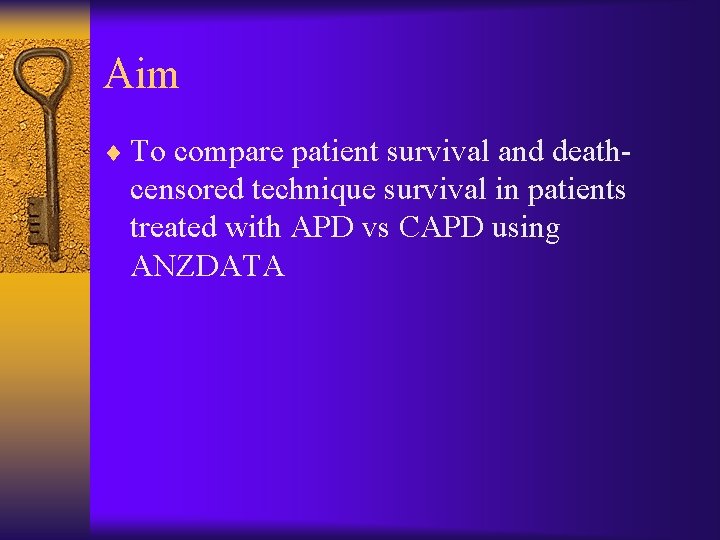
Aim ¨ To compare patient survival and death- censored technique survival in patients treated with APD vs CAPD using ANZDATA
Methods ¨ All ANZ patients starting PD between April 1, 1999 and March 31, 2004 ¨ Complete follow-up ¨ 1° outcomes death and death-censored technique failure ¨ Survival time calculated from date of commencement of each PD episode to the date of death, transfer to hemodialysis, transplantation, loss of follow up, or March 31, 2004.
Statistics ¨ Kaplan-Meier and multivariate Cox proportional hazards model analyses ¨ PD modality included as a time-dependent covariate ¨ Analyses stratified according to initial or subsequent episodes of PD ¨ Used a conditional risk set model for multiple failure data ¨ Standard errors calculated using robust variance estimation for the correlated data, clustered according to the centre of initial treatment
Baseline Characteristics
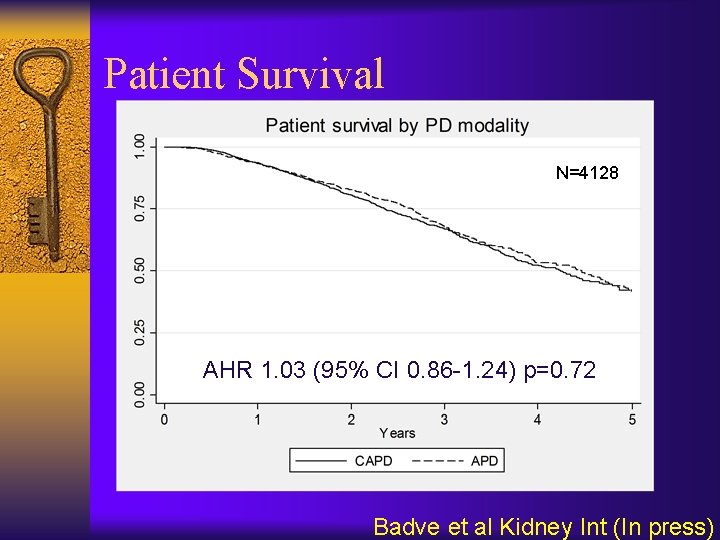
Patient Survival N=4128 AHR 1. 03 (95% CI 0. 86 -1. 24) p=0. 72 Badve et al Kidney Int (In press)
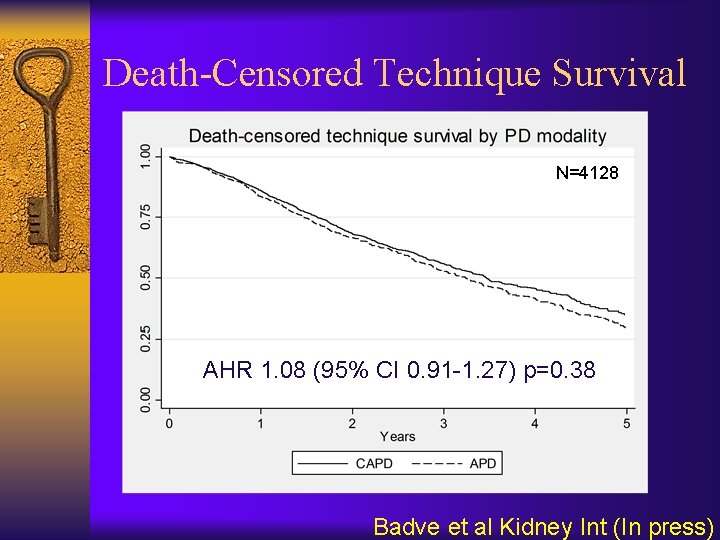
Death-Censored Technique Survival N=4128 AHR 1. 08 (95% CI 0. 91 -1. 27) p=0. 38 Badve et al Kidney Int (In press)
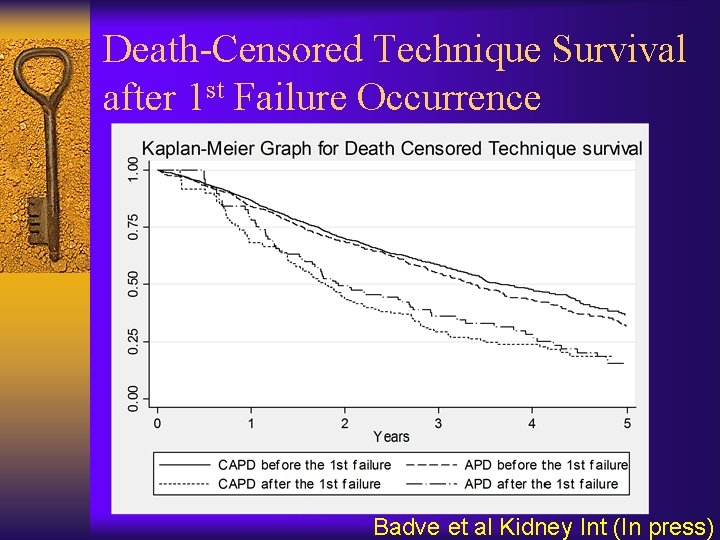
Death-Censored Technique Survival after 1 st Failure Occurrence Badve et al Kidney Int (In press)
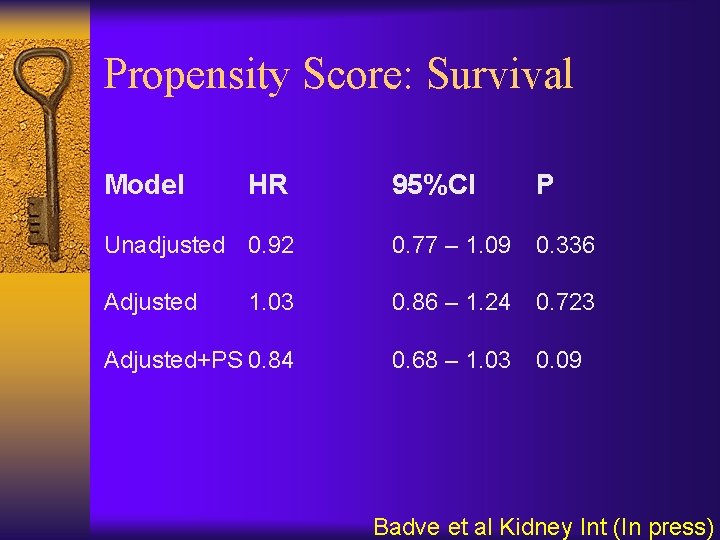
Propensity Score: Survival Model HR 95%CI P Unadjusted 0. 92 0. 77 – 1. 09 0. 336 Adjusted 1. 03 0. 86 – 1. 24 0. 723 Adjusted+PS 0. 84 0. 68 – 1. 03 0. 09 Badve et al Kidney Int (In press)
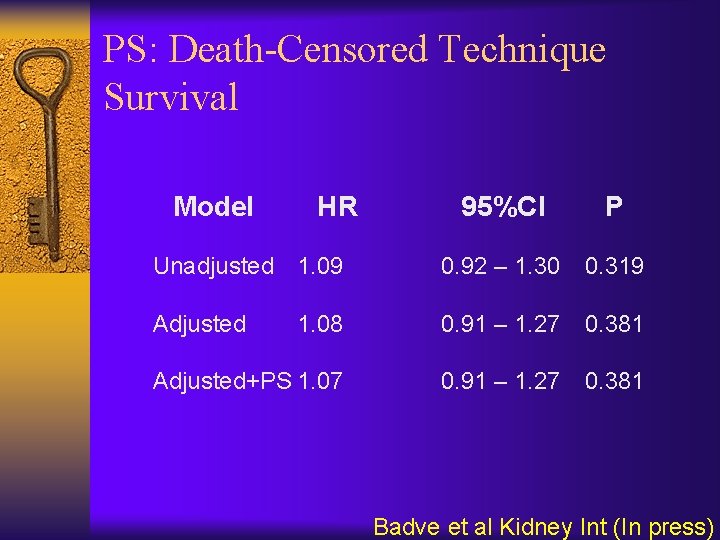
PS: Death-Censored Technique Survival Model HR 95%CI P Unadjusted 1. 09 0. 92 – 1. 30 0. 319 Adjusted 1. 08 0. 91 – 1. 27 0. 381 Adjusted+PS 1. 07 0. 91 – 1. 27 0. 381 Badve et al Kidney Int (In press)
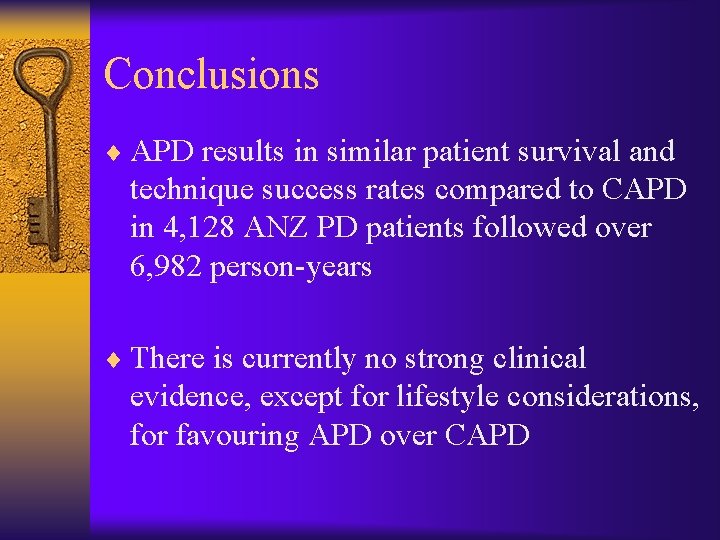
Conclusions ¨ APD results in similar patient survival and technique success rates compared to CAPD in 4, 128 ANZ PD patients followed over 6, 982 person-years ¨ There is currently no strong clinical evidence, except for lifestyle considerations, for favouring APD over CAPD