
RENAL CLEARANCE Renal Clearance Definition Is the volume
- Slides: 21
RENAL CLEARANCE
Renal Clearance Definition: Is the volume of plasma completely cleared of a substance by the kidneys per unit time. The higher the renal clearance, the more plasma that is cleared of the substance. Unit: ml/min
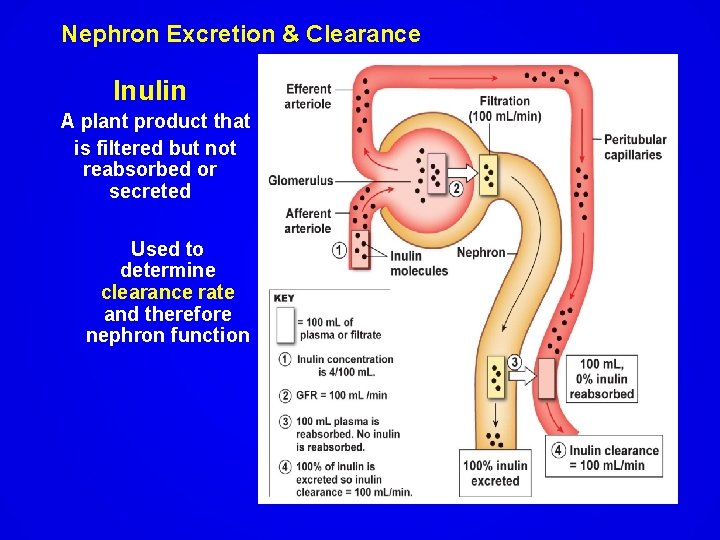
Nephron Excretion & Clearance Inulin A plant product that is filtered but not reabsorbed or secreted Used to determine clearance rate and therefore nephron function
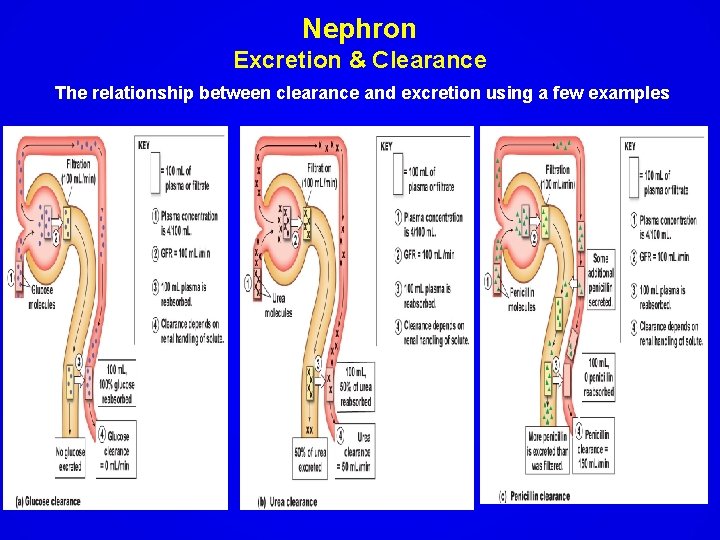
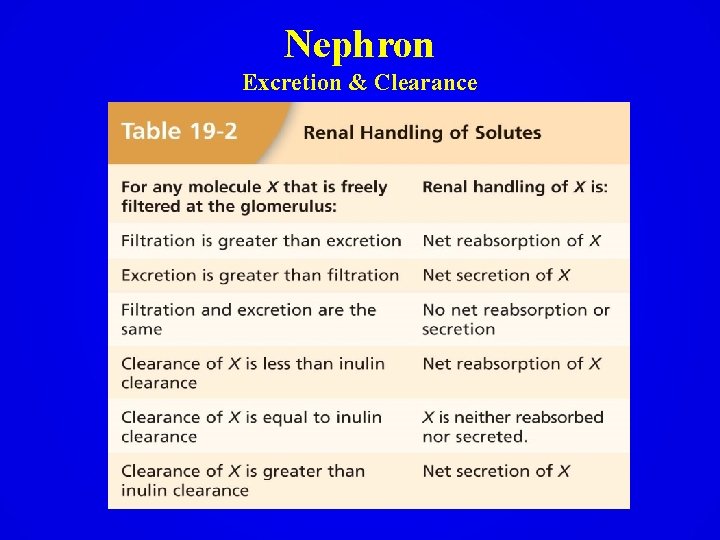
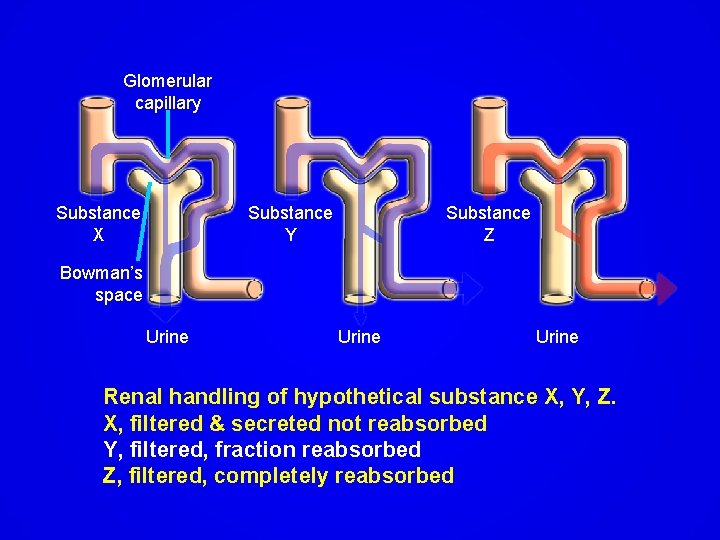
Nephron Excretion & Clearance The relationship between clearance and excretion using a few examples
Nephron Excretion & Clearance
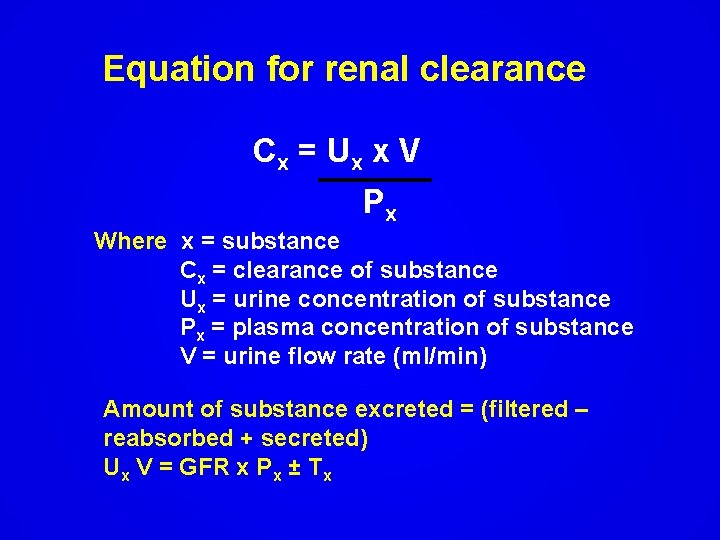
Equation for renal clearance Cx = U x x V Px Where x = substance Cx = clearance of substance Ux = urine concentration of substance Px = plasma concentration of substance V = urine flow rate (ml/min) Amount of substance excreted = (filtered – reabsorbed + secreted) Ux V = GFR x Px ± Tx
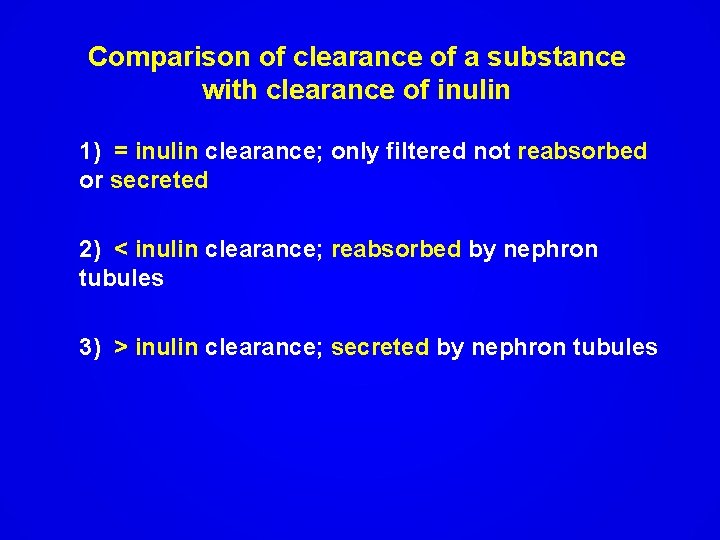
Comparison of clearance of a substance with clearance of inulin 1) = inulin clearance; only filtered not reabsorbed or secreted 2) < inulin clearance; reabsorbed by nephron tubules 3) > inulin clearance; secreted by nephron tubules
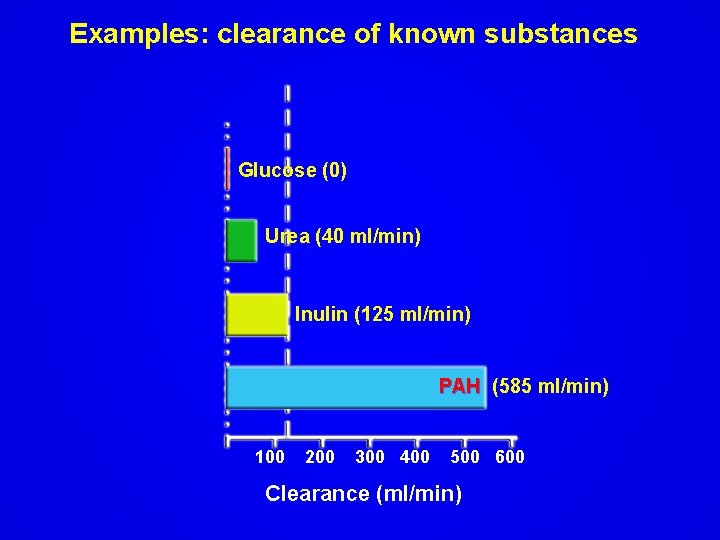
Examples: clearance of known substances Glucose (0) Urea (40 ml/min) Inulin (125 ml/min) PAH (585 ml/min) 100 200 300 400 500 600 Clearance (ml/min)
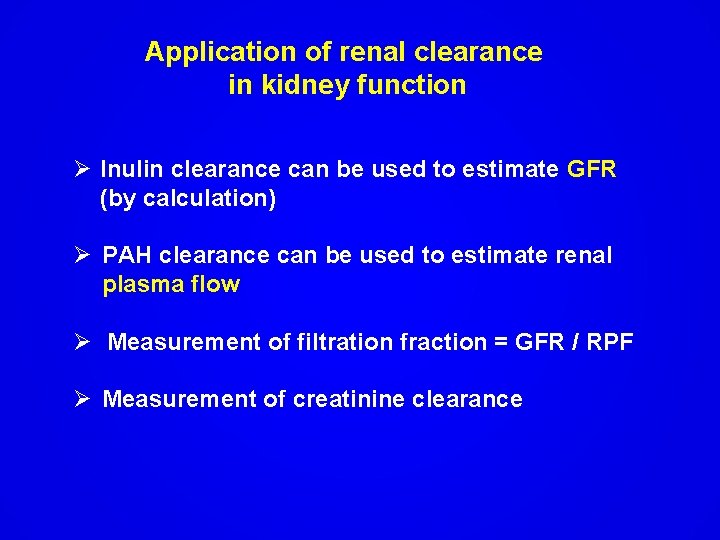
Application of renal clearance in kidney function Ø Inulin clearance can be used to estimate GFR (by calculation) Ø PAH clearance can be used to estimate renal plasma flow Ø Measurement of filtration fraction = GFR / RPF Ø Measurement of creatinine clearance
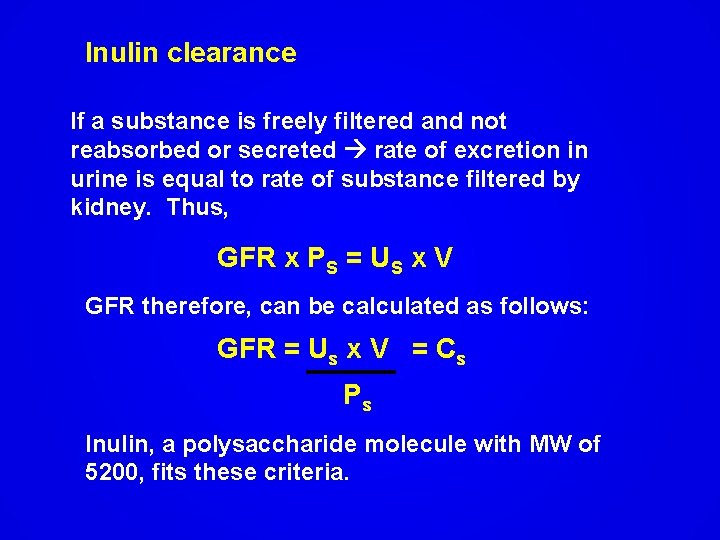
Inulin clearance If a substance is freely filtered and not reabsorbed or secreted rate of excretion in urine is equal to rate of substance filtered by kidney. Thus, GFR x PS = US x V GFR therefore, can be calculated as follows: GFR = Us x V = Cs Ps Inulin, a polysaccharide molecule with MW of 5200, fits these criteria.
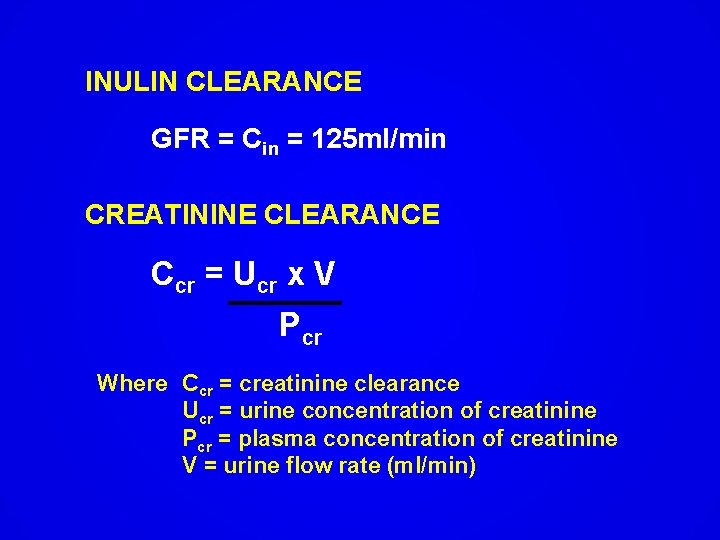
INULIN CLEARANCE GFR = Cin = 125 ml/min CREATININE CLEARANCE Ccr = Ucr x V Pcr Where Ccr = creatinine clearance Ucr = urine concentration of creatinine Pcr = plasma concentration of creatinine V = urine flow rate (ml/min)
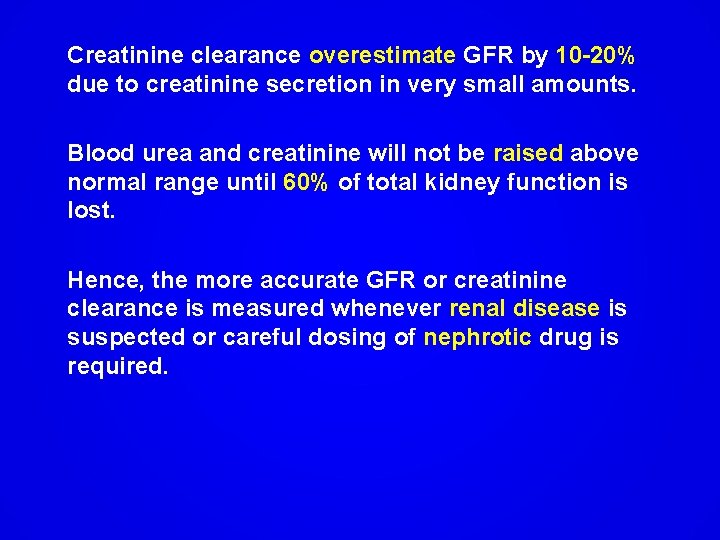
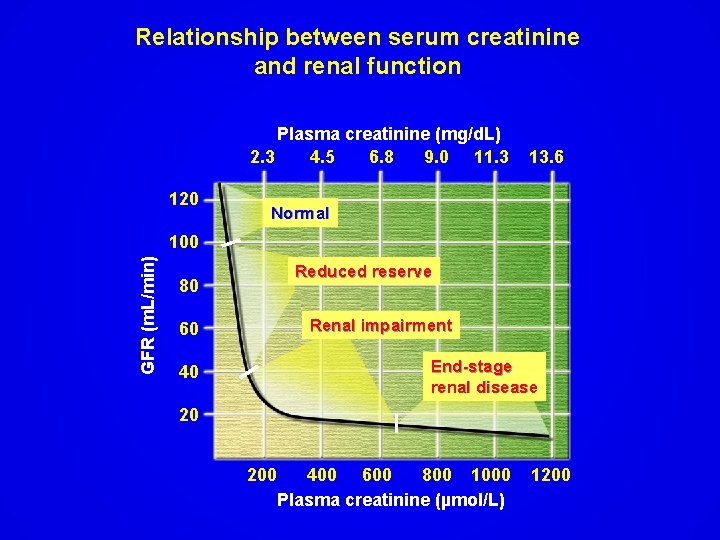
Creatinine clearance overestimate GFR by 10 -20% due to creatinine secretion in very small amounts. Blood urea and creatinine will not be raised above normal range until 60% of total kidney function is lost. Hence, the more accurate GFR or creatinine clearance is measured whenever renal disease is suspected or careful dosing of nephrotic drug is required.
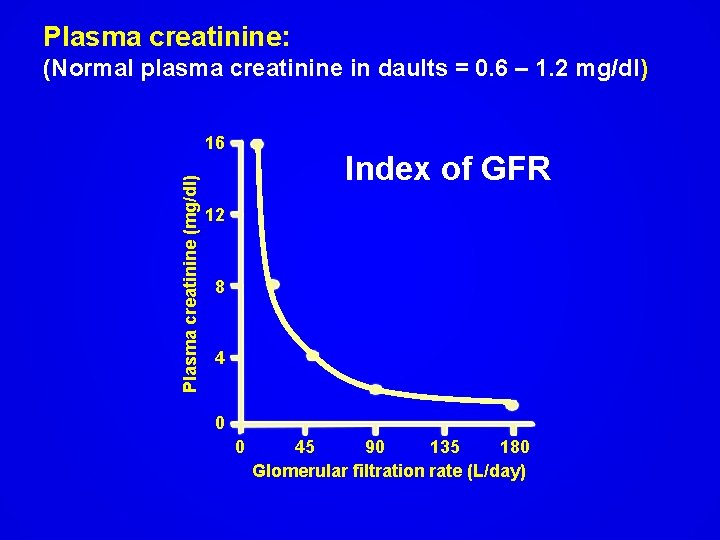
Plasma creatinine: (Normal plasma creatinine in daults = 0. 6 – 1. 2 mg/dl) Plasma creatinine (mg/dl) 16 Index of GFR 12 8 4 0 0 45 90 135 180 Glomerular filtration rate (L/day)
Relationship between serum creatinine and renal function Plasma creatinine (mg/d. L) 2. 3 4. 5 6. 8 9. 0 11. 3 120 13. 6 Normal GFR (m. L/min) 100 80 60 40 Reduced reserve Renal impairment End-stage renal disease 20 200 400 600 800 1000 Plasma creatinine (µmol/L) 1200
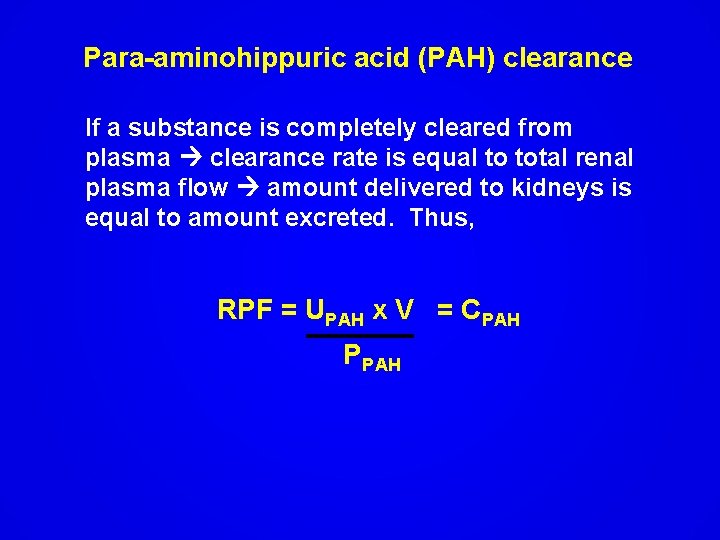
Para-aminohippuric acid (PAH) clearance If a substance is completely cleared from plasma clearance rate is equal to total renal plasma flow amount delivered to kidneys is equal to amount excreted. Thus, RPF = UPAH x V = CPAH PPAH
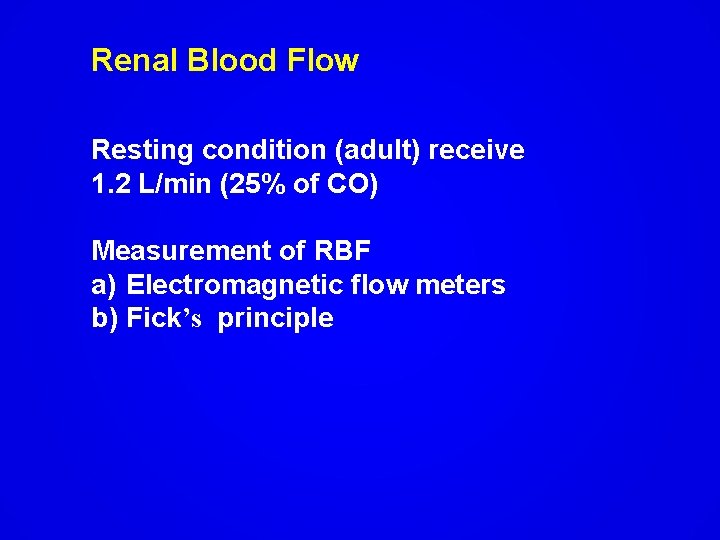
Renal Blood Flow Resting condition (adult) receive 1. 2 L/min (25% of CO) Measurement of RBF a) Electromagnetic flow meters b) Fick’s principle
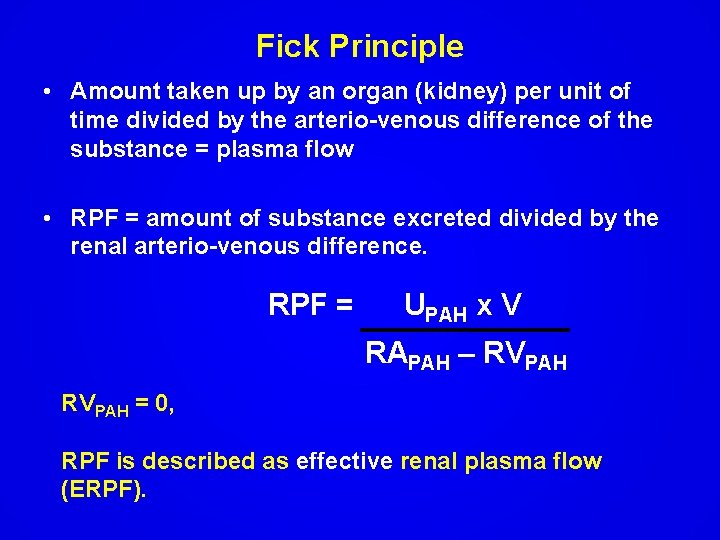
Fick Principle • Amount taken up by an organ (kidney) per unit of time divided by the arterio-venous difference of the substance = plasma flow • RPF = amount of substance excreted divided by the renal arterio-venous difference. RPF = UPAH x V RAPAH – RVPAH = 0, RPF is described as effective renal plasma flow (ERPF).
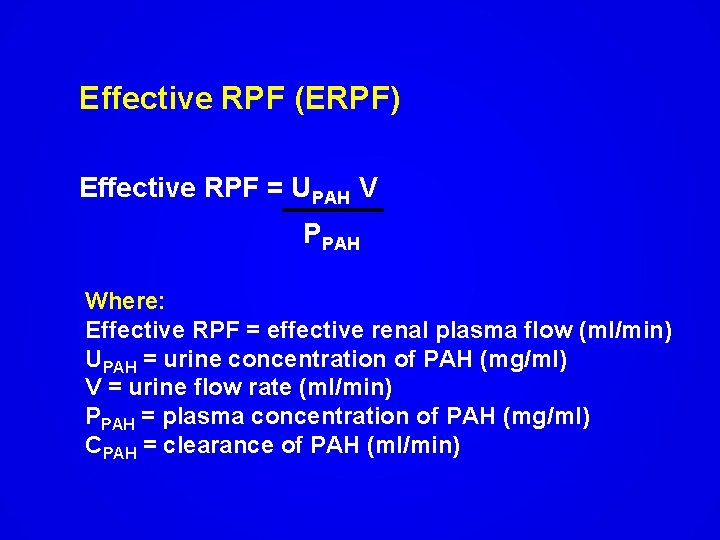
Effective RPF (ERPF) Effective RPF = UPAH V PPAH Where: Effective RPF = effective renal plasma flow (ml/min) UPAH = urine concentration of PAH (mg/ml) V = urine flow rate (ml/min) PPAH = plasma concentration of PAH (mg/ml) CPAH = clearance of PAH (ml/min)
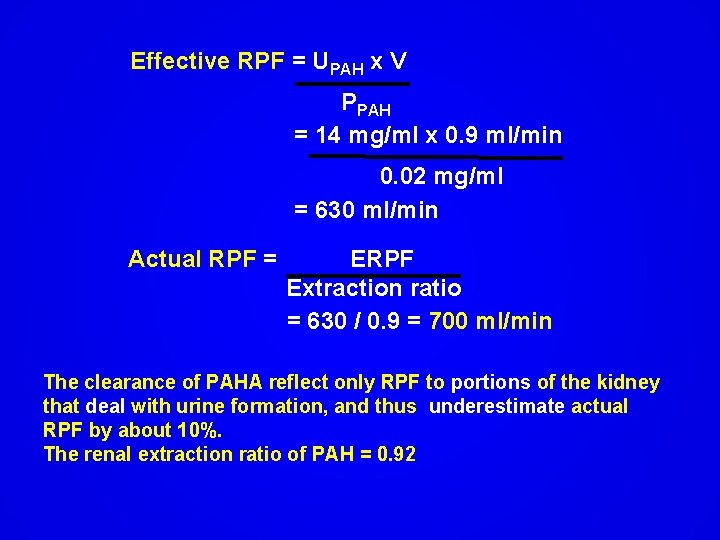
Effective RPF = UPAH x V PPAH = 14 mg/ml x 0. 9 ml/min 0. 02 mg/ml = 630 ml/min Actual RPF = ERPF Extraction ratio = 630 / 0. 9 = 700 ml/min The clearance of PAHA reflect only RPF to portions of the kidney that deal with urine formation, and thus underestimate actual RPF by about 10%. The renal extraction ratio of PAH = 0. 92
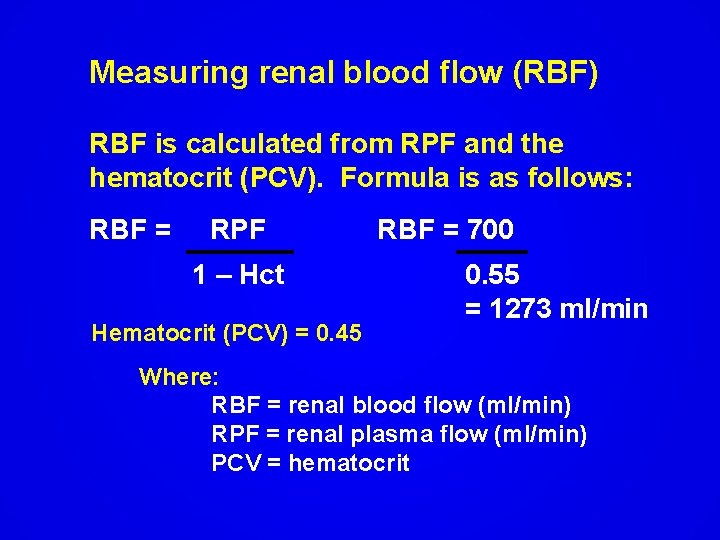
Measuring renal blood flow (RBF) RBF is calculated from RPF and the hematocrit (PCV). Formula is as follows: RBF = RPF 1 – Hct Hematocrit (PCV) = 0. 45 RBF = 700 0. 55 = 1273 ml/min Where: RBF = renal blood flow (ml/min) RPF = renal plasma flow (ml/min) PCV = hematocrit
Glomerular capillary Substance X Substance Y Substance Z Bowman’s space Urine Renal handling of hypothetical substance X, Y, Z. X, filtered & secreted not reabsorbed Y, filtered, fraction reabsorbed Z, filtered, completely reabsorbed