
Renal and Hepatic Disease Claire Nowlan MD Liver
- Slides: 24
Renal and Hepatic Disease Claire Nowlan MD
Liver Function l l l Secretion of bile for fat absorption Short term sugar storage Breakdown of aged red blood cells with excretion of bilirubin Synthesis of coagulation factors Drug metabolism
Hepatitis l l Inflammation of the liver from any cause Most common causes are viral & alcoholic – l Less frequent causes are mononucleosis, secondary syphilis, TB, acetaminophen overdose, methotrexate, ketoconazole Acute symptoms – – Abdominal pain, nausea, vomiting, fever, malaise, jaundice, hepatomegaly, splenomegaly In the recovery phase, hepatomegaly and abnormal liver functions may persist
Symptoms of chronic liver disease l l May be asymptomatic for 10 to 30 years Nonspecific signs – Fatigue, weight loss, itchiness, right upper quadrant pain
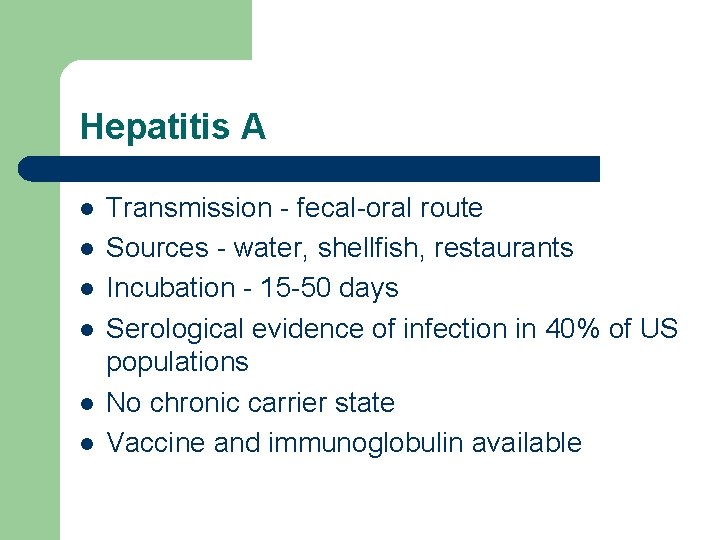
Hepatitis A l l l Transmission - fecal-oral route Sources - water, shellfish, restaurants Incubation - 15 -50 days Serological evidence of infection in 40% of US populations No chronic carrier state Vaccine and immunoglobulin available
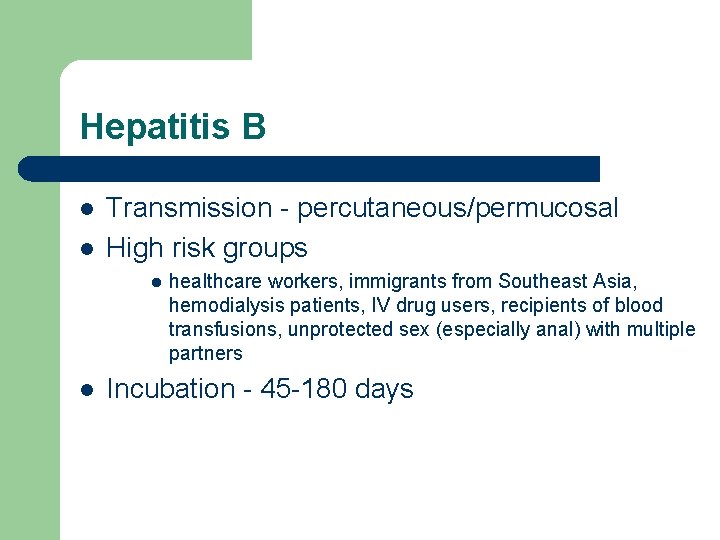
Hepatitis B l l Transmission - percutaneous/permucosal High risk groups l l healthcare workers, immigrants from Southeast Asia, hemodialysis patients, IV drug users, recipients of blood transfusions, unprotected sex (especially anal) with multiple partners Incubation - 45 -180 days
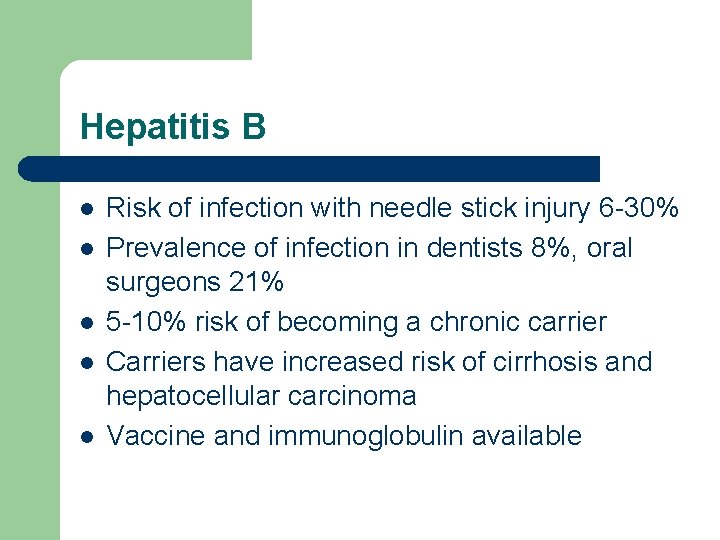
Hepatitis B l l l Risk of infection with needle stick injury 6 -30% Prevalence of infection in dentists 8%, oral surgeons 21% 5 -10% risk of becoming a chronic carrier Carriers have increased risk of cirrhosis and hepatocellular carcinoma Vaccine and immunoglobulin available
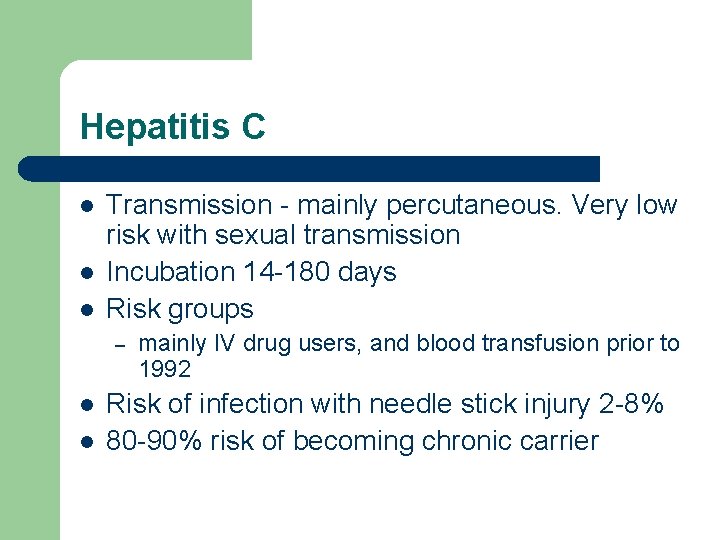
Hepatitis C l l l Transmission - mainly percutaneous. Very low risk with sexual transmission Incubation 14 -180 days Risk groups – l l mainly IV drug users, and blood transfusion prior to 1992 Risk of infection with needle stick injury 2 -8% 80 -90% risk of becoming chronic carrier
Hepatitis C l l l Risk of cirrhosis and hepatocellular carcinoma No active or passive immunization available Treatment is only suggested in certain subgroups, but it is expensive, takes up to 1 year, has many side effects, and only 10 -30% are actually cured
Other Hepatitis Viruses l Hepatitis D – – l only occurs as a coinfection with B transmitted both parenterally and sexually Hepatitis E – resembles hepatitis A, transmitted through the fecal oral route
Dental management l l Difficult to identify all patients through history Many acute cases of Hep B&C are mild Must use infectious precautions for ALL patients Screening recommended for patients from high risk groups
Guidelines for blood exposure l From patients with Hep B – – – l determine titer of anti-HBs in the health care professional if adequate - no tx needed if inadequate give HBIG From patients with Hep C – exposed professional gets baseline and f/u testing for anti-HCV and liver enzymes
Alcoholic liver disease l l Only 10 -15% of alcoholics develop cirrhosis Early change - fatty liver Second stage - alcoholic hepatitis Final stage - cirrhosis
End stage liver disease l l l l Esophageal varicies deficiency of Vit K dependant coagulation factors anemia, leukopenia, thrombocytopenia esophagitis, gastritis endocrine disturbances encephalopathy dementia
Laboratory abnormalities l Increased l l l l AST GGT ALT Bilirubin Alk Phos INR Decreased l l albumin RBC, WBC, platelets
Dental management - alcoholic liver disease l l Beware a second addiction to pain medication no refills, avoid narcotics and sedatives if possible Patient may require more local anesthetic or anxiolytic
Dental management - all liver disease l l Screen for bleeding tendencies Unpredictable metabolism of specific drugs
Renal function l l l l Control fluid volume Acid-base balance Controls secretion of K, Na, phosphate Excrete wastes Synthesize erythropoietin Activates Vit D Controls blood pressure by secreting renin Metabolizes drugs
Chronic renal failure l l Irreversible destruction of the nephrons The kidney can lose about 50% of the nephrons and still maintain normal function Progressive, most often caused by DM, hypertension, Glomerulonephritis Various grades of failure depending on GFR – – 50 -10 ml/min = moderate < 10 ml/min = severe
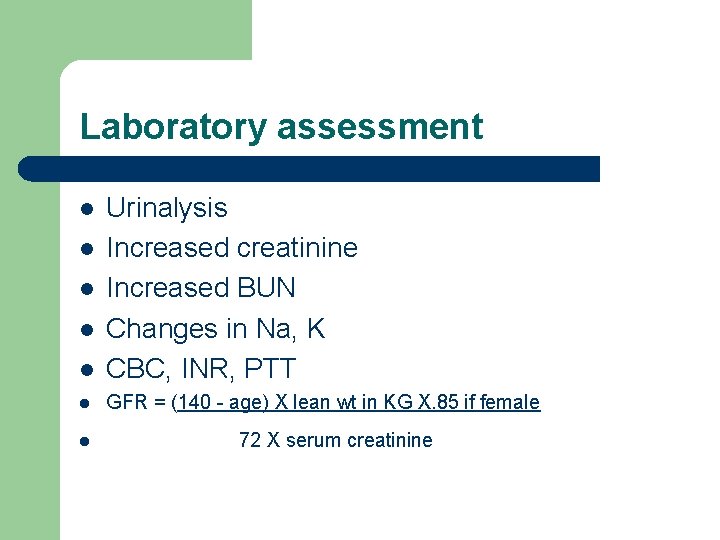
Laboratory assessment l Urinalysis Increased creatinine Increased BUN Changes in Na, K CBC, INR, PTT l GFR = (140 - age) X lean wt in KG X. 85 if female l l l 72 X serum creatinine
Chronic renal failure l Problems l l l l l CV - Fluid overload, hypertension GI nausea, diarrhea Neurologic “uremic encephalopathy” Metabolic - Metabolic acidosis, uremia, hypokalemia Hematologic - Anemia, platelet disfunction Immunity - decreased Dermatologic - yellow tinge to skin, pruritis, bruises Renal rickets Fatigue
Medical management l Conservative care – – – l Hemodialysis – – l l Restrict fluid, K, Na, protein, phosphate Tx DM, hypertension Give recombinant human erythropoietin Patients have arteriovenous shunt Need heparin infusion during dialysis Peritoneal Dialysis Renal Transplantation
Dental management l l Screen for bleeding disorder before surgery Avoid nephrotoxic drugs l l Decrease dosages of drugs mainly metabolized through kidney l l NSAIDs – especially ASA Acyclovir High dose acetaminophen Penicillins, erythromycin, opioids Controversy whether antibiotic prophylaxis needed
Dental management - hemodialysis l l l Be careful of arteriovenous shunt Dental care on non hemodialysis days Be aware of possible Hep B, C, HIV in these patients