
Renaissance definitions 1 1 Depth modeled shading linear
- Slides: 19
Renaissance definitions: 1. 1. Depth: modeled shading linear perspective, spacing and size, chiaroscuro, sfumato Humanism: Divorce from Medieval religious styles to a revival of classical Greek and Roman thought. (see 4). Composition: Focal point is the most important element of the painting and all of the other elements are placed in order to guide to the focal point. humanist Realism: Baby Jesus looks like a real baby. There is pathos and other human emotions. Finally, the body is celebrated and depicted “nude” not “naked”.
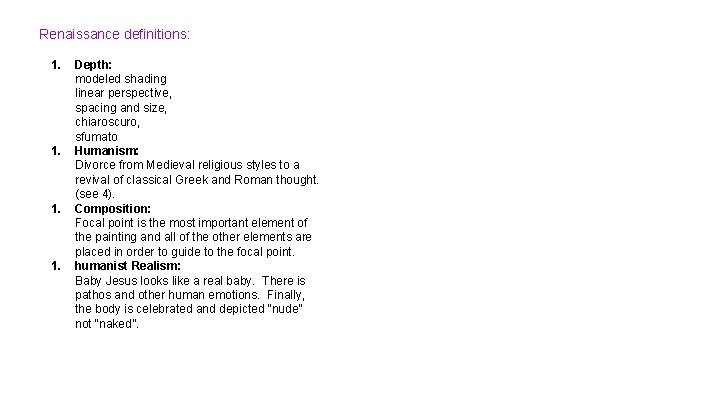
This painting shows characteristics still of the medieval times with nimbuses, gold, is shown inside the interior of a building, Mary is shown much larger than the rest of the people depicted, and Jesus as a large version of a man rather than an actual baby. The difference this painting has from other medieval art is that it shows some knowledge developed in that all of the people are obviously three dimensional and show depth and shading. Duccio, madonna and child
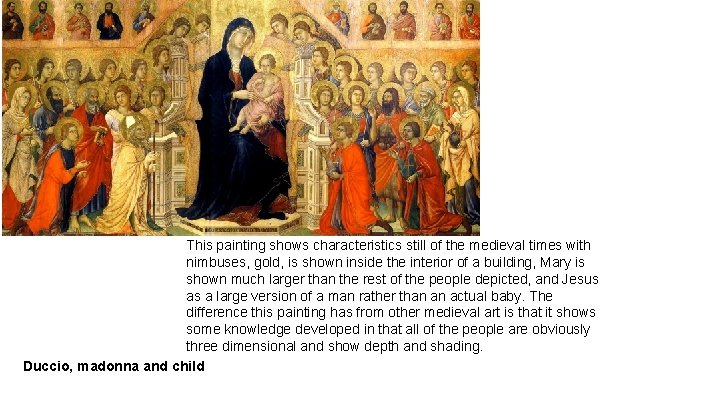
Giotto, Lamentation of Christ This painting is very 3 D. It has a lot of volume in it, and you can tell the painter is exploring depth more, which is a Renaissance idea. In this picture, the mountains are blue because they haven’t figured out chiaroscuro yet. Which is how the color objects change by how far away you are. The figures all also have gold numbuses and are not inside a church. The little angels have a lot of personality and emotion, which has never been painted before.
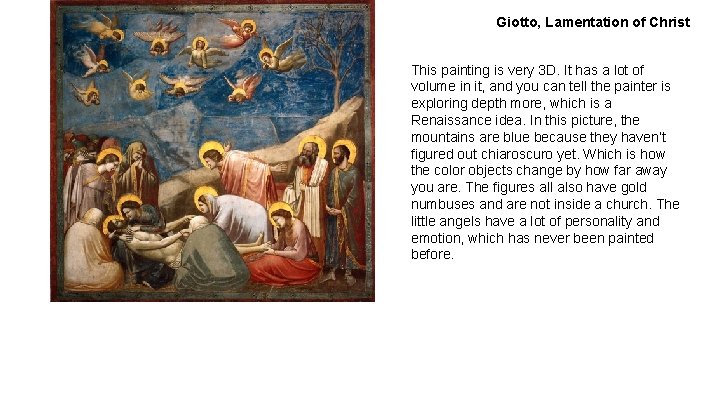
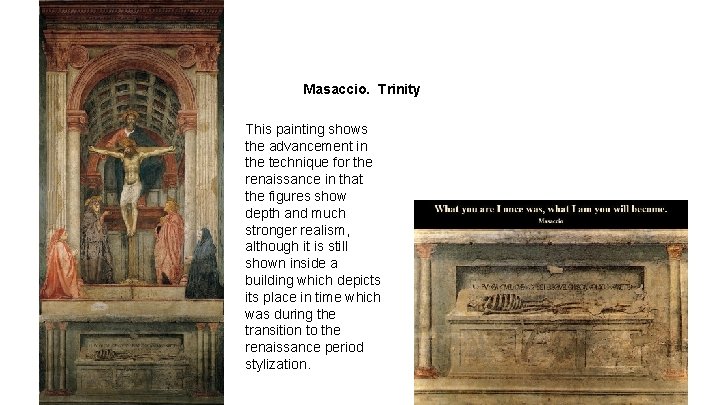
Masaccio. Trinity This painting shows the advancement in the technique for the renaissance in that the figures show depth and much stronger realism, although it is still shown inside a building which depicts its place in time which was during the transition to the renaissance period stylization.
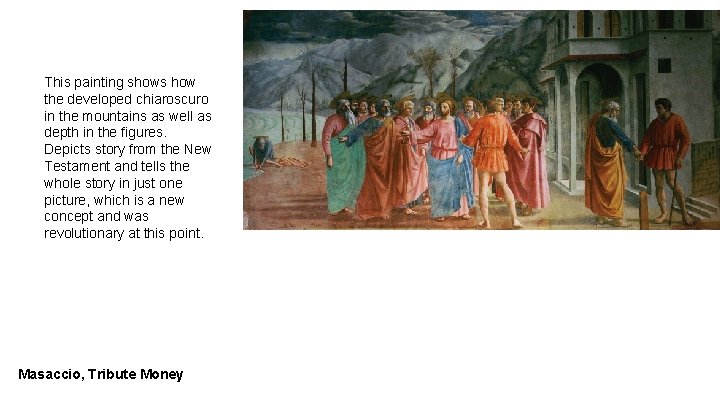
This painting shows how the developed chiaroscuro in the mountains as well as depth in the figures. Depicts story from the New Testament and tells the whole story in just one picture, which is a new concept and was revolutionary at this point. Masaccio, Tribute Money
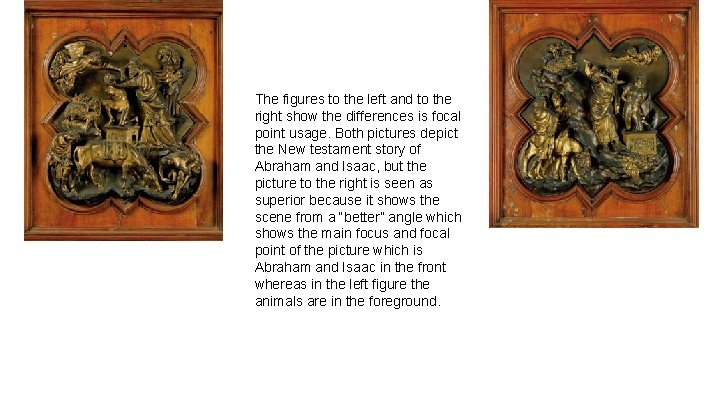
The figures to the left and to the right show the differences is focal point usage. Both pictures depict the New testament story of Abraham and Isaac, but the picture to the right is seen as superior because it shows the scene from a “better” angle which shows the main focus and focal point of the picture which is Abraham and Isaac in the front whereas in the left figure the animals are in the foreground.
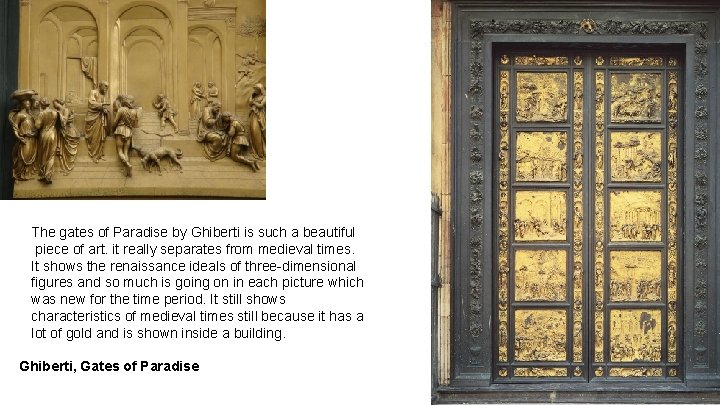
The gates of Paradise by Ghiberti is such a beautiful piece of art. it really separates from medieval times. It shows the renaissance ideals of three-dimensional figures and so much is going on in each picture which was new for the time period. It still shows characteristics of medieval times still because it has a lot of gold and is shown inside a building. Ghiberti, Gates of Paradise
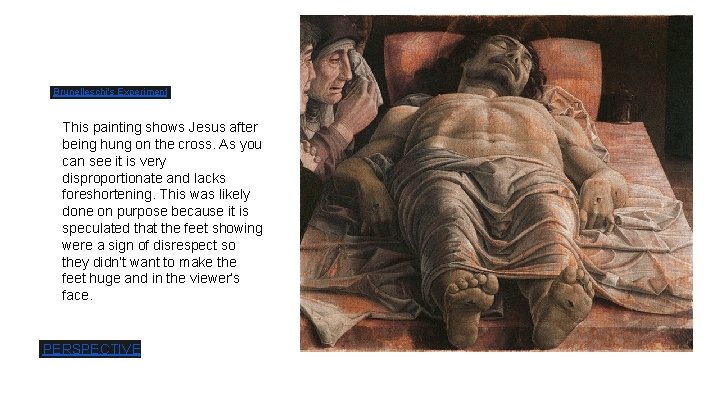
Brunelleschi's Experiment This painting shows Jesus after being hung on the cross. As you can see it is very disproportionate and lacks foreshortening. This was likely done on purpose because it is speculated that the feet showing were a sign of disrespect so they didn’t want to make the feet huge and in the viewer’s face. PERSPECTIVE
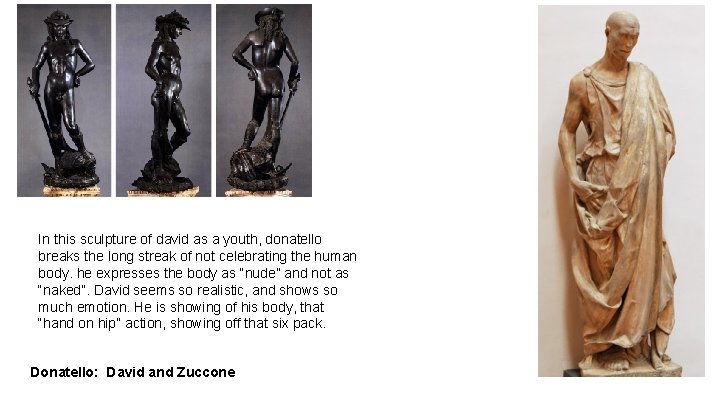
In this sculpture of david as a youth, donatello breaks the long streak of not celebrating the human body. he expresses the body as “nude” and not as “naked”. David seems so realistic, and shows so much emotion. He is showing of his body, that “hand on hip” action, showing off that six pack. Donatello: David and Zuccone
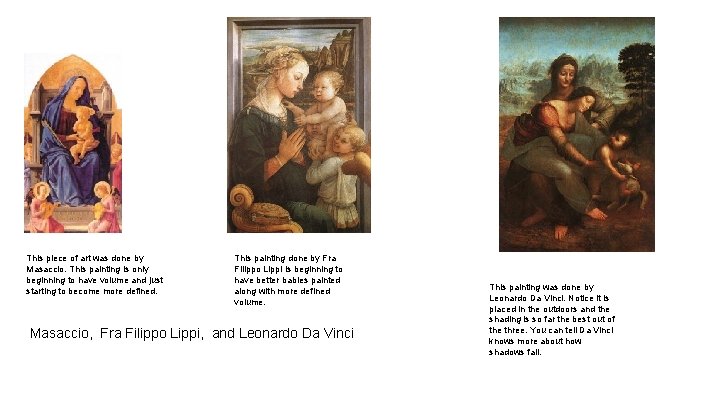
This piece of art was done by Masaccio. This painting is only beginning to have volume and just starting to become more defined. This painting done by Fra Filippo Lippi is beginning to have better babies painted along with more defined volume. Masaccio, Fra Filippo Lippi, and Leonardo Da Vinci This painting was done by Leonardo Da Vinci. Notice it is placed in the outdoors and the shading is so far the best out of the three. You can tell Da Vinci knows more about how shadows fall.
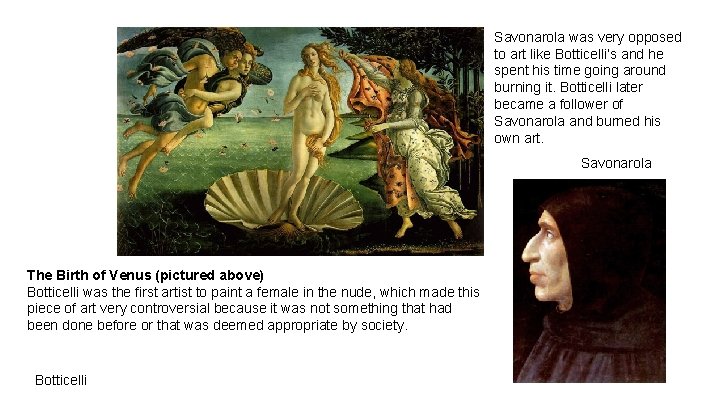
Savonarola was very opposed to art like Botticelli’s and he spent his time going around burning it. Botticelli later became a follower of Savonarola and burned his own art. Savonarola The Birth of Venus (pictured above) Botticelli was the first artist to paint a female in the nude, which made this piece of art very controversial because it was not something that had been done before or that was deemed appropriate by society. Botticelli
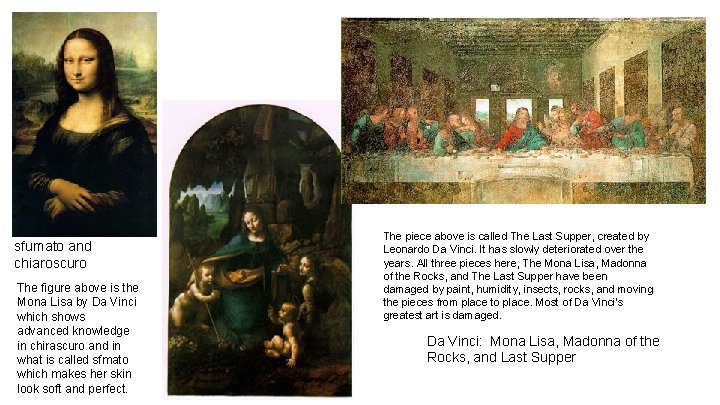
sfumato and chiaroscuro The figure above is the Mona Lisa by Da Vinci which shows advanced knowledge in chirascuro and in what is called sfmato which makes her skin look soft and perfect. The piece above is called The Last Supper, created by Leonardo Da Vinci. It has slowly deteriorated over the years. All three pieces here, The Mona Lisa, Madonna of the Rocks, and The Last Supper have been damaged by paint, humidity, insects, rocks, and moving the pieces from place to place. Most of Da Vinci’s greatest art is damaged. Da Vinci: Mona Lisa, Madonna of the Rocks, and Last Supper
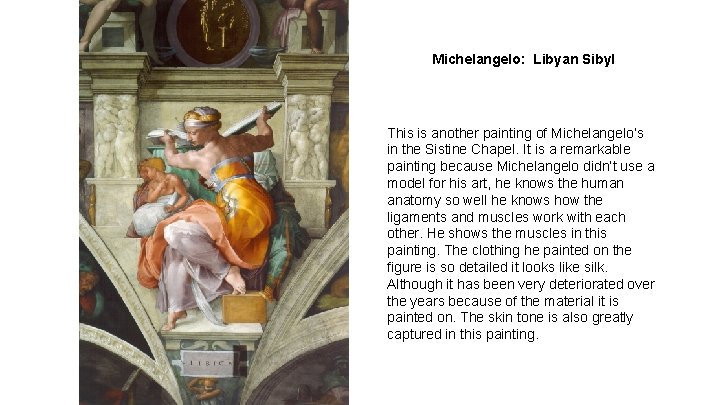
Michelangelo: Libyan Sibyl This is another painting of Michelangelo’s in the Sistine Chapel. It is a remarkable painting because Michelangelo didn’t use a model for his art, he knows the human anatomy so well he knows how the ligaments and muscles work with each other. He shows the muscles in this painting. The clothing he painted on the figure is so detailed it looks like silk. Although it has been very deteriorated over the years because of the material it is painted on. The skin tone is also greatly captured in this painting.
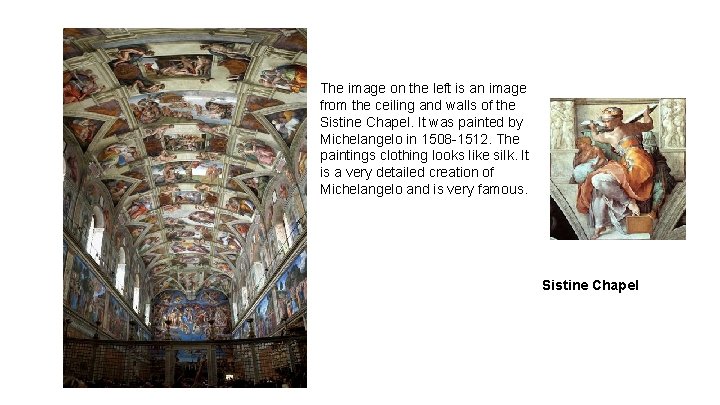
The image on the left is an image from the ceiling and walls of the Sistine Chapel. It was painted by Michelangelo in 1508 -1512. The paintings clothing looks like silk. It is a very detailed creation of Michelangelo and is very famous. Sistine Chapel
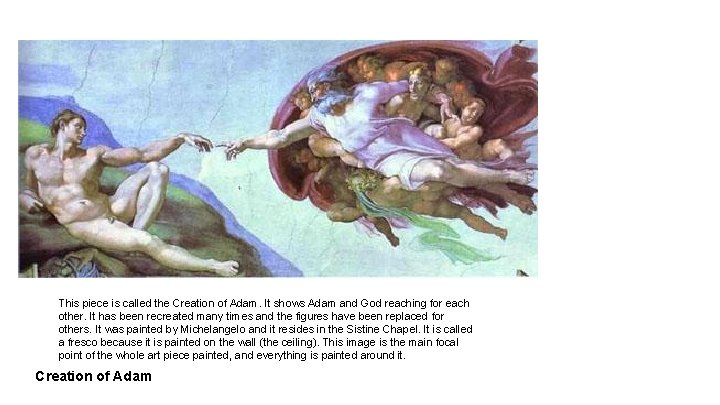
This piece is called the Creation of Adam. It shows Adam and God reaching for each other. It has been recreated many times and the figures have been replaced for others. It was painted by Michelangelo and it resides in the Sistine Chapel. It is called a fresco because it is painted on the wall (the ceiling). This image is the main focal point of the whole art piece painted, and everything is painted around it. Creation of Adam
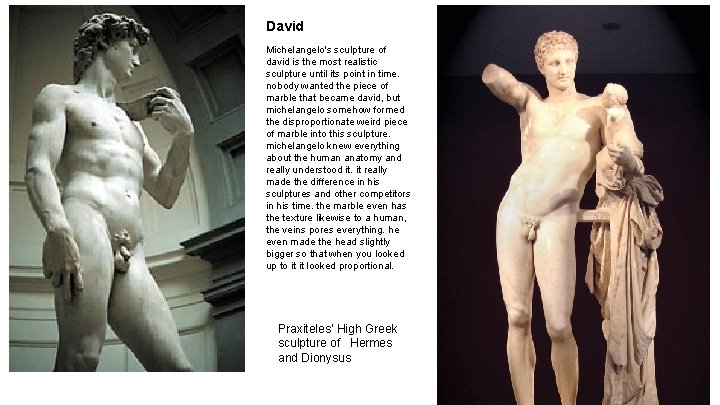
David Michelangelo's sculpture of david is the most realistic sculpture until its point in time. nobody wanted the piece of marble that became david, but michelangelo somehow formed the disproportionate weird piece of marble into this sculpture. michelangelo knew everything about the human anatomy and really understood it. it really made the difference in his sculptures and other competitors in his time. the marble even has the texture likewise to a human, the veins pores everything. he even made the head slightly bigger so that when you looked up to it it looked proportional. Praxiteles’ High Greek sculpture of Hermes and Dionysus
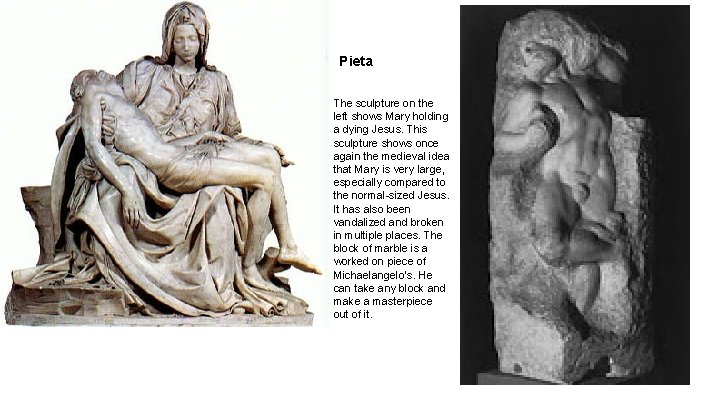
Pieta The sculpture on the left shows Mary holding a dying Jesus. This sculpture shows once again the medieval idea that Mary is very large, especially compared to the normal-sized Jesus. It has also been vandalized and broken in multiple places. The block of marble is a worked on piece of Michaelangelo’s. He can take any block and make a masterpiece out of it.
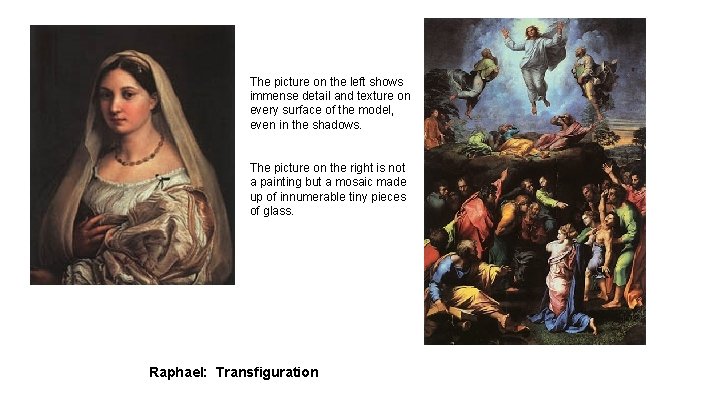
The picture on the left shows immense detail and texture on every surface of the model, even in the shadows. The picture on the right is not a painting but a mosaic made up of innumerable tiny pieces of glass. Raphael: Transfiguration
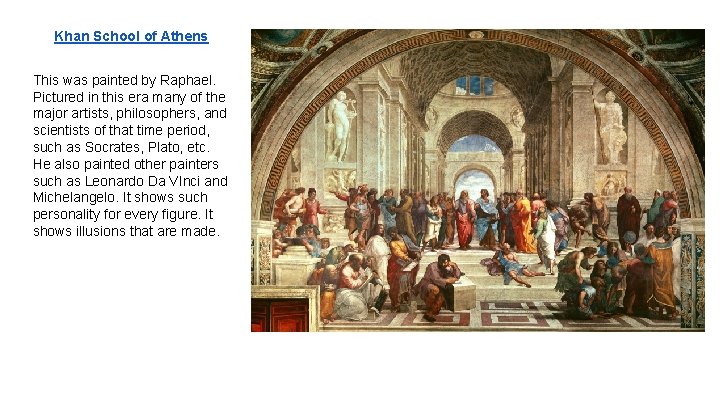
Khan School of Athens This was painted by Raphael. Pictured in this era many of the major artists, philosophers, and scientists of that time period, such as Socrates, Plato, etc. He also painted other painters such as Leonardo Da VInci and Michelangelo. It shows such personality for every figure. It shows illusions that are made.