
Renaissance and Reformation 1450 1600 Differences Between Now

Renaissance and Reformation 1450 -1600
Differences Between Now and Then • Local control of politics; central institutions were weak • Hierarchical Nature of Society • Tradition and Religion • Great danger from disease, poor hygiene, famine, natural disaster, war, violence Renaissance and Reformation 1450 -1600
Religion: Powerful Force • Belief in the devil, hell, and a punishing God were powerful forces • Thinkers of the Renaissance and Reformation would challenge some of these beliefs • Religion guided people ex- Elizabeth I (Film) Renaissance and Reformation 1450 -1600

Medieval versus Renaissance Worldview Medieval View • Idea of a Divine Plan • Importance and Hierarchy • Dualism: Spirit vs. Matter • Allegory • Providence • Teleology Renaissance • Overriding concept: Humanism • Importance of philology • Importance, return and restoration of classical texts, arts, literature and drama from Greek and Roman Period Renaissance and Reformation 1450 -1600
Protestant Reformation Defined: Reformation, was a spiritual/religious revolution that aimed to correct the “problems” of the Catholic Church and sparked a century and a half of religious civil war. It resulted in the establishment of the Protestant branches of Christianity- e. g. Lutheranism, Calvinism etc Renaissance and Reformation 1450 -1600
Causes of Protestant Reformation • Anti-Clericalism • An appetite for spiritual experience • Reliance of church interpretation ended with return to original sources • Martin Luther's 95 Theses Renaissance and Reformation 1450 -1600
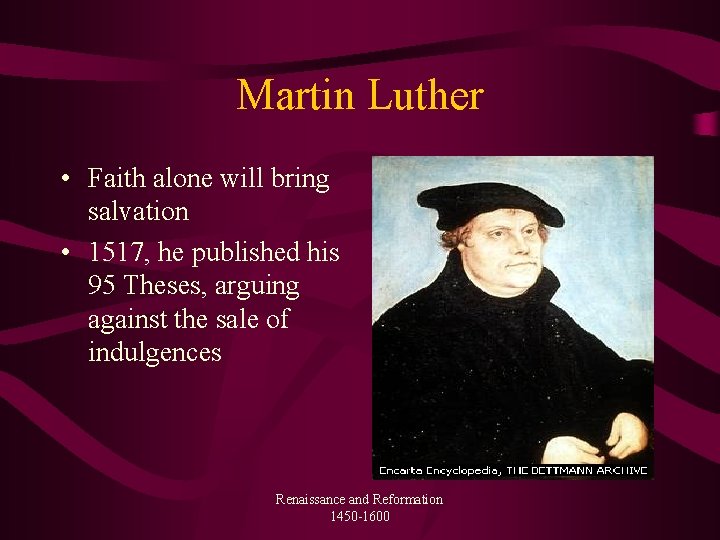
Martin Luther • Faith alone will bring salvation • 1517, he published his 95 Theses, arguing against the sale of indulgences Renaissance and Reformation 1450 -1600
In your own words, explain what each statement means: • Vain is the hope of salvation through letters of pardon, even if a commissary-nay, the Pope himself- were to pledge his own soul for them • Again, why does not the Pope, whose riches are at this day more ample than those of the wealthiest of the wealthy; build the one Basilica of St. Peter with his own money, rather than with that of poor believers? Renaissance and Reformation 1450 -1600
Counter Reformation • Actions taken by Catholic Church to counteract the impact of Protestant Reformation • Includes: Council of Trent, Roman Inquisition, Index of Prohibited Books, creation of religious orders Renaissance and Reformation 1450 -1600
Council of Trent (1546 - 1563) • All medieval church law was valid and important • Latin would remain official language • Re-emphasized the importance of “good works” and “faith” • No new definition of sacraments Renaissance and Reformation 1450 -1600
Other Actions taken by Catholic Church • Roman Inquisition- a tribunal designed to find heretics and bring them to justice • Roman Index of Prohibited Books- a process of reviewing and censoring books • The founding of Religious Orders devoted to teaching, propaganda, and social services, e. g. - Jesuits Renaissance and Reformation 1450 -1600
When the Dust Settles: Catholicism vs. Protestantism • Scripture interpreted by wisdom • Good Works and Faith • 7 Sacraments • Stick with Latin • Clergy must be celibate and chaste • Purgatory is real • Honour Saints • Scripture as you read it • Faith Alone • 2 Sacraments- Eucharist, Baptism • Language of the people • Clergy could marry • Go to Heaven or Hell • Criticized Honouring Saints Renaissance and Reformation 1450 -1600

Renaissance and Reformation 1450 -1600
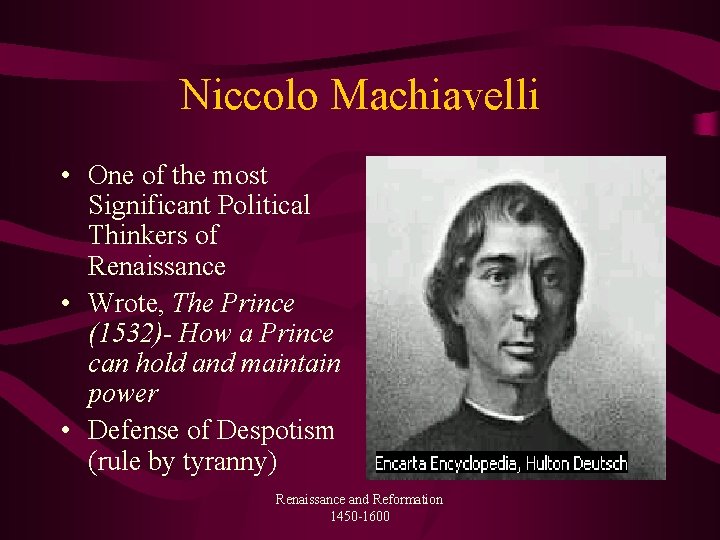
Niccolo Machiavelli • One of the most Significant Political Thinkers of Renaissance • Wrote, The Prince (1532)- How a Prince can hold and maintain power • Defense of Despotism (rule by tyranny) Renaissance and Reformation 1450 -1600
Machiavelli’s Ideas • Rejected the restrictions of honour and religion • Rulers should only be concerned with power and should only be bound by rules that make him/her successful • Rulers must be skilled in the art of war Renaissance and Reformation 1450 -1600
Machiavelli’s Ideas Continued • • Men are evil It is better to be stingy then liberal It is better to be feared then loved Keep your word only when it is too your advantage • Known for the saying “ the end justifies the means” Renaissance and Reformation 1450 -1600
Works Cited • Encarta Reference Library • Legacy: The West and the World by Newman Renaissance and Reformation 1450 -1600
- Slides: 17