
Ren Descartes His mathematical legacy By Nicolas Synnott
René Descartes: His mathematical legacy By Nicolas Synnott
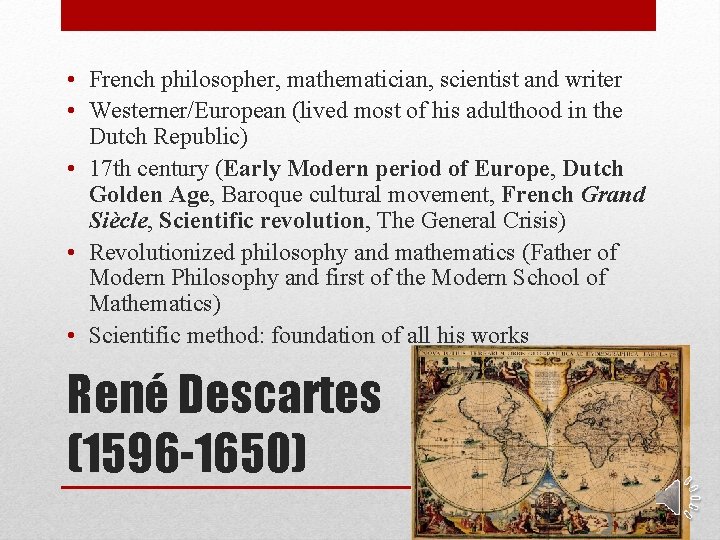
• French philosopher, mathematician, scientist and writer • Westerner/European (lived most of his adulthood in the Dutch Republic) • 17 th century (Early Modern period of Europe, Dutch Golden Age, Baroque cultural movement, French Grand Siècle, Scientific revolution, The General Crisis) • Revolutionized philosophy and mathematics (Father of Modern Philosophy and first of the Modern School of Mathematics) • Scientific method: foundation of all his works René Descartes (1596 -1650)
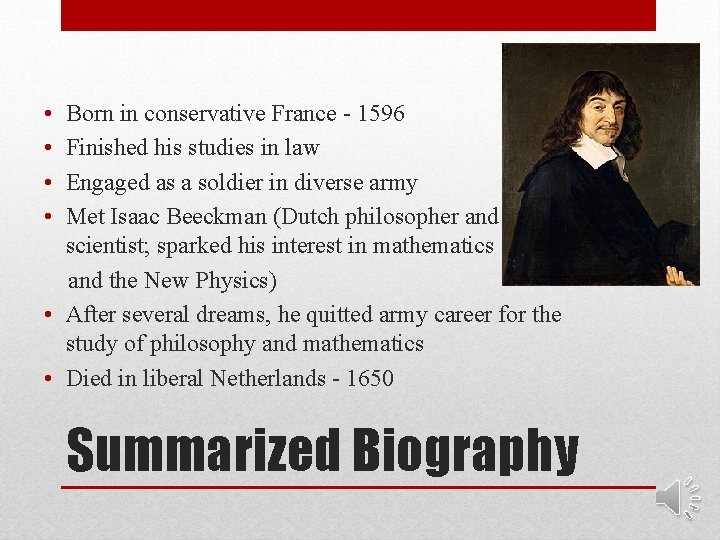
• • Born in conservative France - 1596 Finished his studies in law Engaged as a soldier in diverse army Met Isaac Beeckman (Dutch philosopher and scientist; sparked his interest in mathematics and the New Physics) • After several dreams, he quitted army career for the study of philosophy and mathematics • Died in liberal Netherlands - 1650 Summarized Biography

Before Descartes, the different mathematical fields were considered as separated entities. Descartes had a pioneering approach: he merged geometry and algebra. • Le Discours de la Méthode • Explain everything in terms of matter and motion • La Géométrie (one of three appendices) • Presented analytic geometry • Three main contributions • Notation • Cartesian coordinate system • Analytic or Cartesian geometry (most important legacy) The Mathematician
• Letters at the beginning of the alphabet: data or known quantities (a, b, c) • Letters at the end of the alphabet: variables or unknown quantities (x, y, z) • The number of distinct roots of an equation is equal to the degree of the equation (ax+bx^2+cx^3=y) • Use of superscripts to show powers or exponents (4 x 4 x 4=45) Father of Standard Notation

Descartes defined analytic geometry as “a way of visualizing algebraic formulas”. To do so, he first had to develop the coordinates system: (a “device to locate points on a plane”). • Composition • Two perpendicular lines: the vertical (y) and horizontal (x) axis • The intersection of the two axis: the origin (0, 0) • Axis are both positive and negative • 4 quadrants: (x, y), (-x, -y), (x, -y) • Location of a point on the Cartesian coordinates: • Indicated by its two coordinates (x, y) • The coordinated are determined by how far perpendicularly is the point from each axis in term of units Cartesian Coordinate System
- Slides: 6