
Removing reed canary grass for a wetland restoration
- Slides: 5
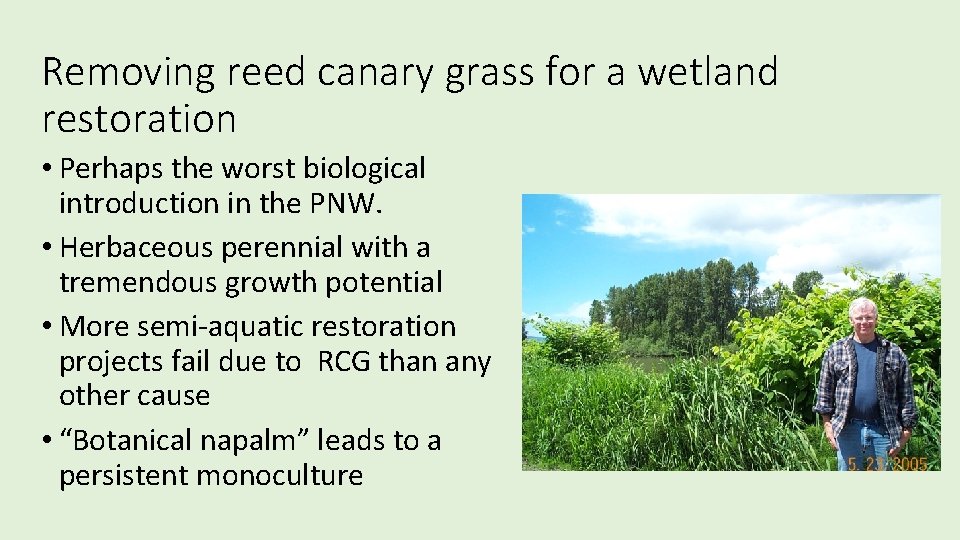
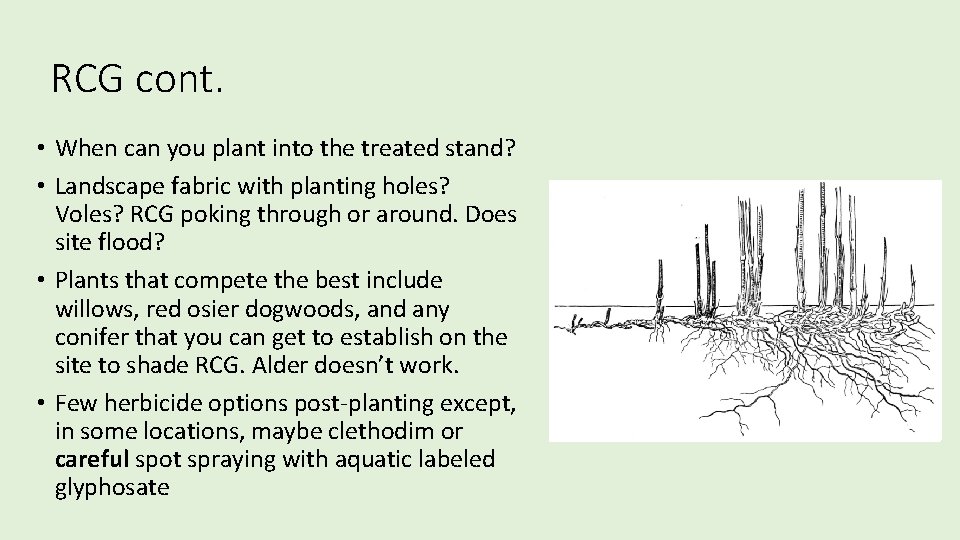
Removing reed canary grass for a wetland restoration • Perhaps the worst biological introduction in the PNW. • Herbaceous perennial with a tremendous growth potential • More semi-aquatic restoration projects fail due to RCG than any other cause • “Botanical napalm” leads to a persistent monoculture
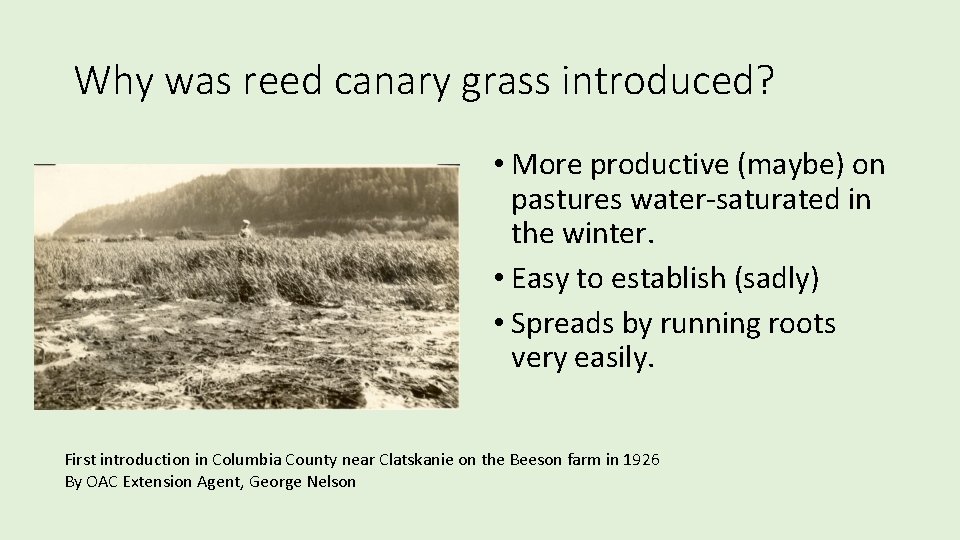
Why was reed canary grass introduced? • More productive (maybe) on pastures water-saturated in the winter. • Easy to establish (sadly) • Spreads by running roots very easily. First introduction in Columbia County near Clatskanie on the Beeson farm in 1926 By OAC Extension Agent, George Nelson
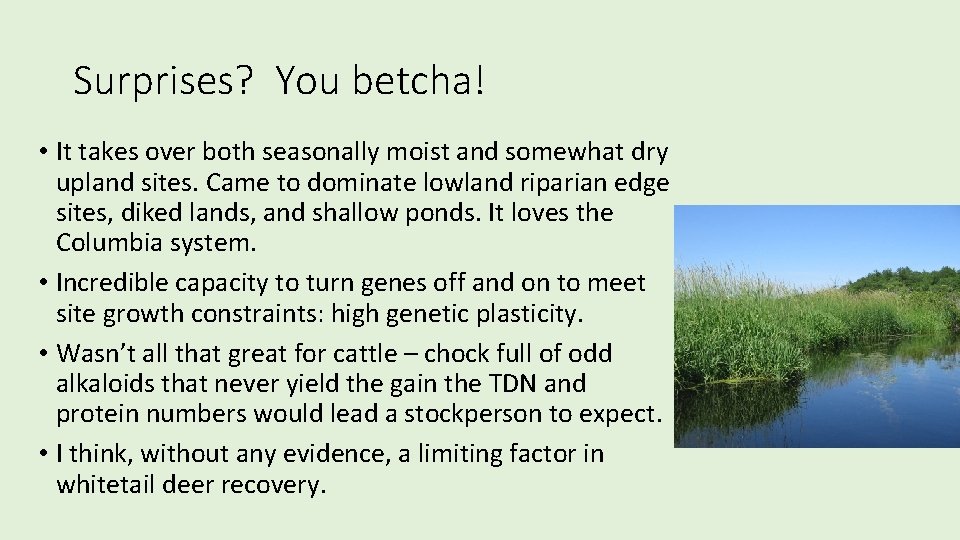
Surprises? You betcha! • It takes over both seasonally moist and somewhat dry upland sites. Came to dominate lowland riparian edge sites, diked lands, and shallow ponds. It loves the Columbia system. • Incredible capacity to turn genes off and on to meet site growth constraints: high genetic plasticity. • Wasn’t all that great for cattle – chock full of odd alkaloids that never yield the gain the TDN and protein numbers would lead a stockperson to expect. • I think, without any evidence, a limiting factor in whitetail deer recovery.
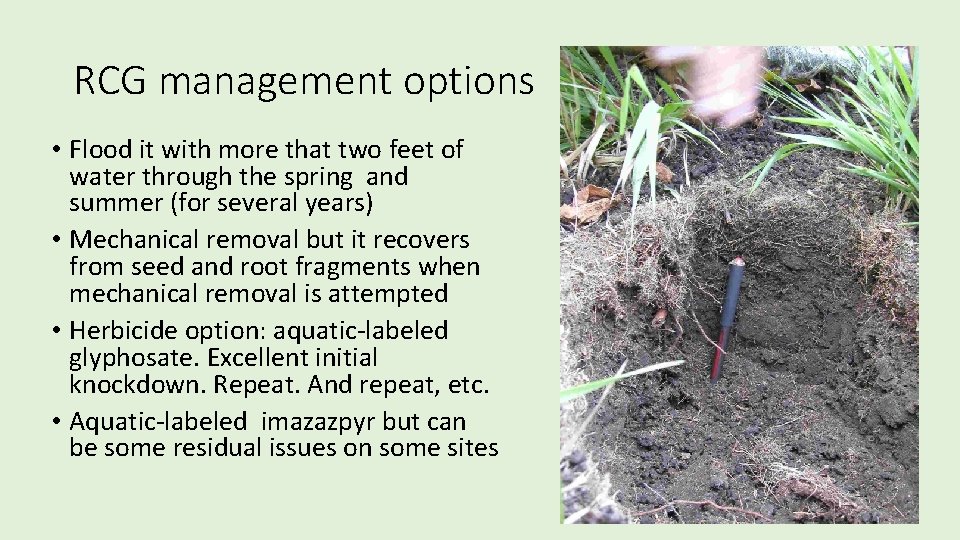
RCG management options • Flood it with more that two feet of water through the spring and summer (for several years) • Mechanical removal but it recovers from seed and root fragments when mechanical removal is attempted • Herbicide option: aquatic-labeled glyphosate. Excellent initial knockdown. Repeat. And repeat, etc. • Aquatic-labeled imazazpyr but can be some residual issues on some sites
RCG cont. • When can you plant into the treated stand? • Landscape fabric with planting holes? Voles? RCG poking through or around. Does site flood? • Plants that compete the best include willows, red osier dogwoods, and any conifer that you can get to establish on the site to shade RCG. Alder doesn’t work. • Few herbicide options post-planting except, in some locations, maybe clethodim or careful spot spraying with aquatic labeled glyphosate