
Removal of Heavy metal by Biological Method Blockcopolymer
Removal of Heavy metal by Biological Method Block-copolymer self-assembly center Seung-yun Yang
Contents Introduction -Heavy metal (Source, Discharge limit, Health effect) -Conventional removal method (Non-biotic, Biotic) Research paper -Biosorption mechanism -Results Summary
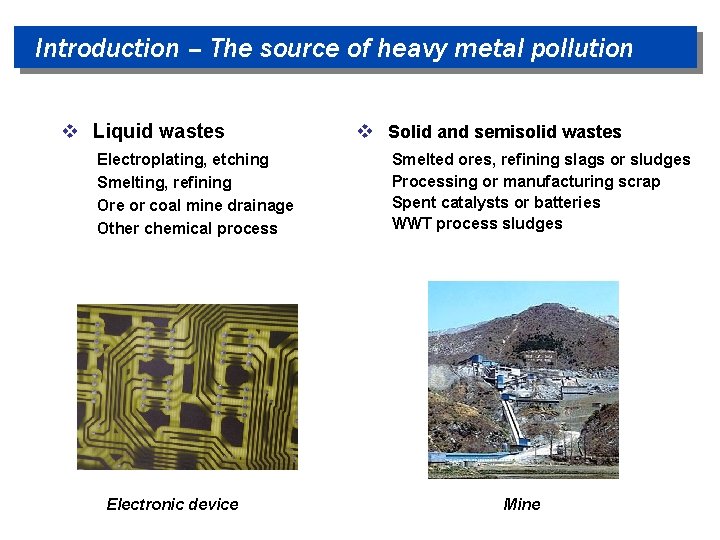
Introduction – The source of heavy metal pollution v Liquid wastes Electroplating, etching Smelting, refining Ore or coal mine drainage Other chemical process Electronic device v Solid and semisolid wastes Smelted ores, refining slags or sludges Processing or manufacturing scrap Spent catalysts or batteries WWT process sludges Mine
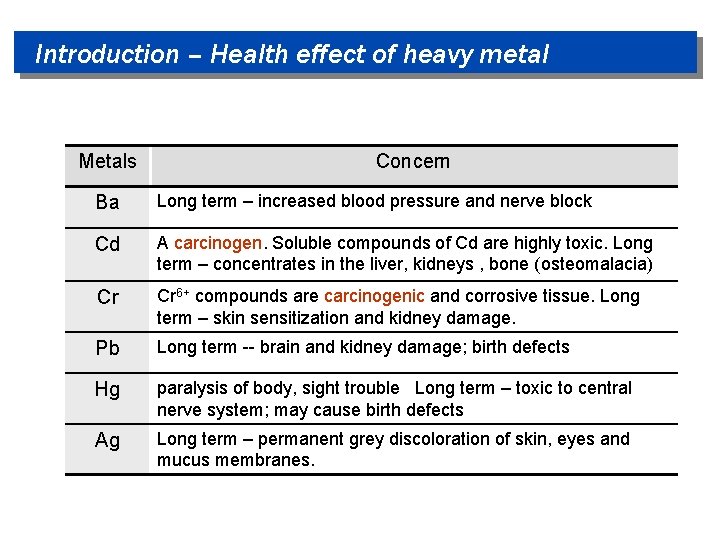
Introduction – Health effect of heavy metal Metals Concern Ba Long term – increased blood pressure and nerve block Cd A carcinogen. Soluble compounds of Cd are highly toxic. Long term – concentrates in the liver, kidneys , bone (osteomalacia) Cr Cr 6+ compounds are carcinogenic and corrosive tissue. Long term – skin sensitization and kidney damage. Pb Long term -- brain and kidney damage; birth defects Hg paralysis of body, sight trouble Long term – toxic to central nerve system; may cause birth defects Ag Long term – permanent grey discoloration of skin, eyes and mucus membranes.
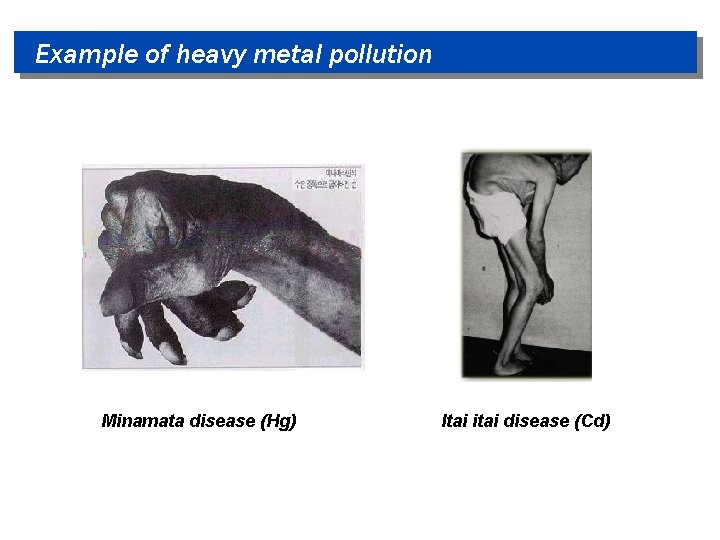
Example of heavy metal pollution Minamata disease (Hg) Itai itai disease (Cd)
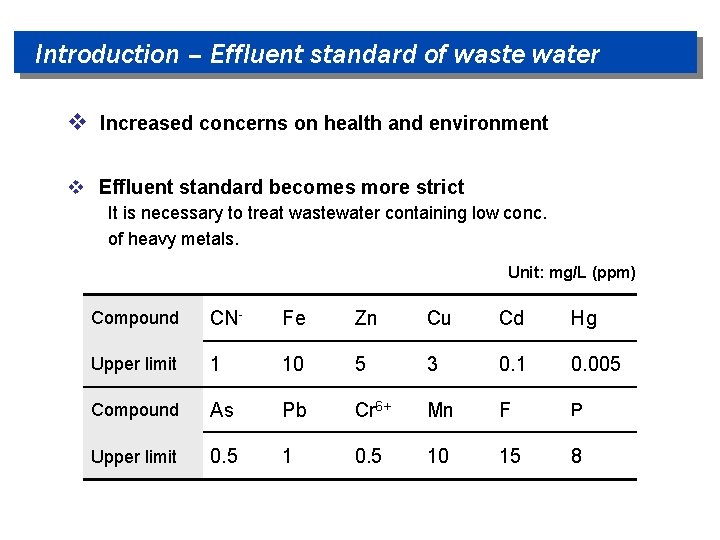
Introduction – Effluent standard of waste water v Increased concerns on health and environment v Effluent standard becomes more strict It is necessary to treat wastewater containing low conc. of heavy metals. Unit: mg/L (ppm) Compound CN- Fe Zn Cu Cd Hg Upper limit 1 10 5 3 0. 1 0. 005 Compound As Pb Cr 6+ Mn F P Upper limit 0. 5 10 15 8
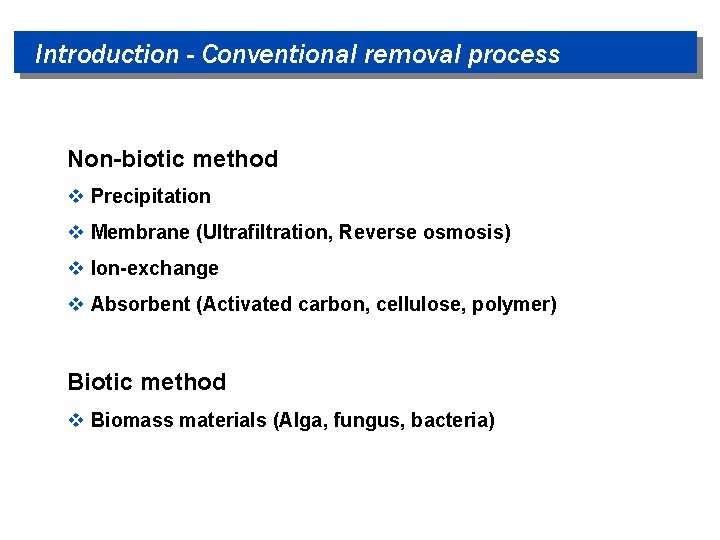
Introduction - Conventional removal process Non-biotic method v Precipitation v Membrane (Ultrafiltration, Reverse osmosis) v Ion-exchange v Absorbent (Activated carbon, cellulose, polymer) Biotic method v Biomass materials (Alga, fungus, bacteria)
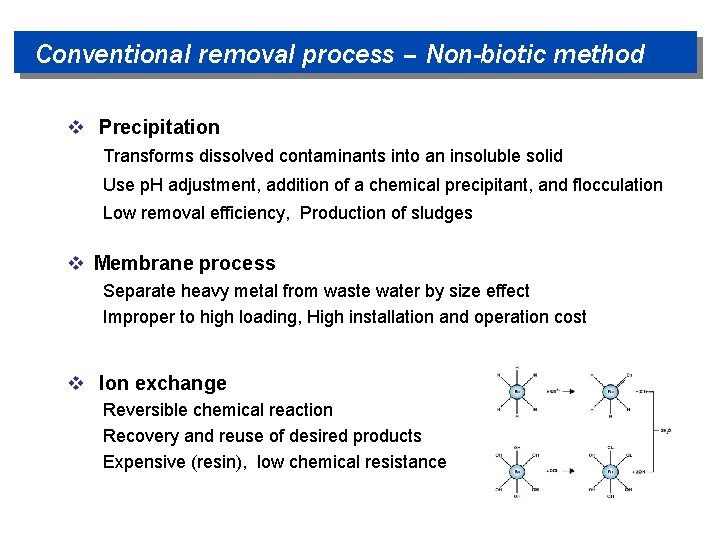
Conventional removal process – Non-biotic method v Precipitation Transforms dissolved contaminants into an insoluble solid Use p. H adjustment, addition of a chemical precipitant, and flocculation Low removal efficiency, Production of sludges v Membrane process Separate heavy metal from waste water by size effect Improper to high loading, High installation and operation cost v Ion exchange Reversible chemical reaction Recovery and reuse of desired products Expensive (resin), low chemical resistance
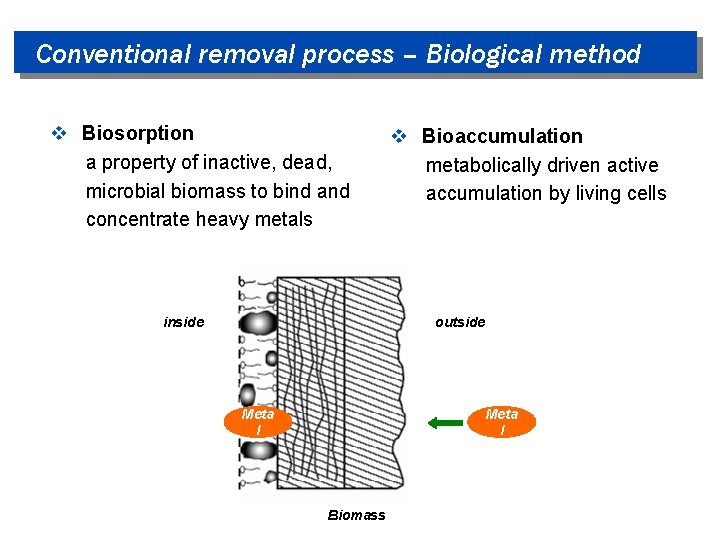
Conventional removal process – Biological method v Biosorption a property of inactive, dead, microbial biomass to bind and concentrate heavy metals inside v Bioaccumulation metabolically driven active accumulation by living cells outside Meta l Biomass

Biosorbent uptake of metals by microbial biomass Metals can be accumulated more than 30% of biomass weight in Some species (Ascophyllum and Sargassum)
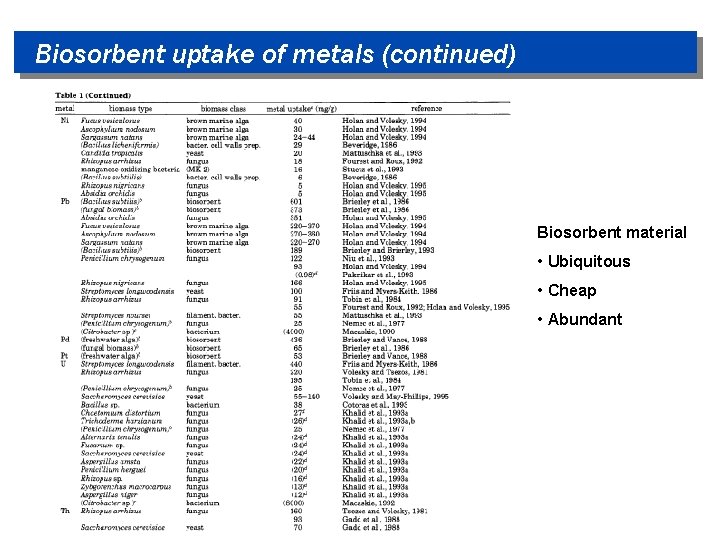
Biosorbent uptake of metals (continued) Biosorbent material • Ubiquitous • Cheap • Abundant
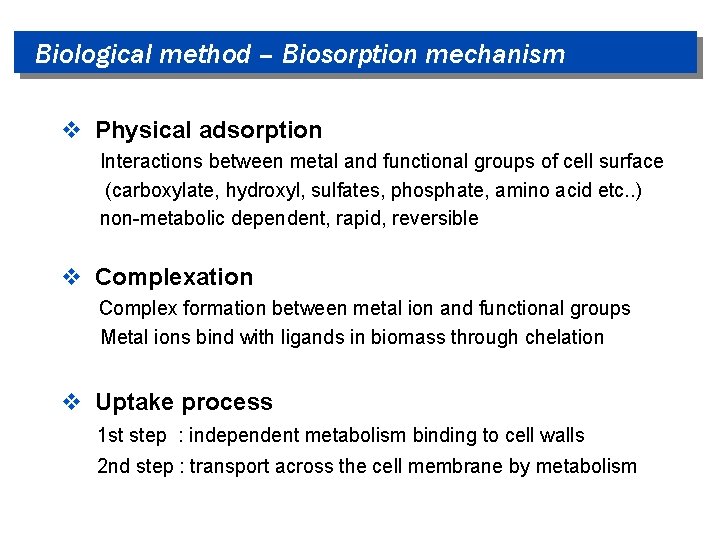
Biological method – Biosorption mechanism v Physical adsorption Interactions between metal and functional groups of cell surface (carboxylate, hydroxyl, sulfates, phosphate, amino acid etc. . ) non-metabolic dependent, rapid, reversible v Complexation Complex formation between metal ion and functional groups Metal ions bind with ligands in biomass through chelation v Uptake process 1 st step : independent metabolism binding to cell walls 2 nd step : transport across the cell membrane by metabolism
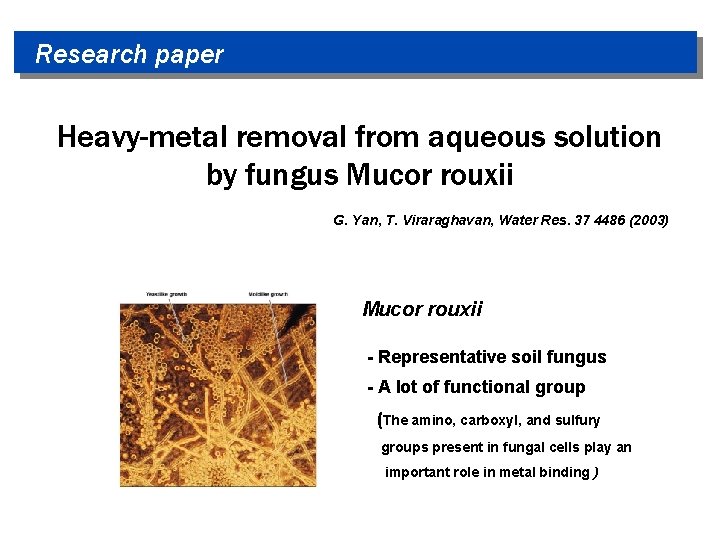
Research paper Heavy-metal removal from aqueous solution by fungus Mucor rouxii G. Yan, T. Viraraghavan, Water Res. 37 4486 (2003) Mucor rouxii - Representative soil fungus - A lot of functional group (The amino, carboxyl, and sulfury groups present in fungal cells play an important role in metal binding )
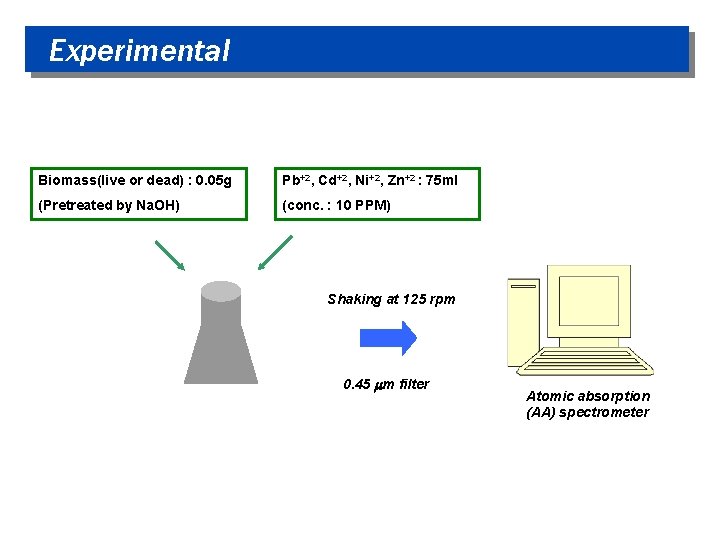
Experimental Biomass(live or dead) : 0. 05 g Pb+2, Cd+2, Ni+2, Zn+2 : 75 ml (Pretreated by Na. OH) (conc. : 10 PPM) Shaking at 125 rpm 0. 45 mm filter Atomic absorption (AA) spectrometer
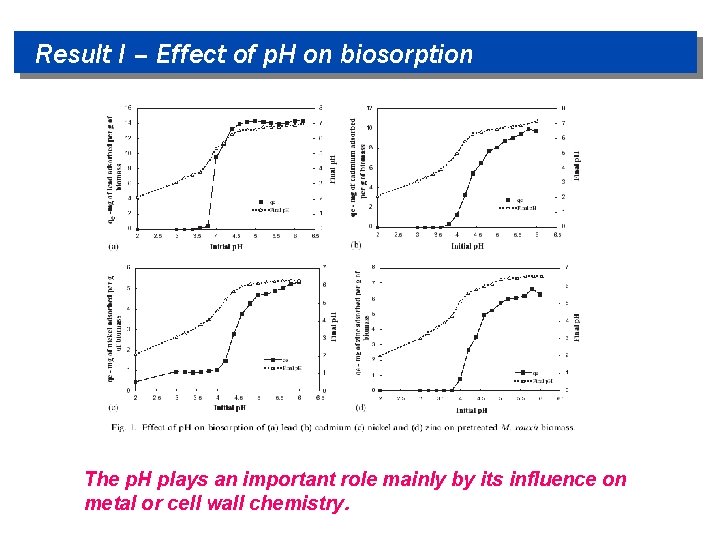
Result I – Effect of p. H on biosorption The p. H plays an important role mainly by its influence on metal or cell wall chemistry.
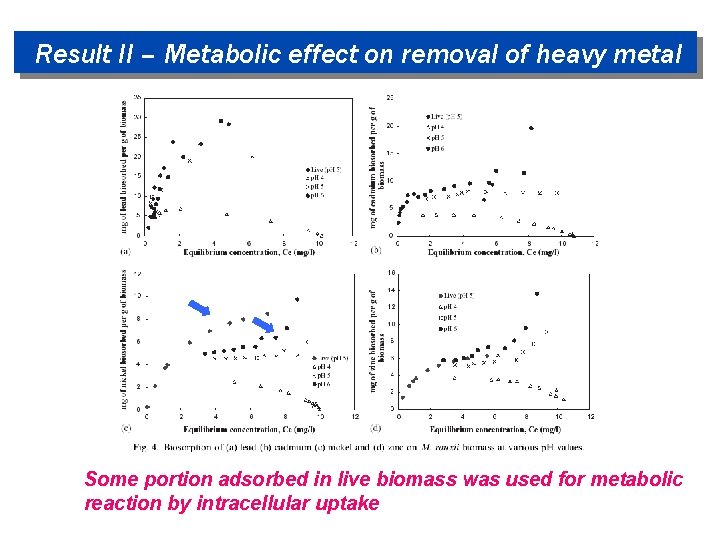
Result II – Metabolic effect on removal of heavy metal Some portion adsorbed in live biomass was used for metabolic reaction by intracellular uptake
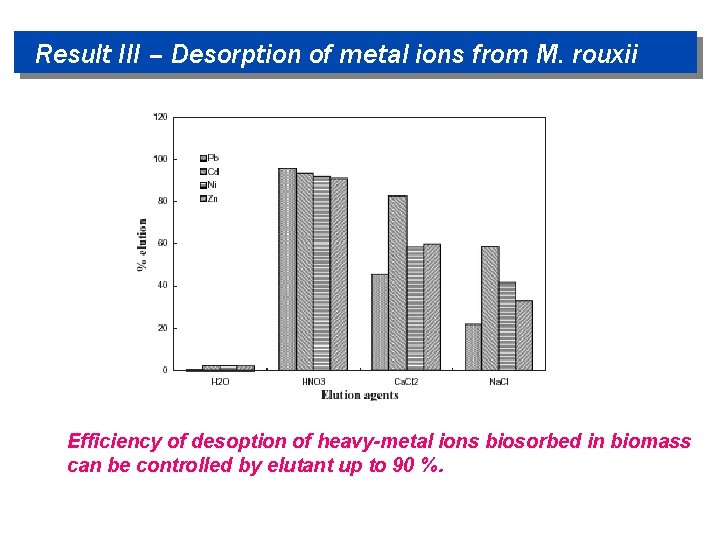
Result III – Desorption of metal ions from M. rouxii Efficiency of desoption of heavy-metal ions biosorbed in biomass can be controlled by elutant up to 90 %.
Summary Biological method can be utilized for removal of heavy metal 1. High efficiency of removal (up to 30% of biomass) 2. Abundance of biosorbent Mucor rouxii biomass showed a high adsorption capability for the heavy metal removal. - p. H plays an important role on metal or cell wall chemistry - Metabolic as well as non-metabolic reaction involved in removal of heavy metal - High recovery of biosorbed metal ions could be achieved with acid elution

Thank you !
- Slides: 19