
REMOTE SOFTWARE INTEGRITY VERIFICATION USING TRUSTED COMPUTING GROUP

- Slides: 15
REMOTE SOFTWARE INTEGRITY VERIFICATION USING TRUSTED COMPUTING GROUP TPM Guy Fedorkow, Juniper Networks Jessica Fitzgerald-Mc. Kay, USG Nov 2019 V 1 b
Introduction Remote software integrity verification is a mechanism that can be used to determine the authenticity of software installed on a fielded device such as a router or firewall. This ppt outlines work submitted as: • draft-fedorkow-rats-network-device-attestation-01 The work is based on Trusted Computing Group document: • • TCG Remote Integrity Verification: Network Equipment Remote Attestation System https: //trustedcomputinggroup. org/wp-content/uploads/TCG-Net. Eq-Attestation. Workflow-Outline_v 1 r 9 b_pubrev. pdf 2 2 Non-Juniper
Problem Statement • How do you know what software is actually running on a device? • You could ask it, but it might not tell the truth • Attestation (‘measured boot’) establishes a chain of trust where each link measures the next before it starts • The TPM reports the results, signed by a key known only by the TPM • A workflow must be established where the entity that wants the validation may query the device in question via standard protocols. • Current RIV Scope: “Things that have a TPM, use YANG and don’t Sleep” • Compatibility with existing TPM practice is critical • Addition of protocol suites other than YANG (e. g. IIo. T) would extend the scope 3 3 Non-Juniper
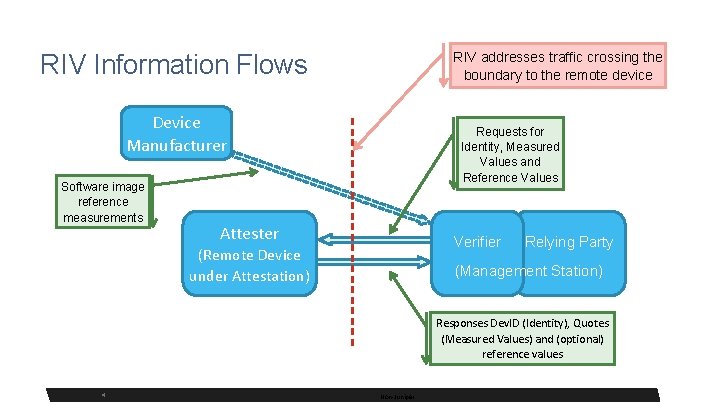
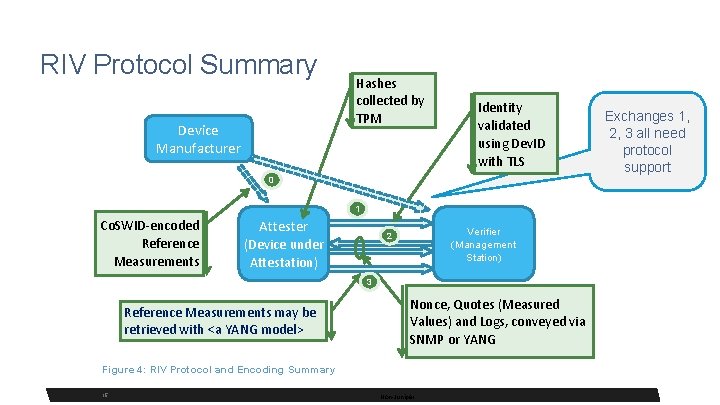
RIV Information Flows RIV addresses traffic crossing the boundary to the remote device Device Manufacturer Software image reference measurements Requests for Identity, Measured Values and Reference Values Attester Verifier (Remote Device under Attestation) Relying Party (Management Station) Responses Dev. ID (Identity), Quotes (Measured Values) and (optional) reference values 4 4 Non-Juniper
Security Considerations: Attacks Against RIV Bad Stuff Can Happen: • Keys may be compromised • A counterfeit device may attempt to impersonate (spoof) a known authentic device • Man-in-the-middle attacks may be used by a counterfeit device to attempt to deliver responses that originate in an actual authentic device • Replay attacks may be attempted by a compromised device. 5 5 Non-Juniper
Defense Against Key Compromise • RIV depends on keys generated inside the TPM for both Identity and Attestation • Secret keys cannot be extracted from the TPM* • Certificate provenance must be managed carefully by device manufacturer • i. e. , be careful of what you sign. * Unless you find a bug or mount a very challenging physical attack 6 6 Non-Juniper
Defense Against Counterfeit Devices • RIV depends on IEEE 802. 1 AR Device ID credentials protected by the TPM • Manufacturers should provision Initial Device Identity (IDev. ID) • Device Owners can (optionally) provision Local Device ID (LDev. ID) • Pre-provisioned IDev. ID allows for Secure Zero Touch Provisioning (e. g. RFC 8572) 7 7 Non-Juniper
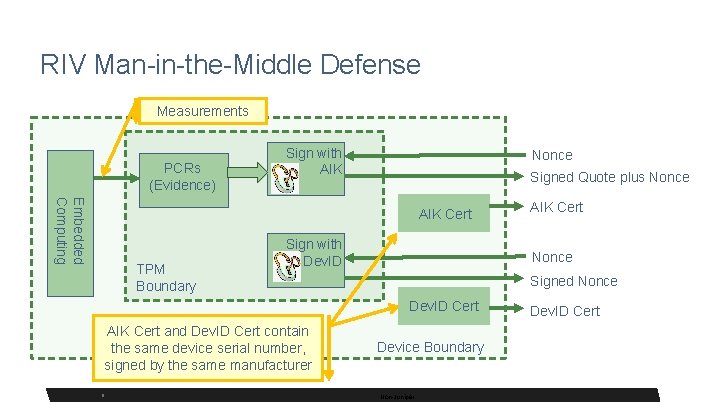
Defense Against Man-in-the-Middle Attacks • Identity depends on difficult-to-forge Dev. ID • Software Attestation evidence is collected and signed inside the TPM …using an Attestation key that can’t be used to sign anything else Implications: • RIV calls for Separate Dev. ID and Attestation keys • The Attestation Certificate must include the same Identity information as the IDev. ID* • Signed TPM data structures must be transmitted without modification * See Asokan Man in the Middle Attack, RFC 6813 8 8 Non-Juniper
RIV Man-in-the-Middle Defense Measurements PCRs (Evidence) Sign with AIK Nonce Signed Quote plus Nonce Embedded Computing AIK Cert TPM Boundary Sign with Dev. ID Nonce Signed Nonce Dev. ID Cert AIK Cert and Dev. ID Cert contain the same device serial number, signed by the same manufacturer 9 9 AIK Cert Device Boundary Non-Juniper Dev. ID Cert
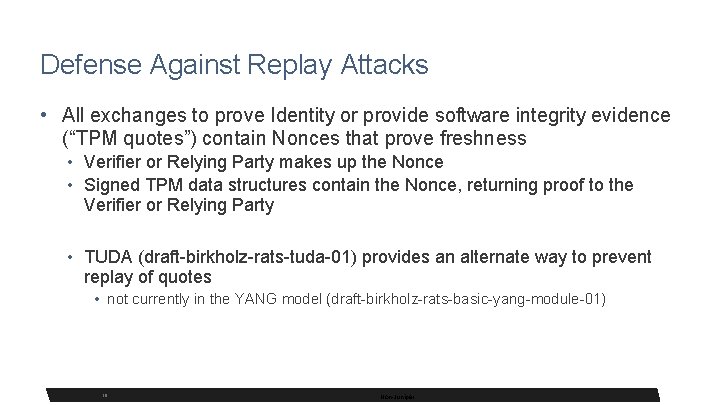
Defense Against Replay Attacks • All exchanges to prove Identity or provide software integrity evidence (“TPM quotes”) contain Nonces that prove freshness • Verifier or Relying Party makes up the Nonce • Signed TPM data structures contain the Nonce, returning proof to the Verifier or Relying Party • TUDA (draft-birkholz-rats-tuda-01) provides an alternate way to prevent replay of quotes • not currently in the YANG model (draft-birkholz-rats-basic-yang-module-01) 10 10 Non-Juniper
Conclusion • TPM rules provide difficult-to-forge evidence of identity and software integrity • But that means the TPM data structures must be transmitted unmodified. 11 11 Non-Juniper
BACKUP 12 12 Non-Juniper
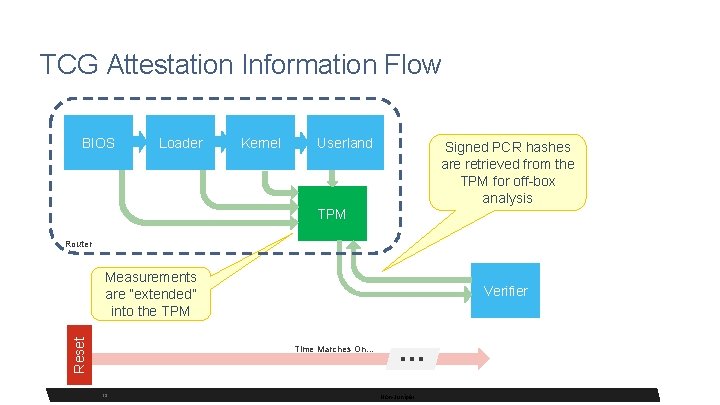
TCG Attestation Information Flow BIOS Loader Kernel Userland Signed PCR hashes are retrieved from the TPM for off-box analysis TPM Router Reset Measurements are “extended” into the TPM 13 Verifier Time Marches On… 13 … Non-Juniper
What’s So Hard about This? • Device Health Attestation is dependent on strong device identity • No point in attesting the state of a box if you don’t know which one it is! • It’s inherently multivendor • A single vendor can collect the measurements, but to be useful, someone off-box has to ask for the results and evaluate them • Software configurations are (almost) infinitely variable. • Determining if a chain of hashes is “good” or not is harder than “if (a==b)” • Common Multi-threaded OSs don’t promise deterministic ordering, complicating hash chain analysis 14 14 Non-Juniper
RIV Protocol Summary Device Manufacturer Hashes collected by TPM Identity validated using Dev. ID with TLS 0 1 Co. SWID-encoded Reference Measurements Attester Verifier (Management Station) 2 (Device under Attestation) 3 Reference Measurements may be retrieved with <a YANG model> Nonce, Quotes (Measured Values) and Logs, conveyed via SNMP or YANG Figure 4: RIV Protocol and Encoding Summary 15 15 Non-Juniper Exchanges 1, 2, 3 all need protocol support