
Remote Shared Access To A Classroom Robotics Lab
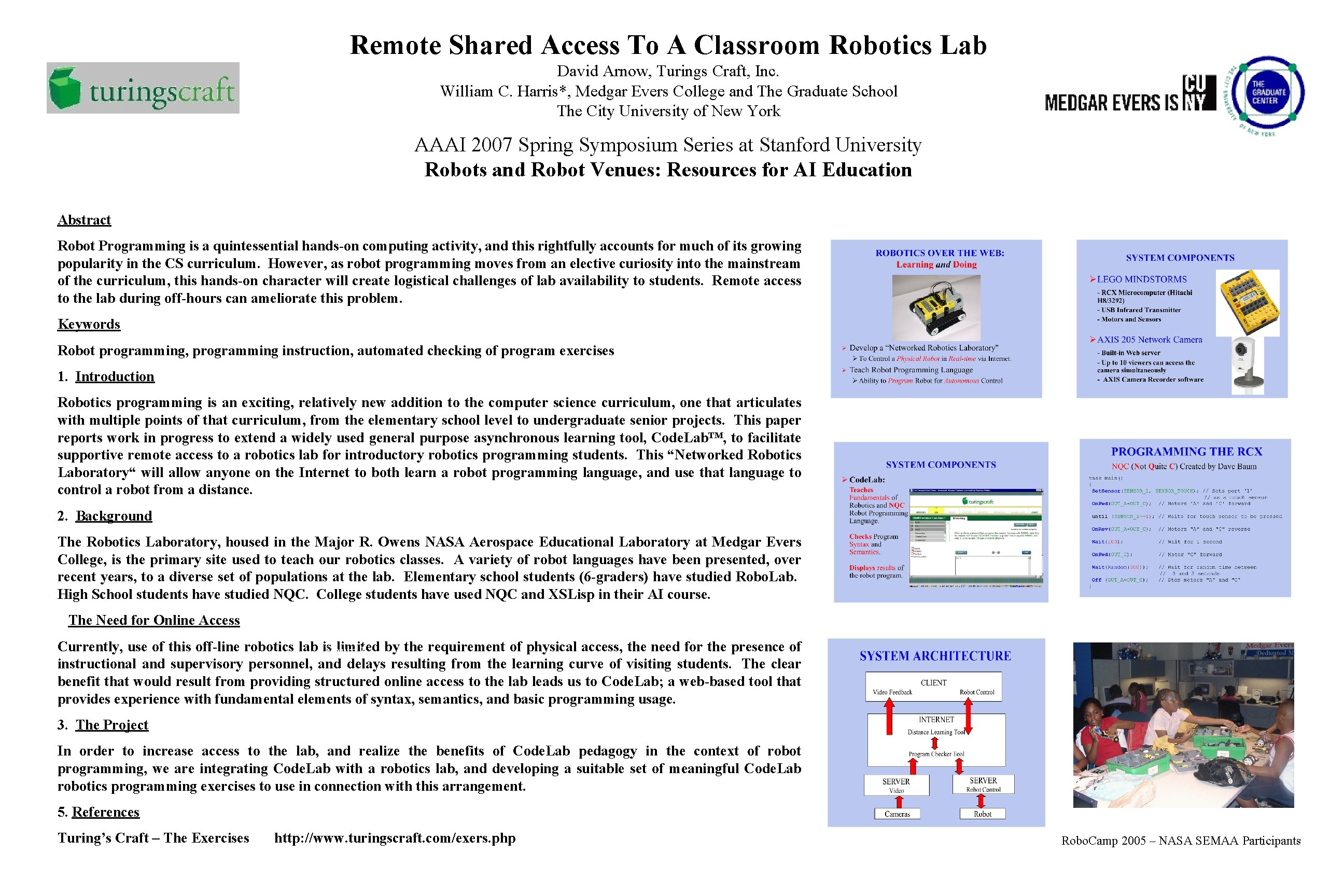
Remote Shared Access To A Classroom Robotics Lab David Arnow, Turings Craft, Inc. William C. Harris*, Medgar Evers College and The Graduate School The City University of New York AAAI 2007 Spring Symposium Series at Stanford University Robots and Robot Venues: Resources for AI Education Abstract Robot Programming is a quintessential hands-on computing activity, and this rightfully accounts for much of its growing popularity in the CS curriculum. However, as robot programming moves from an elective curiosity into the mainstream of the curriculum, this hands-on character will create logistical challenges of lab availability to students. Remote access to the lab during off-hours can ameliorate this problem. Keywords Robot programming, programming instruction, automated checking of program exercises 1. Introduction Robotics programming is an exciting, relatively new addition to the computer science curriculum, one that articulates with multiple points of that curriculum, from the elementary school level to undergraduate senior projects. This paper reports work in progress to extend a widely used general purpose asynchronous learning tool, Code. Lab™, to facilitate supportive remote access to a robotics lab for introductory robotics programming students. This “Networked Robotics Laboratory“ will allow anyone on the Internet to both learn a robot programming language, and use that language to control a robot from a distance. 2. Background The Robotics Laboratory, housed in the Major R. Owens NASA Aerospace Educational Laboratory at Medgar Evers College, is the primary site used to teach our robotics classes. A variety of robot languages have been presented, over recent years, to a diverse set of populations at the lab. Elementary school students (6 -graders) have studied Robo. Lab. High School students have studied NQC. College students have used NQC and XSLisp in their AI course. The Need for Online Access Currently, use of this off-line robotics lab is limited Figure 1 by the requirement of physical access, the need for the presence of instructional and supervisory personnel, and delays resulting from the learning curve of visiting students. The clear benefit that would result from providing structured online access to the lab leads us to Code. Lab; a web-based tool that provides experience with fundamental elements of syntax, semantics, and basic programming usage. 3. The Project Figure 2 In order to increase access to the lab, and realize the benefits of Code. Lab pedagogy in the context of robot programming, we are integrating Code. Lab with a robotics lab, and developing a suitable set of meaningful Code. Lab robotics programming exercises to use in connection with this arrangement. 5. References Turing’s Craft – The Exercises Figure 3 http: //www. turingscraft. com/exers. php Robo. Camp 2005 – NASA SEMAA Participants
- Slides: 1