
Remote Sensing Principles and Applications The NASA Earth




- Slides: 38
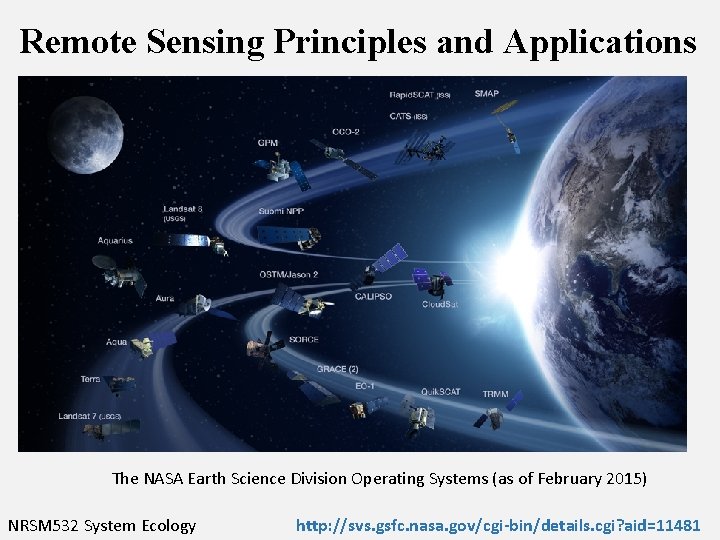
Remote Sensing Principles and Applications The NASA Earth Science Division Operating Systems (as of February 2015) NRSM 532 System Ecology http: //svs. gsfc. nasa. gov/cgi-bin/details. cgi? aid=11481
Remote Sensing Definition Acquisition of information about the condition and/or state of a target by a sensor that is not in direct physical contact with the target (Asrar, 1989)
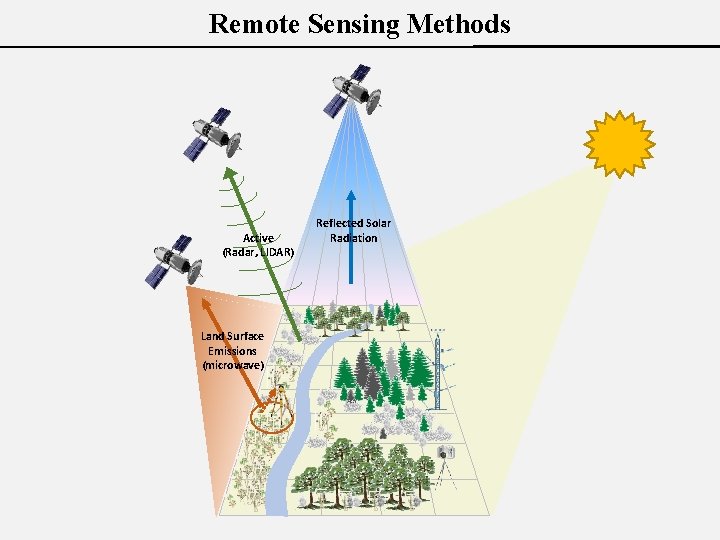
Remote Sensing Methods Active (Radar, LIDAR) Land Surface Emissions (microwave) Reflected Solar Radiation
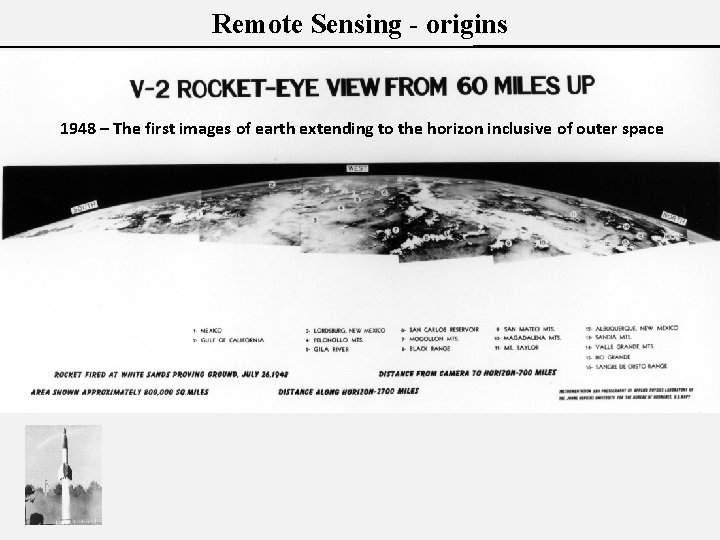
Remote Sensing - origins 1948 – The first images of earth extending to the horizon inclusive of outer space
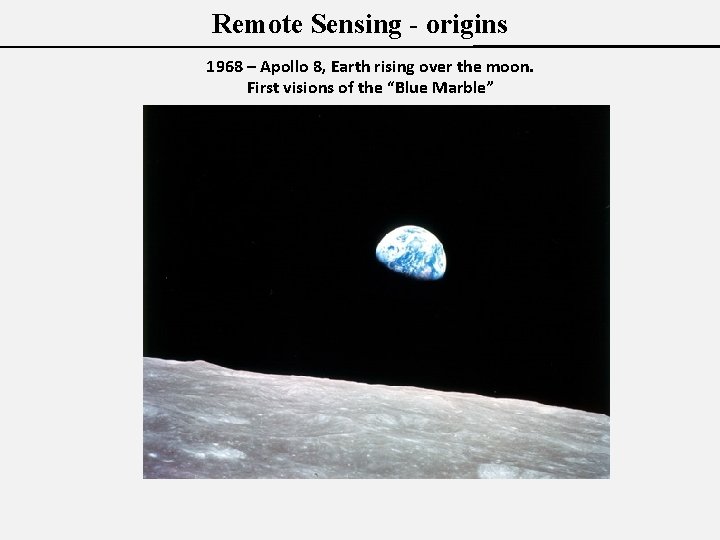
Remote Sensing - origins 1968 – Apollo 8, Earth rising over the moon. First visions of the “Blue Marble”
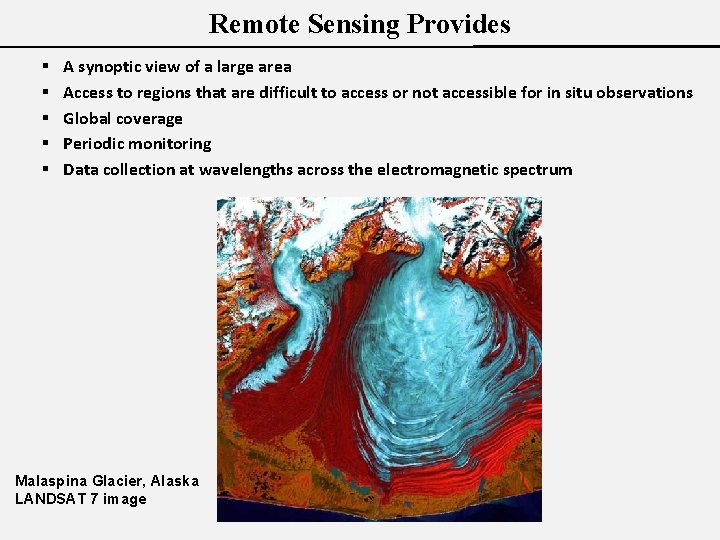
Remote Sensing Provides § § § A synoptic view of a large area Access to regions that are difficult to access or not accessible for in situ observations Global coverage Periodic monitoring Data collection at wavelengths across the electromagnetic spectrum Malaspina Glacier, Alaska LANDSAT 7 image
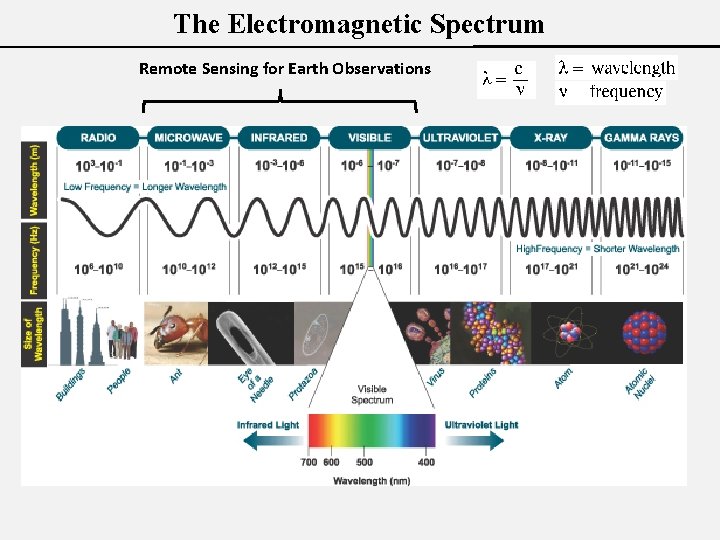
The Electromagnetic Spectrum Remote Sensing for Earth Observations
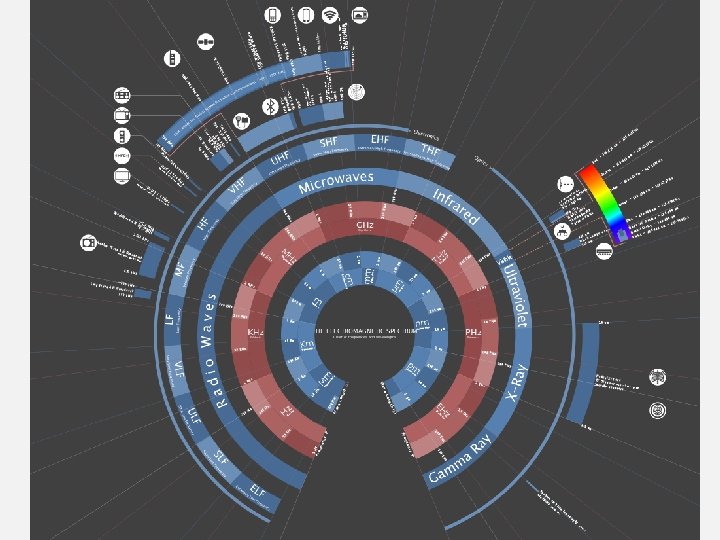
The Electromagnetic Spectrum
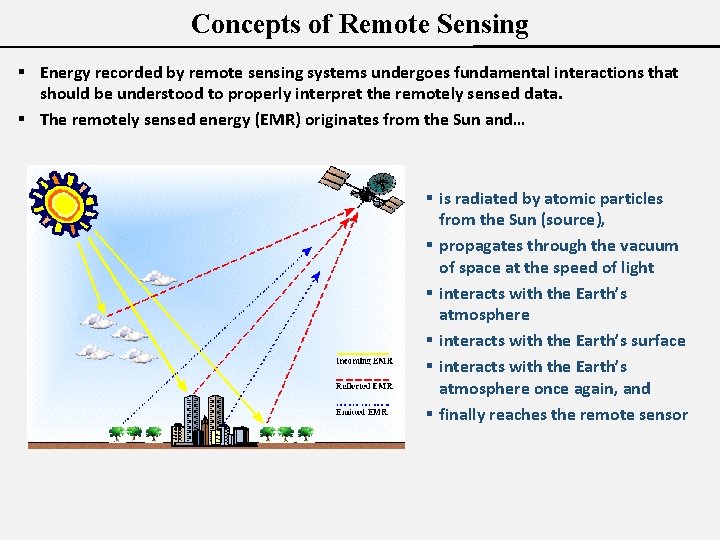
Concepts of Remote Sensing § Energy recorded by remote sensing systems undergoes fundamental interactions that should be understood to properly interpret the remotely sensed data. § The remotely sensed energy (EMR) originates from the Sun and… § is radiated by atomic particles from the Sun (source), § propagates through the vacuum of space at the speed of light § interacts with the Earth’s atmosphere § interacts with the Earth’s surface § interacts with the Earth’s atmosphere once again, and § finally reaches the remote sensor
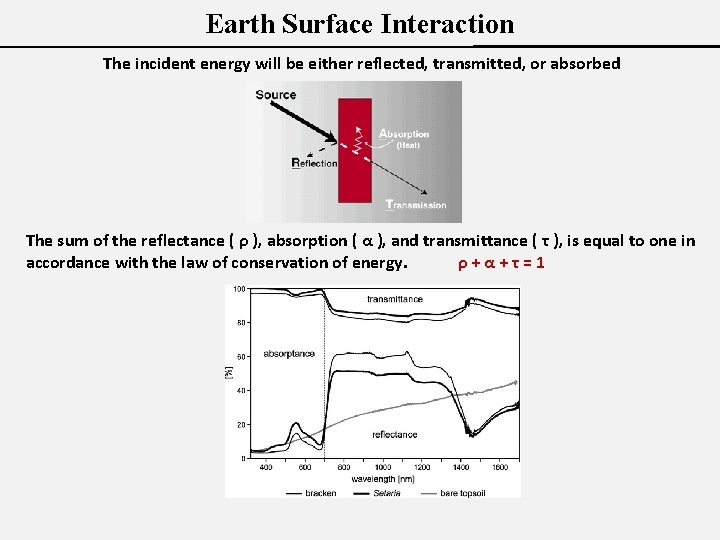
Earth Surface Interaction The incident energy will be either reflected, transmitted, or absorbed The sum of the reflectance ( ρ ), absorption ( α ), and transmittance ( τ ), is equal to one in accordance with the law of conservation of energy. ρ+α+τ=1
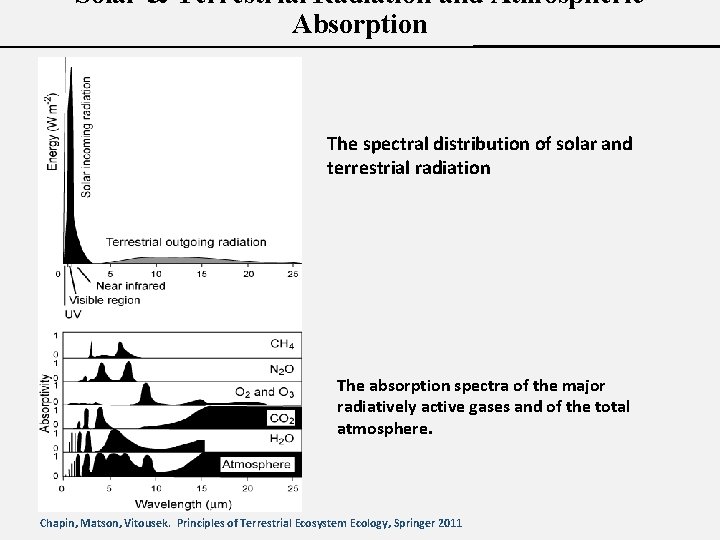
Atmospheric Effects on Radiation The Atmosphere can refract, scatter, and absorb: Ø Refraction refers to the bending of radiation from its original path § Only a major factor in long path lengths through the atmosphere Ø Scattering refers to the redirection of radiation after interaction with a particle in the atmosphere § a function of the wavelength of the incident radiation and the size of a particle (e. g. , gas molecule, dust, water vapor) encountered Ø Absorption is the incorporation of the radiation within the particle to alter the energy state of the particle § Gaseous absorption and aerosol absorption § Gases that cause the largest impact to RS are CO 2, H 2 O, and O 3 • Wavelengths (<300 nm) are almost completely absorbed (e. g. , O 3) • CO 2: greenhouse gas (infrared radiation absorption) • H 2 O: NIR, SWIR, far-infrared and microwave regions Ø Scattering and Absorption are referred to as attenuation or extinction
Atmospheric Transmittance: the fraction of incident EMR at a specified wavelength that passes through a sample (e. g. Earth’s atmosphere) The amount of transmittance will determine what measurements of the surface can be made. § Spectral regions with poor transmittance are good for atmospheric sensing, not good for terrestrial remote sensing § Infrared Atmospheric window (8 -12 µm) can penetrate the earth’s atmosphere
Solar & Terrestrial Radiation and Atmospheric Absorption The spectral distribution of solar and terrestrial radiation The absorption spectra of the major radiatively active gases and of the total atmosphere. Chapin, Matson, Vitousek. Principles of Terrestrial Ecosystem Ecology, Springer 2011
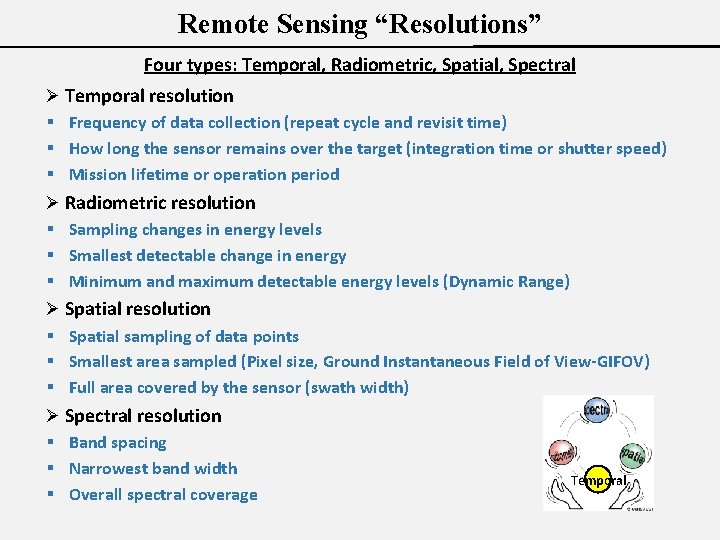
Remote Sensing “Resolutions” Four types: Temporal, Radiometric, Spatial, Spectral Ø Temporal resolution § Frequency of data collection (repeat cycle and revisit time) § How long the sensor remains over the target (integration time or shutter speed) § Mission lifetime or operation period Ø Radiometric resolution § Sampling changes in energy levels § Smallest detectable change in energy § Minimum and maximum detectable energy levels (Dynamic Range) Ø Spatial resolution § Spatial sampling of data points § Smallest area sampled (Pixel size, Ground Instantaneous Field of View-GIFOV) § Full area covered by the sensor (swath width) Ø Spectral resolution § Band spacing § Narrowest band width § Overall spectral coverage Temporal
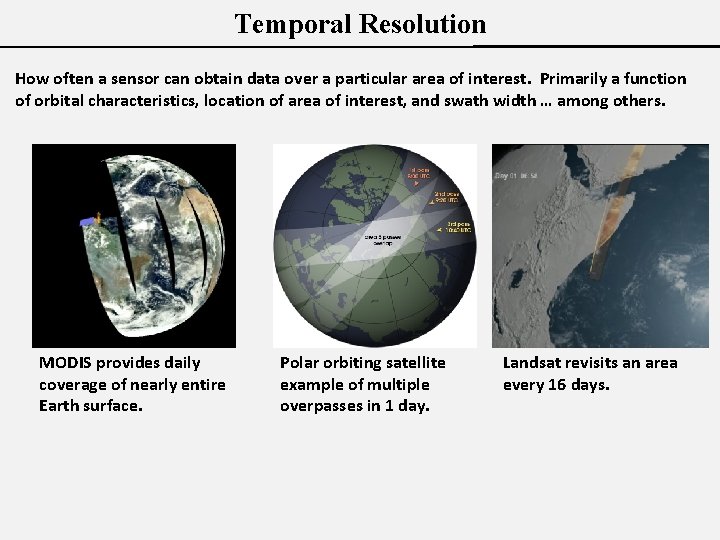
Temporal Resolution How often a sensor can obtain data over a particular area of interest. Primarily a function of orbital characteristics, location of area of interest, and swath width … among others. MODIS provides daily coverage of nearly entire Earth surface. Polar orbiting satellite example of multiple overpasses in 1 day. Landsat revisits an area every 16 days.
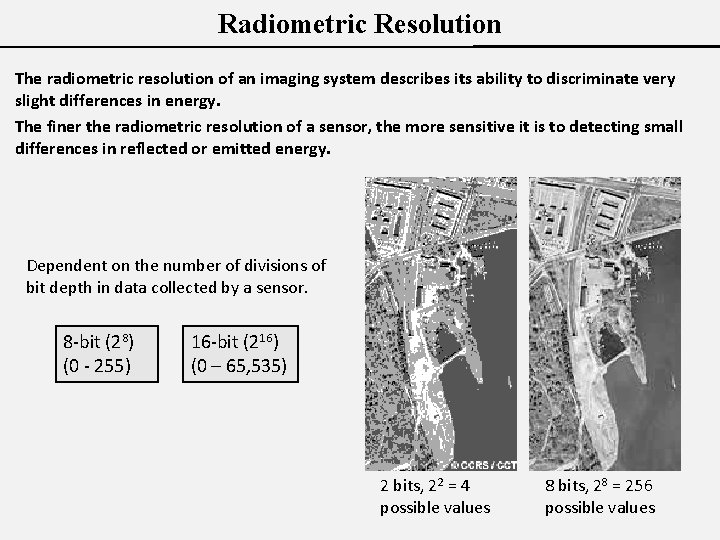
Radiometric Resolution The radiometric resolution of an imaging system describes its ability to discriminate very slight differences in energy. The finer the radiometric resolution of a sensor, the more sensitive it is to detecting small differences in reflected or emitted energy. Dependent on the number of divisions of bit depth in data collected by a sensor. 8 -bit (28) (0 - 255) 16 -bit (216) (0 – 65, 535) 2 bits, 22 = 4 possible values 8 bits, 28 = 256 possible values
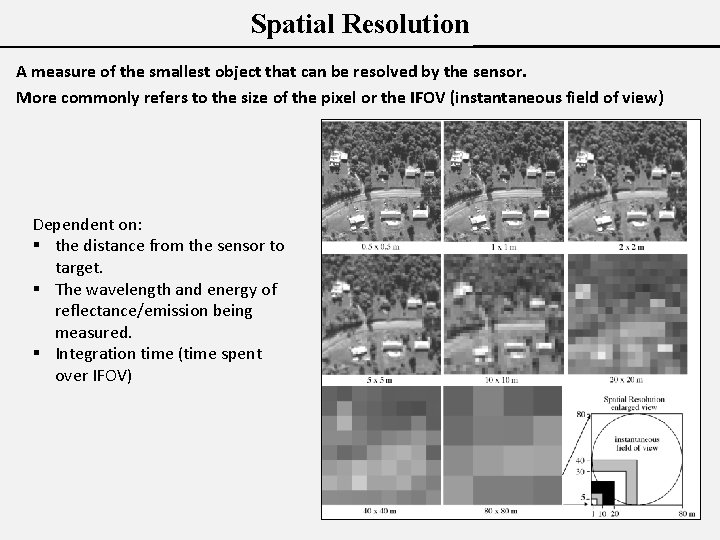
Spatial Resolution A measure of the smallest object that can be resolved by the sensor. More commonly refers to the size of the pixel or the IFOV (instantaneous field of view) Dependent on: § the distance from the sensor to target. § The wavelength and energy of reflectance/emission being measured. § Integration time (time spent over IFOV)
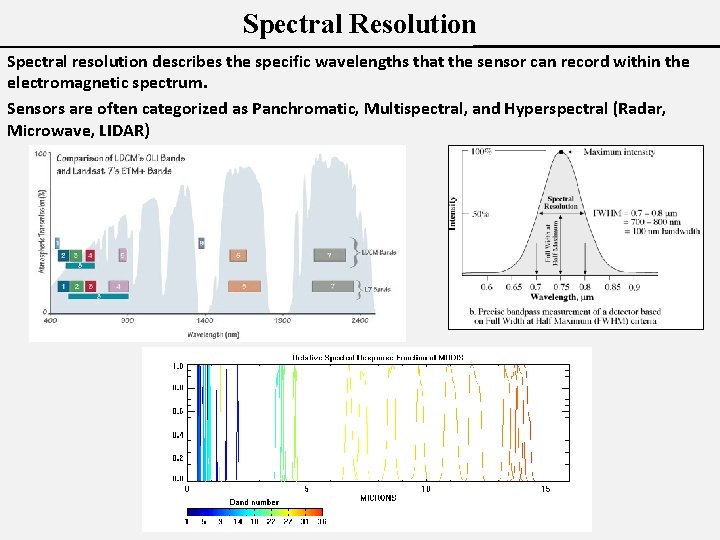
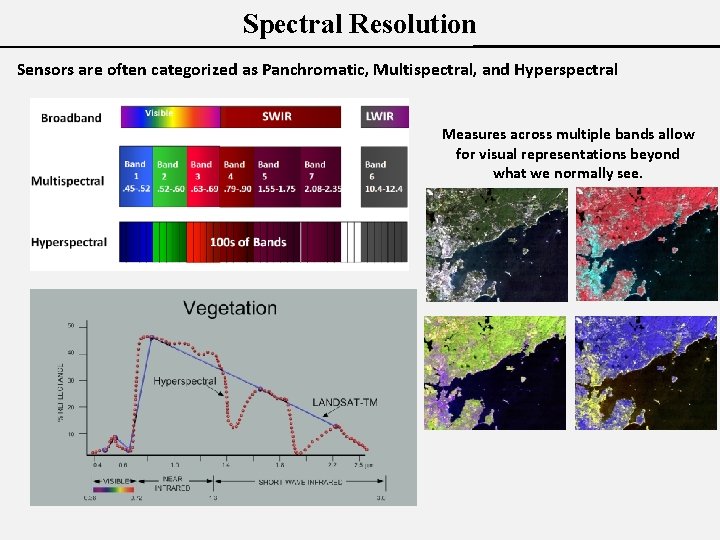
Spectral Resolution Spectral resolution describes the specific wavelengths that the sensor can record within the electromagnetic spectrum. Sensors are often categorized as Panchromatic, Multispectral, and Hyperspectral (Radar, Microwave, LIDAR)
Spectral Resolution Sensors are often categorized as Panchromatic, Multispectral, and Hyperspectral Measures across multiple bands allow for visual representations beyond what we normally see.
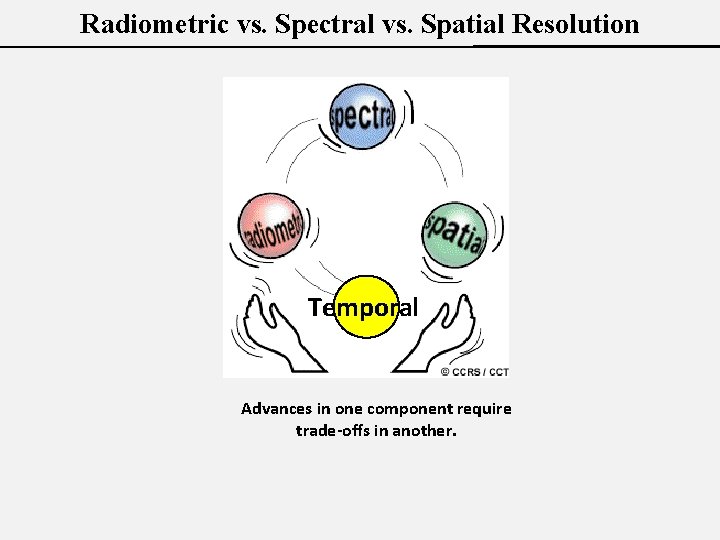
Radiometric vs. Spectral vs. Spatial Resolution Temporal Advances in one component require trade-offs in another.
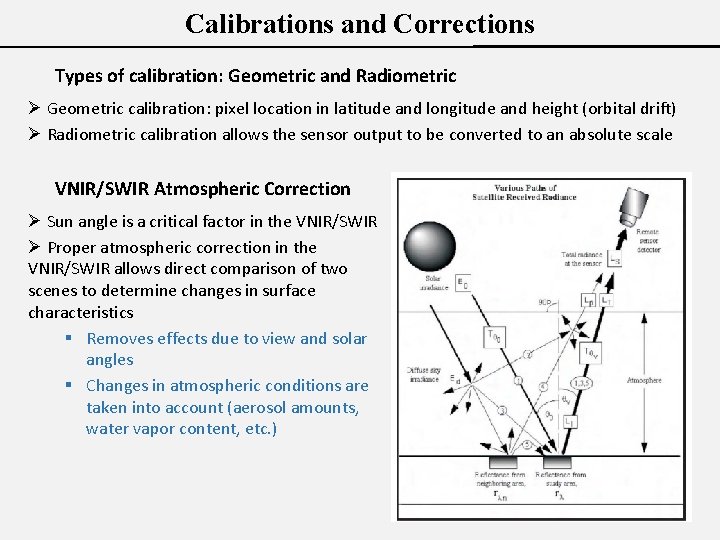
Calibrations and Corrections Types of calibration: Geometric and Radiometric Ø Geometric calibration: pixel location in latitude and longitude and height (orbital drift) Ø Radiometric calibration allows the sensor output to be converted to an absolute scale VNIR/SWIR Atmospheric Correction Ø Sun angle is a critical factor in the VNIR/SWIR Ø Proper atmospheric correction in the VNIR/SWIR allows direct comparison of two scenes to determine changes in surface characteristics § Removes effects due to view and solar angles § Changes in atmospheric conditions are taken into account (aerosol amounts, water vapor content, etc. )
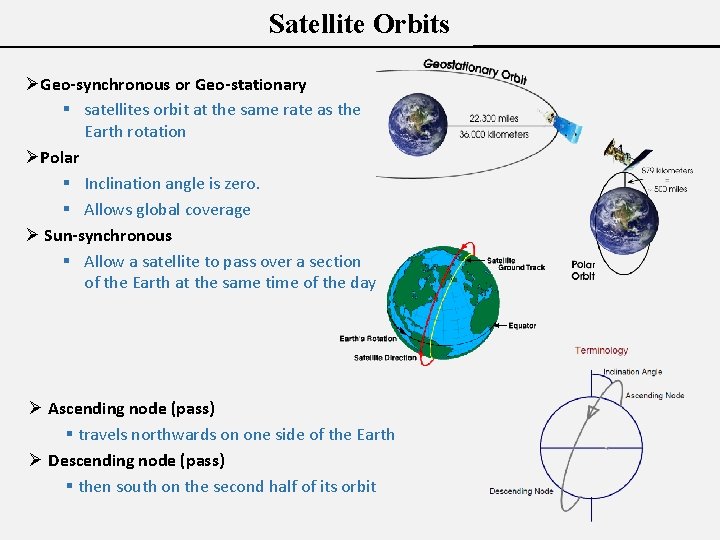
Satellite Orbits ØGeo-synchronous or Geo-stationary § satellites orbit at the same rate as the Earth rotation ØPolar § Inclination angle is zero. § Allows global coverage Ø Sun-synchronous § Allow a satellite to pass over a section of the Earth at the same time of the day Ø Ascending node (pass) § travels northwards on one side of the Earth Ø Descending node (pass) § then south on the second half of its orbit
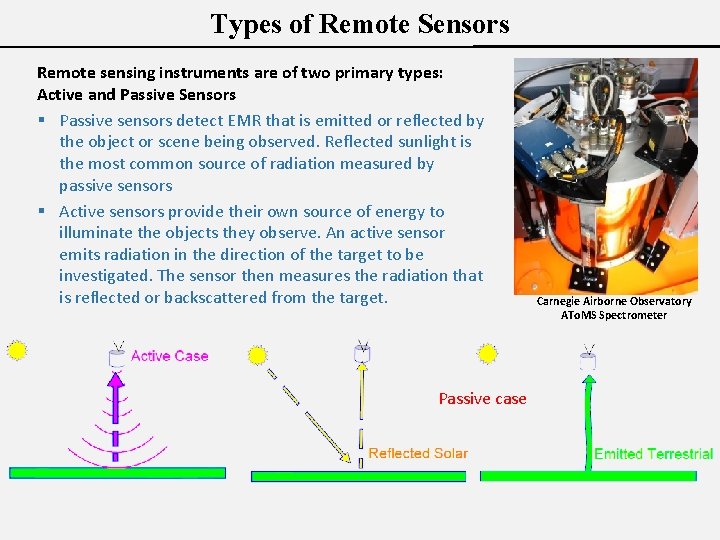
Types of Remote Sensors Remote sensing instruments are of two primary types: Active and Passive Sensors § Passive sensors detect EMR that is emitted or reflected by the object or scene being observed. Reflected sunlight is the most common source of radiation measured by passive sensors § Active sensors provide their own source of energy to illuminate the objects they observe. An active sensor emits radiation in the direction of the target to be investigated. The sensor then measures the radiation that is reflected or backscattered from the target. Passive case Carnegie Airborne Observatory ATo. MS Spectrometer
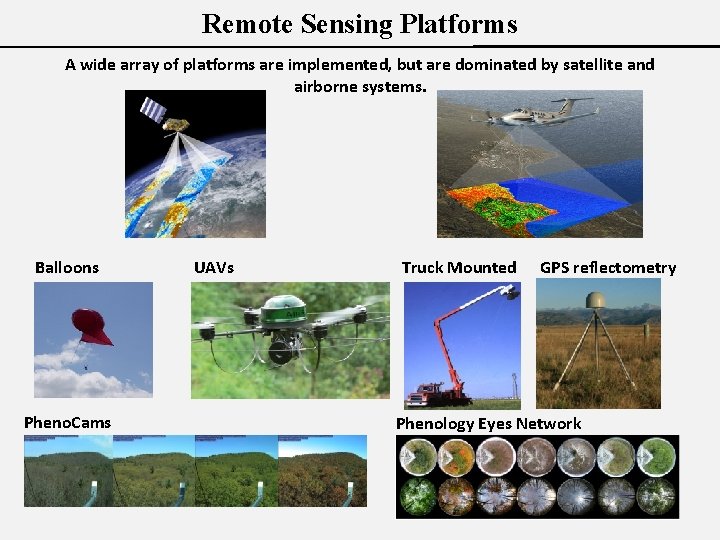
Remote Sensing Platforms A wide array of platforms are implemented, but are dominated by satellite and airborne systems. Balloons Pheno. Cams UAVs Truck Mounted GPS reflectometry Phenology Eyes Network
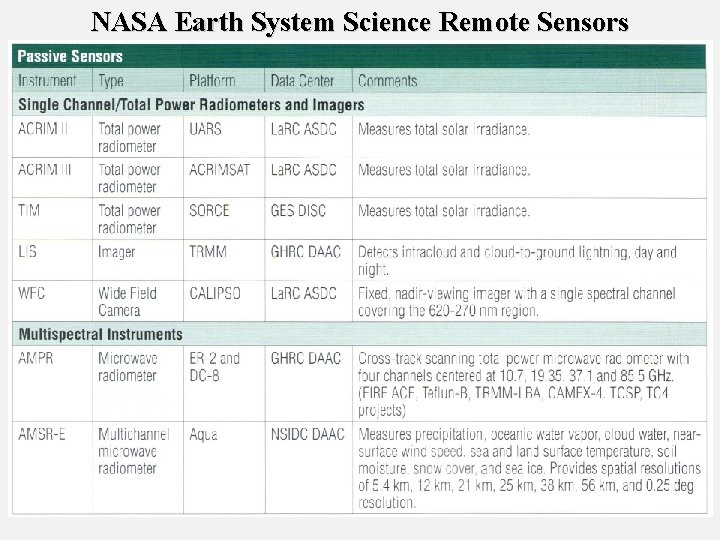
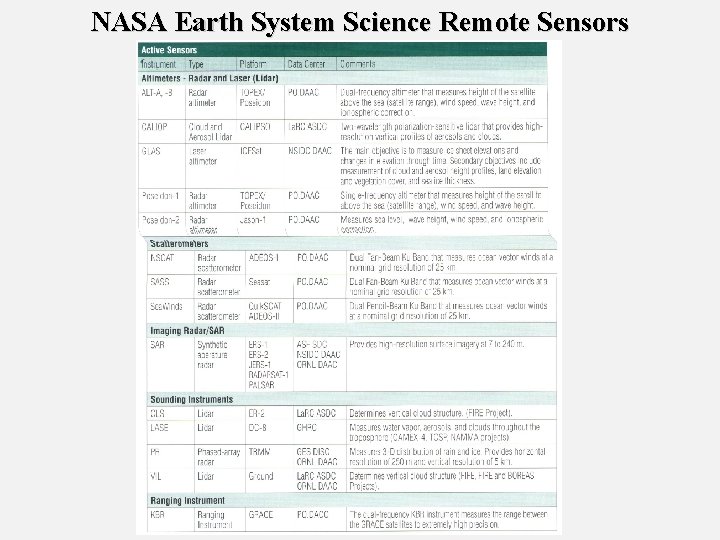
NASA Earth System Science Remote Sensors
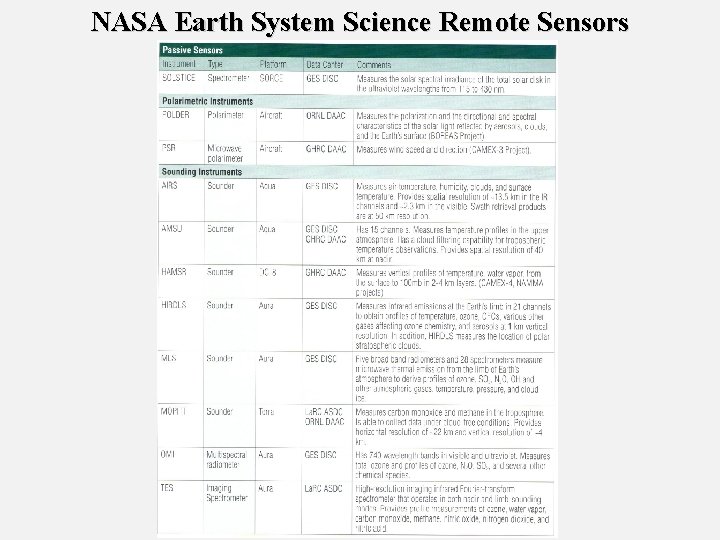
NASA Earth System Science Remote Sensors
NASA Earth System Science Remote Sensors
NASA Earth System Science Remote Sensors
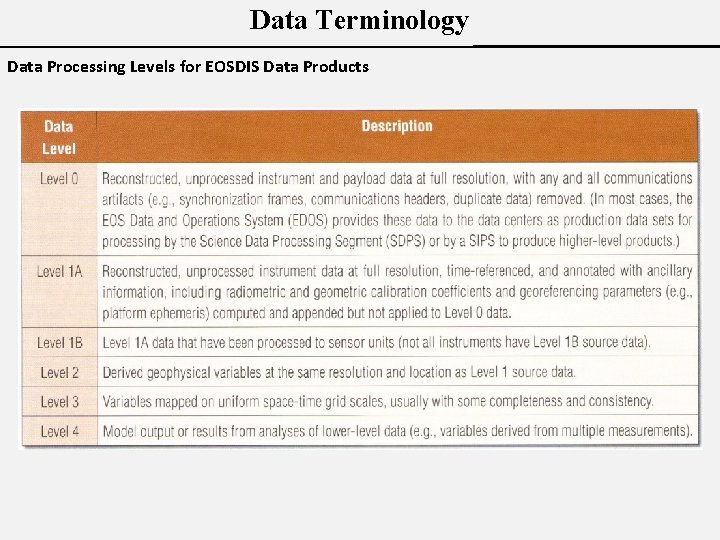
Data Terminology Data Processing Levels for EOSDIS Data Products
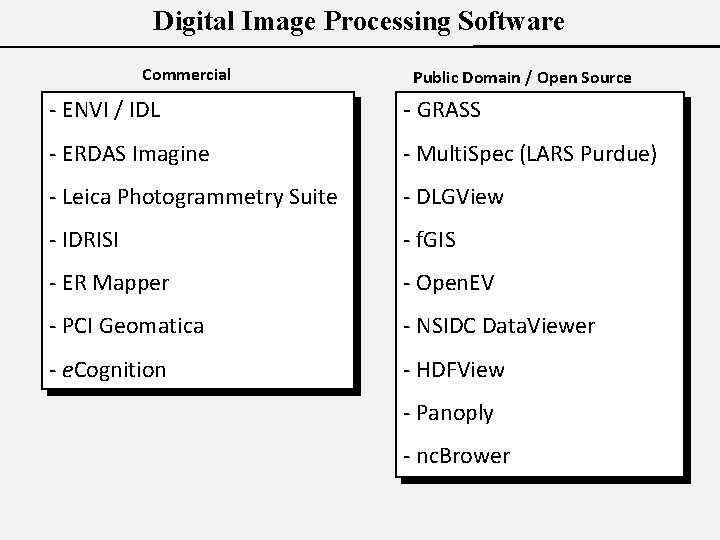
Digital Image Processing Software Commercial Public Domain / Open Source - ENVI / IDL - GRASS - ERDAS Imagine - Multi. Spec (LARS Purdue) - Leica Photogrammetry Suite - DLGView - IDRISI - f. GIS - ER Mapper - Open. EV - PCI Geomatica - NSIDC Data. Viewer - e. Cognition - HDFView - Panoply - nc. Brower
Data Formats § HDF: The Hierarchical Data Format (HDF 4 and HDF 5) § net. CDF: The network Common Data Format § ASCII: An American Standard Code for Information Interchange text file § Binary: Only computer readable format § TIFF: Tagged Image File Format. Raster format. § Geo. Tiff: TIFF having geographic data (. tfw file) § JPEG: File formatted using JPEG are not geolocated Dealing with the wide array of data formats can be overwhelming – don’t let it keep you from applying these valuable data sources to your research!
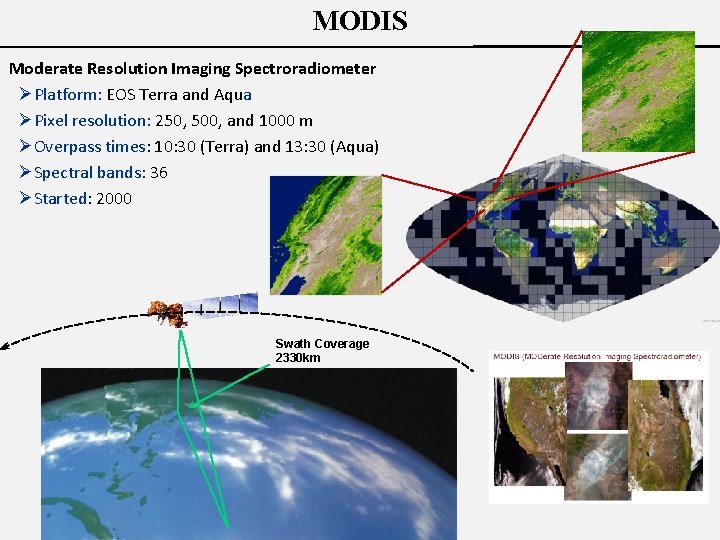
MODIS Moderate Resolution Imaging Spectroradiometer ØPlatform: EOS Terra and Aqua ØPixel resolution: 250, 500, and 1000 m ØOverpass times: 10: 30 (Terra) and 13: 30 (Aqua) ØSpectral bands: 36 ØStarted: 2000 Swath Coverage 2330 km
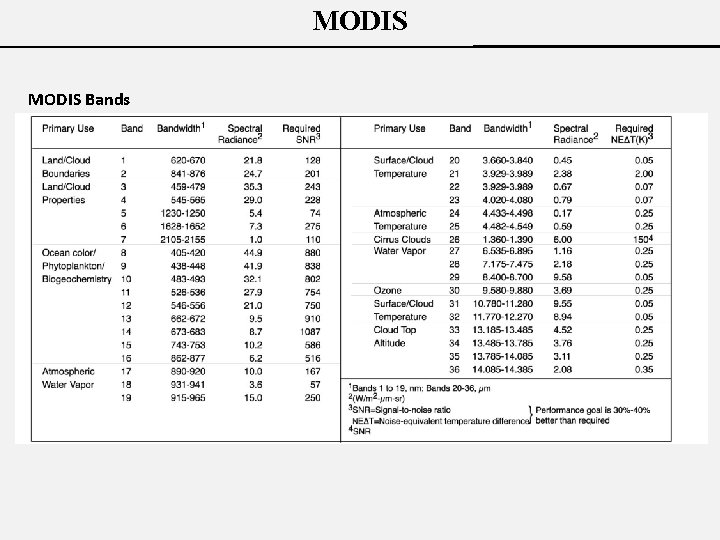
MODIS Bands
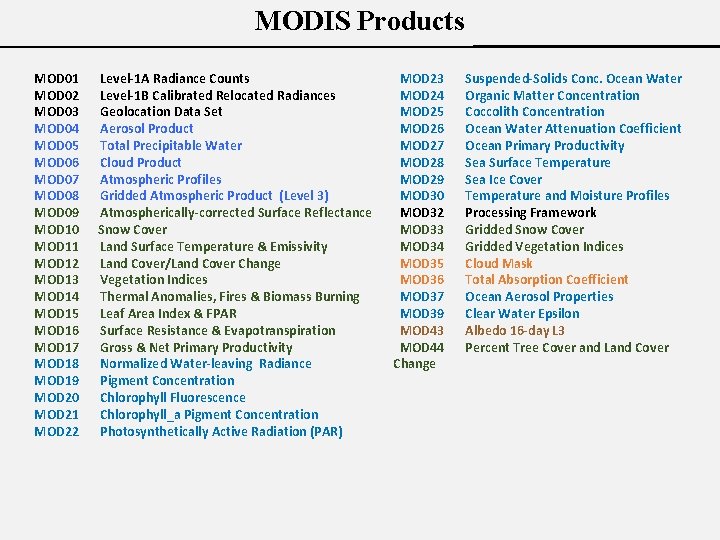
MODIS Products MOD 01 MOD 02 MOD 03 MOD 04 MOD 05 MOD 06 MOD 07 MOD 08 MOD 09 MOD 10 MOD 11 MOD 12 MOD 13 MOD 14 MOD 15 MOD 16 MOD 17 MOD 18 MOD 19 MOD 20 MOD 21 MOD 22 Level-1 A Radiance Counts Level-1 B Calibrated Relocated Radiances Geolocation Data Set Aerosol Product Total Precipitable Water Cloud Product Atmospheric Profiles Gridded Atmospheric Product (Level 3) Atmospherically-corrected Surface Reflectance Snow Cover Land Surface Temperature & Emissivity Land Cover/Land Cover Change Vegetation Indices Thermal Anomalies, Fires & Biomass Burning Leaf Area Index & FPAR Surface Resistance & Evapotranspiration Gross & Net Primary Productivity Normalized Water-leaving Radiance Pigment Concentration Chlorophyll Fluorescence Chlorophyll_a Pigment Concentration Photosynthetically Active Radiation (PAR) MOD 23 MOD 24 MOD 25 MOD 26 MOD 27 MOD 28 MOD 29 MOD 30 MOD 32 MOD 33 MOD 34 MOD 35 MOD 36 MOD 37 MOD 39 MOD 43 MOD 44 Change Suspended-Solids Conc. Ocean Water Organic Matter Concentration Coccolith Concentration Ocean Water Attenuation Coefficient Ocean Primary Productivity Sea Surface Temperature Sea Ice Cover Temperature and Moisture Profiles Processing Framework Gridded Snow Cover Gridded Vegetation Indices Cloud Mask Total Absorption Coefficient Ocean Aerosol Properties Clear Water Epsilon Albedo 16 -day L 3 Percent Tree Cover and Land Cover
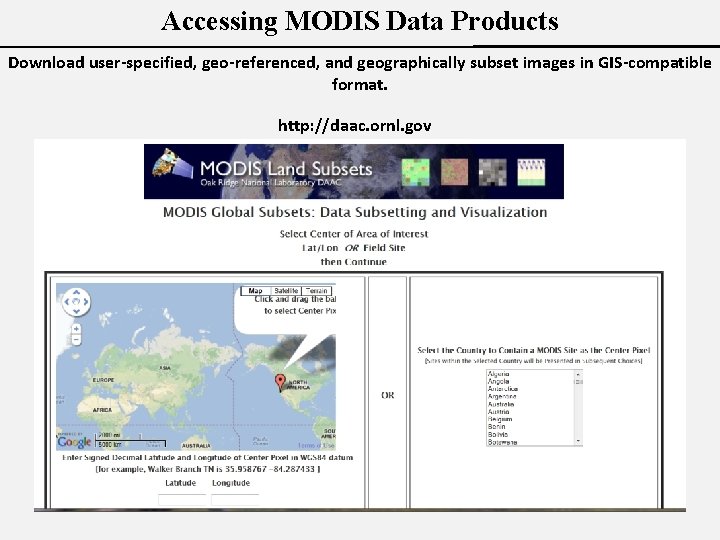
Accessing MODIS Data Products Download user-specified, geo-referenced, and geographically subset images in GIS-compatible format. http: //daac. ornl. gov
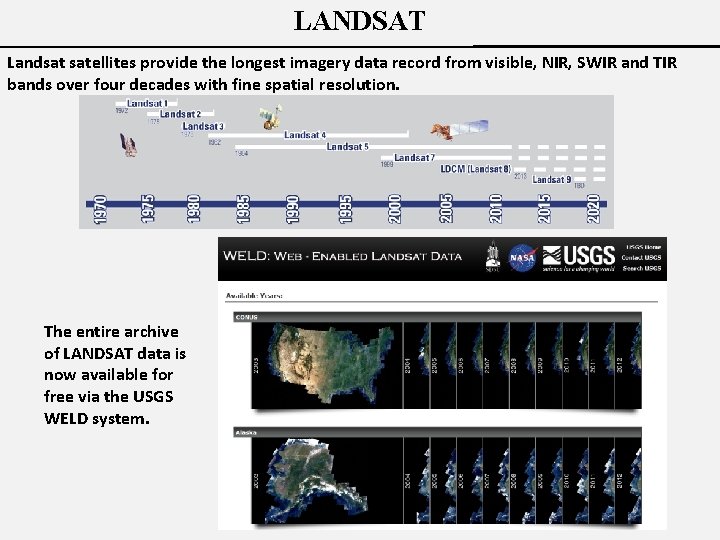
LANDSAT Landsat satellites provide the longest imagery data record from visible, NIR, SWIR and TIR bands over four decades with fine spatial resolution. The entire archive of LANDSAT data is now available for free via the USGS WELD system.
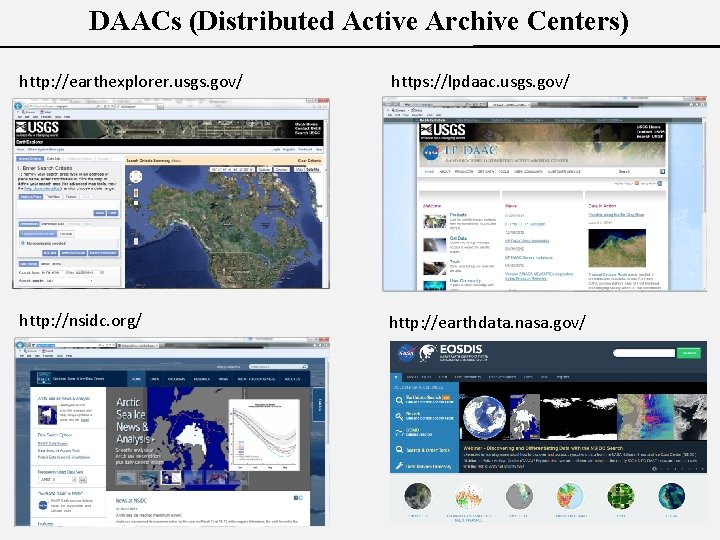
DAACs (Distributed Active Archive Centers) http: //earthexplorer. usgs. gov/ https: //lpdaac. usgs. gov/ http: //nsidc. org/ http: //earthdata. nasa. gov/
Remote Sensing Web References • Federation of American Scientists http: //www. fas. org/irp/imint/docs/rst/Front/tofc. html • CRISP http: //www. crisp. nus. edu. sg/~research/tutorial/rsmain. htm • "Fundamentals of Remote Sensing Tutorial Notes: " http: //www. nrcan. gc. ca/earth-sciences/geography-boundary/remotesensing/fundamentals/1430 • NOAA Center for Satellite Applications and Research http: //www. orbit. nesdis. noaa. gov/star/index. html • NASA Earth Observatory http: //earthobservatory. nasa. gov • Science @ NASA http: //science. hq. nasa. gov/