
Remote sensing of air quality pollutants How new
- Slides: 12
Remote sensing of air quality pollutants: How new datasets can help improve air quality models and methods used in support of regulatory development and health impact studies Canadian TEMPO Workshop November 13 -14, 2013 Dorval, Québec Didier Davignon Air Quality Modelling Applications Section
Outline • AQ scenarios – Who’s involved – How it works – How is this different from AQ forecast? • Current challenges – Can new datasets help? • Other key questions – Page 2 –
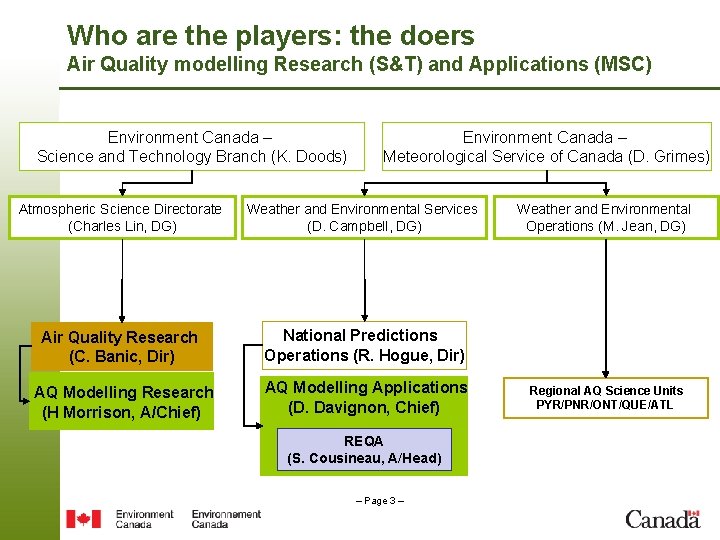
Who are the players: the doers Air Quality modelling Research (S&T) and Applications (MSC) Environment Canada – Science and Technology Branch (K. Doods) Environment Canada – Meteorological Service of Canada (D. Grimes) Atmospheric Science Directorate (Charles Lin, DG) Weather and Environmental Services (D. Campbell, DG) Air Quality Research (C. Banic, Dir) National Predictions Operations (R. Hogue, Dir) AQ Modelling Research (H Morrison, A/Chief) AQ Modelling Applications (D. Davignon, Chief) REQA (S. Cousineau, A/Head) – Page 3 – Weather and Environmental Operations (M. Jean, DG) Regional AQ Science Units PYR/PNR/ONT/QUE/ATL
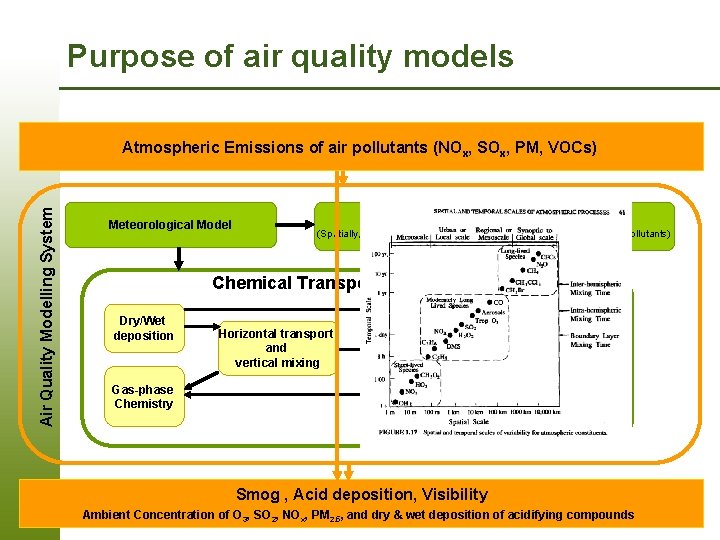
Purpose of air quality models Air Quality Modelling System Atmospheric Emissions of air pollutants (NOx, SOx, PM, VOCs) Meteorological Model Emission Processor (Spatially, temporally and chemically distributed primary emissions of pollutants) Chemical Transport Model Dry/Wet deposition Gas-phase Chemistry Aerosol Module Horizontal transport and vertical mixing Aerosol dynamics Aqueous Phase chemistry Heterogeneous phase chemistry Smog , Acid deposition, Visibility – Page 4 – Ambient Concentration of O 3, SO 2, NOx, PM 2. 5, and dry & wet deposition of acidifying compounds
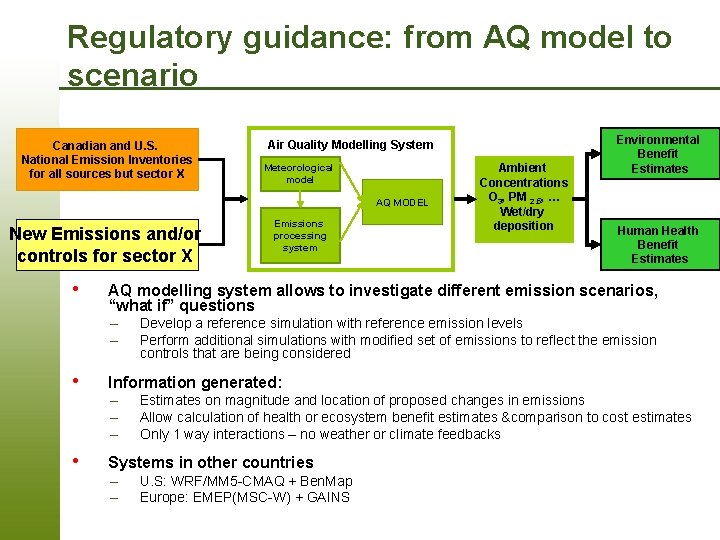
Regulatory guidance: from AQ model to scenario Canadian and U. S. National Emission Inventories for all sources but sector X Air Quality Modelling System Meteorological model AQ MODEL New Emissions and/or controls for sector X • • Human Health Benefit Estimates AQ modelling system allows to investigate different emission scenarios, “what if” questions – – • Emissions processing system Ambient Concentrations O 3, PM 2. 5, … Wet/dry deposition Environmental Benefit Estimates Develop a reference simulation with reference emission levels Perform additional simulations with modified set of emissions to reflect the emission controls that are being considered Information generated: – – – Estimates on magnitude and location of proposed changes in emissions Allow calculation of health or ecosystem benefit estimates &comparison to cost estimates Only 1 way interactions – no weather or climate feedbacks Systems in other countries – – U. S: WRF/MM 5 -CMAQ + Ben. Map Europe: EMEP(MSC-W) + GAINS – Page 5 –
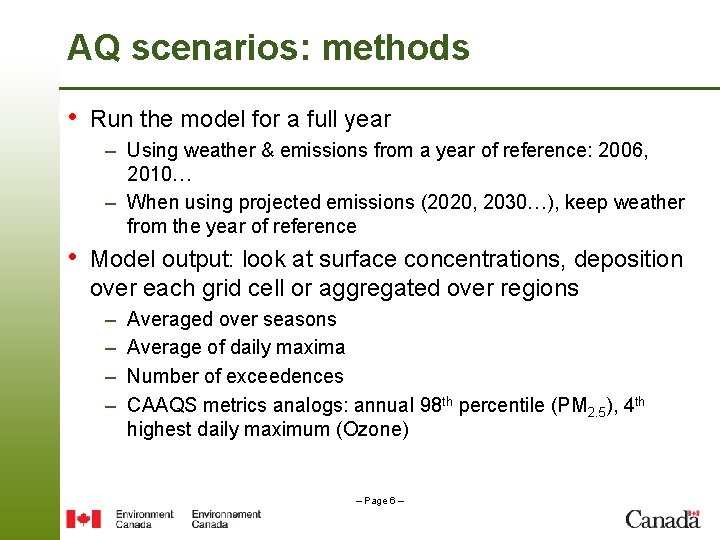
AQ scenarios: methods • Run the model for a full year – Using weather & emissions from a year of reference: 2006, 2010… – When using projected emissions (2020, 2030…), keep weather from the year of reference • Model output: look at surface concentrations, deposition over each grid cell or aggregated over regions – – Averaged over seasons Average of daily maxima Number of exceedences CAAQS metrics analogs: annual 98 th percentile (PM 2. 5), 4 th highest daily maximum (Ozone) – Page 6 –
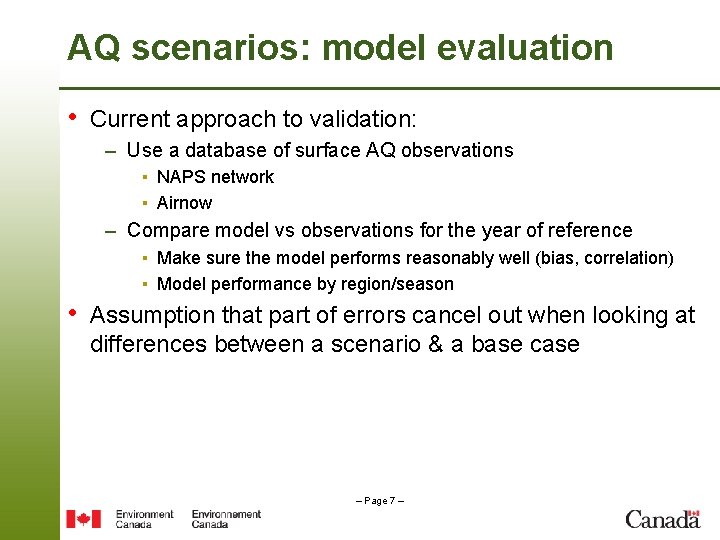
AQ scenarios: model evaluation • Current approach to validation: – Use a database of surface AQ observations ▪ NAPS network ▪ Airnow – Compare model vs observations for the year of reference ▪ Make sure the model performs reasonably well (bias, correlation) ▪ Model performance by region/season • Assumption that part of errors cancel out when looking at differences between a scenario & a base case – Page 7 –
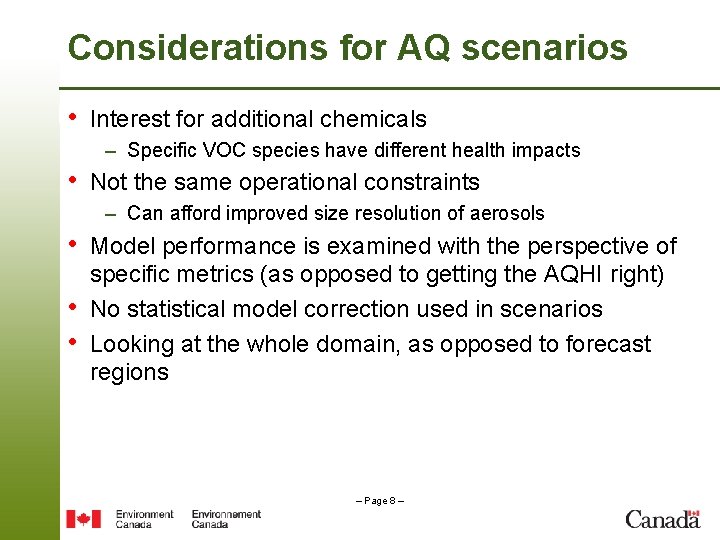
Considerations for AQ scenarios • Interest for additional chemicals – Specific VOC species have different health impacts • Not the same operational constraints – Can afford improved size resolution of aerosols • Model performance is examined with the perspective of • • specific metrics (as opposed to getting the AQHI right) No statistical model correction used in scenarios Looking at the whole domain, as opposed to forecast regions – Page 8 –
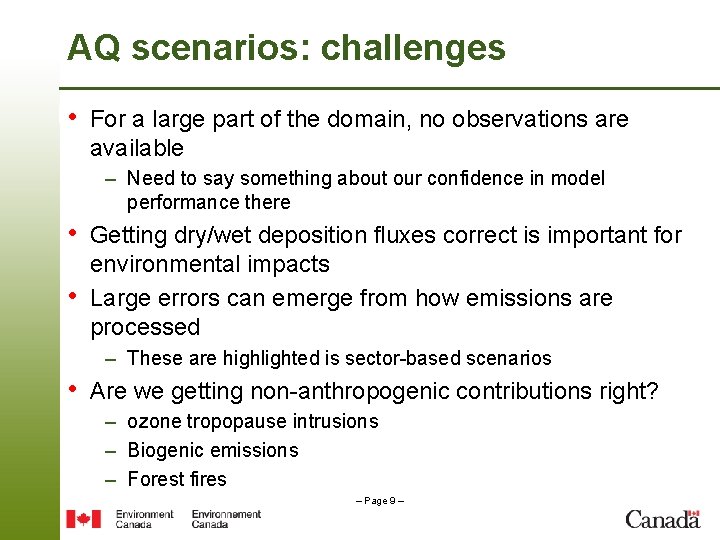
AQ scenarios: challenges • For a large part of the domain, no observations are available – Need to say something about our confidence in model performance there • Getting dry/wet deposition fluxes correct is important for • environmental impacts Large errors can emerge from how emissions are processed – These are highlighted is sector-based scenarios • Are we getting non-anthropogenic contributions right? – ozone tropopause intrusions – Biogenic emissions – Forest fires – Page 9 –
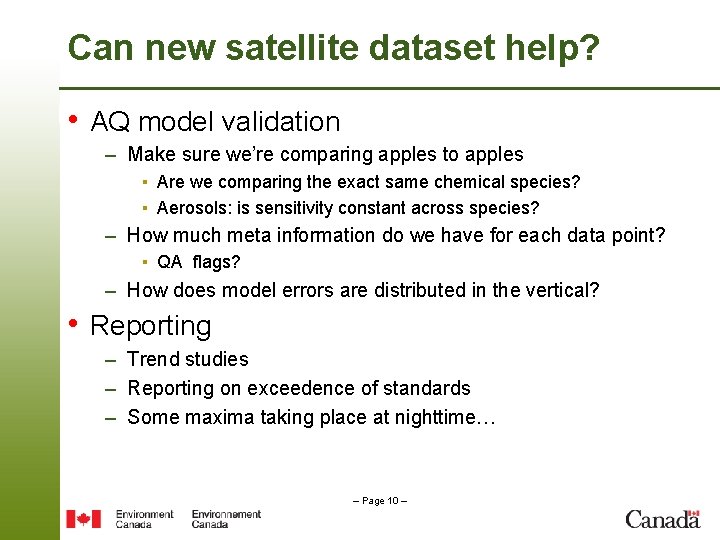
Can new satellite dataset help? • AQ model validation – Make sure we’re comparing apples to apples ▪ Are we comparing the exact same chemical species? ▪ Aerosols: is sensitivity constant across species? – How much meta information do we have for each data point? ▪ QA flags? – How does model errors are distributed in the vertical? • Reporting – Trend studies – Reporting on exceedence of standards – Some maxima taking place at nighttime… – Page 10 –
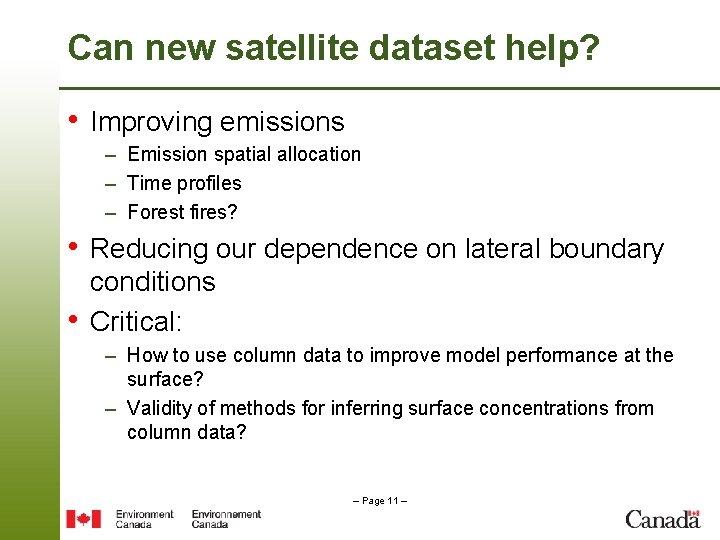
Can new satellite dataset help? • Improving emissions – Emission spatial allocation – Time profiles – Forest fires? • Reducing our dependence on lateral boundary • conditions Critical: – How to use column data to improve model performance at the surface? – Validity of methods for inferring surface concentrations from column data? – Page 11 –
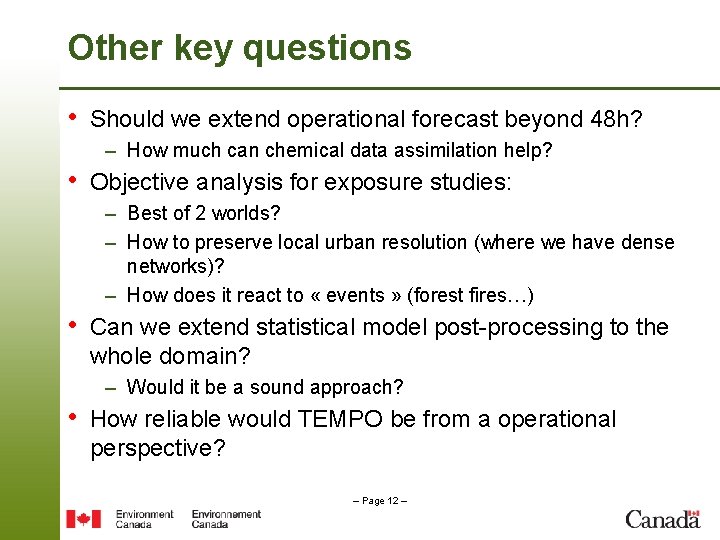
Other key questions • Should we extend operational forecast beyond 48 h? – How much can chemical data assimilation help? • Objective analysis for exposure studies: – Best of 2 worlds? – How to preserve local urban resolution (where we have dense networks)? – How does it react to « events » (forest fires…) • Can we extend statistical model post-processing to the whole domain? – Would it be a sound approach? • How reliable would TEMPO be from a operational perspective? – Page 12 –