
Remote Sensing Fundamentals Part II Radiation and Weighting








- Slides: 48
Remote Sensing Fundamentals Part II: Radiation and Weighting Functions Tim Schmit, NOAA/NESDIS ASPB Material from: Paul Menzel UW/CIMSS/AOS and Paolo Antonelli CIMSS Cachoeira Paulista - São Paulo November, 2007 1
Using wavelengths Planck’s Law where Wien's Law c 2/λT B(λ, T) = c 1 / λ 5 / [e -1] (m. W/m 2/ster/cm) λ = wavelengths in cm T = temperature of emitting surface (deg K) c 1 = 1. 191044 x 10 -5 (m. W/m 2/ster/cm-4) c 2 = 1. 438769 (cm deg K) d. B(λmax, T) / dλ = 0 where λ(max) =. 2897/T indicates peak of Planck function curve shifts to shorter wavelengths (greater wavenumbers) with temperature increase. Note B(λmax, T) ~ T 5. Stefan-Boltzmann Law E = B(λ, T) dλ = T 4, where = 5. 67 x 10 -8 W/m 2/deg 4. o states that irradiance of a black body (area under Planck curve) is proportional to T 4. Brightness Temperature c 1 T = c 2 / [λ ln( _____ + 1)] is determined by inverting Planck function 2 λ 5 Bλ
Spectral Distribution of Energy Radiated from Blackbodies at Various Temperatures 3
Temperature Sensitivity of B(λ, T) for typical earth scene temperatures B (λ, T) / B (λ, 273 K) 4μm 6. 7μm 2 10μm 15μm microwave 1 200 250 Temperature (K) 300 4
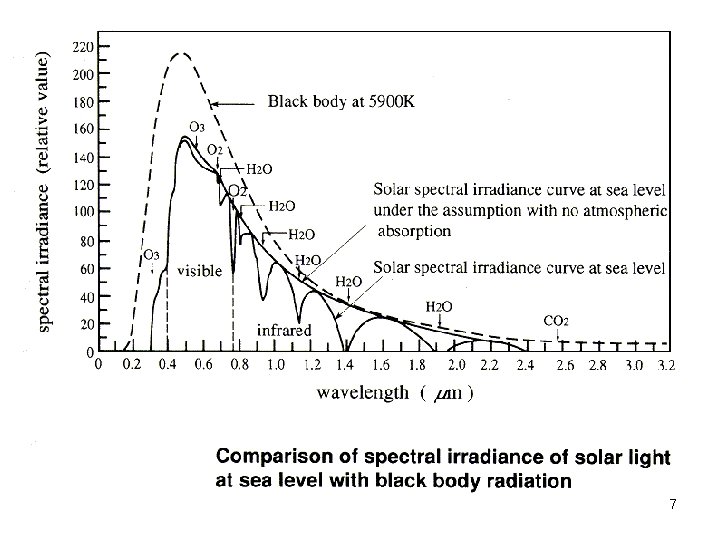
Spectral Characteristics of Energy Sources and Sensing Systems 5
6
7
Black body Spectra Normalized black body spectra representative of the sun (left) and earth (right), plotted on a logarithmic wavelength scale. The ordinate is multiplied by wavelength so that the area under the curves is proportional to irradiance. 8
9
10
11
12
13
14
Emission, Absorption Blackbody radiation B represents the upper limit to the amount of radiation that a real substance may emit at a given temperature for a given wavelength. Emissivity is defined as the fraction of emitted radiation R to Blackbody radiation, = R /B . In a medium at thermal equilibrium, what is absorbed is emitted (what goes in comes out) so a = . Thus, materials which are strong absorbers at a given wavelength are also strong emitters at that wavelength; similarly weak absorbers are weak emitters. 16
Transmittance Transmission through an absorbing medium for a given wavelength is governed by the number of intervening absorbing molecules (path length u) and their absorbing power (k ) at that wavelength. Beer’s law indicates that transmittance decays exponentially with increasing path length - k u (z) (z ) = e where the path length is given by u (z) = dz. z k u is a measure of the cumulative depletion that the beam of radiation has experienced as a result of its passage through the layer and is often called the optical depth . Realizing that the hydrostatic equation implies g dz = - q dp where q is the mixing ratio and is the density of the atmosphere, then p u (p) = q g-1 dp and o - k u (p) (p o ) = e . 17
Energy conservation + a + r = 1 = B (Ts) T + a + r = 1 18
Emission, Absorption, Reflection, and Scattering If a , r , and represent the fractional absorption, reflectance, and transmittance, respectively, then conservation of energy says a + r + = 1 . For a blackbody a = 1, it follows that r = 0 and = 0 for blackbody radiation. Also, for a perfect window = 1, a = 0 and r = 0. For any opaque surface = 0, so radiation is either absorbed or reflected a + r = 1. At any wavelength, strong reflectors are weak absorbers (i. e. , snow at visible wavelengths), and weak reflectors are strong absorbers (i. e. , asphalt at visible wavelengths). 19
Radiative Transfer Equation The radiance leaving the earth-atmosphere system sensed by a satellite borne radiometer is the sum of radiation emissions from the earth-surface and each atmospheric level that are transmitted to the top of the atmosphere. Considering the earth's surface to be a blackbody emitter (emissivity equal to unity), the upwelling radiance intensity, I , for a cloudless atmosphere is given by the expression I = sfc B ( Tsfc) (sfc - top) + layer B ( Tlayer) (layer - top) layers where the first term is the surface contribution and the second term is the atmospheric contribution to the radiance to space. 20
Spectral Characteristics of Atmospheric Transmission and Sensing Systems 21
Relative Effects of Radiative Processes 22
23
Aerosol Size Distribution There are 3 modes : - « nucleation » : radius is between 0. 002 and 0. 05 mm. They result from combustion processes, photo-chemical reactions, etc. - « accumulation » : radius is between 0. 05 mm and 0. 5 mm. Coagulation processes. - « coarse » : larger than 1 mm. From mechanical processes like aeolian erosion. « fine » particles (nucleation and accumulation) result from anthropogenic activities, coarse particles come from natural processes. 0. 01 0. 1 1. 0 10. 0 24
Scattering of early morning sun light from smoke 25
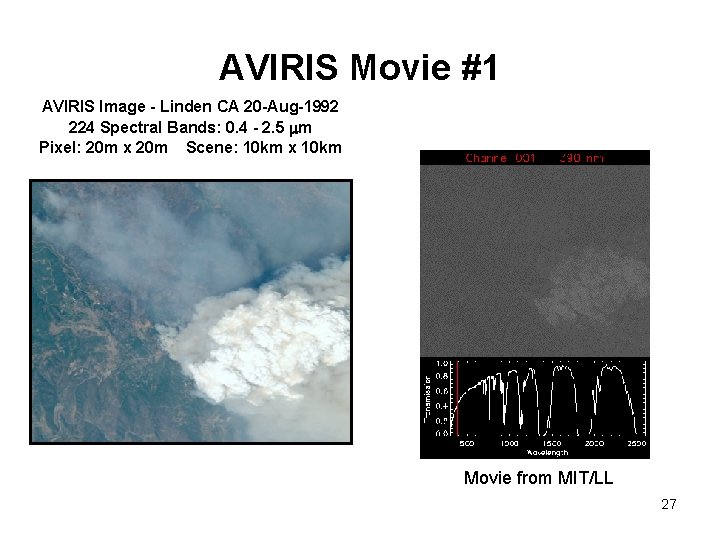
Measurements in the Solar Reflected Spectrum across the region covered by AVIRIS 26
AVIRIS Movie #1 AVIRIS Image - Linden CA 20 -Aug-1992 224 Spectral Bands: 0. 4 - 2. 5 mm Pixel: 20 m x 20 m Scene: 10 km x 10 km Movie from MIT/LL 27
AVIRIS Movie #2 AVIRIS Image - Porto Nacional, Brazil 20 -Aug-1995 224 Spectral Bands: 0. 4 - 2. 5 mm Pixel: 20 m x 20 m Scene: 10 km x 10 km Movie from MIT/LL 28
UV, Visible and Near-IR and Far-IR Far-Infrared (IR) UV, Visible and Near-IR 29
Relevant Material in Applications of Meteorological Satellites CHAPTER 2 - NATURE OF RADIATION 2. 1 Remote Sensing of Radiation 2. 2 Basic Units 2. 3 Definitions of Radiation 2. 5 Related Derivations 2 -1 2 -2 2 -5 CHAPTER 3 - ABSORPTION, EMISSION, REFLECTION, AND SCATTERING 3. 1 Absorption and Emission 3. 2 Conservation of Energy 3. 3 Planetary Albedo 3. 4 Selective Absorption and Emission 3. 7 Summary of Interactions between Radiation and Matter 3. 8 Beer's Law and Schwarzchild's Equation 3. 9 Atmospheric Scattering 3. 10 The Solar Spectrum 3. 11 Composition of the Earth's Atmosphere 3. 12 Atmospheric Absorption and Emission of Solar Radiation 3. 13 Atmospheric Absorption and Emission of Thermal Radiation 3. 14 Atmospheric Absorption Bands in the IR Spectrum 3. 15 Atmospheric Absorption Bands in the Microwave Spectrum 3. 16 Remote Sensing Regions 3 -1 3 -2 3 -6 3 -7 3 -9 3 -11 3 -12 3 -13 3 -14 CHAPTER 5 - THE RADIATIVE TRANSFER EQUATION (RTE) 5. 1 Derivation of RTE 5. 10 Microwave Form of RTE 5 -1 5 -28 30
Radiative Transfer Equation The radiance leaving the earth-atmosphere system sensed by a satellite borne radiometer is the sum of radiation emissions from the earth-surface and each atmospheric level that are transmitted to the top of the atmosphere. Considering the earth's surface to be a blackbody emitter (emissivity equal to unity), the upwelling radiance intensity, I , for a cloudless atmosphere is given by the expression I = sfc B ( Tsfc) (sfc - top) + layer B ( Tlayer) (layer - top) layers where the first term is the surface contribution and the second term is the atmospheric contribution to the radiance to space. 31
Re-emission of Infrared Radiation 32
Radiative Transfer through the Atmosphere 33
Radiative Transfer Equation 34
Rsfc R 1 R 2 top of the atmosphere τ2 = transmittance of upper layer of atm τ1= transmittance of lower layer of atm bb earth surface. Robs = Rsfc τ1 τ2 + R 1 (1 -τ1) τ2 + R 2 (1 - τ2) 35
In standard notation, I = sfc B (T(ps)) (ps) + ( p) B (T(p)) (p) p The emissivity of an infinitesimal layer of the atmosphere at pressure p is equal to the absorptance (one minus the transmittance of the layer). Consequently, ( p) (p) = [1 - ( p)] (p) Since transmittance is an exponential function of depth of absorbing constituent, p+ p p ( p) (p) = exp [ - k q g-1 dp] * exp [ - k q g-1 dp] = (p + p) p o Therefore ( p) (p) = (p) - (p + p) = - (p). So we can write I = sfc B (T(ps)) (ps) - B (T(p)) (p). p which when written in integral form reads ps I = sfc B (T(ps)) (ps) - B (T(p)) [ d (p) / dp ] dp. o 36
When reflection from the earth surface is also considered, the Radiative Transfer Equation for infrared radiation can be written where o I = sfc B (Ts) (ps) + B (T(p)) F (p) [d (p)/ dp] dp ps F (p) = { 1 + (1 - ) [ (ps) / (p)]2 } The first term is the spectral radiance emitted by the surface and attenuated by the atmosphere, often called the boundary term and the second term is the spectral radiance emitted to space by the atmosphere directly or by reflection from the earth surface. The atmospheric contribution is the weighted sum of the Planck radiance contribution from each layer, where the weighting function is [ d (p) / dp ]. This weighting function is an indication of where in the atmosphere the majority of the radiation for a given spectral band comes from. 37
Transmittance for Window Channels + a + r = 1 z z. N close to 1 a close to 0 The molecular species in the atmosphere are not very active: • most of the photons emitted by the surface make it to the Satellite • if a is close to 0 in the atmosphere then is close to 0, not much contribution from the atmospheric layers z 2 z 1 1 38
Trasmittance for Absorption Channels z Absorption Channel: close to 0 a close to 1 z. N One or more molecular species in the atmosphere is/are very active: • most of the photons emitted by the surface will not make it to the Satellite (they will be absorbed) • if a is close to 1 in the atmosphere then is close to 1, most of the observed energy comes from one or more of the uppermost atmospheric layers z 2 z 1 1 39
Earth emitted spectra overlaid on Planck function envelopes O 3 CO 2 H 20 CO 2 40
AIRS – Longwave Movie 41
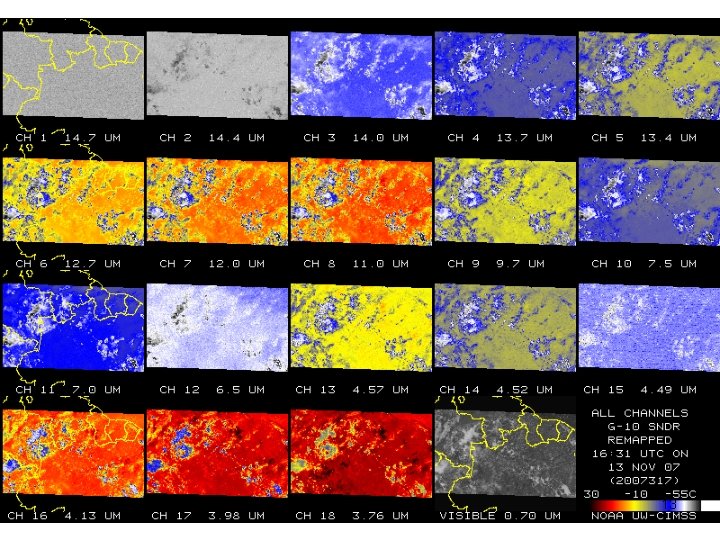
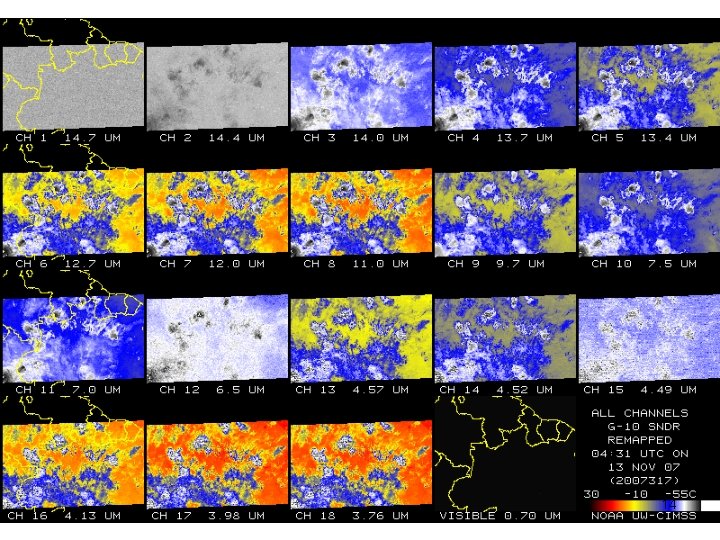
GOES Sounder Weighting Functions Longwave CO 2 14. 7 1 14. 4 2 14. 1 3 13. 9 4 13. 4 5 12. 7 6 12. 0 7 680 696 711 733 748 790 832 Midwave H 2 O & O 3 11. 0 8 907 9. 7 9 1030 7. 4 10 1345 7. 0 11 1425 6. 5 12 1535 CO 2, strat temp CO 2, upper trop temp CO 2, mid trop temp CO 2, lower trop temp H 2 O, lower trop moisture H 2 O, dirty window O 3, strat ozone H 2 O, lower mid trop moisture H 2 O, upper trop moisture 42
Weighting Functions z. N z 2 z 1 1 d /dz 43
CO 2 channels see to different levels in the atmosphere 14. 2 um 13. 9 um 13. 6 um 13. 3 um 45
Low Gain Channels Band 14 low 0. 68 µm Vegetated areas Are visible Saturation over Barren Soil Visible details over water 46
High Gain Channels Band 14 hi 0. 68 µm Saturation over Vegetated areas little barely visible Saturation over Barren Soil Visible details over water 47
H CO O 2 O 32 MODIS absorption bands 48
Conclusion • Radiative Transfer Equation (IR): models the propagation of terrestrial emitted energy through the atmosphere 50
What time of day is this image from? 51