
Remote Rural Mobility Solutions and the Creation of
Remote Rural Mobility Solutions and the Creation of a Rural Transit District Linda K. Cherrington
Sponsored by
Topics for Discussion o o Transit in Texas Rural Transit Services How is Rural Transit Funded? How is Rural Transit Organized?
Transit in Texas o Regional Transit Authorities n n n o County Transit Authority n o Dallas DART Houston METRO San Antonio VIA Austin Capital Metro Fort Worth The T Corpus Christi RTD Denton County Municipal Transit Depts. n n El Paso Sun Metro Laredo El Metro
Transit in Texas o Small Urban Transit n o 30 transit systems Rural Transit n 39 transit providers
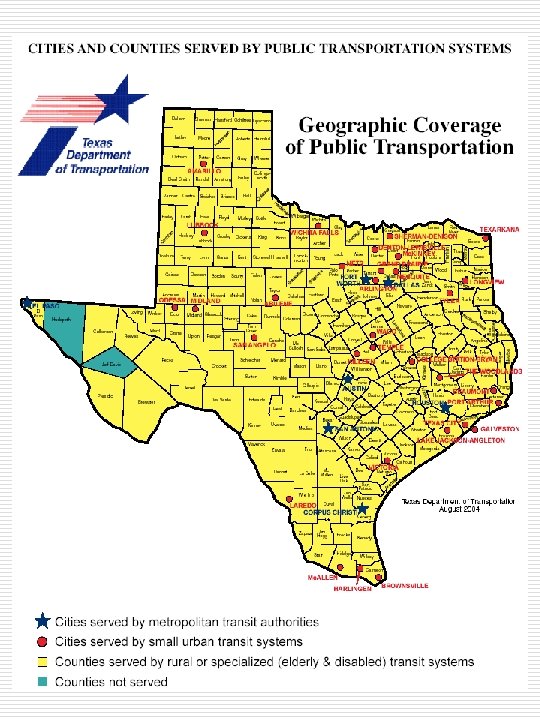
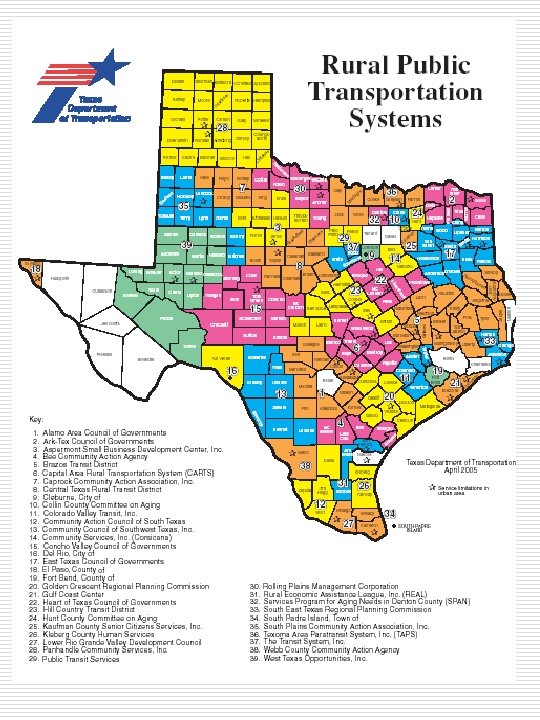
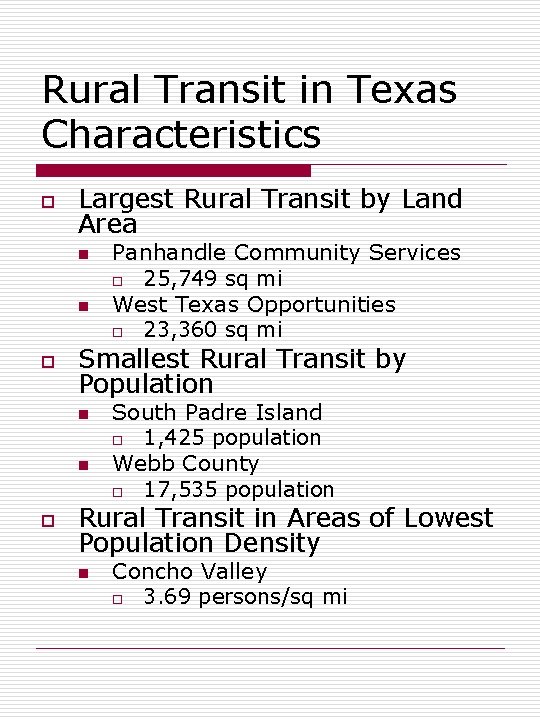
Rural Transit in Texas Characteristics o Largest Rural Transit by Land Area n n o Smallest Rural Transit by Population n n o Panhandle Community Services o 25, 749 sq mi West Texas Opportunities o 23, 360 sq mi South Padre Island o 1, 425 population Webb County o 17, 535 population Rural Transit in Areas of Lowest Population Density n Concho Valley o 3. 69 persons/sq mi
Why Transit in Rural Communities? o Access to Basic Necessities n n n o Improve Quality of Life n n n o Medical Social Services Essential Shopping Personal Business Family Recreation Advance Economic Opportunity n n Jobs Education
Population Served by Rural Transit o o o Seniors Persons with disabilities Persons without limited economic resources Families Persons in remote areas
Rural Transit in West Texas o El Paso County n n n Services in El Paso County outside El Paso Sun Metro Fixed Route General Population Commute services to connect with Sun Metro Area 809 square miles Population 31, 157 in 2000
Rural Transit in West Texas o Permian Basin Rural Transit District n n n n Provider is West Texas Opportunities, Inc. Services in 17 counties Demand-response General population Sub-regional dispatch centers Area 23, 360 square miles Population 166, 056 in 2000
Funding Rural Transit in Texas o o o Federal Section 5311 Funds for Rural Areas State of Texas Public Transportation Funds Local Funds
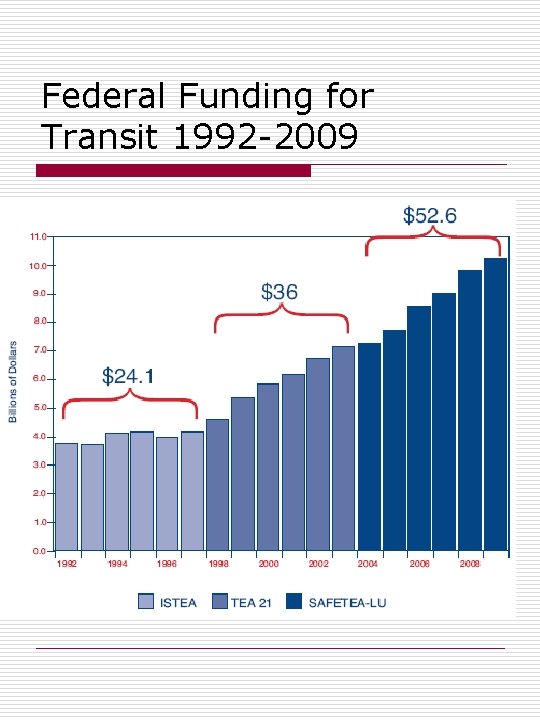
Federal Funding for Transit 1992 -2009
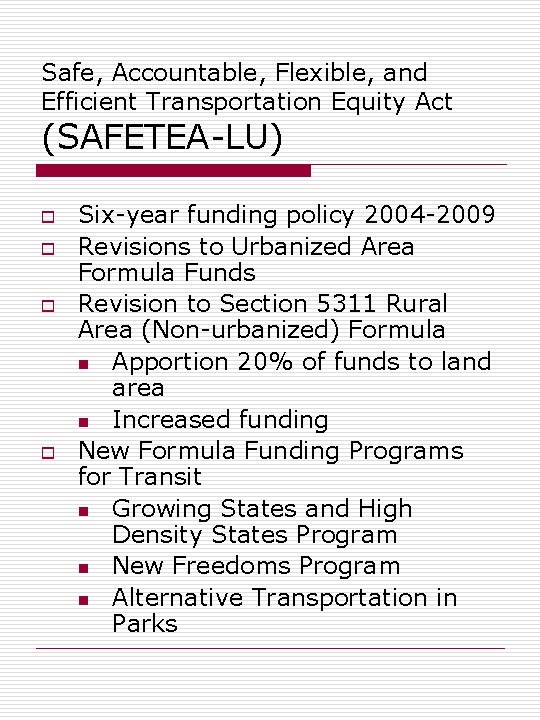
Safe, Accountable, Flexible, and Efficient Transportation Equity Act (SAFETEA-LU) o o Six-year funding policy 2004 -2009 Revisions to Urbanized Area Formula Funds Revision to Section 5311 Rural Area (Non-urbanized) Formula n Apportion 20% of funds to land area n Increased funding New Formula Funding Programs for Transit n Growing States and High Density States Program n New Freedoms Program n Alternative Transportation in Parks
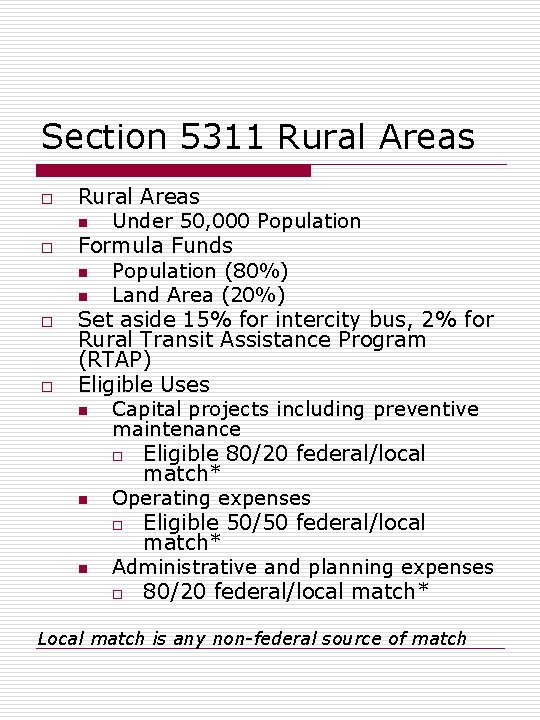
Section 5311 Rural Areas o o Rural Areas n Under 50, 000 Population Formula Funds n Population (80%) n Land Area (20%) Set aside 15% for intercity bus, 2% for Rural Transit Assistance Program (RTAP) Eligible Uses n Capital projects including preventive maintenance o Eligible 80/20 federal/local match* n Operating expenses o Eligible 50/50 federal/local match* n Administrative and planning expenses o 80/20 federal/local match* Local match is any non-federal source of match
Section 5311 Funding Allocation to Rural Areas o o o Federal Funds to the Governor of each State Governor of Texas designates Tx. DOT as responsible state agency Funding formula established by Texas Transportation Commission
Indirect Sources of Federal Funds o o o o o Rural Community Advancement Program Vocational Rehabilitation State Grants Independent Living Programs Medicaid Temporary Assistance for Needy Families Community Services Block Grants Developmental Disabilities Grants Welfare to Work Grants Workforce Investment Act Programs
State of Texas Funding o o Public Transportation Fund Health and Human Service Programs
Public Transportation Fund o State Funds for Public Transportation n n o o Small Urban Areas Rural Areas Subject to Biennium Funding from Texas State Legislature Allocation n n Historical Trend Continued Revised by Legislation 2003
Public Transportation in Texas o Significant Legislation n n o o House Bill 3588 revamped Texas Department of Transportation responsibilities House Bill 2292 revamped organization of health and human services programs Tx. DOT has responsibility for all public transportation funding Administration of programs not consolidated
State Funds for Transit in Texas o o Responsibility delegated by the Legislature to Texas Transportation Commission in 2003 Texas Transportation Commission named Public Transportation Committee (PTAC) to advise on funding formula PTAC recommended goals and objectives for funding transit Includes Rural Federal and State Funding Allocation
PTAC Goal #1 To improve access to public transportation in Texas in a fiscally responsible manner. • Support transit to provide basic mobility for dependent populations in all counties using obtainable resources • Provide incentives for local investment to support public transportation • Encourage service enhancements to support economic opportunity, job access, cleaner air and congestion mitigation by encouraging transit as a mode of choice • Improve awareness of the availability of services to increase the utilization of transit.
PTAC Goal #2 To improve the effectiveness and efficiency of public transportation services. • Recommend state funding formulae that reward efficiency and effectiveness • Recommend changes to current policies that will result in improved efficiency, effectiveness and utilization • Recommend enhancements to processes used to obtain and verify performance data • Recommend programming of capital investments to support managing assets (vehicles, facilities) for enhanced utilization, safety and reliability
PTAC Goal #3 To improve cooperation and coordination of services. • Recommend state funding formulae that reward coordination of services • Support changes to legislative and administrative codes to resolve barriers or remove constraints to the coordination of services • Ensure implementation of the recommendations from the Regional Services Planning (RSP) initiative to coordinate public transportation services
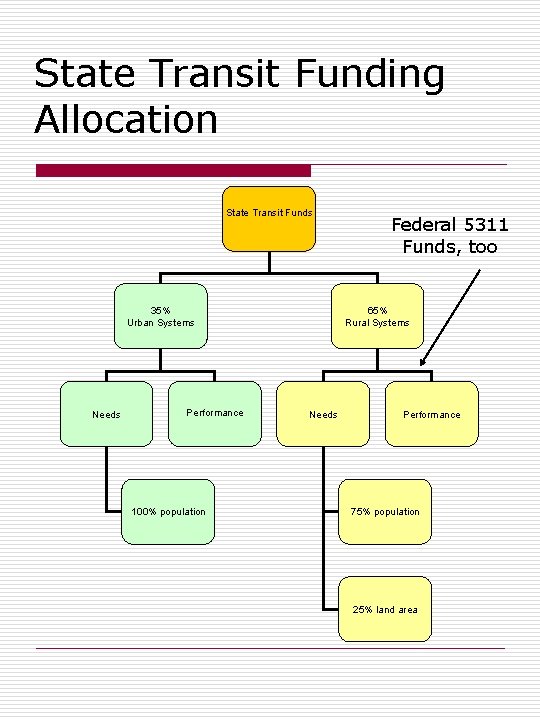
State Transit Funding Allocation State Transit Funds 35% Urban Systems Needs Performance 100% population Federal 5311 Funds, too 65% Rural Systems Needs Performance 75% population 25% land area
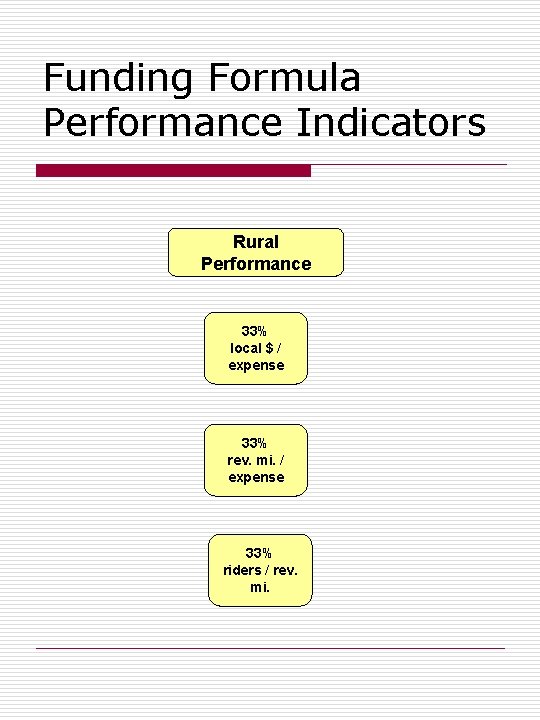
Funding Formula Performance Indicators Rural Performance 33% local $ / expense 33% rev. mi. / expense 33% riders / rev. mi.
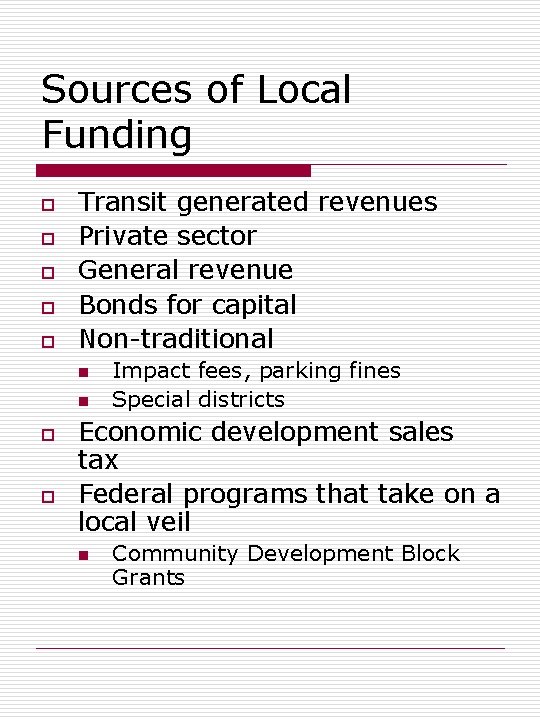
Sources of Local Funding o o o Transit generated revenues Private sector General revenue Bonds for capital Non-traditional n n o o Impact fees, parking fines Special districts Economic development sales tax Federal programs that take on a local veil n Community Development Block Grants
Sources of Local Funding (continued) o Dedicated sales tax n n n o Regional Transit Authorities Municipal Transit Departments County Transportation Authorities Eligible: Funding through Regional Mobility Authorities
Organizing for Rural Transit in Texas o Rural Transit Districts n n n Texas Transportation Code Chapter 458 Political subdivision of the state that provides and coordinates public transportation Eligible to receive funds from State via Tx. DOT Single County or Multicounty New rural transit district Join an existing
Things to Consider o o o Goals for Public Transportation in Your Area Service Plan Provider Local Funding Challenges Opportunities

Questions? o Contact n n Linda Cherrington TTI 409 -740 -4734 L-Cherrington@tamu. edu
- Slides: 32