
Remote Replication Modes of Remote Replication Technologies Sibani
Remote Replication Modes of Remote Replication Technologies Sibani Patra M. Tech. (CSE – DBE) KIIT University
Topics � Introduction � Local Replication � Synchronous Replication � Asynchronous Replication � LVM-Based Replication � Hot-Based Log Shipping � Disk Buffered Replication � Three Site Replication � Data Consistency
What is Replication? �Replication is the process of creating an exact copy of data. Creating one or more replicas of the production data is one of the ways to provide Business Continuity (BC). � Replication can be classified into two major categories: local and remote. �The major advantages of replication is to: � � improve data availability and scalability provide fail safe backup provide load spreading provide disconnected operation (mobile solutions) �Where to apply Replication? � Distributed Systems � Disk Storage � File System
Examples of usage of Replication � Enhance availability of data on different locations by distributing data by providing a mirror � Split workload to different servers by distributing data by providing a mirror � Provide a mirror for disaster recovery � Provide data transformation: change data in a controlled way � Audit or analyze database usage
Remote Replication �Remote replication is the process of creating replicas of information assets at remote sites (locations). � Remote replicas help organizations mitigate the risks associated with regionally driven outages resulting from natural or human-made disasters. �Similar to local replicas, they can also be used for other business operations
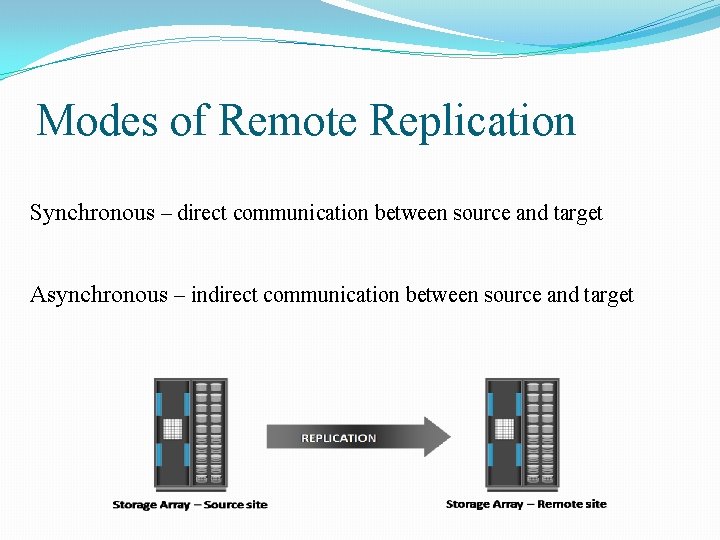
Modes of Remote Replication Synchronous – direct communication between source and target Asynchronous – indirect communication between source and target
Modes of Remote Replication �The infrastructure on which information assets are stored at the primary site is called the source. � The infrastructure on which the replica is stored at the remote site is referred to as the target. � Hosts that access the source or target are referred to as source hosts or target hosts.
Synchronous Replication
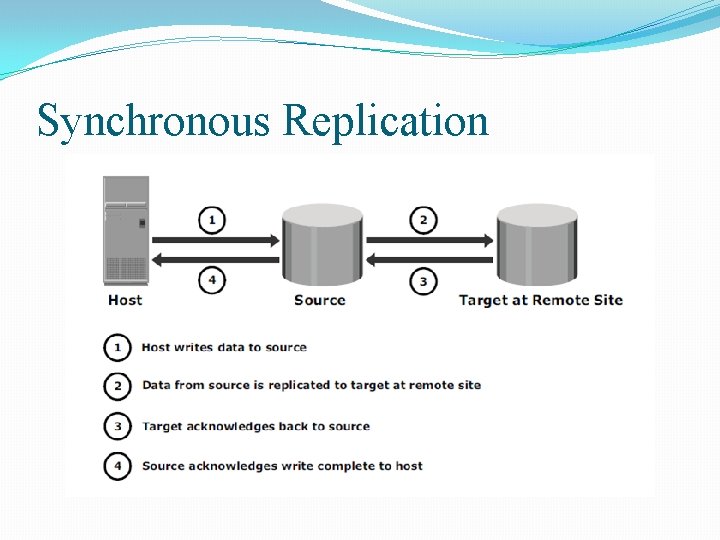
Synchronous Replication Features � A write is committed to both source and remote replica before it is acknowledged to the host. � Ensures source and replica have identical data at all times. � In the event of a failure of the source site, synchronous remote replication provides zero or near-zero RPO, as well as the lowest RTO � Requires bandwidth more than the maximum write workload � Typically deployed for distance less than 200 km (125 miles) between two sites.
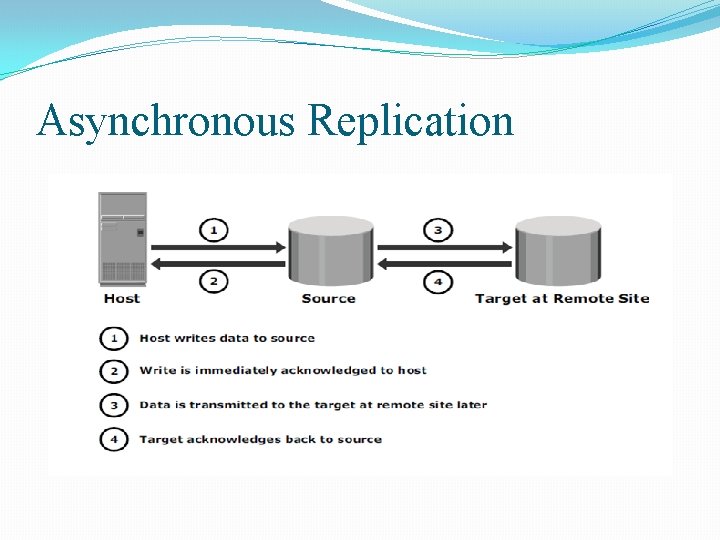
Asynchronous Replication
Asynchronous Replication Features �A write is committed to the source and immediately acknowledged to the host. �Data is buffered at the source and transmitted to the remote site later. �Asynchronous remote replication provides a finite (nonzero) RPO disaster recovery solution. �RPO depends on size of buffer, available network bandwidth and the write workload. �Sufficient buffer capacity should be provisioned. �Can be deployed over long distances.
Asynchronous Replication Features Asynchronous replication systems also makes use of several derived concepts: �Store-and-forward -: means that a message is stored somewhere by the originator, picked up by a message transport system, called a channel, and finally delivered to the receiver. �Send-and-forget - : means that the originator sends a message and then forget about it. �Guarantied-delivery -: means that whenever a message is send to a receiver, the originator can be sure about the fact that the message is actually delivered to the receiver. If not, some kind of notification must be done to let the originator know that deliverance was not possible.

- Slides: 13