
Remote Procedure Call CS4513 Distributed Computing Systems Slides
Remote Procedure Call CS-4513 Distributed Computing Systems (Slides include materials from Operating System Concepts, 7 th ed. , by Silbershatz, Galvin, & Gagne, Distributed Systems: Principles & Paradigms, 2 nd ed. By Tanenbaum and Van Steen, and Modern Operating Systems, 2 nd ed. , by Tanenbaum) CS-4513 D-term 2008 Remote Procedure Call 1
Review Definition — Protocol • Formal set of rules that govern the formats, contents, and meanings of messages from computer to computer, process to process, etc. • Must be agreed to by all parties to a communication • May be defined in terms of other protocols • E. g. , 7 -layer OSI model CS-4513 D-term 2008 Remote Procedure Call 2
Message-oriented Protocols • Many in widespread use • Traditional TCP/IP and Internet protocols • Difficult to design and implement • Especially with more sophisticated applications • Many difficult implementation issues for each new protocol and each platform • • Formatting Uniform representation of data Client-server relationships … CS-4513 D-term 2008 Remote Procedure Call 3
Alphabet Soup of many, many Protocols • TCP, UDP, IP, NCP, SMTP, SNNP, NNTP, FTP, TFTP, POP, IMAP, HTTP, VMRL, … • Appletalk, Netware, … • Remote Procedure Call, NFS, … • CORBA, GLOBE, JINI, … • Network Streaming, … • … CS-4513 D-term 2008 Remote Procedure Call 4
Message-oriented Protocols • Many in widespread use • Traditional TCP/IP and Internet protocols • Difficult to design and implement • Especially with more sophisticated applications • Many difficult implementation issues for each new protocol and each platform • • Formatting Uniform representation of data Client-server relationships … CS-4513 D-term 2008 Remote Procedure Call 5
Problem • How to make sense out of many different kinds of protocols • How to design new protocols for new, more sophisticated applications • How to automate the nitty-gritty of protocol design and testing CS-4513 D-term 2008 Remote Procedure Call 6
Solution — Remote Procedure Call (RPC) • The most common framework for newer protocols and for middleware • Used both by operating systems and by applications – NFS (Network File System) is implemented as a set of RPCs – DCOM, CORBA, Java RMI, etc. , are just RPC systems • Reference – Birrell, Andrew D. , and Nelson, Bruce, “Implementing Remote Procedure Calls, ” ACM Transactions on Computer Systems, vol. 2, #1, February 1984, pp 39 -59. (. pdf) CS-4513 D-term 2008 Remote Procedure Call 7
Remote Procedure Call (RPC) • Fundamental idea: – – Server process exports an interface of procedures or functions that can be called by client programs • similar to library API, class definitions, etc. • Clients make local procedure/function calls – As if directly linked with the server process – Under the covers, procedure/function call is converted into a message exchange with remote server process CS-4513 D-term 2008 Remote Procedure Call 8
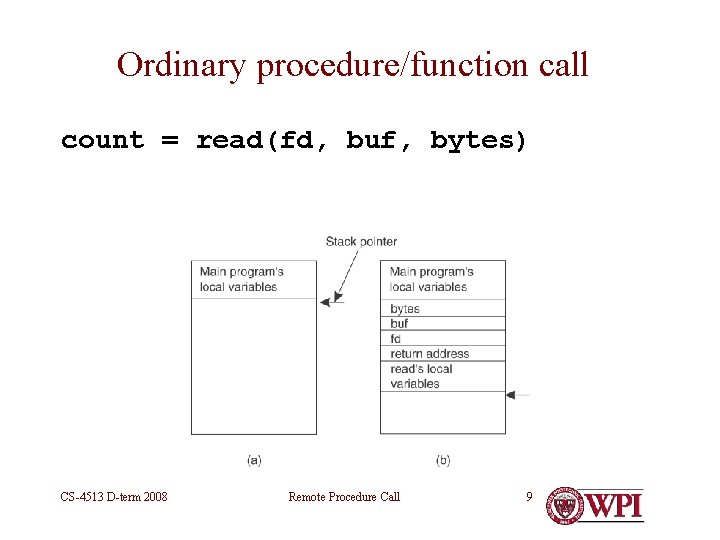
Ordinary procedure/function call count = read(fd, buf, bytes) CS-4513 D-term 2008 Remote Procedure Call 9
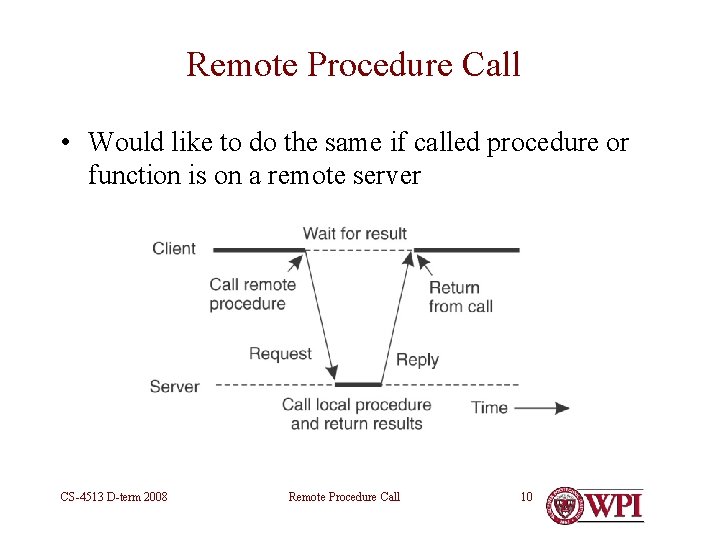
Remote Procedure Call • Would like to do the same if called procedure or function is on a remote server CS-4513 D-term 2008 Remote Procedure Call 10
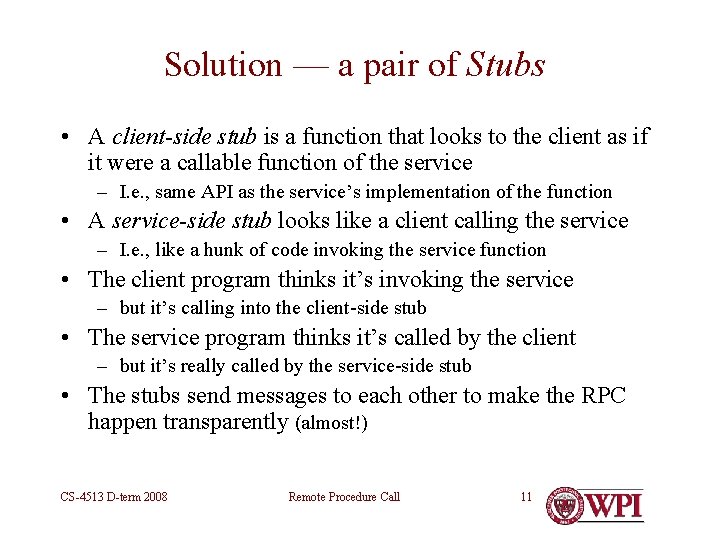
Solution — a pair of Stubs • A client-side stub is a function that looks to the client as if it were a callable function of the service – I. e. , same API as the service’s implementation of the function • A service-side stub looks like a client calling the service – I. e. , like a hunk of code invoking the service function • The client program thinks it’s invoking the service – but it’s calling into the client-side stub • The service program thinks it’s called by the client – but it’s really called by the service-side stub • The stubs send messages to each other to make the RPC happen transparently (almost!) CS-4513 D-term 2008 Remote Procedure Call 11
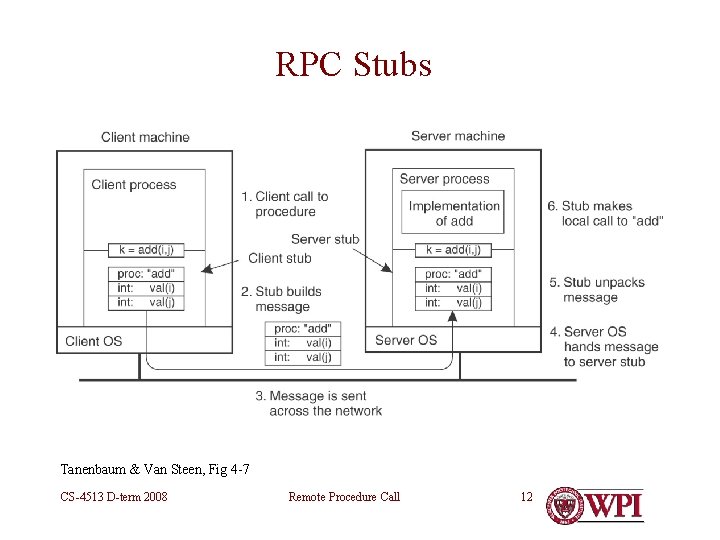
RPC Stubs Tanenbaum & Van Steen, Fig 4 -7 CS-4513 D-term 2008 Remote Procedure Call 12
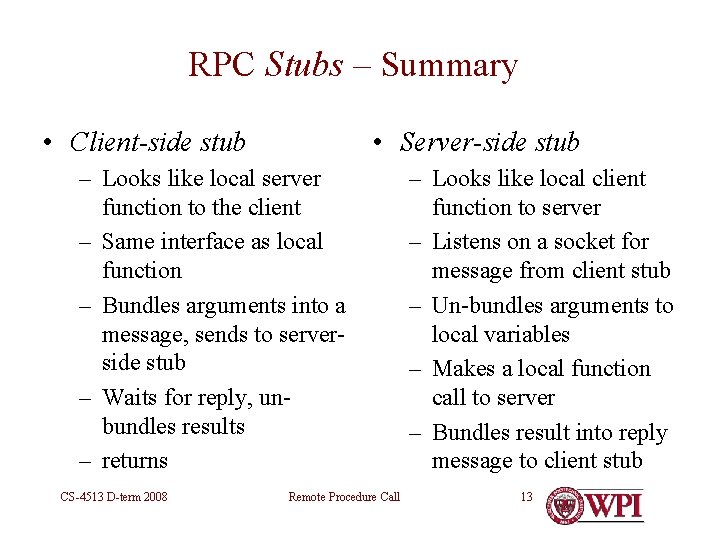
RPC Stubs – Summary • Client-side stub • Server-side stub – Looks like local server function to the client – Same interface as local function – Bundles arguments into a message, sends to serverside stub – Waits for reply, unbundles results – returns CS-4513 D-term 2008 Remote Procedure Call – Looks like local client function to server – Listens on a socket for message from client stub – Un-bundles arguments to local variables – Makes a local function call to server – Bundles result into reply message to client stub 13
Result – a very useful Abstraction • The hard work of building messages, formatting, uniform representation, etc. , is buried in the stubs • Where it can be automated! • Designers of client and server can concentrate on semantics of application • Programs behave in familiar way CS-4513 D-term 2008 Remote Procedure Call 14
RPC – Issues • How to make the “remote” part of RPC invisible to the programmer? • What are semantics of parameter passing? – E. g. , pass by reference? • How to bind (locate & connect) to servers? • How to handle heterogeneity? – OS, language, architecture, … • How to make it go fast? CS-4513 D-term 2008 Remote Procedure Call 15
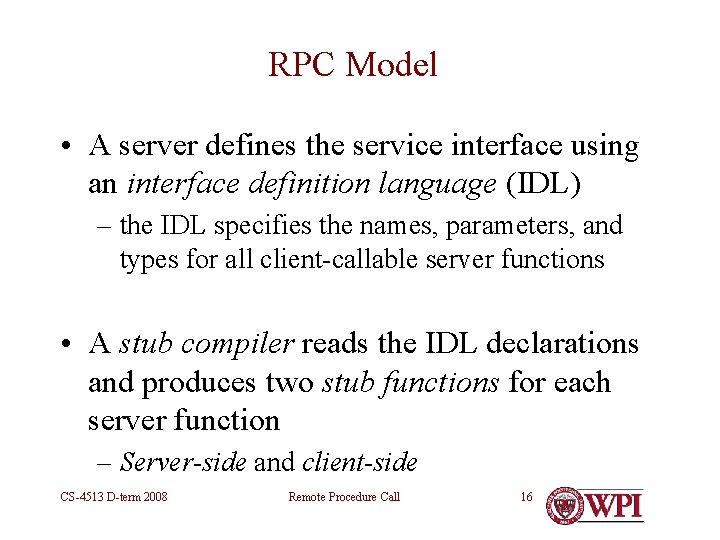
RPC Model • A server defines the service interface using an interface definition language (IDL) – the IDL specifies the names, parameters, and types for all client-callable server functions • A stub compiler reads the IDL declarations and produces two stub functions for each server function – Server-side and client-side CS-4513 D-term 2008 Remote Procedure Call 16
RPC Model (continued) • Linking: – – Server programmer implements the service’s functions and links with the server-side stubs – Client programmer implements the client program and links it with client-side stubs • Operation: – – Stubs manage all of the details of remote communication between client and server CS-4513 D-term 2008 Remote Procedure Call 17
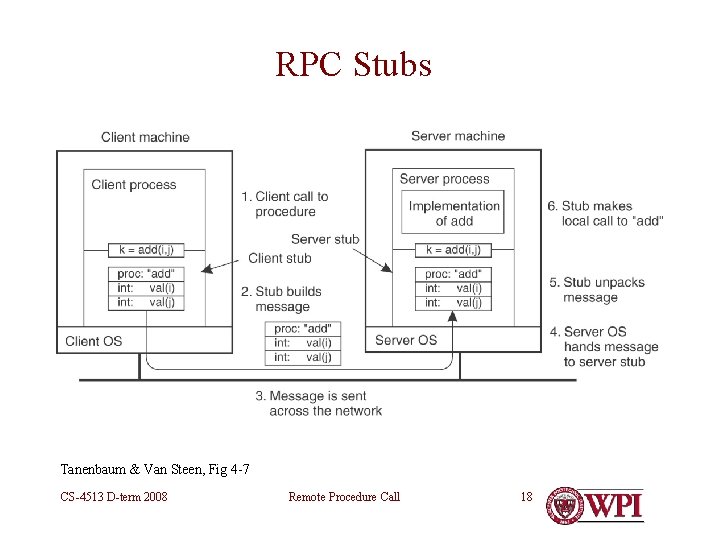
RPC Stubs Tanenbaum & Van Steen, Fig 4 -7 CS-4513 D-term 2008 Remote Procedure Call 18
Marshalling and Unmarshalling Arguments • Marshalling – the packing of function parameters into a message • Unmarshalling – the extraction of parameters from a message • Function call: – – Client stub marshals the arguments into message – Server stub unmarshals the arguments and uses them to invoke the service function • Function return: – – Server stub marshals return values into message – Client stub unmarshals return values and returns them as results to client program CS-4513 D-term 2008 Remote Procedure Call 19
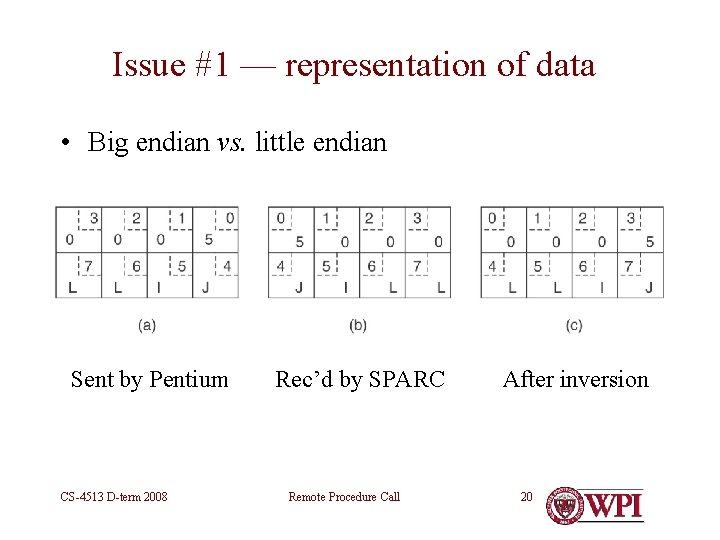
Issue #1 — representation of data • Big endian vs. little endian Sent by Pentium CS-4513 D-term 2008 Rec’d by SPARC Remote Procedure Call After inversion 20
Representation of Data (continued) • IDL must also define representation of data on network – – Multi-byte integers Strings, character codes Floating point, complex, … … • example: Sun’s XDR (e. Xternal Data Representation) • Each stub converts machine representation to/from network representation • Clients and servers must not try to cast data! CS-4513 D-term 2008 Remote Procedure Call 21
Issue #2 — Pointers and References read(int fd, char* buf, int nbytes) • Pointers are only valid within one address space • Cannot be interpreted by another process • Even on same machine! • Pointers and references are ubiquitous in C, C++ • Even in Java implementations! CS-4513 D-term 2008 Remote Procedure Call 22
Pointers and References — Restricted Semantics • Option: call by value – Sending stub dereferences pointer, copies result to message – Receiving stub conjures up a new pointer • Option: call by result – Sending stub provides buffer, called function puts data into it – Receiving stub copies data to caller’s buffer as specified by pointer CS-4513 D-term 2008 Remote Procedure Call 23
Pointers and References — Restricted Semantics (continued) • Option: call by value-result – Caller’s stub copies data to message, then copies result back to client buffer – Server stub keeps data in own buffer, server updates it; server sends data back in reply • Not allowed: – – Call by reference – Aliased arguments CS-4513 D-term 2008 Remote Procedure Call 24
Transport of Remote Procedure Call • Option — TCP • Connection-based, reliable transmission • Useful but heavyweight, less efficient • Necessary if repeating a call produces different result • Alternative — UDP • Unreliable transmission • If message fails to arrive within a reasonable time, caller’s stub simply sends it again • Okay if repeating a call produces same result CS-4513 D-term 2008 Remote Procedure Call 25
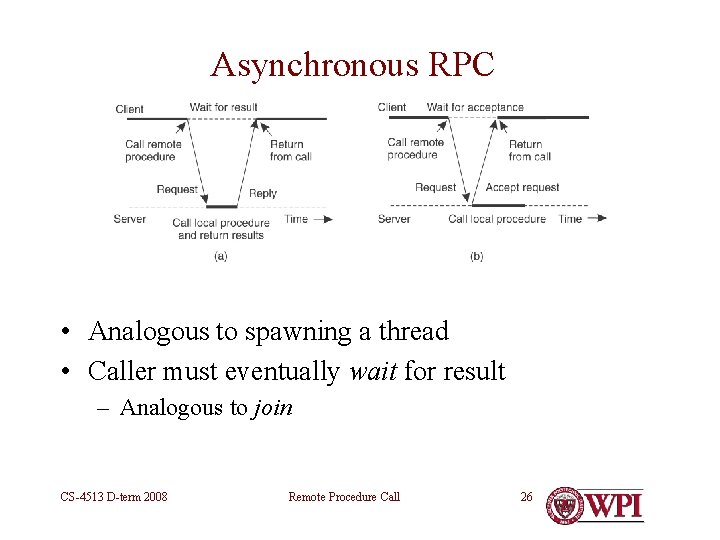
Asynchronous RPC • Analogous to spawning a thread • Caller must eventually wait for result – Analogous to join CS-4513 D-term 2008 Remote Procedure Call 26
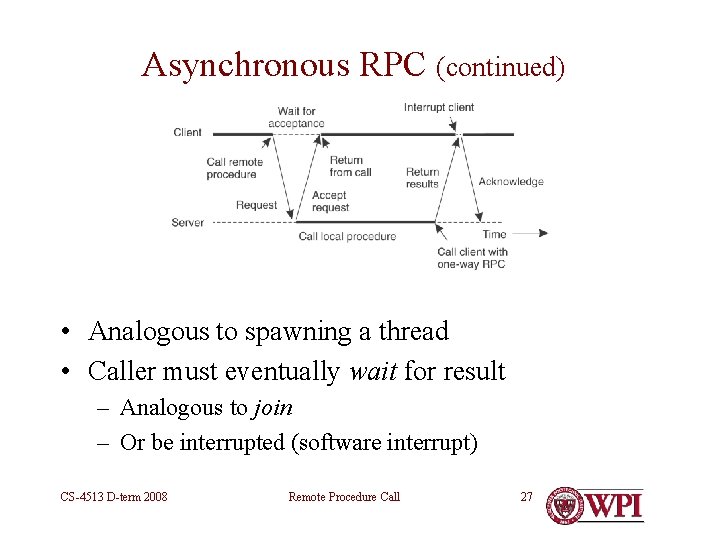
Asynchronous RPC (continued) • Analogous to spawning a thread • Caller must eventually wait for result – Analogous to join – Or be interrupted (software interrupt) CS-4513 D-term 2008 Remote Procedure Call 27
RPC Binding • Binding is the process of connecting the client to the server – the server, when it starts up, exports interface • identifies itself to a network name server • tells RPC runtime that it is alive and ready to accept calls – the client, before issuing any calls, imports the server • RPC runtime uses the name server to find the location of the server and establish a connection • The import and export operations are explicit in the server and client programs CS-4513 D-term 2008 Remote Procedure Call 28
Remote Procedure Call is used … • Between processes on different machines – E. g. , client-server model • Between processes on the same machine – More structured than simple message passing • Between subsystems of an operating system – Windows XP (called Local Procedure Call) CS-4513 D-term 2008 Remote Procedure Call 29
Questions? CS-4513 D-term 2008 Remote Procedure Call 30
Practical RPC Systems • DCE (Distributed Computing Environment) • Open Software Foundation • Basis for Microsoft DCOM • Tanenbaum & Van Steen, § 4. 2. 4 • Sun’s ONC (Open Network Computing) • Very similar to DCE • Widely used • rpcgen • http: //h 30097. www 3. hp. com/docs/base_doc/DOCUMENTATI ON/HTML/AA-Q 0 R 5 B-TET 1_html/TITLE. html CS-4513 D-term 2008 Remote Procedure Call 31
Practical RPC Systems (continued) • Java RMI (Remote Method Invocation) • java. rmi standard package • Java-oriented approach — objects and methods • CORBA (Common Object Request Broker Architecture) • Standard, multi-language, multi-platform middleware • Object-oriented • Heavyweight • … CS-4513 D-term 2008 Remote Procedure Call 32
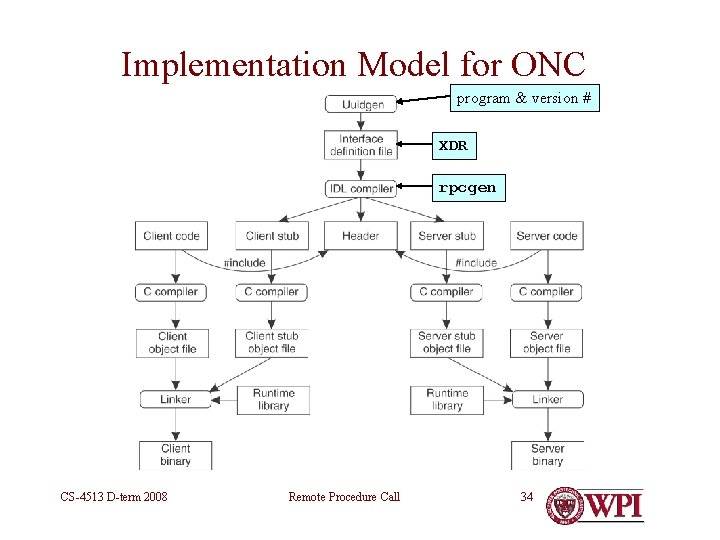
Implementation Model for ONC program & version # XDR rpcgen CS-4513 D-term 2008 Remote Procedure Call 34
Validating a Remote Service • Purpose • Avoid binding to wrong service or wrong version • DCE • Globally unique ID – Generated in template of IDL file • Sun ONC • Program numbers registered with Sun • Version # and procedure # administered locally CS-4513 D-term 2008 Remote Procedure Call 35
RPC Binding — Sun ONC • Service registers with portmapper service on server OS • Program # and version # • Optional static port # • Client • Must know host name or IP address • clnt_create(host, prog, vers, proto) – I. e. , RPC to portmapper of host requesting to bind to prog, vers using protocol proto (tcp or udp) • (Additional functions for authentication, etc. ) • Invokes remote functions by name CS-4513 D-term 2008 Remote Procedure Call 36
Sun ONC (continued) • #include <rpc/rpc. h> • Header file for client and server • rpcgen • The stub compiler – Compiles interface. x – Produces. h files for client and service; also stubs • See also • rpcinfo • RPC Programming Guide CS-4513 D-term 2008 Remote Procedure Call 37
Note on XDR (the Interface Definition Language for ONC) • Much like C header file • Exceptions – string type – maps to char * – bool type – maps to bool_t CS-4513 D-term 2008 Remote Procedure Call 38
Sun ONC • Online tutorial • http: //h 30097. www 3. hp. com/docs/base_doc/DOCUMENTATI ON/HTML/AA-Q 0 R 5 B-TET 1_html/TITLE. html • Code samples • http: //web. cs. wpi. edu/~rek/DCS/D 04/Sun. RPC. html • http: //web. cs. wpi. edu/~goos/Teach/cs 4513 -d 05/ • http: //web. cs. wpi. edu/~cs 4513/b 05/week 4 -sunrpc. pdf • Any other resources you can find CS-4513 D-term 2008 Remote Procedure Call 39
Questions? CS-4513 D-term 2008 Remote Procedure Call 40
- Slides: 39