
REMOTE PLASMA SOURCES SUSTAINED IN NF 3 MIXTURES

![F vs POWER: 100 – 800 W · With power increase, [F] saturates at](https://slidetodoc.com/presentation_image_h2/9d7bac9d699c92f405d9766d3b4ab5dc/image-21.jpg "F vs POWER: 100 – 800 W · With power increase, [F] saturates at")
- Slides: 23
REMOTE PLASMA SOURCES SUSTAINED IN NF 3 MIXTURES* Shuo Huang and Mark J. Kushner Department of Electrical Engineering and Computer Science, University of Michigan, Ann Arbor, MI 48109, USA (shuoh@umich. edu, mjkush@umich. edu) James R. Hamilton and Jonathan Tennyson Department of Physics and Astronomy, University College London, WC 1 E 6 BT, UK (james. hamilton@ucl. ac. uk, j. tennyson@ucl. ac. uk) The 22 nd International Symposium on Plasma Chemistry Antwerp, Belgium July 9, 2015 * Work supported by Samsung Electronics Co. , Ltd. , Semiconductor Research Corp. , DOE Office of Fusion Energy Science and National Science Foundation.
AGENDA · Remote NF 3 sources · Reaction mechanism · Description of the models · Plug flow mode of Global_Kin · CCP operation of HPEM · Comparison between results from Global_Kin and HPEM · Concluding remarks · Acknowledgements · Vladimir Volynets, Sangheon Lee, In-Cheol Song and Siqing Lu (Samsung Electronics Co. , Ltd. , Republic of Korea) S. H_ISPC 2015 University of Michigan Institute for Plasma Science & Engr.
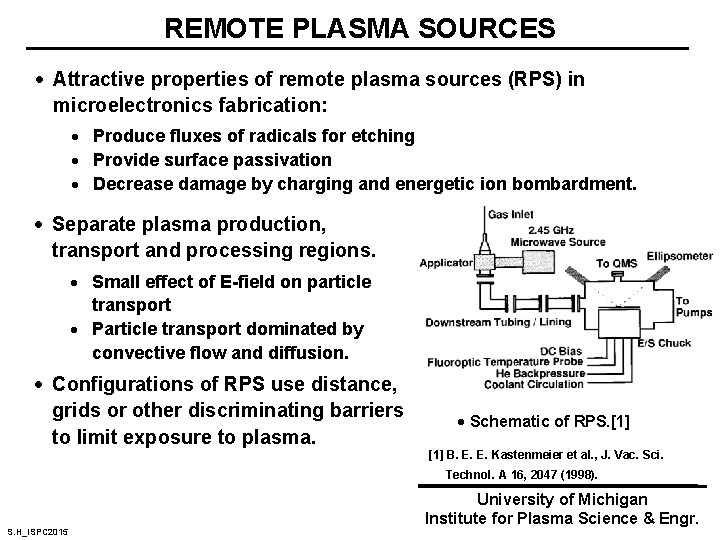
REMOTE PLASMA SOURCES · Attractive properties of remote plasma sources (RPS) in microelectronics fabrication: · Produce fluxes of radicals for etching · Provide surface passivation · Decrease damage by charging and energetic ion bombardment. · Separate plasma production, transport and processing regions. · Small effect of E-field on particle transport · Particle transport dominated by convective flow and diffusion. · Configurations of RPS use distance, grids or other discriminating barriers to limit exposure to plasma. · Schematic of RPS. [1] B. E. E. Kastenmeier et al. , J. Vac. Sci. Technol. A 16, 2047 (1998). S. H_ISPC 2015 University of Michigan Institute for Plasma Science & Engr.
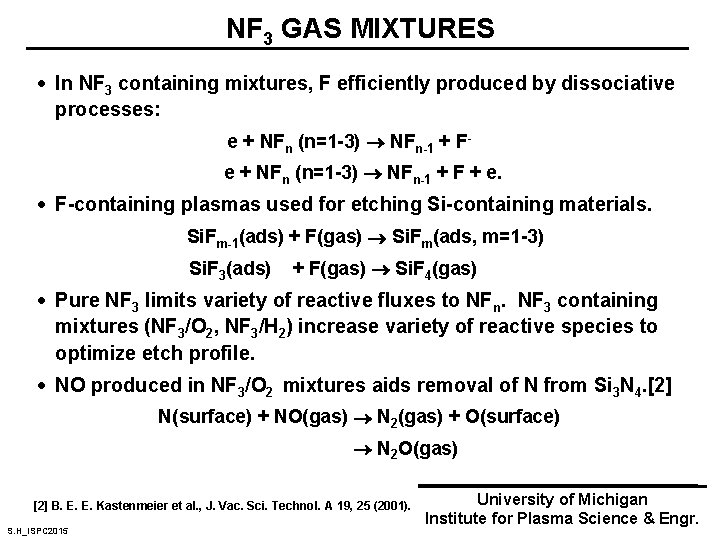
NF 3 GAS MIXTURES · In NF 3 containing mixtures, F efficiently produced by dissociative processes: e + NFn (n=1 -3) NFn-1 + F + e. · F-containing plasmas used for etching Si-containing materials. Si. Fm-1(ads) + F(gas) Si. Fm(ads, m=1 -3) Si. F 3(ads) + F(gas) Si. F 4(gas) · Pure NF 3 limits variety of reactive fluxes to NFn. NF 3 containing mixtures (NF 3/O 2, NF 3/H 2) increase variety of reactive species to optimize etch profile. · NO produced in NF 3/O 2 mixtures aids removal of N from Si 3 N 4. [2] N(surface) + NO(gas) N 2(gas) + O(surface) N 2 O(gas) [2] B. E. E. Kastenmeier et al. , J. Vac. Sci. Technol. A 19, 25 (2001). S. H_ISPC 2015 University of Michigan Institute for Plasma Science & Engr.
REACTIVE SPECIES FOR REMOTE PLASMA PROCESSING · We report on results from computational investigation of remote plasma sources sustained in NF 3 mixtures. · Global "plug-flow" · 2 D modeling of CCP source. · We discuss reaction mechanisms and scaling with power, flow rate and gas mixture. S. H_ISPC 2015 University of Michigan Institute for Plasma Science & Engr.
ELECTRON IMPACT NF 3 CROSS SECTIONS · Updated cross section set for NF 3 · Preliminary cross section set for NF 3 calculated using R-matrix method based on work of V. Lisovskiy et al. [3] by Quantemol. [3] V. Lisovskiy et al. , J. Phys. D 47, 115203 (2014). S. H_ISPC 2015 University of Michigan Institute for Plasma Science & Engr.
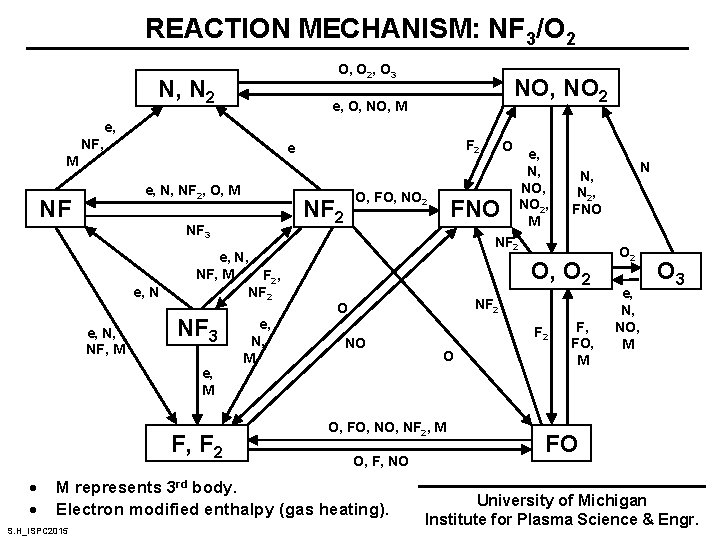
REACTION MECHANISM: NF 3/O 2 O, O 2, O 3 N, N 2 NO, NO 2 e, O, NO, M e, NF, M e, N, NF 2, O, M NF e, N, NF, M F 2, NF 2 NF 3 e, M F, F 2 · · O, FO, NO 2 NF 3 e, N, NF, M F 2 e e, N, M FNO e, N, NO 2, M O, O 2 NF 2 O NO F 2 O O, FO, NF 2, M O, F, NO N N, N 2, FNO NF 2 M represents 3 rd body. Electron modified enthalpy (gas heating). S. H_ISPC 2015 O F, FO, M O 2 e, N, NO, M O 3 FO University of Michigan Institute for Plasma Science & Engr.
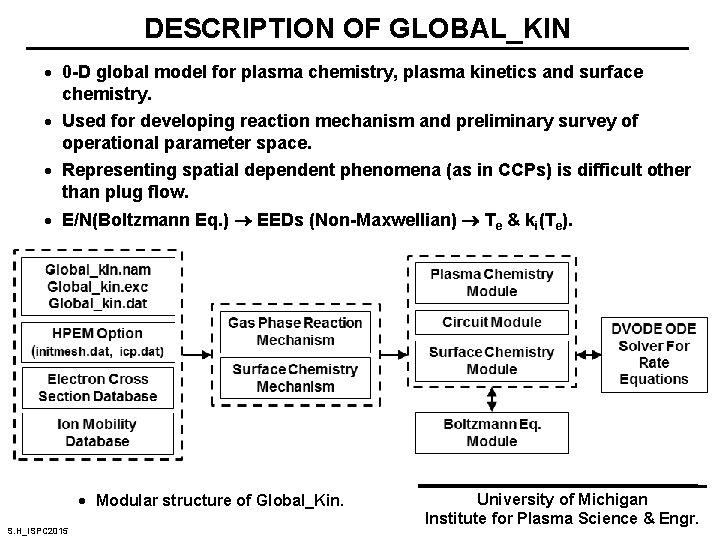
DESCRIPTION OF GLOBAL_KIN · 0 -D global model for plasma chemistry, plasma kinetics and surface chemistry. · Used for developing reaction mechanism and preliminary survey of operational parameter space. · Representing spatial dependent phenomena (as in CCPs) is difficult other than plug flow. · E/N(Boltzmann Eq. ) EEDs (Non-Maxwellian) Te & ki(Te). · Modular structure of Global_Kin. S. H_ISPC 2015 University of Michigan Institute for Plasma Science & Engr.
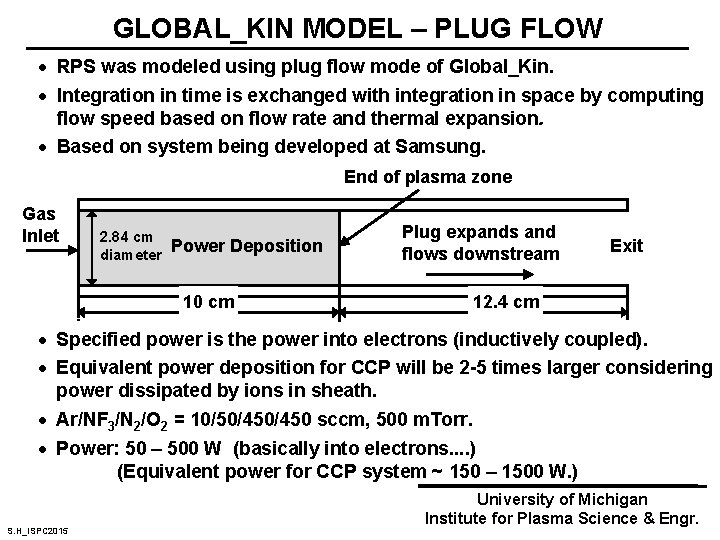
GLOBAL_KIN MODEL – PLUG FLOW · RPS was modeled using plug flow mode of Global_Kin. · Integration in time is exchanged with integration in space by computing flow speed based on flow rate and thermal expansion. · Based on system being developed at Samsung. End of plasma zone Gas Inlet 2. 84 cm diameter Power Deposition 10 cm Plug expands and flows downstream Exit 12. 4 cm · Specified power is the power into electrons (inductively coupled). · Equivalent power deposition for CCP will be 2 -5 times larger considering power dissipated by ions in sheath. · Ar/NF 3/N 2/O 2 = 10/50/450 sccm, 500 m. Torr. · Power: 50 – 500 W (basically into electrons. . ) (Equivalent power for CCP system ~ 150 – 1500 W. ) S. H_ISPC 2015 University of Michigan Institute for Plasma Science & Engr.
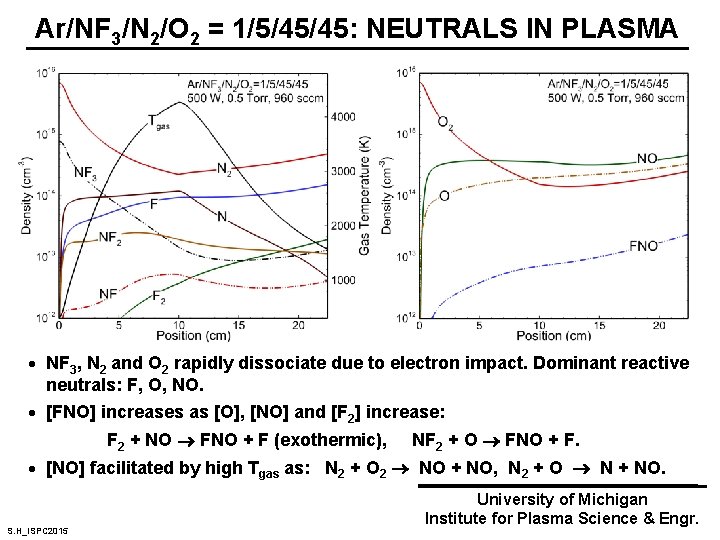
Ar/NF 3/N 2/O 2 = 1/5/45/45: NEUTRALS IN PLASMA · NF 3, N 2 and O 2 rapidly dissociate due to electron impact. Dominant reactive neutrals: F, O, NO. · [FNO] increases as [O], [NO] and [F 2] increase: F 2 + NO FNO + F (exothermic), NF 2 + O FNO + F. · [NO] facilitated by high Tgas as: N 2 + O 2 NO + NO, N 2 + O N + NO. S. H_ISPC 2015 University of Michigan Institute for Plasma Science & Engr.
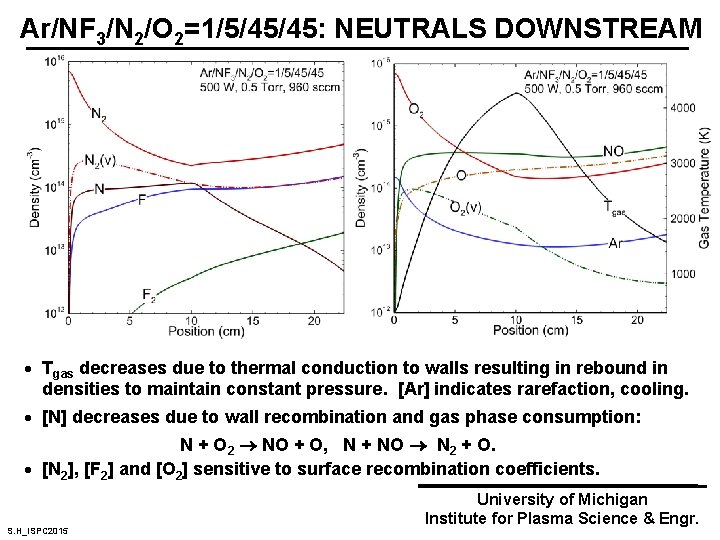
Ar/NF 3/N 2/O 2=1/5/45/45: NEUTRALS DOWNSTREAM · Tgas decreases due to thermal conduction to walls resulting in rebound in densities to maintain constant pressure. [Ar] indicates rarefaction, cooling. · [N] decreases due to wall recombination and gas phase consumption: N + O 2 NO + O, N + NO N 2 + O. · [N 2], [F 2] and [O 2] sensitive to surface recombination coefficients. S. H_ISPC 2015 University of Michigan Institute for Plasma Science & Engr.
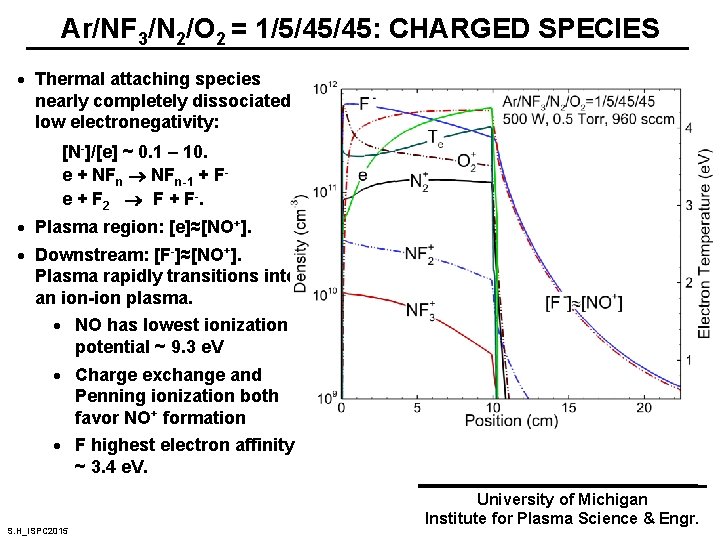
Ar/NF 3/N 2/O 2 = 1/5/45/45: CHARGED SPECIES · Thermal attaching species nearly completely dissociated, low electronegativity: [N-]/[e] ~ 0. 1 – 10. e + NFn-1 + Fe + F 2 F + F-. · Plasma region: [e]≈[NO+]. · Downstream: [F-]≈[NO+]. Plasma rapidly transitions into an ion-ion plasma. · NO has lowest ionization potential ~ 9. 3 e. V · Charge exchange and Penning ionization both favor NO+ formation · F highest electron affinity ~ 3. 4 e. V. S. H_ISPC 2015 University of Michigan Institute for Plasma Science & Engr.
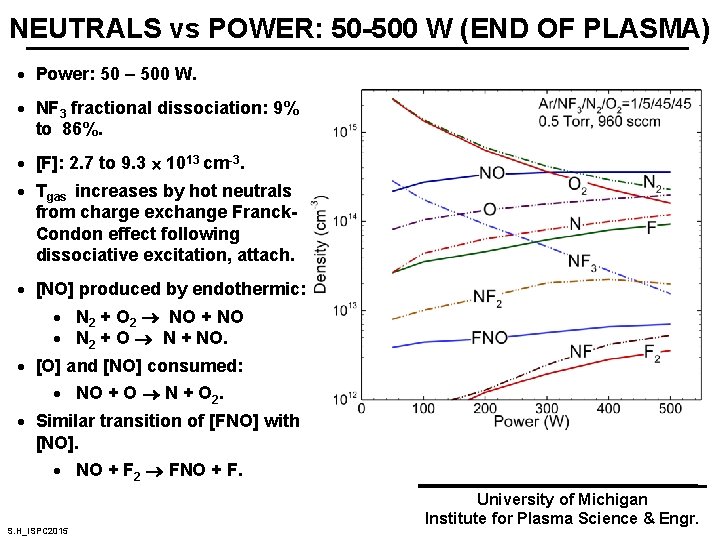
NEUTRALS vs POWER: 50 -500 W (END OF PLASMA) · Power: 50 – 500 W. · NF 3 fractional dissociation: 9% to 86%. · [F]: 2. 7 to 9. 3 1013 cm-3. · Tgas increases by hot neutrals from charge exchange Franck. Condon effect following dissociative excitation, attach. · [NO] produced by endothermic: · N 2 + O 2 NO + NO · N 2 + O N + NO. · [O] and [NO] consumed: · NO + O N + O 2. · Similar transition of [FNO] with [NO]. · NO + F 2 FNO + F. S. H_ISPC 2015 University of Michigan Institute for Plasma Science & Engr.
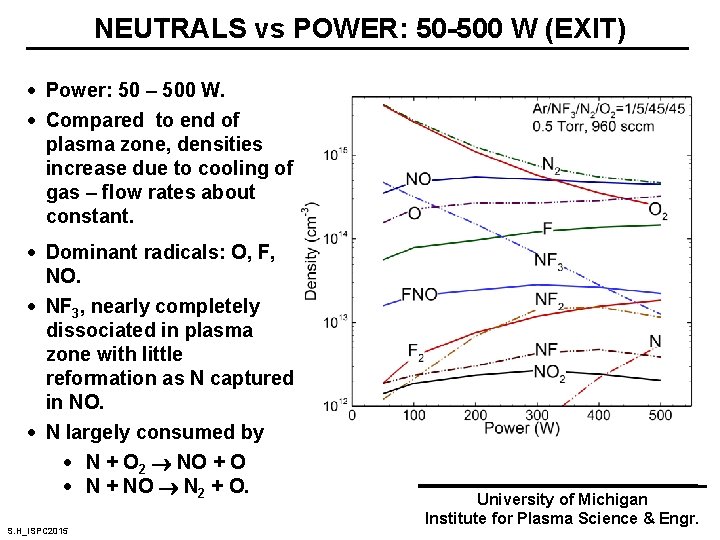
NEUTRALS vs POWER: 50 -500 W (EXIT) · Power: 50 – 500 W. · Compared to end of plasma zone, densities increase due to cooling of gas – flow rates about constant. · Dominant radicals: O, F, NO. · NF 3, nearly completely dissociated in plasma zone with little reformation as N captured in NO. · N largely consumed by · N + O 2 NO + O · N + NO N 2 + O. S. H_ISPC 2015 University of Michigan Institute for Plasma Science & Engr.
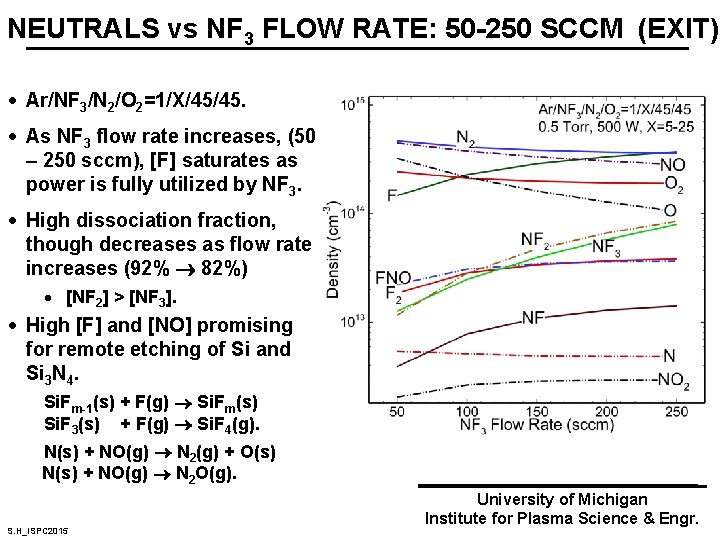
NEUTRALS vs NF 3 FLOW RATE: 50 -250 SCCM (EXIT) · Ar/NF 3/N 2/O 2=1/X/45/45. · As NF 3 flow rate increases, (50 – 250 sccm), [F] saturates as power is fully utilized by NF 3. · High dissociation fraction, though decreases as flow rate increases (92% 82%) · [NF 2] > [NF 3]. · High [F] and [NO] promising for remote etching of Si and Si 3 N 4. Si. Fm-1(s) + F(g) Si. Fm(s) Si. F 3(s) + F(g) Si. F 4(g). N(s) + NO(g) N 2(g) + O(s) N(s) + NO(g) N 2 O(g). S. H_ISPC 2015 University of Michigan Institute for Plasma Science & Engr.
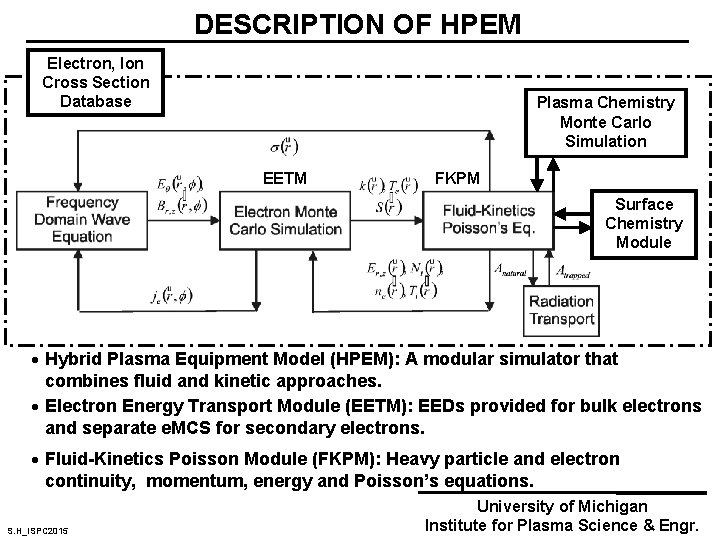
DESCRIPTION OF HPEM Electron, Ion Cross Section Database Plasma Chemistry Monte Carlo Simulation EETM FKPM Surface Chemistry Module · Hybrid Plasma Equipment Model (HPEM): A modular simulator that combines fluid and kinetic approaches. · Electron Energy Transport Module (EETM): EEDs provided for bulk electrons and separate e. MCS for secondary electrons. · Fluid-Kinetics Poisson Module (FKPM): Heavy particle and electron continuity, momentum, energy and Poisson’s equations. S. H_ISPC 2015 University of Michigan Institute for Plasma Science & Engr.
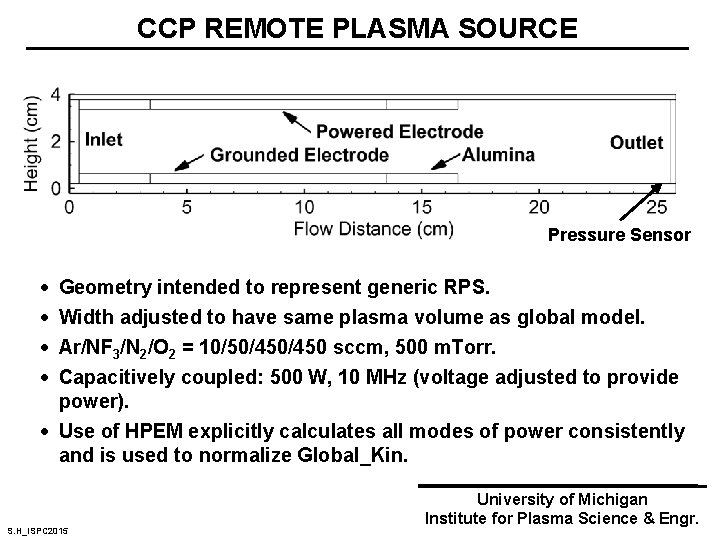
CCP REMOTE PLASMA SOURCE Pressure Sensor · · Geometry intended to represent generic RPS. Width adjusted to have same plasma volume as global model. Ar/NF 3/N 2/O 2 = 10/50/450 sccm, 500 m. Torr. Capacitively coupled: 500 W, 10 MHz (voltage adjusted to provide power). · Use of HPEM explicitly calculates all modes of power consistently and is used to normalize Global_Kin. S. H_ISPC 2015 University of Michigan Institute for Plasma Science & Engr.
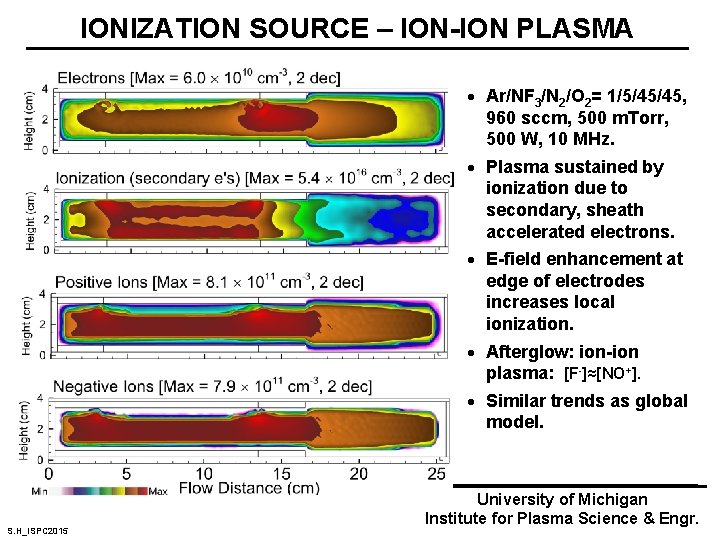
IONIZATION SOURCE – ION-ION PLASMA · Ar/NF 3/N 2/O 2= 1/5/45/45, 960 sccm, 500 m. Torr, 500 W, 10 MHz. · Plasma sustained by ionization due to secondary, sheath accelerated electrons. · E-field enhancement at edge of electrodes increases local ionization. · Afterglow: ion-ion plasma: [F-]≈[NO+]. · Similar trends as global model. S. H_ISPC 2015 University of Michigan Institute for Plasma Science & Engr.
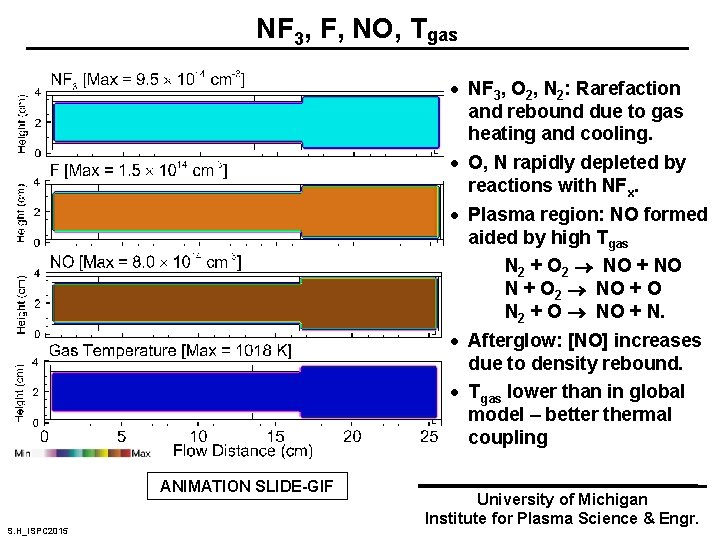
NF 3, F, NO, Tgas · NF 3, O 2, N 2: Rarefaction and rebound due to gas heating and cooling. · O, N rapidly depleted by reactions with NFx. · Plasma region: NO formed aided by high Tgas N 2 + O 2 NO + NO N + O 2 NO + O N 2 + O NO + N. · Afterglow: [NO] increases due to density rebound. · Tgas lower than in global model – better thermal coupling ANIMATION SLIDE-GIF S. H_ISPC 2015 University of Michigan Institute for Plasma Science & Engr.
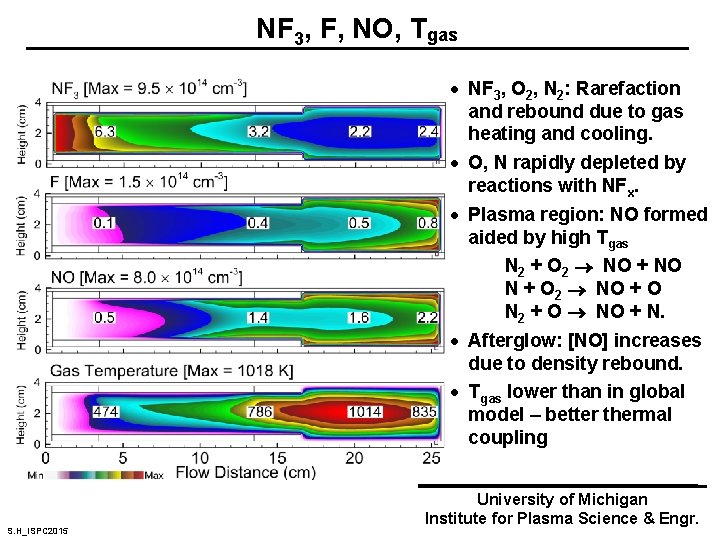
NF 3, F, NO, Tgas · NF 3, O 2, N 2: Rarefaction and rebound due to gas heating and cooling. · O, N rapidly depleted by reactions with NFx. · Plasma region: NO formed aided by high Tgas N 2 + O 2 NO + NO N + O 2 NO + O N 2 + O NO + N. · Afterglow: [NO] increases due to density rebound. · Tgas lower than in global model – better thermal coupling S. H_ISPC 2015 University of Michigan Institute for Plasma Science & Engr.
F vs POWER: 100 – 800 W · With power increase, [F] saturates at 800 W. · [F]max near walls · Quenching of F* · Low Twall ~ 325 K · Small wall recombination coefficient · Charge exchange in sheath. · [F 2] and [F] sensitive to surface recombination coefficient. · F recomb. coef. in current mechanism: 0. 1 · [C 2 F 4]n (PTFE): Low sticking coef. inhibits F recombination. S. H_ISPC 2015 University of Michigan Institute for Plasma Science & Engr.
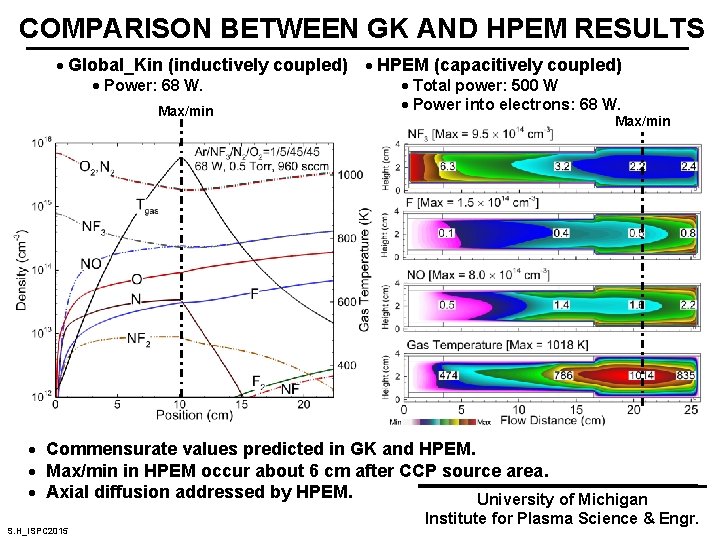
COMPARISON BETWEEN GK AND HPEM RESULTS · Global_Kin (inductively coupled) · Power: 68 W. Max/min · HPEM (capacitively coupled) · Total power: 500 W · Power into electrons: 68 W. Max/min · Commensurate values predicted in GK and HPEM. · Max/min in HPEM occur about 6 cm after CCP source area. · Axial diffusion addressed by HPEM. University of Michigan S. H_ISPC 2015 Institute for Plasma Science & Engr.
CONCLUDING REMARKS · A reaction mechanism for Ar/NF 3/N 2/O 2 has been developed. · RPS has been modeled using plug flow mode of Global-Kin (0 -D) and CCP operation of HPEM (2 -D). · Adding O 2 and N 2 diversifies the variety of radicals (e. g. , NO, FO) and enhances radical concentration. · Enables optimized etch rate and profile. · Ion-ion plasma in afterglow. · Enables etching only by radicals by removing ions with grid. · Alternately, charge free etching assisted by ions. · When accounting for power deposition by electrons (dissociation, ionization) between global and 2 d models, surprising agreement, through offset in space. S. H_ISPC 2015 University of Michigan Institute for Plasma Science & Engr.