
Remote Method Invocation RMI and Distributed Theodore Norvell
Remote Method Invocation (RMI) and Distributed Theodore Norvell in Java Observers 1
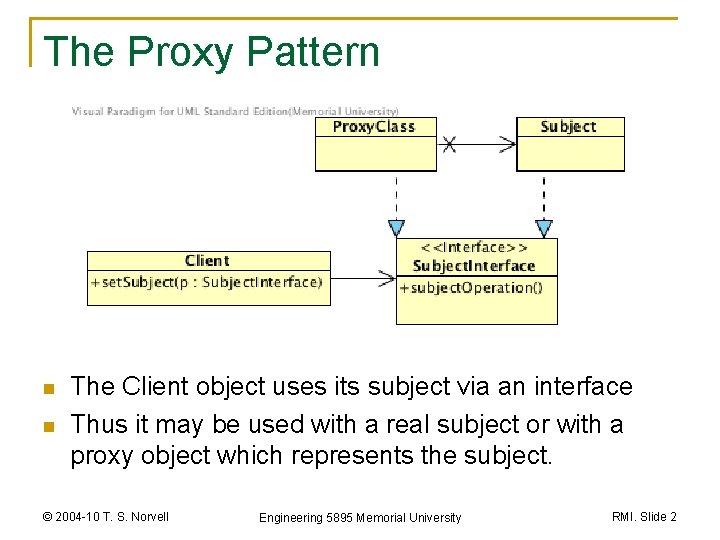
The Proxy Pattern n n The Client object uses its subject via an interface Thus it may be used with a real subject or with a proxy object which represents the subject. © 2004 -10 T. S. Norvell Engineering 5895 Memorial University RMI. Slide 2
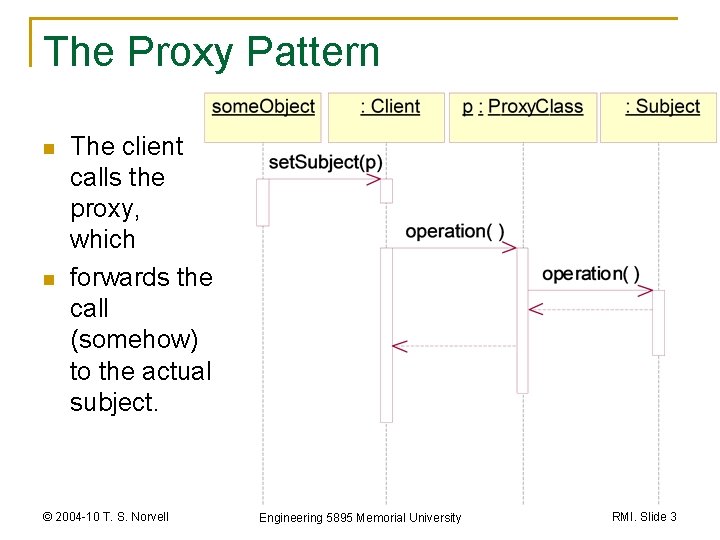
The Proxy Pattern n n The client calls the proxy, which forwards the call (somehow) to the actual subject. © 2004 -10 T. S. Norvell Engineering 5895 Memorial University RMI. Slide 3
RMI and the Proxy pattern n RMI uses the Proxy pattern to distribute objects across a network. Recall that in the Proxy pattern a proxy and a subject share a common interface. In RMI, objects call methods in a proxy (aka stub) on its own machine q q The proxy sends messages across the network to a “skeleton” object The skeleton calls the subject object. © 2004 -10 T. S. Norvell Engineering 5895 Memorial University RMI. Slide 4
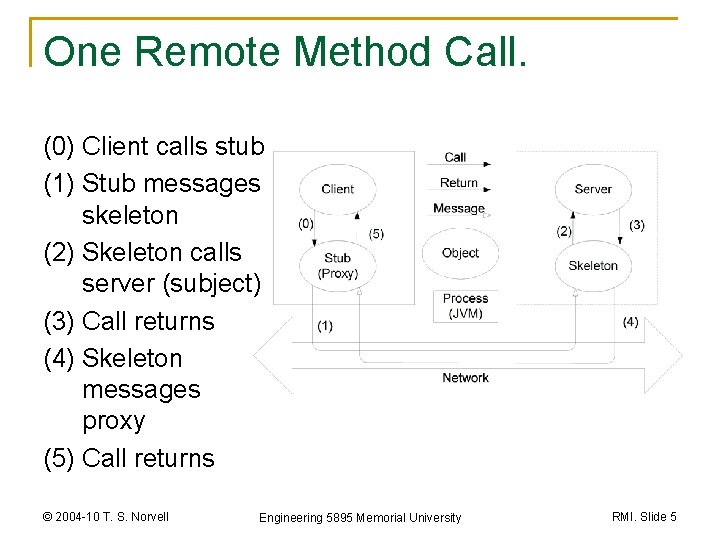
One Remote Method Call. (0) Client calls stub (1) Stub messages skeleton (2) Skeleton calls server (subject) (3) Call returns (4) Skeleton messages proxy (5) Call returns © 2004 -10 T. S. Norvell Engineering 5895 Memorial University RMI. Slide 5
Full disclosure n n Java no longer uses skeleton objects that are paired one-to-one with the server objects. I’ll include them in the pictures to represent whatever set of objects is listening for net traffic and capable of sending messages to the true server object. © 2004 -10 T. S. Norvell Engineering 5895 Memorial University RMI. Slide 6
Issues n Concurrency q If there are multiple clients, the server may field multiple calls at the same time. n n Argument passing q n Arguments are passed by value or “by proxy” not by reference. Proxy generation q n So use synchronization as appropriate. Proxy classes are automatically derived from the server class’s interface. Lookup q Objects are usually found via a registry (program rmiregistry) © 2004 -10 T. S. Norvell Engineering 5895 Memorial University RMI. Slide 7
Nitty-Gritty n The proxy and the server share an interface. q q n This interface must extend java. rmi. Remote. Every method in the interface should be declared to throw java. rmi. Remote. Exceptions are thrown when network problems are encountered, or when server objects no longer exist. The server typically extends class java. rmi. server. Unicast. Remote. Object q q The constructor of this class throws a Remote. Exception Therefore, so should the constructor of any specialization. © 2004 -10 T. S. Norvell Engineering 5895 Memorial University RMI. Slide 8
Argument Passing Revisited n Most arguments and results q q n But q q q n are converted to a sequence of bytes sent over the net therefore the class should implement the java. io. Serializable interface a clone of the argument/result is built on the other side. Pass by object value, rather than by object reference. objects that extend java. rmi. server. Unicast. Remote. Object instead have a proxy constructed for them on the other side I call this “pass by proxy”. Essentially pass/return by reference So each argument, result, exception type should be q a primitive type, implement Serializable, or extend Unicast. Remote. Object © 2004 -10 T. S. Norvell Engineering 5895 Memorial University RMI. Slide 9
An Example – Distributed Othello n n Othello is a two person board game My implementation uses the observer pattern so that, q q n n n when the (game state) model changes, all observers are informed of the change. I wanted to put the model on one machine and the observers on other machines. Hence I implemented the observer pattern with RMI. This is example othello-2 on the website. © 2004 -10 T. S. Norvell Engineering 5895 Memorial University RMI. Slide 10
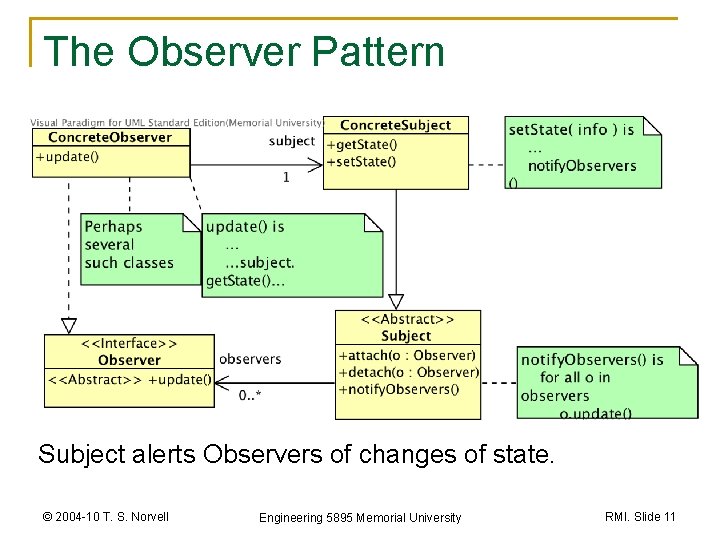
The Observer Pattern Subject alerts Observers of changes of state. © 2004 -10 T. S. Norvell Engineering 5895 Memorial University RMI. Slide 11
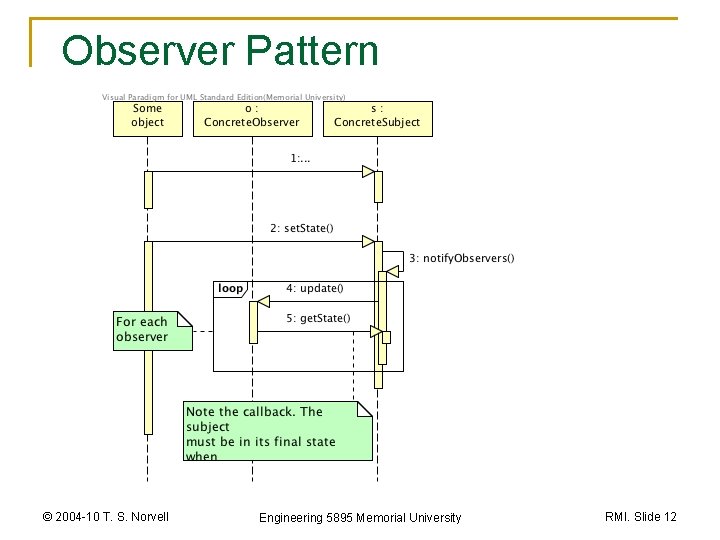
Observer Pattern © 2004 -10 T. S. Norvell Engineering 5895 Memorial University RMI. Slide 12
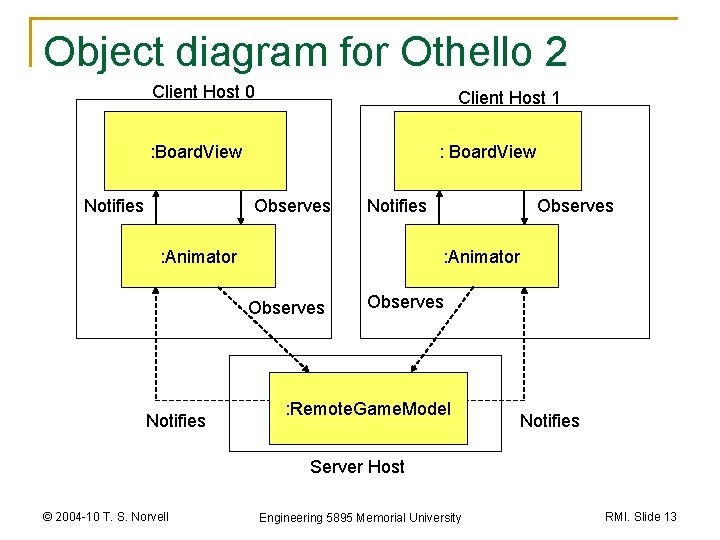
Object diagram for Othello 2 Client Host 0 Client Host 1 : Board. View Notifies : Board. View Observes Notifies : Animator Observes Notifies Observes : Remote. Game. Model Notifies Server Host © 2004 -10 T. S. Norvell Engineering 5895 Memorial University RMI. Slide 13
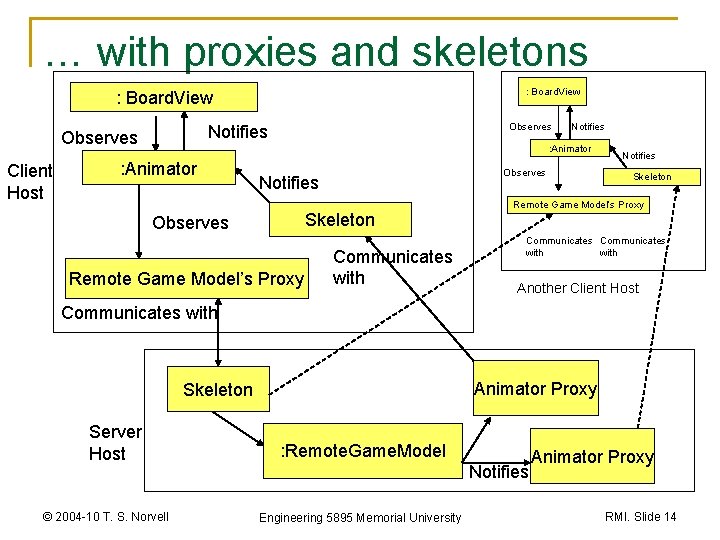
… with proxies and skeletons : Board. View Client Host Observes Notifies : Animator Observes Notifies Skeleton Observes Remote Game Model’s Proxy Communicates with Notifies Skeleton Remote Game Model’s Proxy Communicates with Another Client Host Communicates with Animator Proxy Skeleton Server Host © 2004 -10 T. S. Norvell : Remote. Game. Model Notifies Engineering 5895 Memorial University Animator Proxy RMI. Slide 14
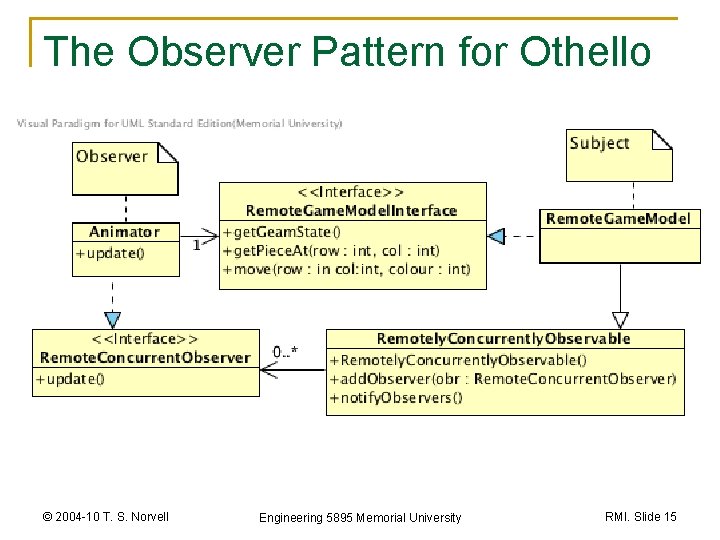
The Observer Pattern for Othello © 2004 -10 T. S. Norvell Engineering 5895 Memorial University RMI. Slide 15
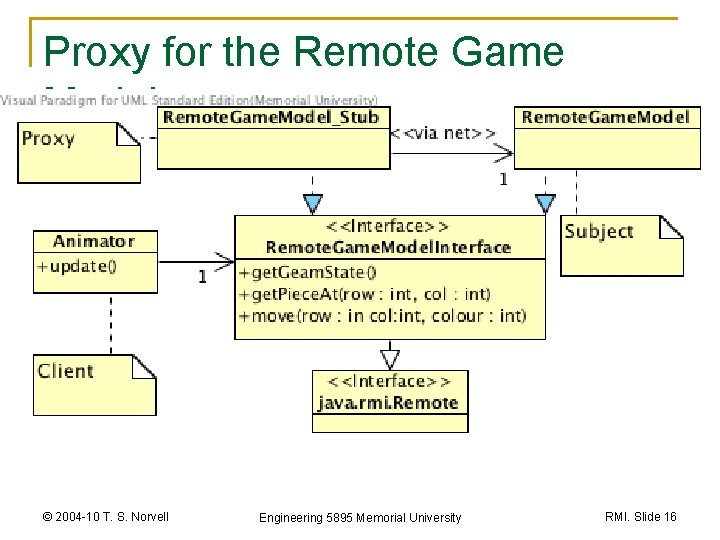
Proxy for the Remote Game Model © 2004 -10 T. S. Norvell Engineering 5895 Memorial University RMI. Slide 16
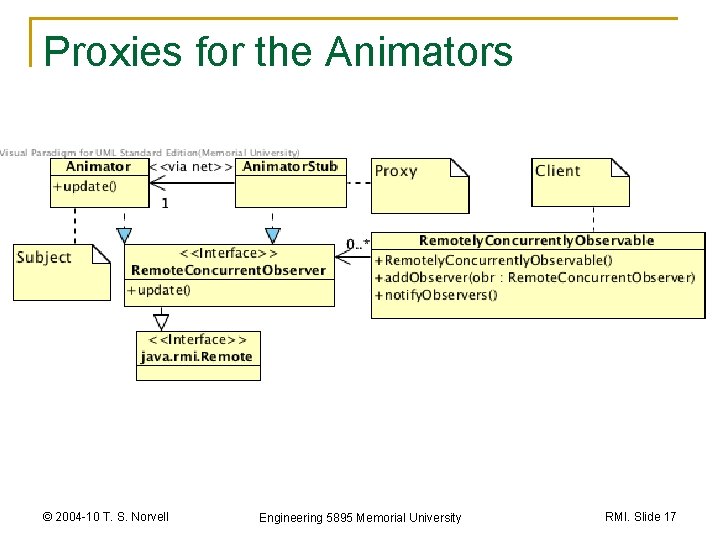
Proxies for the Animators © 2004 -10 T. S. Norvell Engineering 5895 Memorial University RMI. Slide 17
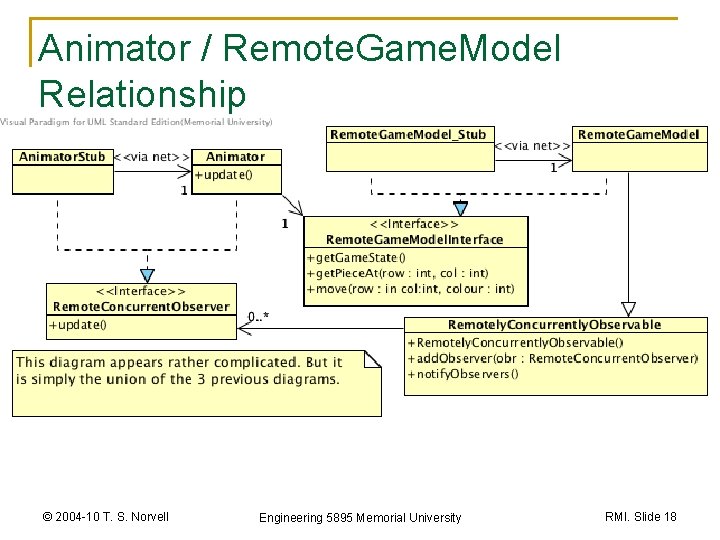
Animator / Remote. Game. Model Relationship © 2004 -10 T. S. Norvell Engineering 5895 Memorial University RMI. Slide 18
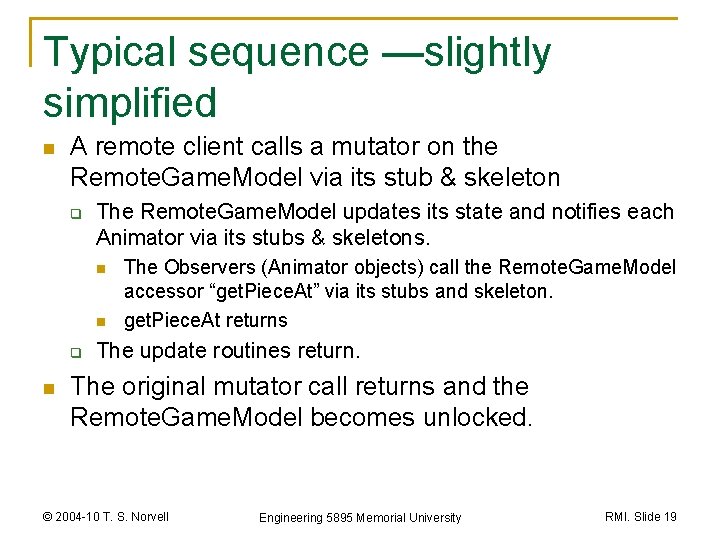
Typical sequence —slightly simplified n A remote client calls a mutator on the Remote. Game. Model via its stub & skeleton q The Remote. Game. Model updates its state and notifies each Animator via its stubs & skeletons. n n q n The Observers (Animator objects) call the Remote. Game. Model accessor “get. Piece. At” via its stubs and skeleton. get. Piece. At returns The update routines return. The original mutator call returns and the Remote. Game. Model becomes unlocked. © 2004 -10 T. S. Norvell Engineering 5895 Memorial University RMI. Slide 19
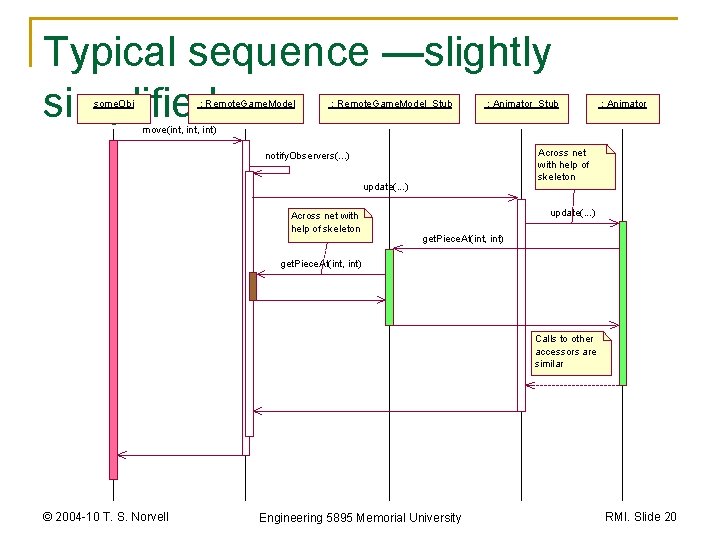
Typical sequence —slightly simplified some. Obj : Remote. Game. Model_Stub : Animator move(int, int) Across net with help of skeleton notify. Observers(. . . ) update(. . . ) Across net with help of skeleton update(. . . ) get. Piece. At(int, int) Calls to other accessors are similar © 2004 -10 T. S. Norvell Engineering 5895 Memorial University RMI. Slide 20
Concurrent Notification n The previous sequence is slightly simplified. q In fact the Animators start fresh animation threads and return from update almost immediately (so that all can be informed essentially at the same time). n q The Animation threads will inform the Remote. Game. Model of when they have completed their animation. The Remote. Game. Model waits until it has been informed that all animations are complete. © 2004 -10 T. S. Norvell Engineering 5895 Memorial University RMI. Slide 21
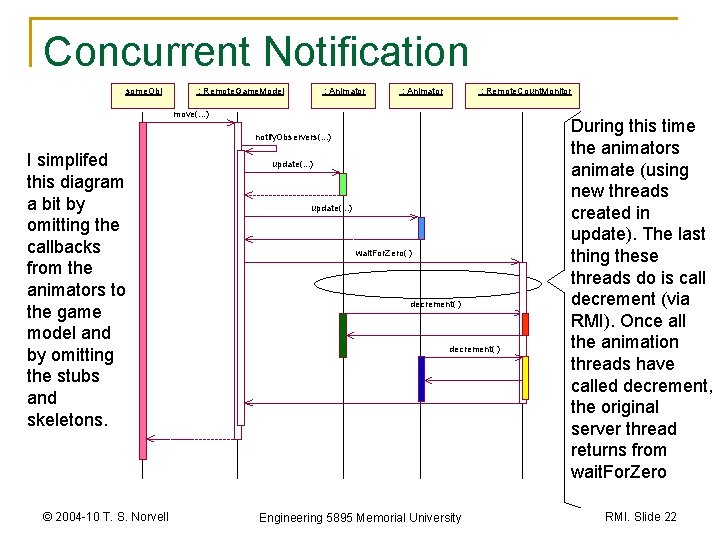
Concurrent Notification some. Obj : Remote. Game. Model : Animator : Remote. Count. Monitor move(. . . ) notify. Observers(. . . ) I simplifed this diagram a bit by omitting the callbacks from the animators to the game model and by omitting the stubs and skeletons. © 2004 -10 T. S. Norvell update(. . . ) wait. For. Zero( ) decrement( ) Engineering 5895 Memorial University During this time the animators animate (using new threads created in update). The last thing these threads do is call decrement (via RMI). Once all the animation threads have called decrement, the original server thread returns from wait. For. Zero RMI. Slide 22
A concurrency problem n Since the Remote. Game. Model is accessed by multiple threads, I originally made all public methods synchronized. q n This was a mistake. Look at the sequence diagram a few slides back. Note that the white thread executes “move”, but the brown thread executes the callback to “get. Piece”. This caused a deadlock! The solution was to use a reader/writer lock q This ensured that only one mutator at a time could be executed. q But it allows accessors to be executed during the observation phase. See my notes on Animation with Threads and the code for Remote. Game. Model in othello-2 for details. © 2004 -10 T. S. Norvell Engineering 5895 Memorial University RMI. Slide 23
Naming the Server n n The clients must be able to find the server (Remote. Game. Model object) A Registry is an object that listens on a known port and that associates proxies (stubs) with names. The server registers the Remote. Game. Model under an known name. The client uses a URI of the form rmi: //host: port/name n To ask the registry at host: port for a copy of the stub. © 2004 -10 T. S. Norvell Engineering 5895 Memorial University RMI. Slide 24
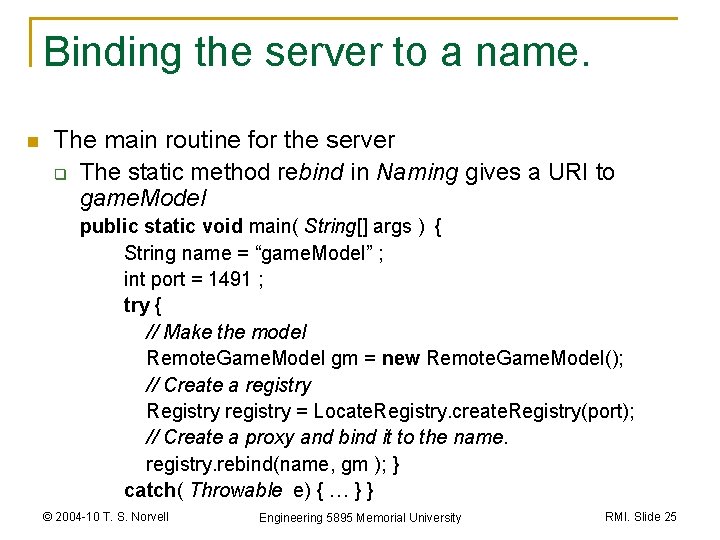
Binding the server to a name. n The main routine for the server q The static method rebind in Naming gives a URI to game. Model public static void main( String[] args ) { String name = “game. Model” ; int port = 1491 ; try { // Make the model Remote. Game. Model gm = new Remote. Game. Model(); // Create a registry Registry registry = Locate. Registry. create. Registry(port); // Create a proxy and bind it to the name. registry. rebind(name, gm ); } catch( Throwable e) { … } } © 2004 -10 T. S. Norvell Engineering 5895 Memorial University RMI. Slide 25
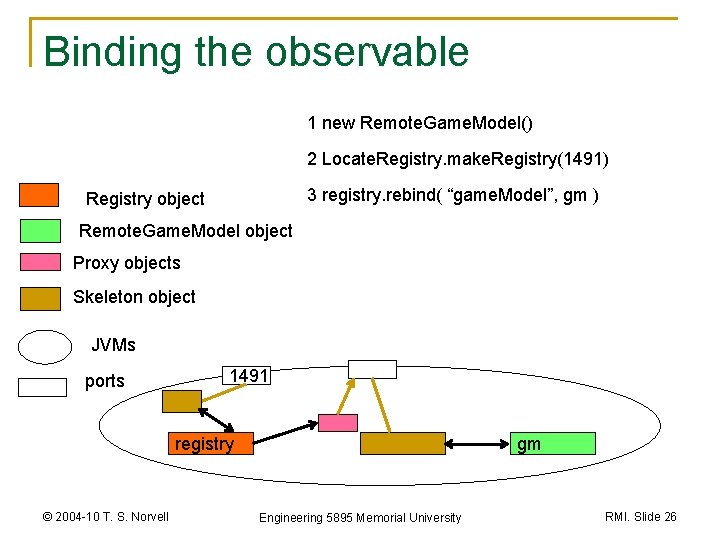
Binding the observable 1 new Remote. Game. Model() 2 Locate. Registry. make. Registry(1491) 3 registry. rebind( “game. Model”, gm ) Registry object Remote. Game. Model object Proxy objects Skeleton object JVMs ports 1491 registry © 2004 -10 T. S. Norvell gm Engineering 5895 Memorial University RMI. Slide 26
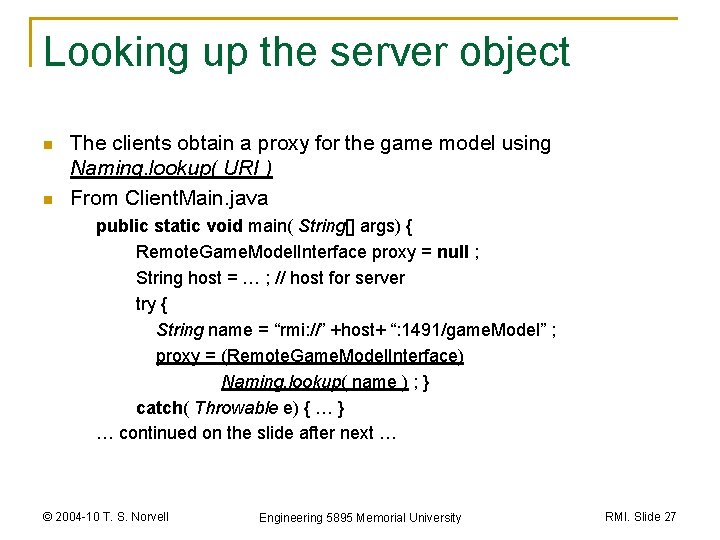
Looking up the server object n n The clients obtain a proxy for the game model using Naming. lookup( URI ) From Client. Main. java public static void main( String[] args) { Remote. Game. Model. Interface proxy = null ; String host = … ; // host for server try { String name = “rmi: //” +host+ “: 1491/game. Model” ; proxy = (Remote. Game. Model. Interface) Naming. lookup( name ) ; } catch( Throwable e) { … } … continued on the slide after next … © 2004 -10 T. S. Norvell Engineering 5895 Memorial University RMI. Slide 27
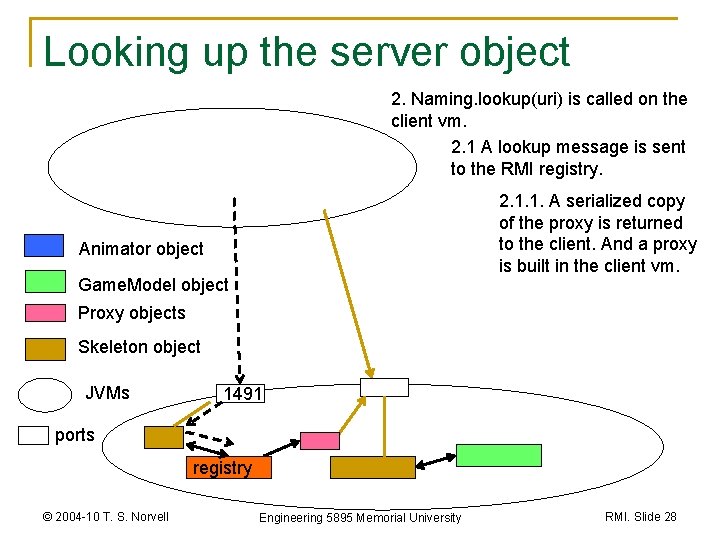
Looking up the server object 2. Naming. lookup(uri) is called on the client vm. 2. 1 A lookup message is sent to the RMI registry. 2. 1. 1. A serialized copy of the proxy is returned to the client. And a proxy is built in the client vm. Animator object Game. Model object Proxy objects Skeleton object JVMs 1491 ports registry © 2004 -10 T. S. Norvell Engineering 5895 Memorial University RMI. Slide 28
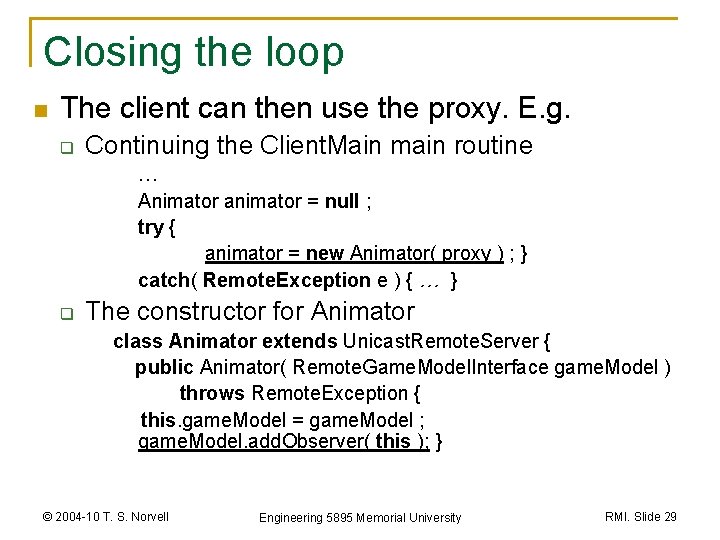
Closing the loop n The client can then use the proxy. E. g. q Continuing the Client. Main main routine … Animator animator = null ; try { animator = new Animator( proxy ) ; } catch( Remote. Exception e ) { … } q The constructor for Animator class Animator extends Unicast. Remote. Server { public Animator( Remote. Game. Model. Interface game. Model ) throws Remote. Exception { this. game. Model = game. Model ; game. Model. add. Observer( this ); } © 2004 -10 T. S. Norvell Engineering 5895 Memorial University RMI. Slide 29
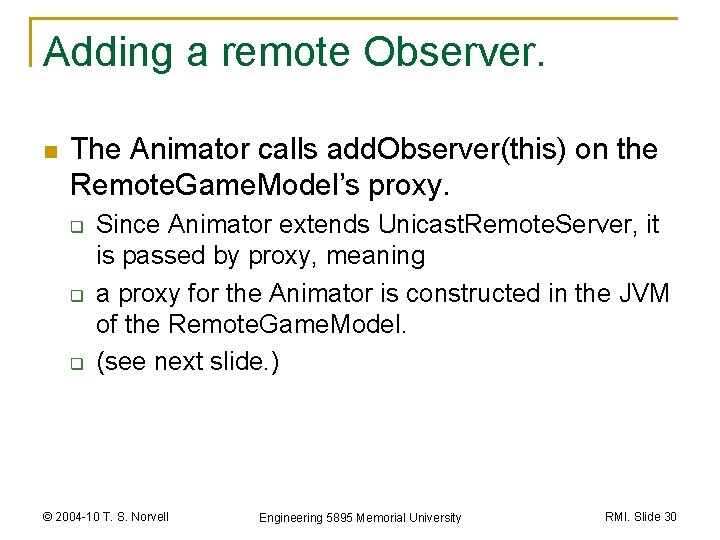
Adding a remote Observer. n The Animator calls add. Observer(this) on the Remote. Game. Model’s proxy. q q q Since Animator extends Unicast. Remote. Server, it is passed by proxy, meaning a proxy for the Animator is constructed in the JVM of the Remote. Game. Model. (see next slide. ) © 2004 -10 T. S. Norvell Engineering 5895 Memorial University RMI. Slide 30
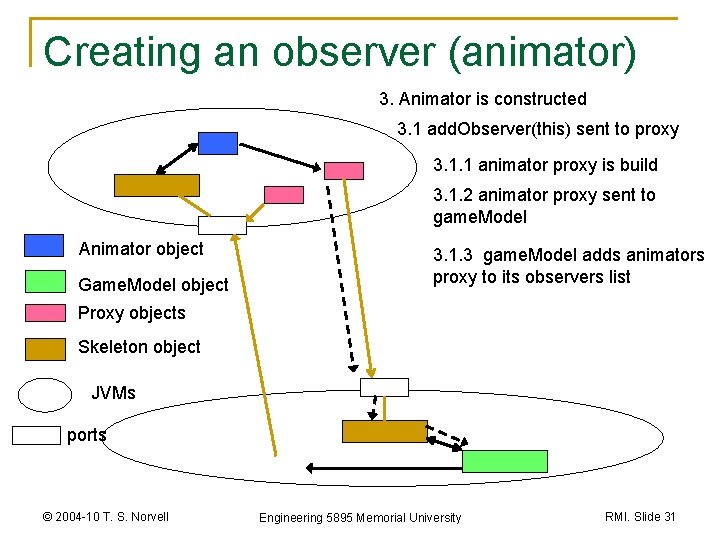
Creating an observer (animator) 3. Animator is constructed 3. 1 add. Observer(this) sent to proxy 3. 1. 1 animator proxy is build 3. 1. 2 animator proxy sent to game. Model Animator object Game. Model object 3. 1. 3 game. Model adds animators proxy to its observers list Proxy objects Skeleton object JVMs ports © 2004 -10 T. S. Norvell Engineering 5895 Memorial University RMI. Slide 31
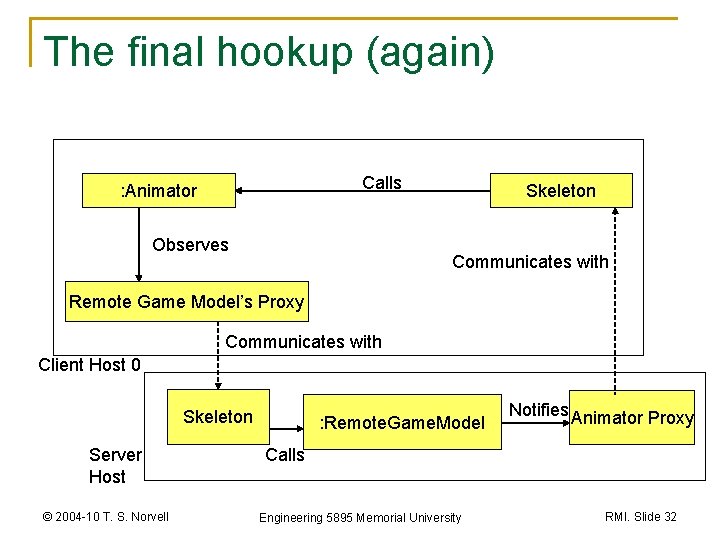
The final hookup (again) Calls : Animator Observes Skeleton Communicates with Remote Game Model’s Proxy Communicates with Client Host 0 Skeleton Server Host © 2004 -10 T. S. Norvell : Remote. Game. Model Notifies Animator Proxy Calls Engineering 5895 Memorial University RMI. Slide 32
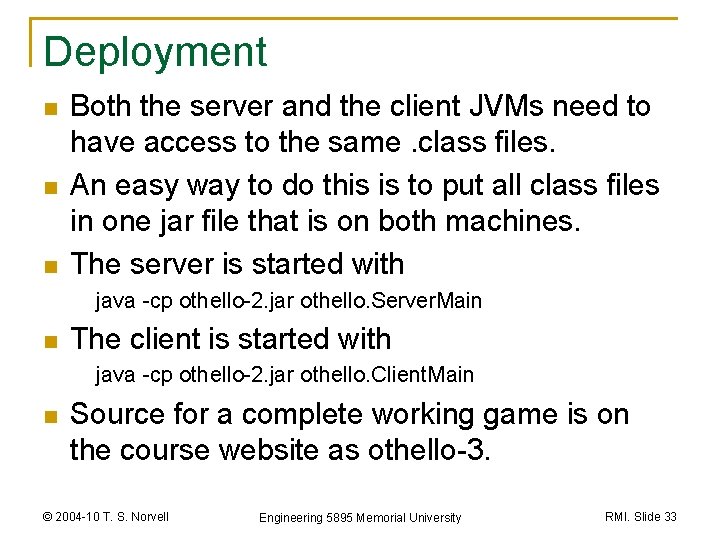
Deployment n n n Both the server and the client JVMs need to have access to the same. class files. An easy way to do this is to put all class files in one jar file that is on both machines. The server is started with java -cp othello-2. jar othello. Server. Main n The client is started with java -cp othello-2. jar othello. Client. Main n Source for a complete working game is on the course website as othello-3. © 2004 -10 T. S. Norvell Engineering 5895 Memorial University RMI. Slide 33
A Few Words of Warning n n RMI makes it seductively easy to treat remote objects as if they were local. Keep in mind q Partial Failure n n Part of the system of objects may fail Partial failures may be intermittent Network delays On a large network, delays are indistinguishable from failures q In the Othello example, failure was not considered. The system is not designed to be resilient to partial failures. © 2004 -10 T. S. Norvell Engineering 5895 Memorial University RMI. Slide 34
A Few Words of Warning (cont. ) n Keep in mind (cont. ) q Performance n Remote calls are several orders of magnitude more expensive than local calls (100, 000 or more to 1) q q E. g. in the Othello example, this motivated splitting the model into local (Animator) and remote (Remote. Game. Model) copies. Concurrency n Remote calls introduce threads that may not be in a nondistributed system. q E. g. in the remote observer pattern, callbacks from the observer to the observable will be on a thread different from the one that calls “update”. © 2004 -10 T. S. Norvell Engineering 5895 Memorial University RMI. Slide 35
A Few Words of Warning (cont. ) n Keep in mind (cont. ) q Semantics changes n n In Java, local calls pass objects by pointer value. Remote calls pass objects either by copy or by copying a proxy. q E. g. in the Othello game as I converted from the nondistributed to a distributed version, the semantics of some calls changed, even though I did not change the source code for those calls. © 2004 -10 T. S. Norvell Engineering 5895 Memorial University RMI. Slide 36
- Slides: 36