
Remote learning entitlements Examples from the national overviews
- Slides: 16
Remote learning entitlements: Examples from the national overviews of practice Supporting transitions for vulnerable learners returning to school, including children and young people with complex learning needs Educational Psychology Service, Orkney Islands Council >National overviews of practice<
Remote learning entitlements: Examples from the national overviews of practice Orkney Islands Council As a direct result of partnership working across The Northern Alliance, Orkney’s Educational Psychology Service has created guidance and delivered professional learning to support transitions for vulnerable learners returning to school, including children and young people with complex learning needs (CYPCLN). The view is that transition is not a single event and can be a protracted, flexible process to take account of needs. The delivery of professional learning in relation to the transition guidance has built capacity of staff working with CYPCLN. They have adopted a range of approaches and resources to ensure successful transitions, engagement and learning opportunities during the remote learning period. School staff supporting CYPCLN report the transition guidance from the authority is particularly helpful. Furthermore, it has influenced school approaches to designing learning opportunities, developing individualised packages of support and in how they approach staffing allocations to meet needs. School and central staff are learning from what has gone well for CYPCLN when they have been learning at home to inform what will happen when they return to school. All of this is centred on wellbeing of children and young people and the formation of positive relationships with parents. School-based staff stress the importance of involving parents and finding out what is going to work for them when learning at home. Staff with specialities, for example in autism or communication, work with families using videoconferencing to reinforce school programmes and help with self-care. When planning significant transitions, for example moving from primary to secondary, additional planning is in place to respond to the current context. Transition videos are in use for some CYPCLN to orient them for the point when they start to physically come into the school. This has reduced anxiety of young people moving from one stage of education to another and increased their engagement during the transition period. The following information has been shared by the local authority to illustrate some of this work.
Transition back to school and ELC settings for Orkney’s Vulnerable Children and Young People (to accompany Orkney Guidance [June 2020]) August 2020 Orkney Educational Psychology Service
Overview • Welcome back! • Transition – What are the issues? • Transition – What can we do? • Familiarization with transition document:
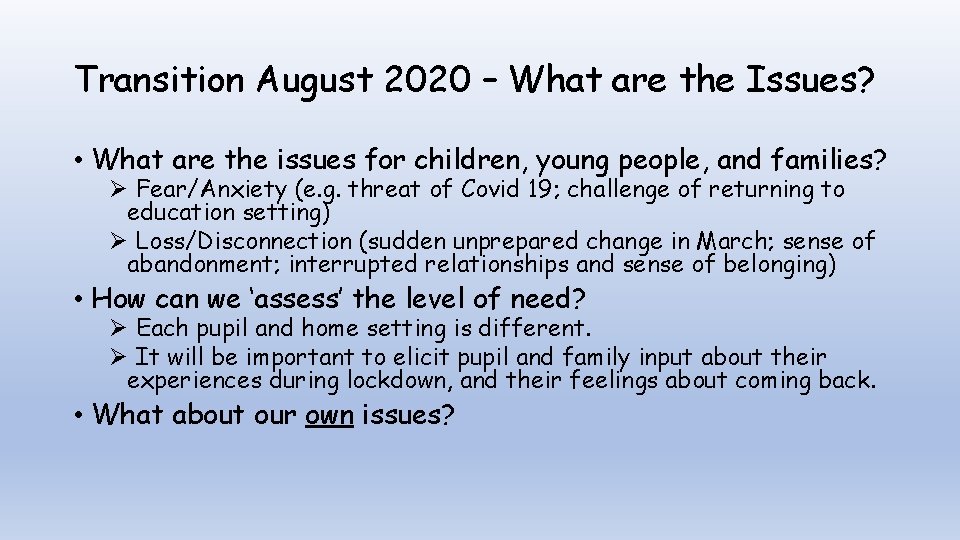
Transition August 2020 – What are the Issues? • What are the issues for children, young people, and families? Ø Fear/Anxiety (e. g. threat of Covid 19; challenge of returning to education setting) Ø Loss/Disconnection (sudden unprepared change in March; sense of abandonment; interrupted relationships and sense of belonging) • How can we ‘assess’ the level of need? Ø Each pupil and home setting is different. Ø It will be important to elicit pupil and family input about their experiences during lockdown, and their feelings about coming back. • What about our own issues?
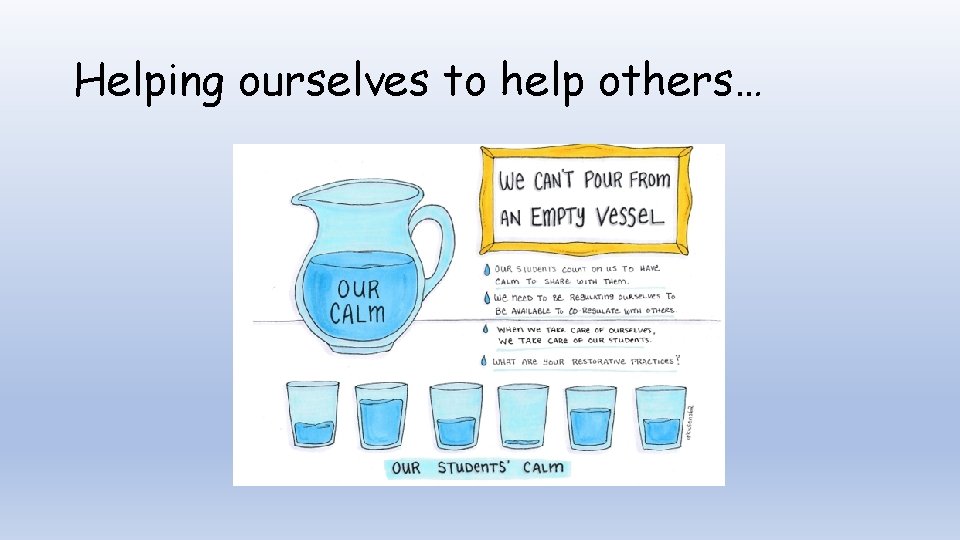
Helping ourselves to help others…
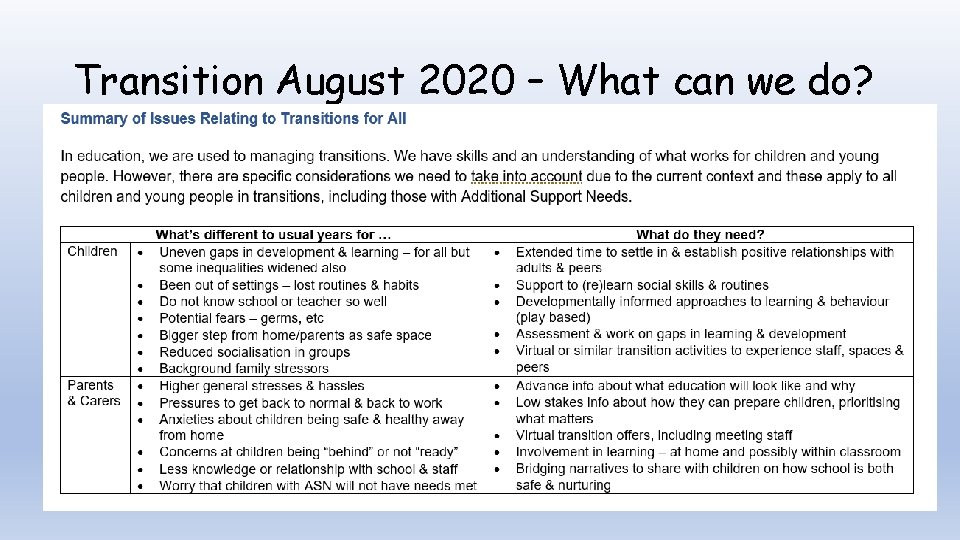
Transition August 2020 – What can we do?
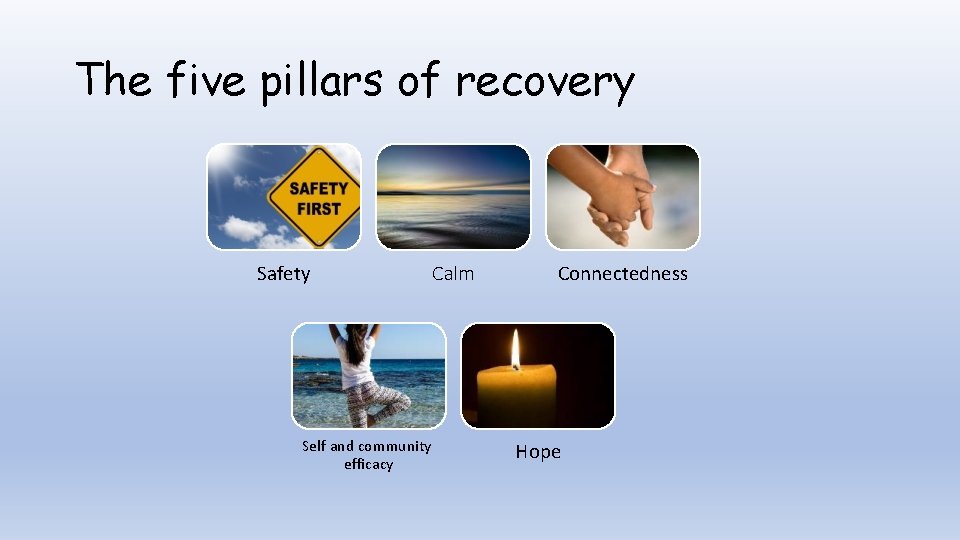
The five pillars of recovery Safety Self and community efficacy Calm Connectedness Hope
Orkney 2020 Transition Guidance Contents • Contents Page Overview • Appendices and Exemplars Overview
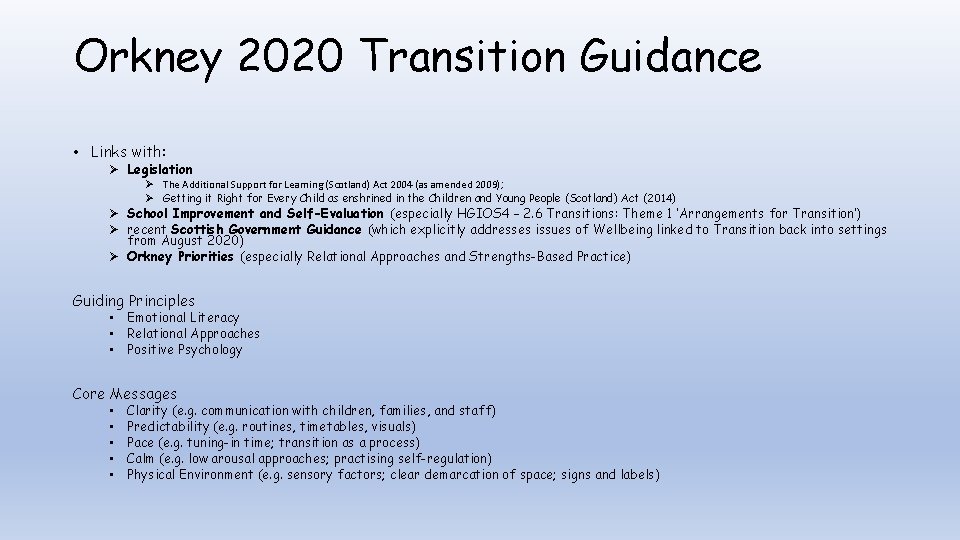
Orkney 2020 Transition Guidance • Links with: Ø Legislation Ø The Additional Support for Learning (Scotland) Act 2004 (as amended 2009); Ø Getting it Right for Every Child as enshrined in the Children and Young People (Scotland) Act (2014) Ø School Improvement and Self-Evaluation (especially HGIOS 4 – 2. 6 Transitions: Theme 1 ‘Arrangements for Transition’) Ø recent Scottish Government Guidance (which explicitly addresses issues of Wellbeing linked to Transition back into settings from August 2020) Ø Orkney Priorities (especially Relational Approaches and Strengths-Based Practice) Guiding Principles • Emotional Literacy • Relational Approaches • Positive Psychology Core Messages • • • Clarity (e. g. communication with children, families, and staff) Predictability (e. g. routines, timetables, visuals) Pace (e. g. tuning-in time; transition as a process) Calm (e. g. low arousal approaches; practising self-regulation) Physical Environment (e. g. sensory factors; clear demarcation of space; signs and labels)
Transition is a process… It will take time to re-learn the habits of attending an education setting. • Be patient • Interpret behaviours as communications of emotion • Think… Connection before Correction (Dan Hughes)
Transition for Children and Young People with Autism This section will help us to engage with recent Scottish Government expectations (in partnership with NAIT [Scottish Government’s National Autism Implementation Team] and the NAS [National Autistic Society]). Especially, a call for personalized planning for transition back to education settings focused on ASD-related needs. More resources at: https: //www. thirdspace. scot/nait/covid-19 -return-to-school/
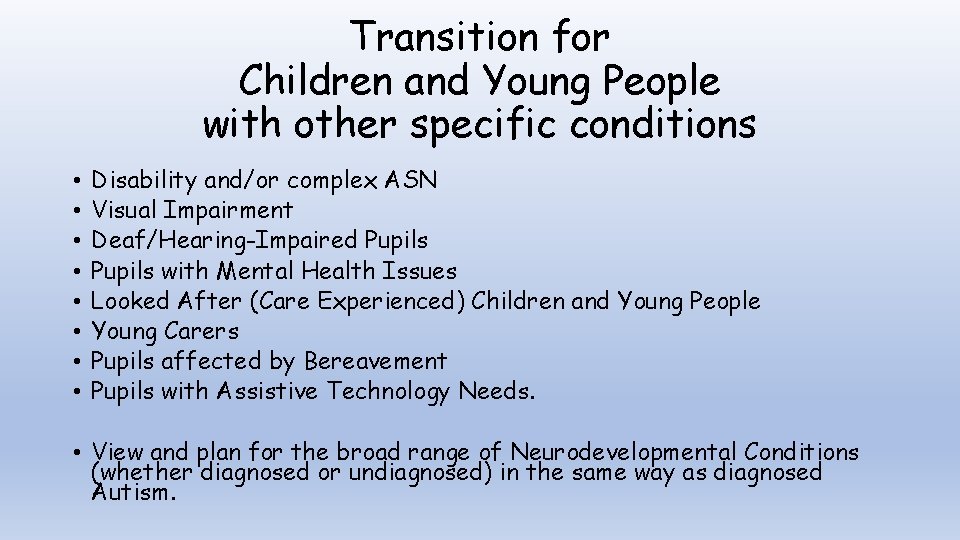
Transition for Children and Young People with other specific conditions • • Disability and/or complex ASN Visual Impairment Deaf/Hearing-Impaired Pupils with Mental Health Issues Looked After (Care Experienced) Children and Young People Young Carers Pupils affected by Bereavement Pupils with Assistive Technology Needs. • View and plan for the broad range of Neurodevelopmental Conditions (whether diagnosed or undiagnosed) in the same way as diagnosed Autism.
Orkney 2020 Transition Guidance Appendices and Supplements
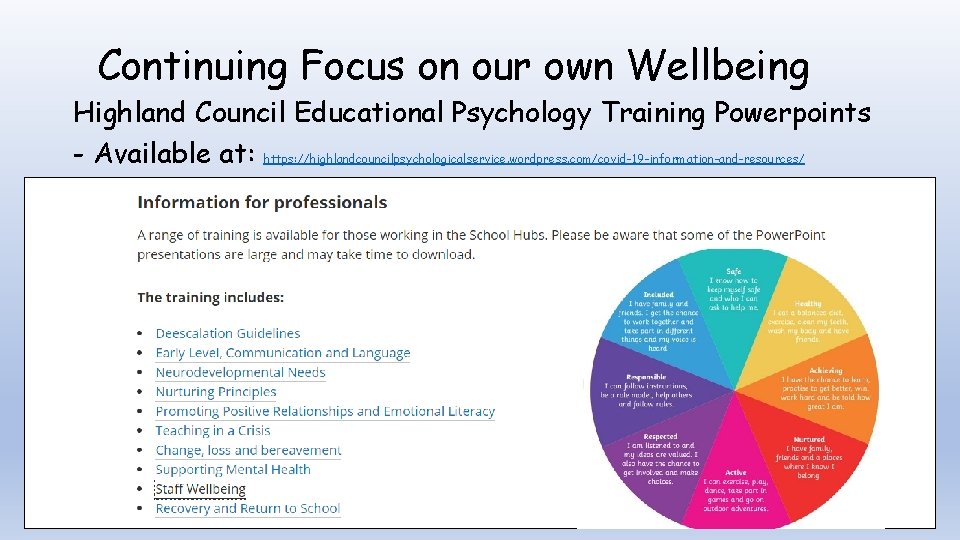
Continuing Focus on our own Wellbeing Highland Council Educational Psychology Training Powerpoints - Available at: https: //highlandcouncilpsychologicalservice. wordpress. com/covid-19 -information-and-resources/
Discussion (to be continued…) Some suggested topics: • How can we gauge need for additional transition support in these early days? • Are there children we already know of with specific conditions/needs? • How can we record our focused planning for specific pupils? • What should we do, now and ongoing, to communicate effectively and reduce uncertainty for children and young people, families, and staff?