
Reminder n Please return Assignment 1 to the

- Slides: 40
Reminder n Please return Assignment 1 to the School Office by 13: 00 Weds. 11 th February (tomorrow!) – The assignment questions will be reviewed in next week’s workshop
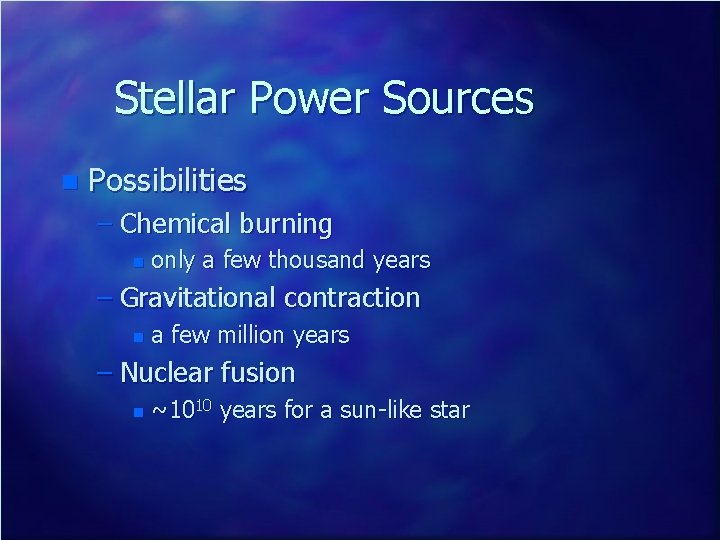
Stellar Power Sources n Possibilities – Chemical burning n only a few thousand years – Gravitational contraction n a few million years – Nuclear fusion n ~1010 years for a sun-like star
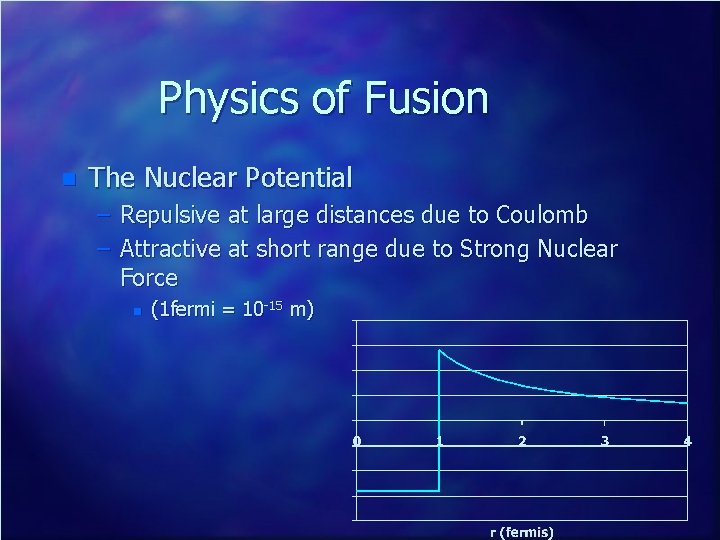
Physics of Fusion n The Nuclear Potential – Repulsive at large distances due to Coulomb – Attractive at short range due to Strong Nuclear Force n (1 fermi = 10 -15 m)
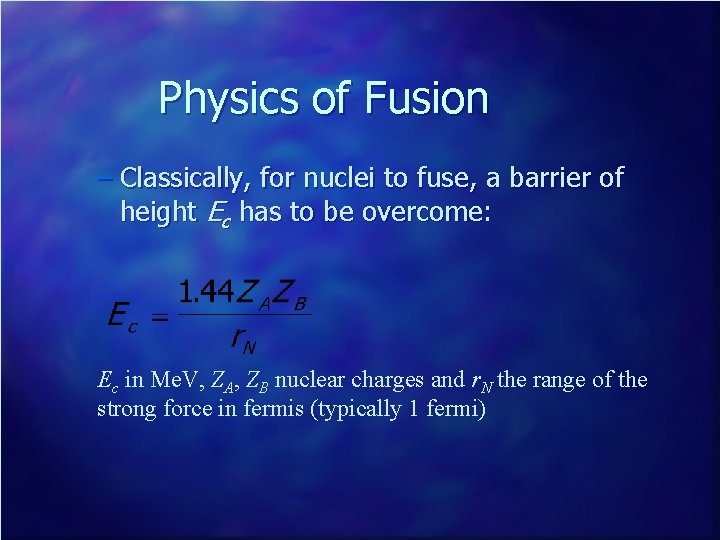
Physics of Fusion – Classically, for nuclei to fuse, a barrier of height Ec has to be overcome: Ec in Me. V, ZA, ZB nuclear charges and r. N the range of the strong force in fermis (typically 1 fermi)
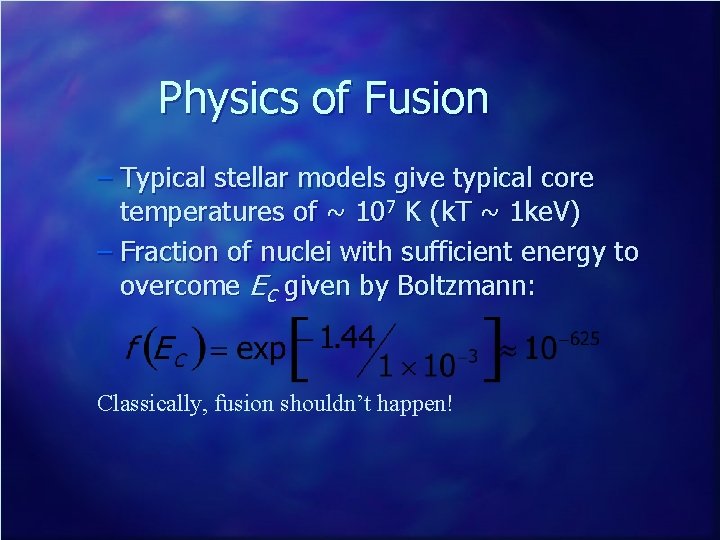
Physics of Fusion – Typical stellar models give typical core temperatures of ~ 107 K (k. T ~ 1 ke. V) – Fraction of nuclei with sufficient energy to overcome EC given by Boltzmann: Classically, fusion shouldn’t happen!
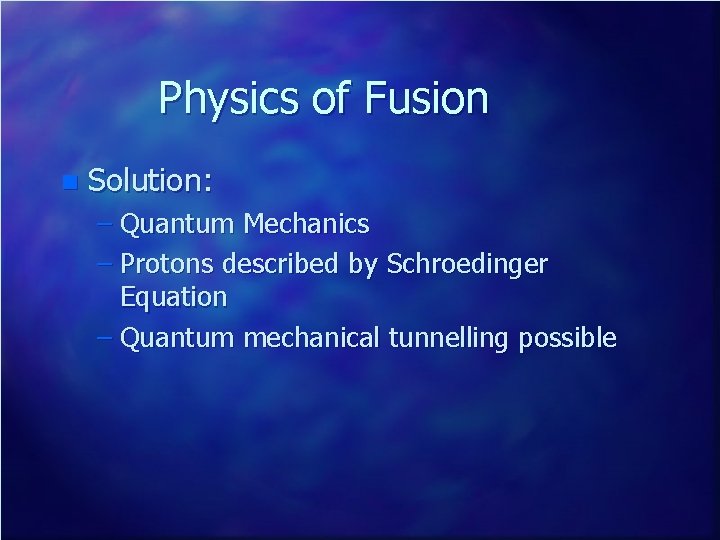
Physics of Fusion n Solution: – Quantum Mechanics – Protons described by Schroedinger Equation – Quantum mechanical tunnelling possible
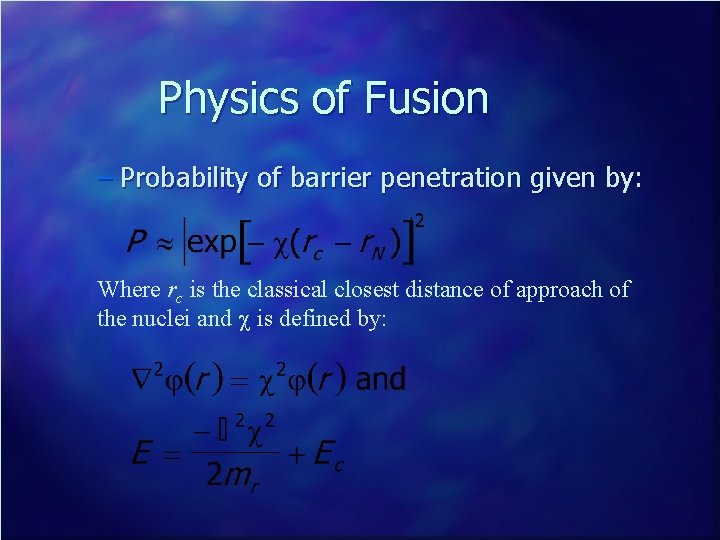
Physics of Fusion – Probability of barrier penetration given by: Where rc is the classical closest distance of approach of the nuclei and c is defined by:
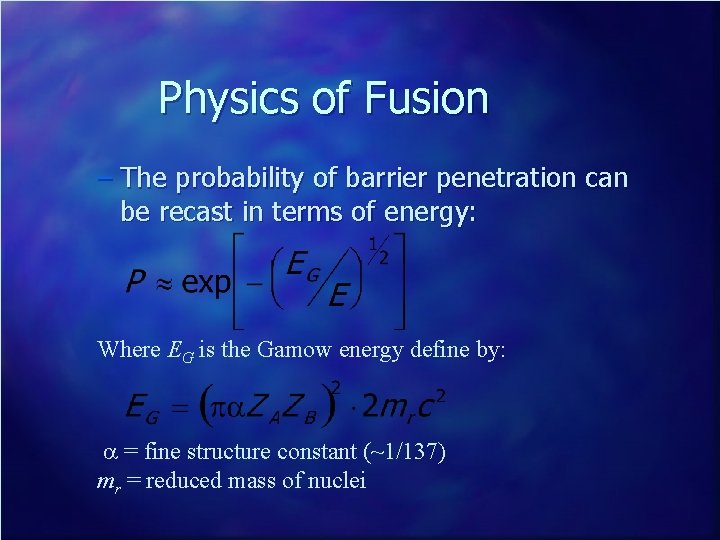
Physics of Fusion – The probability of barrier penetration can be recast in terms of energy: Where EG is the Gamow energy define by: a = fine structure constant (~1/137) mr = reduced mass of nuclei
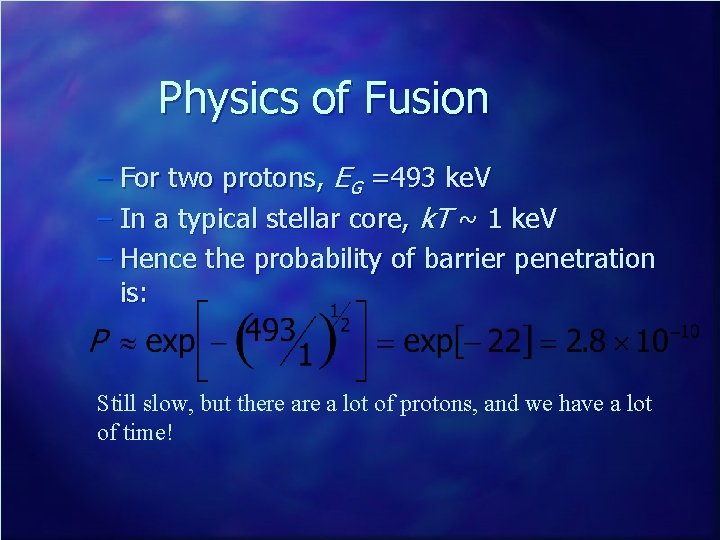
Physics of Fusion – For two protons, EG =493 ke. V – In a typical stellar core, k. T ~ 1 ke. V – Hence the probability of barrier penetration is: Still slow, but there a lot of protons, and we have a lot of time!
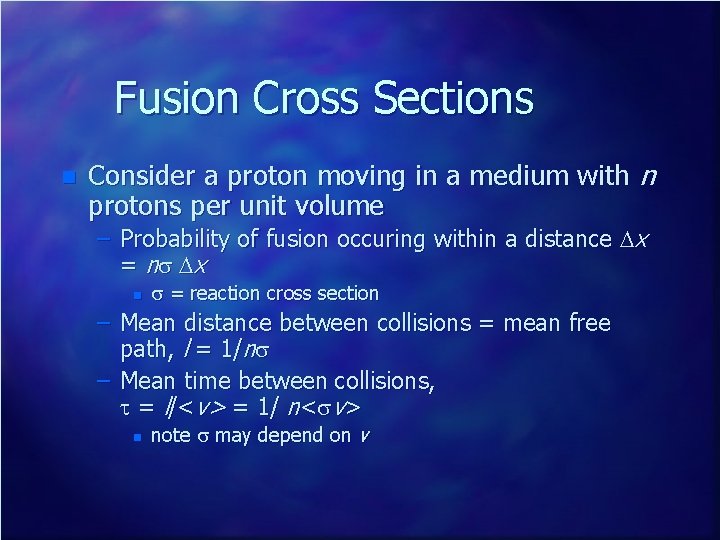
Fusion Cross Sections n Consider a proton moving in a medium with n protons per unit volume – Probability of fusion occuring within a distance Dx = ns D x n s = reaction cross section – Mean distance between collisions = mean free path, l = 1/ns – Mean time between collisions, t = l/<v> = 1/ n<sv> n note s may depend on v
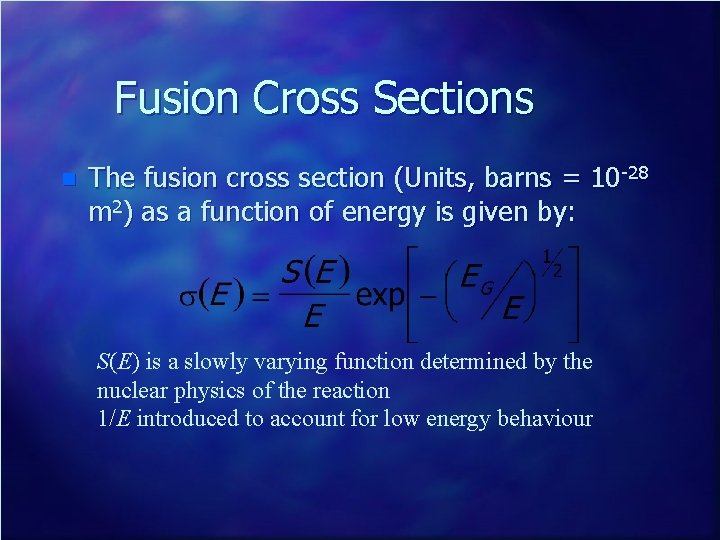
Fusion Cross Sections n The fusion cross section (Units, barns = 10 -28 m 2) as a function of energy is given by: S(E) is a slowly varying function determined by the nuclear physics of the reaction 1/E introduced to account for low energy behaviour
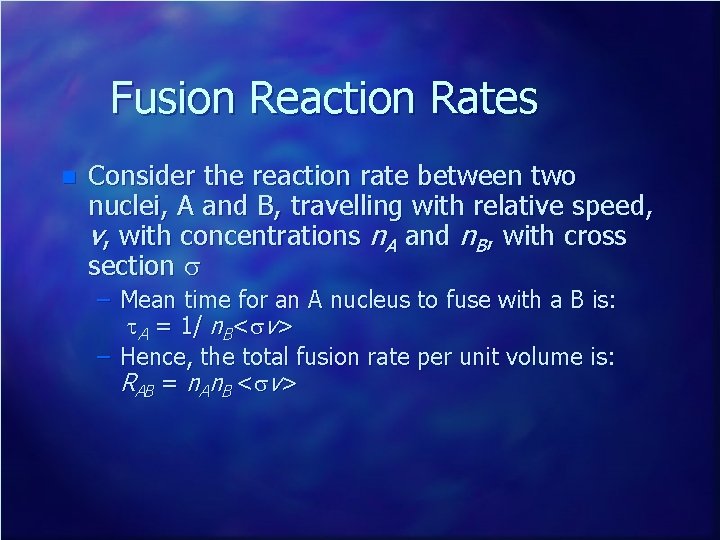
Fusion Reaction Rates n Consider the reaction rate between two nuclei, A and B, travelling with relative speed, v, with concentrations n. A and n. B, with cross section s – Mean time for an A nucleus to fuse with a B is: t. A = 1/ n. B<sv> – Hence, the total fusion rate per unit volume is: RAB = n. An. B <sv>
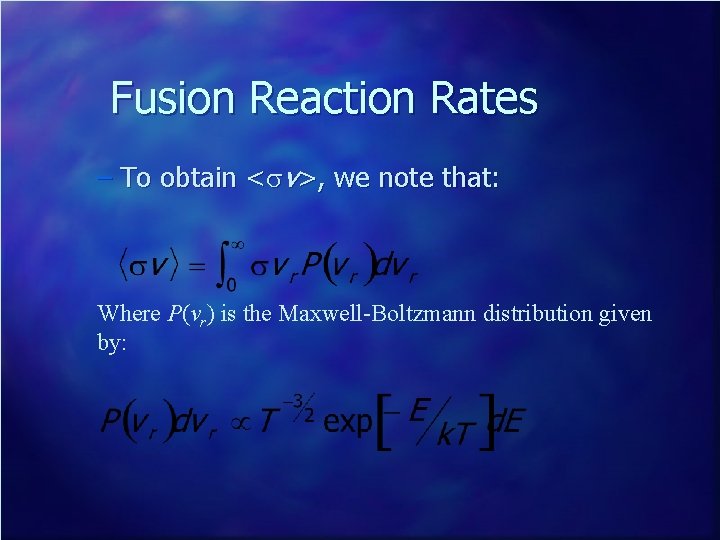
Fusion Reaction Rates – To obtain <sv>, we note that: Where P(vr) is the Maxwell-Boltzmann distribution given by:
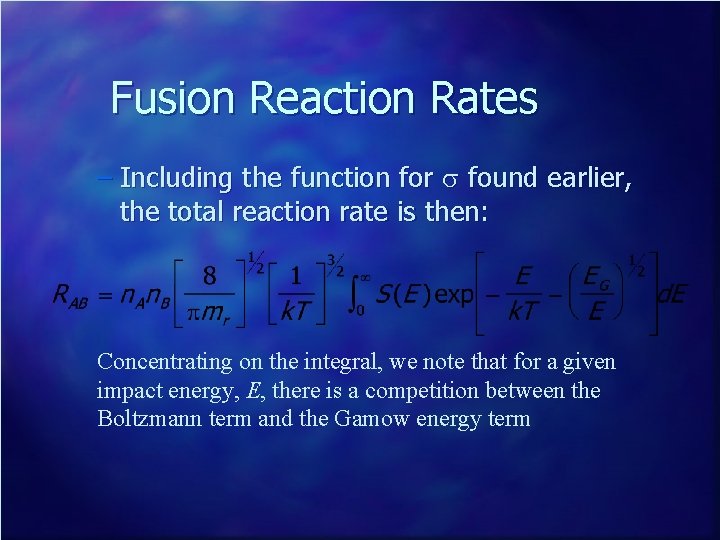
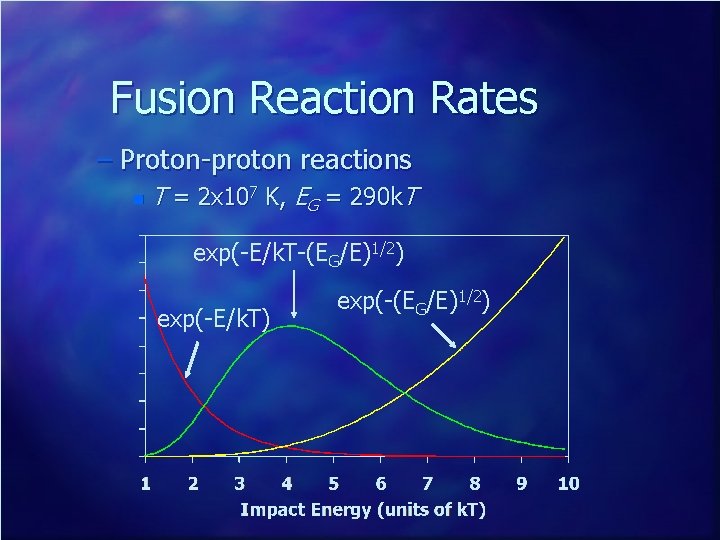
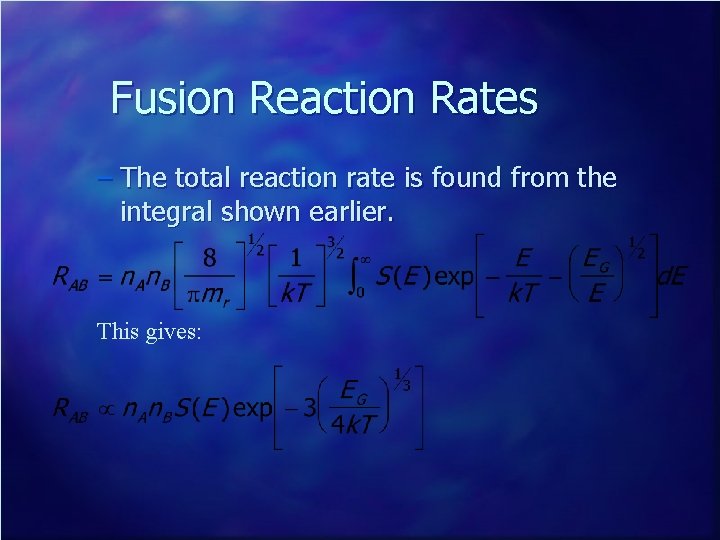
Fusion Reaction Rates – Including the function for s found earlier, the total reaction rate is then: Concentrating on the integral, we note that for a given impact energy, E, there is a competition between the Boltzmann term and the Gamow energy term
Fusion Reaction Rates – Proton-proton reactions n T = 2 x 10⁷ K, EG = 290 k. T exp(-E/k. T-(EG/E)1/2) exp(-E/k. T) exp(-(EG/E)1/2)
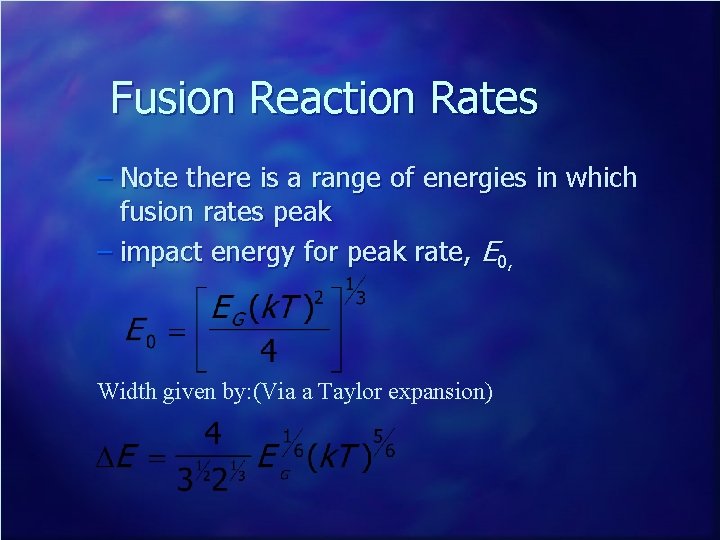
Fusion Reaction Rates – Note there is a range of energies in which fusion rates peak – impact energy for peak rate, E 0, Width given by: (Via a Taylor expansion)
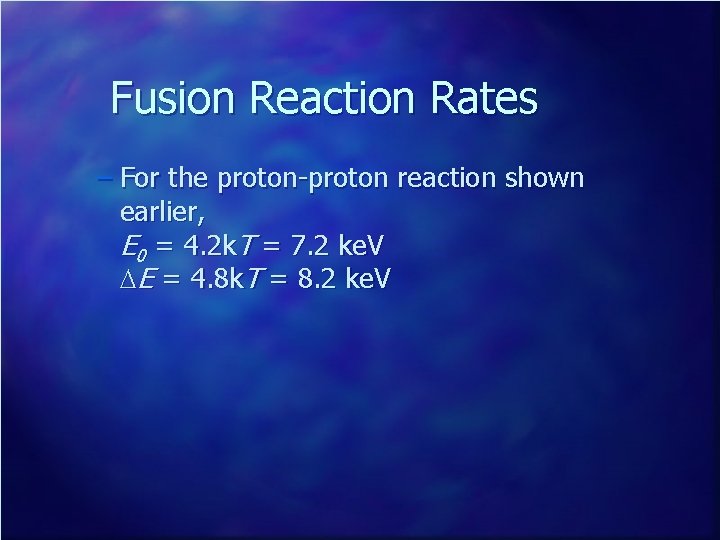
Fusion Reaction Rates – For the proton-proton reaction shown earlier, E 0 = 4. 2 k. T = 7. 2 ke. V DE = 4. 8 k. T = 8. 2 ke. V
Fusion Reaction Rates – The total reaction rate is found from the integral shown earlier. This gives:
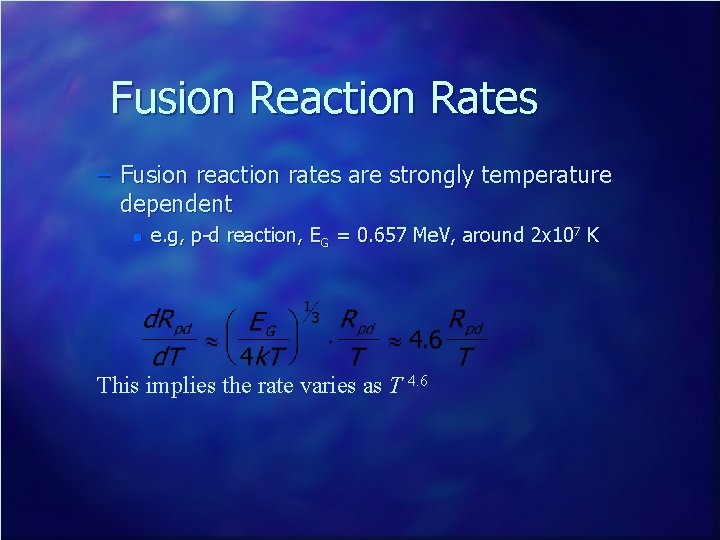
Fusion Reaction Rates – Fusion reaction rates are strongly temperature dependent n e. g, p-d reaction, EG = 0. 657 Me. V, around 2 x 10⁷ K This implies the rate varies as T 4. 6
Fusion in Stars I n Hydrogen fusion mechanisms in main sequence stars – Proton-Proton Chain – CNO Cycle – Relative rates and temperature dependencies
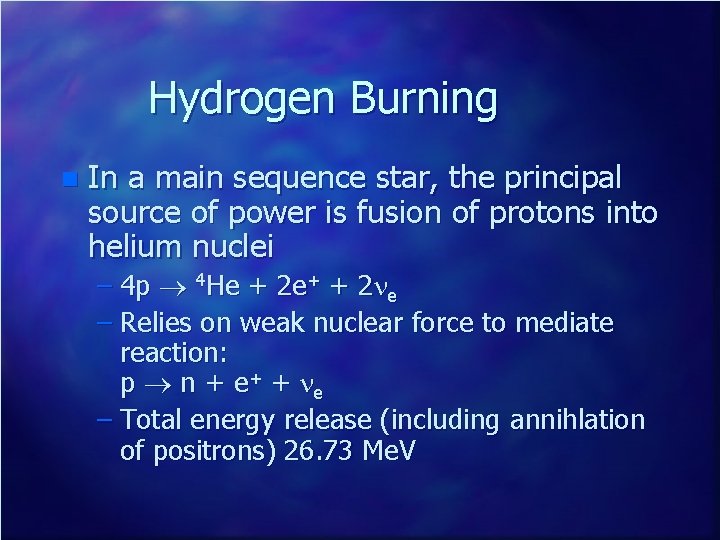
Hydrogen Burning n In a main sequence star, the principal source of power is fusion of protons into helium nuclei – 4 p ® 4 He + 2 e+ + 2 ne – Relies on weak nuclear force to mediate reaction: p ® n + e + + ne – Total energy release (including annihlation of positrons) 26. 73 Me. V
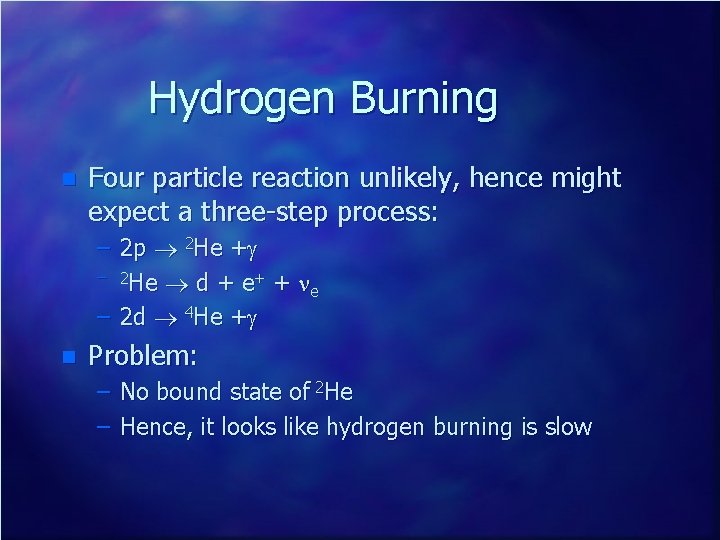
Hydrogen Burning n Four particle reaction unlikely, hence might expect a three-step process: – 2 p ® 2 He +g – 2 He ® d + e+ + n e – 2 d ® 4 He +g n Problem: – No bound state of 2 He – Hence, it looks like hydrogen burning is slow
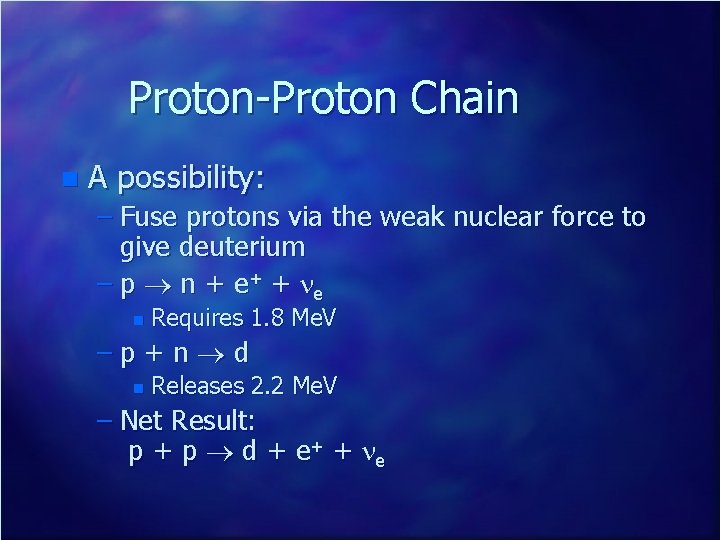
Proton-Proton Chain n A possibility: – Fuse protons via the weak nuclear force to give deuterium – p ® n + e + + ne n Requires 1. 8 Me. V –p+n®d n Releases 2. 2 Me. V – Net Result: p + p ® d + e + + ne
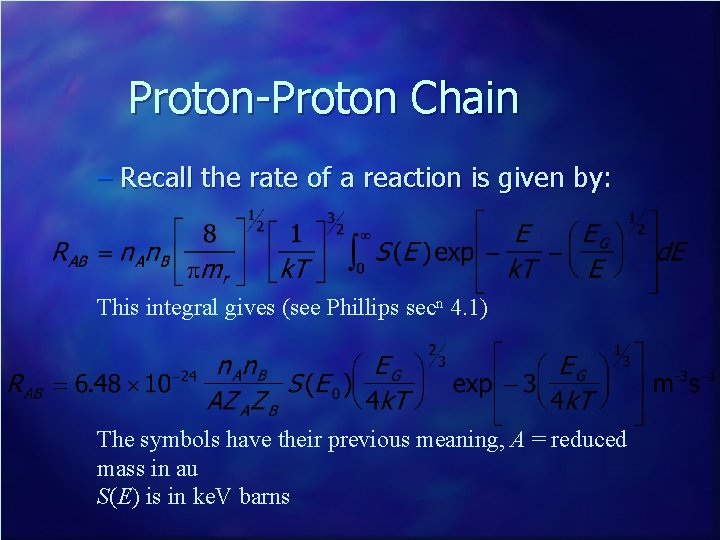
Proton-Proton Chain – Recall the rate of a reaction is given by: This integral gives (see Phillips secn 4. 1) The symbols have their previous meaning, A = reduced mass in au S(E) is in ke. V barns
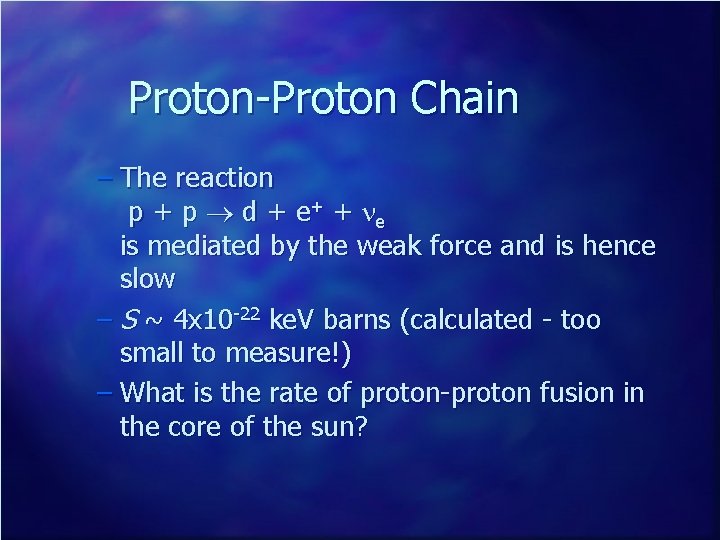
Proton-Proton Chain – The reaction p + p ® d + e + + ne is mediated by the weak force and is hence slow – S ~ 4 x 10 -22 ke. V barns (calculated - too small to measure!) – What is the rate of proton-proton fusion in the core of the sun?
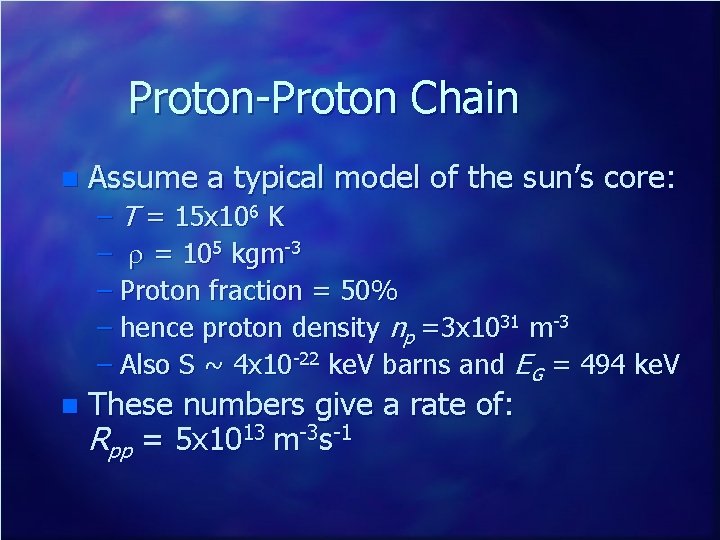
Proton-Proton Chain n Assume a typical model of the sun’s core: – T = 15 x 106 K – r = 105 kgm-3 – Proton fraction = 50% – hence proton density np =3 x 1031 m-3 – Also S ~ 4 x 10 -22 ke. V barns and EG = 494 ke. V n These numbers give a rate of: Rpp = 5 x 10¹³ m-3 s-1
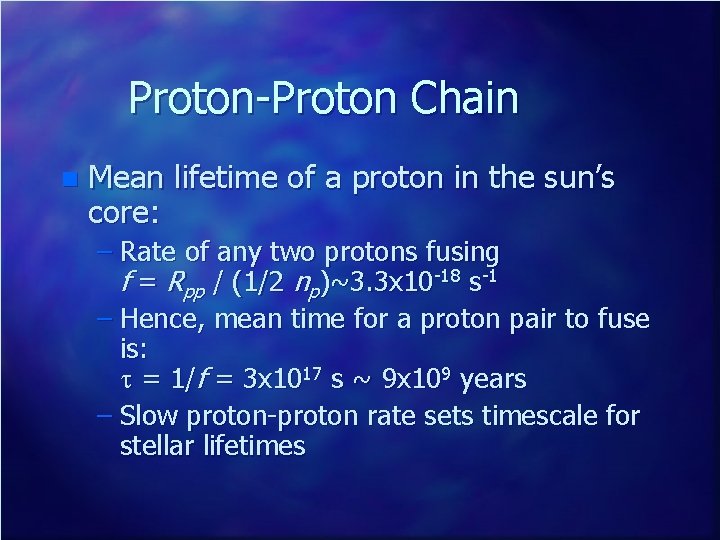
Proton-Proton Chain n Mean lifetime of a proton in the sun’s core: – Rate of any two protons fusing f = Rpp / (1/2 np)~3. 3 x 10 -18 s-1 – Hence, mean time for a proton pair to fuse is: t = 1/f = 3 x 10¹⁷ s ~ 9 x 10⁹ years – Slow proton-proton rate sets timescale for stellar lifetimes
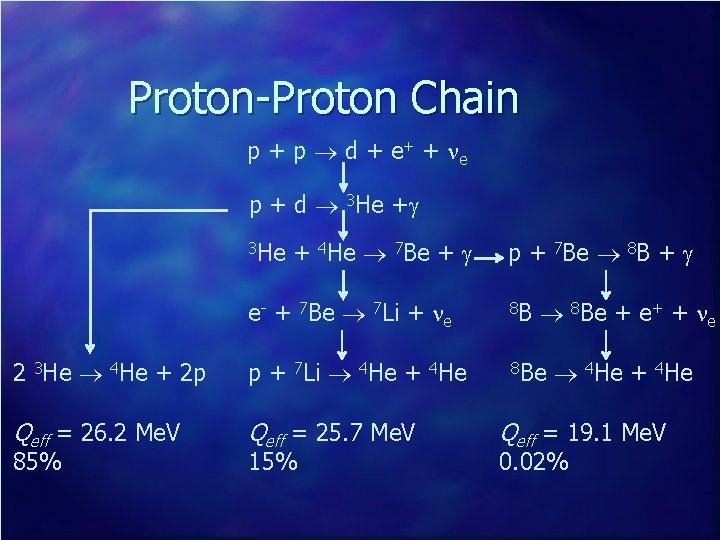
Proton-Proton Chain Following p-p fusion, further reactions to produce 4 He are rapid n The proton-proton chain can follow three branches (pathways): n
Proton-Proton Chain p + p ® d + e + + ne p + d ® 3 He +g 3 He + 4 He ® 7 Be + g p + 7 Be ® 8 B + g e- + 7 Be ® 7 Li + ne 8 B 2 3 He ® 4 He + 2 p p + 7 Li ® 4 He + 4 He 8 Be Qeff = 26. 2 Me. V Qeff = 25. 7 Me. V 85% 15% ® 8 Be + e+ + ne ® 4 He + 4 He Qeff = 19. 1 Me. V 0. 02%
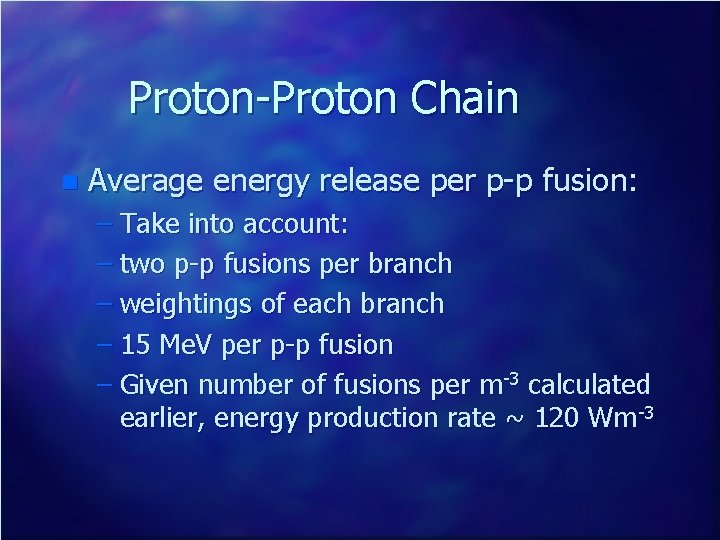
Proton-Proton Chain n Average energy release per p-p fusion: – Take into account: – two p-p fusions per branch – weightings of each branch – 15 Me. V per p-p fusion – Given number of fusions per m-3 calculated earlier, energy production rate ~ 120 Wm-3
The CNO Cycle The proton-proton chain has a temperature dependence of ~ T 4 n Internal temperatures of more massive stars are only moderatly higher n Luminosities much greater than can be explained by the T 4 dependence n
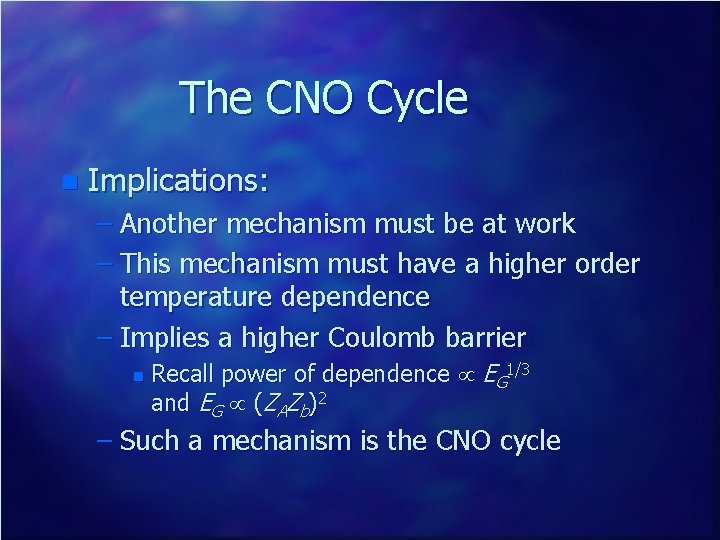
The CNO Cycle n Implications: – Another mechanism must be at work – This mechanism must have a higher order temperature dependence – Implies a higher Coulomb barrier n Recall power of dependence µ EG 1/3 and EG µ (ZAZb)2 – Such a mechanism is the CNO cycle
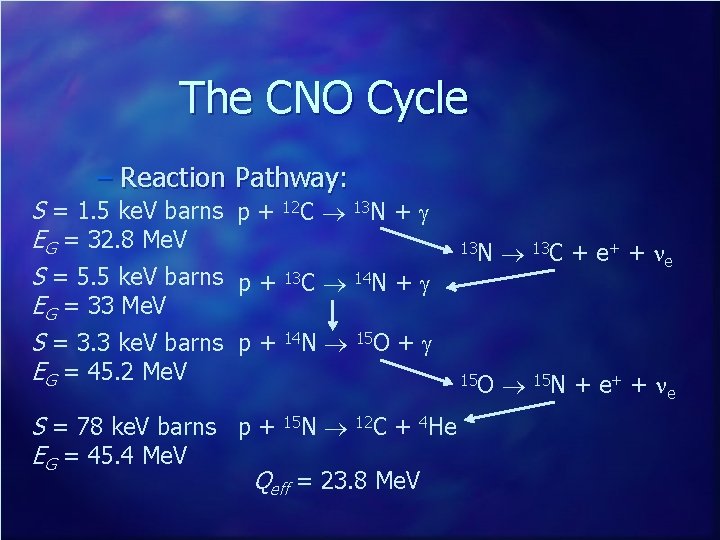
The CNO Cycle – Reaction Pathway: S = 1. 5 ke. V barns p + 12 C ® 13 N + g EG = 32. 8 Me. V S = 5. 5 ke. V barns p + 13 C ® 14 N + g EG = 33 Me. V S = 3. 3 ke. V barns p + 14 N ® 15 O + g EG = 45. 2 Me. V S = 78 ke. V barns p + 15 N ® 12 C + 4 He EG = 45. 4 Me. V Qeff = 23. 8 Me. V 13 N ® 13 C + e + + ne 15 O ® 15 N + e + + ne
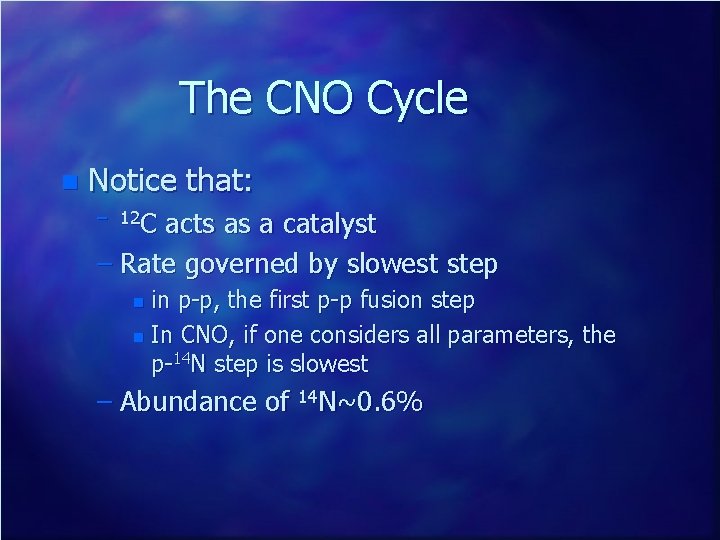
The CNO Cycle n Notice that: – 12 C acts as a catalyst – Rate governed by slowest step in p-p, the first p-p fusion step n In CNO, if one considers all parameters, the p-14 N step is slowest n – Abundance of 14 N~0. 6%
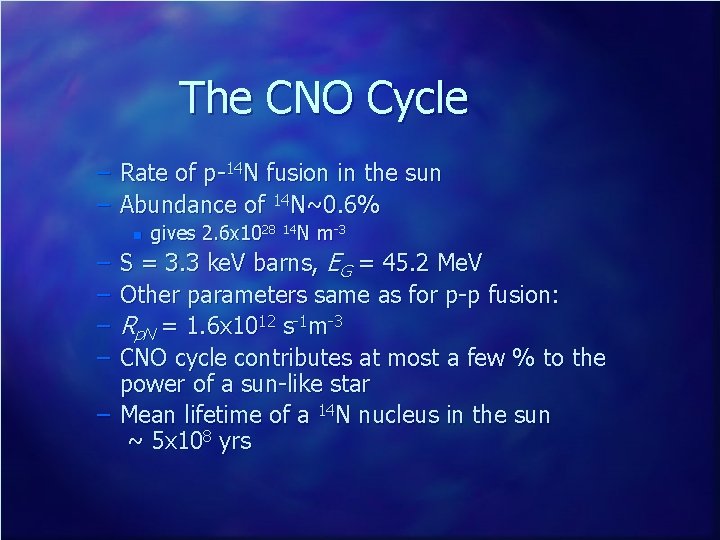
The CNO Cycle – Rate of p-14 N fusion in the sun – Abundance of 14 N~0. 6% n gives 2. 6 x 1028 14 N m-3 S = 3. 3 ke. V barns, EG = 45. 2 Me. V Other parameters same as for p-p fusion: Rp. N = 1. 6 x 10¹² s-1 m-3 CNO cycle contributes at most a few % to the power of a sun-like star – Mean lifetime of a 14 N nucleus in the sun ~ 5 x 10⁸ yrs – –
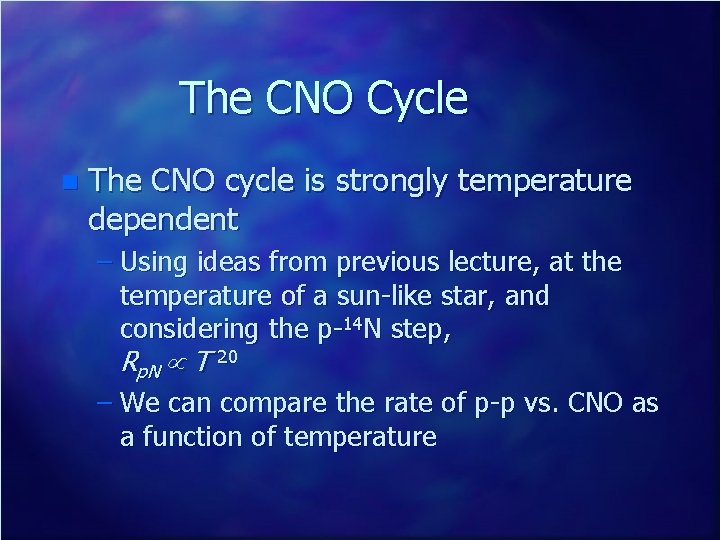
The CNO Cycle n The CNO cycle is strongly temperature dependent – Using ideas from previous lecture, at the temperature of a sun-like star, and considering the p-14 N step, Rp. N µ T 20 – We can compare the rate of p-p vs. CNO as a function of temperature
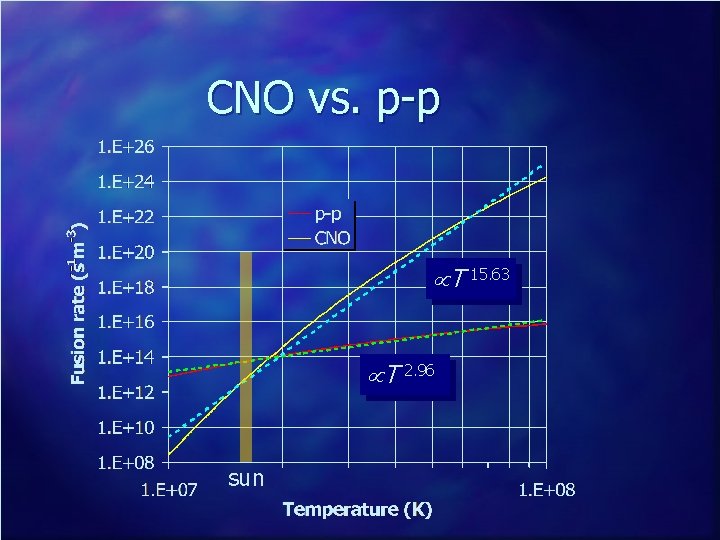
CNO vs. p-p µT 15. 63 µT 2. 96 sun
CNO vs. p-p n We can see that: – CNO contributes a few % of the sun’s output – In a moderately hotter stellar core (~1. 8 x 10⁷ K) CNO ~ p-p – In hot (>2 x 10⁷) cores, CNO > p-p
A requirement for CNO n The CNO cycle requires the heavy elements C, N and O. – These elements have negligible abundance from the Big Bang – They are not formed in the p-p chain – What is the origin of heavy elements? – See Next Lecture - Fusion in Stars II
Next Week Heavy element production n Star formation n