
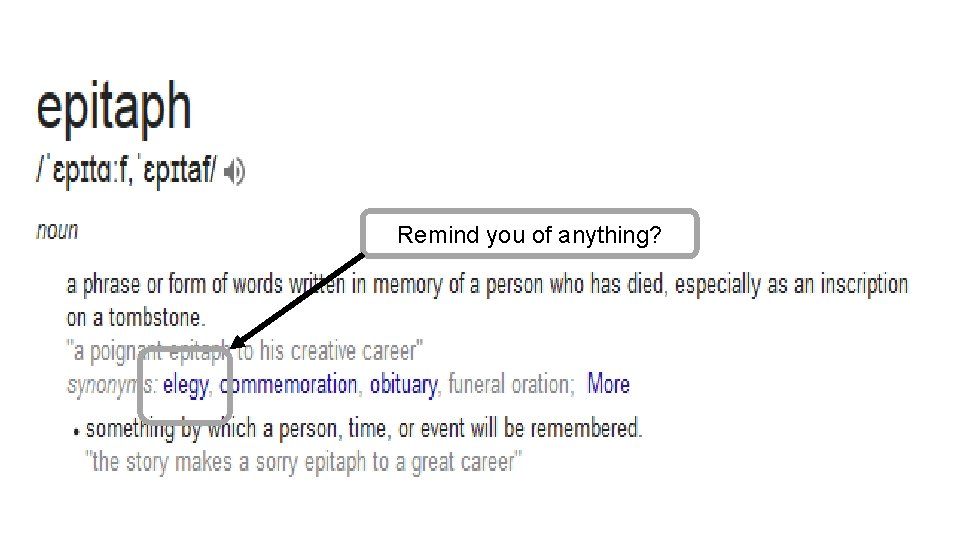
Remind you of anything Epitaph on a Well
- Slides: 13
Remind you of anything?
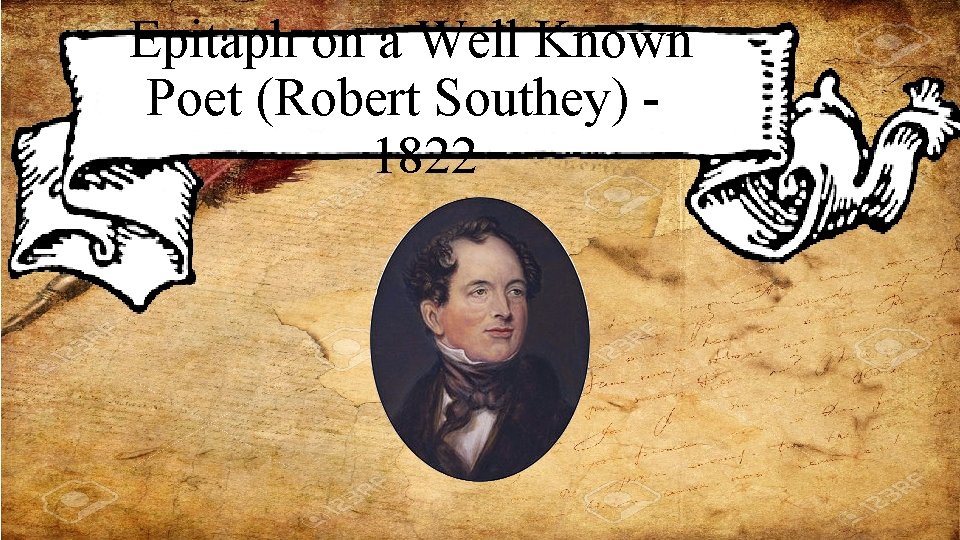
Epitaph on a Well Known Poet (Robert Southey) 1822
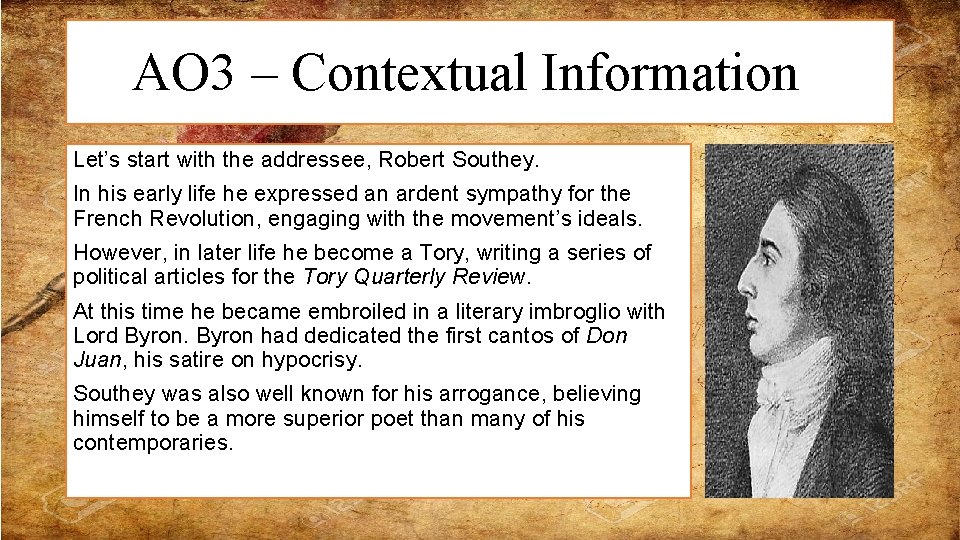
AO 3 – Contextual Information Let’s start with the addressee, Robert Southey. In his early life he expressed an ardent sympathy for the French Revolution, engaging with the movement’s ideals. However, in later life he become a Tory, writing a series of political articles for the Tory Quarterly Review. At this time he became embroiled in a literary imbroglio with Lord Byron had dedicated the first cantos of Don Juan, his satire on hypocrisy. Southey was also well known for his arrogance, believing himself to be a more superior poet than many of his contemporaries.
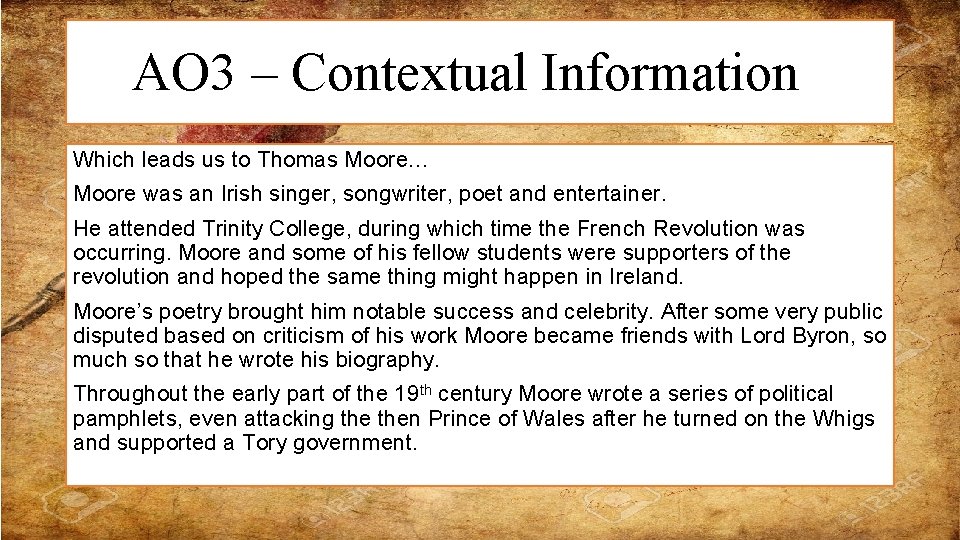
AO 3 – Contextual Information Which leads us to Thomas Moore… Moore was an Irish singer, songwriter, poet and entertainer. He attended Trinity College, during which time the French Revolution was occurring. Moore and some of his fellow students were supporters of the revolution and hoped the same thing might happen in Ireland. Moore’s poetry brought him notable success and celebrity. After some very public disputed based on criticism of his work Moore became friends with Lord Byron, so much so that he wrote his biography. Throughout the early part of the 19 th century Moore wrote a series of political pamphlets, even attacking then Prince of Wales after he turned on the Whigs and supported a Tory government.
AO 3 – Contextual Information The Whigs were the rival party of the Tories and opposed constitutional monarchism and absolute monarchy. They were the totally dominant party until 1760 when King George III allowed the Tories to come back in power. What does all of this mean? Robert Southey was a hypocrite and, in Moore’s eyes, a poor poet. Moore’s Epitaph… is a satirical attack on Southey, his life and his works.
Moore’s satire opens with a description of Southey’s body in the grave. Three key questions: Beneath these poppies buried deep, The bones of Bob the bard lie hid; Peace to his manes, and may he sleep As soundly as his readers did! AO 1 – What sentence mood is used? AO 2 – What effect is created by the end focus of the verb hid? AO 3 – Informal address link to context?
He then moves on to a criticism of his poetic ability. Three key questions: Though every sort of verse meandering, Bob went without a hitch or fall, Through Epic, Sapphic, Alexandrine, To verse that was no verse at all; AO 1 – Find examples of internal rhyme and end focus. AO 2 – Why does Moore asyndetically list abstract poetic forms? AO 3 – How does this quatrain reveal to us Moore’s opinion of Southey’s work?
Quatrain three then focuses on Southey and his political point of view. Three key questions: Till fiction having done enough, To make a bard at least absurd, And give his readers QUANTUM SUFF, To took to praising George the Third: AO 1 – What can you find? AO 2 – What does the adjective ‘absurd’ suggest? AO 3 – Why does Moore reference George the Third?
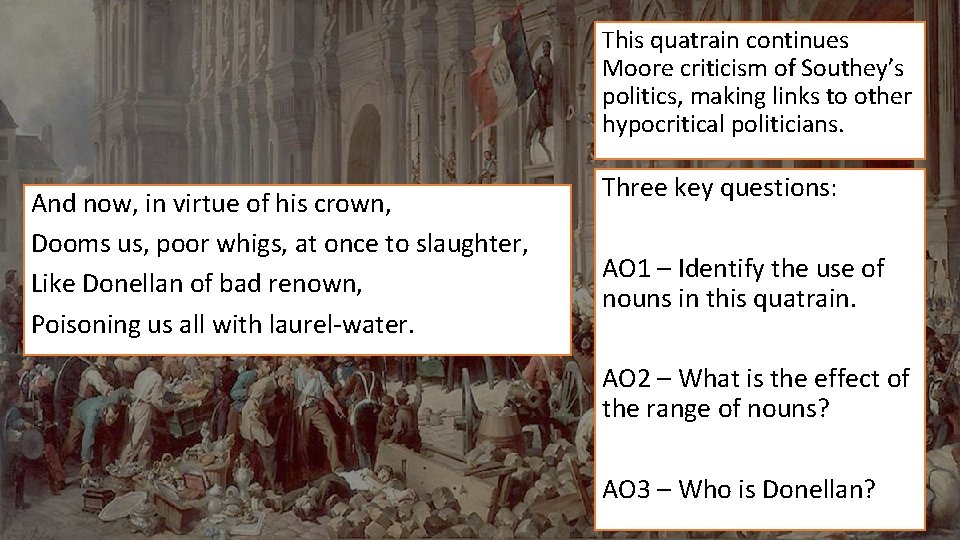
This quatrain continues Moore criticism of Southey’s politics, making links to other hypocritical politicians. And now, in virtue of his crown, Dooms us, poor whigs, at once to slaughter, Like Donellan of bad renown, Poisoning us all with laurel-water. Three key questions: AO 1 – Identify the use of nouns in this quatrain. AO 2 – What is the effect of the range of nouns? AO 3 – Who is Donellan?
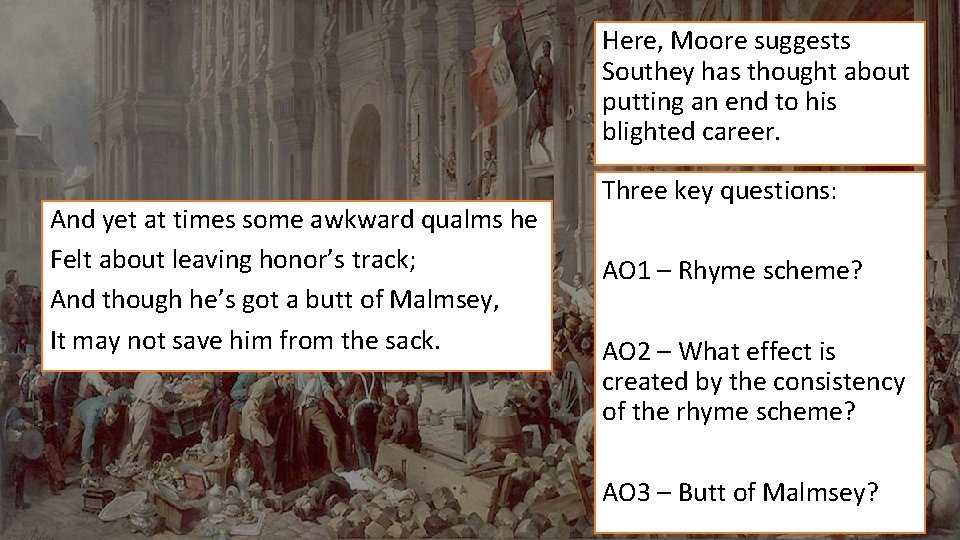
Here, Moore suggests Southey has thought about putting an end to his blighted career. And yet at times some awkward qualms he Felt about leaving honor’s track; And though he’s got a butt of Malmsey, It may not save him from the sack. Three key questions: AO 1 – Rhyme scheme? AO 2 – What effect is created by the consistency of the rhyme scheme? AO 3 – Butt of Malmsey?
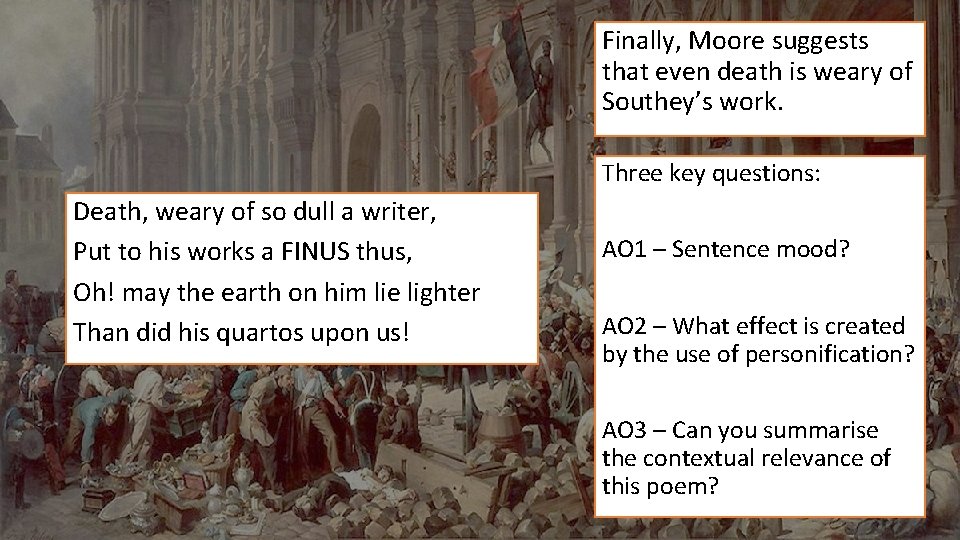
Finally, Moore suggests that even death is weary of Southey’s work. Three key questions: Death, weary of so dull a writer, Put to his works a FINUS thus, Oh! may the earth on him lie lighter Than did his quartos upon us! AO 1 – Sentence mood? AO 2 – What effect is created by the use of personification? AO 3 – Can you summarise the contextual relevance of this poem?
Remind you of anything?
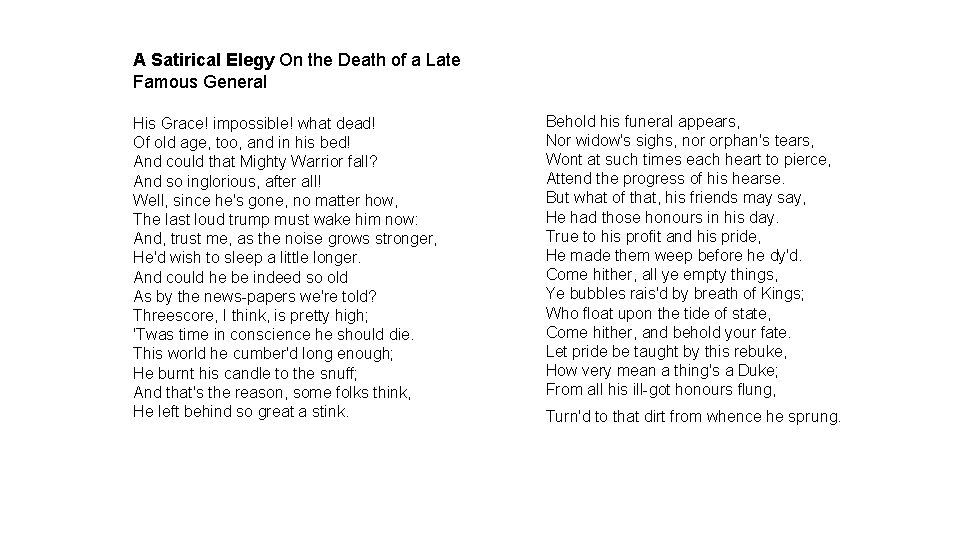
A Satirical Elegy On the Death of a Late Famous General His Grace! impossible! what dead! Of old age, too, and in his bed! And could that Mighty Warrior fall? And so inglorious, after all! Well, since he's gone, no matter how, The last loud trump must wake him now: And, trust me, as the noise grows stronger, He'd wish to sleep a little longer. And could he be indeed so old As by the news-papers we're told? Threescore, I think, is pretty high; 'Twas time in conscience he should die. This world he cumber'd long enough; He burnt his candle to the snuff; And that's the reason, some folks think, He left behind so great a stink. Behold his funeral appears, Nor widow's sighs, nor orphan's tears, Wont at such times each heart to pierce, Attend the progress of his hearse. But what of that, his friends may say, He had those honours in his day. True to his profit and his pride, He made them weep before he dy'd. Come hither, all ye empty things, Ye bubbles rais'd by breath of Kings; Who float upon the tide of state, Come hither, and behold your fate. Let pride be taught by this rebuke, How very mean a thing's a Duke; From all his ill-got honours flung, Turn'd to that dirt from whence he sprung.