
Remeshing for FEM Analysis of Viscous Objects CPSC
Remeshing for FEM Analysis of Viscous Objects CPSC 524 Final Project Tricia Pang, Kyle Porter, Josna Rao January 8, 2008
Outline n Introduction n Dataset n Method n Results n Discussion 2
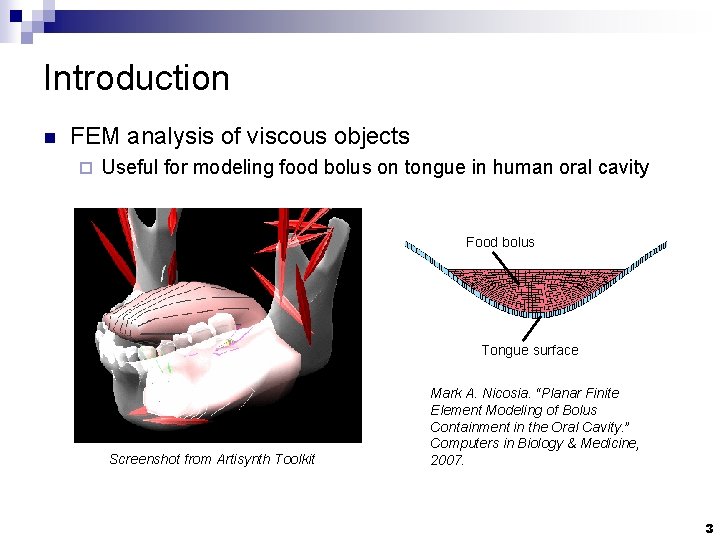
Introduction n FEM analysis of viscous objects ¨ Useful for modeling food bolus on tongue in human oral cavity Food bolus Tongue surface Screenshot from Artisynth Toolkit Mark A. Nicosia. “Planar Finite Element Modeling of Bolus Containment in the Oral Cavity. ” Computers in Biology & Medicine, 2007. 3
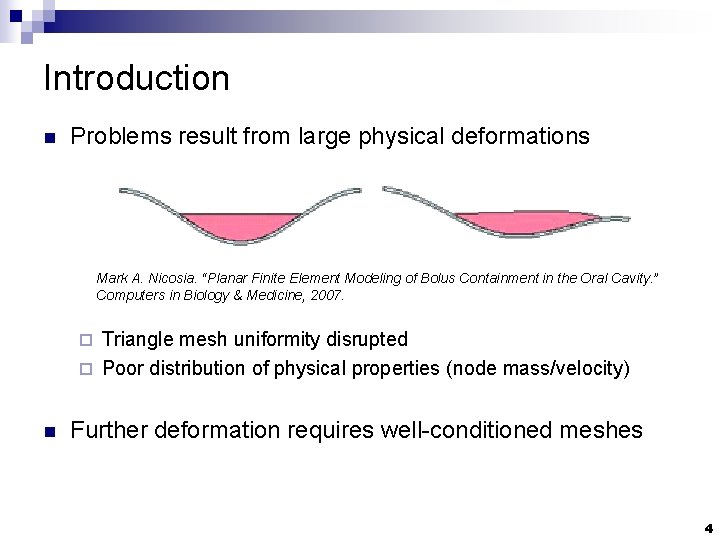
Introduction n Problems result from large physical deformations Mark A. Nicosia. “Planar Finite Element Modeling of Bolus Containment in the Oral Cavity. ” Computers in Biology & Medicine, 2007. Triangle mesh uniformity disrupted ¨ Poor distribution of physical properties (node mass/velocity) ¨ n Further deformation requires well-conditioned meshes 4
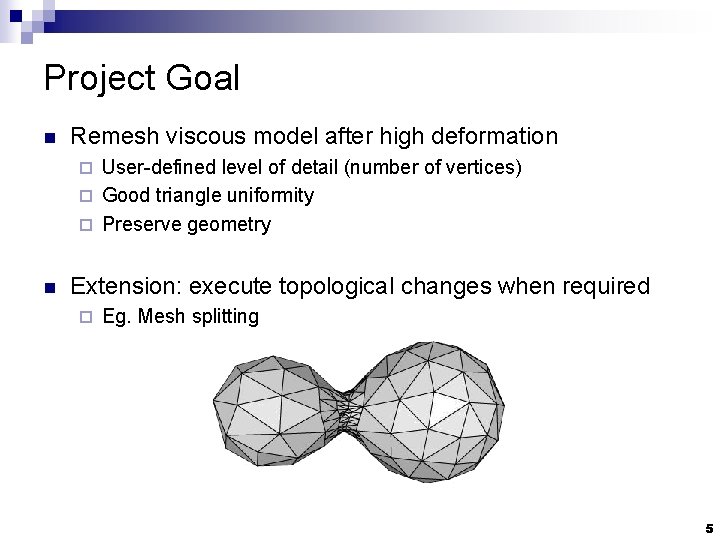
Project Goal n Remesh viscous model after high deformation User-defined level of detail (number of vertices) ¨ Good triangle uniformity ¨ Preserve geometry ¨ n Extension: execute topological changes when required ¨ Eg. Mesh splitting 5
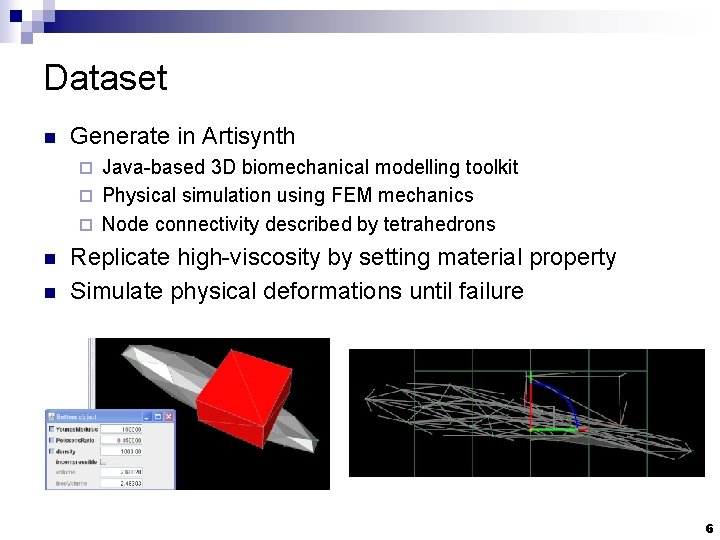
Dataset n Generate in Artisynth Java-based 3 D biomechanical modelling toolkit ¨ Physical simulation using FEM mechanics ¨ Node connectivity described by tetrahedrons ¨ n n Replicate high-viscosity by setting material property Simulate physical deformations until failure 6
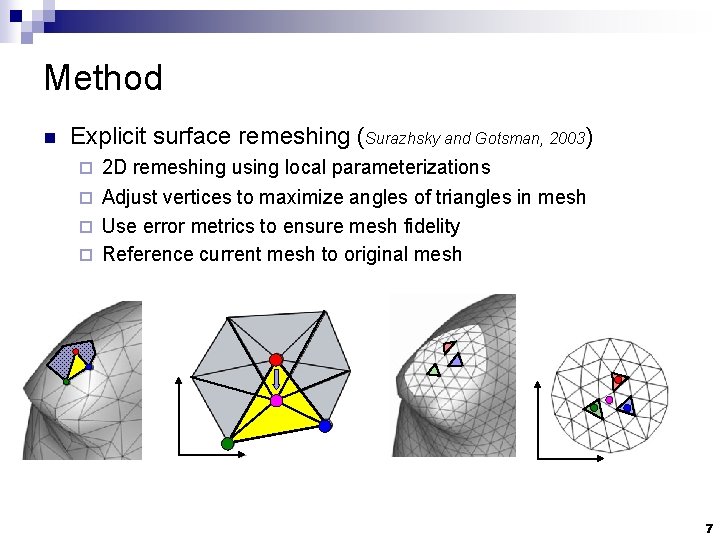
Method n Explicit surface remeshing (Surazhsky and Gotsman, 2003) ¨ 2 D remeshing using local parameterizations Adjust vertices to maximize angles of triangles in mesh ¨ Use error metrics to ensure mesh fidelity ¨ Reference current mesh to original mesh ¨ 7
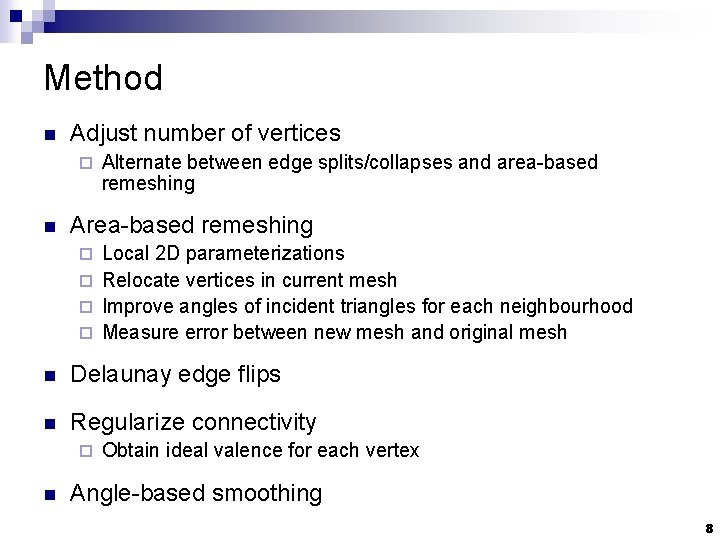
Method n Adjust number of vertices ¨ n Alternate between edge splits/collapses and area-based remeshing Area-based remeshing Local 2 D parameterizations ¨ Relocate vertices in current mesh ¨ Improve angles of incident triangles for each neighbourhood ¨ Measure error between new mesh and original mesh ¨ n Delaunay edge flips n Regularize connectivity ¨ n Obtain ideal valence for each vertex Angle-based smoothing 8
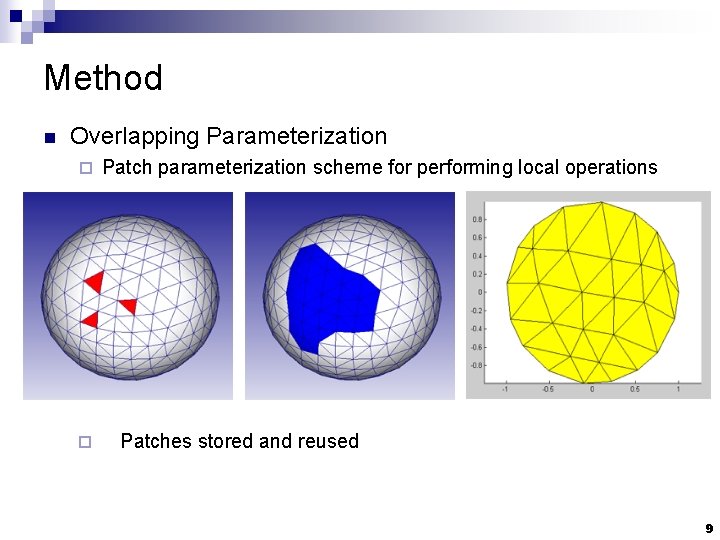
Method n Overlapping Parameterization ¨ ¨ Patch parameterization scheme for performing local operations Patches stored and reused 9
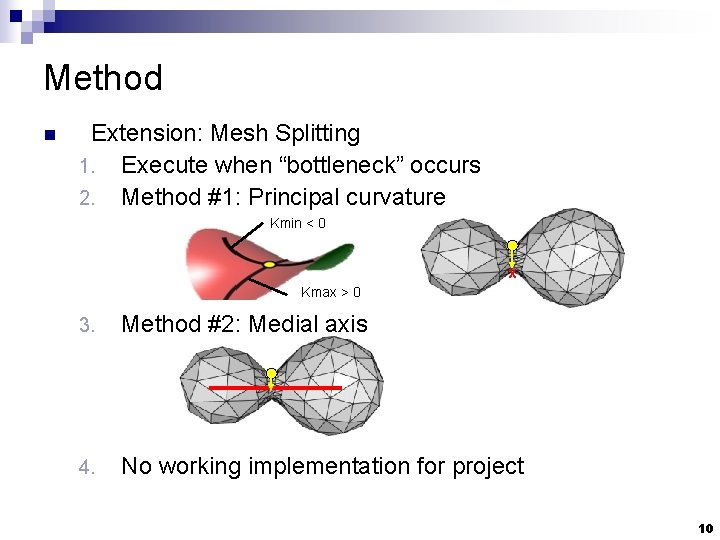
Method n Extension: Mesh Splitting 1. Execute when “bottleneck” occurs 2. Method #1: Principal curvature Kmin < 0 x Kmax > 0 3. Method #2: Medial axis 4. No working implementation for project 10
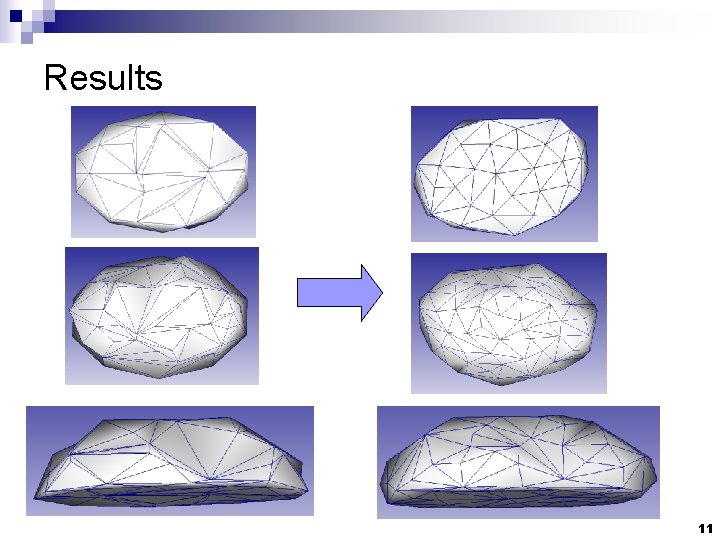
Results 11
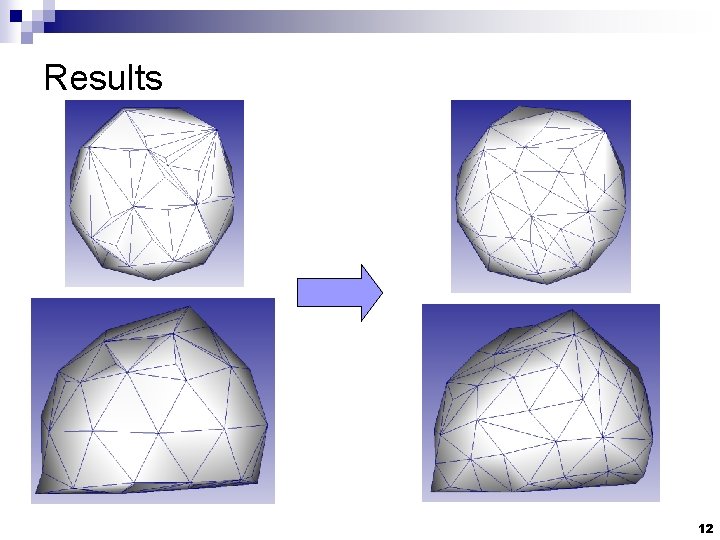
Results 12
Discussion n High triangle uniformity in final meshes n Limitation of method: ¨ Sharp ¨ More n features sometimes not preserved fine-tuning of error metrics Limited dataset ¨ Could not reproduce highly-deformed meshes in Artisynth because poor mesh quality results in deformation failure 13
References n V. Surazhsky and C. Gotsman. Explicit Surface Remeshing. Eurographics Symposium on Geometry Processing, pages 17– 28, 2003. n V. Surazhsky and C. Gotsman. High quality compatible triangulations. Proceedings of 11 th International Meshing Roundtable, pages 183 -192, Sept. 2002. n S. Fels, F. Vogt, K. van den Doel, J. Lloyd, I. Stavness and E. Vatikiotis-Bateson. Developing Physically-Based, Dynamic Vocal Tract Models using Arti. Synth. Proc. Int. Seminar Speech Production, pages 419 -426, 2006. 14
Questions? 15
- Slides: 15