
Remembrance and Armistice Day Why is it important
Remembrance and Armistice Day Why is it important to remember?
Remembrance and Armistice Day Today/This week (insert the day), is Remembrance Day. At 11 o’clock (on what day? ) it will be the anniversary of the end of the First World War, when the Armistice (peace agreement) was signed.
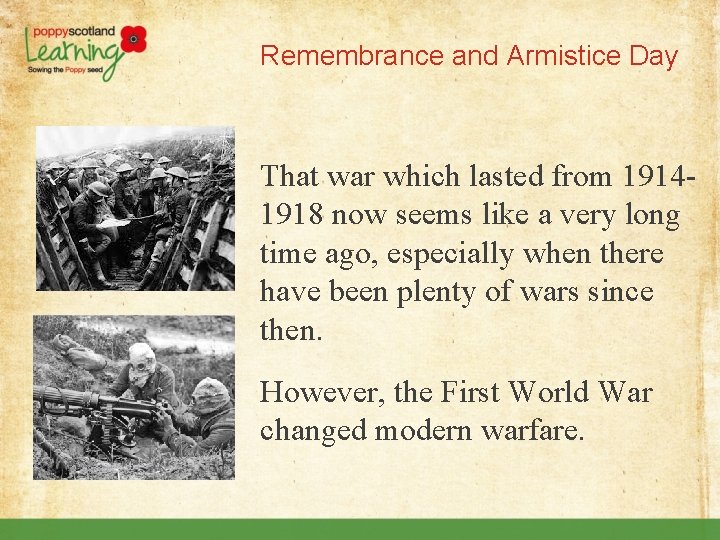
Remembrance and Armistice Day That war which lasted from 19141918 now seems like a very long time ago, especially when there have been plenty of wars since then. However, the First World War changed modern warfare.
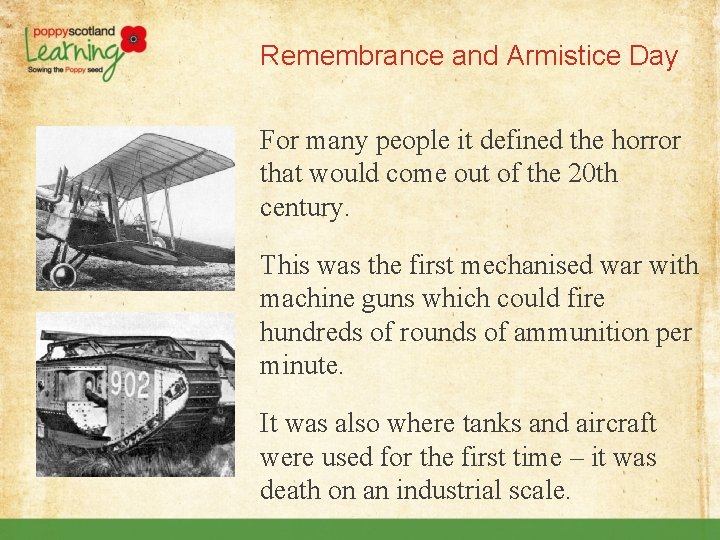
Remembrance and Armistice Day For many people it defined the horror that would come out of the 20 th century. This was the first mechanised war with machine guns which could fire hundreds of rounds of ammunition per minute. It was also where tanks and aircraft were used for the first time – it was death on an industrial scale.
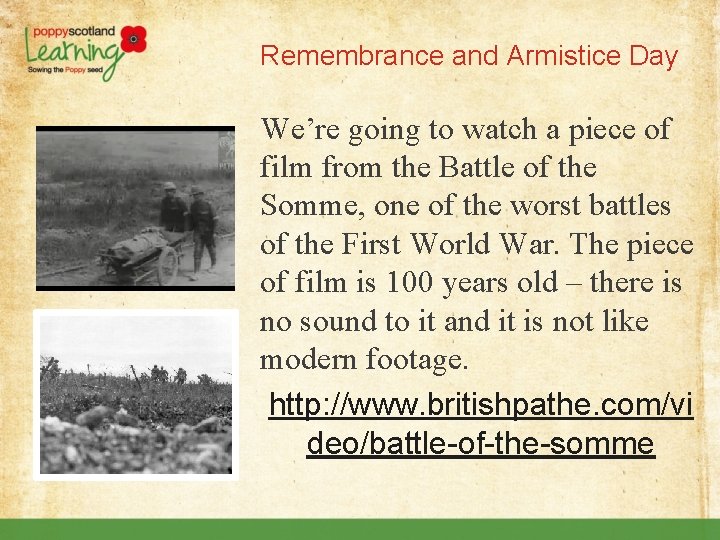
Remembrance and Armistice Day We’re going to watch a piece of film from the Battle of the Somme, one of the worst battles of the First World War. The piece of film is 100 years old – there is no sound to it and it is not like modern footage. http: //www. britishpathe. com/vi deo/battle-of-the-somme
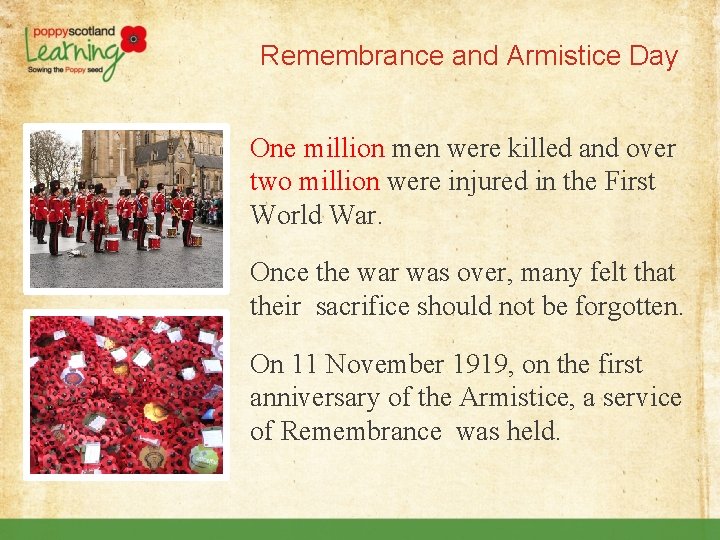
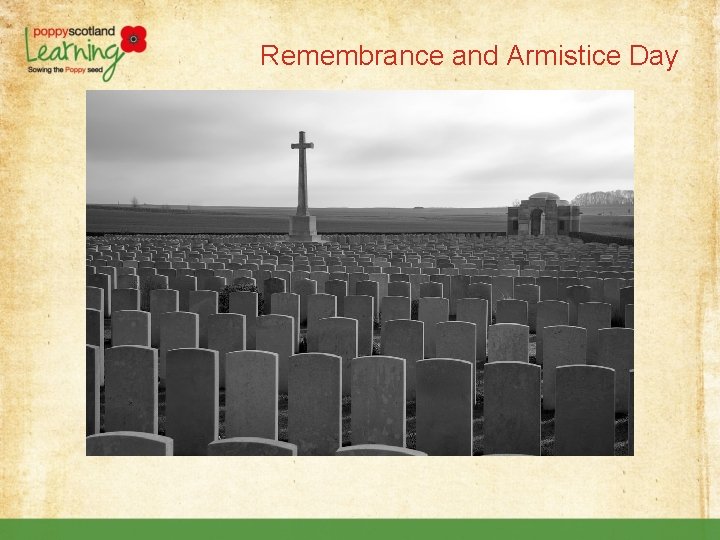
Remembrance and Armistice Day One million men were killed and over two million were injured in the First World War. Once the war was over, many felt that their sacrifice should not be forgotten. On 11 November 1919, on the first anniversary of the Armistice, a service of Remembrance was held.
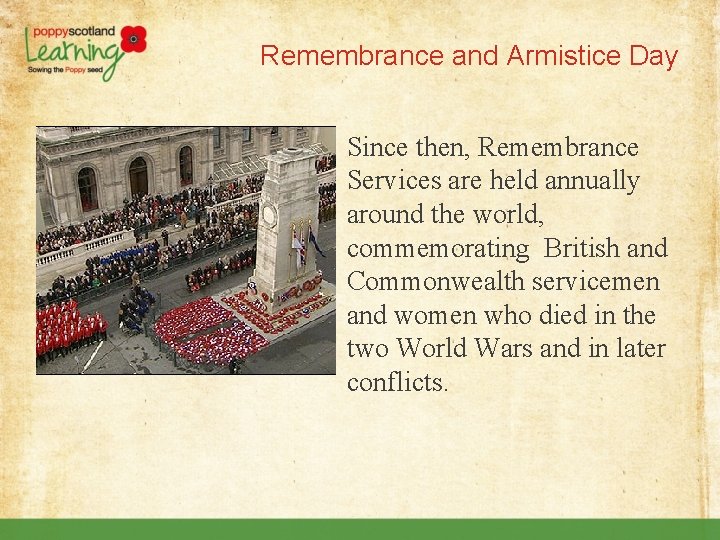
Remembrance and Armistice Day Since then, Remembrance Services are held annually around the world, commemorating British and Commonwealth servicemen and women who died in the two World Wars and in later conflicts.
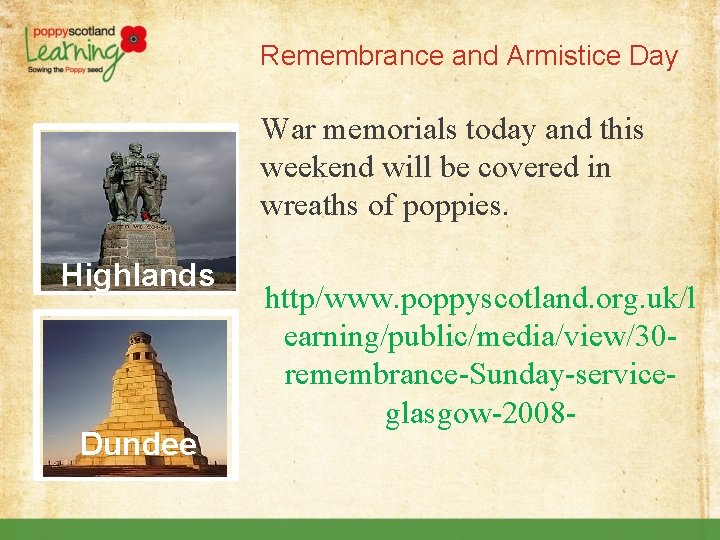
Remembrance and Armistice Day War memorials today and this weekend will be covered in wreaths of poppies. Highlands Dundee http/www. poppyscotland. org. uk/l earning/public/media/view/30 remembrance-Sunday-serviceglasgow-2008 -
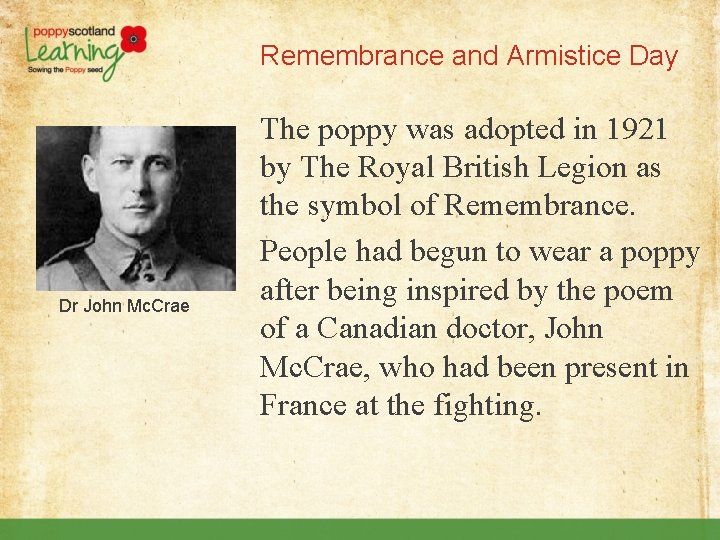
Remembrance and Armistice Day Dr John Mc. Crae The poppy was adopted in 1921 by The Royal British Legion as the symbol of Remembrance. People had begun to wear a poppy after being inspired by the poem of a Canadian doctor, John Mc. Crae, who had been present in France at the fighting.
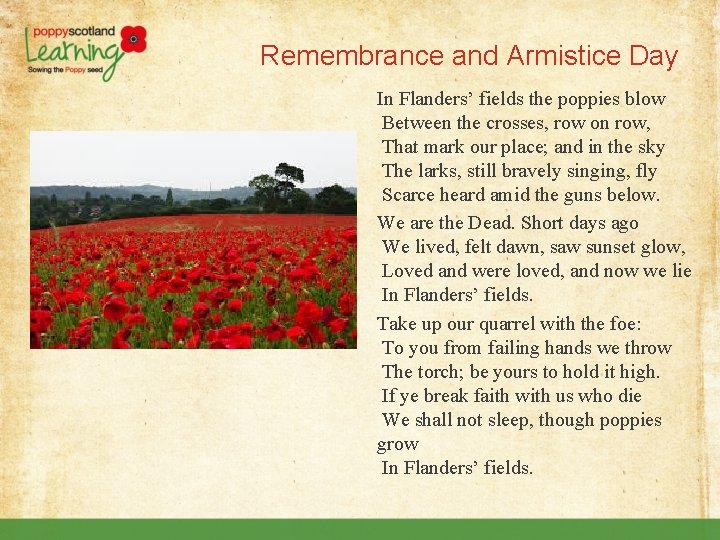
Remembrance and Armistice Day In Flanders’ fields the poppies blow Between the crosses, row on row, That mark our place; and in the sky The larks, still bravely singing, fly Scarce heard amid the guns below. We are the Dead. Short days ago We lived, felt dawn, saw sunset glow, Loved and were loved, and now we lie In Flanders’ fields. Take up our quarrel with the foe: To you from failing hands we throw The torch; be yours to hold it high. If ye break faith with us who die We shall not sleep, though poppies grow In Flanders’ fields.
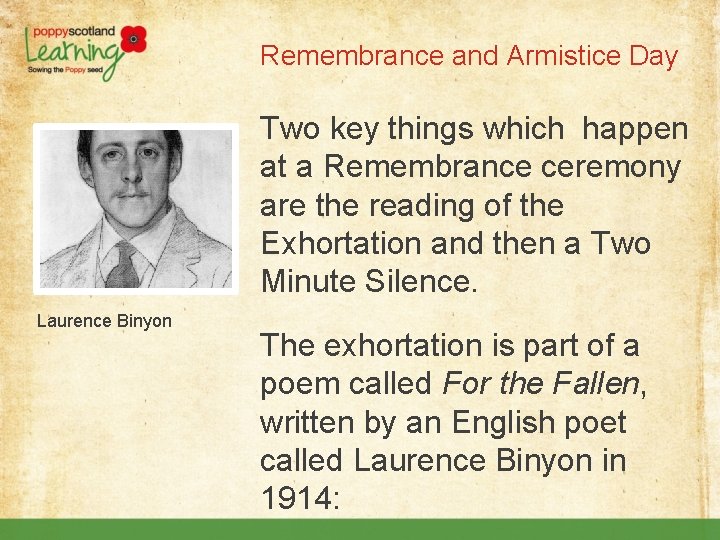
Remembrance and Armistice Day Two key things which happen at a Remembrance ceremony are the reading of the Exhortation and then a Two Minute Silence. Laurence Binyon The exhortation is part of a poem called For the Fallen, written by an English poet called Laurence Binyon in 1914:
Remembrance and Armistice Day
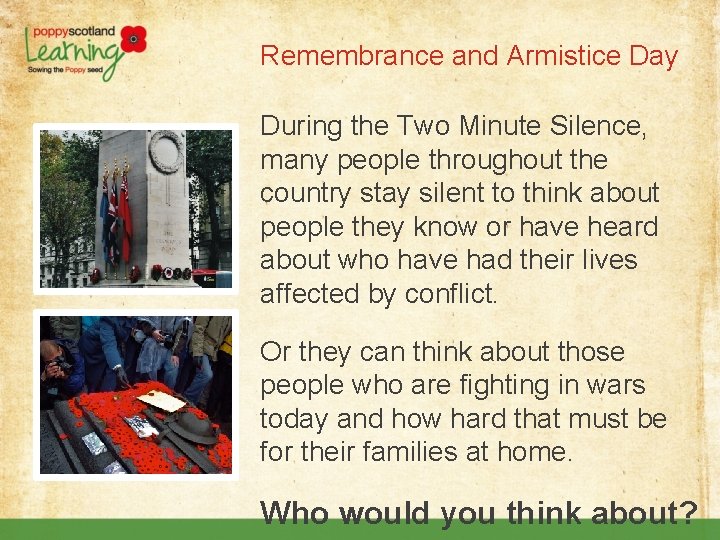
Remembrance and Armistice Day During the Two Minute Silence, many people throughout the country stay silent to think about people they know or have heard about who have had their lives affected by conflict. Or they can think about those people who are fighting in wars today and how hard that must be for their families at home. Who would you think about?
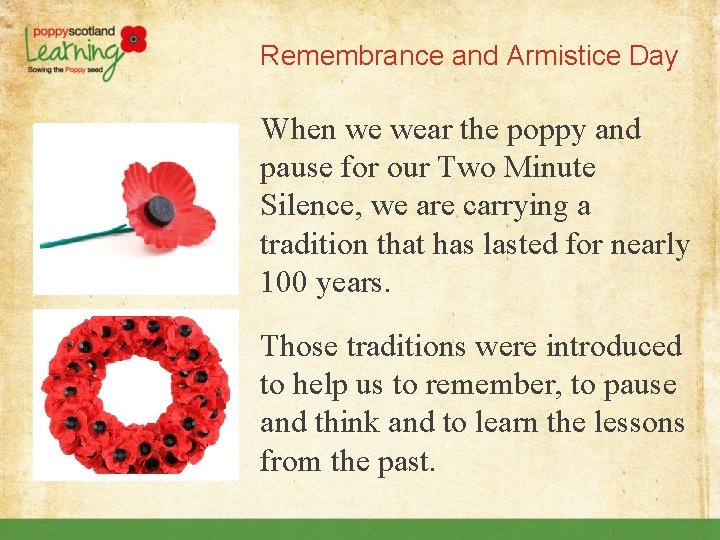
Remembrance and Armistice Day When we wear the poppy and pause for our Two Minute Silence, we are carrying a tradition that has lasted for nearly 100 years. Those traditions were introduced to help us to remember, to pause and think and to learn the lessons from the past.
- Slides: 14