
Remembering the Forgotten Princesses Reconstructing Intersected Structural Violence
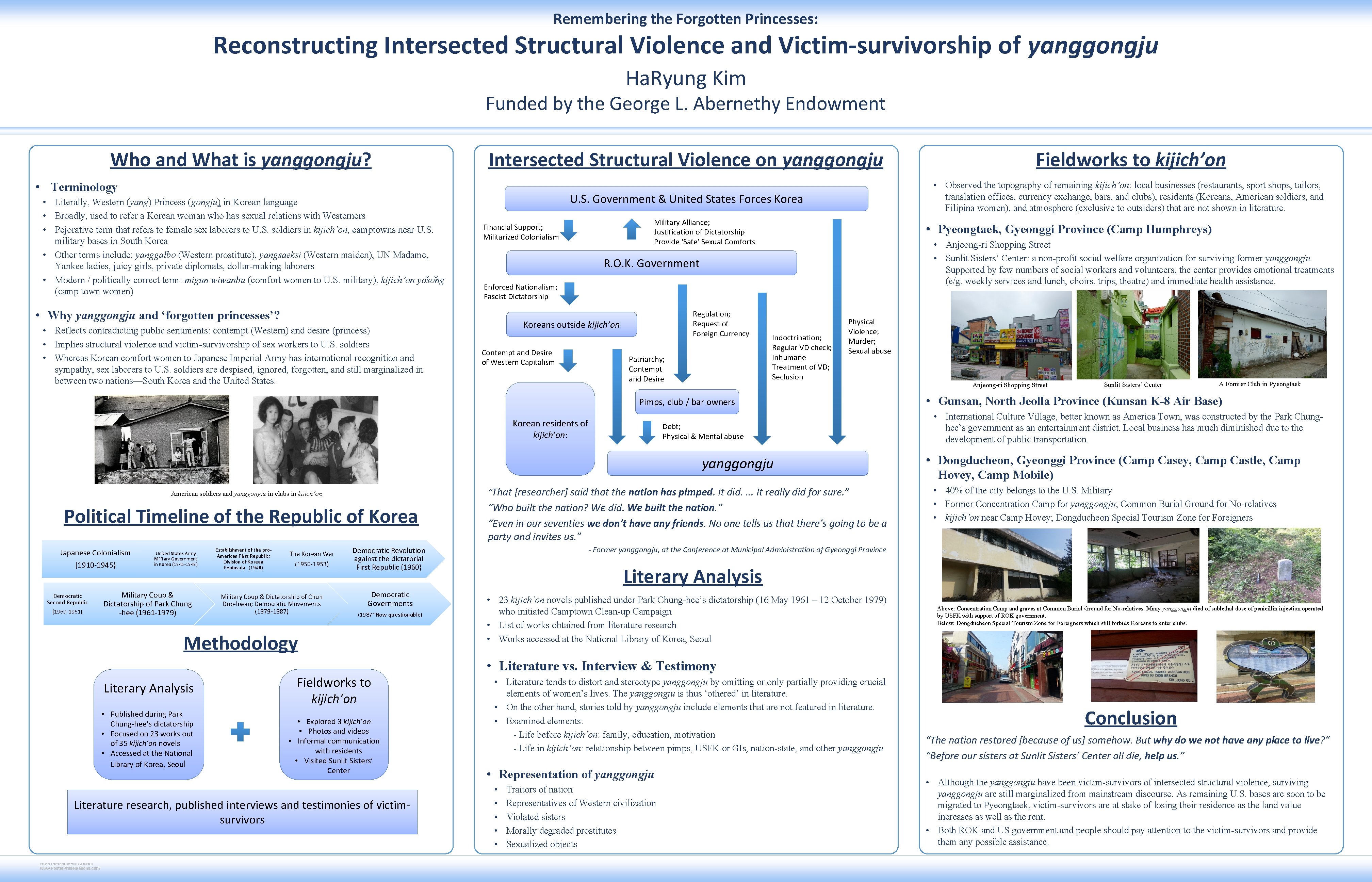
Remembering the Forgotten Princesses: Reconstructing Intersected Structural Violence and Victim-survivorship of yanggongju Ha. Ryung Kim Funded by the George L. Abernethy Endowment Who and What is yanggongju? Intersected Structural Violence on yanggongju Fieldworks to kijich’on U. S. Government & United States Forces Korea • Observed the topography of remaining kijich’on: local businesses (restaurants, sport shops, tailors, translation offices, currency exchange, bars, and clubs), residents (Koreans, American soldiers, and Filipina women), and atmosphere (exclusive to outsiders) that are not shown in literature. • Terminology • Literally, Western (yang) Princess (gongju) in Korean language • Broadly, used to refer a Korean woman who has sexual relations with Westerners • Pejorative term that refers to female sex laborers to U. S. soldiers in kijich’on, camptowns near U. S. military bases in South Korea • Other terms include: yanggalbo (Western prostitute), yangsaeksi (Western maiden), UN Madame, Yankee ladies, juicy girls, private diplomats, dollar-making laborers • Modern / politically correct term: migun wiwanbu (comfort women to U. S. military), kijich’on yo so ng (camp town women) • Pyeongtaek, Gyeonggi Province (Camp Humphreys) • Anjeong-ri Shopping Street • Sunlit Sisters’ Center: a non-profit social welfare organization for surviving former yanggongju. Supported by few numbers of social workers and volunteers, the center provides emotional treatments (e/g. weekly services and lunch, choirs, trips, theatre) and immediate health assistance. R. O. K. Government Enforced Nationalism; Fascist Dictatorship • Why yanggongju and ‘forgotten princesses’? • Reflects contradicting public sentiments: contempt (Western) and desire (princess) • Implies structural violence and victim-survivorship of sex workers to U. S. soldiers • Whereas Korean comfort women to Japanese Imperial Army has international recognition and sympathy, sex laborers to U. S. soldiers are despised, ignored, forgotten, and still marginalized in between two nations—South Korea and the United States. Military Alliance; Justification of Dictatorship Provide ‘Safe’ Sexual Comforts Financial Support; Militarized Colonialism Regulation; Request of Foreign Currency Koreans outside kijich’on Contempt and Desire of Western Capitalism Patriarchy; Contempt and Desire Indoctrination; Regular VD check; Inhumane Treatment of VD; Seclusion Physical Violence; Murder; Sexual abuse Pimps, club / bar owners Korean residents of kijich’on: Debt; Physical & Mental abuse yanggongju “That [researcher] said that the nation has pimped. It did. . It really did for sure. ” American soldiers and yanggongju in clubs in kijich’on Political Timeline of the Republic of Korea Japanese Colonialism (1910 -1945) Democratic Second Republic (1960 -1961) United States Army Military Government in Korea (1945 -1948) Military Coup & Dictatorship of Park Chung -hee (1961 -1979) Establishment of the pro. American First Republic; Division of Korean Peninsula (1948) The Korean War (1950 -1953) Military Coup & Dictatorship of Chun Doo-hwan; Democratic Movements (1979 -1987) “Who built the nation? We did. We built the nation. ” “Even in our seventies we don’t have any friends. No one tells us that there’s going to be a party and invites us. ” (1987~Now questionable) Methodology Sunlit Sisters’ Center A Former Club in Pyeongtaek • Gunsan, North Jeolla Province (Kunsan K-8 Air Base) • International Culture Village, better known as America Town, was constructed by the Park Chunghee’s government as an entertainment district. Local business has much diminished due to the development of public transportation. • Dongducheon, Gyeonggi Province (Camp Casey, Camp Castle, Camp Hovey, Camp Mobile) • 40% of the city belongs to the U. S. Military • Former Concentration Camp for yanggongju; Common Burial Ground for No-relatives • kijich’on near Camp Hovey; Dongducheon Special Tourism Zone for Foreigners - Former yanggongju, at the Conference at Municipal Administration of Gyeonggi Province Democratic Revolution against the dictatorial First Republic (1960) Democratic Governments Anjeong-ri Shopping Street Literary Analysis • 23 kijich’on novels published under Park Chung-hee’s dictatorship (16 May 1961 – 12 October 1979) who initiated Camptown Clean-up Campaign • List of works obtained from literature research • Works accessed at the National Library of Korea, Seoul Above: Concentration Camp and graves at Common Burial Ground for No-relatives. Many yanggongju died of sublethal dose of penicillin injection operated by USFK with support of ROK government. Below: Dongducheon Special Tourism Zone for Foreigners which still forbids Koreans to enter clubs. • Literature vs. Interview & Testimony Literary Analysis • Published during Park Chung-hee’s dictatorship • Focused on 23 works out of 35 kijich’on novels • Accessed at the National Library of Korea, Seoul Fieldworks to kijich’on • Explored 3 kijich’on • Photos and videos • Informal communication with residents • Visited Sunlit Sisters’ Center Literature research, published interviews and testimonies of victimsurvivors RESEARCH POSTER PRESENTATION DESIGN © 2015 www. Poster. Presentations. com • Literature tends to distort and stereotype yanggongju by omitting or only partially providing crucial elements of women’s lives. The yanggongju is thus ‘othered’ in literature. • On the other hand, stories told by yanggongju include elements that are not featured in literature. • Examined elements: - Life before kijich’on: family, education, motivation - Life in kijich’on: relationship between pimps, USFK or GIs, nation-state, and other yanggongju • Representation of yanggongju • • • Traitors of nation Representatives of Western civilization Violated sisters Morally degraded prostitutes Sexualized objects Conclusion “The nation restored [because of us] somehow. But why do we not have any place to live? ” “Before our sisters at Sunlit Sisters’ Center all die, help us. ” • Although the yanggongju have been victim-survivors of intersected structural violence, surviving yanggongju are still marginalized from mainstream discourse. As remaining U. S. bases are soon to be migrated to Pyeongtaek, victim-survivors are at stake of losing their residence as the land value increases as well as the rent. • Both ROK and US government and people should pay attention to the victim-survivors and provide them any possible assistance.
- Slides: 1