
Remembering Ch 5 HURIER Model of Listening Hearing

Remembering Ch. 5

HURIER Model of Listening • • • Hearing Understanding Remembering Interpreting Evaluating Responding
The process of remembering: principles – p. 139 • Remembering – storing for later use ideas you have captured • Learning - how you accumulate knowledge
• What affects your memory function • • • Self-talk Other information exposed to at same time Language What you were doing What happens between then and now Information already stored
Memory systems – p. 140 • Immediate memory • Short-term memory • Long-term memory
• Immediate memory - Filtering device for what you discard and what you keep • Focus your attention without letting it wander • “In one ear and out the other” • Determine most important facts or aspects to pay attention to and remember • 25%
• Short-term memory – “working memory” serves as intermediate step in processing information into your long-term memory • Repetition • Chunking • Identifying logical patterns

• Repetition • Recite silently to yourself over and over • Listen to something over and over • Read something over and over • Activities Workbook: Shakespearean fill the blanks

• https: //www. youtube. com/watch? v=x. YZHb 2 xo 0 OI • https: //www. youtube. com/watch? v=HZna. XDRwu 84 • http: //www. bing. com/videos/search? q=balcony+scene+romeo+and+juliet&qpvt=balc ony+scene+romeo+and+juliet&FORM=VDRE#view=detail&mid=81 B 9 EA 8388579 CC C 190 A 81 B 9 EA 8388579 CCC 190 A
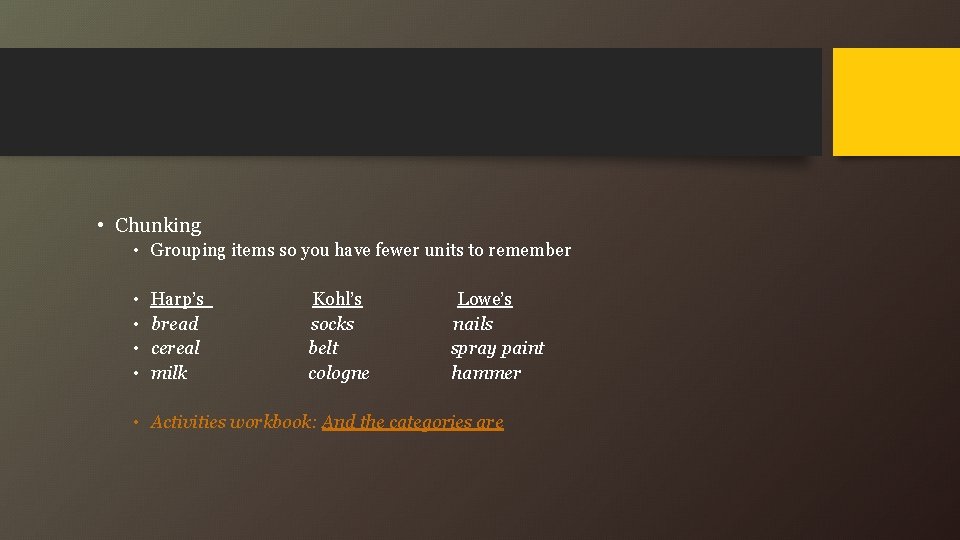
• Chunking • Grouping items so you have fewer units to remember • • Harp’s bread cereal milk Kohl’s socks belt cologne Lowe’s nails spray paint hammer • Activities workbook: And the categories are
• Identifying logical patterns • Finding anything that helps fit things together • • Chronological Spatial Alphabetical By color • Activities Workbook: Organizing your closet
• Long-term memory – “data bank” or warehouse for all your impressions and experiences • Organizational schema • Long-term memory strategies

• Organizational schema – hierarchies of information established in your brain that help you select and make sense of new information • “We had the room next to the elevator. ” • “Don’t you remember when the professor warned us about that on the first day of class? ”

• Long-term memory strategies • • • Association Categorization Mediation Imagery Mnemonics (Sensory)
• Association – cueing things into a setting or context • “I know you from somewhere. ” • “UAFS, golf, umpiring, poker? ” • Activities workbook: Opening lines
• Categorization – similar to chunking and identifying logical patterns
• Mediation – making sense out of nonsense • "Mairsy dotes and dosey dotes and little lambsy divey, a kiddleat ivey too, wooden shoe? "

“Mares eat oats. And does eats oats. And little lambs eat ivy. A kid will eat ivy, too. Wouldn’t you? ”

• THAT IS IS THAT IS NOT IS THAT IT IT IS • https: //www. youtube. com/watch? v=_g. UDNc 0 od. Iw

• “That that is, is. That that is not, is not. Is that it? It is. ”

• Imagery – creating pictures in your mind • Concrete • “Fishing on a riverbank” • Abstract • “Freedom of speech” • Activities workbook: Color your world
• Mnemonics – creating any kind of visual or auditory cue to make sense of complicated information • Acronyms • Rhymes • Story-telling

• Acronyms • HOMES • ROY G. BIV • Activities workbook: Acronyms

• Rhymes • I before E, except after C … • 30 days hath September …

• Stories • Every Good Boy Deserves Favor. • Mom’s Very Easy Meal. Just Serve Us Nine Pizzas.
• (Sensory) – Using your five senses to create more vividmemories • • • Seeing Hearing Touching Tasting Smelling • Activities workbook: Using your senses
Obstacles to effective memory – p. 150 • • Repression and distortion Retroactive inhibition Primacy and recency effects Rigid thinking
• Repression and distortion • Remembering information that supports your position • Forgetting or distorting information that contradicts or is inconsistent with your current beliefs
• Primacy and recency effects • Tendency to remember best what you heard last vs. what you heard first • That’s why good speakers use conclusion to review and “ta-dum”
• Rigid thinking • Being able to apply memory techniques to help you remember what’s on “the tip of your tongue”
Paths to better memory – p. 152 • Eat right • Increase creativity • Reduce stress
• Eat right • Foods influence production of chemicals in brain • Good – keeps you alert • Protein • Moderate amounts of caffeine • Bad – makes you drowsy • High-fat foods • Too many carbs
• Increase creativity • Encouraging yourself and others to • • share ideas set positive tempo recognize potential provide opportunities for expressing talents

• Reduce stress • • Time stressors Encounter stressors Situation stressors Anticipatory stressors

• Time stressors • When running late you may become • Disoriented • Anxious • Unable to think logically
• Encounter stressors • When you anticipate difficult interpersonal interactions you may • Try to avoid confronting them • Be unable to relax • Focus on issue at hand
• Situation stressors • When you unexpectedly run into someone you know you may • Not remember his/her name • Feel uncomfortable about how you look • Be embarrassed about where you are
• Anticipatory stressors • Knowing well in advance about inevitable and uncomfortable encounter • Activities workbook: For Better or Worse

• How to reduce stress • “I” – messages • Positive thinking • Take ownership
• Positive thinking • “I’m going to do great on my speech. ” • “I’m going to feel so much better after having surgery. ”

• Take ownership • “I allow myself to worry too much. ” • “I choose to get too worked up. ”
- Slides: 41