
Remember Versus Know Remember versus Know Process Model
Remember Versus Know Remember versus Know Process Model Gardiner et al (1990, 1991, 1993) gives an explanation: Remember judgments are influenced by conceptual and attentional factors Know judgments are based on a procedural memory system This is similar to a distinction between explicit and implicit memory
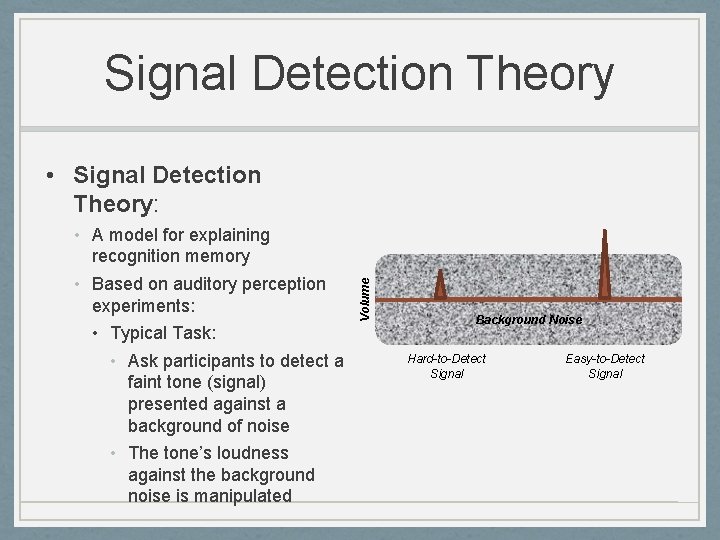
Signal Detection Theory • A model for explaining recognition memory • Based on auditory perception experiments: • Typical Task: • Ask participants to detect a faint tone (signal) presented against a background of noise • The tone’s loudness against the background noise is manipulated Volume • Signal Detection Theory: Background Noise Hard-to-Detect Signal Easy-to-Detect Signal
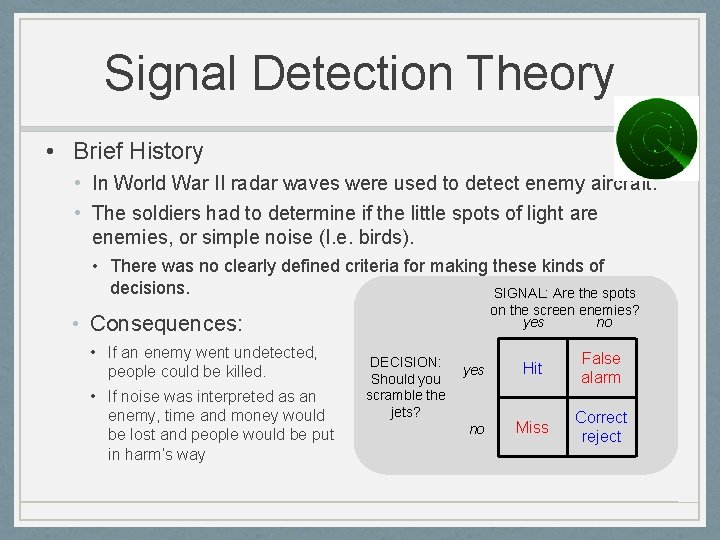
Signal Detection Theory • Brief History • In World War II radar waves were used to detect enemy aircraft. • The soldiers had to determine if the little spots of light are enemies, or simple noise (I. e. birds). • There was no clearly defined criteria for making these kinds of decisions. SIGNAL: Are the spots on the screen enemies? yes no • Consequences: • If an enemy went undetected, people could be killed. • If noise was interpreted as an enemy, time and money would be lost and people would be put in harm’s way DECISION: Should you scramble the jets? yes Hit False alarm no Miss Correct reject
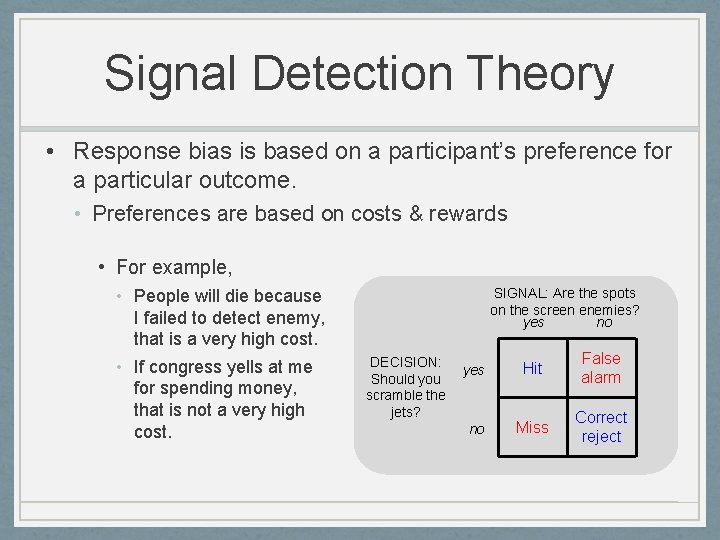
Signal Detection Theory • Response bias is based on a participant’s preference for a particular outcome. • Preferences are based on costs & rewards • For example, • People will die because I failed to detect enemy, that is a very high cost. • If congress yells at me for spending money, that is not a very high cost. SIGNAL: Are the spots on the screen enemies? yes no DECISION: Should you scramble the jets? yes Hit False alarm no Miss Correct reject
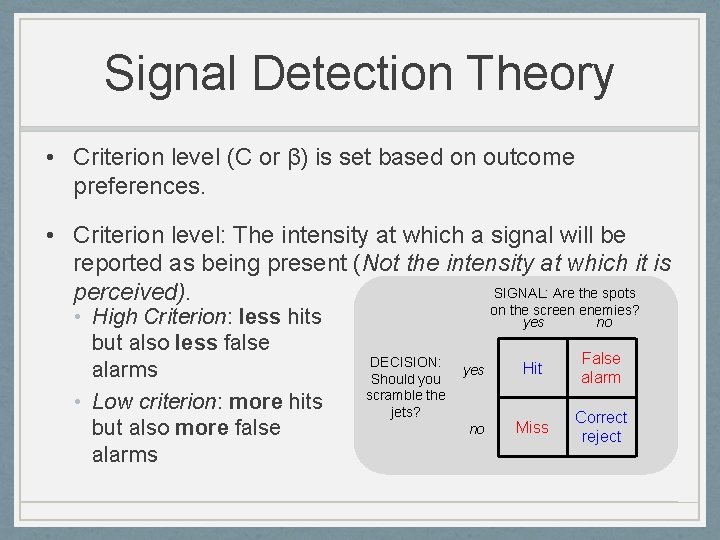
Signal Detection Theory • Criterion level (C or β) is set based on outcome preferences. • Criterion level: The intensity at which a signal will be reported as being present (Not the intensity at which it is SIGNAL: Are the spots perceived). • High Criterion: less hits but also less false alarms • Low criterion: more hits but also more false alarms on the screen enemies? yes no DECISION: Should you scramble the jets? yes Hit False alarm no Miss Correct reject
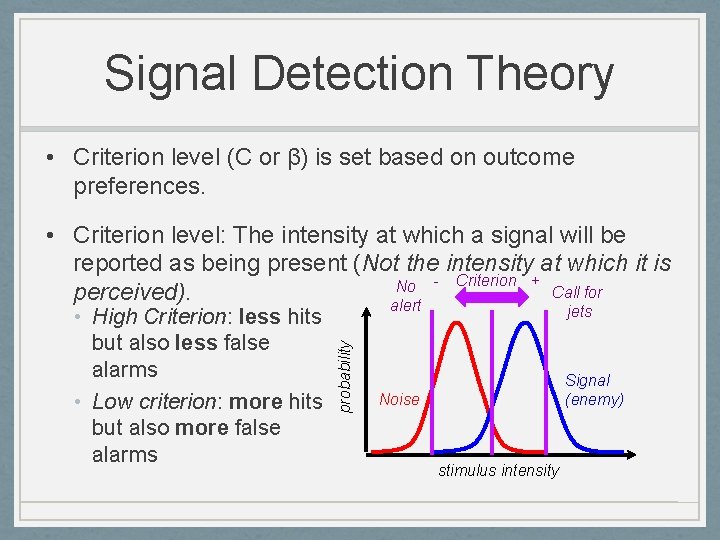
Signal Detection Theory • Criterion level (C or β) is set based on outcome preferences. • Criterion level: The intensity at which a signal will be reported as being present (Not the intensity at which it is No - Criterion + Call for perceived). alert jets probability • High Criterion: less hits but also less false alarms • Low criterion: more hits but also more false alarms Signal (enemy) Noise stimulus intensity
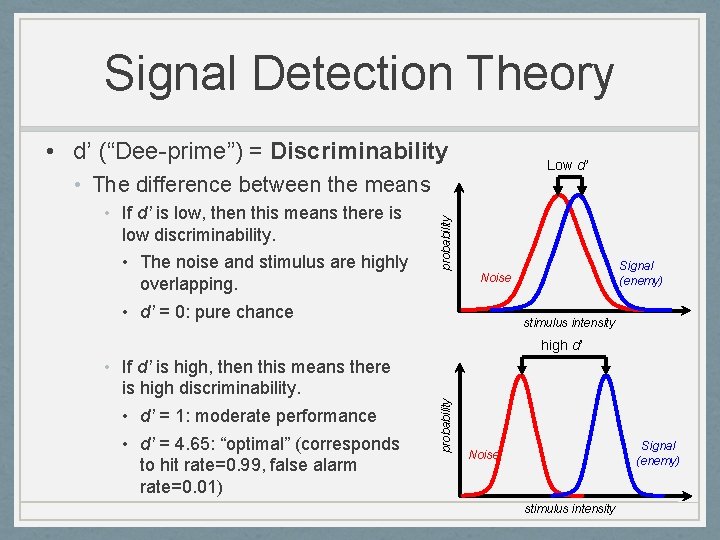
Signal Detection Theory • d’ (“Dee-prime”) = Discriminability Low d’ • If d’ is low, then this means there is low discriminability. • The noise and stimulus are highly overlapping. • d’ = 0: pure chance probability • The difference between the means Signal (enemy) Noise stimulus intensity • If d’ is high, then this means there is high discriminability. • d’ = 1: moderate performance • d’ = 4. 65: “optimal” (corresponds to hit rate=0. 99, false alarm rate=0. 01) probability high d’ Signal (enemy) Noise stimulus intensity
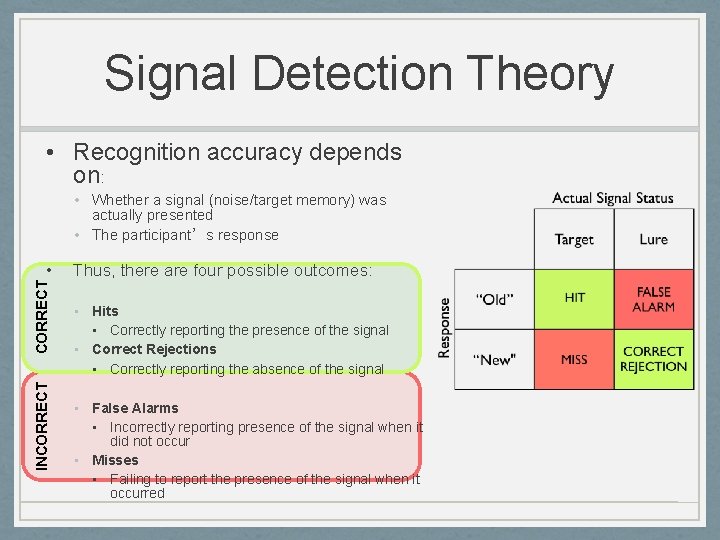
Signal Detection Theory • Recognition accuracy depends on: • Whether a signal (noise/target memory) was actually presented • The participant’s response INCORRECT • Thus, there are four possible outcomes: • Hits • Correctly reporting the presence of the signal • Correct Rejections • Correctly reporting the absence of the signal • False Alarms • Incorrectly reporting presence of the signal when it did not occur • Misses • Failing to report the presence of the signal when it occurred
Signal Detection Theory • Assumptions: • Memory traces have strength values (i. e. activation levels) • Activation levels dictate how “familiar” a stimulus feels • Traces vary in terms of their familiarity, based on: • Attention paid to the stimulus during encoding • The number of repetitions • Familiarity values for “old” and “new” items are each normally distributed • On average, “new” items are less familiar than “old” items • However, some distractors are quite familiar because they appear often in other contexts or are similar to “old” items • Thus, there can be overlap between the distributions • Items that surpass a threshold (i. e. response criterion) of familiarity are judged “old” 9
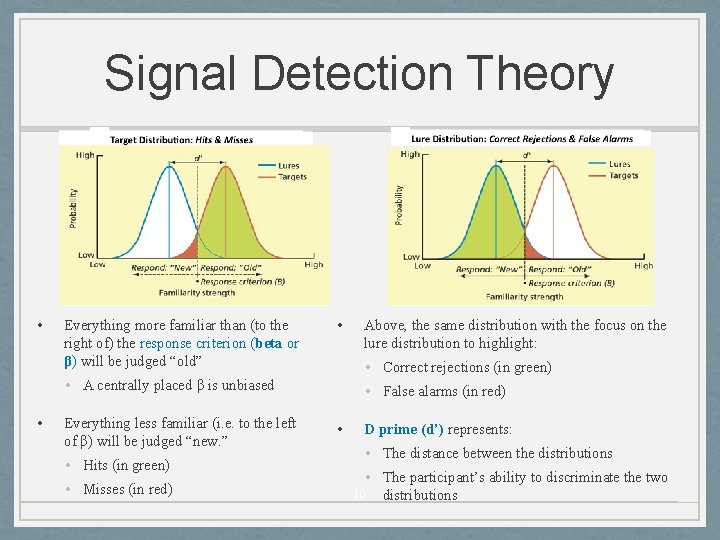
Signal Detection Theory • Everything more familiar than (to the right of) the response criterion (beta or β) will be judged “old” • • Correct rejections (in green) • A centrally placed β is unbiased • Everything less familiar (i. e. to the left of β) will be judged “new. ” • Hits (in green) • Misses (in red) Above, the same distribution with the focus on the lure distribution to highlight: • False alarms (in red) • D prime (d’) represents: • The distance between the distributions • The participant’s ability to discriminate the two 10 distributions

Face Recognition
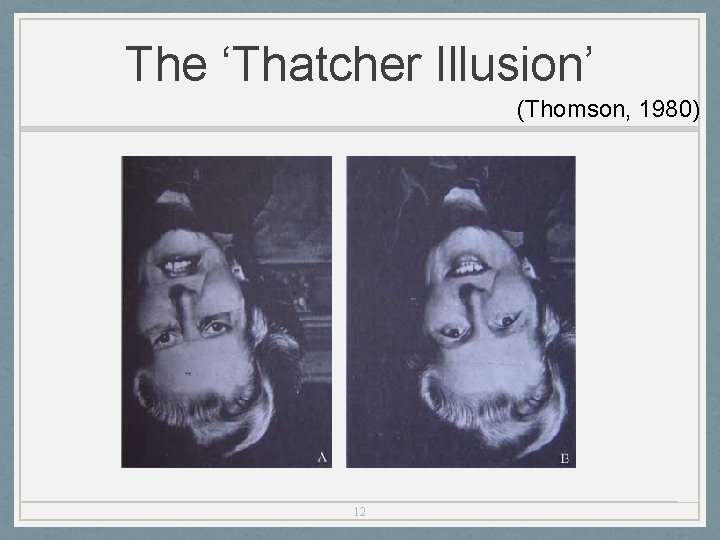
The ‘Thatcher Illusion’ (Thomson, 1980) 12
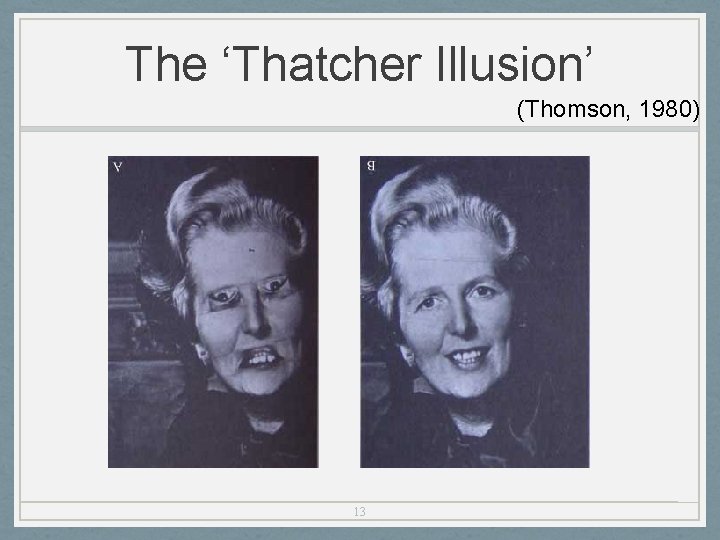
The ‘Thatcher Illusion’ (Thomson, 1980) 13
- Slides: 13