
Remember the Triangle M D V 1 State
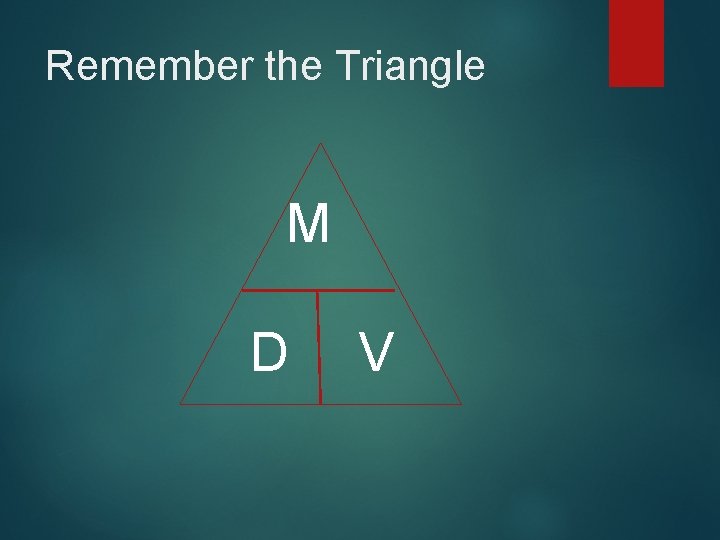
Remember the Triangle M D V

1. State the formula for density in words and mathematical symbols Density is mass divided by volume. D = M/V
2. A rock has a mass of 210 grams and occupies a volume of 70 cm 3. What is its density? D = M/V = 210 g/70 cm 3 D = 3 g/cm 3
3. An unknown liquid occupies a volume of 5 m. L and has a mass of 40 grams. Find its density: D = M/V = 40 g / 5 m. L D = 8 g/m. L
4. Define the following words: MASS = the amount of matter in a substance VOLUME takes up = how much space an object
5. How does the volume occupied by a cubic centimeter (cm 3) compare with the volume occupied by a milliliter (m. L) The volume is the same (cm 3 is just measured for solids and m. L is measured for liquids)
6. A rectangular solid of unknown density is 5 m long, 2 m high and 4 m wide. The mass of this solid is 300 grams. Calculate the density: D =? M = 300 g V = 5 x 4 x 2 = 40 m 3 = 300 g / 40 m 3 D = 7. 5 g/m 3
7. A rock occupies a volume of 20 cm 3 and has a mass of 54 grams. Find the density of the rock: D =? M = 54 g V = 20 cm 3 = 54 g / 20 cm 3 D = 2. 7 g/cm 3
8. A rock has a density of 4 g/m. L and a mass of 16 grams. What is the volume this rock occupies? D = 4 g/m. L M = 16 g V =? V = M/D = 16 g / 4 g/m. L V = 4 m. L
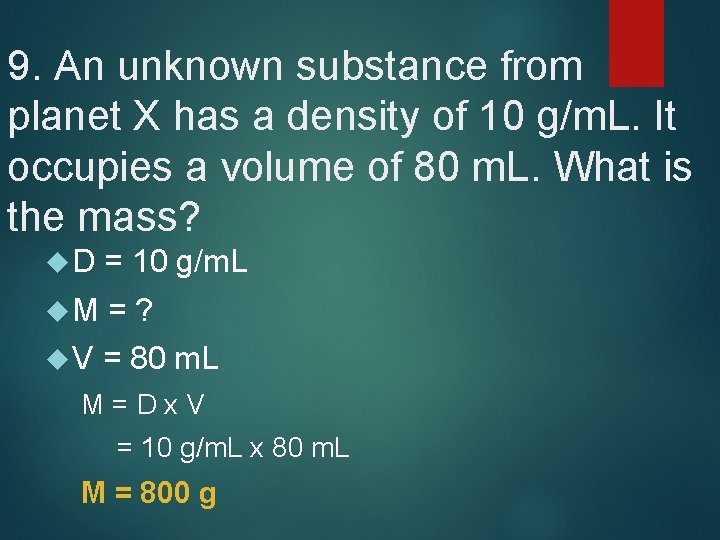
9. An unknown substance from planet X has a density of 10 g/m. L. It occupies a volume of 80 m. L. What is the mass? D = 10 g/m. L M =? V = 80 m. L M=Dx. V = 10 g/m. L x 80 m. L M = 800 g
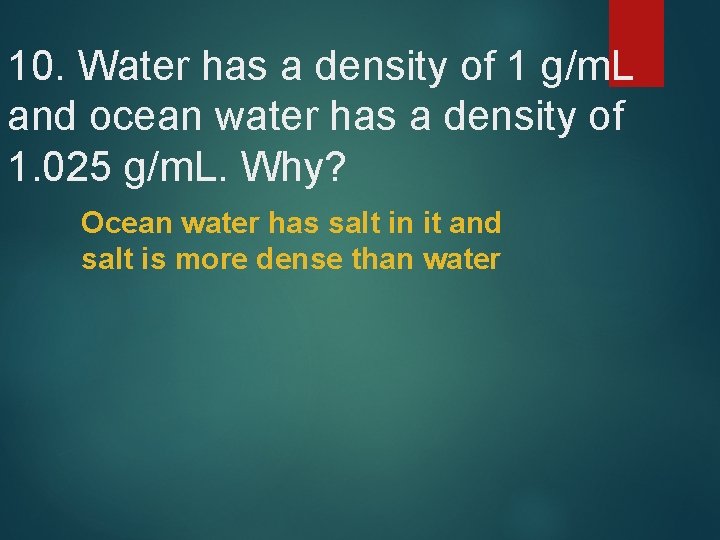
10. Water has a density of 1 g/m. L and ocean water has a density of 1. 025 g/m. L. Why? Ocean water has salt in it and salt is more dense than water
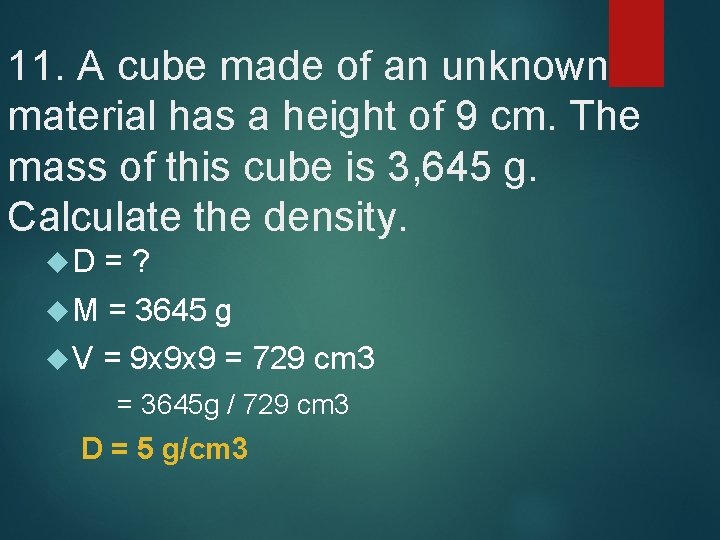
11. A cube made of an unknown material has a height of 9 cm. The mass of this cube is 3, 645 g. Calculate the density. D =? M = 3645 g V = 9 x 9 x 9 = 729 cm 3 = 3645 g / 729 cm 3 D = 5 g/cm 3
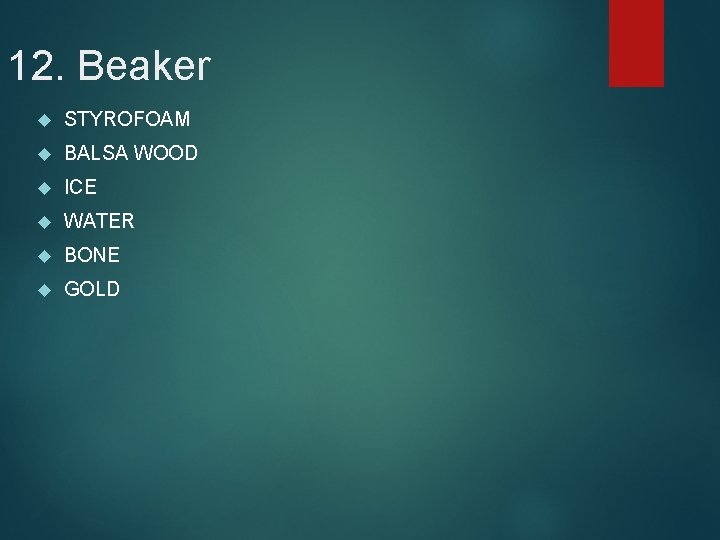
12. Beaker STYROFOAM BALSA WOOD ICE WATER BONE GOLD
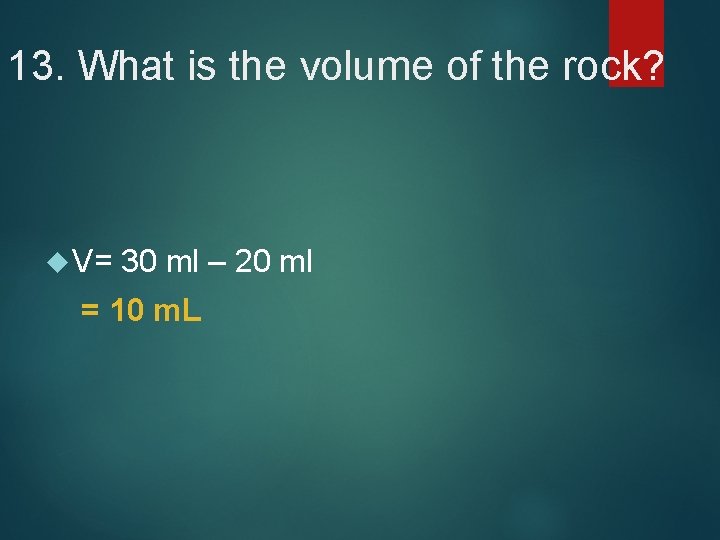
13. What is the volume of the rock? V= 30 ml – 20 ml = 10 m. L
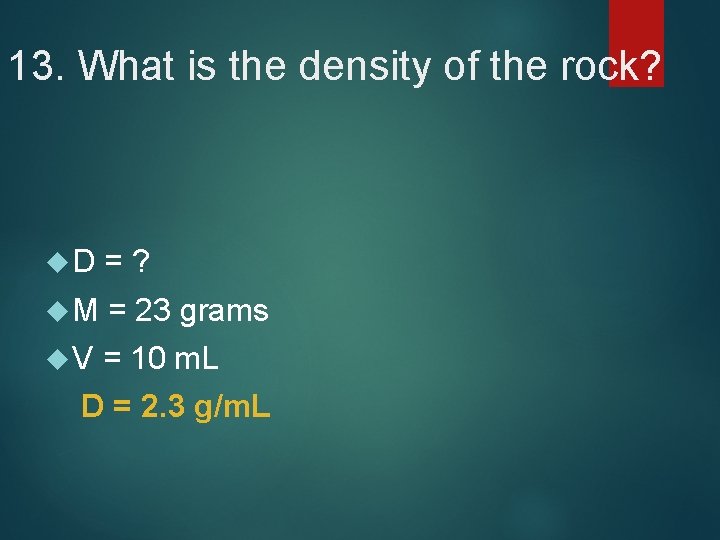
13. What is the density of the rock? D =? M = 23 grams V = 10 m. L D = 2. 3 g/m. L
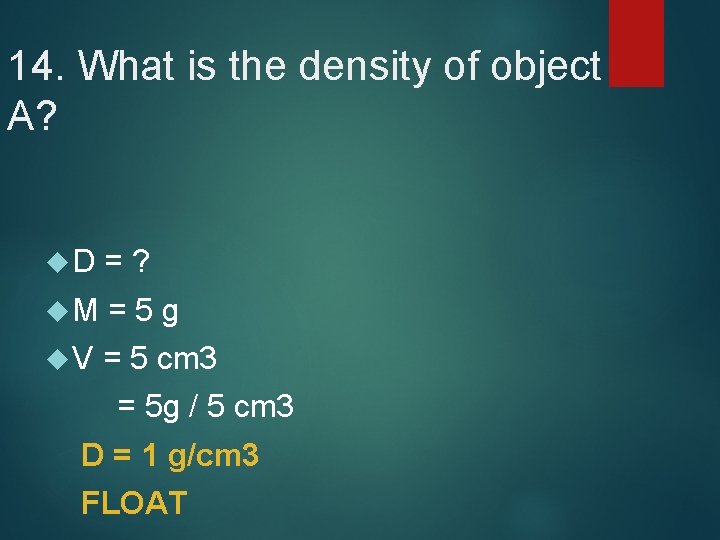
14. What is the density of object A? D =? M =5 g V = 5 cm 3 = 5 g / 5 cm 3 D = 1 g/cm 3 FLOAT
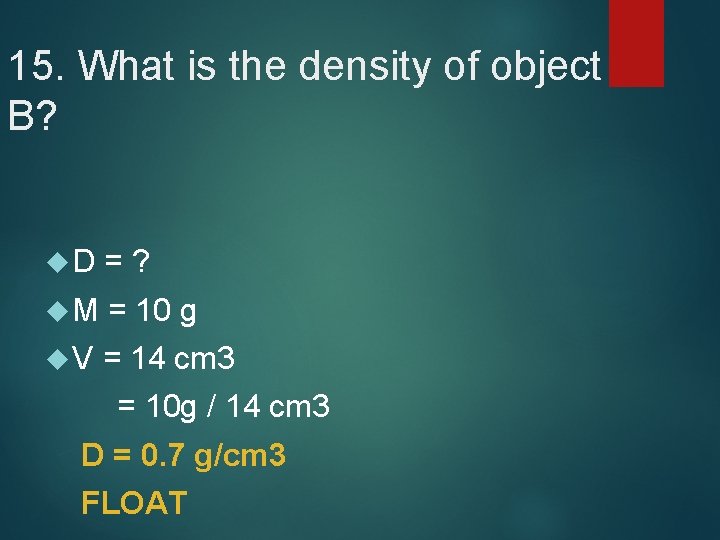
15. What is the density of object B? D =? M = 10 g V = 14 cm 3 = 10 g / 14 cm 3 D = 0. 7 g/cm 3 FLOAT
16. What is the density of object B? D =? M = 23 g V = 24 cm 3 = 23 g / 24 cm 3 D = 0. 958 g/cm 3 FLOAT
17. An object with a mass of 24 g and a volume of 32 m. L is most like what substance? D =? M = 24 g V = 32 m. L = 24 g / 32 m. L D = 0. 75 g/m. L WOOD
18. What is the only object in the table that would sink in corn syrup? Copper
19. What is the mass of 100 m. L of corn oil? D = 0. 92 g/cm 3 M =? V = 100 m. L M=Dx. V = 0. 92 g/cm 3 x 100 m. L M = 92 g
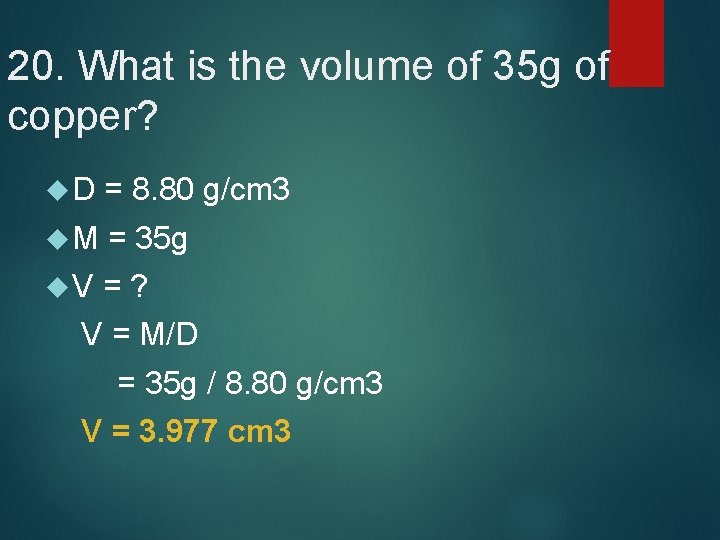
20. What is the volume of 35 g of copper? D = 8. 80 g/cm 3 M = 35 g V =? V = M/D = 35 g / 8. 80 g/cm 3 V = 3. 977 cm 3
Density Practice 20 points total Record score on top page
Density Table Contest With your table, create one density problem Tables will have 2 minutes to answer the questions at each table Write final question & table number on whiteboard RULES: Must have numbers less that 1000 Must include units in question Must provide teacher with the correct answer
Learning Goal: Density 4 – I can find and compare the density of different substances 3 – I can compare the density of different substances 2 – I know the equation 1 – I need to review
TOPIC: p. H EQ: What does p. H tell us about different substances?
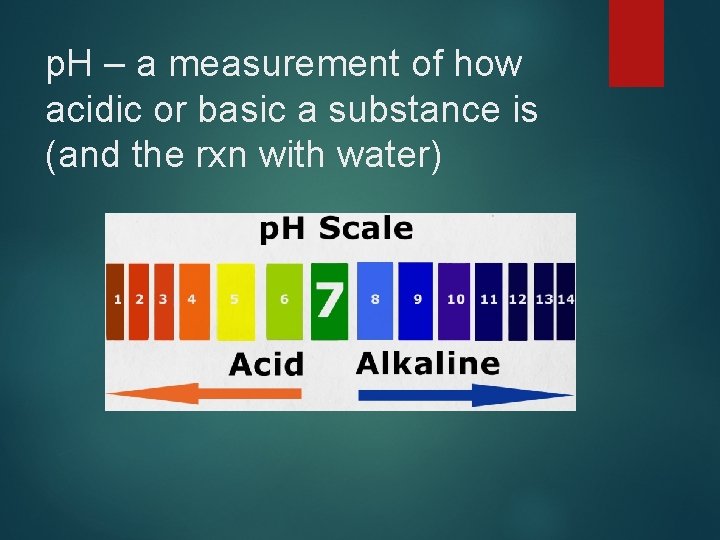
p. H – a measurement of how acidic or basic a substance is (and the rxn with water)
Applications with p. H Skin levels (more acidic) (lotions, soaps, creams, face wash…) Plant growth Calcium Teeth Deposits – lime away, use an acid – acids break down enamel yellow teeth Pool Care
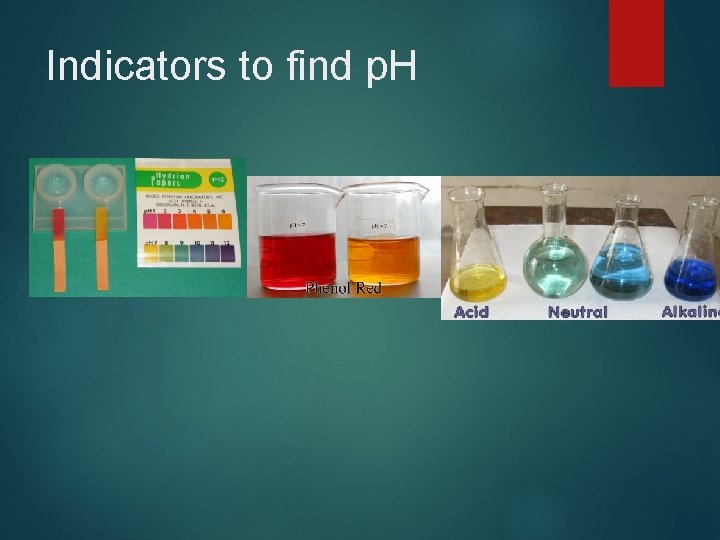
Indicators to find p. H
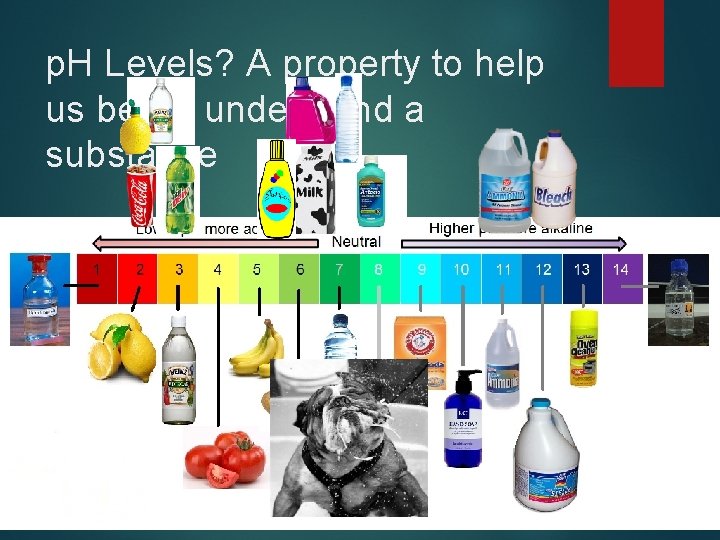
p. H Levels? A property to help us better understand a substance
- Slides: 30