
Remember Please pay your fees Chapter 14 1

Remember: Please pay your fees!!!
Chapter 14. 1: Further aspects of covalent bonding and structures Larger structures and more in-depth explanations of bonding systems often require more sophisticated concepts and theories of bonding
Important terms for this section �Expanded octets �Molecular geometry: 5 ED � Triangular bipyramidal � See-saw/unsymmetrical tetrahedral � T-shaped � Linear �Molecular geometry: 6 ED � Octahedral � Square pyramidal � Square planar �Molecular polarity �Formal charge �Bond order �Ozone � Atmosphere � Stratosphere � Ozone layer � Free radical � CFCs �Molecular orbital � Sigma ( ) bond � Pi (π) bond
General Bonding Conventions �NOTE: There always exceptions! �Oxygen and sulfur often forms 2 bonds and 2 lone pairs �Carbon forms 4 bonds �Carbon and oxygen can form single, double, and triple bonds �Nitrogen and Phosphorus form 3 bonds and have 1 lone pair �Alkali metals, Hydrogen and Halogens only form 1 single bond �Alkaline earth metals form 2 bonds
Octets and exceptions �Octet rule is followed by most elements when possible (8 e- around central atom) � Single electrons will join together = lone pair �Boron has only 3 e- so tends to form only 3 bonds but will seek out 4 th e- to make an octet (happens in absence of any other options) �Be bonds covalently and has only 2 e- so tends to form only 2 bonds, but will allow for coordinate bonding �Expanded octets can have 10 or 12 e- around the central atom e. x. SF 6, PH 5
Expanded octets �Central atom from Period 3 or below on the PT can use d orbital electrons to expand their octets (d orbital electrons get closer in energy going down the PT) �Can have 5 or 6 electron domains � Changes the ED geometry and often the molecular (VSEPR) geometry �Uses the 3 p and 3 d orbitals to expand octets (P, S, Cl can expand octets) �
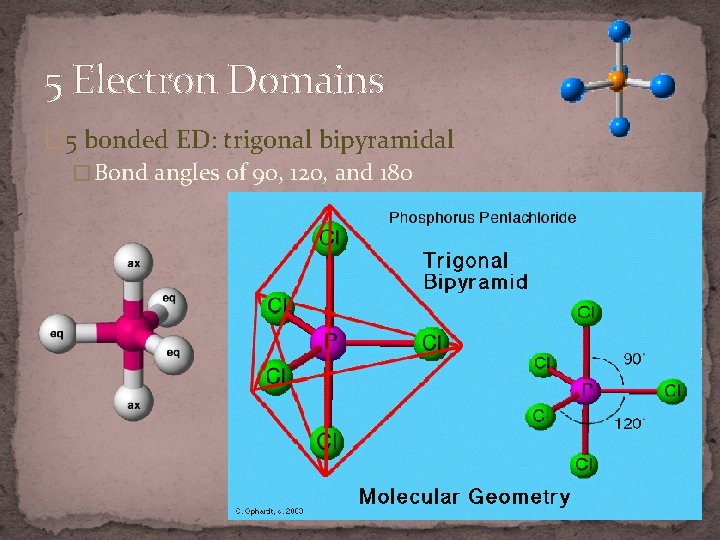
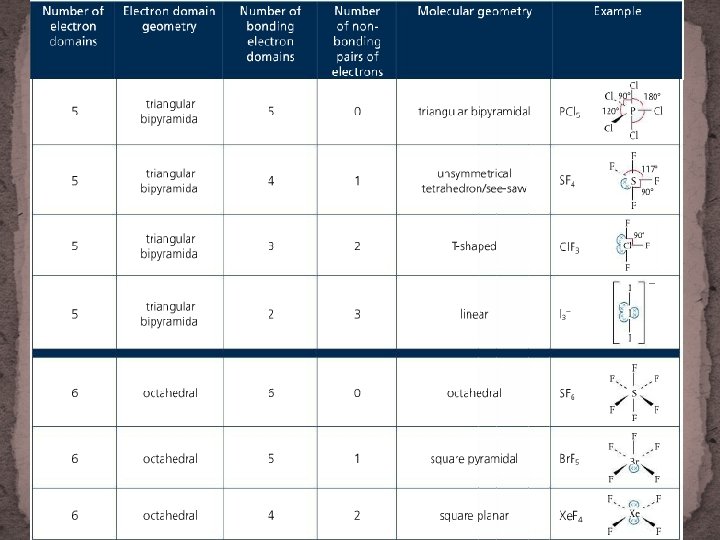
5 Electron Domains � 5 bonded ED: trigonal bipyramidal � Bond angles of 90, 120, and 180
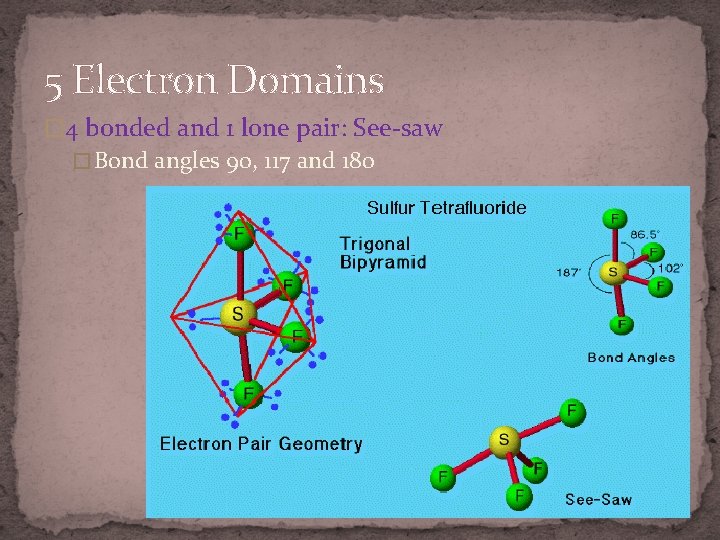
5 Electron Domains � 4 bonded and 1 lone pair: See-saw � Bond angles 90, 117 and 180
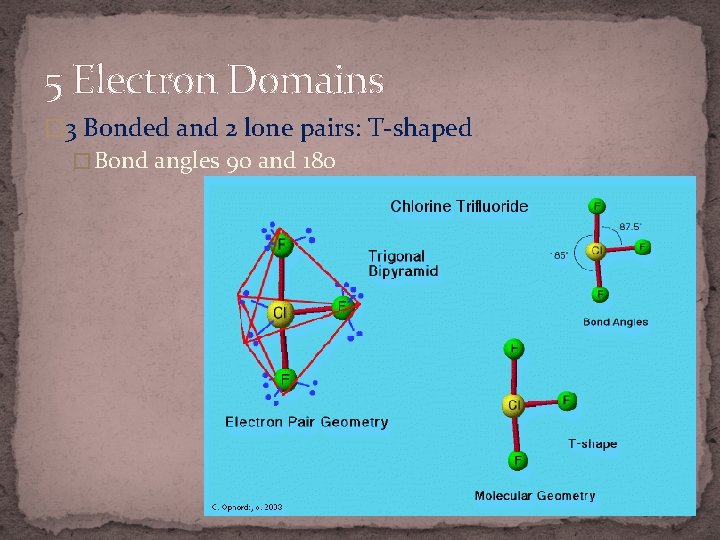
5 Electron Domains � 3 Bonded and 2 lone pairs: T-shaped � Bond angles 90 and 180
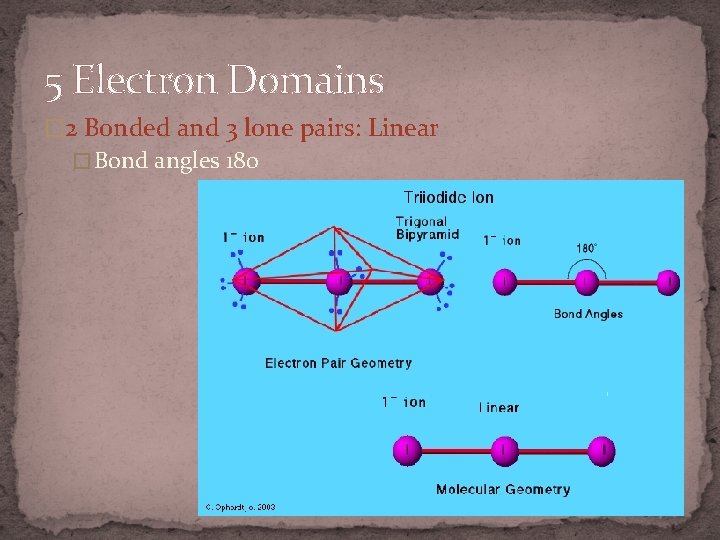
5 Electron Domains � 2 Bonded and 3 lone pairs: Linear � Bond angles 180
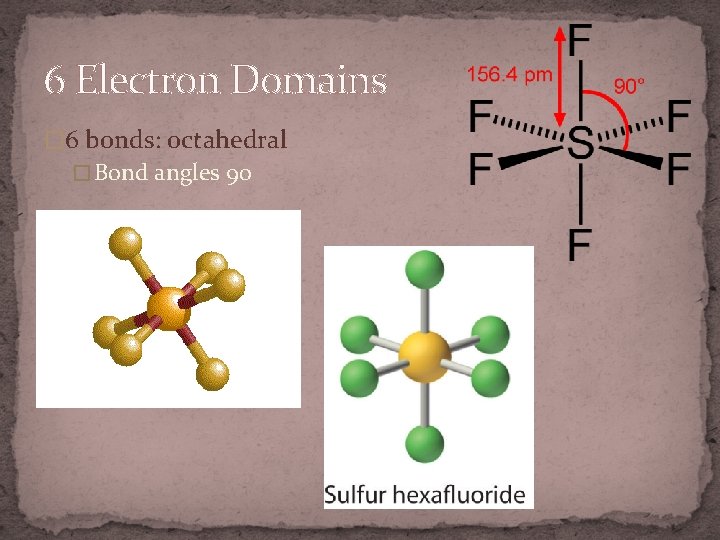
6 Electron Domains � 6 bonds: octahedral � Bond angles 90
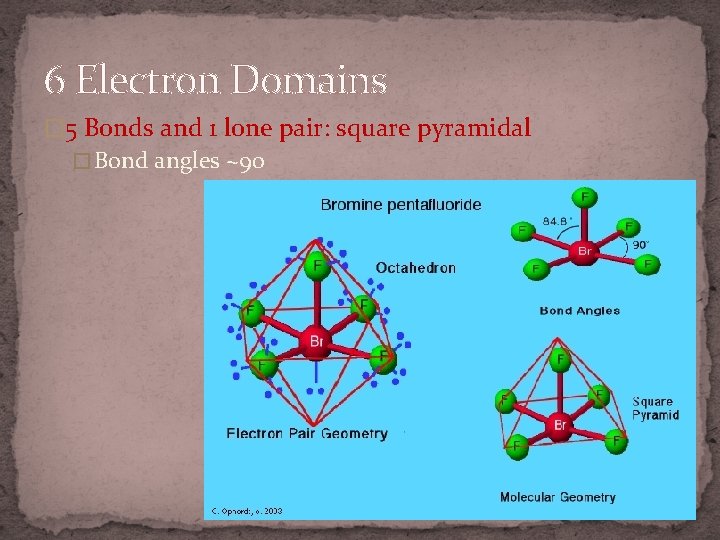
6 Electron Domains � 5 Bonds and 1 lone pair: square pyramidal � Bond angles ~90
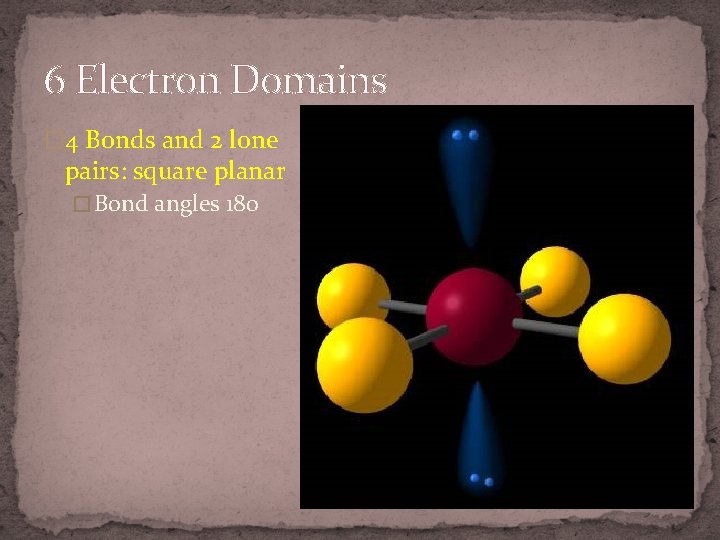
6 Electron Domains � 4 Bonds and 2 lone pairs: square planar � Bond angles 180
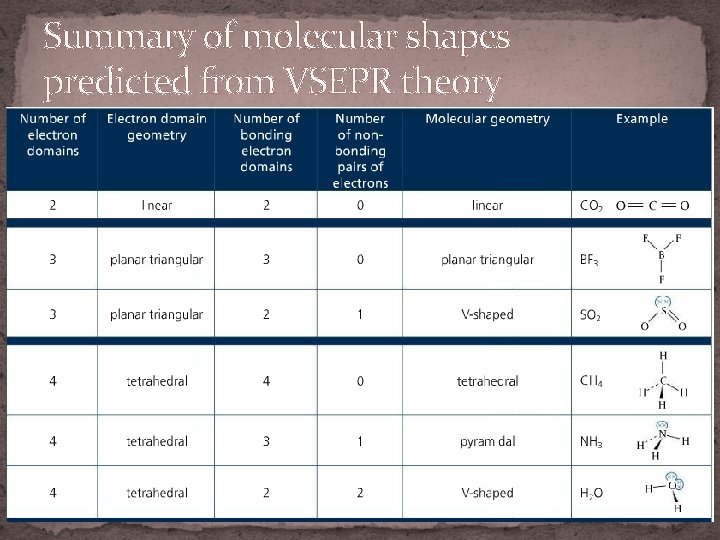
Summary of molecular shapes predicted from VSEPR theory
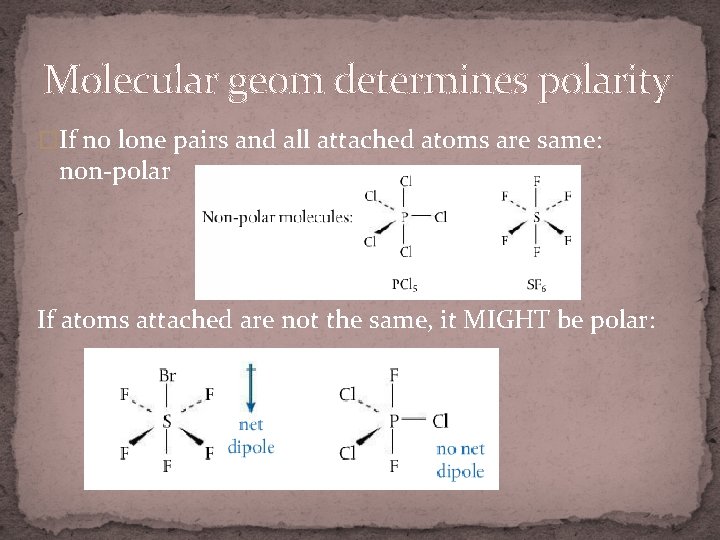
Molecular geom determines polarity �If no lone pairs and all attached atoms are same: non-polar If atoms attached are not the same, it MIGHT be polar:
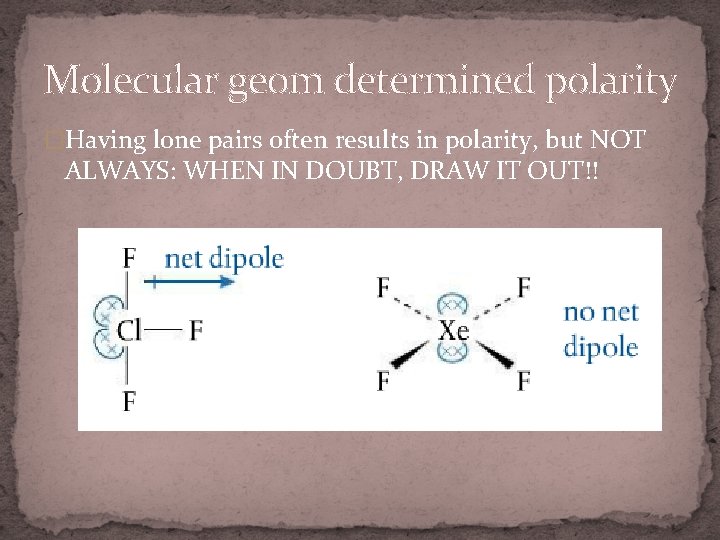
Molecular geom determined polarity �Having lone pairs often results in polarity, but NOT ALWAYS: WHEN IN DOUBT, DRAW IT OUT!!
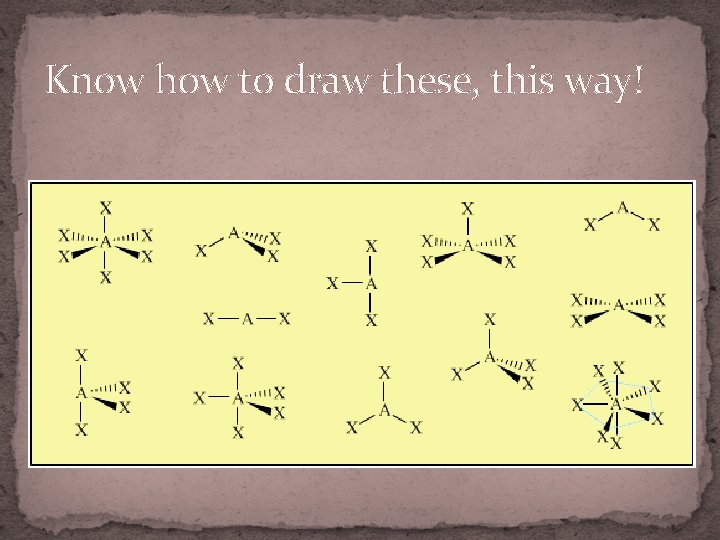
Know how to draw these, this way!
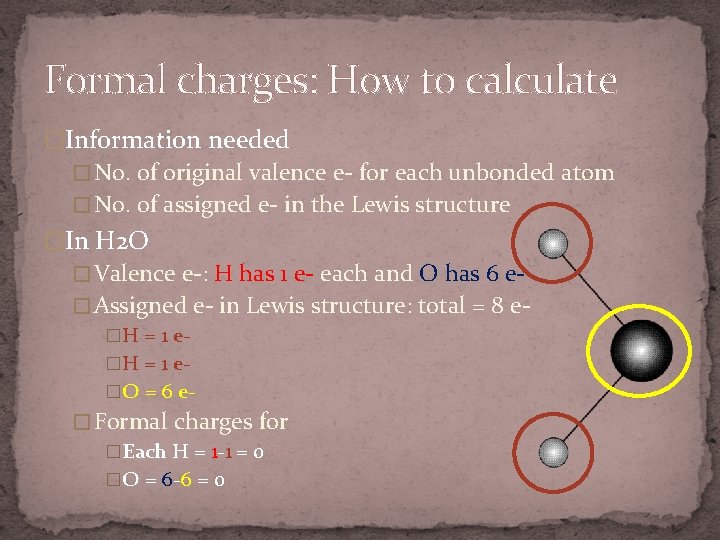
Formal charges: How to calculate �Information needed � No. of original valence e- for each unbonded atom � No. of assigned e- in the Lewis structure �In H 2 O � Valence e-: H has 1 e- each and O has 6 e� Assigned e- in Lewis structure: total = 8 e�H = 1 e�O = 6 e� Formal charges for �Each H = 1 -1 = 0 �O = 6 -6 = 0
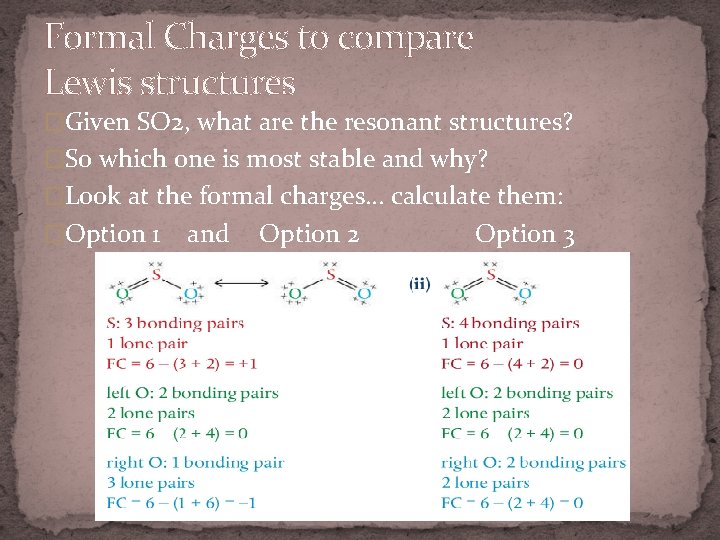
Formal Charges to compare Lewis structures �Given SO 2, what are the resonant structures? �So which one is most stable and why? �Look at the formal charges… calculate them: �Option 1 and Option 2 Option 3
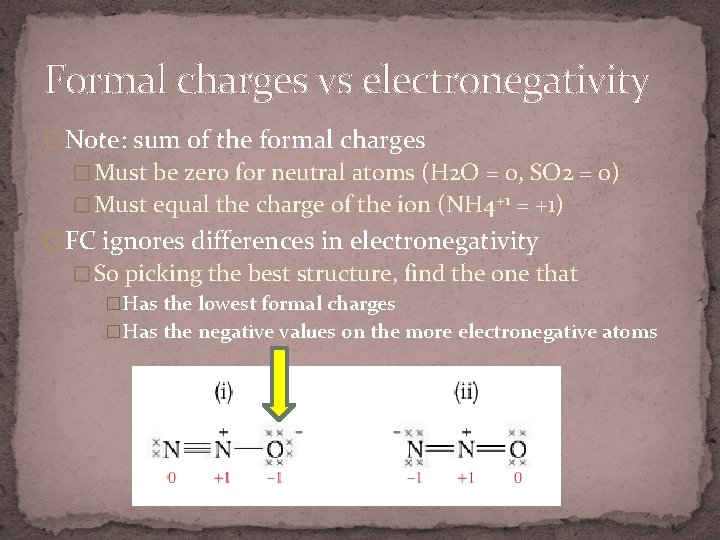
Formal charges vs electronegativity �Note: sum of the formal charges � Must be zero for neutral atoms (H 2 O = 0, SO 2 = 0) � Must equal the charge of the ion (NH 4+1 = +1) �FC ignores differences in electronegativity � So picking the best structure, find the one that �Has the lowest formal charges �Has the negative values on the more electronegative atoms
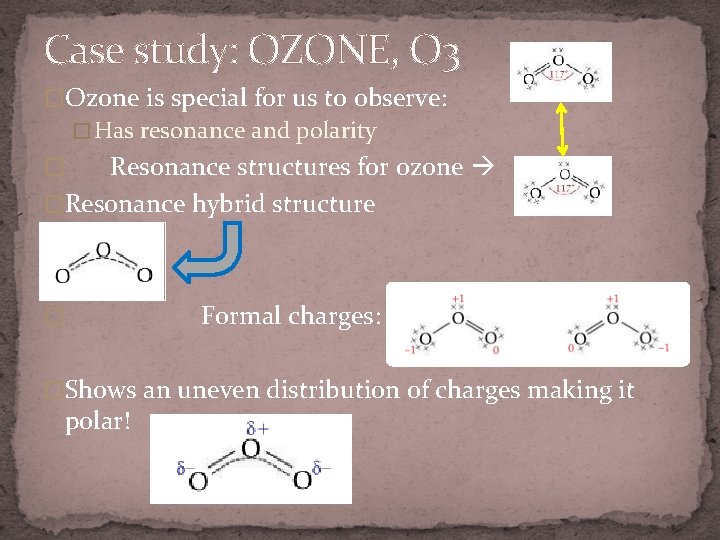
Case study: OZONE, O 3 �Ozone is special for us to observe: � Has resonance and polarity Resonance structures for ozone �Resonance hybrid structure � � Formal charges: �Shows an uneven distribution of charges making it polar!
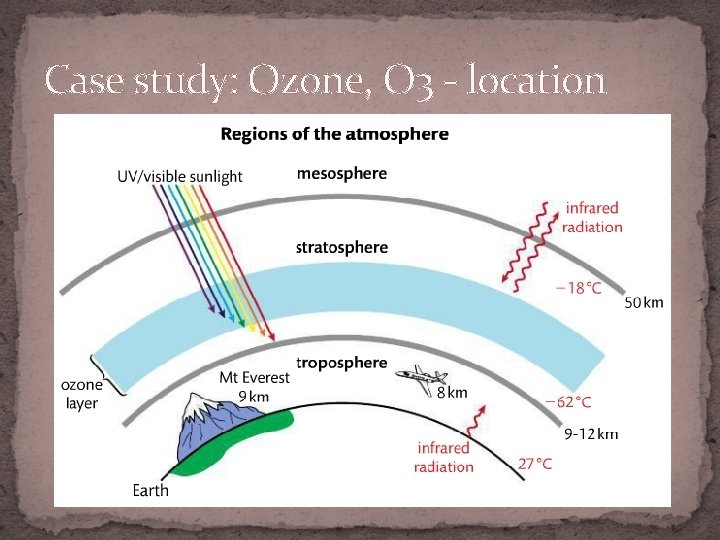
Case study: Ozone, O 3 - location
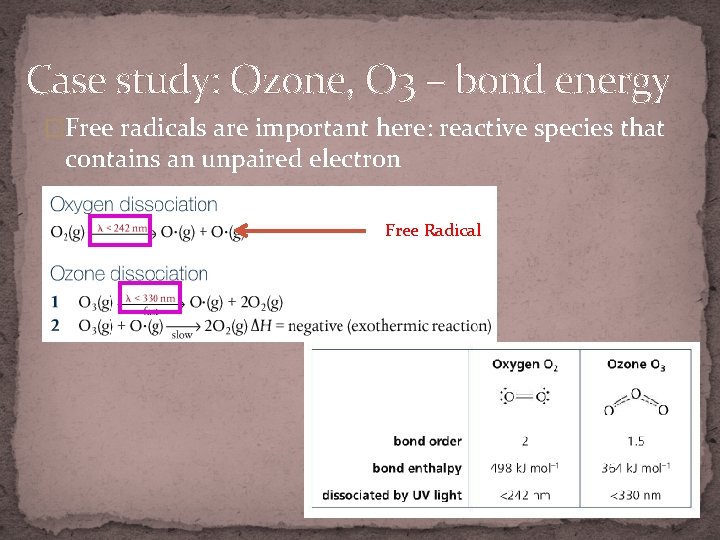
Case study: Ozone, O 3 – bond energy �Free radicals are important here: reactive species that contains an unpaired electron Free Radical
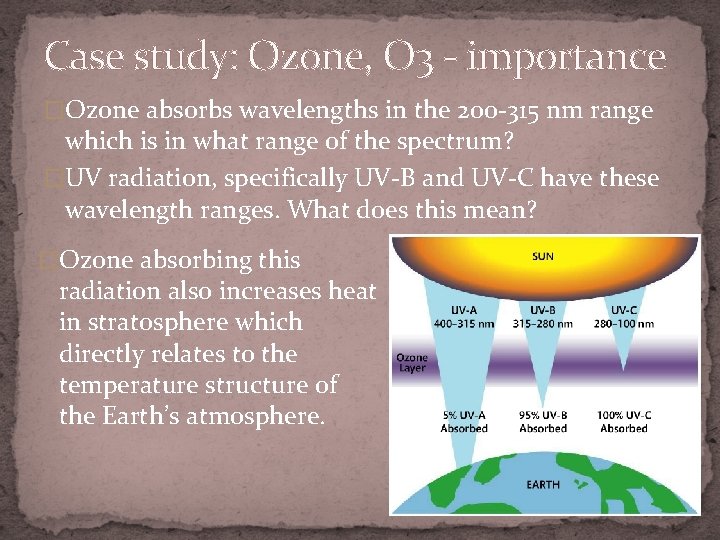
Case study: Ozone, O 3 - importance �Ozone absorbs wavelengths in the 200 -315 nm range which is in what range of the spectrum? �UV radiation, specifically UV-B and UV-C have these wavelength ranges. What does this mean? �Ozone absorbing this radiation also increases heat in stratosphere which directly relates to the temperature structure of the Earth’s atmosphere.
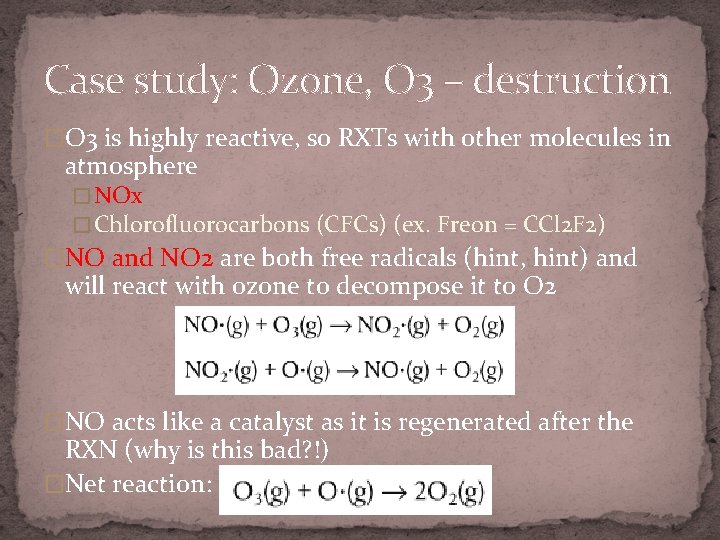
Case study: Ozone, O 3 – destruction �O 3 is highly reactive, so RXTs with other molecules in atmosphere � NOx � Chlorofluorocarbons (CFCs) (ex. Freon = CCl 2 F 2) �NO and NO 2 are both free radicals (hint, hint) and will react with ozone to decompose it to O 2 �NO acts like a catalyst as it is regenerated after the RXN (why is this bad? !) �Net reaction:
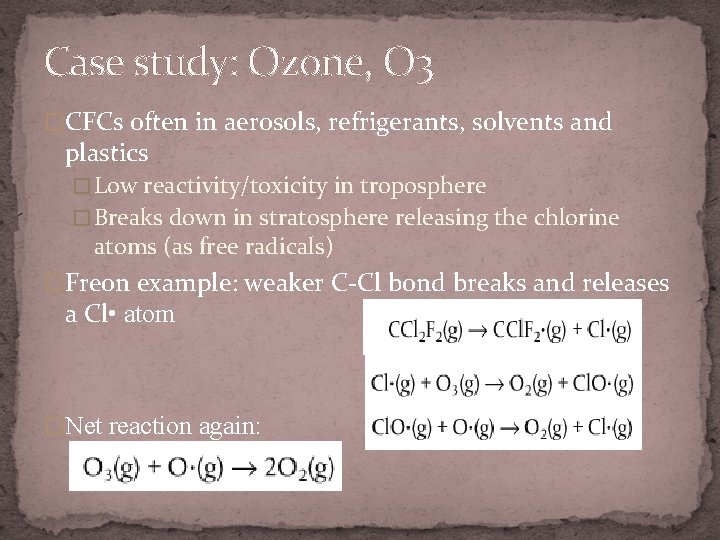
Case study: Ozone, O 3 �CFCs often in aerosols, refrigerants, solvents and plastics � Low reactivity/toxicity in troposphere � Breaks down in stratosphere releasing the chlorine atoms (as free radicals) �Freon example: weaker C-Cl bond breaks and releases a Cl • atom �Net reaction again:
Atomic orbitals: formation of bonds �Atomic orbitals overlap to form two types of covalent bonds: sigma, σ and pi, π �When two atomic orbitals (each with one electron) overlap, it forms a new molecular orbital = lower energy �Sigma: � All single covalent bonds are sigma � Form by overlap of orbitals along the bond axis �Pi: � Second and third covalent bonds (in double or triple bonds) � Form by the sideways overlap of p orbitals
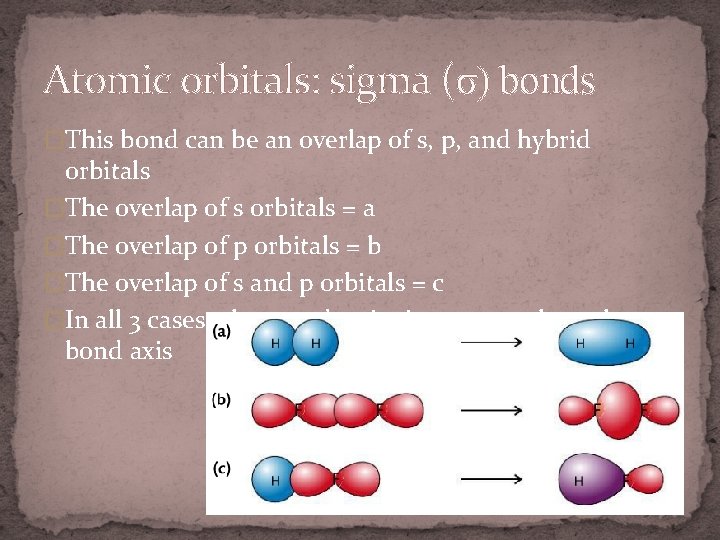
Atomic orbitals: sigma (σ) bonds �This bond can be an overlap of s, p, and hybrid orbitals �The overlap of s orbitals = a �The overlap of p orbitals = b �The overlap of s and p orbitals = c �In all 3 cases, electron density is greatest along the bond axis
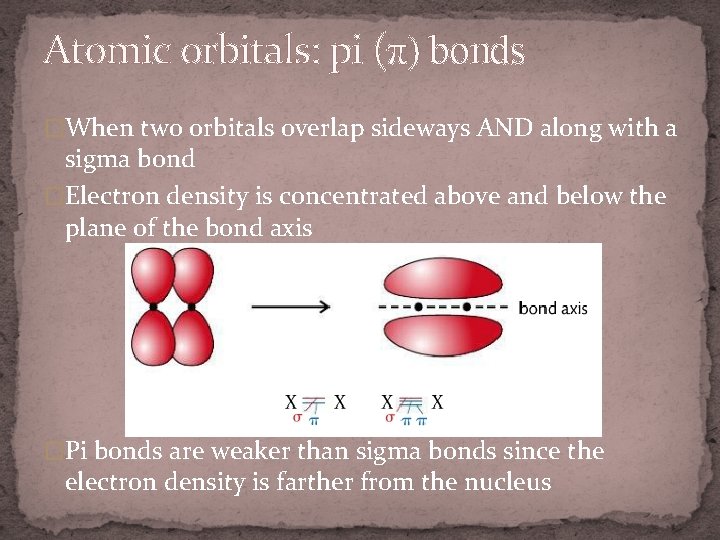
Atomic orbitals: pi (π) bonds �When two orbitals overlap sideways AND along with a sigma bond �Electron density is concentrated above and below the plane of the bond axis �Pi bonds are weaker than sigma bonds since the electron density is farther from the nucleus
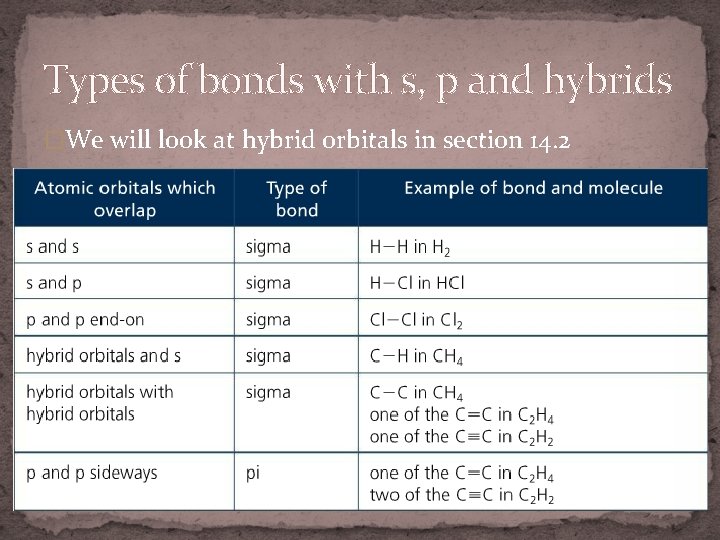
Types of bonds with s, p and hybrids �We will look at hybrid orbitals in section 14. 2
Chapter 14. 2: Hybridization results from the mixing of atomic orbitals to form the same number of new equivalent hybrid orbitals that can have the same mean energy as the contributing atomic orbitals.
Important terms for this section �Ground-state �Excitation �Hybridization �Hybrid atomic orbitals � sp 2 � sp 3 �Electrophilic reagents �Shape of molecules
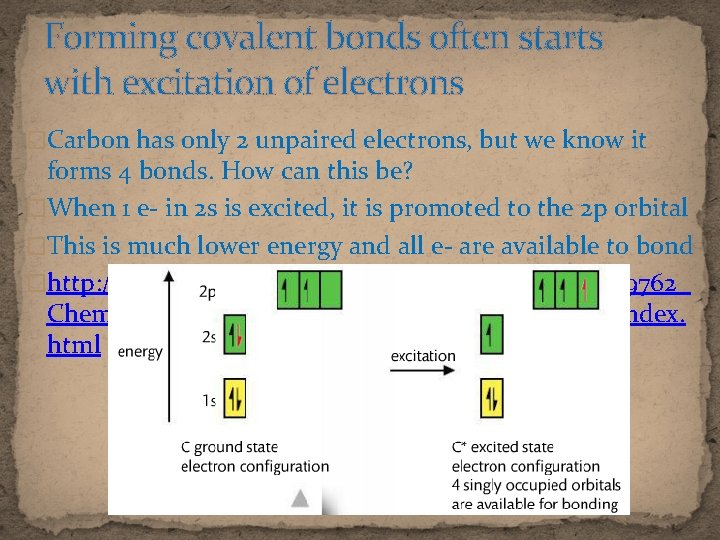
Forming covalent bonds often starts with excitation of electrons �Carbon has only 2 unpaired electrons, but we know it forms 4 bonds. How can this be? �When 1 e- in 2 s is excited, it is promoted to the 2 p orbital �This is much lower energy and all e- are available to bond �http: //media. pearsoncmg. com/intl/ema/9781447959762_ Chem. HL_Brown_Ford/animations/Chapter 4 p 205/index. html
Hybridization �Mixing of the atomic orbitals to form new hybrid atomic orbitals of intermediate energy � Can form stronger covalent bonds �Looking at carbon, there is 1 s and 3 p electrons in their own orbitals, but CH 4 has 4 identical bonds � This comes from the mixing of the orbitals to make hybrid orbitals = hybridization � Hybrid orbitals have different (from the parent orbitals) �Energy �Shape �Orientation in space �An overlap of a hybrid with any other orbital creates a σ bond �See the paint bucket analogy in the book!
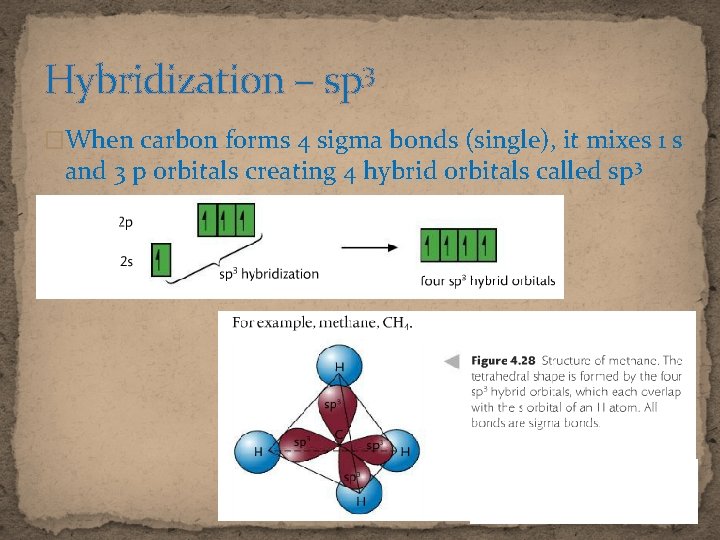
Hybridization – sp 3 �When carbon forms 4 sigma bonds (single), it mixes 1 s and 3 p orbitals creating 4 hybrid orbitals called sp 3
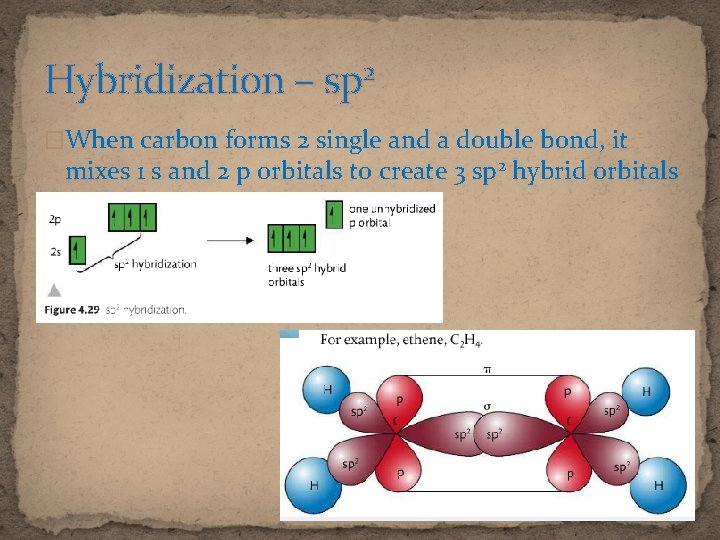
Hybridization – sp 2 �When carbon forms 2 single and a double bond, it mixes 1 s and 2 p orbitals to create 3 sp 2 hybrid orbitals
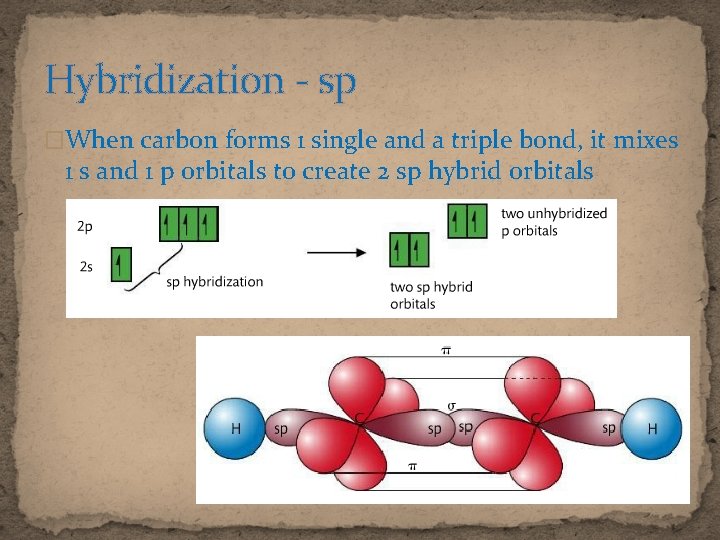
Hybridization - sp �When carbon forms 1 single and a triple bond, it mixes 1 s and 1 p orbitals to create 2 sp hybrid orbitals
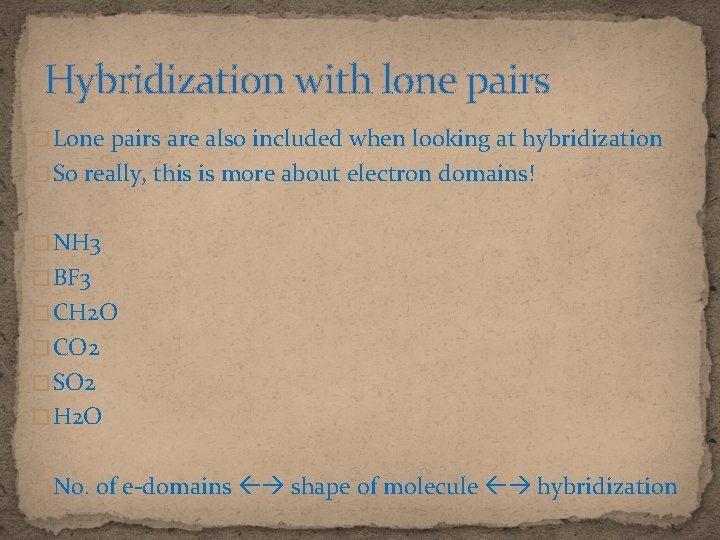
Hybridization with lone pairs � Lone pairs are also included when looking at hybridization � So really, this is more about electron domains! � NH 3 � BF 3 � CH 2 O � CO 2 � SO 2 � H 2 O � No. of e-domains shape of molecule hybridization
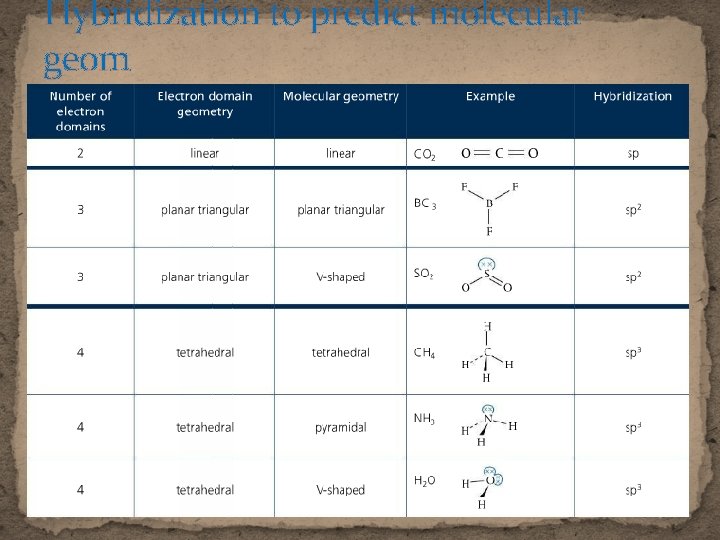
Hybridization to predict molecular geom
- Slides: 40