
Remember A humanocentric history is our focus Terms
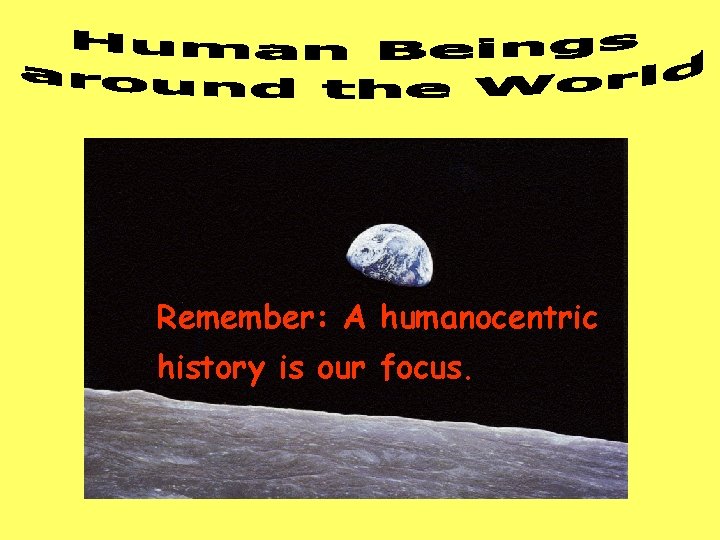
Remember: A humanocentric history is our focus.
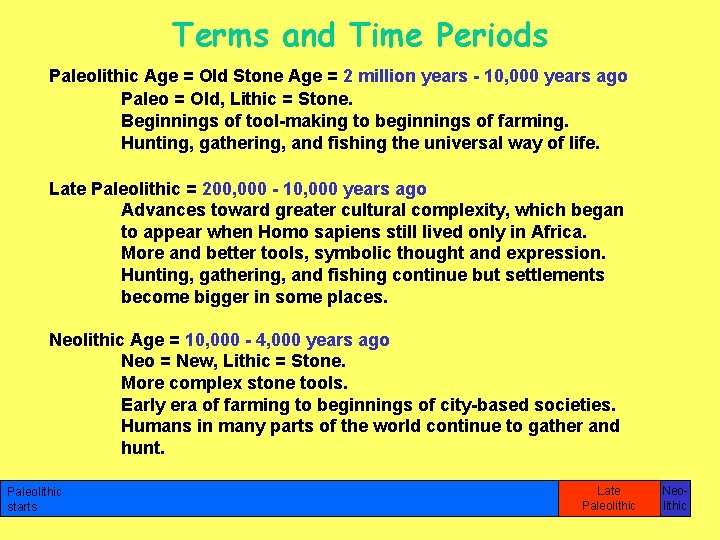
Terms and Time Periods Paleolithic Age = Old Stone Age = 2 million years - 10, 000 years ago Paleo = Old, Lithic = Stone. Beginnings of tool-making to beginnings of farming. Hunting, gathering, and fishing the universal way of life. Late Paleolithic = 200, 000 - 10, 000 years ago Advances toward greater cultural complexity, which began to appear when Homo sapiens still lived only in Africa. More and better tools, symbolic thought and expression. Hunting, gathering, and fishing continue but settlements become bigger in some places. Neolithic Age = 10, 000 - 4, 000 years ago Neo = New, Lithic = Stone. More complex stone tools. Early era of farming to beginnings of city-based societies. Humans in many parts of the world continue to gather and hunt. Paleolithic starts Late Paleolithic Neolithic
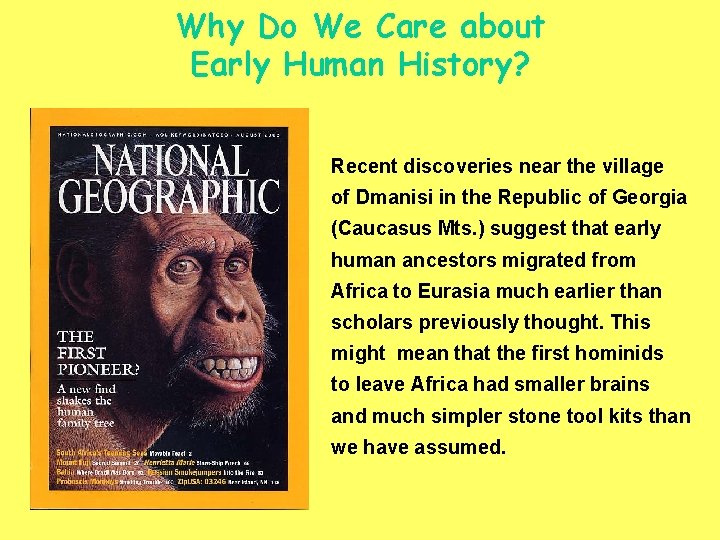
Why Do We Care about Early Human History? Recent discoveries near the village of Dmanisi in the Republic of Georgia (Caucasus Mts. ) suggest that early human ancestors migrated from Africa to Eurasia much earlier than scholars previously thought. This might mean that the first hominids to leave Africa had smaller brains and much simpler stone tool kits than we have assumed.
Why Do We Care about Early Human History? • • • We want to know what it means to be human rather than to be some other kind of life form. What makes us different from chimps? We want to know what connects us and the world we live in to the past, including the very, very remote past. We want to know how the world got to be the way it is because the way it used to be was so different. Early history is part of the human experience. We want to be able to talk about it with others without sounding like ignoramuses. The way national and ethnic groups view their distant past is an important aspect of their identity. The question of whether nature or nurture makes us the way we are always fascinates us. “The past was not only weirder than we realize, it was weirder than we can imagine. ” David Lowenthal
Early Human History What’s the Evidence? • • • Bones “As DNA flows from one generation to the next, small alterations, or mutations Stones – Physical traces of tools or weapons occur, and at a regular rate. • Evidence of changing technology • Evidence of movement in space This means that over time the genetic distance Grave goods – Physical traces of human-made objects • Evidence of changing technology and between individuals life ways, i. e. culture sharing a common ancestor Climatology steadily increases. The – Physical traces of changing climate • Evidence of interrelationship between longer two human environment and human history populations have no contact DNA with one another, the greater – Physical evidence of genetic change in the tissue of people, living or dead. the genetic • Evidence of movement in time and space distance between them will • Evidence of adaptation to differing environments be. ” – Physical traces of human beings • Evidence of anatomical evolution • Evidence of movement in space

Family Tree of Human Evolution (part of the modern “creation myth”) This family tree shows the variety of hominid species that have populated the planet--some known only by a fragment of skull or jaw. As the tree suggests, the emergence of Homo sapiens has not been a single, linear transformation of one species into another but rather a meandering, multifaceted evolution. Ian Tattersall Homo sapiens Homo Neanderthalensis Homo Heidelbergensis Homo Erectus Homo Ergaster Homo Habilis Australopithecus afarensis

Why are humans everywhere, and how did they get there? Unlike most animals, humankind is a cosmopolitan species. That is, it has adapted to almost all the earth’s regions and climates.
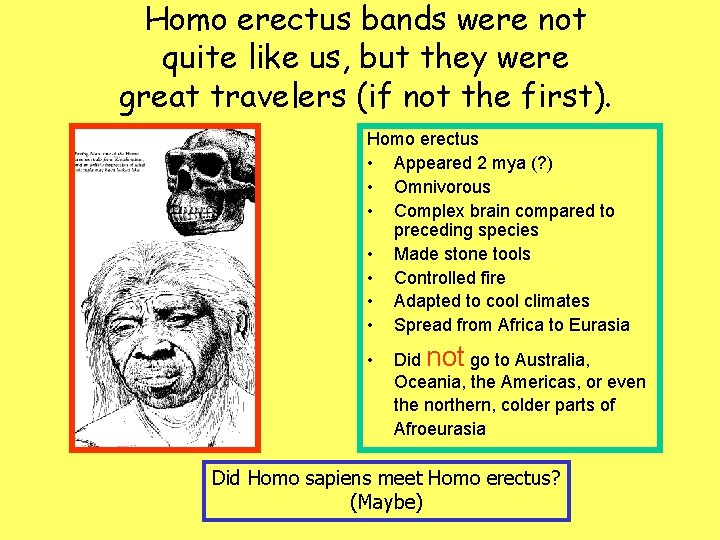
Homo erectus bands were not quite like us, but they were great travelers (if not the first). Homo erectus • Appeared 2 mya (? ) • Omnivorous • Complex brain compared to preceding species • Made stone tools • Controlled fire • Adapted to cool climates • Spread from Africa to Eurasia • Did not go to Australia, Oceania, the Americas, or even the northern, colder parts of Afroeurasia Did Homo sapiens meet Homo erectus? (Maybe)
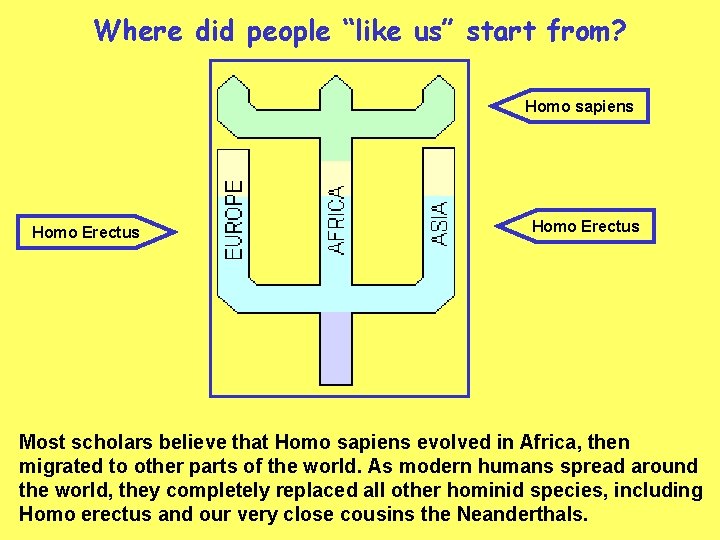
Where did people “like us” start from? Homo sapiens Homo Erectus Most scholars believe that Homo sapiens evolved in Africa, then migrated to other parts of the world. As modern humans spread around the world, they completely replaced all other hominid species, including Homo erectus and our very close cousins the Neanderthals.
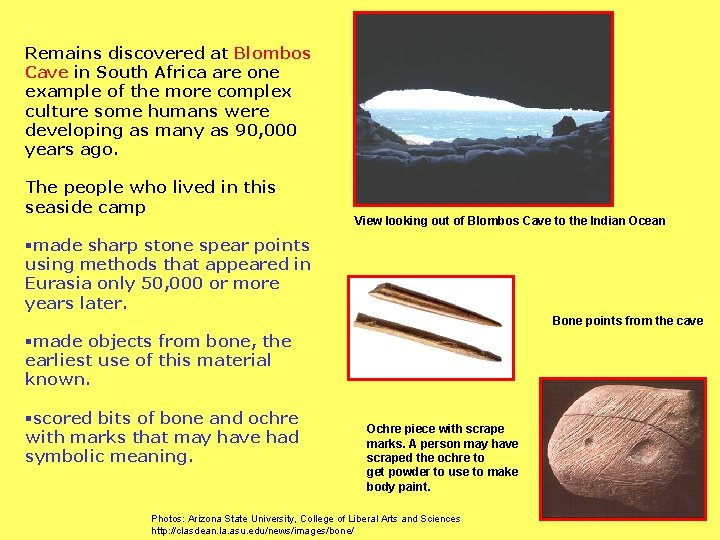
Remains discovered at Blombos Cave in South Africa are one example of the more complex culture some humans were developing as many as 90, 000 years ago. The people who lived in this seaside camp View looking out of Blombos Cave to the Indian Ocean §made sharp stone spear points using methods that appeared in Eurasia only 50, 000 or more years later. Bone points from the cave §made objects from bone, the earliest use of this material known. §scored bits of bone and ochre with marks that may have had symbolic meaning. Ochre piece with scrape marks. A person may have scraped the ochre to get powder to use to make body paint. Photos: Arizona State University, College of Liberal Arts and Sciences http: //clasdean. la. asu. edu/news/images/bone/
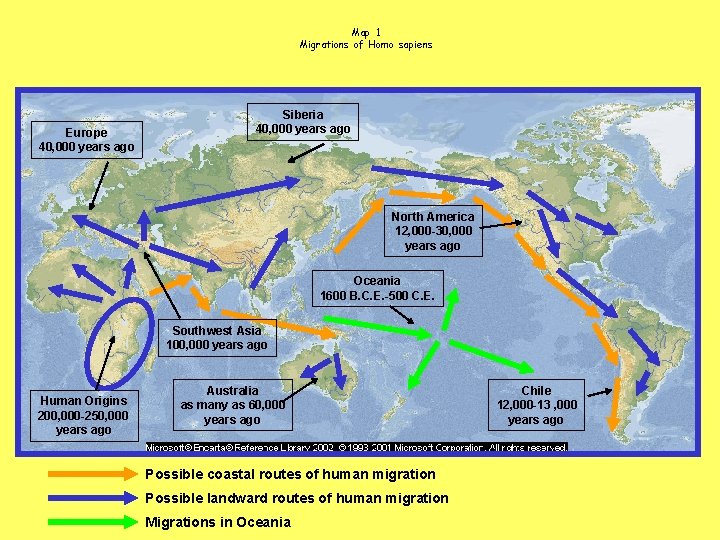
Map 1 Migrations of Homo sapiens Europe 40, 000 years ago Siberia 40, 000 years ago North America 12, 000 -30, 000 years ago Oceania 1600 B. C. E. -500 C. E. Southwest Asia 100, 000 years ago Human Origins 200, 000 -250, 000 years ago Australia as many as 60, 000 years ago Possible coastal routes of human migration Possible landward routes of human migration Migrations in Oceania Chile 12, 000 -13 , 000 years ago
Why are Human Beings Everywhere? By perhaps 200, 000 years ago, human beings possessed the intelligence, capacity for shared learning, and technical skills to adapt to just about any climate on earth. But why did they populate all the major land masses and most islands of the globe?
Why Did People End Up Everywhere? • • • Humans did not “decide” to populate the world. Neither did humans drift aimlessly from continent to continent. Migrating peoples did not have long-distance objectives. But they did have short distance ones to survive and perpetuate the group. Sometimes that meant moving. When population rose in an area, some were forced to move on. Climatic fluctuations and crises could also be “engines” stimulating migration.
Introducing
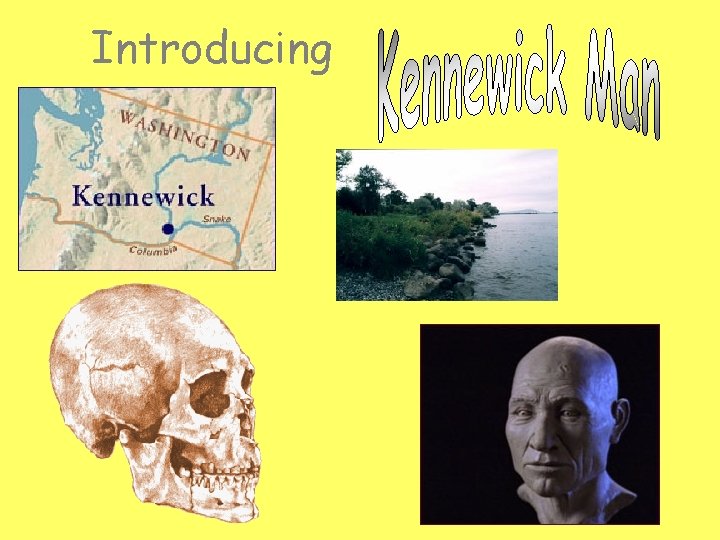
Facts about Kennewick Man • • Skeletal remains discovered on a bank of the Columbia River in Washington State in 1996. Radio carbon dating showed the skeleton to be about 9, 000 years old. Skull appears to have features unlike other ancient skulls of Native American ancestors. DNA study has been inconclusive in determining genetic connection between the skeleton and human groups. The origins of Kennewick Man are unknown. Umatilla Indian group claimed the skeleton for immediate ritual burial. The skeleton was found on federal land, not on a reservation. Even so, the law requires that remains of Native Americans found on federal land be returned to affiliated tribes for reburial. This law, enacted in 1990, is called the Native American Graves Protection and Repatriation Act (NAGPRA). Scientists have sued to be permitted to undertake long-term study of the remains. Popular media at first reported Kennewick Man as a “European” whose genetic relatives had come to North America more than 9, 000 years ago. The notion that this man came from “Europe” has been discredited. A court has recently found in favor of the scientists, but Indian groups will appeal that decision.
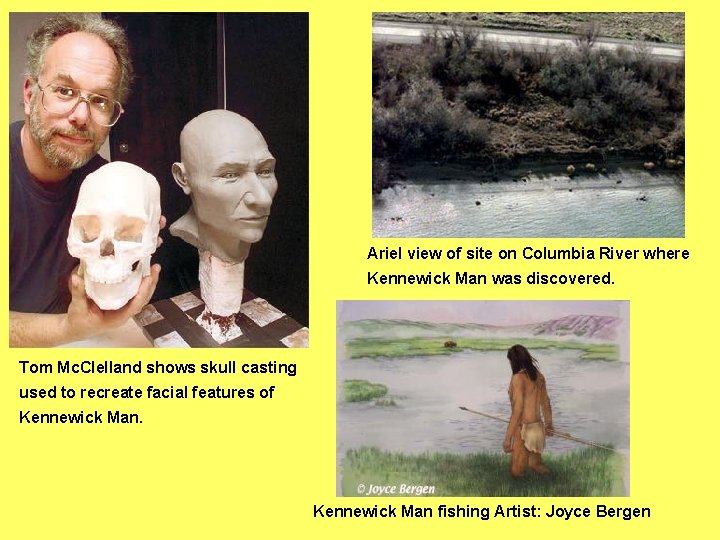
Ariel view of site on Columbia River where Kennewick Man was discovered. Tom Mc. Clelland shows skull casting used to recreate facial features of Kennewick Man fishing Artist: Joyce Bergen
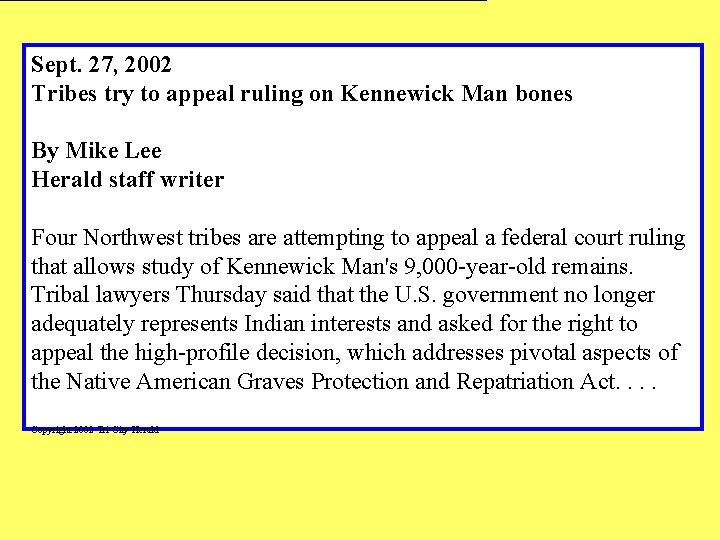
Sept. 27, 2002 Tribes try to appeal ruling on Kennewick Man bones By Mike Lee Herald staff writer Four Northwest tribes are attempting to appeal a federal court ruling that allows study of Kennewick Man's 9, 000 -year-old remains. Tribal lawyers Thursday said that the U. S. government no longer adequately represents Indian interests and asked for the right to appeal the high-profile decision, which addresses pivotal aspects of the Native American Graves Protection and Repatriation Act. . Copyright 2002 Tri-City Herald
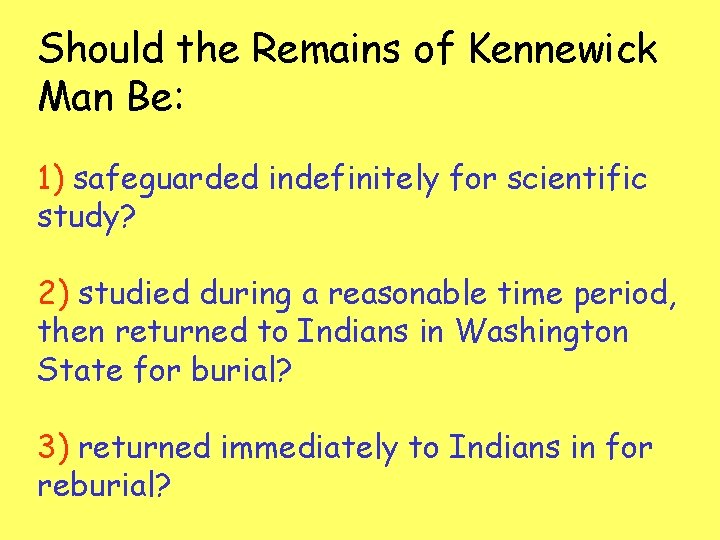
Should the Remains of Kennewick Man Be: 1) safeguarded indefinitely for scientific study? 2) studied during a reasonable time period, then returned to Indians in Washington State for burial? 3) returned immediately to Indians in for reburial?

END
- Slides: 19