
Remarks on the Physical Church Turing Thesis Scott
- Slides: 13
Remarks on the Physical Church. Turing Thesis Scott Aaronson MIT
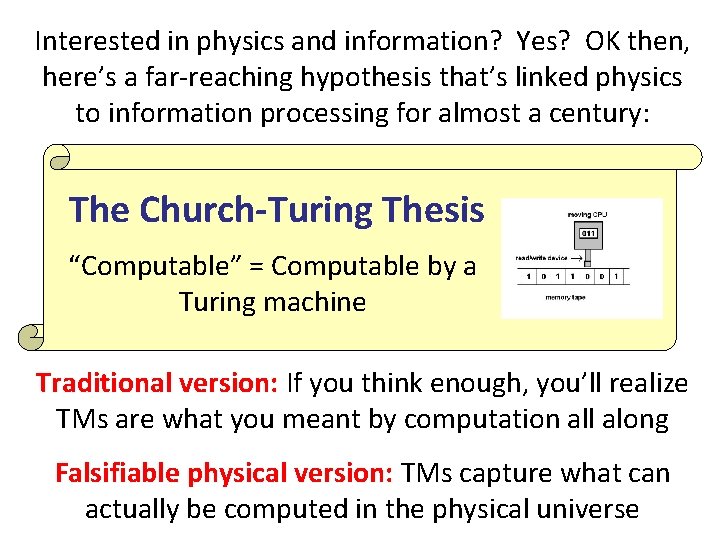
Interested in physics and information? Yes? OK then, here’s a far-reaching hypothesis that’s linked physics to information processing for almost a century: The Church-Turing Thesis “Computable” = Computable by a Turing machine Traditional version: If you think enough, you’ll realize TMs are what you meant by computation all along Falsifiable physical version: TMs capture what can actually be computed in the physical universe
Stuff to Get Out of the Way What about interactions, manipulating the world, etc? What about chaos or unknowable initial conditions? What about consciousness? Just because the universe can be simulated by a Turing machine, doesn’t mean it is one! The Church-Turing Thesis is an “infinite” claim, but the real world is finite!
My view: When properly interpreted, the Church. Turing Thesis has held up remarkably well since the 1930 s But even if true, it’s an empirical truth, not a logical one What sort of thing would falsify the Church. Turing Thesis, were it possible?
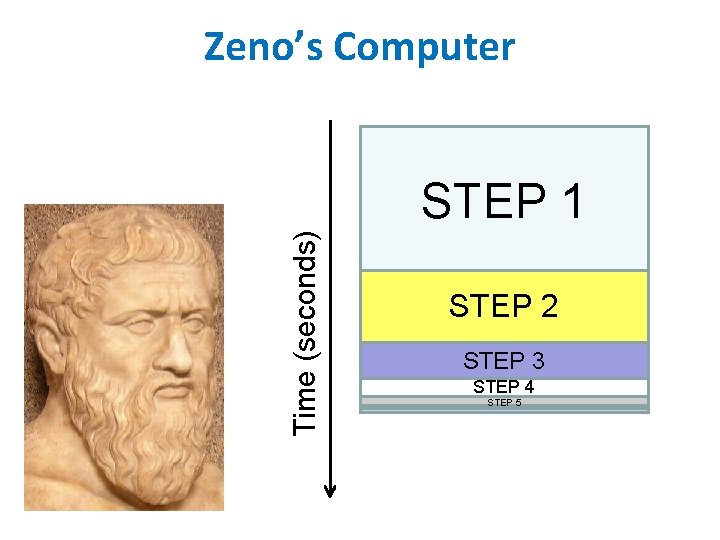
Zeno’s Computer Time (seconds) STEP 1 STEP 2 STEP 3 STEP 4 STEP 5
Relativity Computer DONE
We can stick our necks out even further… Extended Church-Turing Thesis “Efficiently computable” = Computable in polynomial time by a deterministic or probabilistic Turing machine Again, comes in both “traditional” and “falsifiable physical” versions
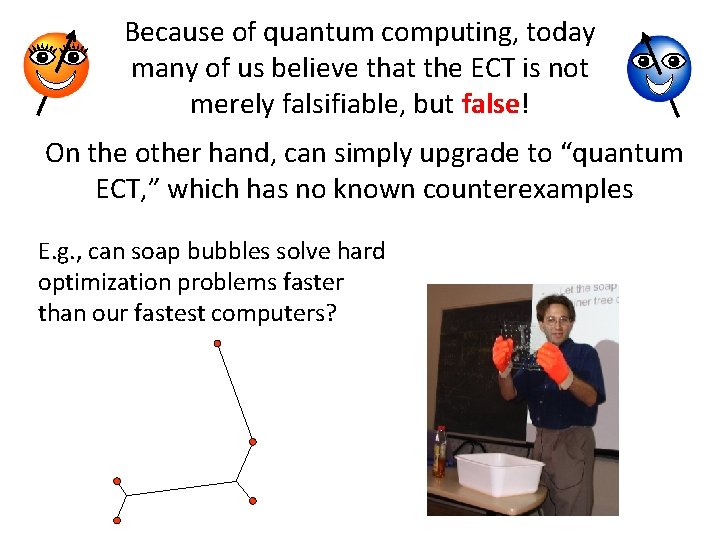
Because of quantum computing, today many of us believe that the ECT is not merely falsifiable, but false! On the other hand, can simply upgrade to “quantum ECT, ” which has no known counterexamples E. g. , can soap bubbles solve hard optimization problems faster than our fastest computers?
Aaronson’s Thesis No matter what “physical laws” we try to make up, if they’re not absurdly constricted, then they’ll either be Turing-universal, or else Turing-universal with implausible additions like the ability to solve the halting problem. What are examples of challenges to this thesis?
The Digi-Comp II A. , recently: There’s a clear sense in which the Digi-Comp is not Turing-universal. (Main issue: Digi-Comp lacks capacity for “fanout”)
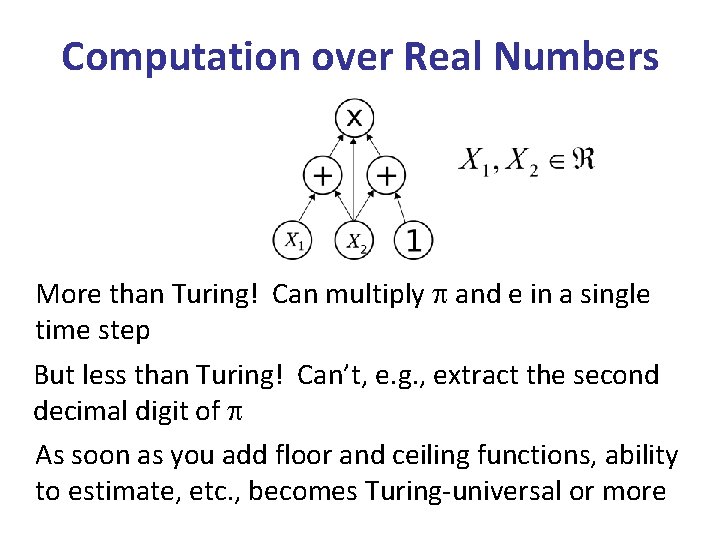
Computation over Real Numbers More than Turing! Can multiply and e in a single time step But less than Turing! Can’t, e. g. , extract the second decimal digit of As soon as you add floor and ceiling functions, ability to estimate, etc. , becomes Turing-universal or more
Concluding Thoughts Understanding the limits of efficient computation (the ECT) is one of the great scientific quests of our time: - Can scalable quantum computers be built? - Is there anything beyond quantum computing? Whatever the answers to these questions, few would claim they’re knowable a priori… But what about the original Church-Turing Thesis? Despite being falsifiable, it has a much more “inevitable” feel than the extended version does
Open Problem Could we build sensible laws of physics around a notion of computation totally incomparable to Turing’s—say, where the halting problem was computable but the OR function wasn’t?