
Religious Liberty and Religious Accommodation in the United
Religious Liberty and Religious Accommodation in the United States Army OCCH/USACHCS CH (LTC) Stephen Pratel OCCH Religious Accommodation Officer E-Mail: stephen. pratel 3. mil@mail. mil Phone: 571 256 -8771 PHASE 2 & 3 RL/RA Training (Commanders) As of 14 September 2020 UNCLASSIFIED 1
Learning Objectives Task: Train the Army on Religious Liberty and Religious Accommodation. Terminal Learning Objective: Command Teams at echelon trained and capable to execute the Religious Accommodation (RA) Mission in accordance with law, DOD, and Army policy. Enabling Learning Objective: Inform and educate participants on current legal and policy standards on Religious Liberty and Religious Accommodation in AR 600 -20. Phase 2&3 Training UNCLASSIFIED 2
References • Title 42, United States Code § 2000 bb- 1 (Religious Freedom Restoration Act). • Title 10, United States Code § 774 (1 st Amendment: Free Exercise and Establishment Clause“). • Attorney General Memorandum on Religious Liberty, 6 October 2017, (Implementing Executive Order 13798). • Department of Defense Instruction 1300. 17 (Religious Liberty in the Military Services), September 1, 2020. • Army Regulation (AR) 670 -1 (Wear and Appearance of Army Uniforms and Insignia), 25 May 2017. • Army Regulation (AR) 600 -20 (Army Command Policy), para 5/Appendix P (Accommodating Religious Practices) July 24, 2020. • Army Regulation (AR) 690– 12 (Civilian Personnel Equal Employment Opportunity and Diversity), 12 December 2019. • Army Techniques Publication (ATP) 1 -05. 04 Religious Support and Internal Advisement, March 2017. Phase 2&3 Training UNCLASSIFIED 3
Introduction • Religious Accommodation (RA) procedures and policy have been revised and consolidated into an updated AR 600 -20, July 24, 2020 and DODI 1300. 17, 1 Sep, 2020. • All Army Directives (AD) 2016 -34, (AD) 2018 -19, and prior ALARACTS are superseded with the new publication of AR 600 -20. • Commanders, Staff, Chaplains and Religious Affairs Specialists (RAS) must maintain familiarity with RA law and policy to fulfill: • Requirement to train Army Soldiers and leaders in RA. • Command responsibility to act on requests for Religious Accommodation in a timely and effective manner. • Chaplain/RAS responsibility to advise Army leaders and Soldiers on religious exercise in military contexts and to lead the RA process as subject matter experts. • Chaplain responsibility to conduct formal RA interviews as part of RA requests and write effective memorandums. Phase 2&3 Training UNCLASSIFIED 4
Agenda/Contents TRAINING SLIDES Section 1. Foundations of Religious Liberty and Religious Accommodation in the United States Army. Section 2. Roles of Commanders, Chaplains and Religious Affairs Specialists (RAS) in Religious Accommodation. A) Overview of changes in AR 600 -20 and Annex P. B) Command Roles and Responsibilities C) Commanders TTPs and Best Practices in RA. D) RA Packet Glide Path, Contents and Process Tables. E) Chaplain/RAS Roles in Religious Accommodation. Section 3. Scenarios and Discussion – Time permitting. Section 4. Supplementary Resources. BACKUP SLIDES A) Overview of AR 600 -20 Paragraph 5 -6. B) Overview of AR 600 -20 Appendix P. Phase 2&3 Training UNCLASSIFIED 5
SECTION 1. Foundations of Religious Liberty and Religious Accommodation in the United States Army Phase 2&3 Training UNCLASSIFIED 6
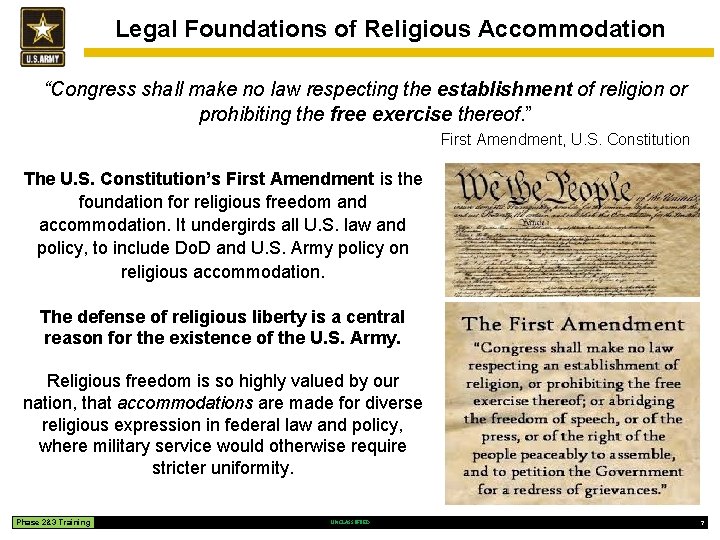
Legal Foundations of Religious Accommodation “Congress shall make no law respecting the establishment of religion or prohibiting the free exercise thereof. ” First Amendment, U. S. Constitution The U. S. Constitution’s First Amendment is the foundation for religious freedom and accommodation. It undergirds all U. S. law and policy, to include Do. D and U. S. Army policy on religious accommodation. The defense of religious liberty is a central reason for the existence of the U. S. Army. Religious freedom is so highly valued by our nation, that accommodations are made for diverse religious expression in federal law and policy, where military service would otherwise require stricter uniformity. Phase 2&3 Training UNCLASSIFIED 7
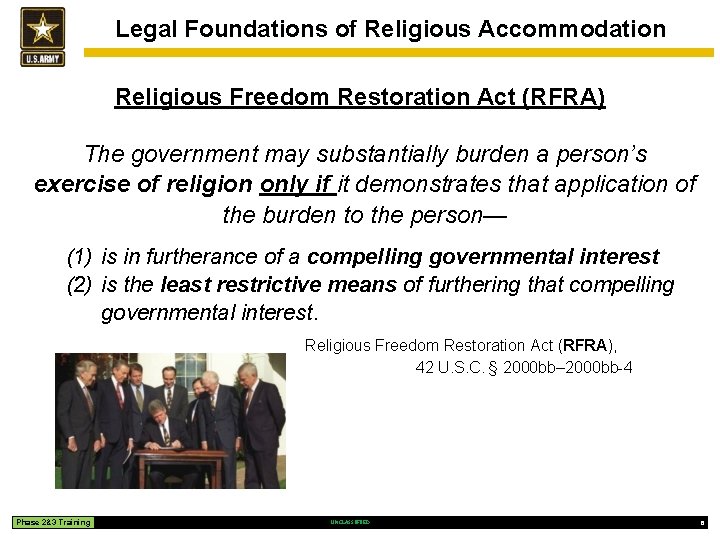
Legal Foundations of Religious Accommodation Religious Freedom Restoration Act (RFRA) The government may substantially burden a person’s exercise of religion only if it demonstrates that application of the burden to the person— (1) is in furtherance of a compelling governmental interest (2) is the least restrictive means of furthering that compelling governmental interest. Religious Freedom Restoration Act (RFRA), 42 U. S. C. § 2000 bb– 2000 bb-4 Phase 2&3 Training UNCLASSIFIED 8
RFRA is THE Religious Liberty Standard The 6 Oct 2017 Attorney General Memo (Implementing Executive Order 13798) explains that, under RFRA: • Religious observance and practice should be reasonably accommodated to the greatest extent practicable and permitted by law. • • The Government (Army) may not favor or disfavor any religious group. • A governmental action substantially burdens an exercise of religion under RFRA if it bans an aspect of religious observance or practice, compels an act inconsistent with that observance or practice, or substantially pressures the adherent to modify such observance or practice. • Under RFRA, the free exercise of religion includes the right to act or abstain from action in accordance with one’s religious beliefs. • This Religious Liberty Standard may apply to: Religious practices, Religious/Worship observances, Religious expression and speech, Abstention from activities that violate ones religious beliefs, Daily activities and interactions. Compelling Government Interests can outweigh legitimate claims to the free exercise of religion, but must show that its chosen restriction on free religious exercise is the least restrictive means of achieving that interest. Phase 2&3 Training UNCLASSIFIED 9
Do. D and ARMY Religious Accommodation Policy Do. D RL/RA Policy - Do. DI 1300. 17 “Pursuant to the Free Exercise Clause of the First Amendment to the United States Constitution, Service members have the right to observe the tenets of their religion or to observe no religion at all. ” “Do. D Components will accommodate individual expressions of sincerely held beliefs… which do not have an adverse impact on military readiness, unit cohesion, good order and discipline, or health and safety. A Service member’s expression of such beliefs may not… be used as the basis of any adverse personnel action, discrimination, or denial of promotion, schooling, training, or assignment. ” Do. DI 1300. 17, 1 September 2020. Army RA Policy - AR 600 -20 “The Army places a high value on the rights of its Soldiers to observe tenets of their respective religions or to observe no religion at all, while protecting the civil liberties of its personnel to the greatest extent possible, consistent with its military requirements. ” “…requests for religious accommodations from a military policy, practice, or duty that substantially burdens a Soldier’s (to include military prisoner’s) exercise of religion may be denied only when the military policy, practice, or duty furthers a compelling government interest and is the least restrictive means of furthering that interest. ” AR 600 -20, 5 -6 Army Command Policy, July 24, 2020. Phase 2&3 Training UNCLASSIFIED 10
Religious Liberty and Army Equal Opportunity Policy AR 600 -20 (Army Command Policy) and AR 690 -12 (Civilian Personnel Equal Employment Opportunity and Diversity) prohibit discrimination and harassment based on religion. • The Army will provide fair treatment for military personnel and Family members without regard to religion on and off post, during duty and non-duty hours in all work, living, and recreational environments, (including on and offpost housing). • Soldiers will not be accessed, classified, trained, assigned, promoted, or otherwise managed on the basis of religion. AR 600 -20, 6– 2. • The law requires accommodation of a civilian employee's religious beliefs or practices, unless doing so would cause more than a minimal burden on the operations of the agency's business. • Religious discrimination involves treating a person unfavorably because of sincerely held religious, ethical, or moral beliefs, or a connection to a religious group, including the beliefs and connections of their spouse. AR 690 -12, 1 -6, D-1. Phase 2&3 Training UNCLASSIFIED 11
Chaplains and Religious Liberty • Chaplains play a critical role in fostering positive command climates that support religious liberty. In addition to facilitating the free exercise of religion, chaplains advise commands on all matters of religion at all echelons. • The RFRA standard for religious freedom applies to all Soldiers including chaplains in the discharge of their duties. If chaplains are unable to perform a service due to their religious conviction, they will provide coordination and referral for that service by alternate means. • Chaplains are accountable to their endorsing religious group in all matters pertaining to the maintenance of their credentials. If a chaplain jeopardizes their religious credentials, it could force a separation from service. • No member of the Armed Forces may require a chaplain to perform duties that are contrary to the conscience, moral principles, or religious beliefs of the chaplain; discriminate, or take adverse action against a chaplain if they are unable to perform a requirement that is prohibited by their religious group. • Adverse actions against a chaplain based on acceptability of religious viewpoints (of the chaplain or their endorser) in the course of official chaplain duties risks violation of law such as RFRA and Constitutional standards. Phase 2&3 Training UNCLASSIFIED 12
Religious Liberty is Essential Command policies and climates that guarantee and protect religious liberties, including the accommodation of sincere religious practices supports the Army in critical ways: • Enhances Mission Accomplishment - Free exercise of religion and religious liberty is essential to, and supports the Army’s mission of sustaining Soldier readiness, builds ethical and moral strength, and sustains motivation to meet present and future challenges. • Sustains Positive Command Climates - Free exercise of religion and religious liberty supports the mission-enhancing benefits of positive command climates that encourage respect, tolerance, and ample opportunity for expression or abstention of religion and worship. • Fosters Respect - Chaplains and Religious Affairs Specialists advise the command at all echelons and provide religious leadership, facilitating the vigilant respect, support and awareness of the religious freedom of all Soldiers to practice or not practice a religion, including the responsible exercise of those freedoms. Taken from: ATP 1 -05. 04, para. 1 -11 Phase 2&3 Training UNCLASSIFIED 13
Questions and Discussion Phase 2&3 Training UNCLASSIFIED 14
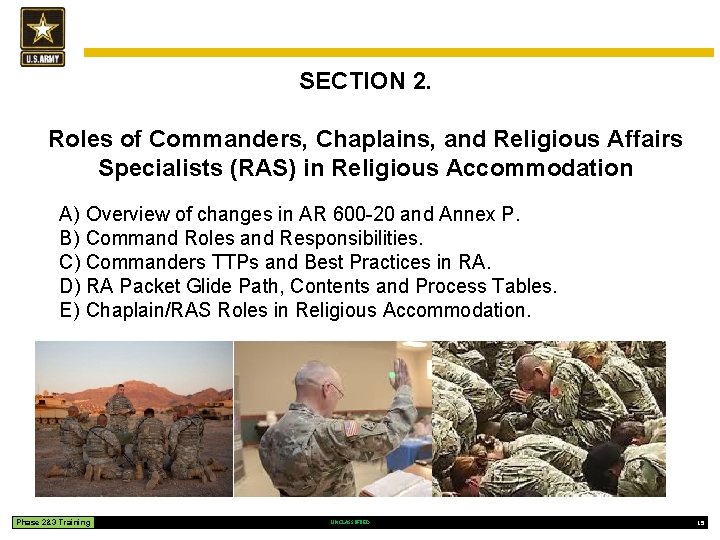
SECTION 2. Roles of Commanders, Chaplains, and Religious Affairs Specialists (RAS) in Religious Accommodation A) Overview of changes in AR 600 -20 and Annex P. B) Command Roles and Responsibilities. C) Commanders TTPs and Best Practices in RA. D) RA Packet Glide Path, Contents and Process Tables. E) Chaplain/RAS Roles in Religious Accommodation. Phase 2&3 Training UNCLASSIFIED 15
A. AR 600 -20. Overview AR 600 -20 was significantly revised and updated effective 24 July 2020. The new AR 600 -20 has two components: 1. Paragraph 5 -6 “Accommodating Religious Practices” A. Policy B. Responsibilities C. Pre-Accessioning Requests D. Types of Requests E. Request Procedures and Approval Authorities F. Continuation of Accommodation G. Separation Procedures 2. Appendix P – “Religious Accommodation Processes” P-1. Worship and Dietary Practices P-2. Medical Care P-3. Uniform and Grooming Table P-1 Request Table Matrix • A FULL examination of 600 -20 5 -6 and Annex P is included as backup slides. • STRONGLY recommend all leaders review these slides and keep as a reference when engaging in RA activities. • AR 600 -20 Supersedes ALL prior AD’s and ALARACTS. Most of the procedures detailed in AD 2016 -34, and AD 2018 -19 are contained and combined into Annex P. Phase 2&3 Training UNCLASSIFIED 16
A. AR 600 -20 -5 -6. Overview of Changes 1. Focus on the RFRA standard and language of “substantial burden, compelling government interest, and accommodation by least restrictive means. ” *Emphasizes the Soldier’s responsibility to “demonstrate a sincerely held religious belief, and that Army policy/regulation is substantially burdening their religious exercise”. 2. Focus on Pre-Accession Requests (Officer and Enlisted) and all military prisoners in DA run facilities. 3. Chaplain Interview conducted by a unit chaplain or “other chaplain determined by the senior chaplain present. ” 4. RA approval Authority expanded to commanders at the GCMCA, to include the first general officer in the chain of command. 5. Expands RA to include requests not sincerely based on a religious belief or do not substantially burden a Soldier. In these cases commanders will consider requests NOT on the RFRA standard, but on how the needs of the Soldier balance against “mission accomplishment”. 6. Directs review of approved RA requests by a gaining GCMCA at a Soldier’s PCS, as well as ongoing questions of sincerity, or change of MOS. 7. GCMCA Suspension Criteria expanded to include issues of sincerity. Phase 2&3 Training UNCLASSIFIED 17
B. Command Roles in Religious Accommodation “The Army places a high value on the rights of its Soldiers to observe tenets of their respective religions or to observe no religion at all; while protecting the civil liberties of its personnel to the greatest extent possible, consistent with its military requirements. ” AR 600 -20 • It is the Commander’s responsibility to approve RA requests or demonstrate how/why disapproval is necessary (military necessity) and must do so by the least restrictive means. *see slide 23 “Command Considerations. ” • It is the Soldier’s responsibility to demonstrate a sincerely held religious belief, and that their religious exercise/practice is substantially burdened. • The exercise of religion may include religious practice(s), activity in worship services, daily activities and interactions, and abstention from activities that violate one’s religious beliefs, whether or not compelled by, or central to, a system of religious belief. • Approval authorities vary by category of request. Phase 2&3 Training UNCLASSIFIED 18
B. Command Roles - Types of RA Requests (AR 600 -20 -5 -6) Requests for religious accommodation fall into five major areas: (1) Worship practices (2) (3) (4) (5) Dietary practices Medical care (including immunizations) Wear and appearance of the uniform Personal appearance and grooming practices. • Procedures and approval authorities vary depending on the type of accommodation requested. Slide 20 (next slide) is a tool to help Commanders identify the proper procedure and approval authority. • Approval Authority for Immunizations is The Surgeon General (TSG). • See appendix P (in backup slides) for detailed processing information for each category of request. Phase 2&3 Training UNCLASSIFIED 19
B. Command Roles - RA Assessment Tool* *Religious Accommodation Categories have various approval authorities ranging from Company Commander to the GCMCA. The categories of the assessment tool below are NOT official Army categories but are intended as a tool to help identify which approval authority is appropriate. CATEGORY 1: Routine Requests where no waiver or unit command approval is required. Relates to issues specifically permitted by AR 670 -1. Command approval is not required, but should be aware. *This includes opportunity to participate in religious services, wear of religious bracelets, Kufi, Yarmulke, etc. CATEGORY 2: Routine Requests where unit command approval is required, but not effected by AR 670 -1. Unit commanders may approve formal or informal waiver/exception from standards/uniformity rather than waiver from Army-wide policy/regulations. *i. e. temporary or permanent adjustments to work and duty rosters/schedules, wear of long APFT pants during PT, separate rations, etc. CATEGORY 3: Uniform and Grooming Requests requiring approval by GCMCA. Uniform and Grooming Standard Waivers for: hijabs, beards (up to 2”), turbans with uncut beard/hair IAW AR 600 -20 and AR 670 -1. CATEGORY 4: Uniform and Grooming Requests requiring approval by Secretary of the Army or other *This includes requests and waivers of Army-wide policies/regulations exceeding GCMCA approval authority. *i. e. Medical Boards, Surgeon General, immunizations, beard length exceeding 2”, uncut hair w/o turban, etc. Phase 2&3 Training UNCLASSIFIED 20
C. Commander TTPs and Best Practices: (1 of 4) Routine Religious Accommodation (RA) Requests • Routine RA requests are those not requiring waiver of Army policy. • Unit commanders can approve or disapprove a RA request for worship and dietary practices, adjustments to work and duty rosters, religious speech and abstentions, dietary practices, meals, separate rations, and some uniform wear (i. e. year round long PT pants and shirt), unless it requires a waiver of Army policy. • Routine RA requests are temporary and only last during the Soldiers time under that commander, and will need to be renewed on PCS, change of commander, etc. • Routine RA requests should be answered in writing by the unit commander within 10 days of receiving request. • Requests Requiring Waiver or deviation from Army Policy require GCMCA or higher approval. (see next slide for GCMCA approvals). • Disapproved RA requests can be appealed. See Annex P in backup slides for details. Phase 2&3 Training UNCLASSIFIED 21
C. Commander TTPs and Best Practices: (2 of 4) GCMCA (or higher) Uniform and Grooming RA Requests • GCMCA is authorized to approve wear of a hijab, beard, and turban with uncut beard in accordance with provisions in AR 670 -1. Requests exceeding AR 670 -1 must be elevated from the GCMCA to the DCS G-1 for SECARMY consideration. • GCMCA Approved accommodations are permanent and continue throughout a Soldier’s career unless revoked. • UNIT COMMANDERS will forward RA packets through command chain (CO -BN-BDE) to GCMCA for consideration. • GCMCA will review approved RA’s upon a Soldier’s change of MOS, when as a gaining command in a PCS, or if issues of sincerity arise. • GCMCA Timelines* - The GCMCA must approve (or recommend disapprove) all RA requests with decision sent to requesting Soldier (if approved) or DCS G-1 (if recommending disapproval) NLT 30 days after unit receives request from the Soldier (60 days for USAR/ARNG). * Due to requirements in Do. DI 1300. 17 and AR 600 -20, GCMCA staff should send complete packets to OCCH/OTJAG/G-1 for review NLT 23 -25 days after receiving request from Soldier. This will ensure timely review and response by DA staff elements and enable GCMCA to respond to requests in the 30 day window (60 for USAR/ARNG). Phase 2&3 Training UNCLASSIFIED 22
C. Commander Consideration TTPs (3 of 4) Commanders (Unit through GCMCA) should consider the following when assessing RA requests: A. B. C. D. E. F. G. H. • • Military requirements in terms of mission accomplishment, military readiness, unit cohesion, good order, discipline, health, and safety. The religious importance of the accommodation to the requestor. The credibility and demeanor of the applicant The circumstances of the request. The cumulative impact of repeated accommodations of a similar nature. The measurable effect of approving an accommodation, to include if it results in the sanctioned discrimination of other Soldiers. Alternative means available to meet the requested accommodation. Previous treatment of the same or similar requests, including treatment of similar requests if made for other than religious reasons. A religious practice does not have to be compelled by, or central to a system of religious belief. If a request is not based on a sincere religious belief or does not substantially burden a Soldier, commanders will balance the needs of the Soldier against “mission accomplishment NOT on the RFRA standard. Phase 2&3 Training UNCLASSIFIED ** The S-1, Command, JAG and Chaplain can always reach out to the OTJAG, G-1 or OCCH for assistance and advice. 23
C. Commander TTPs and Best Practices: (4 of 4) • Annual Training - Commanders (BN/BDE) should direct unit chaplains to conduct annual Religious Accommodation/Liberty and confidentiality training to their units. *can be included as part of ongoing SHARP/EO or other unit training activities. • SME participation - Chaplains and JAG personnel should be considered SMEs and engaged throughout the RA process. • A Command Function - Commanders (Unit thru GCMCA) must ensure use of recommended memo formats, packet contents and routing requirements. *See slide 45 (section 4) format and details. • Commanders and staff must Know the “Glidepath and Process” of Religious Accommodation Requests. It is essential for Commanders and staff to understand packet contents and routing of RA requests. *See slides 25 -28 for details on RA packet Glide path and processes. Phase 2&3 Training UNCLASSIFIED 24
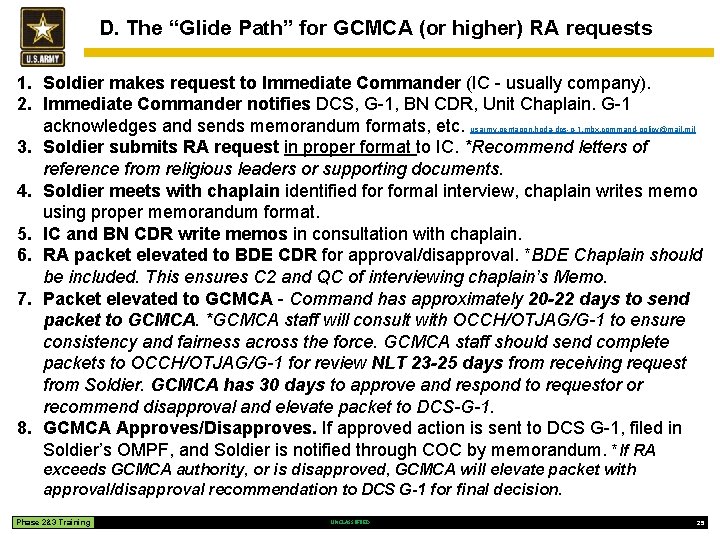
D. The “Glide Path” for GCMCA (or higher) RA requests 1. Soldier makes request to Immediate Commander (IC - usually company). 2. Immediate Commander notifies DCS, G-1, BN CDR, Unit Chaplain. G-1 acknowledges and sends memorandum formats, etc. usarmy. pentagon. hqda-dcs-g-1. mbx. command-policy@mail. mil 3. Soldier submits RA request in proper format to IC. *Recommend letters of reference from religious leaders or supporting documents. 4. Soldier meets with chaplain identified formal interview, chaplain writes memo using proper memorandum format. 5. IC and BN CDR write memos in consultation with chaplain. 6. RA packet elevated to BDE CDR for approval/disapproval. *BDE Chaplain should be included. This ensures C 2 and QC of interviewing chaplain’s Memo. 7. Packet elevated to GCMCA - Command has approximately 20 -22 days to send packet to GCMCA. *GCMCA staff will consult with OCCH/OTJAG/G-1 to ensure consistency and fairness across the force. GCMCA staff should send complete packets to OCCH/OTJAG/G-1 for review NLT 23 -25 days from receiving request from Soldier. GCMCA has 30 days to approve and respond to requestor or recommend disapproval and elevate packet to DCS-G-1. 8. GCMCA Approves/Disapproves. If approved action is sent to DCS G-1, filed in Soldier’s OMPF, and Soldier is notified through COC by memorandum. *If RA exceeds GCMCA authority, or is disapproved, GCMCA will elevate packet with approval/disapproval recommendation to DCS G-1 for final decision. Phase 2&3 Training UNCLASSIFIED 25
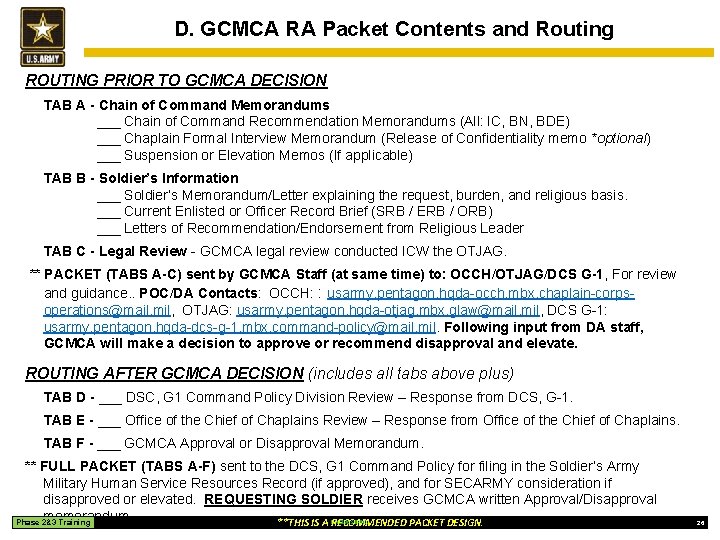
D. GCMCA RA Packet Contents and Routing ROUTING PRIOR TO GCMCA DECISION TAB A - Chain of Command Memorandums ___ Chain of Command Recommendation Memorandums (All: IC, BN, BDE) ___ Chaplain Formal Interview Memorandum (Release of Confidentiality memo *optional) ___ Suspension or Elevation Memos (If applicable) TAB B - Soldier’s Information ___ Soldier’s Memorandum/Letter explaining the request, burden, and religious basis. ___ Current Enlisted or Officer Record Brief (SRB / ERB / ORB) ___ Letters of Recommendation/Endorsement from Religious Leader TAB C - Legal Review - GCMCA legal review conducted ICW the OTJAG. ** PACKET (TABS A-C) sent by GCMCA Staff (at same time) to: OCCH/OTJAG/DCS G-1, For review and guidance. . POC/DA Contacts: OCCH: : usarmy. pentagon. hqda-occh. mbx. chaplain-corpsoperations@mail. mil, OTJAG: usarmy. pentagon. hqda-otjag. mbx. glaw@mail. mil, DCS G-1: usarmy. pentagon. hqda-dcs-g-1. mbx. command-policy@mail. mil. Following input from DA staff, GCMCA will make a decision to approve or recommend disapproval and elevate. ROUTING AFTER GCMCA DECISION (includes all tabs above plus) TAB D - ___ DSC, G 1 Command Policy Division Review – Response from DCS, G-1. TAB E - ___ Office of the Chief of Chaplains Review – Response from Office of the Chief of Chaplains. TAB F - ___ GCMCA Approval or Disapproval Memorandum. ** FULL PACKET (TABS A-F) sent to the DCS, G 1 Command Policy for filing in the Soldier’s Army Military Human Service Resources Record (if approved), and for SECARMY consideration if disapproved or elevated. REQUESTING SOLDIER receives GCMCA written Approval/Disapproval memorandum. Phase 2&3 Training **THIS IS A RECOMMENDED PACKET DESIGN. UNCLASSIFIED 26
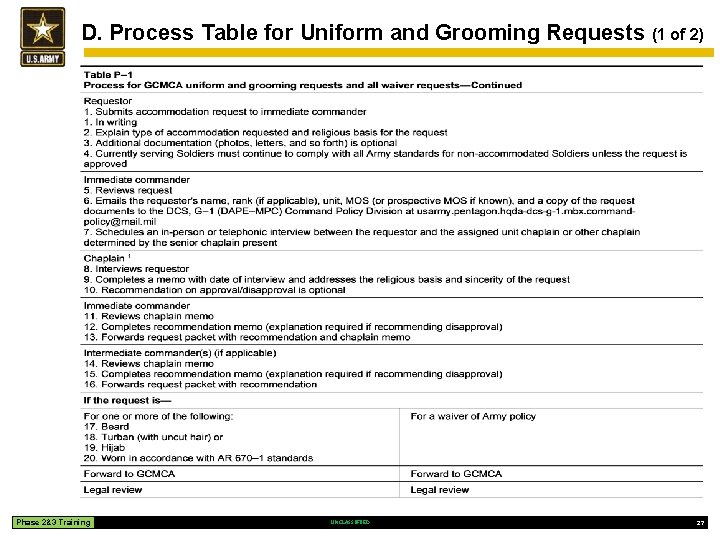
D. Process Table for Uniform and Grooming Requests Phase 2&3 Training UNCLASSIFIED (1 of 2) 27
D. Process Table for Uniform and Grooming Requests Phase 2&3 Training UNCLASSIFIED (2 of 2) 28
Chaplain/RAS Roles and Responsibilities Phase 2&3 Training UNCLASSIFIED 29
E. Chaplain/RAS Roles in Religious Accommodation 1. Chaplain/RAS General RA Advisory Role (Internal Advisement) • Chaplains and Religious Affairs Specialists (RAS) serve in a General RA Advisory role helping Army leaders understand the free exercise of religion beyond mere compliance with minimal legal requirements. • Chaplains and RAS offer confidential advice to Soldiers and commanders for all communication including one-on-one RA discussions. • Chaplains and Religious Affairs Specialists serve as ‘subject matter experts’ and must understand Army RA policy and processes. • Authoritative guidance on the Chaplain Corps RA advisory role is provided in Chapter 1 and Appendix A of ATP 1 -05. 04. “[I]nternal advisement supports commanders' and leaders' awareness of free exercise values not merely for reason of legal compliance. Free exercise of religion also serves end state purposes related to the Army mission of sustaining Soldiers' short- and long-term readiness, building ethical and moral strength and motivation to meet present and future challenges. ” ATP 1 -05. 04, p. 1 -6 Phase 2&3 Training UNCLASSIFIED 30
E. Chaplains’ RA Formal Interviewer Role 2. Chaplains RA Formal Interviewer Role* - A chaplain-conducted formal RA interview (with accompanying memorandum) is a defined requirement for certain types of RA. • When Required: A chaplain formal interview and memorandum is required in the following instances: a) RA requests related to deviations from uniform and grooming standards in accordance with AR 600 -20 or as waivers to AR 670 -1. b) RA requests related to immunizations. c) RA appeals to higher levels of command (provided to Soldiers in all cases of RA request denial). • Purpose: The purpose of the RA interview and memorandum is to address: a) The religious basis of the Soldier’s RA request b) The sincerity of the Soldier’s RA request and burden imposed without the accommodation. *Chaplains should have Soldiers use the sample RA Interview Questionnaire provided in the supplementary materials in Section 4 of this training. Phase 2&3 Training UNCLASSIFIED 31
E. Chaplain/RAS Roles in RA (continued) 3. Confidentiality • Chaplains (and RAS) offer full confidential advice to Soldiers and commanders for all communication including one-on-one RA discussions as a “matter of conscience” IAW Mil. Rule of Evid. 503. • Confidentiality is also offered to Soldiers ‘seeking advice’ regarding religious accommodation, and the appropriate exercise of religious belief and practice. • Confidentiality does not apply to the formal RA interview. • Distinguishing between roles is important due to differences in the ability to offer confidential/privileged communication. • Misunderstanding about confidentiality risks loss of Soldier/leader trust in chaplain counsel. BLUF: General advisement and counseling IS confidential; The Formal Religious Accommodation Interview IS NOT. Phase 2&3 Training UNCLASSIFIED 32
SECTION 3. Scenarios and Discussion (as time permits) Phase 2&3 Training UNCLASSIFIED 33
Scenario 1 (Latter Day Saints) A trainee arrives at Reception with T-shirts and briefs he intends to wear in the uniform he will soon be issued. The T-shirts appear identical to those he will be issued. The briefs extend to the knee, but otherwise match the color of the t-shirts. The trainee identifies as a practicing Latter-day Saint. He associates wearing these items with sacred covenants he made with God. Remaining faithful to his covenants requires that he wear them at all times, except when bathing or during PT. The reception Drill Sergeant informed him that all personal items from home, to include these items must remain locked in a duffle bag until he graduates. The trainee is permitted to speak to a chaplain about the issue and requests counseling on religious accommodation. • How does the Command respond? • How does the Chaplain respond? • Who is the approval authority and for this issue? Phase 2&3 Training UNCLASSIFIED 34
Scenario 2 (Jewish) A Jewish Soldier wearing a yarmulke that is concealed when he wears headgear outdoors is asked for a copy of the signed approval allowing him to do so. The Soldier admits he does not have written approval, but he is “pretty sure” it is allowed. He identifies other Jewish Soldiers (none in his unit) who wear them. His NCO instructs him to remove it until he has signed documentation allowing him to wear it in uniform. • How does the Command respond? • How does the Chaplain respond? • Who is the approval authority and what is the process for this issue? Phase 2&3 Training UNCLASSIFIED 35
Scenario 3 (Jewish) A Soldier identifies as Jewish and submits a request in writing for religious accommodation to observe the Sabbath. The Soldier requests whenever possible, by means of duty schedule adjustment and distributing workload with their team, the command exempts them from duty from sundown Friday until sundown Saturday. • How does the Command respond? • How does the Chaplain respond? • Who is the approval authority and what is the process for this issue? Phase 2&3 Training UNCLASSIFIED 36
Scenario 4 (Pentecostal/Holiness) A Soldier on their first day in the unit and who identifies with a branch within the Pentecostal/Holiness tradition comes to PT formation wearing long sleeves and pants when everyone else is wearing the warm weather PT uniform (short sleeves and shorts). The Soldier explains modesty—remaining covered to wrists and ankles—is a religious practice and is important. The Soldier and their First Line Supervisor seek out the UMT for help. • How does the Command respond? • How does the Chaplain respond? • Who is the approval authority and what is the process for this issue? Phase 2&3 Training UNCLASSIFIED 37
Scenario 5 (Muslim) A Soldier marries a Muslim and converts to Islam. She returns from leave (her honeymoon) wearing a hijab (head scarf) with both her PT and work uniforms. Her First Sergeant dismisses her from formations, stating she is out of uniform, and later provides her written, corrective counseling. The Soldier informs the First Sergeant hijabs are now allowed in the Army. The Soldier and the First Sergeant seek out the UMT for help. • How does the Command respond? • How does the Chaplain respond? • Who is the approval authority and what is the process for this issue? Phase 2&3 Training UNCLASSIFIED 38
Scenario 6 (Muslim) Your unit’s Public Affairs NCO just PCS’d from Germany. She is wearing a khimara and identifies with the Hanfi Mussulman branch of Islam. The Garrison Sergeant Major stops her in the PX food court, asks for her unit, and notifies her battalion Command Sergeant Major to address the issue. Her CSM informs her the article of clothing is not authorized. If she continues to wear it she will face UCMJ action. The Soldier seeks out the UMT for help. How do you respond? • How does the Command respond? • How does the Chaplain respond? • Who is the approval authority and what is the process for this issue? Phase 2&3 Training UNCLASSIFIED 39
Scenario 7 (Norse Pagan) A Chaplain is approached by a Soldier who wants to grow out his beard and hair as part of his sincere religious practice. The Soldier is not a Sikh but a Norse Pagan. The Chaplain is a nice person and wants to help his Soldier out, checks Army policy and sees that uncut hair is only approved with a turban. The Chaplain puts in their memo that the Soldier is requesting a beard and uncut hair with a turban and recommends approval. • Evaluate the Chaplain’s approach. • Where are the issues and challenges in this situation? • Who is the approving authority for uncut hair without a turban? **See Notes Phase 2&3 Training UNCLASSIFIED 40
Scenario 8 (Rastafarian) A Soldier identifies as Rastafarian and submits a request in writing for religious accommodation to wear dreadlocks. The Soldier is directed to the Unit Ministry Team to receive guidance. How do you respond? • How does the Command respond? • How does the Chaplain respond? • Who is the approval authority and what is the process for this issue? Phase 2&3 Training UNCLASSIFIED 41
Scenario 9 (Religious Speech) A Soldier routinely shares their faith with co-workers during personal time and lunch breaks, and sometimes states that other religions are false and will not bring salvation. Their supervisor heard another Soldier complain that they found this expression of beliefs annoying and offensive. The supervisor, desiring to avoid workplace controversy, creates a new rule: Proselytizing or critiquing of religions in the unit is prohibited and religious conversations should occur only after duty hours. The Soldier comes to the chaplain saying their religion requires sharing their faith with others. The Soldier wants to know if they have a right to do so, or if they should request an accommodation for religious reasons to continue to share their faith to include expressing exclusive views on how their religion is the only true religion. The supervisor wants to talk to the chaplain about limiting religious talk to the chapel. • How does the Command respond? • How does the Chaplain respond? Phase 2&3 Training UNCLASSIFIED 42
Scenario 10 (Religious Speech) As part of a sermon series, a chaplain is assigned a text with a controversial topic. The text for the sermon was determined by the lectionary used by the chapel service. The garrison chaplain is aware of the text to be covered in the upcoming sermon, and with the support of the garrison commander directs the chaplain to not read the text or address the controversial topic. The chaplain understands the controversy surrounding the topic and discusses the situation with his endorsing agency, supervisory chaplain, and unit commander. After considering how to proceed, the chaplain feels that he is obligated to stick to the assigned text and topic and assures the garrison chaplain that he will address the topic with wisdom, respect, and sensitivity. The garrison chaplain does not agree. • Where and what are the issues? • What are the Chaplain’s options? • How does the Command respond? • Who is the approval authority for this issue (if any) and what is the process for this? Phase 2&3 Training UNCLASSIFIED 43
Questions and Discussion TRAINING COMPLETE Phase 2&3 Training UNCLASSIFIED 44
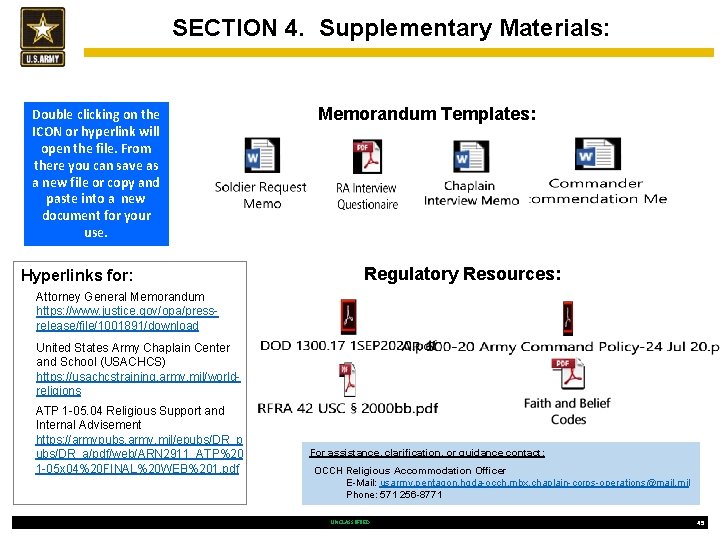
SECTION 4. Supplementary Materials: Double clicking on the ICON or hyperlink will open the file. From there you can save as a new file or copy and paste into a new document for your use. Hyperlinks for: Memorandum Templates: Regulatory Resources: Attorney General Memorandum https: //www. justice. gov/opa/pressrelease/file/1001891/download United States Army Chaplain Center and School (USACHCS) https: //usachcstraining. army. mil/worldreligions ATP 1 -05. 04 Religious Support and Internal Advisement https: //armypubs. army. mil/epubs/DR_p ubs/DR_a/pdf/web/ARN 2911_ATP%20 1 -05 x 04%20 FINAL%20 WEB%201. pdf For assistance, clarification, or guidance contact: OCCH Religious Accommodation Officer E-Mail: usarmy. pentagon. hqda-occh. mbx. chaplain-corps-operations@mail. mil Phone: 571 256 -8771 UNCLASSIFIED 45
BACKUP SLIDES OVERVIEW OF AR 600 -20/ANNEX P. July 24, 2020. UNCLASSIFIED 46
Overview of AR 600 -20 Paragraph 5 -6 has seven sections: A. B. C. D. E. F. G. Policy Responsibilities Pre-Accessioning Requests Types of Requests Procedures and approval Authorities Continuation of Accommodation Separation Procedures • This Revision and update to AR 600 -20 July 24, 2020. • Supersedes all prior Army Directives and ALARACTS. • Most procedures detailed in AD 2016 -34, and AD 2018 -19 are contained and combined into Annex P. UNCLASSIFIED 47
A. Policy (AR 600 -20 -5 -6) (1) The Army places a high value on the rights of its Soldiers to observe tenets of their respective religions or to observe no religion at all; while protecting the civil liberties of its personnel to the greatest extent possible, consistent with its military requirements. (2) Requests for religious accommodations from a military policy, practice, or duty that substantially burdens a Soldier’s (including military prisoner’s) exercise of religion may be denied only when the military policy, practice, or duty furthers a compelling government interest and is the least restrictive means of furthering that compelling government interest. • It is the Soldier’s responsibility to demonstrate a sincerely held religious belief, and that the government policy, practice, or duty is substantially burdening their religious exercise/practice. • If the Soldier demonstrates a sincerely held religious belief and a substantial burden to their religious exercise; the commander must then demonstrate how/why the government action furthers a compelling government interest and is the least restrictive means of furthering that interest. UNCLASSIFIED 48
A. Policy (continued) (3) Requests that are not sincerely based on a religious belief or do not substantially burden a Soldier’s exercise of religion should not be evaluated using the compelling government interest standard prescribed in a(2). Under these circumstances, commanders are only required to balance the needs of the Soldier against the needs of mission accomplishment. (4) A religious exercise includes any exercise of religion, whether or not compelled by, or central to, a system of religious belief. • RA assessed on a case-by-case basis. • Considered based on unique facts; the nature of the accommodation; the effect of approval or denial on the Soldier’s exercise of religion; and the effect of approval or denial on military necessity. • Compelling government interest includes: safety, health, good order, discipline, uniformity, National Security, and mission accomplishment. • Accommodation of a Soldier’s religious practices must be examined against military necessity and cannot be guaranteed at all times. • Some religious practices, such as dietary and worship practices, do not need a request for a waiver of policy and can be accommodated by immediate commanders. UNCLASSIFIED 49
B. Responsibilities (AR 600 -20 -5 -6) (1) ASA (M&RA) oversees RA implementation and execution to ensure compliance with DOD and Army policy. (2) DCS, G-1 develops RA policy in the Army. Every prospective enlisted Soldier (to include reenlistment), cadet, and commissioned officer is informed of the Army’s religious accommodation policy and that recruits and candidates for officer producing programs acknowledge in writing that they have been so informed: (a) (b) (c) (d) (e) USARC (enlisted Soldier and AMEDD officer accessions). TRADOC (ROTC cadets, WOCs, and OCs). Judge Advocate General (judge advocate officer accessions). Chief of Chaplains (chaplain officer accessions). USMA (for USMA cadets). (3) Chief of Chaplains serves as an advisor to the DCS, G-1. OCCH will develop and publish training on the process for requesting and receiving religious accommodations. The training will be reviewed by the Office of The Judge Advocate General prior to publication. (4) CG, TRADOC ensures that training is incorporated in pre-command training provided to brigade commanders. UNCLASSIFIED 50
C. Pre-Accessioning Requests (AR 600 -20 -5 -6) Individuals intending to enter service may submit a pre-accession RA request for uniform, grooming, and initial immunizations required at MEPS using the procedures in Appendix P. (1) A pre-accession request is defined as a request before any of the following occur: contracting for enlistment, contracting in ROTC program, appointment to the United States Military Academy (USMA), or direct commission. (2) The chain of command routing for pre-accessions requests is established by each accessions agency/command through their GCMCA. (3) For pre-accession requests requiring HQDA action, the procedures for requesting a waiver related to uniform and grooming or medical policy are outlined in Appendix P. See AR 600 -20 Appendix P for details UNCLASSIFIED 51
D. Types of RA Requests (AR 600 -20 -5 -6) Requests for religious accommodation generally fall into five major areas: (1) Worship practices, (2) Dietary practices, (3) Medical care (including immunizations), (4) Wear and appearance of the uniform, and (5) Personal appearance and grooming practices. • Procedures and approval authorities vary depending on the type of accommodation. See appendix P for additional processing information for each category of request. • Appendix P dictates specific and detailed processing information for each category of request. • Slide 28 is a tool to help Commanders, Chaplains, Religious Affairs Specialists, and staff identify the procedure and approval authority. • Many RA requests (adjustment to duty rosters, worship and observance, speech and abstentions, dietary practices, meals, separate rations, etc. ) can be approved by local commanders UNCLASSIFIED 52
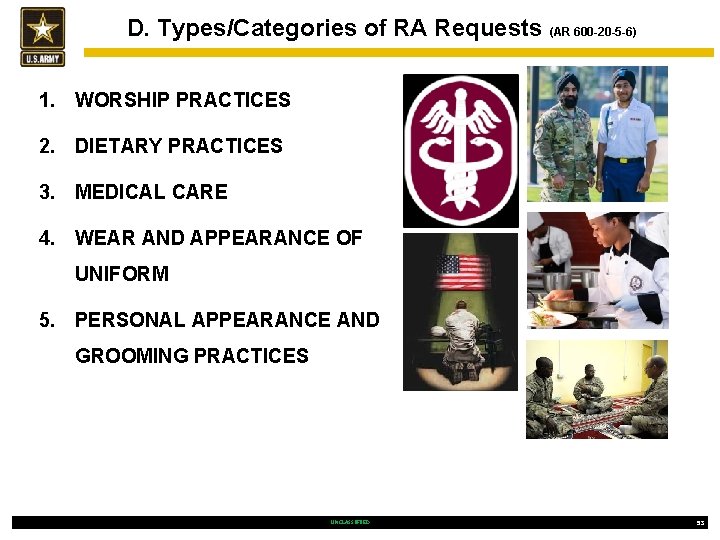
D. Types/Categories of RA Requests (AR 600 -20 -5 -6) 1. WORSHIP PRACTICES 2. DIETARY PRACTICES 3. MEDICAL CARE 4. WEAR AND APPEARANCE OF UNIFORM 5. PERSONAL APPEARANCE AND GROOMING PRACTICES UNCLASSIFIED 53
D. Types of RA Requests (AR 600 -20 -5 -6) (1) Worship practices. (CATEGORY 1 -2) • Includes practices such as religious speech and abstentions, religious studies, discussion and prayer groups. • Worship on days other than Saturday or Sunday • 25 -hour Sabbath, or special holy days or periods • While many worship practices can be accommodated informally, others may require a formal accommodation request. • Worship practices involving the use of prohibited substances require a waiver of Army policy and can only be approved by the SECARMY or designee. (DCS G-1, ASA M&RA). (2) Dietary practices. (CATEGORY 1 -2) • Many dietary requirements can be accommodated using existing authorized resources. • A Soldier with a conflict between the diet provided by the Army and that required by religious practice may request to ration separately. (3) Medical care. (CATEGORY 4) • Belief in self-care • Prohibitions against immunizations, blood transfusions, or surgery • Requires coordination between unit commander and healthcare provider. UNCLASSIFIED 54
D. Types of Requests (continued 2 of 3) (4) Wear and appearance of the uniform. (CATEGORY Varies) (a) Religious items. • Jewelry, apparel, or articles with religious significance C 1 -2 • Discreet religious items, such as a yarmulke (kufi), necklace, or metal bracelet, are authorized for wear in uniform, or in civilian clothes on duty, without submitting a religious accommodation request. C 2 • Hijabs, or turbans, require a religious accommodation request using procedures in Appendix P. C 3 (b) Modesty. Some Soldiers have religious or cultural practices which encourage greater body coverage than is provided by certain uniform variations (for example, summer Army Physical Fitness Uniform (APFU). • Commanders may authorize wear of additional or alternative uniform items in accordance with AR 670 -1. C 1 -2 • Requests to wear apparel that is not authorized by AR 670 -1 require a religious accommodation using procedures in Appendix P. C 4 Example: Local commanders may authorize a Soldier to wear the pants or long sleeve shirt of the Army Physical Fitness Uniform (APFU), but a request to wear unauthorized apparel to cover arms and legs would require action by the SECARMY or DCS, G-1) UNCLASSIFIED 55
D. Types of Requests (continued 3 of 3) (5) Appearance and Grooming. (CATEGORY Varies, usually C 3/4) • Appearance and grooming standards are contained in AR 670 -1. • Soldiers must request a religious accommodation to engage in modifications to grooming and appearance practices regardless of whether the practice is addressed in AR 670– 1. • GCMCA Approval Authority is limited to the provisions as described in AR 670 -1 and include: • • Wear of a hijab Wear of a beard (limit to 2”) Wear of a turban or under-turban/patka uncut hair Other provisions as described in AR 670 -1 • All other requests for accommodation must be elevated through the chain of command GCMCA to the DCS G-1. • Slide 28 is a tool to help Commanders, Chaplains, Religious Affairs Specialists, and staff identify the appropriate procedure and approval authority for the accommodation request. UNCLASSIFIED 56
E. Procedures and Approval Authorities (AR 600 -20 -5 -6: 1 of 3) (1) Requests for religious accommodation are processed under distinct approval channels depending on the type of accommodation requested. (a) Worship, modesty, and dietary practices. Unit commanders are the designated decision authority for most worship and dietary practices, including procedures for appeal. (b) Medical practices. Unit commanders, in consultation with MTF commanders and/or medical advisors are the decision authority for medical practices which do not involve exemption from immunization. TSG is the decision authority for ALL immunization exemptions and appeals. (c) Uniform and grooming practices. Some uniform and grooming requests may be approved or disapproved by the GCMCA. Any request which requires a waiver of Army policy may only be approved or disapproved by the SECARMY or designee. UNCLASSIFIED 57
E. Procedures and Approval Authorities (continued: 2 of 3) (2) Commanders should consider the following factors when considering a request: (a) The importance of military requirements in terms of mission accomplishment, including military readiness, unit cohesion, good order, discipline, health, and safety. (b) The religious importance of the accommodation to the requestor. (c) The cumulative impact of repeated accommodations of a similar nature. (d) The measurable effect, if any, of granting the single accommodation requested, to include whether it results in the sanctioned discrimination of other Soldiers. (e) Alternative means available to meet the requested accommodation. (f) Previous treatment of the same or similar requests, including treatment of similar requests if made for other than religious reasons. • See AR 600 -20, Appendix P for procedures. • The wear of the Kufi, Yarmulke, some religious jewelry are permitted by AR 670 -1. See AR 670 -1, 3 -15 for details. UNCLASSIFIED 58
F. Continuation of Accommodation (AR 600 -20 Ch 5) (1) Routine Accommodations are temporary. Accommodations for worship and dietary practices, medical care, and modesty concerns are temporary and subject to modification or revocation in accordance with the provisions of para 5– 6 a(4). (2) GCMCA Accommodations are permanent. Accommodations for: wear of a hijab, beard, and turban or under-turban/patka with uncut beard and hair continue throughout a Soldier’s career and cannot be permanently revoked or modified unless authorized by the SECARMY or designee (DCS G-1). (a) Accommodations are subject to GCMCA review at any time for health and safety, or if questions of sincerity arise. (b) GCMCA of gaining commands will review approved accommodations on a Soldier’s PCS. (c) GCMCA will review approved accommodations when a Soldier reclassifies into a new or secondary MOS. UNCLASSIFIED 59
F. Continuation of Accommodation (continued) (3) Suspension of accommodations. (a) When the GCMCA identifies a specific and concrete threat to health and safety (threat of exposure to toxic chemical, biological, radiological, nuclear (CBRN), the GCMCA, after consultation with Staff Judge Advocate, notifies the Soldier of the need to suspend, the basis and date the suspension will go into effect, and the Soldier's right to appeal. (b) In circumstances involving an imminent threat to health and safety, the GCMCA may shorten the time for appeal and, in urgent circumstances, may require immediate suspension of the accommodation. The GCMCA will notify the Office of the DCS, G – 1 Command Policy Division of the decision and its basis as soon as possible at usarmy. pentagon. hqda-dcsg-1. mbx. command-policy@mail. mil. (c) The GCMCA will reinstate the suspended accommodation when the specific and concrete threat to health and safety as a result of the accommodation no longer exists. See Appendix P for suspension procedures. Note: Beard accommodations can be suspended when a specific and concrete threat requires all Soldiers to be clean-shaven, including those with medical profiles. UNCLASSIFIED 60
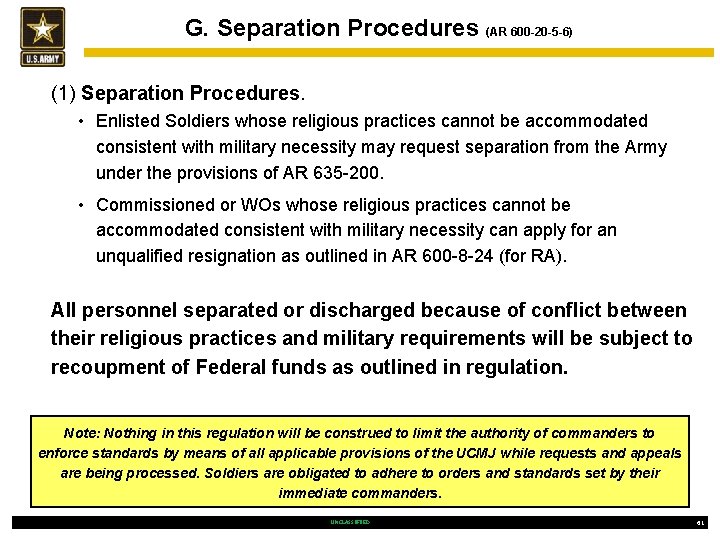
G. Separation Procedures (AR 600 -20 -5 -6) (1) Separation Procedures. • Enlisted Soldiers whose religious practices cannot be accommodated consistent with military necessity may request separation from the Army under the provisions of AR 635 -200. • Commissioned or WOs whose religious practices cannot be accommodated consistent with military necessity can apply for an unqualified resignation as outlined in AR 600 -8 -24 (for RA). All personnel separated or discharged because of conflict between their religious practices and military requirements will be subject to recoupment of Federal funds as outlined in regulation. Note: Nothing in this regulation will be construed to limit the authority of commanders to enforce standards by means of all applicable provisions of the UCMJ while requests and appeals are being processed. Soldiers are obligated to adhere to orders and standards set by their immediate commanders. UNCLASSIFIED 61
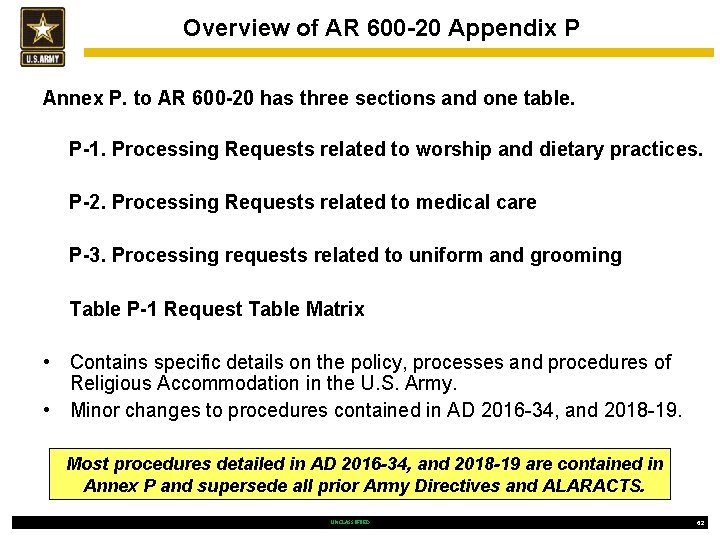
Overview of AR 600 -20 Appendix P Annex P. to AR 600 -20 has three sections and one table. P-1. Processing Requests related to worship and dietary practices. P-2. Processing Requests related to medical care P-3. Processing requests related to uniform and grooming Table P-1 Request Table Matrix • Contains specific details on the policy, processes and procedures of Religious Accommodation in the U. S. Army. • Minor changes to procedures contained in AD 2016 -34, and 2018 -19. Most procedures detailed in AD 2016 -34, and 2018 -19 are contained in Annex P and supersede all prior Army Directives and ALARACTS. UNCLASSIFIED 62
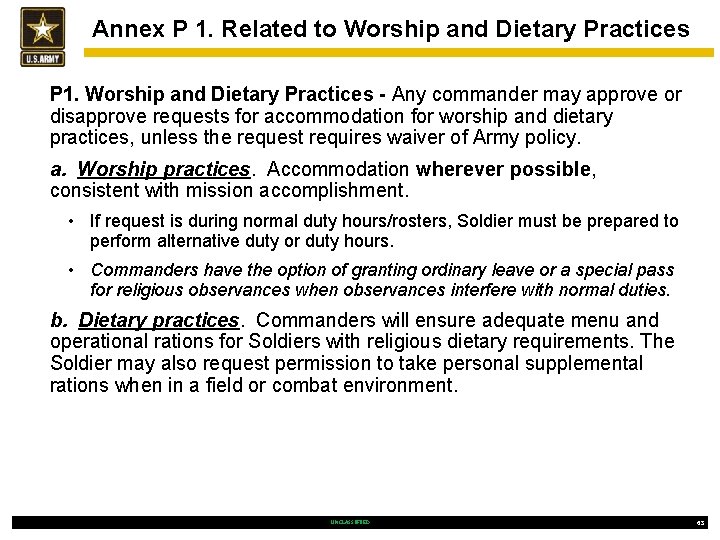
Annex P 1. Related to Worship and Dietary Practices P 1. Worship and Dietary Practices - Any commander may approve or disapprove requests for accommodation for worship and dietary practices, unless the request requires waiver of Army policy. a. Worship practices. Accommodation wherever possible, consistent with mission accomplishment. • If request is during normal duty hours/rosters, Soldier must be prepared to perform alternative duty or duty hours. • Commanders have the option of granting ordinary leave or a special pass for religious observances when observances interfere with normal duties. b. Dietary practices. Commanders will ensure adequate menu and operational rations for Soldiers with religious dietary requirements. The Soldier may also request permission to take personal supplemental rations when in a field or combat environment. UNCLASSIFIED 63
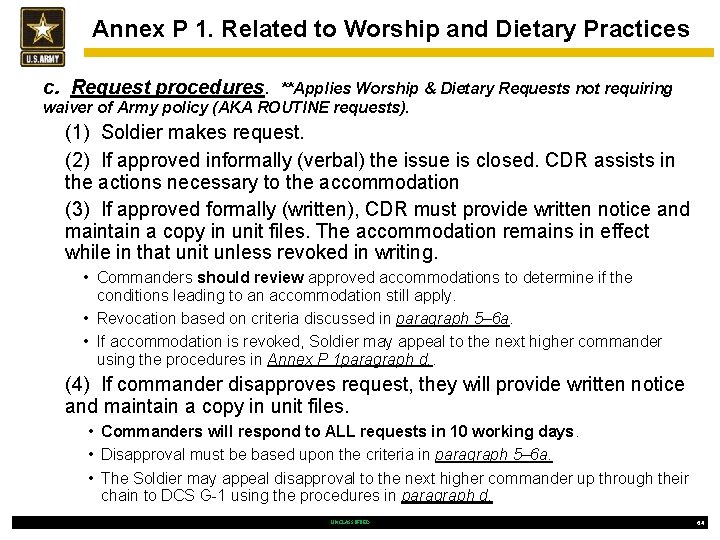
Annex P 1. Related to Worship and Dietary Practices c. Request procedures. **Applies Worship & Dietary Requests not requiring waiver of Army policy (AKA ROUTINE requests). (1) Soldier makes request. (2) If approved informally (verbal) the issue is closed. CDR assists in the actions necessary to the accommodation (3) If approved formally (written), CDR must provide written notice and maintain a copy in unit files. The accommodation remains in effect while in that unit unless revoked in writing. • Commanders should review approved accommodations to determine if the conditions leading to an accommodation still apply. • Revocation based on criteria discussed in paragraph 5– 6 a. • If accommodation is revoked, Soldier may appeal to the next higher commander using the procedures in Annex P 1 paragraph d. . (4) If commander disapproves request, they will provide written notice and maintain a copy in unit files. • Commanders will respond to ALL requests in 10 working days. • Disapproval must be based upon the criteria in paragraph 5– 6 a. • The Soldier may appeal disapproval to the next higher commander up through their chain to DCS G-1 using the procedures in paragraph d. UNCLASSIFIED 64
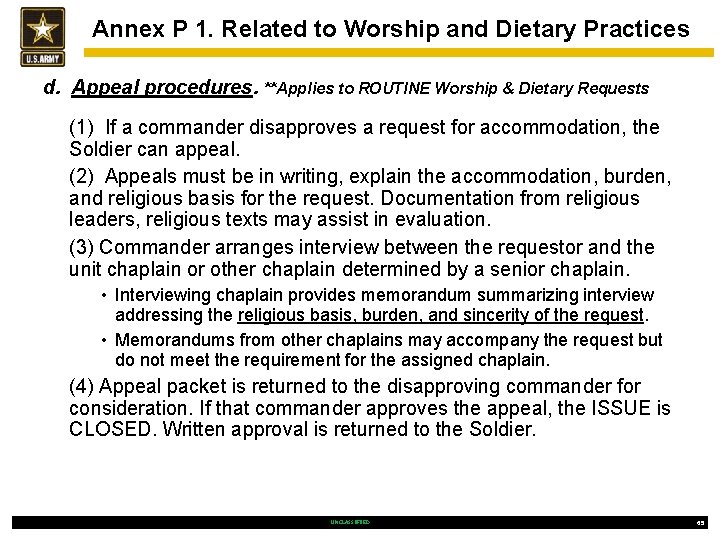
Annex P 1. Related to Worship and Dietary Practices d. Appeal procedures. **Applies to ROUTINE Worship & Dietary Requests (1) If a commander disapproves a request for accommodation, the Soldier can appeal. (2) Appeals must be in writing, explain the accommodation, burden, and religious basis for the request. Documentation from religious leaders, religious texts may assist in evaluation. (3) Commander arranges interview between the requestor and the unit chaplain or other chaplain determined by a senior chaplain. • Interviewing chaplain provides memorandum summarizing interview addressing the religious basis, burden, and sincerity of the request. • Memorandums from other chaplains may accompany the request but do not meet the requirement for the assigned chaplain. (4) Appeal packet is returned to the disapproving commander for consideration. If that commander approves the appeal, the ISSUE is CLOSED. Written approval is returned to the Soldier. UNCLASSIFIED 65
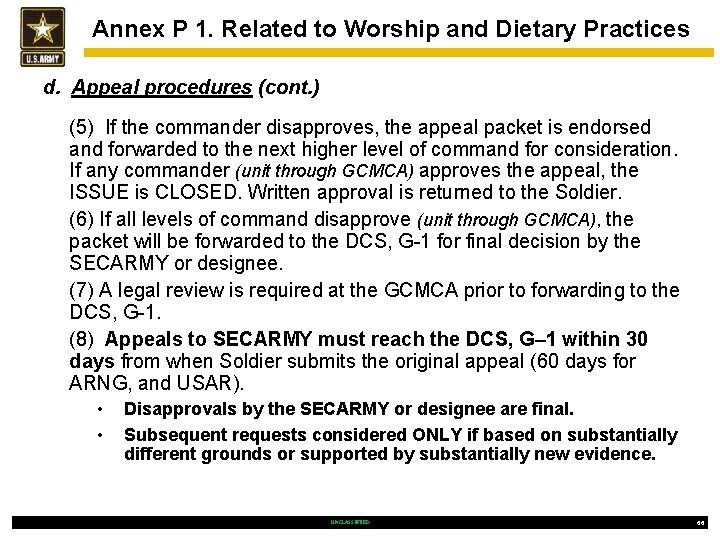
Annex P 1. Related to Worship and Dietary Practices d. Appeal procedures (cont. ) (5) If the commander disapproves, the appeal packet is endorsed and forwarded to the next higher level of command for consideration. If any commander (unit through GCMCA) approves the appeal, the ISSUE is CLOSED. Written approval is returned to the Soldier. (6) If all levels of command disapprove (unit through GCMCA), the packet will be forwarded to the DCS, G-1 for final decision by the SECARMY or designee. (7) A legal review is required at the GCMCA prior to forwarding to the DCS, G-1. (8) Appeals to SECARMY must reach the DCS, G– 1 within 30 days from when Soldier submits the original appeal (60 days for ARNG, and USAR). • • Disapprovals by the SECARMY or designee are final. Subsequent requests considered ONLY if based on substantially different grounds or supported by substantially new evidence. UNCLASSIFIED 66
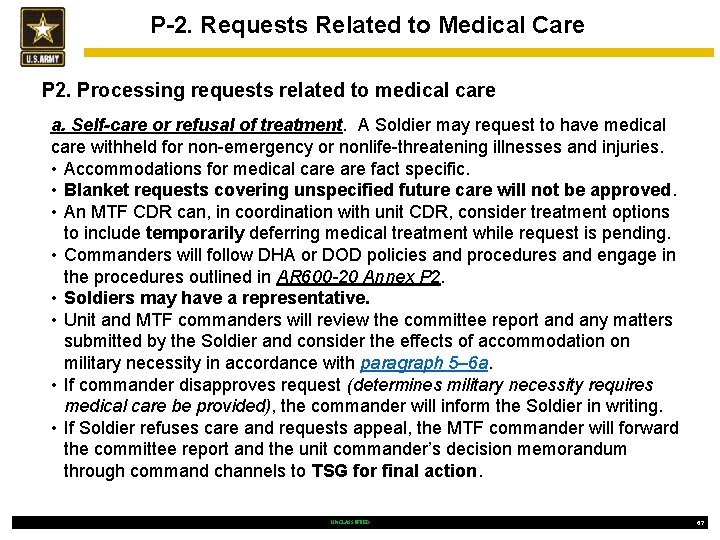
P-2. Requests Related to Medical Care P 2. Processing requests related to medical care a. Self-care or refusal of treatment. A Soldier may request to have medical care withheld for non-emergency or nonlife-threatening illnesses and injuries. • Accommodations for medical care fact specific. • Blanket requests covering unspecified future care will not be approved. • An MTF CDR can, in coordination with unit CDR, consider treatment options to include temporarily deferring medical treatment while request is pending. • Commanders will follow DHA or DOD policies and procedures and engage in the procedures outlined in AR 600 -20 Annex P 2. • Soldiers may have a representative. • Unit and MTF commanders will review the committee report and any matters submitted by the Soldier and consider the effects of accommodation on military necessity in accordance with paragraph 5– 6 a. • If commander disapproves request (determines military necessity requires medical care be provided), the commander will inform the Soldier in writing. • If Soldier refuses care and requests appeal, the MTF commander will forward the committee report and the unit commander’s decision memorandum through command channels to TSG for final action. UNCLASSIFIED 67
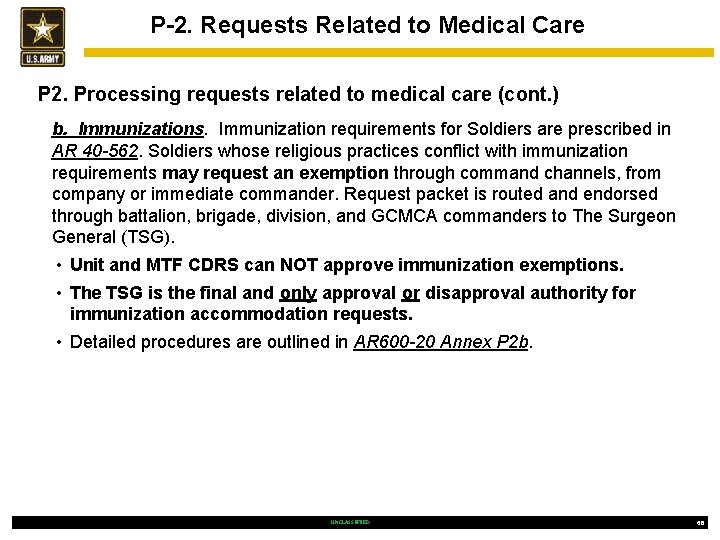
P-2. Requests Related to Medical Care P 2. Processing requests related to medical care (cont. ) b. Immunizations. Immunization requirements for Soldiers are prescribed in AR 40 -562. Soldiers whose religious practices conflict with immunization requirements may request an exemption through command channels, from company or immediate commander. Request packet is routed and endorsed through battalion, brigade, division, and GCMCA commanders to The Surgeon General (TSG). • Unit and MTF CDRS can NOT approve immunization exemptions. • The TSG is the final and only approval or disapproval authority for immunization accommodation requests. • Detailed procedures are outlined in AR 600 -20 Annex P 2 b. UNCLASSIFIED 68
P-3. Processing Requests Related to Uniform and Grooming P 3. Processing requests related to uniform and grooming (GCMCA Approval) a. Beards, hijabs, and turbans. Commanders at the GCMCA or the first general officer in the chain of command, and above may approve, disapprove, or elevate religious accommodation requests for beards, hijabs, and turbans worn within the standards provided in AR 670 -1 or AR 600 -20 Appendix P, table P-1. GCMCA must forward decision to approve or disapprove to the DCS, G– 1 within: • 30 calendar days of initial submission (Soldier’s written memorandum) for Regular Army and pre-accession requests. • 60 calendar days of initial submission for ARNG and USAR requests. • Only the DCS, G-1 may grant a request for extension of these timelines. • Accession agencies and commands may designate an officer in the grade of BG/O – 7 or higher to serve as GCMCA approval authority for RA requests. UNCLASSIFIED 69
P-3. Overview Of GCMCA U&G Request Process (1 of 3) Overview Of GCMCA U&G Request Process (1) All requests must be in writing, explain the type of accommodation, burden, and religious basis for the request. Other documentation (photos, copies of religious texts, letters from religious leaders) is optional but may assist commanders evaluating the request. • Requestors must comply with AR 670– 1 standards while the request is pending. (2) When receiving an RA request, commanders will immediately notify the Office of the DCS, G-1 at: usarmy. pentagon. hqda-dcs-g-1. mbx. command-policy@mail. mil. Notification MUST include requestor’s name, rank, unit, MOS, and a copy of the request memo. (3) Commanders will arrange an in-person or telephonic interview between with the unit chaplain or other chaplain determined by a senior chaplain. The chaplain must provide a memorandum which summarizes this interview and addresses the religious basis, burden and sincerity of the Soldier’s request. (4) The immediate commander will review the chaplain memorandum and complete a recommendation memorandum. An explanation is required if commander recommends disapproval of the request. The immediate commander will forward the request packet through intermediate commanders to the brigade level commander, and then forwarded to the GCMCA. The following 3 slides are a condensed overview of the request process. See Annex P-3 for detailed instructions *This is ALSO summarized in Section 3 - slide 61 & 62 of this slide deck) UNCLASSIFIED 70
P-3. Overview Of GCMCA U&G Request Process (2 of 3) (5) The GCMCA will consider every RA request on a case-by-case basis. (6) When evaluating sincerity, the GCMCA may consider the credibility and demeanor of the applicant as well as the circumstances of the request. A religious practice does not have to be compelled by, or central to, a system of religious belief. GCMCA will consider the Soldier’s ability to articulate the religious basis and importance of the request. (7) Before acting on a request, the GCMCA will direct their staff to: (a) Obtain a legal review in consultation with the Office of the Judge Advocate General (OTJAG), at usarmy. pentagon. hqda-otjag. mbx. g-law@mail. mil. (b) Consult the DCS, G– 1 and Policy Division for policy contents at: usarmy. pentagon. hqdadcs-g-1. mbx. command-policy@mail. mil. (c) Consult with the Office of the Chief of Chaplains (OCCH) to evaluate the religious basis and sincerity of the request, and to ensure consistency and fairness across the force at: usarmy. pentagon. hqda-occh. mbx. chaplain-corps-operations@mail. mil (d) Consult with Army Corrections Command when requestor is confined in an Army correctional facility at usarmy. pentagon. corrections-cmd. list. admin-operations-npemgt@mail. mil. • The GCMCA will make decision to approve/disapprove after reviewing packet and consultation/feedback from OTJAG/OCCH/G-1. UNCLASSIFIED 71
P-3. Overview Of GCMCA U&G Request Process (3 of 3) (8) GCMCA will notify the Soldier of decision in writing and forward a COMPLETE packet with approval or disapproval memorandum to the DCS, G-1. • The DCS, G-1 will upload approval memos to i. PERMS for filing in the Soldier’s Army Military Human Resource Record (AMHRR), • Soldiers are not entitled to a copy of the packet provided to the GCMCA, except through a request under the FOIA. (9) If GCMCA elevates the request (requests beyond allowances in AR 670 -1), the GCMCA forwards packet to the DCS, G-1 for waiver approval with a recommendation for approval/disapproval with the reason(s) for the decision. Only the SECARMY or designee may take final action to approve or disapprove. See P-3 b for details. (10) The decision of the SECARMY will be transmitted through command channels to the requesting Soldier within 60 days after receipt of the final request packet by DCS, G-1. (11) The DCS, G-1 will track ALL approved religious accommodations. (12) Disapprovals by the SECARMY are final. Subsequent requests are only considered on substantially different grounds or supported by substantially new evidence. UNCLASSIFIED 72
P-3. Processing requests related to Uniform and Grooming b. Waiver requests. An RA request requiring waiver of AR 670 -1, or any other Army policy exceeding GCMCA approval authority are only approved or disapproved by the SECARMY or designee. • Routing and Process for 670 -1 Waiver Requests (exceeding GCMCA authority) is the same as a GCMCA request (memo’s interviews, etc. ) with the addition: • GCMCA’s SJA must conduct a legal review before forwarding to DCS, G-1. • SJA will review the packet for legal sufficiency and may make a recommendation for disposition of the request. The review will also state whether the request and enclosures are complete within the provisions of AR 600 -20. • The GCMCA will forward packet with recommendation to the DCS, G-1 usarmy. pentagon. hqda-dcs-g-1. mbx. command-policy@mail. mil and provide concurrent notification to Soldier through command channels. • RA Waiver packets must be forwarded to the DCS, G-1 within 30 days of the initial request for RA and pre-accession requests and 60 days for USAR and ARNG. • Only the DCS, G-1 may grant a request for extension. • Requestors (other than pre-accession) must continue to comply with AR 670 -1 standards for non-accommodated Soldiers while the request is pending. Questions about whether a request requires a waiver can be sent to: DCS, G-1 usarmy. pentagon. hqda-dcs-g-1. mbx. command-policy@mail. mil. UNCLASSIFIED 73
P-3. Processing requests related to Uniform and Grooming c. Duty considerations. (1) An RA consistent with the standards in AR 670 -1 will not affect a Soldier’s assignment of MOS or branch, duty location, or attendance at military schools, except as described in paragraph 5 b. • If a GCMCA, CDR, or MOS proponent identifies specific hazards that cannot be reasonably mitigated, they must immediately inform the DCS, G-1. (2) Beard growth consistently degrades the protection provided by the protective masks currently in Army inventory. Until the Army can field such protective gear that meets safety standards in conjunction with beard growth, these restrictions apply: (a) Soldiers with beard accommodations may not attend schools requiring toxic chemical agent training or be assigned to positions requiring compliance with biological, chemical, or nuclear surety requirements in accordance with AR 50 -5, and AR 50 -6. (may not serve as 74 A, CBRN Officers; 740 A, CBRN Technicians; or 74 D, CBRN Specialists. ) (b) Beard accommodations can be temporarily suspended when exposure to CBRN agents exists requiring all Soldiers to be clean-shaven (including medical profiles). • Procedures in paragraph P– 3 d, outline how commanders can require a Soldier to shave if the unit is in, or about to enter, a tactical situation where use of a protective mask will likely be required and where the inability to safely use the mask could endanger the Soldier and the unit. • A Soldier may wear a beard while participating in training or tactical simulations designed to ensure that the Soldier is fully familiar with use of the protective mask. UNCLASSIFIED 74
P-3. Processing requests related to Uniform and Grooming d. Suspension Procedures. (1) Approved Religious Accommodations can be suspended at any time when the Soldier’s GCMCA : • • Identifies a specific threat to health and safety based on the accommodation (such as threat of exposure to toxic CBRN agents that may merit a heightened protective posture). Identifies an issue of sincerity. The GCMCA, after consultation with their SJA will notify the Soldier of the need to suspend the accommodation, the basis for the suspension, the date the suspension will likely go into effect, and the Soldier’s right to appeal. Soldiers have 10 days to submit appeal packet to the DCS, G-1 at usarmy. pentagon. hqda-dcs-g-1. mbx. command-policy@mail. mil. If appealed, the suspension will not take effect before G-1 responds. (2) In exigent circumstances involving imminent threat to health and safety, the GCMCA may shorten the time for appeal and may immediately suspend the accommodation. The GCMCA will notify the DCS G-1 of the decision and its basis as soon as possible. (3) The GCMCA will reinstate the accommodation when the specific and concrete threat to health and safety as a result of the accommodation no longer exists. UNCLASSIFIED 75
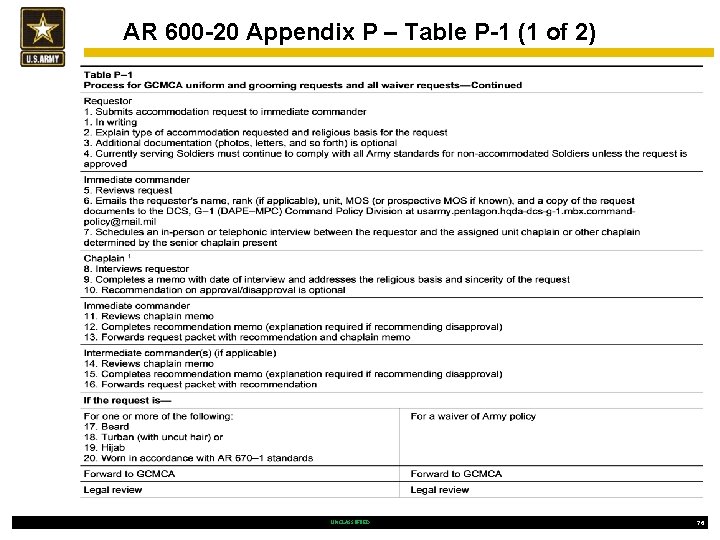
AR 600 -20 Appendix P – Table P-1 (1 of 2) UNCLASSIFIED 76
AR 600 -20 Appendix P – Table P-1 (2 of 2) UNCLASSIFIED 77
- Slides: 77