
RELIGIOUS DISCRIMINATION IN THE WORKPLACE Kelly Goode EEO




- Slides: 46
RELIGIOUS DISCRIMINATION IN THE WORKPLACE Kelly Goode EEO Officer U. S. Drug Enforcement Administration November 2016
Overview • How religious discrimination happens • What constitutes a religion/religious belief? • What are an employee’s obligations? • What are an employer’s obligations? • Unique issues around religious discrimination • Challenging Islamophobia
Title VII Protections No job discrimination because of a person’s religion or lack of religious beliefs No harassment Employers must accommodate employees’ religious beliefs and practices unless there is undue hardship No requirement to participate, or not, in religious activity as condition of employment No retaliation
RELIGIOUS DISCRIMINATION
How Religious Discrimination Happens • Affiliation with a particular religious group • Display of physical or cultural traits commonly associated with a particular religion • Perceptions or beliefs that another is a member of a religious group
How Religious Discrimination Happens • Employer’s failure to accommodate • Conflicts between religious expression and need for harassment-free workplace • Stereotypes of non-mainstream religions • Unconscious bias
Discussion What constitutes a religion or a religious belief? What are examples of religious practices that might conflict with work requirements?
Defining Religious Beliefs – Title VII • Moral or ethical beliefs as to what is right and wrong that are sincerely held with the strength of traditional religious views. • Set of attitudes, beliefs or practices that permeates a person’s life.
Questioning an Employee’s Religious Beliefs … • May get you in trouble – here’s why: • Employer cannot judge what a religion is or what a religion requires • May result in charge of harassment • First Amendment protections • Although: • Unionism, military idealism, veganism, cold fusion, Confederate Southern American are not religious beliefs
Discussion What are an employee’s obligations at work when religious beliefs and practices conflict with work requirements?
Employee Responsibilities • Inform employer when conflict exists – no “magic words” needed. • Give enough information to all management to understand nature of conflict and religious belief. • Work with management to find a solution. • Respect other employees’ beliefs and practices.
Discussion What is an employer’s obligation to accommodate an employee’s religious beliefs and practices that conflict with work requirements? How do these obligations extend to non -mainstream faiths?
Religious Accommodation • Employee has a sincerely held and bona fide religious belief. • Employee informs employer of conflict between religion and job requirement. • Employer must accommodate absent undue hardship.
Religious Accommodation Is … • Adjustment to the work environment that allows an employee to practice his or her religion. • Differs depending on religious requirements. • Day off for church services. • Halal, kosher, vegetarian or vegan food at training.
Duty to Accommodate • Employer must accommodate absent undue hardship. • Be flexible. • Be open-minded. • Ask questions if need not clear. • Good faith effort is required. • Know policies and options related to religious accommodation requests.
Religious Compensatory Time • OPM Fact Sheet: Adjustment of Work Schedules for Religious Observances – Requirements: • Modifications in work schedules cannot interfere with efficient accomplishment of mission. • Employees who need adjustment for religious purposes must be permitted to work alternate hours. • No entitlement to premium pay (overtime) for extra hours worked for religious comp time.
Scenario • A Sikh employee is denied access to the federal building where she works because she wears a kirpan (ceremonial sword). She offers to work at home, wear a dulled kirpan blade, or work at other buildings with less security. She does not wear the kirpan when she travels on airplanes to comply with airline security requirements. • What should the employer consider to accommodate this employee? Tagore v. Dep’t of Homeland Security, 735 F. 3 rd 324, 113 LRP 50493 (5 th Cir. 2013).
UNDUE HARDSHIP
Undue Hardship • Must be based on objective evidence, not mere speculation about hardship. • More than ordinary administrative costs. • Diminished efficiency in other jobs. • Infringement on other employees’ job rights or benefits, such as seniority rights. • Impaired workplace safety. • Shifts share of hazardous or burdensome work to other employees. • Conflicts with another law or regulation.
Scenario • An employee requests that he receive a waiver from the agency’s automated biometric identification system because his religious beliefs prohibit him from providing fingerprints for biometric purposes. The agency’s program is used for identification, security checks, and access control. • Can this employee be accommodated? • What if the system only tracked time and attendance? Petitioner v. Energy, Petition No. 0320130027, 114 LRP 44107 (Sept. 19, 2014); compare EEOC v. CONSOL Energy, Inc. and Consolidation Coal Company, 2016 WL 538478 (N. D. W. Va. Feb. 9, 2016).
Undue Hardship Is Not … • Customer or co-worker preference • Worrying that “everyone will want it” • Permitting an employee to engage in harassing conduct • Minor timekeeping or payroll changes that are not overly expensive • Vague statements about conflicts in seniority rights in a collective bargaining agreement • Automatically denying a change in days off
RELIGIOUS EXPRESSION & HARASSMENT
Religious Expression & Harassment • Agencies must balance employee’s right to religious expression with duty to provide workplace free from harassment.
Religious Harassment • Religious expression • Discussions among employees, even if not directed at another employee • Non-mainstream religions and religious practices • Evangelizing, prayer meetings or other religious activities • “Lifestyle” issues
Scenario • A scientist files a complaint after receiving an “All Staff” email announcing the agency’s LGBT observance. He previously complained about an announcement of the same-sex wedding of another employee. • Is this harassment? Complainant v. Environmental Protection Agency, EEOC Appeal No. 0120150930, 115 LRP 25788 (May 19, 2015).
Scenario • An employee attends a class, “Arab Names/Arab Culture, ” during which the instructor uses stereotypes, gives factually inaccurate information about Arabs and Muslims, and makes disparaging comments about Muslims. • “The goal of a Muslim is to convert you and kill you. ” • “The Koran does not mention a God of love. ” • Is this harassment? Rana v. DHS, Appeal No. 07200600561, 107 LRP 1319 (January 5, 2007).
Limiting Religious Expression • Title VII permits limiting religious expression to avoid harassment claims. • 1 st Amendment prohibits government from establishing religion and requires government to permit free exercise of religion. • Consider impact on employees, customers, agency operations. • Undue hardship may exist if disruption is too great.
Scenario • A customs and border patrol agent wants to read religious materials and the Bible during his break. He also wants citizens crossing the border to read from the Bible and discusses religious passages with them. He told a Jewish coworker that “Jews killed Jesus. ” • What should the agency do? Esparza v. DHS (CPB), Appeal No. 0120055950, 107 LRP 15499 (March 16, 2007).
THE CHANGING U. S. RELIGIOUS LANDSCAPE
The Changing U. S. Religious Landscape • Pew Research study showed that: • Protestants are no longer the majority of adults, dropping from 51. 3% in 2006 to 46. 5% in 2014. • The number of religiously unaffiliated individuals grew from 16% in 2007 to 23% in 2014. • More Millennials identify as “unaffiliated” than older Americans. • 1 in 4 people raised in a religious tradition now identify as “unaffiliated. ”
The Changing Religious Landscape Worldwide • Pew Research projects that by 2050: • The number of Muslims will nearly equal the number of Christians worldwide. • Muslims will be the largest non-Christian religion in the U. S. , surpassing Judaism. • Muslims will constitute 10% of the population in Europe. • India will retain a Hindu majority and have the largest number of Muslims.
Rising Islamophobia • Terrorist attacks in Paris, San Bernardino, Brussels, and elsewhere trigger backlash against Muslims. • Employers and employees may unreasonably fear Muslims or those perceived to be Muslim or Middle Eastern. • Misinformation and stereotypes about Islam and what it requires as acts of faith. • Rise in bias claims and hate crimes.
Combatting Islamophobia at Work • Know that Title VII protections extend to Muslims. • Like Christians and other religious people, followers of Islam may differ in their religious practices. • Understand some basic requirements of Islam and how they may arise in the workplace. • Approach requests for accommodation with an open mind. • Don’t tolerate harassment.
Common Islamic Practices • Daily prayers • Dress and grooming • Social interactions • Holidays • Recognizing importance of these practices central to accommodating them and creating an inclusive workplace
Understanding Islamic Practices • Daily prayers – one of the five pillars of Islam: • Observed five times a day. • Obligatory. • Friday congregational prayer. • Accommodations: • Be flexible in scheduling breaks. • Provide a clean and private space.
Understanding Islamic Practices • Dress and grooming: • Modesty is a central aspect of faith. • Women may wear loose clothing and a hijab. • Men may have beards and wear a kufi. • Accommodations: • Be flexible in dress policies.
Understanding Islamic Practices • Social Interactions: • Limitations on shaking hands. • Eye contact may be limited. • Alcohol prohibited. • Halal food. • Accommodations: • Don’t be offended if a Muslim doesn’t shake your hand. • Understand why Muslims may not participate in certain social activities. • Be open to different foods at events where food served.
Major Islamic Holidays • Ramadan: one of the holiest months in Islam. • Muslims abstain from eating and drinking from dawn to dusk. • Encouraged to observe the five daily prayers and break their fast at sunset. • Eid Al-Fitr: celebrated at the end of Ramadan. • Eid Al-Adha: commemorates Abraham’s sacrifice. • The Hajj: annual pilgrimage by Muslims from across the world to Mecca, Saudi Arabia.
Accommodating Major Religious Holidays • Recognize importance of religious holidays. • Understand why a religious person may not participate in certain social activities. • Be flexible about schedules and breaks. • Solicit voluntary swaps for time off. • Allow employee to earn religious “comp” time. • Alter arrival and/or departure times. • Stagger work hours to permit employees to make up time lost to religious observances.
CREATING INCLUSION FOR RELIGIOUS DIVERSITY
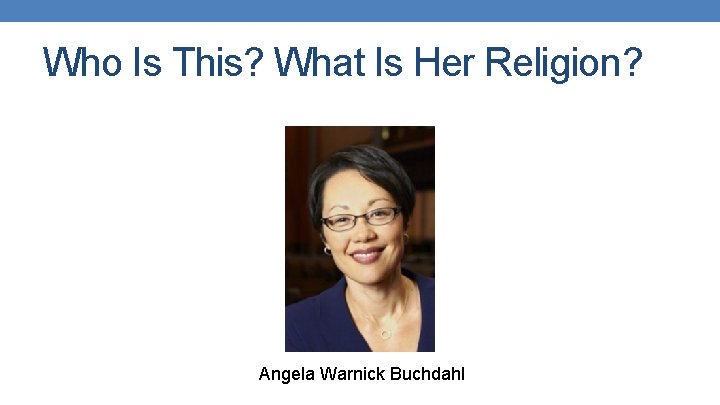
Who Is This? What Is Her Religion? Angela Warnick Buchdahl
Creating Inclusion for Religious Diversity • Know your policies for religious accommodation. • Publicize those policies so employees know what they can ask for. • Train your managers and supervisors to have a positive attitude about accommodation requests and to know what resources they have. • Balance freedom of religious expression with freedom from harassment.
Creating Inclusion for Religious Diversity • Respect everyone — those with and those without religious beliefs. • Understand that different religions will require different accommodations. • Be aware of religious holidays when scheduling events, training, staff meetings, etc. • Offer different foods for events. • Understand why some may not participate in social events.
QUESTIONS?
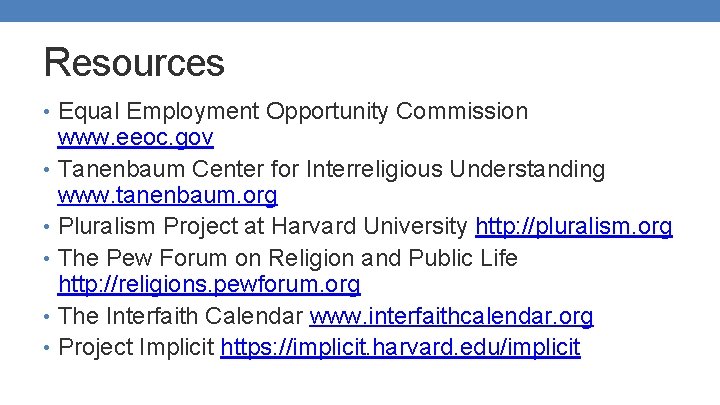
Resources • Equal Employment Opportunity Commission www. eeoc. gov • Tanenbaum Center for Interreligious Understanding www. tanenbaum. org • Pluralism Project at Harvard University http: //pluralism. org • The Pew Forum on Religion and Public Life http: //religions. pewforum. org • The Interfaith Calendar www. interfaithcalendar. org • Project Implicit https: //implicit. harvard. edu/implicit
VA Resources Georgia Coffey Office of Diversity and Inclusion 202 -461 -4131 Tracey Therit Office of Resolution Management 202 -461 -0135