
Religion Study Notes 2011 By Andrew Newbound Andrew
Religion Study Notes 2011 By Andrew Newbound © Andrew Newbound 2013
Personal Moral Responsibility Topic 1 © Andrew Newbound 2013
Definitions Moral Conform to rules of right conduct Distinction between right and wrong Immoral Not conforming to moral law or accepted patterns of conduct Amoral Neither moral nor immoral Responsibility Answerable or accountable for something within one’s power Sin Transgressions of divine law © Andrew Newbound 2013
Definitions Apathy Lack of interest/enthusiasm Integrity Quality of high moral principles Sin Breakdown of relationship with God, self and others. Mortal Sin Requires full knowledge & complete consent, deliberate personal choice Venial Sin Less Serious matter © Andrew Newbound 2013
Conscience Whole person trying to make decisions about right and wrong Reflects values and convictions that direct the person to integrity of life and action Christian understanding People have natural sense of what they should or should not do © Andrew Newbound 2013
Decisions of Conscience Complex As much info as possible Make best thing they can be Search out MORAL TRUTH to follow your conscience © Andrew Newbound 2013
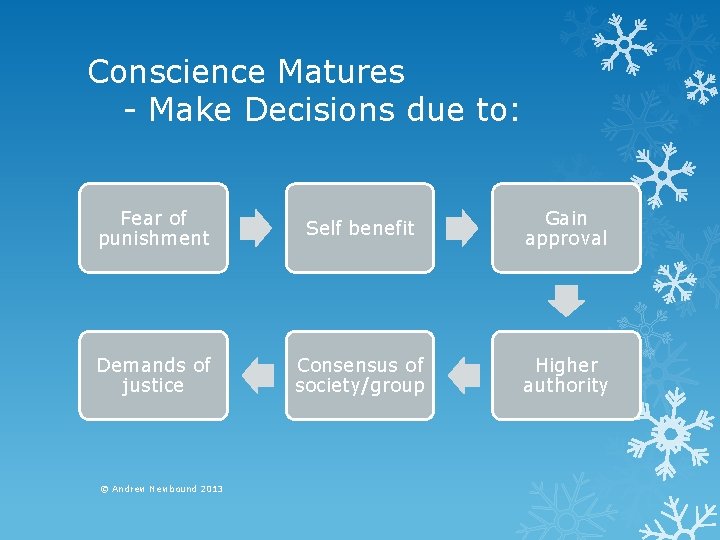
Conscience Matures - Make Decisions due to: Fear of punishment Self benefit Gain approval Demands of justice Consensus of society/group Higher authority © Andrew Newbound 2013
Defining Sin Not just acts/omissions Underlying attitudes Social + personal level Everyone has responsibility for social sin © Andrew Newbound 2013
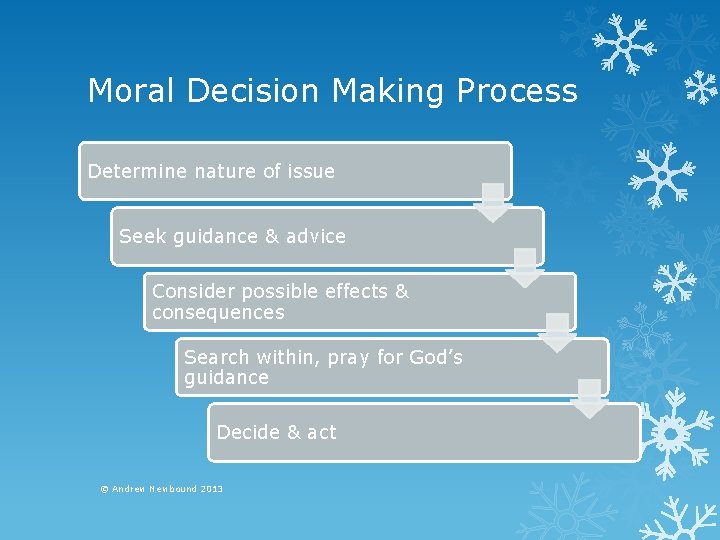
Moral Decision Making Process Determine nature of issue Seek guidance & advice Consider possible effects & consequences Search within, pray for God’s guidance Decide & act © Andrew Newbound 2013
The 10 Commandments Moses delivered for God to Israelites Part of solemn agreement (covenant) they made with God Guidelines for behaviour God expected from his people First 3 = relationship with God Rest = relationship with others Designed to ensure survival & unity of a community Served as basis of laws of many societies © Andrew Newbound 2013
The 10 Commandments 1. I am the Lord your God. You shall have no other gods before Me. 2. You shall not take the name of the Lord you God in vain 3. Remember to keep holy the Lord’s day. 4. Honour you father and your mother. 5. You shall not kill 6. You shall not commit adultery 7. You shall not steal 8. You shall not bear false witness against your neighbour 9. You shall not covet your neighbour’s wife. 10. You shall not covet your neighbour’s goods. © Andrew Newbound 2013
The Beatitudes 1. Blessed are the poor in spirit, for theirs is the kingdom of heaven 2. Blessed are those who mourn for they shall be comforted 3. Blessed are the meek, for they shall inherit the earth 4. Blessed are those who hunger and thirst for justice righteousness, for they shall be satisfied 5. Blessed are the merciful, for they shall obtain mercy 6. Blessed are the pure in heart for they shall see God 7. Blessed are the peacemakers for they shall be called sons of God 8. Blessed are those who are persecuted for righteousness’ sake for theirs is the kingdom of heaven. © Andrew Newbound 2013
Euthanasia Voluntary Euthanasia Patient decides Involuntary Euthanasia Person other than patient decides Active euthanasia Means taken to destroy life Passive euthanasia Nothing is done to continue life Catholic Church beliefs You don’t have to keep someone alive using extraordinary means (passive) Against all other euthanasia © Andrew Newbound 2013
Euthanasia For Against Murder/suicide Free up hospital beds End pain Going to die anyway Less grief Person doesn’t know best Humans put dogs down, dogs don’t put dogs down God’s plan Still hope Pain & suffering part of life Die in dignity Overused power People’s own decision Murder case to get inheritance Cover up murder © Andrew Newbound 2013
Sin A breakdown of relationship with God, self and others Catholic Church describes as An offense against reason, truth and right conscience Not just acts/omissions Also underlying attitudes Social + personal level Society participates in system that harms human welfare Everyone shares some degree of moral responsibility for social sin © Andrew Newbound 2013
Mortal Sins Totally cut you off from any relationship with God Conditions for sin to be Mortal Must be serious (e. g. murder) (grave matter) Person must know what they are doing (full knowledge) Person must freely consent to the evil (freedom and consent) © Andrew Newbound 2013
Serious, Venial Sins Serious sins Actions, words, omissions that deeply wound and threaten your relationship with God but don’t totally destroy it Venial Sins Deliberate acts of selfishness that destroy some of the peace and harmony in a friendship © Andrew Newbound 2013
Cardinal Sins Lust Excessive thoughts/desires of a sexual nature Gluttony Over-indulgence to the point of waste Greed Desire and pursuit of wealth, status, power Sloth The failure to utilise one’s talents and gifts © Andrew Newbound 2013 Might not be in exam
Cardinal Sins Wrath Rage Envy Resenting anther who has something you are lacking Pride The desire to be more important/attractive than others © Andrew Newbound 2013
Theological Virtues A habit of acting that develops by acting well Either naturally belong/learned Possess virtue Should be proud not embarrassed Faith Trust in God’s power and love in our lives Hope Work for good future in our world Belief that Kingdom of God will come Love Freely chosen good will towards all people, expressed in action © Andrew Newbound 2013
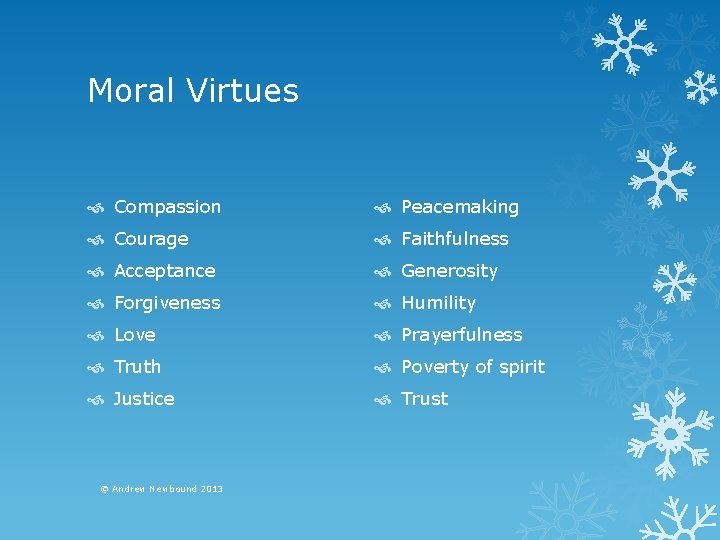
Moral Virtues Compassion Peacemaking Courage Faithfulness Acceptance Generosity Forgiveness Humility Love Prayerfulness Truth Poverty of spirit Justice Trust © Andrew Newbound 2013
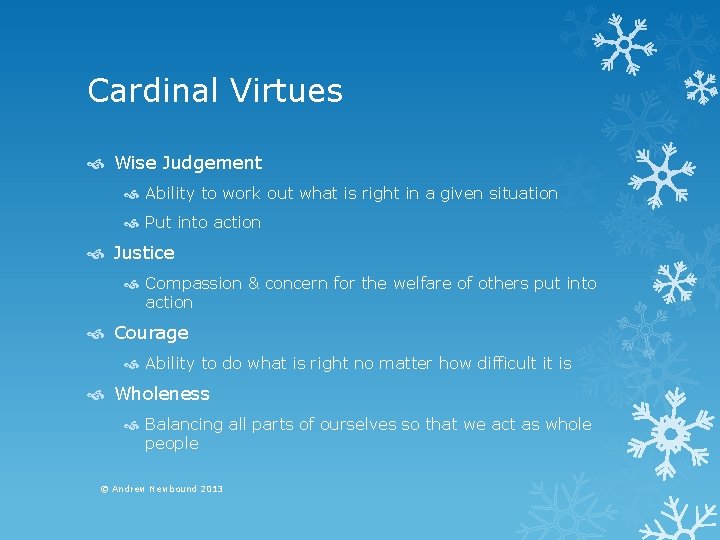
Cardinal Virtues Wise Judgement Ability to work out what is right in a given situation Put into action Justice Compassion & concern for the welfare of others put into action Courage Ability to do what is right no matter how difficult it is Wholeness Balancing all parts of ourselves so that we act as whole people © Andrew Newbound 2013
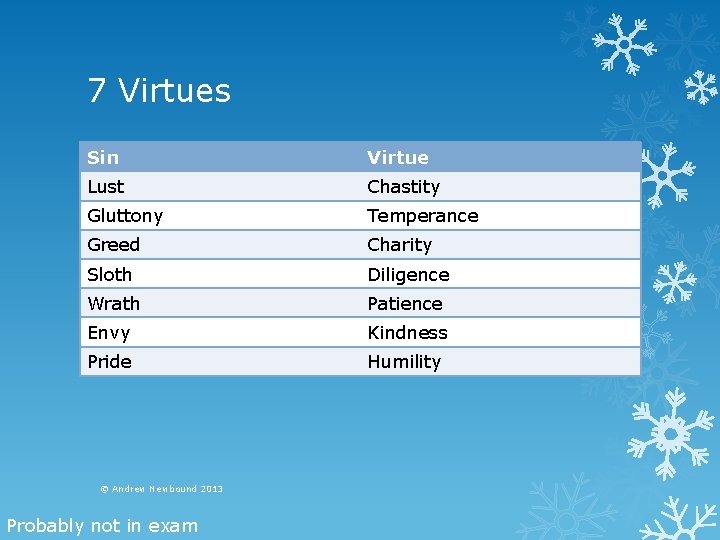
7 Virtues Sin Virtue Lust Chastity Gluttony Temperance Greed Charity Sloth Diligence Wrath Patience Envy Kindness Pride Humility © Andrew Newbound 2013 Probably not in exam
The Church in History Topic 2 © Andrew Newbound 2013
Timeline C 4 BC Birth of Jesus 30 Crucifixion of Jesus C 51 Council of Apostles held in Jerusalem 64 1 st persecution of Christians be Roman Emperor Nero Martyrdom of St Peter, St Paul 312 Conversion of Emperor Constantine 313 Edie of Milan – freedom of Christian religious practice 325 1 st council of Nicea – formulation of Nicene Creed 432 St Patrick’s mission to Ireland 529 St Benedict founds monastery of Monte Cassino © Andrew Newbound 2013
Timeline 570 Birth of Mohammed 787 2 nd Council of Nicea deal with iconoclast issue 1054 Division of Christianity into East and West 1095 1 st crusade proclaimed by Pope Urban II 1209 St Francis found Order of Friars and of Poor Clares 1300 s Black Death in Europe 1309 -77 Papacy based in Avigon, France 1377 Pope Gregory XI returns papal to Rome 1378 St Catherine of Siena succeeds in bringing peace between papal states © Andrew Newbound 2013
Timeline 1431 St Joan of Arc burned at the stake 1517 Martin Luther begins the Protestant Reformation 1534 Henry VIII establishes the Church of England, persecutes Catholics 1540 Foundation of the Jesuits 1545 -63 Council of Trent 1665 Bubonic plauge in London 1858 Marian apparitions to St Bernadette near Lourdes 1869 -70 1 st Vatican Council © Andrew Newbound 2013
Timeline 1917 Marian apparitions at Fatima Portugal, Bolshevik Revolution in Russia 1962 -65 2 nd Vatican Council 1978 Deaths of Pope Paul VI, John Paul I, Pope John Paul II elected 2000 Year of Jubilee – 20 Centuries of Christianity © Andrew Newbound 2013
Most people are religious ¾ of world’s population believe in a higher power Over 2 billion Christians Over ½ = catholic Major Christian groups Catholic Protestant Eastern orthodox Church = all of Christ’s followers © Andrew Newbound 2013
Christian Church Beliefs God sent his son, Jesus Christ into the world Jesus died for us Jesus was raised from the dead Jesus ascended into heaven where he pleads for us Jesus action = our sin is forgiven © Andrew Newbound 2013
Catholic Beliefs Pope = head of church Special Eucharist ceremony = the mass 7 sacraments Unique, special liturgies for worship Honour Mary the Mother of God in special ways Faith common in every diocese of the world Distinctive theology (explanation) of the meaning of Jesus in history History dating back to Jesus through the bishops who are the successors of the apostles © Andrew Newbound 2013
The Rift Between East and West Language East = Greek West = Latin Liturgy East = lavish West = simple Communication made difficult Physical barrier between Rome and Constantinople Differences in customs & religious practices © Andrew Newbound 2013
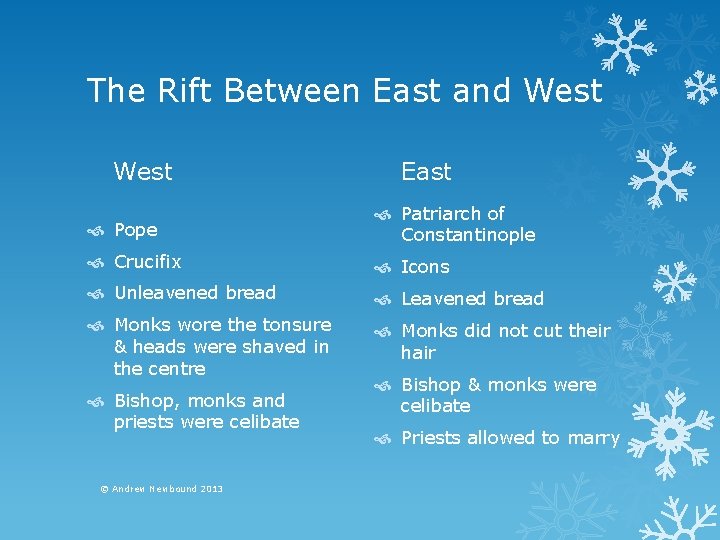
The Rift Between East and West East Pope Patriarch of Constantinople Crucifix Icons Unleavened bread Leavened bread Monks wore the tonsure & heads were shaved in the centre Monks did not cut their hair Bishop, monks and priests were celibate © Andrew Newbound 2013 Bishop & monks were celibate Priests allowed to marry
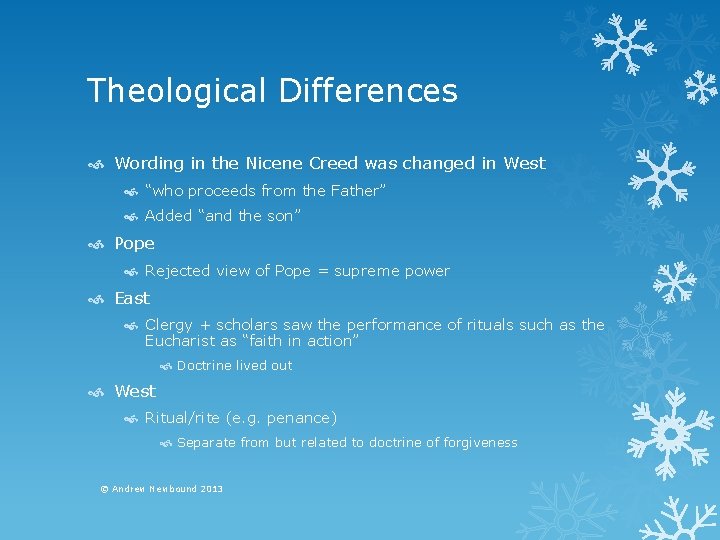
Theological Differences Wording in the Nicene Creed was changed in West “who proceeds from the Father” Added “and the son” Pope Rejected view of Pope = supreme power East Clergy + scholars saw the performance of rituals such as the Eucharist as “faith in action” Doctrine lived out West Ritual/rite (e. g. penance) Separate from but related to doctrine of forgiveness © Andrew Newbound 2013
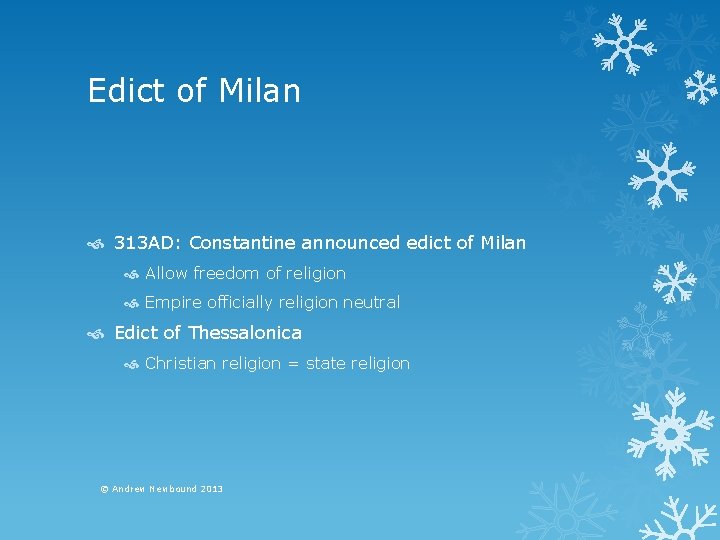
Edict of Milan 313 AD: Constantine announced edict of Milan Allow freedom of religion Empire officially religion neutral Edict of Thessalonica Christian religion = state religion © Andrew Newbound 2013
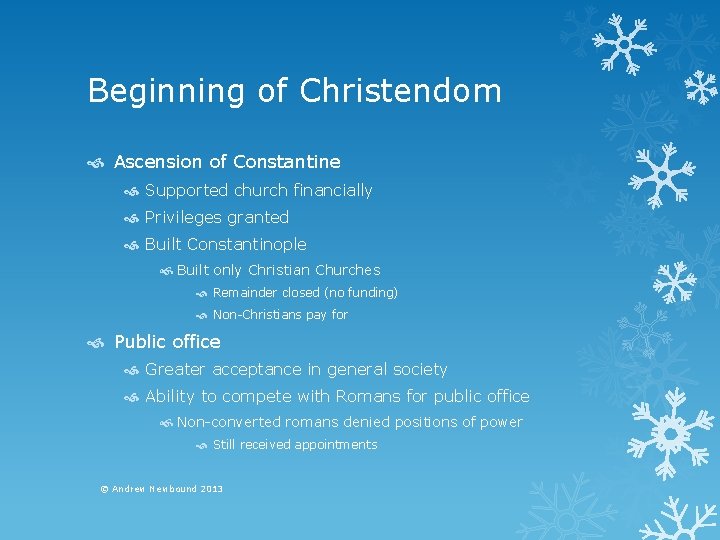
Beginning of Christendom Ascension of Constantine Supported church financially Privileges granted Built Constantinople Built only Christian Churches Remainder closed (no funding) Non-Christians pay for Public office Greater acceptance in general society Ability to compete with Romans for public office Non-converted romans denied positions of power Still received appointments © Andrew Newbound 2013
Legal Reforms Crucifixion abolished Replaced with hanging Sunday declared day of rest March 7 321 Markets banned Public offices closed Except for freeing slaves No restrictions on farming work © Andrew Newbound 2013
Legal Reforms More humane punishments (even by modern standards) Slaves not allowed to be kept in complete darkness Condemned man allowed to die in arena Only branded on the feet Gladiator games eliminated Slave master’s rights were limited © Andrew Newbound 2013
The Reformation: The Black Death Originated in Gobi desert in 1320 s Followed trade routes Blamed on God’s anger at sinfulness of humanity Flagellants went through countryside to atone evil Supressed by the pope Church questioned over what God was angered by World at end – otherwise would not punish so severely © Andrew Newbound 2013
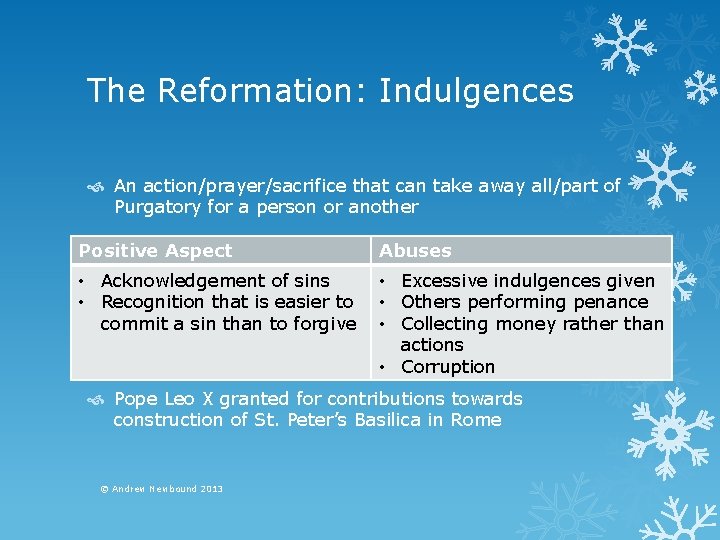
The Reformation: Indulgences An action/prayer/sacrifice that can take away all/part of Purgatory for a person or another Positive Aspect Abuses • Acknowledgement of sins • Recognition that is easier to commit a sin than to forgive • Excessive indulgences given • Others performing penance • Collecting money rather than actions • Corruption Pope Leo X granted for contributions towards construction of St. Peter’s Basilica in Rome © Andrew Newbound 2013
The Reformation: Causes Bishops completely absent from their diocese Some clergy were dishonest Powerless lay people Sale of indulgences General corruption within the Church © Andrew Newbound 2013
The Reformation: Martin Luther Augustine friar Opposed sale of indulgences used to pay for St Peter’s Basilica ~1517 Circulated Ninety-Five Theses 95 statements opposing about Church life with he opposed Particularly about indulgences © Andrew Newbound 2013
The Reformation: Martin Luther 1517: 95 Theses Circulated 1518: Pope Leo X outlined Church’s view on indulgences 1519: Luther wrote to Pope Leo X RE: Not meant to question authority of the church 1520: Gained support of German nobility Wrote direct letter to Pope apologising 1521: Excommunicated 1522: Preached throughout Germany for next 2 years © Andrew Newbound 2013
The Reformation: Martin Luther 1524: Teachings used by groups as basis of religious revolution Disgust of Luther 1530: Augsburg Confession signed to express new Protestant faith by many German princes and cities 1546: Dies aged 62 1555: German Princes right to choose religion of own territory Reformation spread throughout N&E Europe © Andrew Newbound 2013
The Reformation: Rise of Protestantism 1519: Zwingli (powerful Catholic priest) brought Protestantism to Zurich 1534: King Henry VIII made himself head of Church in England 1534 -49: Pope Paul III 1 st Pope of Catholic Reformation/Counter Reformation 1545: Convening of the Council of Trent © Andrew Newbound 2013
The Reformation: - The Council of Trent Forbidden many corrupt practices All clergy remain within diocese All appointed bishops ordained for 6 months Forbidding taxation & collection of money from parishes they visited Forbade use of indulgences to raise money Re-affirmed that doctrine comes from God as pure gift + requires human cooperation Salvation comes from faith & good actions Sources of revelation Both scripture & tradition © Andrew Newbound 2013
The Reformation: - The Council of Trent Establishing that were 7 sacraments True meaning of Eucharist emphasised Sacrifice of Christ Specific rules about form of mass & liturgical music Wedding Performed before a priest + 2 witnesses Registered Every diocese provide proper education of future priests Seminaries under the authority of the church Clergy to give more attention to preaching & teaching Bishops in particular © Andrew Newbound 2013
The Council of Chalcedon The Council of Nicea taught that Jesus was divine Jesus was both human & divine Cannot emphasis one over the other Heresy Cornerstone of Christian faith Gathered in AD 451 Find precise language to be able to speak about his humanness and divinity Jesus had 2 natures “Fully human and fully divine in one person” © Andrew Newbound 2013
The Council of Chalcedon Council of Nicea & Chalcedon Focused on critical issue of Jesus’ identify in relationship to God and relationship to humanity Incorrect teaches of Jesus’ divinity etc. = heresy Remains beyond our human experience to fully understand this mystery We are fully human © Andrew Newbound 2013
First Vatican Council 1869 -1870 Called by Pius IX Review & summarise Catholic faith Dealt with authority of the Pope Was true successor of St Peter Supreme power over whole Church “Infallible” Free from error © Andrew Newbound 2013
First Vatican Council Infallibility Applies when Pope teaches DEFINITIVELY Doctrine concerning faith & morals To be believed by whole Church Used in 1854 Affirm belief that Mary, the Mother of God = free from sin from moment was conceived Dogma of the Immaculate Conception Confined to specific occasions Pope makes decisive pronouncements/ with bishops in an Ecumenical Council that teaches about faith © Andrew Newbound 2013
Second Vatican Council 1962 -1965 3 months per year Church’s openness to the modern world Announced Pope John XXIII Greatest number of attendance 2600 + bishops Came from all over world 52 lay people Theologians & other experts © Andrew Newbound 2013
Second Vatican Council 1 st to use Electricity Telephones + other modern technologies 1 st Covered by newspapers + magazines from all over world Covered by TV + radio Promote peace & unity among humanity Show mercy & understanding + ability to listen to the Holy Spirit © Andrew Newbound 2013
Second Vatican Council Aggiornamento Renewal and updating the Church Adapt to the changing world Pope John Renewal 16 key documents were produced © Andrew Newbound 2013
Definitions Theology The study of God and God’s action in human history Protestant Reformation A major religion movement protesting certain conditions in the church and aiming at reform Bishop Ordained leader of a diocese Church The whole community of those who believe in Jesus Christ Orthodoxy The accepted doctrines & practices of a religion © Andrew Newbound 2013
Definitions Schism A division/serious split, usually in a religious body Protestantism A branch of Christianity which emerging from the reformation of the 16 th Century Monasticism A style or order of life of religious communities that is characterised by life in a monastery Abbot The superior/head of a monastery Abbess The female head/superior of a monastery © Andrew Newbound 2013
Definitions Celibate Abstaining from sexual intercourse and practicing chastity Icon A pictorial image of Christ, Mary or the saints Chastity The virtue that regulate our sexual behaviour, attitudes and though in co-operation with God’s plans for human sexuality Orthodox True/right worship Creed An official formula of religious belief © Andrew Newbound 2013
Definitions Patriarch A high ranking Bishop in any of what were principal cities of the early church E. g. Jerusalem, Antioch, Alexandria, Rome, Constantinople Tonsure The way the head was shaved in the centre to represent the ‘crown of thorns’ that Christ wore when he was crucified Pope The Bishop of Rome who heads the Catholic Church © Andrew Newbound 2013
- Slides: 58