
Religion Policy and FaithBased Organizations Charting the Shifting
Religion Policy and Faith-Based Organizations: Charting the Shifting Boundaries between Church and State Michael D. Mc. Ginnis Professor, Department of Political Science and Director, Workshop in Political Theory and Policy Analysis, Indiana University, Bloomington mcginnis@indiana. edu Paper URL: http: //php. indiana. edu/~mcginnis/asrec_version. pdf Presentation Slides: http: //php. indiana. edu/~mcginnis/asrec_slides. pptx Presented at the 2011 Annual Meeting of ASREC, Association for the Study of Religion, Economics & Culture, Washington, D. C. , April 7 -10, 2011.
A Definition: A religion consists of an identifiable group of individuals who share all of the following: 1. Beliefs and doctrines, often related to things unseen or unknowable (especially what happens to human beings after death), 2. Rituals and individual religious experience (typically interpreted as encounters with the “other”), 3. Familiarity with symbols, stories, and modes of understanding (especially concerned with the meaning of life), 4. Reverence for sacred objects (scriptures, places, persons, things), 5. Social expectations shaped by codes of conduct (which typically differ for interactions with believers and non-believers), 6. Mechanisms for enhancing social ties and common experiences (often involving organizations for specialized activities), 7. Procedures for selecting and training leaders and making common decisions (both informally and within formal organizations), 8. Identification as members of a trans-generational community. 2
Points of Emphasis in Definition • Religion is inherently multi-dimensional: no one component is determinative or dominant. • Religion is inherently social, and cannot be reduced to individual beliefs or experiences. • Since religion is a collective activity, – it necessarily involves disagreements among its members (on any of its 8 component dimensions and on their implications for other matters, such as implications for practical policy concerns), – And the formation or operation of religious organization necessarily involves dilemmas of collective action, – And any successful instance of collective action by members of a religious community necessarily has consequences that affect others, even if these consequences are unintended side-effects, • In technical terms, religion generates externalities for society 3
Religious organizations can produce public goods for society as a whole: • charity: provide some public services at lower or no cost, especially to marginalized groups • morality: support general moral values, legitimize political regime, divert potential revolutions • prophetic voice: enhance public discourse, encourage reform towards peace and justice, alternate source of legitimacy • congregational form nurtures widespread experience in democratic self-governance (Tocqueville) • important source of volunteers for community engagement and of philanthropy • liberty: essential manifestation of personal liberty, freedom Public “bads” include diversion of resources diverted from pressing concerns, and tendency to spread extremism & intolerance 4

FBOs (Faith-Based Service Organizations) FBO: Faith-Based Organization: organizations that specialize in delivery of some particular form of service (food, shelter, education, health care, personal rehabilitation, etc. ) and that base some aspects of their programs on religious inspirations or personnel. An FBO can be affected by religion in one or more ways, such as if 1. Mission goals of program are shaped by religious doctrine or beliefs 2. Content of service program includes religious rituals and/or stories 3. Intended beneficiaries are co-religionists or are targeted for conversion 4. Reliance on financial support from religious organizations and/or donors 5. Implemented by hired staff or volunteers from a religious community 6. Religious specialists are managers or form majority of oversight board. 5
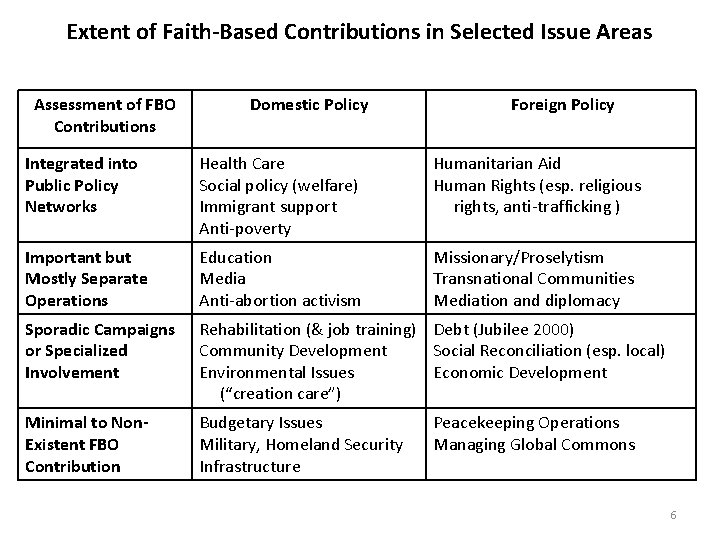
Extent of Faith-Based Contributions in Selected Issue Areas Assessment of FBO Contributions Domestic Policy Foreign Policy Integrated into Public Policy Networks Health Care Social policy (welfare) Immigrant support Anti-poverty Humanitarian Aid Human Rights (esp. religious rights, anti-trafficking ) Important but Mostly Separate Operations Education Media Anti-abortion activism Missionary/Proselytism Transnational Communities Mediation and diplomacy Sporadic Campaigns or Specialized Involvement Rehabilitation (& job training) Debt (Jubilee 2000) Community Development Social Reconciliation (esp. local) Environmental Issues Economic Development (“creation care”) Minimal to Non. Existent FBO Contribution Budgetary Issues Military, Homeland Security Infrastructure Peacekeeping Operations Managing Global Commons 6
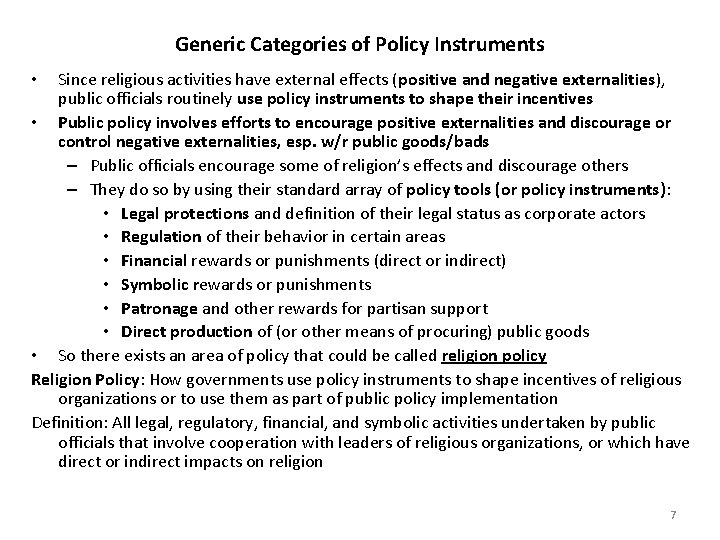
Generic Categories of Policy Instruments Since religious activities have external effects (positive and negative externalities), public officials routinely use policy instruments to shape their incentives • Public policy involves efforts to encourage positive externalities and discourage or control negative externalities, esp. w/r public goods/bads – Public officials encourage some of religion’s effects and discourage others – They do so by using their standard array of policy tools (or policy instruments): • Legal protections and definition of their legal status as corporate actors • Regulation of their behavior in certain areas • Financial rewards or punishments (direct or indirect) • Symbolic rewards or punishments • Patronage and other rewards for partisan support • Direct production of (or other means of procuring) public goods • So there exists an area of policy that could be called religion policy Religion Policy: How governments use policy instruments to shape incentives of religious organizations or to use them as part of public policy implementation Definition: All legal, regulatory, financial, and symbolic activities undertaken by public officials that involve cooperation with leaders of religious organizations, or which have direct or indirect impacts on religion • 7
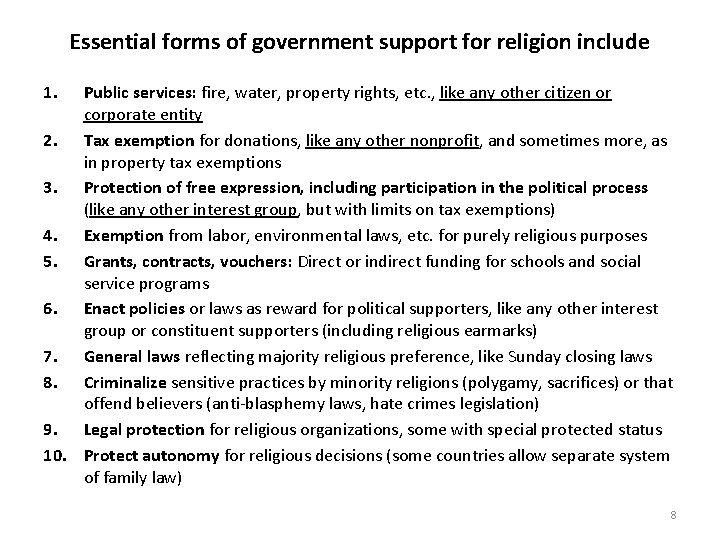
Essential forms of government support for religion include 1. Public services: fire, water, property rights, etc. , like any other citizen or corporate entity 2. Tax exemption for donations, like any other nonprofit, and sometimes more, as in property tax exemptions 3. Protection of free expression, including participation in the political process (like any other interest group, but with limits on tax exemptions) 4. Exemption from labor, environmental laws, etc. for purely religious purposes 5. Grants, contracts, vouchers: Direct or indirect funding for schools and social service programs 6. Enact policies or laws as reward for political supporters, like any other interest group or constituent supporters (including religious earmarks) 7. General laws reflecting majority religious preference, like Sunday closing laws 8. Criminalize sensitive practices by minority religions (polygamy, sacrifices) or that offend believers (anti-blasphemy laws, hate crimes legislation) 9. Legal protection for religious organizations, some with special protected status 10. Protect autonomy for religious decisions (some countries allow separate system of family law) 8
9
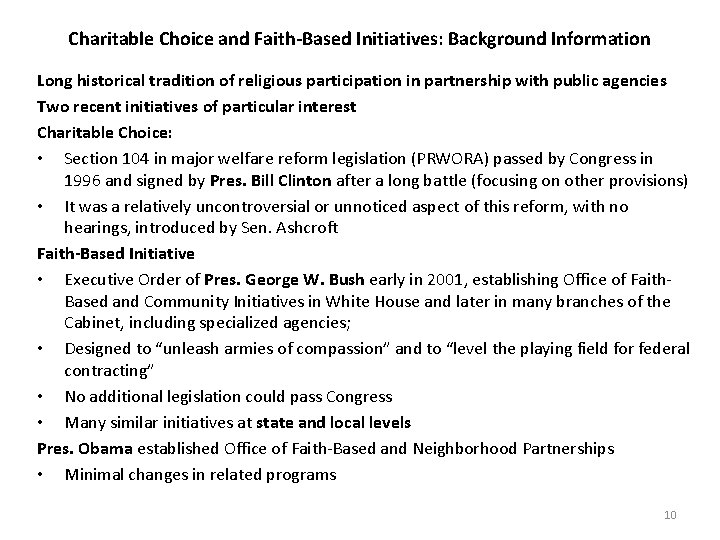
Charitable Choice and Faith-Based Initiatives: Background Information Long historical tradition of religious participation in partnership with public agencies Two recent initiatives of particular interest Charitable Choice: • Section 104 in major welfare reform legislation (PRWORA) passed by Congress in 1996 and signed by Pres. Bill Clinton after a long battle (focusing on other provisions) • It was a relatively uncontroversial or unnoticed aspect of this reform, with no hearings, introduced by Sen. Ashcroft Faith-Based Initiative • Executive Order of Pres. George W. Bush early in 2001, establishing Office of Faith. Based and Community Initiatives in White House and later in many branches of the Cabinet, including specialized agencies; • Designed to “unleash armies of compassion” and to “level the playing field for federal contracting” • No additional legislation could pass Congress • Many similar initiatives at state and local levels Pres. Obama established Office of Faith-Based and Neighborhood Partnerships • Minimal changes in related programs 10
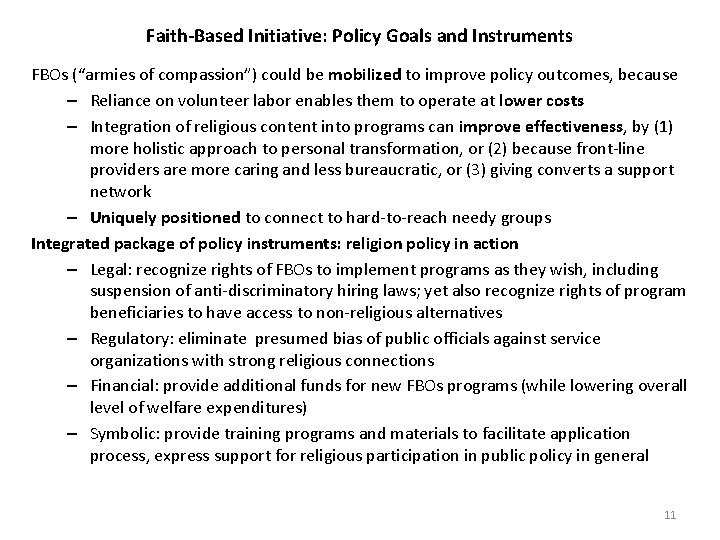
Faith-Based Initiative: Policy Goals and Instruments FBOs (“armies of compassion”) could be mobilized to improve policy outcomes, because – Reliance on volunteer labor enables them to operate at lower costs – Integration of religious content into programs can improve effectiveness, by (1) more holistic approach to personal transformation, or (2) because front-line providers are more caring and less bureaucratic, or (3) giving converts a support network – Uniquely positioned to connect to hard-to-reach needy groups Integrated package of policy instruments: religion policy in action – Legal: recognize rights of FBOs to implement programs as they wish, including suspension of anti-discriminatory hiring laws; yet also recognize rights of program beneficiaries to have access to non-religious alternatives – Regulatory: eliminate presumed bias of public officials against service organizations with strong religious connections – Financial: provide additional funds for new FBOs programs (while lowering overall level of welfare expenditures) – Symbolic: provide training programs and materials to facilitate application process, express support for religious participation in public policy in general 11
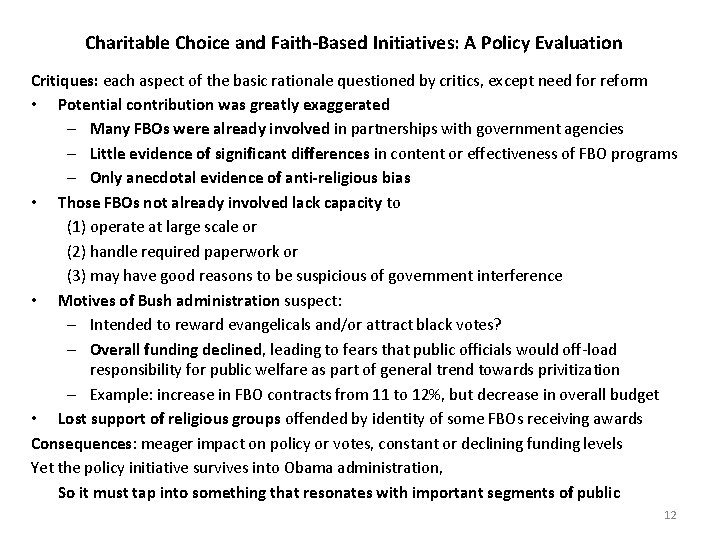
Charitable Choice and Faith-Based Initiatives: A Policy Evaluation Critiques: each aspect of the basic rationale questioned by critics, except need for reform • Potential contribution was greatly exaggerated – Many FBOs were already involved in partnerships with government agencies – Little evidence of significant differences in content or effectiveness of FBO programs – Only anecdotal evidence of anti-religious bias • Those FBOs not already involved lack capacity to (1) operate at large scale or (2) handle required paperwork or (3) may have good reasons to be suspicious of government interference • Motives of Bush administration suspect: – Intended to reward evangelicals and/or attract black votes? – Overall funding declined, leading to fears that public officials would off-load responsibility for public welfare as part of general trend towards privitization – Example: increase in FBO contracts from 11 to 12%, but decrease in overall budget • Lost support of religious groups offended by identity of some FBOs receiving awards Consequences: meager impact on policy or votes, constant or declining funding levels Yet the policy initiative survives into Obama administration, So it must tap into something that resonates with important segments of public 12
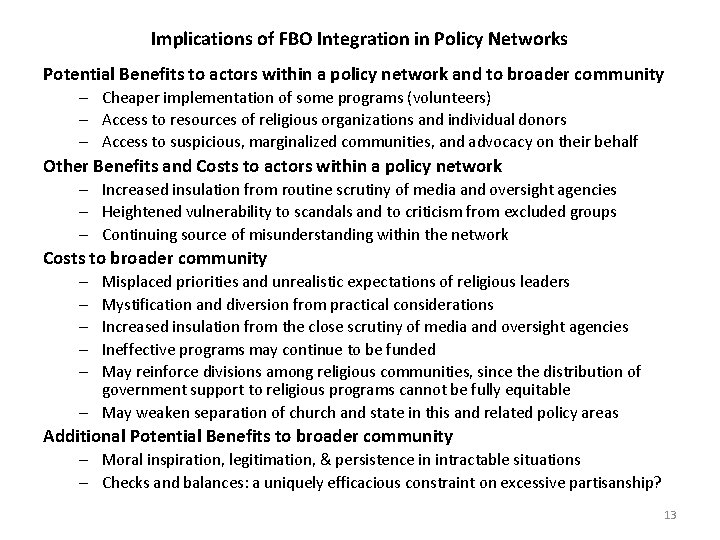
Implications of FBO Integration in Policy Networks Potential Benefits to actors within a policy network and to broader community – Cheaper implementation of some programs (volunteers) – Access to resources of religious organizations and individual donors – Access to suspicious, marginalized communities, and advocacy on their behalf Other Benefits and Costs to actors within a policy network – Increased insulation from routine scrutiny of media and oversight agencies – Heightened vulnerability to scandals and to criticism from excluded groups – Continuing source of misunderstanding within the network Costs to broader community Misplaced priorities and unrealistic expectations of religious leaders Mystification and diversion from practical considerations Increased insulation from the close scrutiny of media and oversight agencies Ineffective programs may continue to be funded May reinforce divisions among religious communities, since the distribution of government support to religious programs cannot be fully equitable – May weaken separation of church and state in this and related policy areas – – – Additional Potential Benefits to broader community – Moral inspiration, legitimation, & persistence in intractable situations – Checks and balances: a uniquely efficacious constraint on excessive partisanship? 13
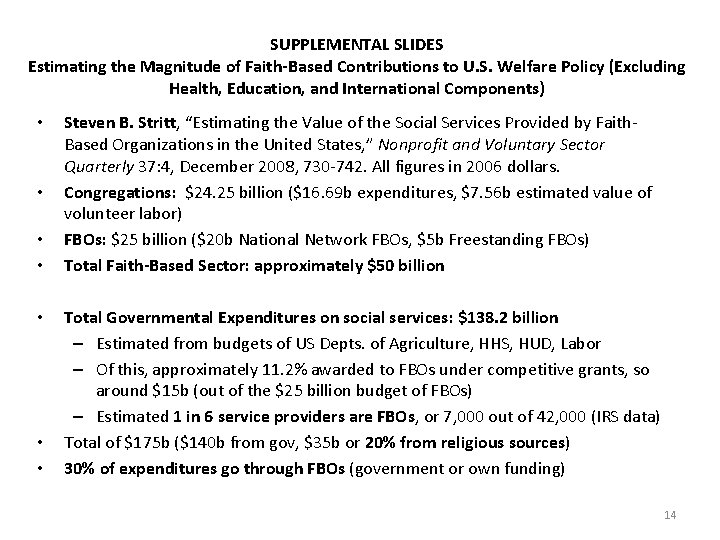
SUPPLEMENTAL SLIDES Estimating the Magnitude of Faith-Based Contributions to U. S. Welfare Policy (Excluding Health, Education, and International Components) • • Steven B. Stritt, “Estimating the Value of the Social Services Provided by Faith. Based Organizations in the United States, ” Nonprofit and Voluntary Sector Quarterly 37: 4, December 2008, 730 -742. All figures in 2006 dollars. Congregations: $24. 25 billion ($16. 69 b expenditures, $7. 56 b estimated value of volunteer labor) FBOs: $25 billion ($20 b National Network FBOs, $5 b Freestanding FBOs) Total Faith-Based Sector: approximately $50 billion Total Governmental Expenditures on social services: $138. 2 billion – Estimated from budgets of US Depts. of Agriculture, HHS, HUD, Labor – Of this, approximately 11. 2% awarded to FBOs under competitive grants, so around $15 b (out of the $25 billion budget of FBOs) – Estimated 1 in 6 service providers are FBOs, or 7, 000 out of 42, 000 (IRS data) Total of $175 b ($140 b from gov, $35 b or 20% from religious sources) 30% of expenditures go through FBOs (government or own funding) 14
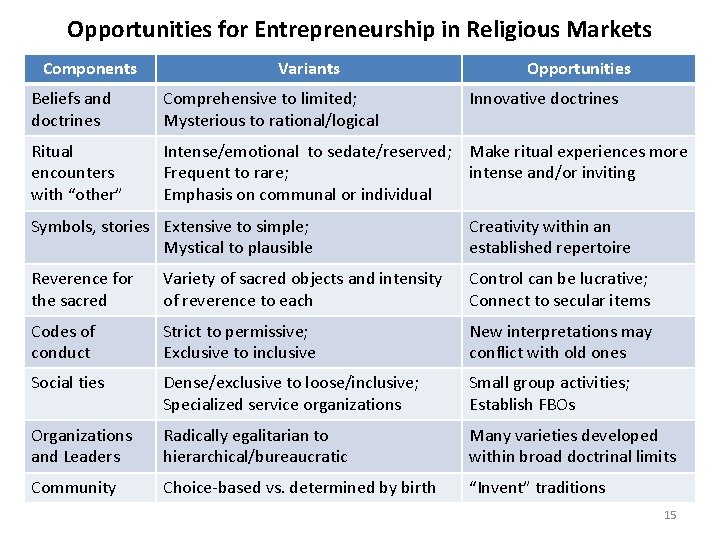
Opportunities for Entrepreneurship in Religious Markets Components Variants Opportunities Beliefs and doctrines Comprehensive to limited; Mysterious to rational/logical Innovative doctrines Ritual encounters with “other” Intense/emotional to sedate/reserved; Make ritual experiences more Frequent to rare; intense and/or inviting Emphasis on communal or individual Symbols, stories Extensive to simple; Mystical to plausible Creativity within an established repertoire Reverence for the sacred Variety of sacred objects and intensity of reverence to each Control can be lucrative; Connect to secular items Codes of conduct Strict to permissive; Exclusive to inclusive New interpretations may conflict with old ones Social ties Dense/exclusive to loose/inclusive; Specialized service organizations Small group activities; Establish FBOs Organizations and Leaders Radically egalitarian to hierarchical/bureaucratic Many varieties developed within broad doctrinal limits Community Choice-based vs. determined by birth “Invent” traditions 15
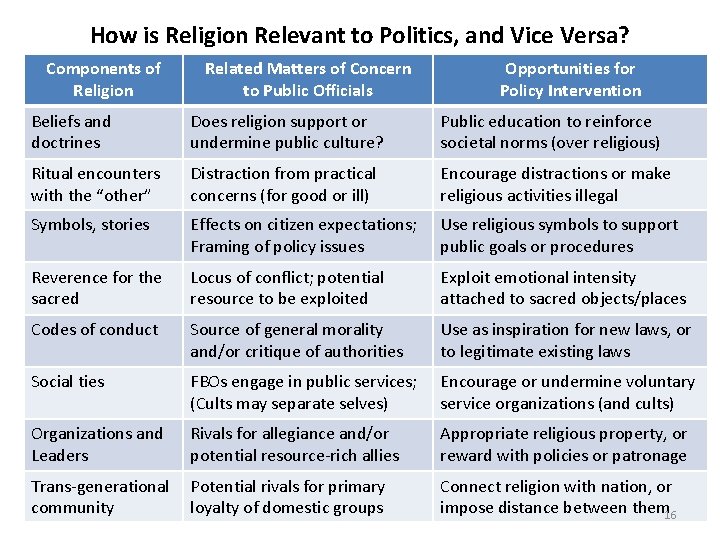
How is Religion Relevant to Politics, and Vice Versa? Components of Religion Related Matters of Concern to Public Officials Opportunities for Policy Intervention Beliefs and doctrines Does religion support or undermine public culture? Public education to reinforce societal norms (over religious) Ritual encounters with the “other” Distraction from practical concerns (for good or ill) Encourage distractions or make religious activities illegal Symbols, stories Effects on citizen expectations; Framing of policy issues Use religious symbols to support public goals or procedures Reverence for the sacred Locus of conflict; potential resource to be exploited Exploit emotional intensity attached to sacred objects/places Codes of conduct Source of general morality and/or critique of authorities Use as inspiration for new laws, or to legitimate existing laws Social ties FBOs engage in public services; (Cults may separate selves) Encourage or undermine voluntary service organizations (and cults) Organizations and Leaders Rivals for allegiance and/or potential resource-rich allies Appropriate religious property, or reward with policies or patronage Trans-generational community Potential rivals for primary loyalty of domestic groups Connect religion with nation, or impose distance between them 16
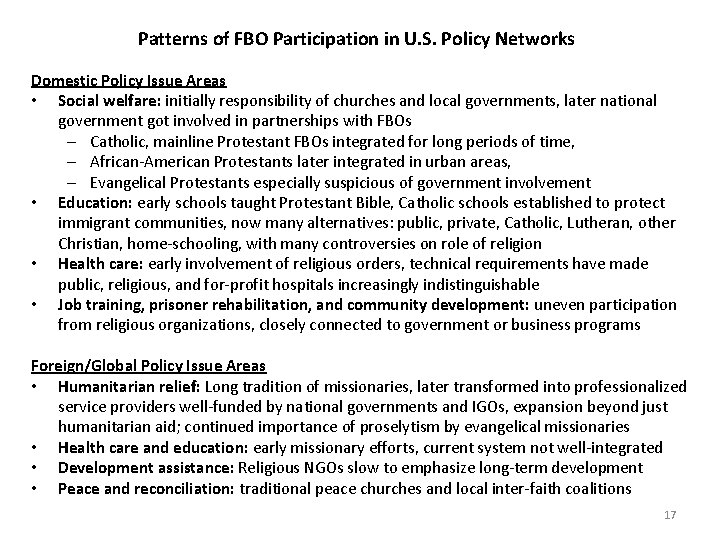
Patterns of FBO Participation in U. S. Policy Networks Domestic Policy Issue Areas • Social welfare: initially responsibility of churches and local governments, later national government got involved in partnerships with FBOs – Catholic, mainline Protestant FBOs integrated for long periods of time, – African-American Protestants later integrated in urban areas, – Evangelical Protestants especially suspicious of government involvement • Education: early schools taught Protestant Bible, Catholic schools established to protect immigrant communities, now many alternatives: public, private, Catholic, Lutheran, other Christian, home-schooling, with many controversies on role of religion • Health care: early involvement of religious orders, technical requirements have made public, religious, and for-profit hospitals increasingly indistinguishable • Job training, prisoner rehabilitation, and community development: uneven participation from religious organizations, closely connected to government or business programs Foreign/Global Policy Issue Areas • Humanitarian relief: Long tradition of missionaries, later transformed into professionalized service providers well-funded by national governments and IGOs, expansion beyond just humanitarian aid; continued importance of proselytism by evangelical missionaries • Health care and education: early missionary efforts, current system not well-integrated • Development assistance: Religious NGOs slow to emphasize long-term development • Peace and reconciliation: traditional peace churches and local inter-faith coalitions 17
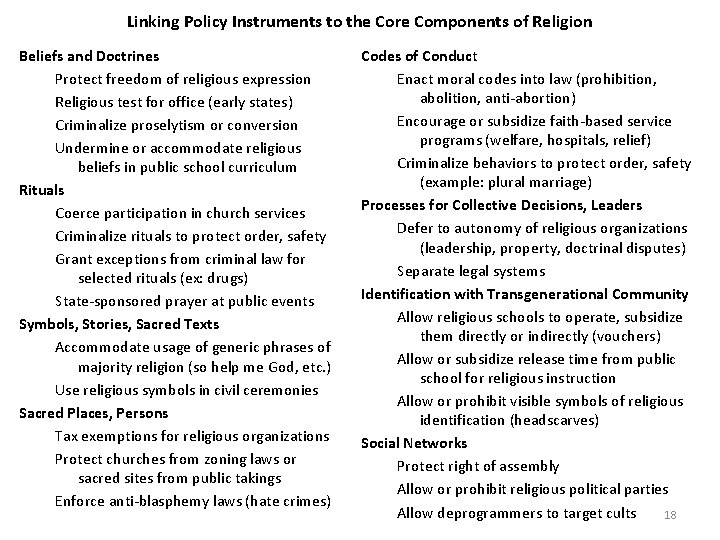
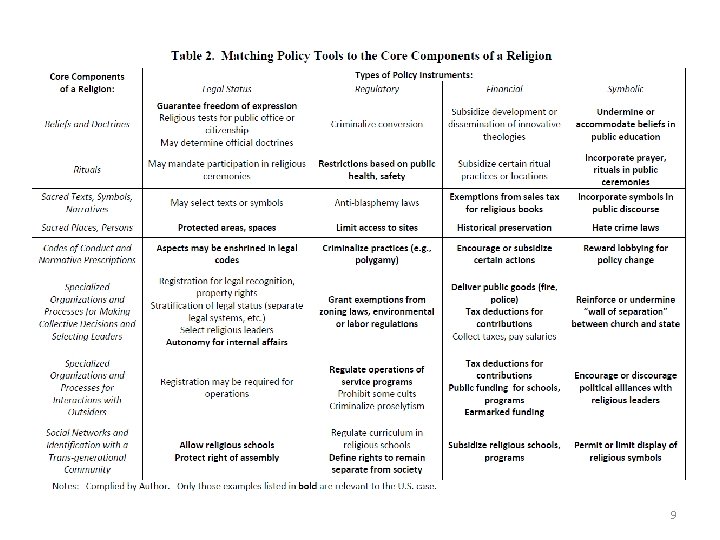
Linking Policy Instruments to the Core Components of Religion Beliefs and Doctrines Protect freedom of religious expression Religious test for office (early states) Criminalize proselytism or conversion Undermine or accommodate religious beliefs in public school curriculum Rituals Coerce participation in church services Criminalize rituals to protect order, safety Grant exceptions from criminal law for selected rituals (ex: drugs) State-sponsored prayer at public events Symbols, Stories, Sacred Texts Accommodate usage of generic phrases of majority religion (so help me God, etc. ) Use religious symbols in civil ceremonies Sacred Places, Persons Tax exemptions for religious organizations Protect churches from zoning laws or sacred sites from public takings Enforce anti-blasphemy laws (hate crimes) Codes of Conduct Enact moral codes into law (prohibition, abolition, anti-abortion) Encourage or subsidize faith-based service programs (welfare, hospitals, relief) Criminalize behaviors to protect order, safety (example: plural marriage) Processes for Collective Decisions, Leaders Defer to autonomy of religious organizations (leadership, property, doctrinal disputes) Separate legal systems Identification with Transgenerational Community Allow religious schools to operate, subsidize them directly or indirectly (vouchers) Allow or subsidize release time from public school for religious instruction Allow or prohibit visible symbols of religious identification (headscarves) Social Networks Protect right of assembly Allow or prohibit religious political parties Allow deprogrammers to target cults 18
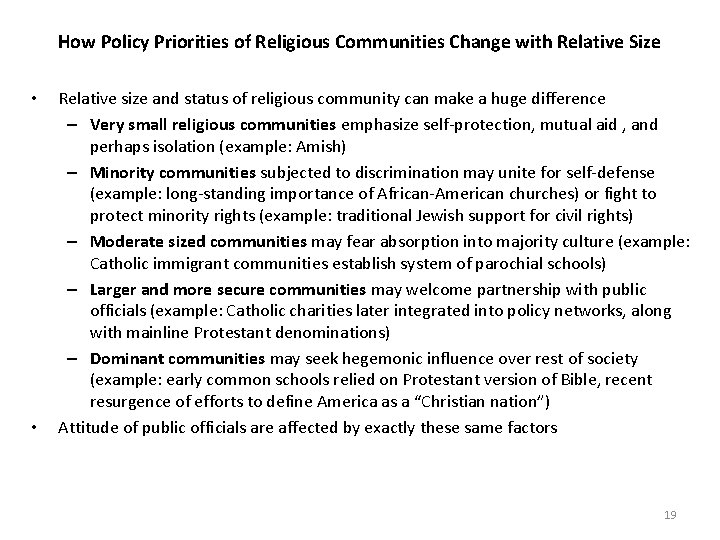
How Policy Priorities of Religious Communities Change with Relative Size • • Relative size and status of religious community can make a huge difference – Very small religious communities emphasize self-protection, mutual aid , and perhaps isolation (example: Amish) – Minority communities subjected to discrimination may unite for self-defense (example: long-standing importance of African-American churches) or fight to protect minority rights (example: traditional Jewish support for civil rights) – Moderate sized communities may fear absorption into majority culture (example: Catholic immigrant communities establish system of parochial schools) – Larger and more secure communities may welcome partnership with public officials (example: Catholic charities later integrated into policy networks, along with mainline Protestant denominations) – Dominant communities may seek hegemonic influence over rest of society (example: early common schools relied on Protestant version of Bible, recent resurgence of efforts to define America as a “Christian nation”) Attitude of public officials are affected by exactly these same factors 19
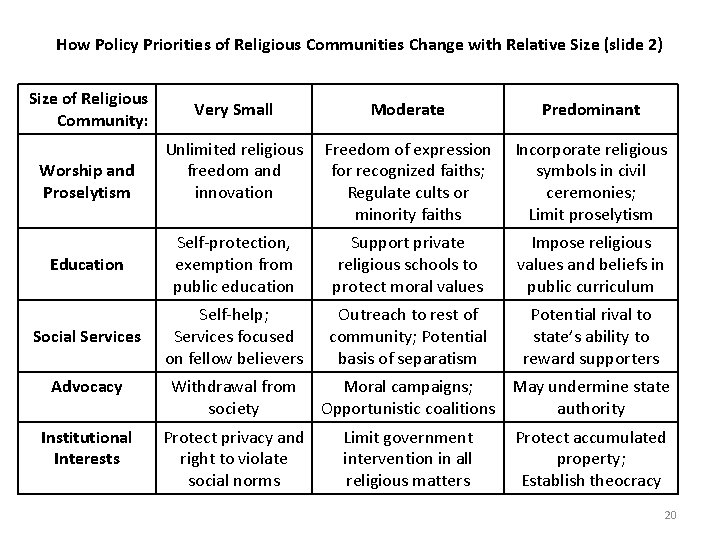
How Policy Priorities of Religious Communities Change with Relative Size (slide 2) Size of Religious Community: Very Small Moderate Predominant Unlimited religious freedom and innovation Freedom of expression for recognized faiths; Regulate cults or minority faiths Incorporate religious symbols in civil ceremonies; Limit proselytism Education Self-protection, exemption from public education Support private religious schools to protect moral values Impose religious values and beliefs in public curriculum Social Services Self-help; Services focused on fellow believers Outreach to rest of community; Potential basis of separatism Potential rival to state’s ability to reward supporters Worship and Proselytism Advocacy Withdrawal from society Institutional Interests Protect privacy and right to violate social norms Moral campaigns; May undermine state Opportunistic coalitions authority Limit government intervention in all religious matters Protect accumulated property; Establish theocracy 20
- Slides: 20