
Religion Hajj Ganges River Pope Francis Call to

- Slides: 75
Religion
Hajj – Ganges River – Pope Francis – Call to Prayer
Warm Up Question Which of the following religions is one that proselytizes, or actively seeks converts? A. Judaism B. Hinduism C. Animism D. Shamanism E. Buddhism
Warm Up Question – A person who practices the Hindu religion would be most likely to A. Visit a shrine built on the shore of a lake. B. Pray five times a day. C. Bathe in the Ganges River. D. Make a pilgrimage to Jerusalem. E. Make a pilgrimage to Mecca.
Warm Up Question – The faith that is most widely dispersed around the world is A. Christianity. B. Islam. C. Shamanism. D. Buddhism. E. Judaism.
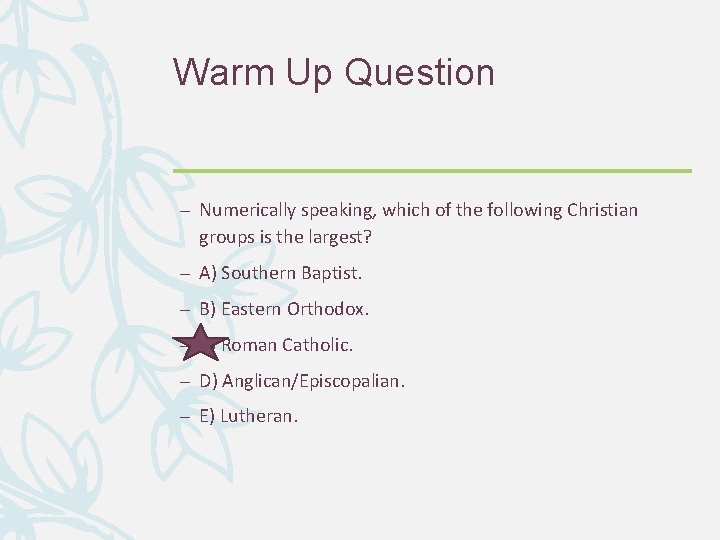
Warm Up Question – Numerically speaking, which of the following Christian groups is the largest? – A) Southern Baptist. – B) Eastern Orthodox. – C) Roman Catholic. – D) Anglican/Episcopalian. – E) Lutheran.
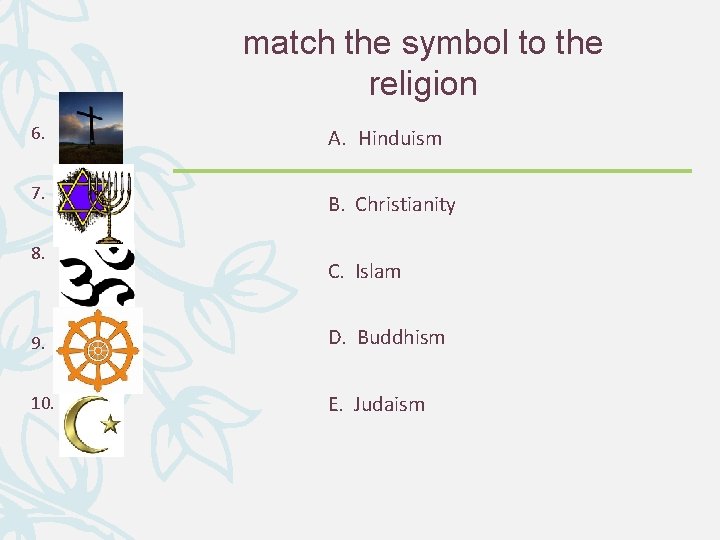
match the symbol to the religion 6. A. Hinduism 7. B. Christianity 8. C. Islam 9. D. Buddhism 10. E. Judaism
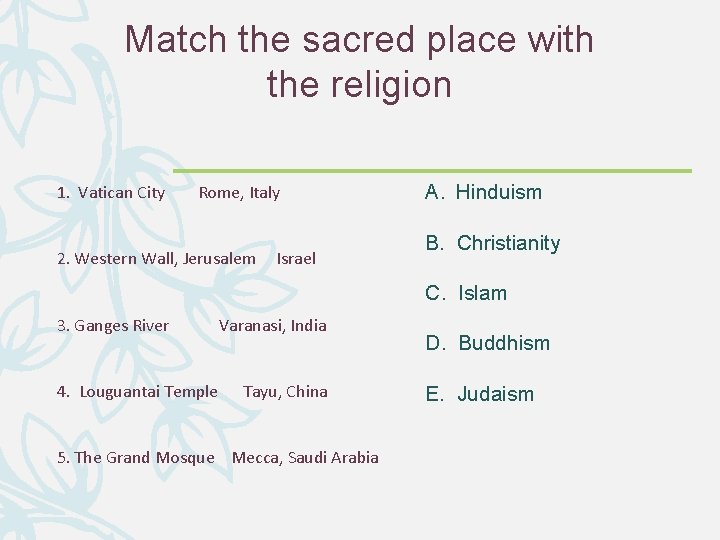
Match the sacred place with the religion 1. Vatican City Rome, Italy 2. Western Wall, Jerusalem Israel A. Hinduism B. Christianity C. Islam 3. Ganges River 4. Louguantai Temple Varanasi, India Tayu, China 5. The Grand Mosque Mecca, Saudi Arabia D. Buddhism E. Judaism
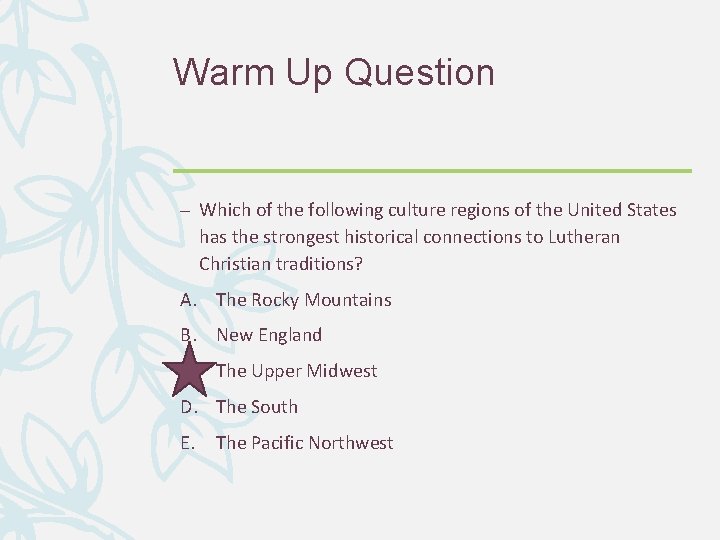
Warm Up Question – Which of the following culture regions of the United States has the strongest historical connections to Lutheran Christian traditions? A. The Rocky Mountains B. New England C. The Upper Midwest D. The South E. The Pacific Northwest
Warm-Up Question – Local Native American and African religions that teach belief in a natural world full of spiritual beings and supernatural powers are often referred to as – A) animistic. – B) shamanistic. – C) missionary. – D) denominational. – E) local religions.
Warm Up Question – Europe’s Roman Catholic population is largely concentrated in the southern part of the continent. This is most likely due to A. Protestants finding refuge in the north high mountains. B. The influence of the Huguenots on the south. C. Northern European areas that were never converted to Roman Catholicism. D. Its proximity to Rome. E. All of the above.
What is Religion and What Role does it Play in Culture?
Religion – Commonalities: – A set of teachings – Imply a value system – Some notion of the sacred- whether it’s a divine being, set of texts, or a symbol – Creation story to explain the origins of humans and the physical universe – Differences: – Teachings about law, politics, social mores, sexual relations, physical fitness, cleanliness, eating habits, and interior decorating
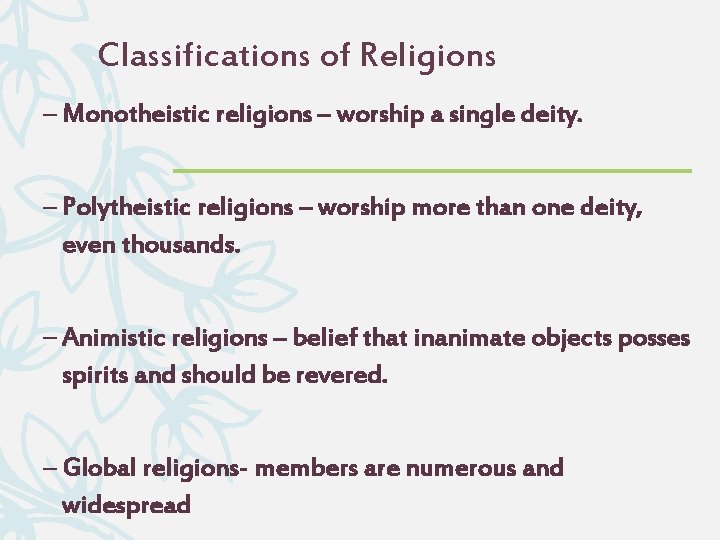
Classifications of Religions – Monotheistic religions – worship a single deity. – Polytheistic religions – worship more than one deity, even thousands. – Animistic religions – belief that inanimate objects posses spirits and should be revered. – Global religions- members are numerous and widespread
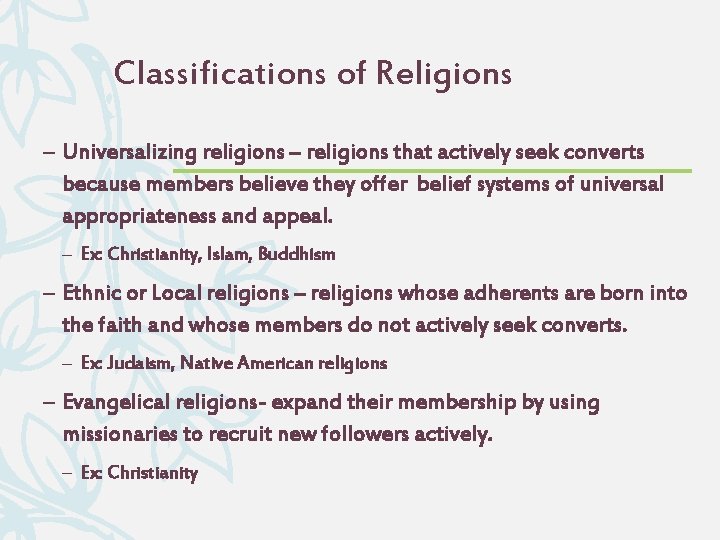
Classifications of Religions – Universalizing religions – religions that actively seek converts because members believe they offer belief systems of universal appropriateness and appeal. – Ex: Christianity, Islam, Buddhism – Ethnic or Local religions – religions whose adherents are born into the faith and whose members do not actively seek converts. – Ex: Judaism, Native American religions – Evangelical religions- expand their membership by using missionaries to recruit new followers actively. – Ex: Christianity
Sacred Sites and Pilgrimage – Sacred Sites places or spaces people infuse with religious meaning. – Pilgrimage purposeful travel to a religious site to pay respects or participate in a ritual at the site.
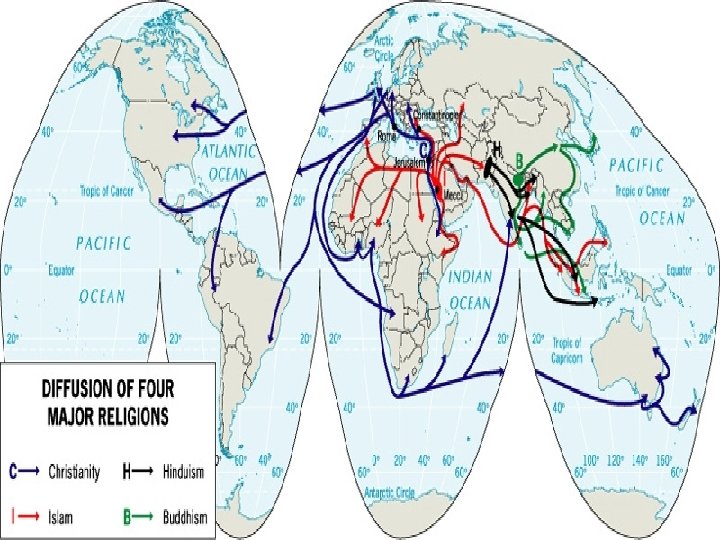
What are the world’s major religions and where did they diffuse to?
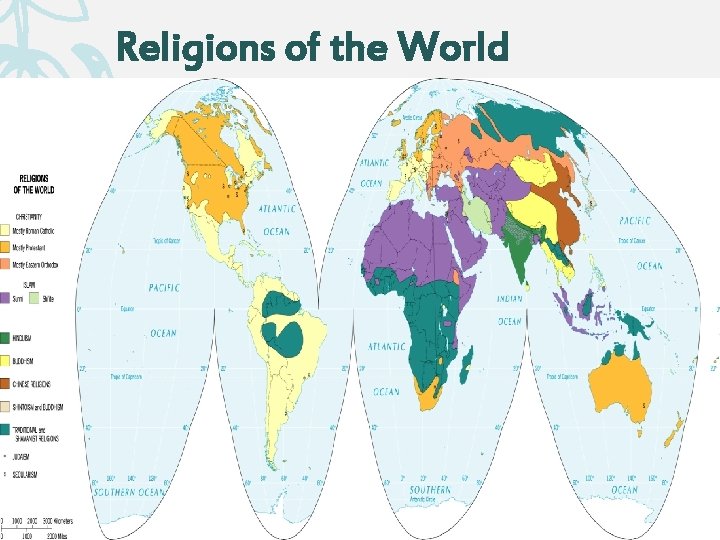
Religions of the World
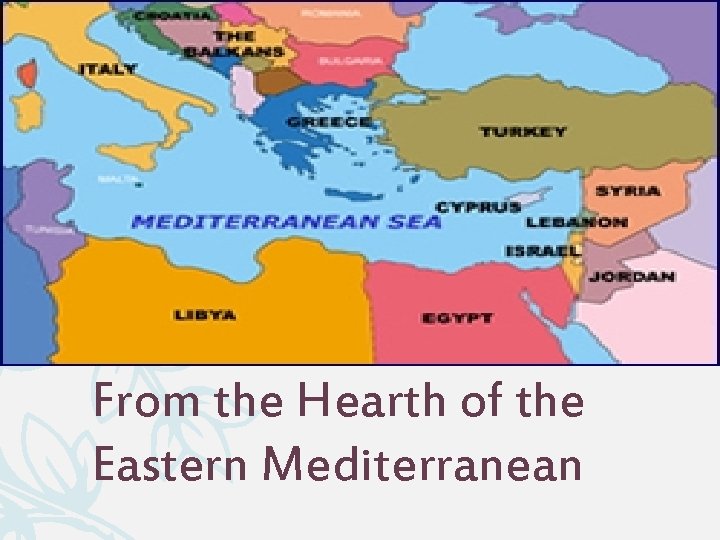
From the Hearth of the Eastern Mediterranean
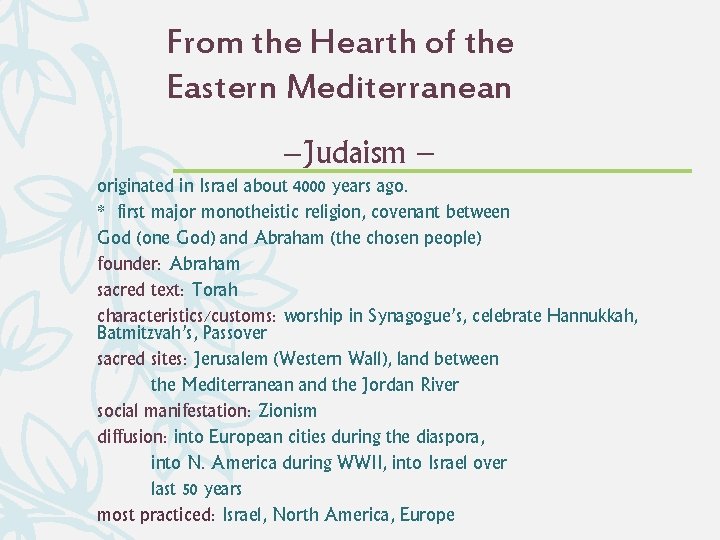
From the Hearth of the Eastern Mediterranean – Judaism – originated in Israel about 4000 years ago. * first major monotheistic religion, covenant between God (one God) and Abraham (the chosen people) founder: Abraham sacred text: Torah characteristics/customs: worship in Synagogue’s, celebrate Hannukkah, Batmitzvah’s, Passover sacred sites: Jerusalem (Western Wall), land between the Mediterranean and the Jordan River social manifestation: Zionism diffusion: into European cities during the diaspora, into N. America during WWII, into Israel over last 50 years most practiced: Israel, North America, Europe
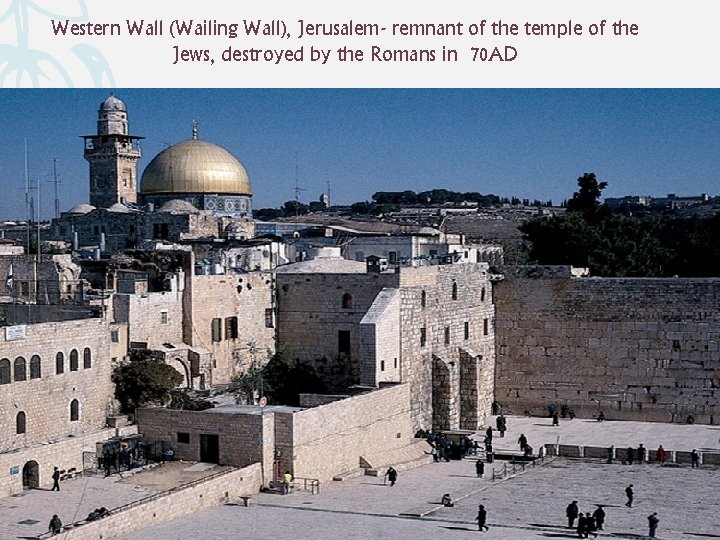
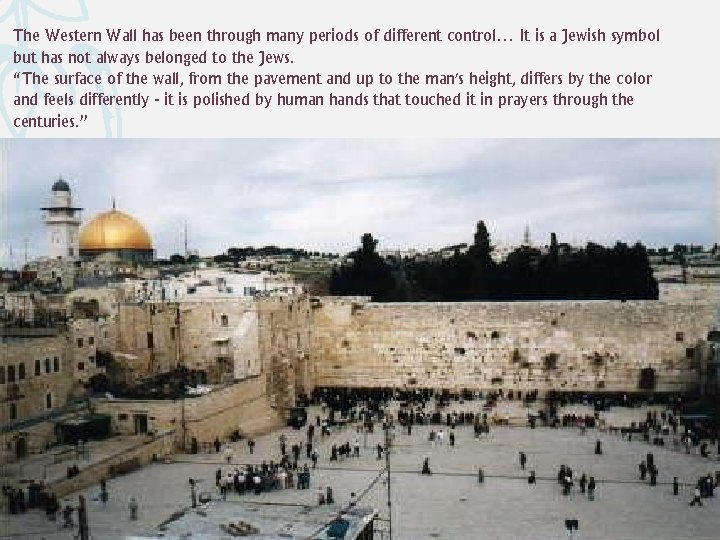
Western Wall (Wailing Wall), Jerusalem- remnant of the temple of the Jews, destroyed by the Romans in 70 AD
The Western Wall has been through many periods of different control… It is a Jewish symbol but has not always belonged to the Jews. “The surface of the wall, from the pavement and up to the man's height, differs by the color and feels differently - it is polished by human hands that touched it in prayers through the centuries. ”
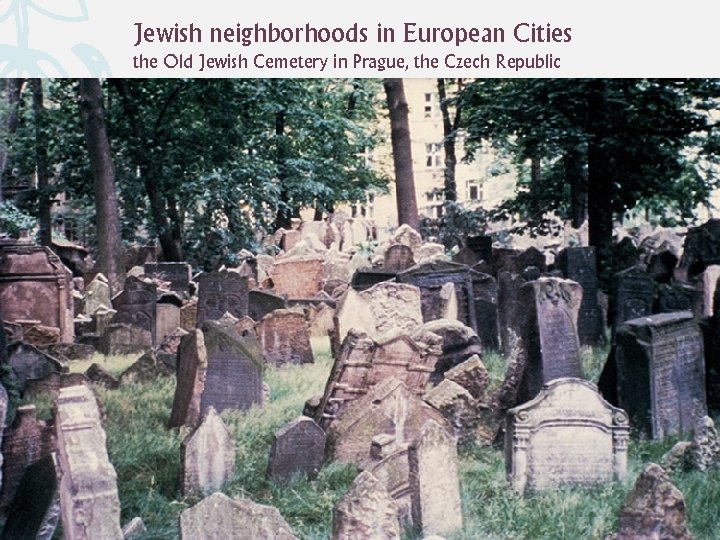
Jewish neighborhoods in European Cities the Old Jewish Cemetery in Prague, the Czech Republic
From the Hearth of the Eastern Mediterranean – Christianity – originated in Israel about 2000 years ago. * monotheistic religion, follow teachings of Jesus to achieve eternal life founder: Jesus (son of God) characteristics: worship in Churches, celebrate Easter, Christmas, Baptisms sacred text: Bible sacred sites: Bethlehem, Jerusalem split in the church: * split into Eastern Orthodox and Roman Catholic churches in 1054 * Protestant sect split off in 1517 diffusion: into Western Europe, and then world wide during colonialism and after. most practiced in North and South America, Europe, and parts of Asia.
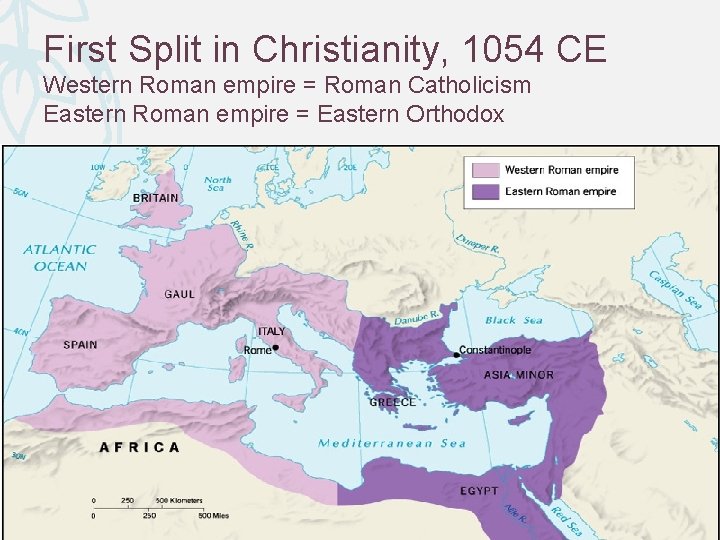
First Split in Christianity, 1054 CE Western Roman empire = Roman Catholicism Eastern Roman empire = Eastern Orthodox
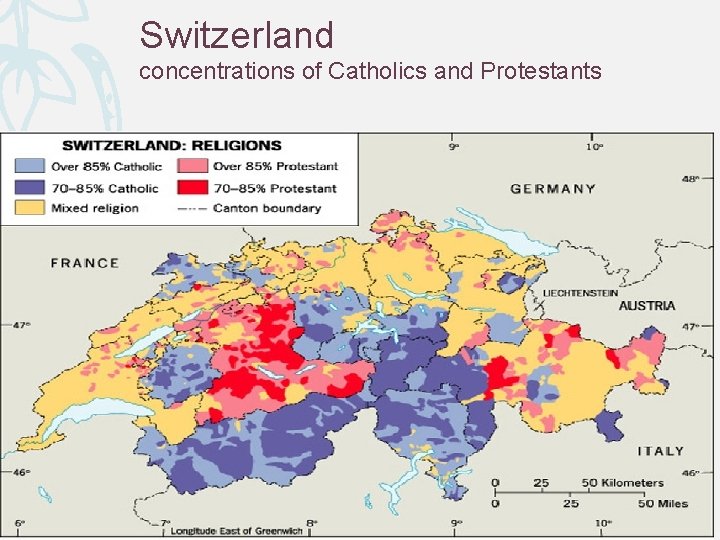
Switzerland concentrations of Catholics and Protestants
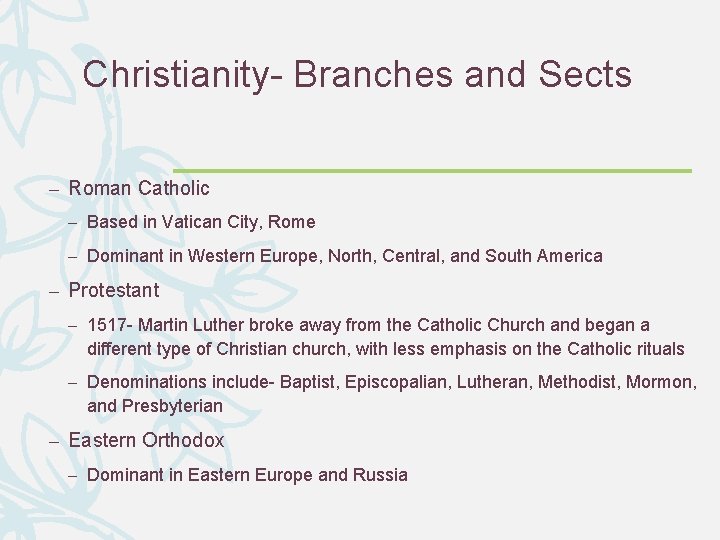
Christianity- Branches and Sects – Roman Catholic – Based in Vatican City, Rome – Dominant in Western Europe, North, Central, and South America – Protestant – 1517 - Martin Luther broke away from the Catholic Church and began a different type of Christian church, with less emphasis on the Catholic rituals – Denominations include- Baptist, Episcopalian, Lutheran, Methodist, Mormon, and Presbyterian – Eastern Orthodox – Dominant in Eastern Europe and Russia
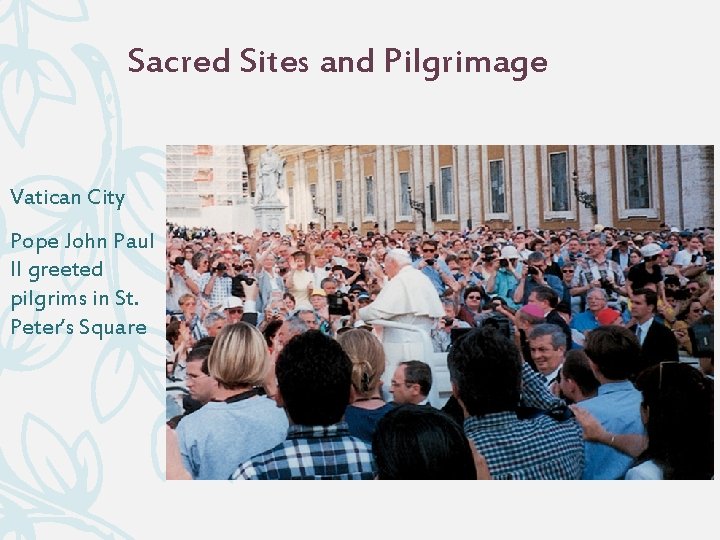
Sacred Sites and Pilgrimage Vatican City Pope John Paul II greeted pilgrims in St. Peter’s Square
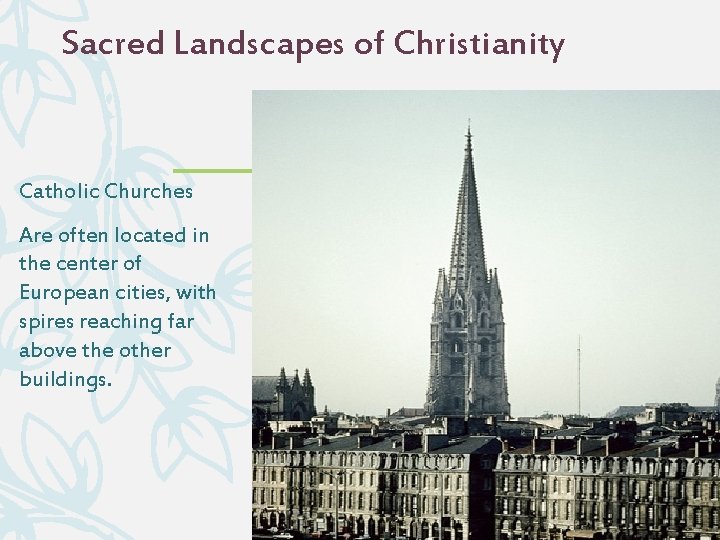
Sacred Landscapes of Christianity Catholic Churches Are often located in the center of European cities, with spires reaching far above the other buildings.
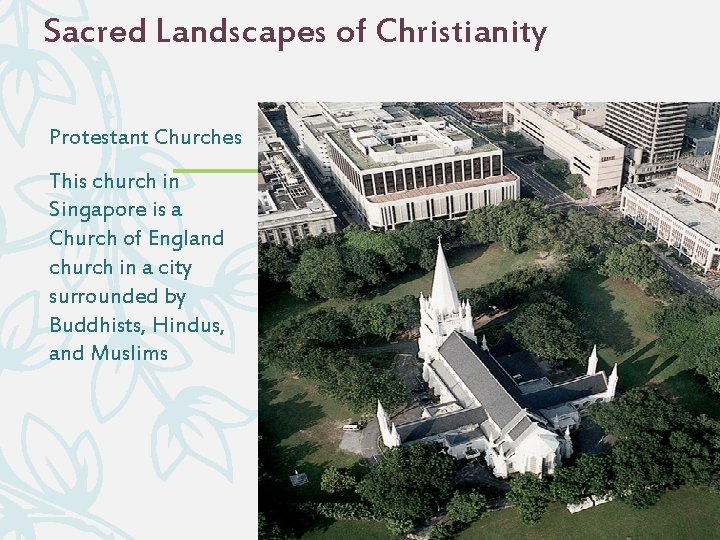
Sacred Landscapes of Christianity Protestant Churches This church in Singapore is a Church of England church in a city surrounded by Buddhists, Hindus, and Muslims
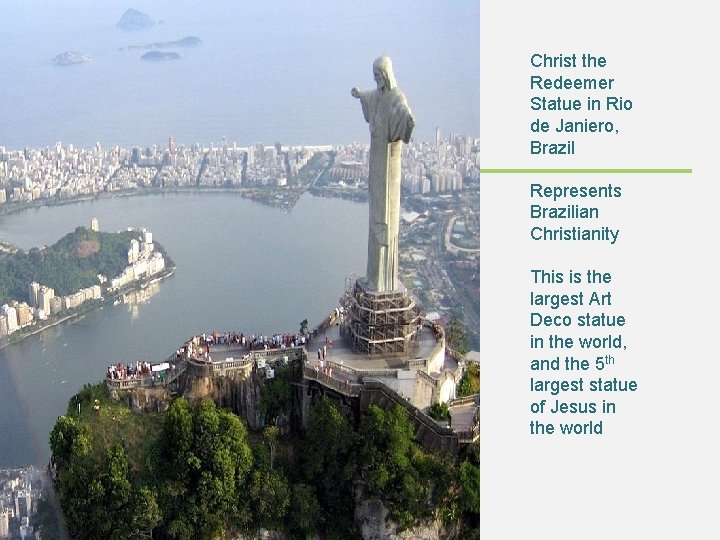
Christ the Redeemer Statue in Rio de Janiero, Brazil Represents Brazilian Christianity This is the largest Art Deco statue in the world, and the 5 th largest statue of Jesus in the world
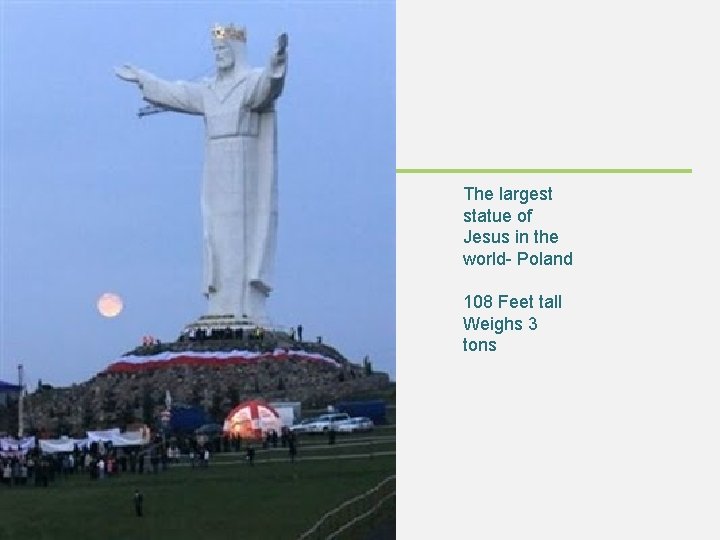
The largest statue of Jesus in the world- Poland 108 Feet tall Weighs 3 tons
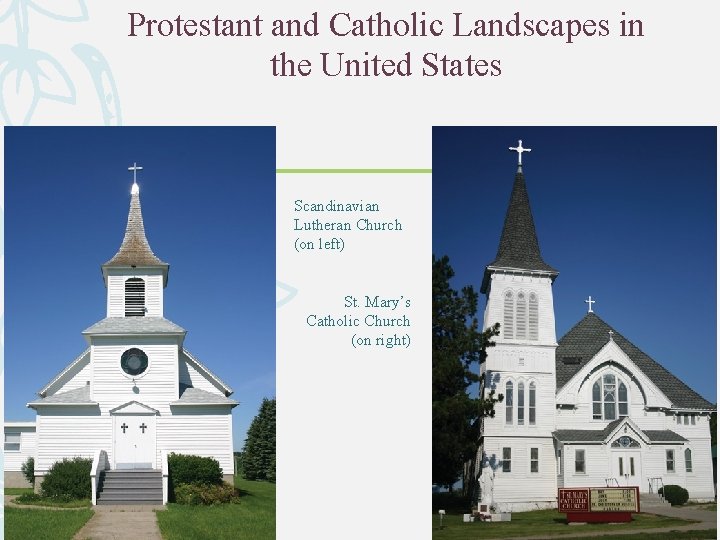
Protestant and Catholic Landscapes in the United States Scandinavian Lutheran Church (on left) St. Mary’s Catholic Church (on right)
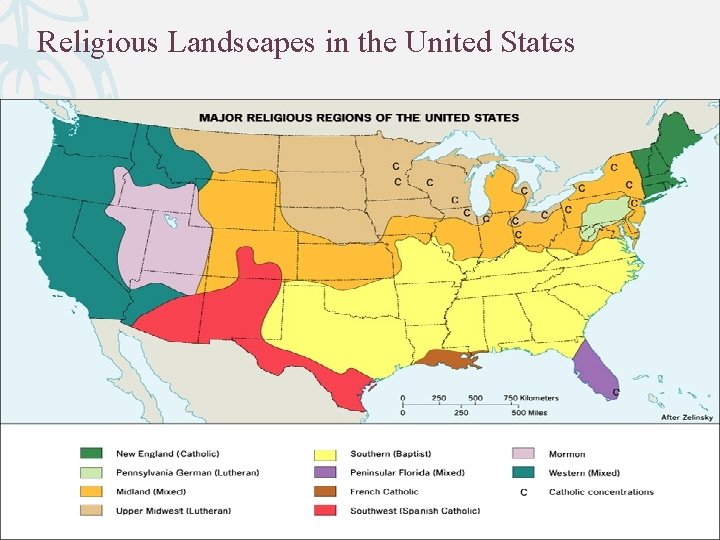
Religious Landscapes in the United States
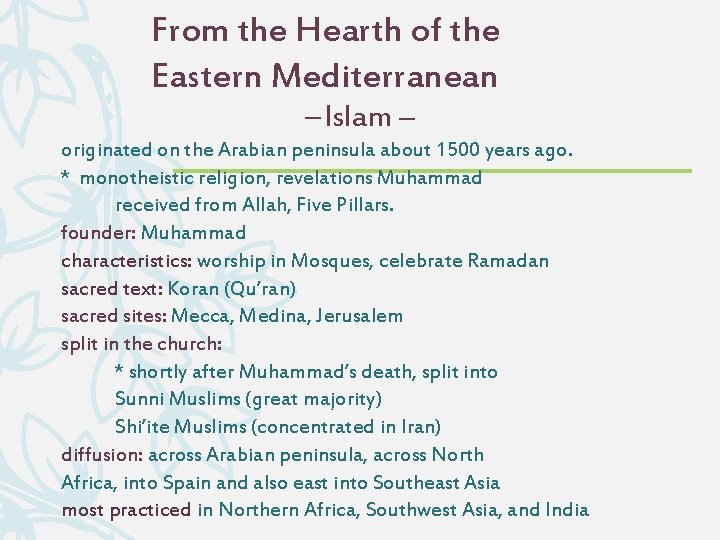
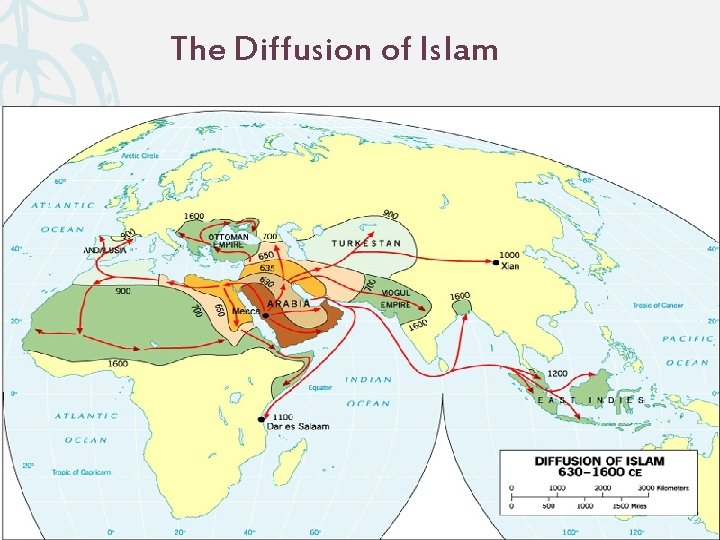
From the Hearth of the Eastern Mediterranean – Islam – originated on the Arabian peninsula about 1500 years ago. * monotheistic religion, revelations Muhammad received from Allah, Five Pillars. founder: Muhammad characteristics: worship in Mosques, celebrate Ramadan sacred text: Koran (Qu’ran) sacred sites: Mecca, Medina, Jerusalem split in the church: * shortly after Muhammad’s death, split into Sunni Muslims (great majority) Shi’ite Muslims (concentrated in Iran) diffusion: across Arabian peninsula, across North Africa, into Spain and also east into Southeast Asia most practiced in Northern Africa, Southwest Asia, and India
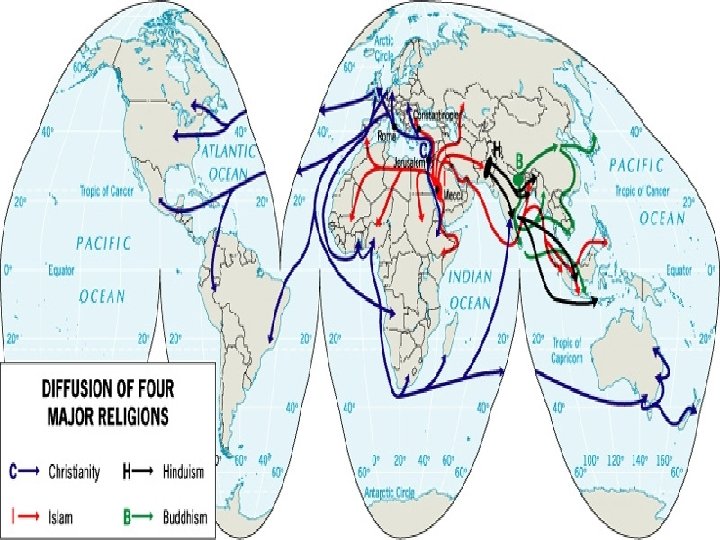
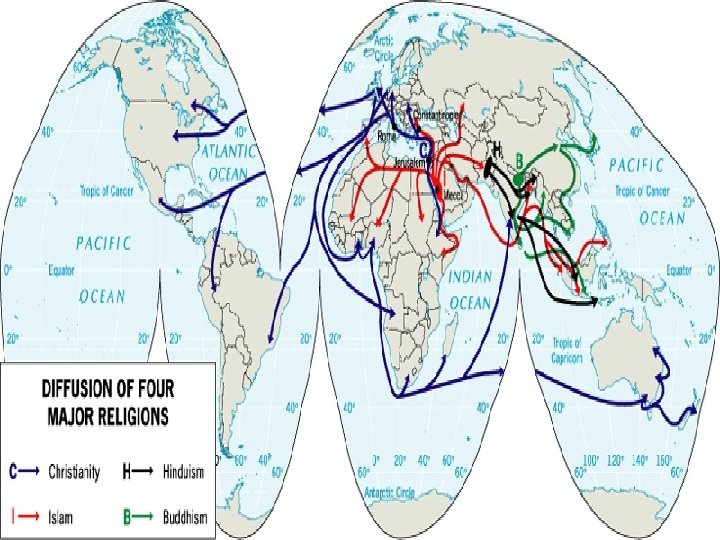
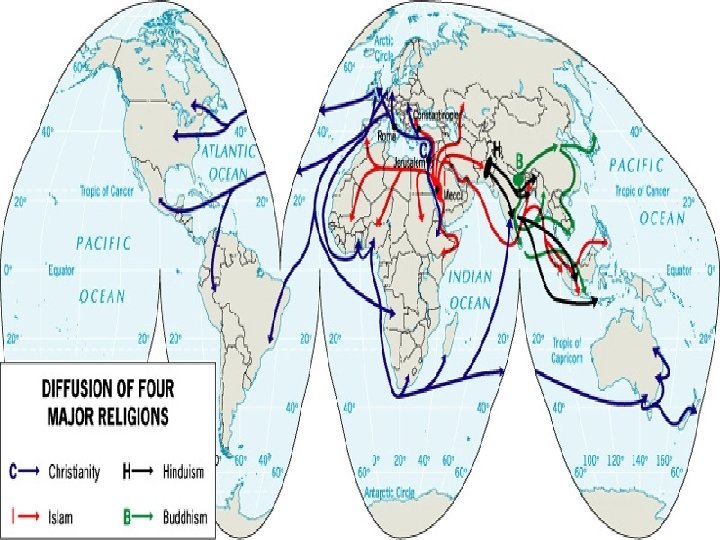
The Diffusion of Islam
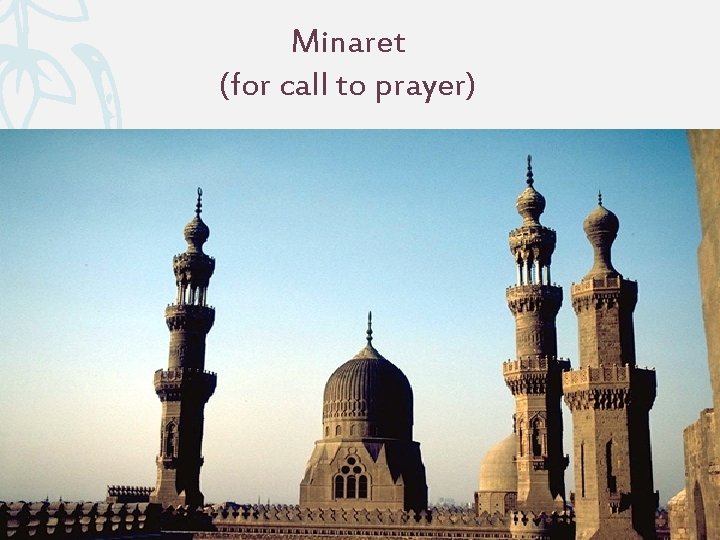
Minaret (for call to prayer)
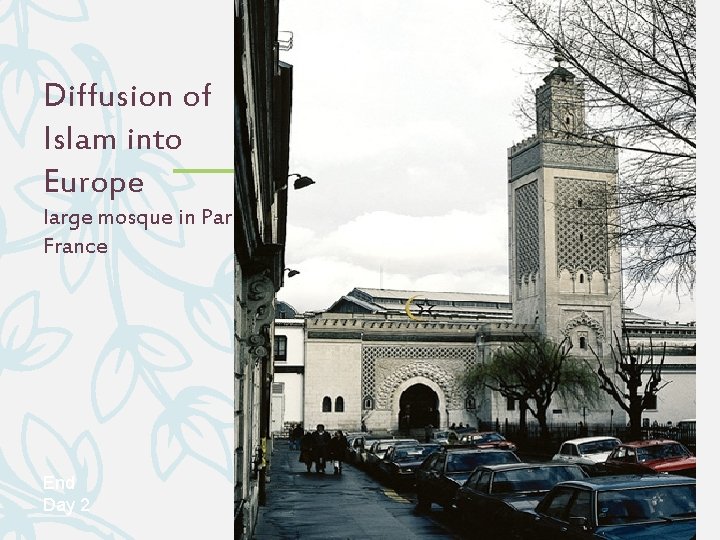
Diffusion of Islam into Europe large mosque in Paris, France End Day 2
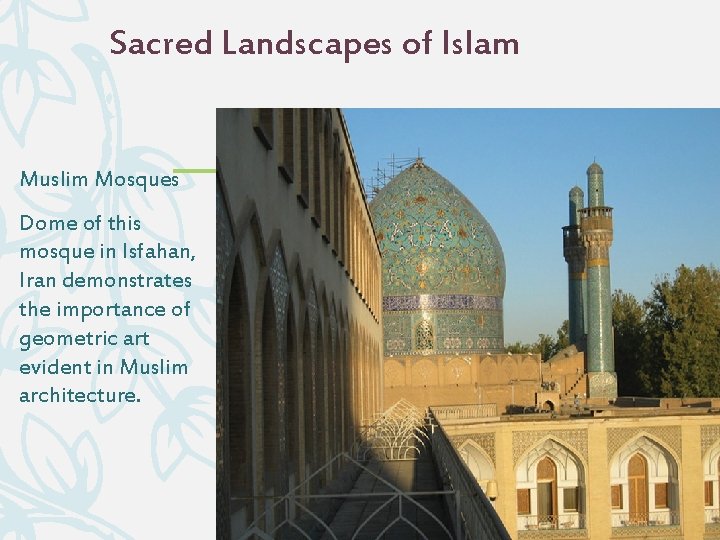
Sacred Landscapes of Islam Muslim Mosques Dome of this mosque in Isfahan, Iran demonstrates the importance of geometric art evident in Muslim architecture.
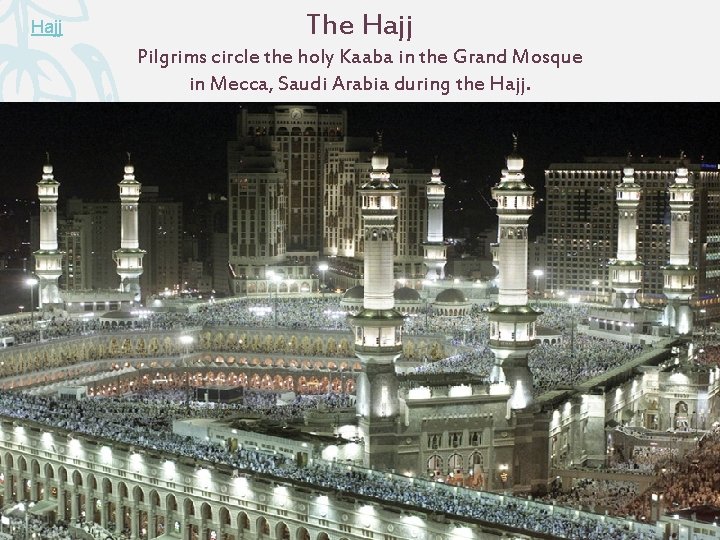
Hajj The Hajj Pilgrims circle the holy Kaaba in the Grand Mosque in Mecca, Saudi Arabia during the Hajj.
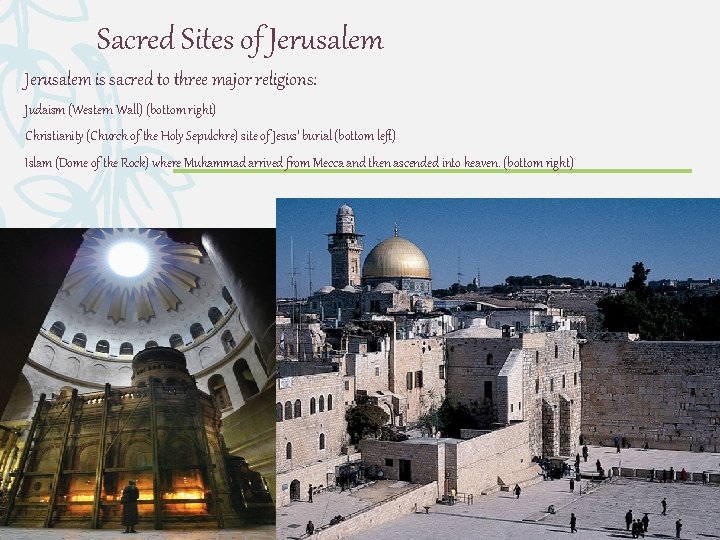
Sacred Sites of Jerusalem is sacred to three major religions: Judaism (Western Wall) (bottom right) Christianity (Church of the Holy Sepulchre) site of Jesus’ burial (bottom left) Islam (Dome of the Rock) where Muhammad arrived from Mecca and then ascended into heaven. (bottom right)
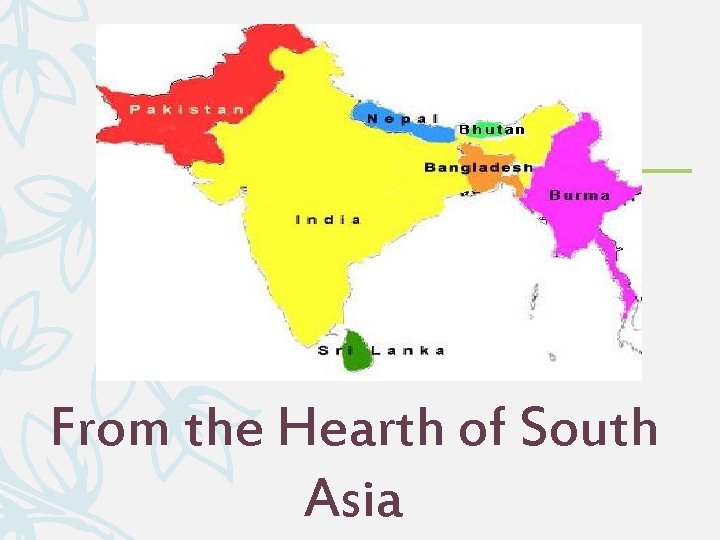
From the Hearth of South Asia
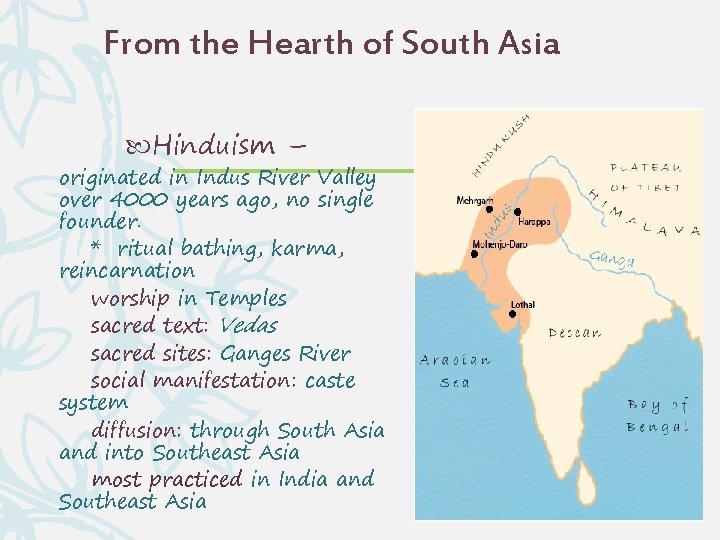
From the Hearth of South Asia Hinduism – originated in Indus River Valley over 4000 years ago, no single founder. * ritual bathing, karma, reincarnation worship in Temples sacred text: Vedas sacred sites: Ganges River social manifestation: caste system diffusion: through South Asia and into Southeast Asia most practiced in India and Southeast Asia
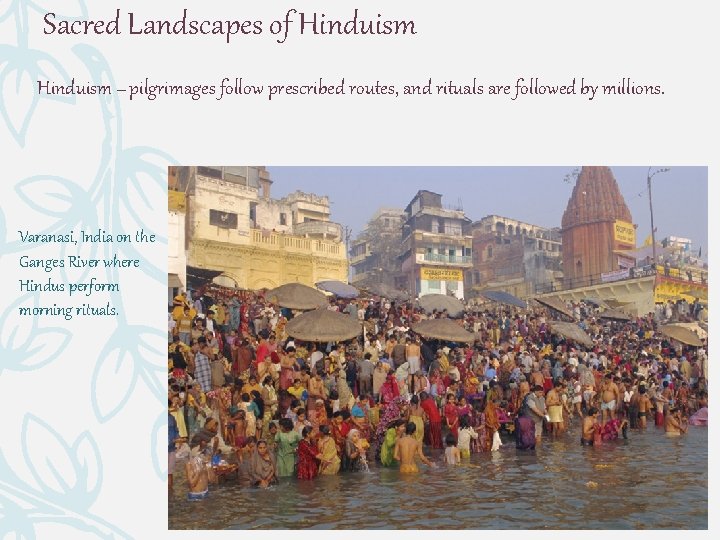
Sacred Landscapes of Hinduism – pilgrimages follow prescribed routes, and rituals are followed by millions. Varanasi, India on the Ganges River where Hindus perform morning rituals.
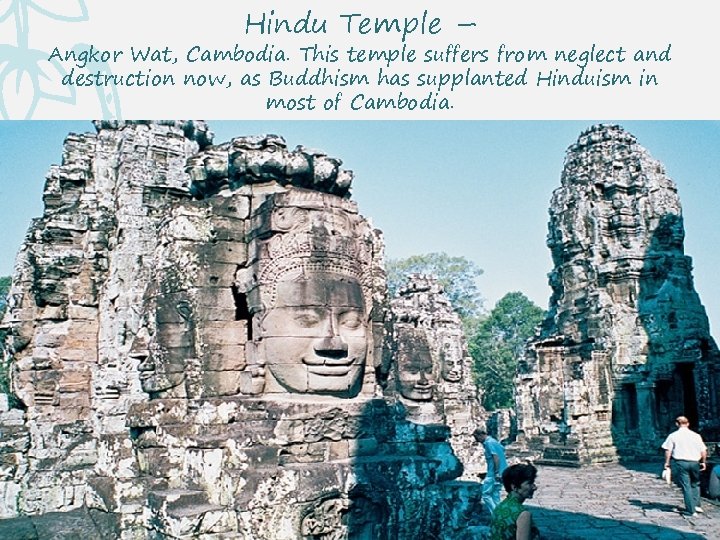
Hindu Temple – Angkor Wat, Cambodia. This temple suffers from neglect and destruction now, as Buddhism has supplanted Hinduism in most of Cambodia.
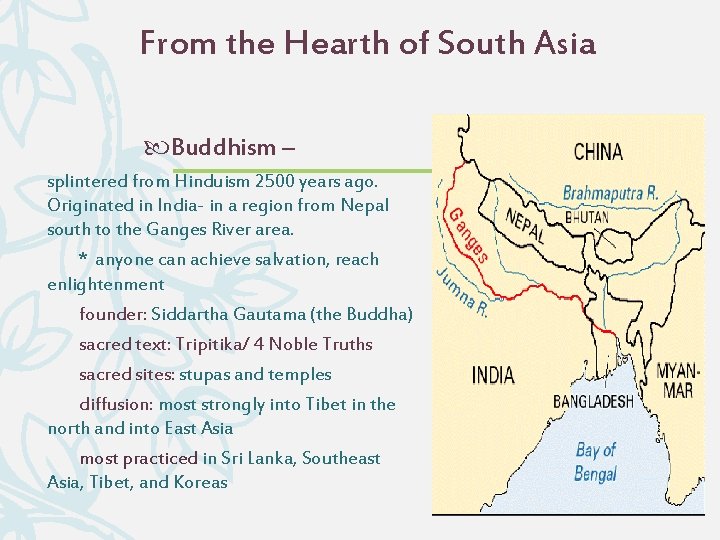
From the Hearth of South Asia Buddhism – splintered from Hinduism 2500 years ago. Originated in India- in a region from Nepal south to the Ganges River area. * anyone can achieve salvation, reach enlightenment founder: Siddartha Gautama (the Buddha) sacred text: Tripitika/ 4 Noble Truths sacred sites: stupas and temples diffusion: most strongly into Tibet in the north and into East Asia most practiced in Sri Lanka, Southeast Asia, Tibet, and Koreas
Siddhartha Gautama – Was the son of a warrior king, and thoroughly enjoyed his life in the upper caste. – However, he became bored as a young adult, and started to search the world for an understanding of life. – During his travels, he encountered an old man, an ill man, and a dying man. He quickly came to the conclusion that suffering lay at the end of all existence. – He then denounced his princely status and became a monk. He gave up all worldly possessions and continued his search for truth and understanding.
The “Enlightened One” – Siddhartha found this truth and understanding while meditating under a tree one day, and claimed to have an epiphany. – He believed to have finally understood how to be free from suffering , and ultimately, reach salvation. – After this epiphany, Siddhartha was known as the Buddha, meaning the “Enlightened One” – The Buddha spent the rest of his life traveling around India teaching people about what he had come to understand.
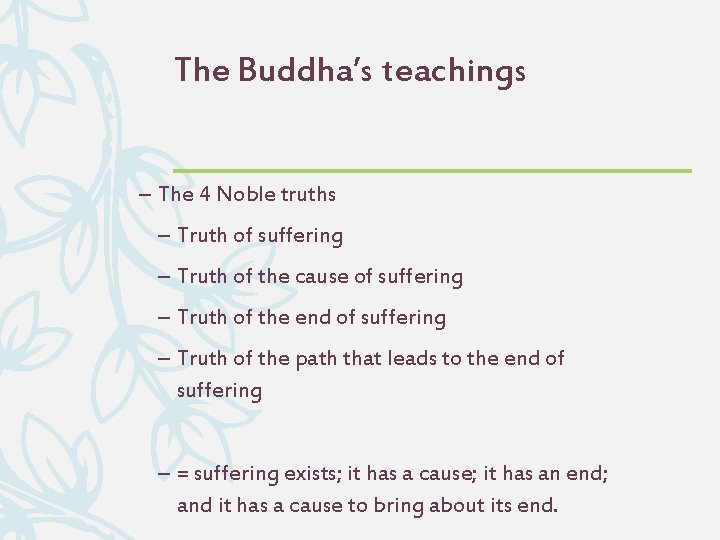
The Buddha’s teachings – The 4 Noble truths – Truth of suffering – Truth of the cause of suffering – Truth of the end of suffering – Truth of the path that leads to the end of suffering – = suffering exists; it has a cause; it has an end; and it has a cause to bring about its end.
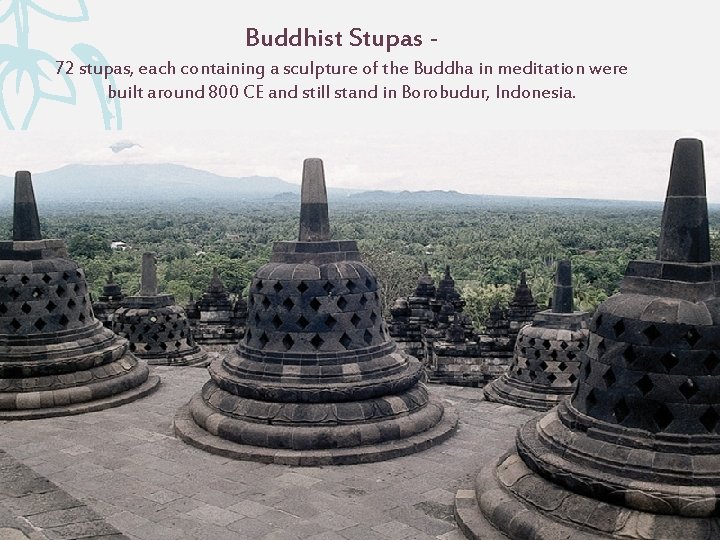
Buddhist Stupas 72 stupas, each containing a sculpture of the Buddha in meditation were built around 800 CE and still stand in Borobudur, Indonesia.
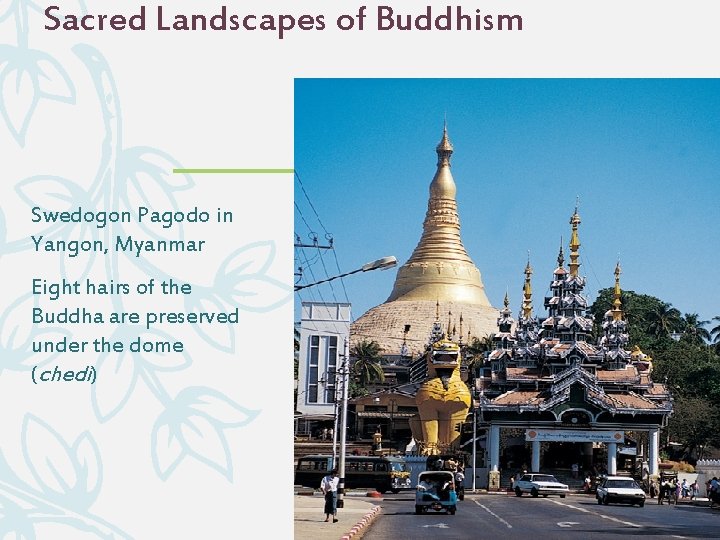
Sacred Landscapes of Buddhism Swedogon Pagodo in Yangon, Myanmar Eight hairs of the Buddha are preserved under the dome (chedi)
Not on the Map
Rise of Secularism – indifference to or rejection of organized religious affiliations and ideas. Agnostic- may believe in a higher power but not in religious affiliation Athiest- disbelief in gods, will not affirm that gods may exist Secular- in different to all religious affiliation * worldwide, especially in the United States and Europe
Secularism – 2002 - Is religion very important to you? – 30% of Canadians, 59% of Americans said yes – French government banned all religious symbols in public schools – Church membership dropped drastically in the Soviet Union under Communist rule – In the strongly Catholic regions of Southern Europe and Latin America, many people are dissatisfied with the papal teachings on birth control – The actual amount of people attending church has drastically declined – Participation in church activities by members has declined – Secularism is on the rise in the United States
What Role does Religion play in Political Conflicts?
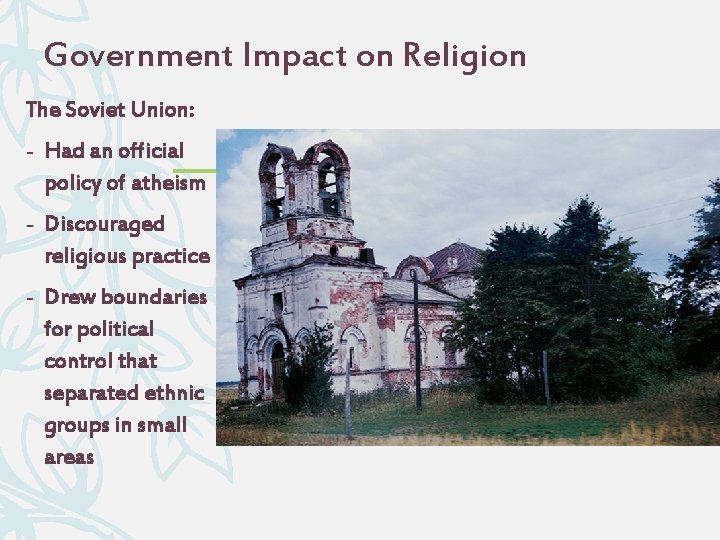
Government Impact on Religion The Soviet Union: - Had an official policy of atheism - Discouraged religious practice - Drew boundaries for political control that separated ethnic groups in small areas
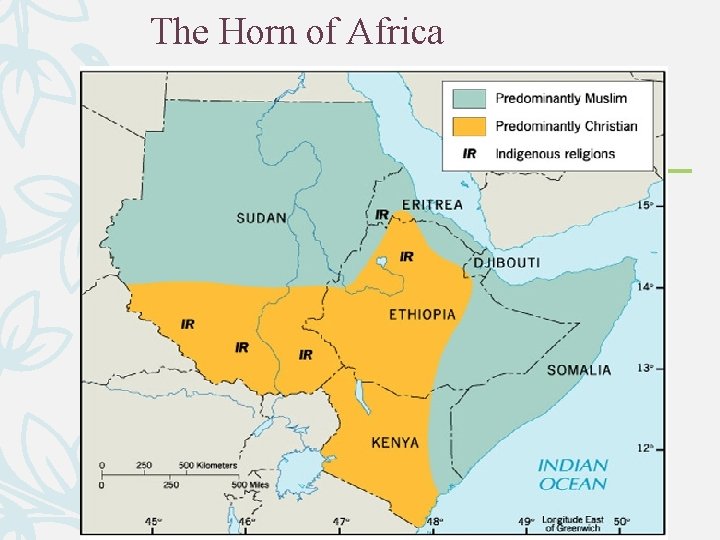
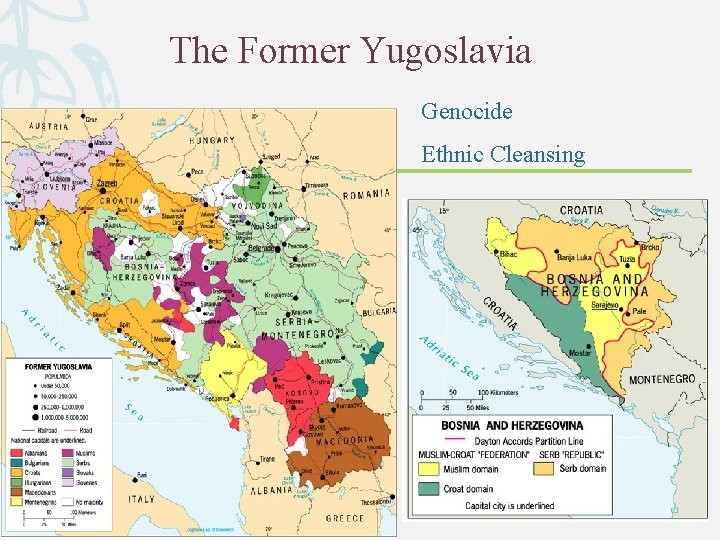
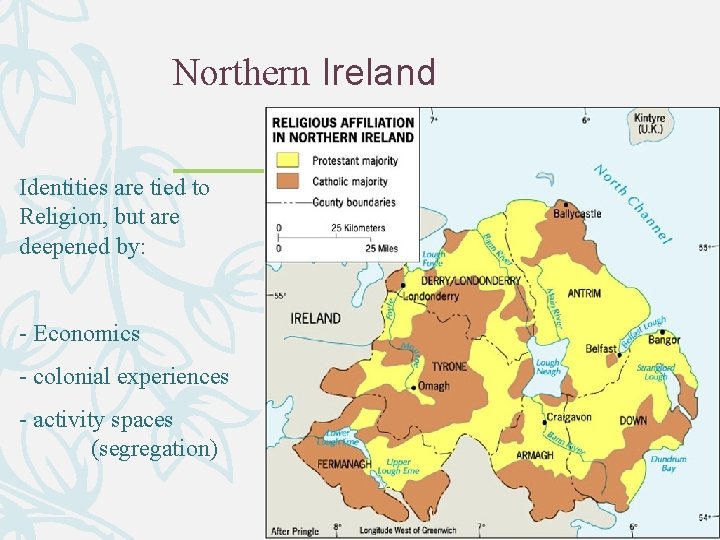
Conflicts along Religious Borders – Interfaith Boundaries – Boundaries between the world’s major faiths. – Example: Christian-Muslim, Israel-Palestine, Horn of Africa, former Yugoslavia – Intrafaith Boundaries – Boundaries within a single major faith. – Example: Sunni-Shi’ite Muslims , Northern Ireland
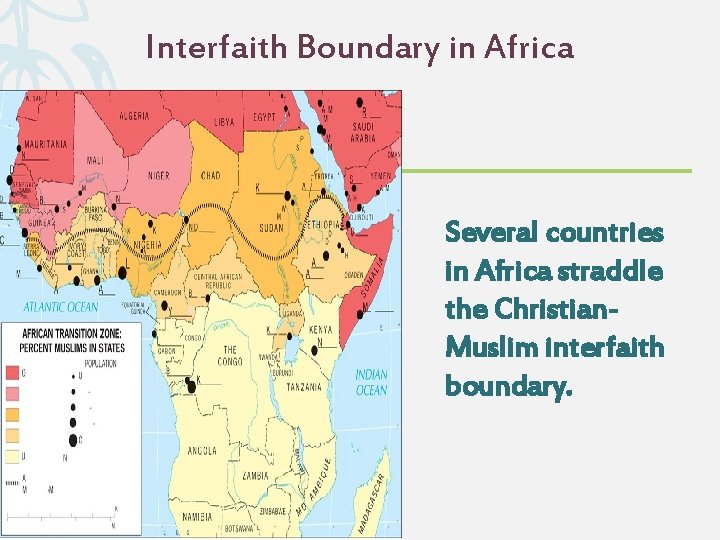
Interfaith Boundary in Africa Several countries in Africa straddle the Christian. Muslim interfaith boundary.
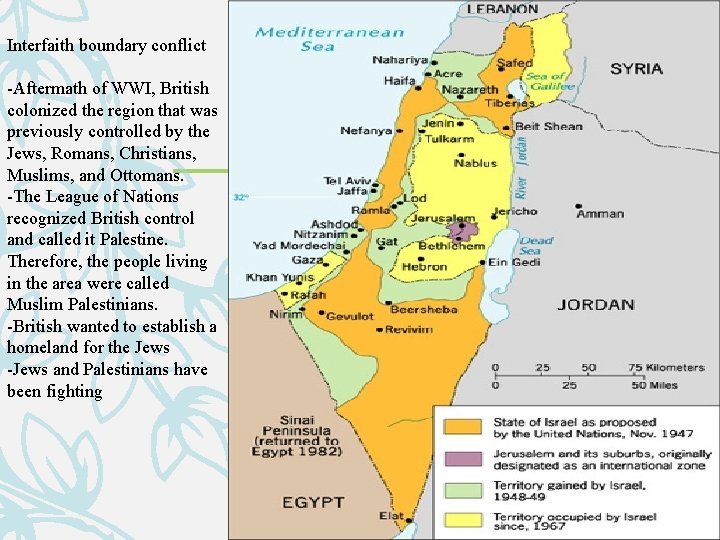
Interfaith boundary conflict -Aftermath of WWI, British colonized the region that was previously controlled by the Jews, Romans, Christians, Muslims, and Ottomans. -The League of Nations recognized British control and called it Palestine. Therefore, the people living in the area were called Muslim Palestinians. -British wanted to establish a homeland for the Jews -Jews and Palestinians have been fighting
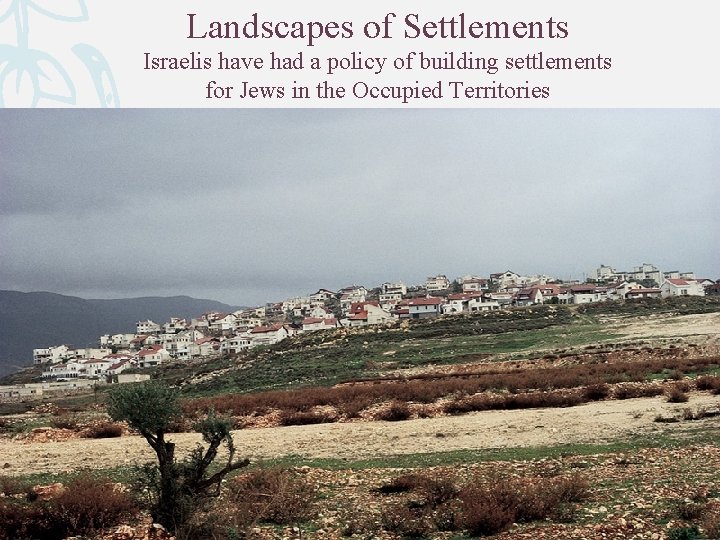
Landscapes of Settlements Israelis have had a policy of building settlements for Jews in the Occupied Territories
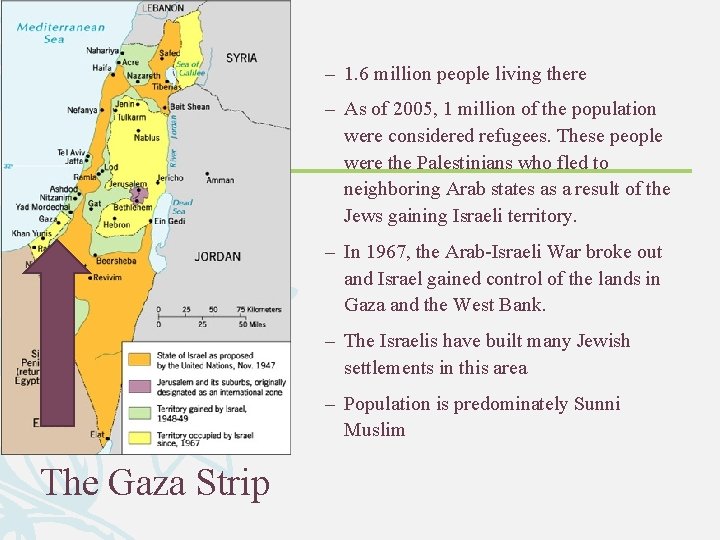
– 1. 6 million people living there – As of 2005, 1 million of the population were considered refugees. These people were the Palestinians who fled to neighboring Arab states as a result of the Jews gaining Israeli territory. – In 1967, the Arab-Israeli War broke out and Israel gained control of the lands in Gaza and the West Bank. – The Israelis have built many Jewish settlements in this area – Population is predominately Sunni Muslim The Gaza Strip
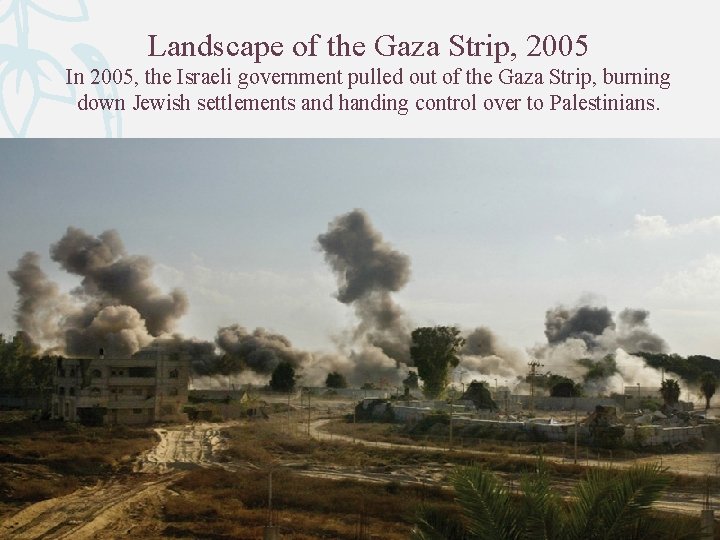
Landscape of the Gaza Strip, 2005 In 2005, the Israeli government pulled out of the Gaza Strip, burning down Jewish settlements and handing control over to Palestinians.
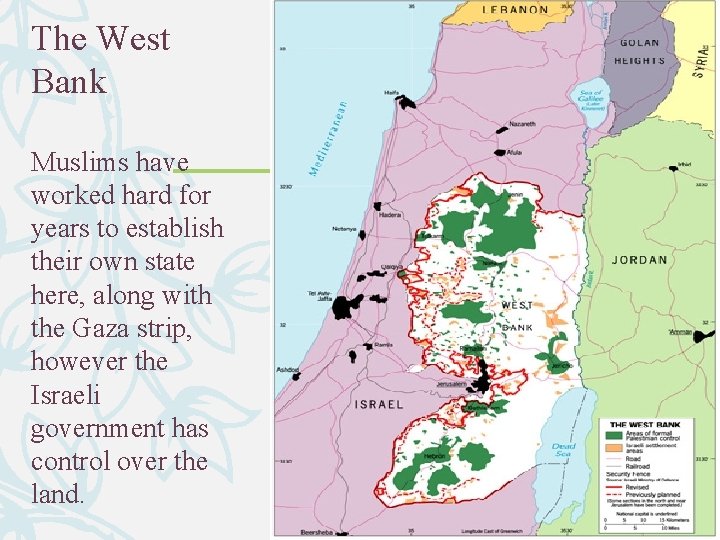
The West Bank Muslims have worked hard for years to establish their own state here, along with the Gaza strip, however the Israeli government has control over the land.
The Horn of Africa
The Former Yugoslavia Genocide Ethnic Cleansing
Northern Ireland Identities are tied to Religion, but are deepened by: - Economics - colonial experiences - activity spaces (segregation)
Religious Fundamentalism and Extremism – Religious fundamentalism – a return to the basics of their faith. found in Christianity, Judaism, and Islam, and many other religions. – Religious extremism – fundamentalism carried to the point of violence. found in Christianity, Judaism, and Islam, and many other religions.
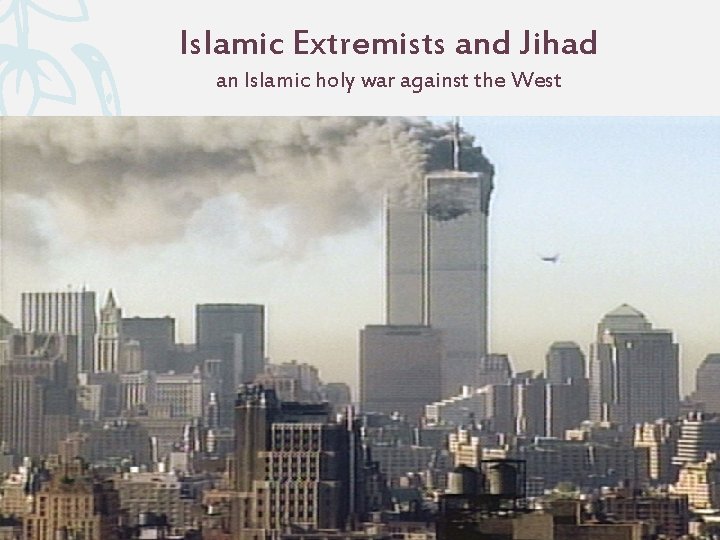
Islamic Extremists and Jihad an Islamic holy war against the West
Christian Fundamentalism & Extremism – More a movement back to fundamentalism – Bombing of abortion clinics – Intolerance of homosexuality – Protestant Church – Arguing for prayer in public schools – Teaching “creationism” in science class – Roman Catholic Church – Disputes over birth control, family planning, abortion, and role of women in the religious bureaucracy – Holding mass in Latin