
Reliablereliability computing for concrete structures Methodology and software

Reliable/reliability computing for concrete structures: Methodology and software tools D. Novak Brno University of Technology Brno, Czech Republic R. Pukl Cervenka Consulting, Prague, Czech Republic + many co-workers!
Outline • A complex and systematic methodoloy for concrete structures assessment – Experiment – Deterministic computational model development to capture experiment – Inverse analysis – Deterministic nonlinear computational model of a structure – Stochastic model of a structure – Statistical, sensitivity and reliability analyses • Methods and software – Uncertainties simulation – Nonlinear behaviour of concrete • Application 2/25 2/18
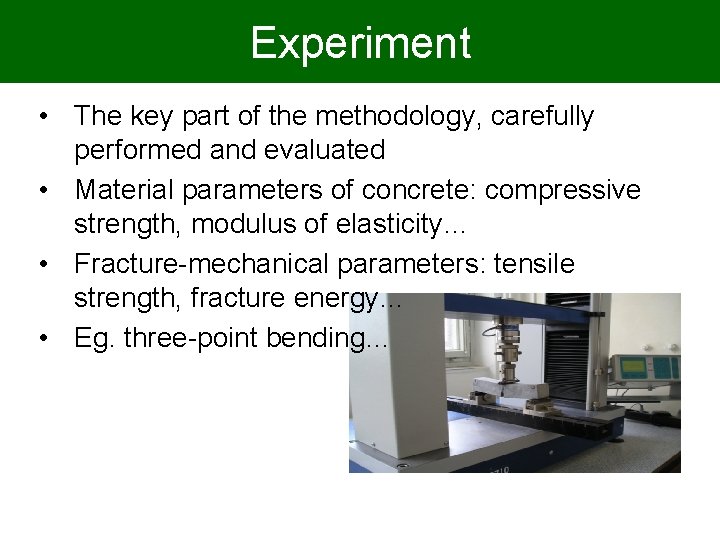
Experiment • The key part of the methodology, carefully performed and evaluated • Material parameters of concrete: compressive strength, modulus of elasticity… • Fracture-mechanical parameters: tensile strength, fracture energy… • Eg. three-point bending… 3/25 2/18
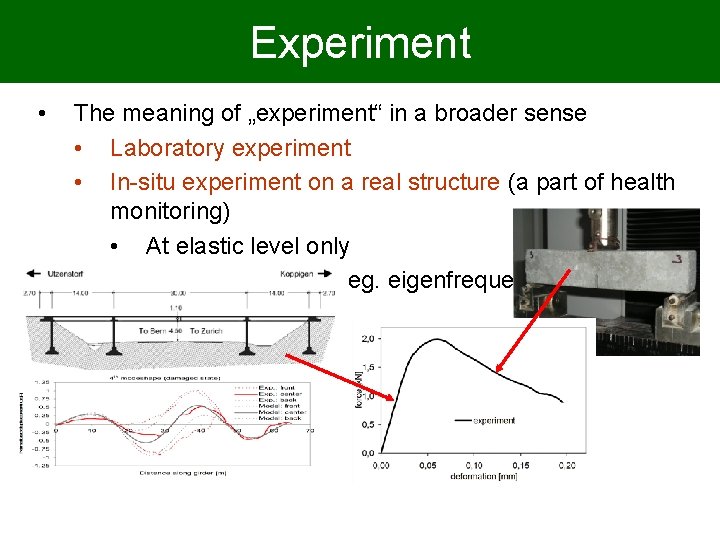
Experiment • The meaning of „experiment“ in a broader sense • Laboratory experiment • In-situ experiment on a real structure (a part of health monitoring) • At elastic level only • Other parameters, eg. eigenfrequencies… 4/25 2/18
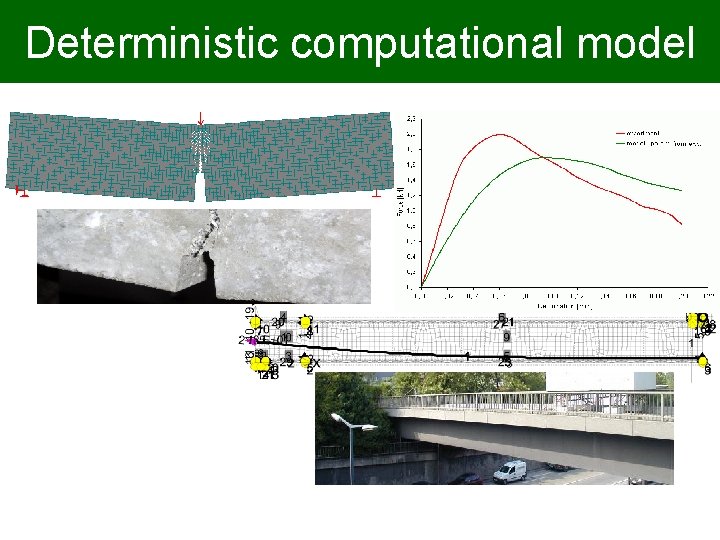
Deterministic computational model 5/25 2/18
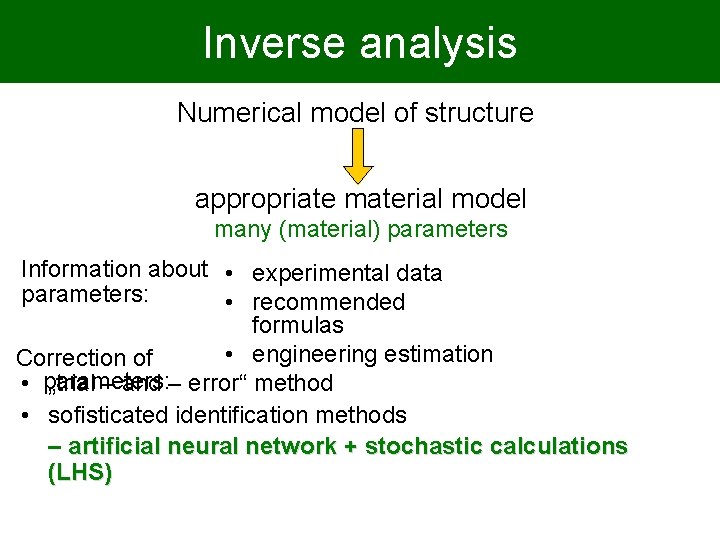
Inverse analysis Numerical model of structure appropriate material model many (material) parameters Information about • experimental data parameters: • recommended formulas • engineering estimation Correction of • parameters: „trial – and – error“ method • sofisticated identification methods – artificial neural network + stochastic calculations (LHS) 6/25 2/18

Artificial neural network Modeling of processes in brain (1943 - Mc. Culloch-Pitts Perceptron) Various fields of technical practice Neural network type – Multi-layer perceptron: - set of neurons arranged in several layers - all neurons in one layer are connected with all neurons of the following layer Output from 1 neuron: 7/25 2/18
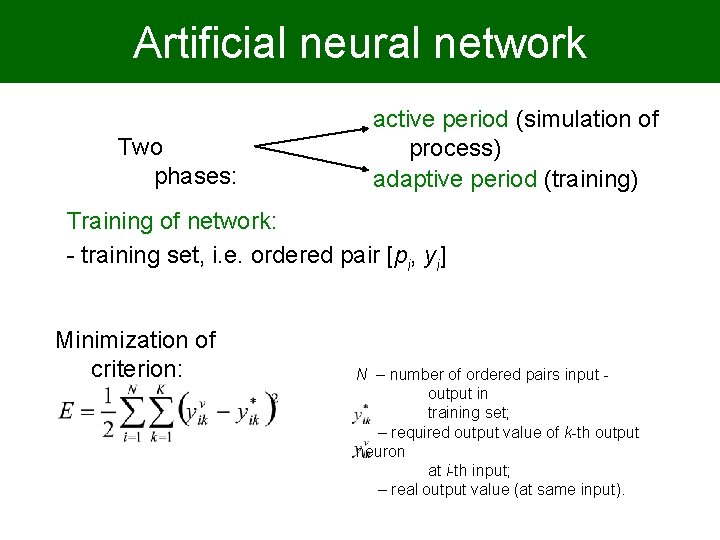
Artificial neural network Two phases: active period (simulation of process) adaptive period (training) Training of network: - training set, i. e. ordered pair [pi, yi] Minimization of criterion: N – number of ordered pairs input output in training set; – required output value of k-th output neuron at i-th input; – real output value (at same input). 8/25 2/18
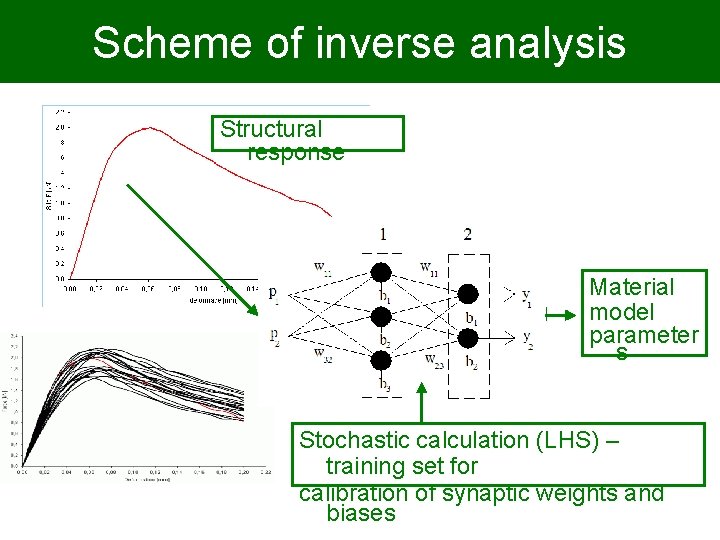
Scheme of inverse analysis Structural response Material model parameter s Stochastic calculation (LHS) – training set for calibration of synaptic weights and biases 9/25 2/18
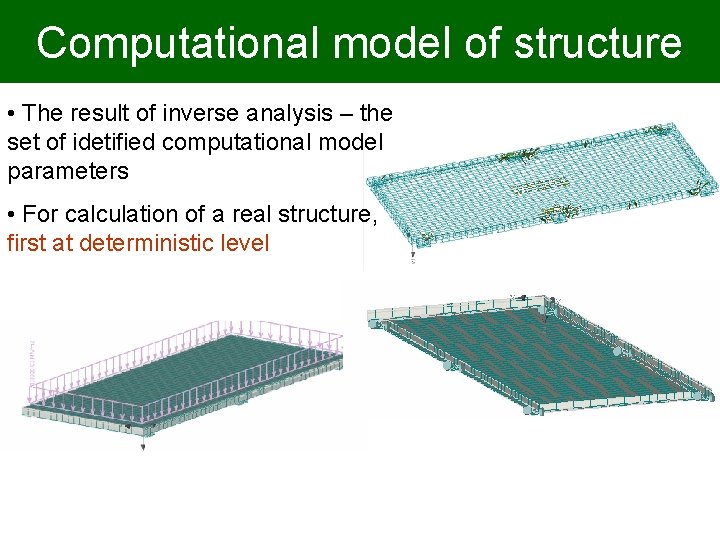
Computational model of structure • The result of inverse analysis – the set of idetified computational model parameters • For calculation of a real structure, first at deterministic level 10/25 2/18
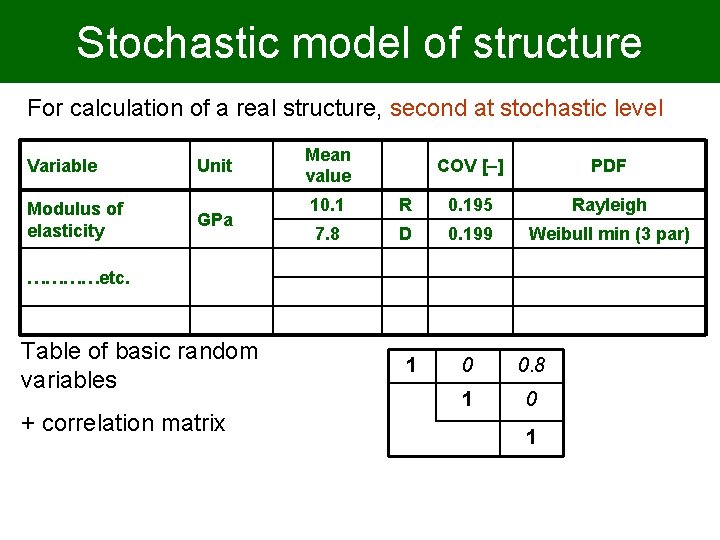
Stochastic model of structure For calculation of a real structure, second at stochastic level Variable Modulus of elasticity Unit GPa Mean value COV [–] PDF 10. 1 R 0. 195 Rayleigh 7. 8 D 0. 199 Weibull min (3 par) …………etc. Table of basic random variables + correlation matrix 1 0 0. 8 1 0 1 11/25 2/18
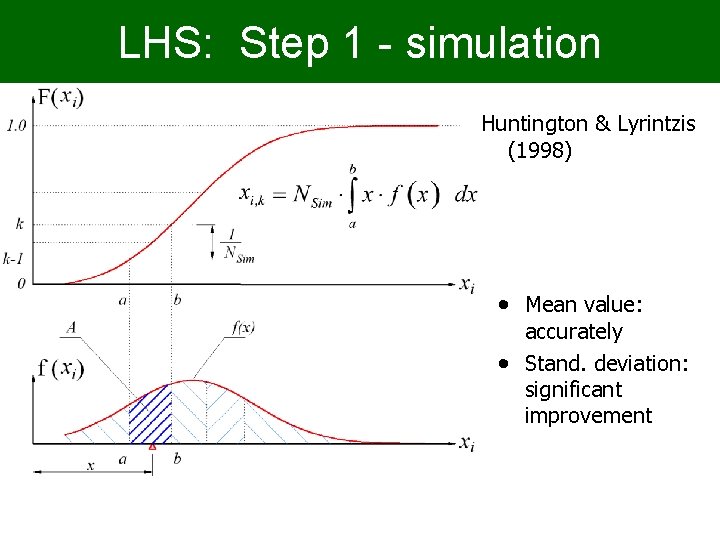
LHS: Step 1 - simulation Huntington & Lyrintzis (1998) • Mean value: accurately • Stand. deviation: significant improvement 14/25 2/18
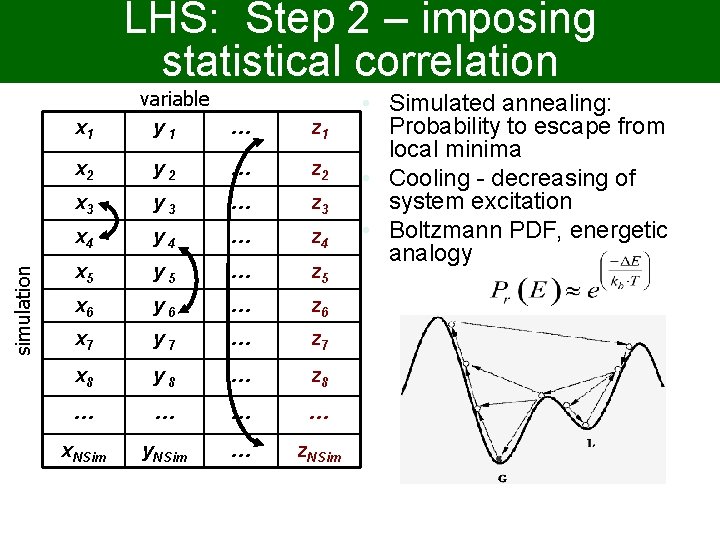
LHS: Step 2 – imposing statistical correlation simulation x 1 variable y 1 … z 1 x 2 y 2 … z 2 x 3 y 3 … z 3 x 4 y 4 … z 4 x 5 y 5 … z 5 x 6 y 6 … z 6 x 7 y 7 … z 7 x 8 y 8 … z 8 … … x. NSim y. NSim … z. NSim • Simulated annealing: Probability to escape from local minima • Cooling - decreasing of system excitation • Boltzmann PDF, energetic analogy 15/25 2/18
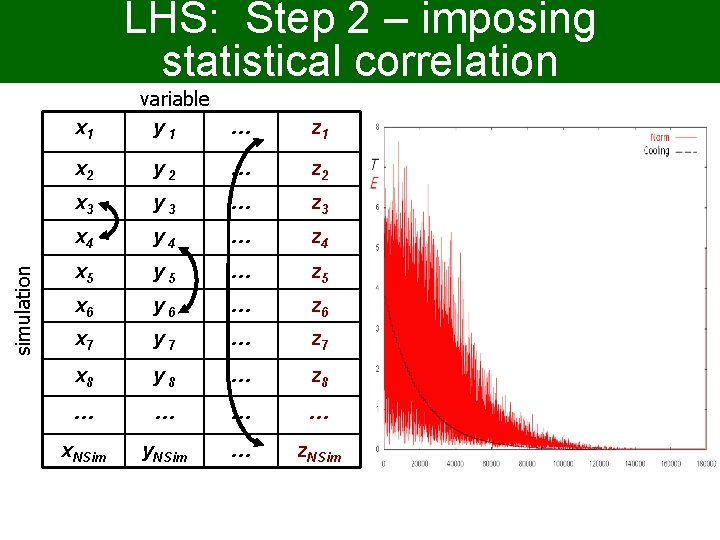
LHS: Step 2 – imposing statistical correlation simulation x 1 variable y 1 … z 1 x 2 y 2 … z 2 x 3 y 3 … z 3 x 4 y 4 … z 4 x 5 y 5 … z 5 x 6 y 6 … z 6 x 7 y 7 … z 7 x 8 y 8 … z 8 … … x. NSim y. NSim … z. NSim 16/25 2/18
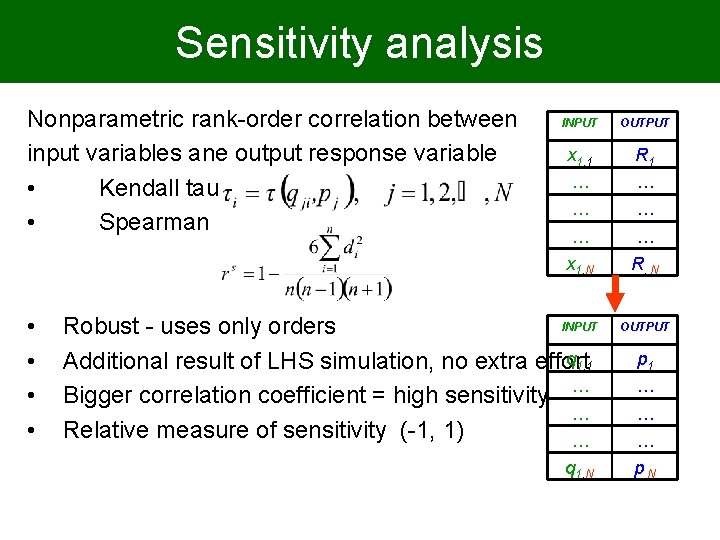
Sensitivity analysis Nonparametric rank-order correlation between input variables ane output response variable • Kendall tau • Spearman • • INPUT OUTPUT x 1, 1 R 1 … … … x 1, N R, N INPUT Robust - uses only orders q 1, 1 Additional result of LHS simulation, no extra effort Bigger correlation coefficient = high sensitivity … … Relative measure of sensitivity (-1, 1) … q 1, N OUTPUT p 1 … … … p. N 17/25 2/18
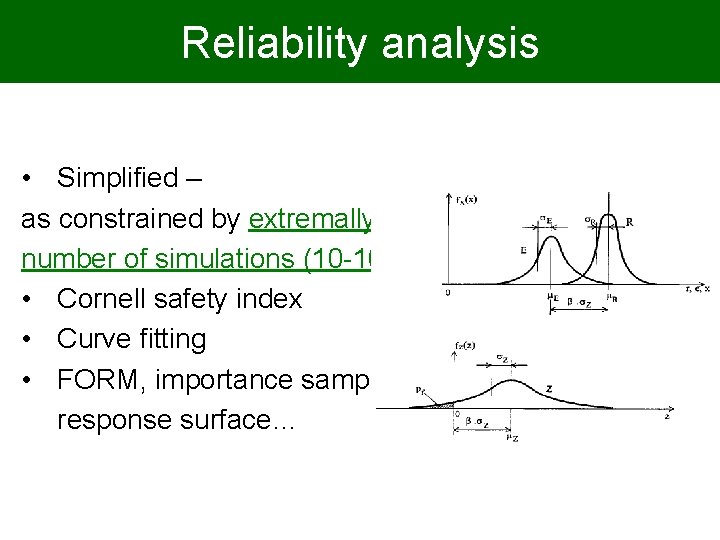
Reliability analysis • Simplified – as constrained by extremally small number of simulations (10 -100)! • Cornell safety index • Curve fitting • FORM, importance sampling response surface… 18/25 2/18

ATENA • Well-balanced approach for practical applications of advanced FEM in civil engineering • Numerical core – state-of-art background • User friendly Graphical user environment visualization + interaction 22/25 2/18

Material models for concrete: ATENA software Numerical core – advanced nonlinear material models concrete • damage based models • SBETA model • fracture-plastic model • microplane M 4 (Bažant) steel • multi-linear uniaxial law • von Mises 19/25 2/18
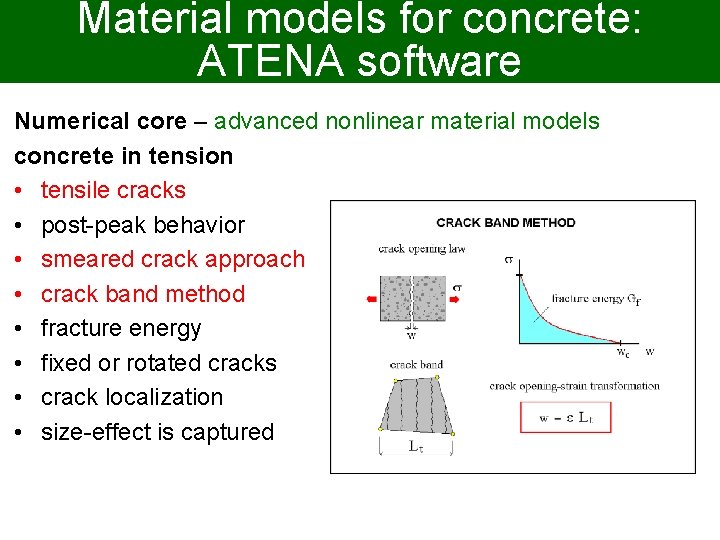
Material models for concrete: ATENA software Numerical core – advanced nonlinear material models concrete in tension • tensile cracks • post-peak behavior • smeared crack approach • crack band method • fracture energy • fixed or rotated cracks • crack localization • size-effect is captured 20/25 2/18
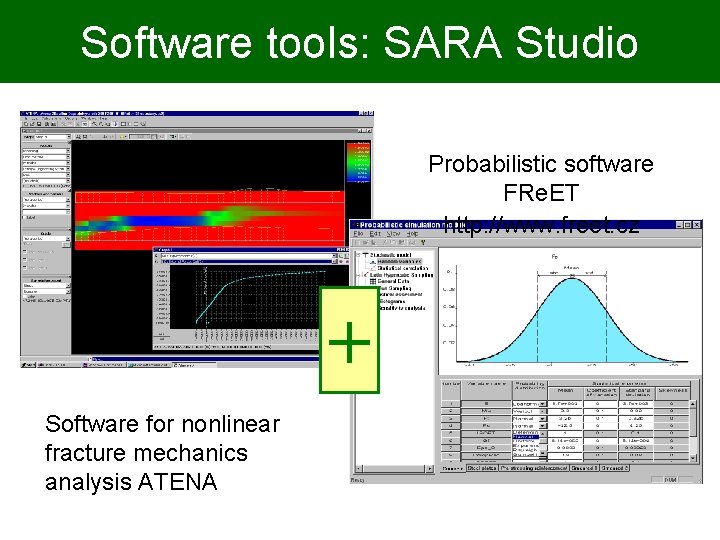
Software tools: SARA Studio Probabilistic software FRe. ET http: //www. freet. cz + Software for nonlinear fracture mechanics analysis ATENA 21/25 2/18
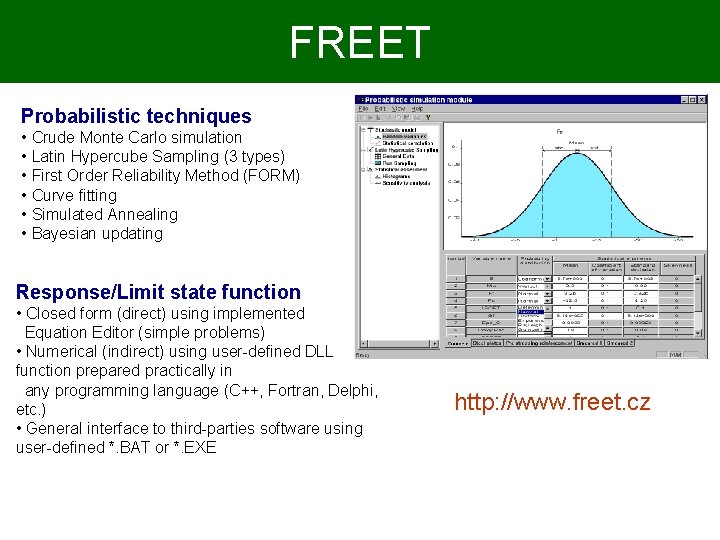
FREET Probabilistic techniques • Crude Monte Carlo simulation • Latin Hypercube Sampling (3 types) • First Order Reliability Method (FORM) • Curve fitting • Simulated Annealing • Bayesian updating Response/Limit state function • Closed form (direct) using implemented Equation Editor (simple problems) • Numerical (indirect) using user-defined DLL function prepared practically in. . any programming language (C++, Fortran, Delphi, etc. ) • General interface to third-parties software using user-defined *. BAT or *. EXE http: //www. freet. cz 23/25 2/18
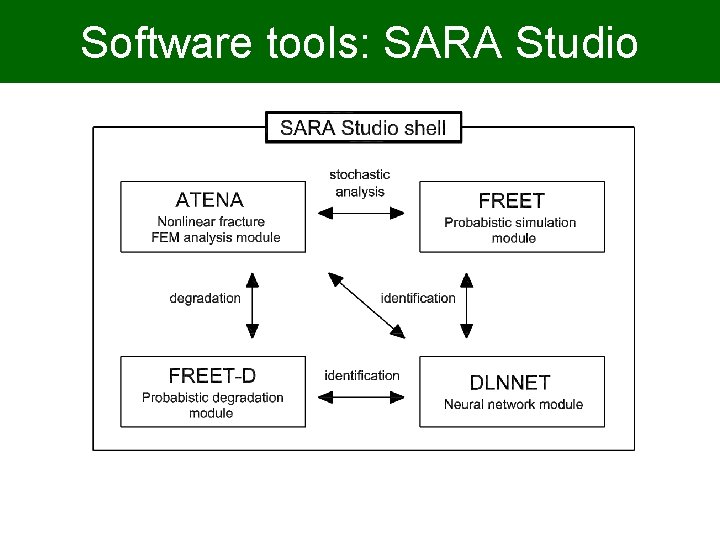
Software tools: SARA Studio 24/25 2/18
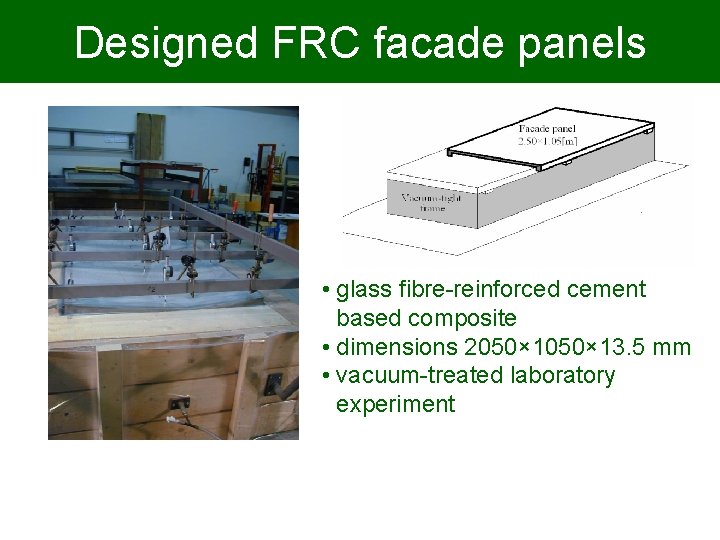
Designed FRC facade panels • glass fibre-reinforced cement based composite • dimensions 2050× 13. 5 mm • vacuum-treated laboratory experiment 10/18
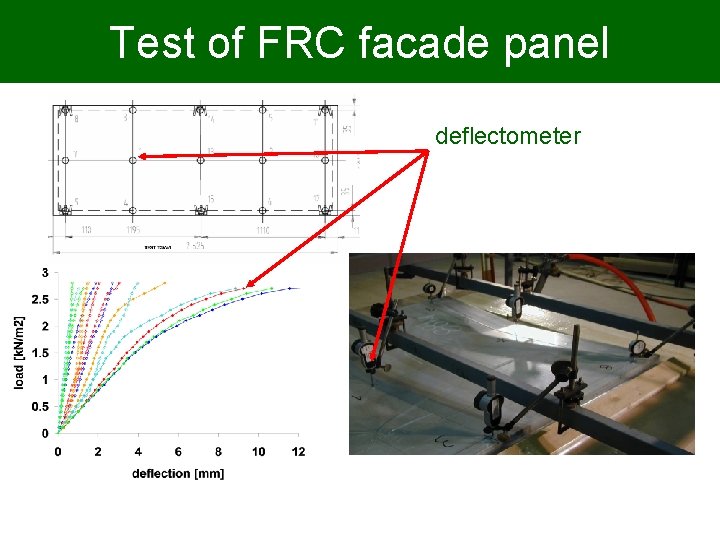
Test of FRC facade panel deflectometer 11/18
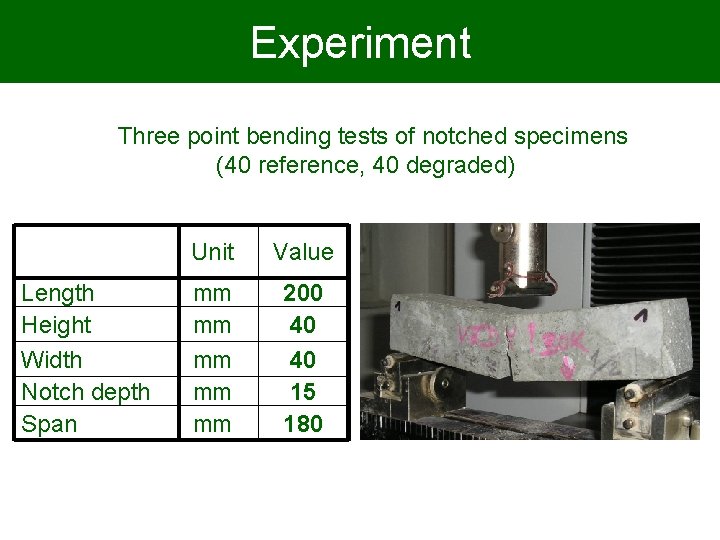
Experiment Three point bending tests of notched specimens (40 reference, 40 degraded) Length Height Width Notch depth Span Unit Value mm mm mm 200 40 40 15 180 4/18
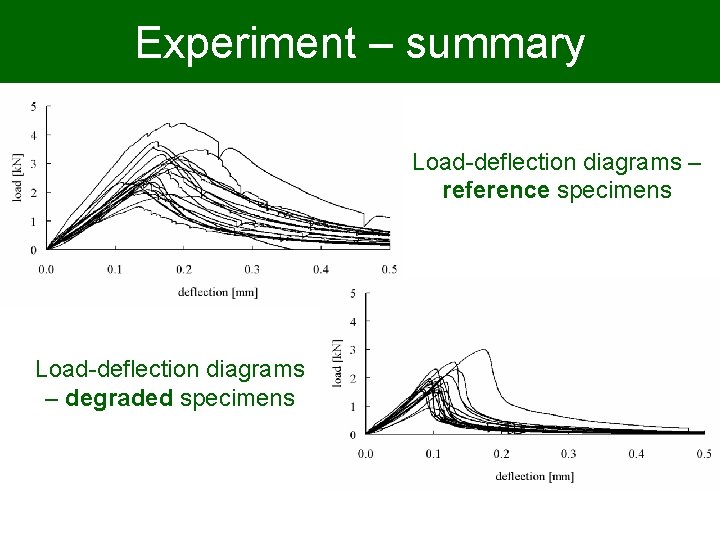
Experiment summary Materiálové–parametry Load-deflection diagrams – reference specimens Load-deflection diagrams – degraded specimens 6/18
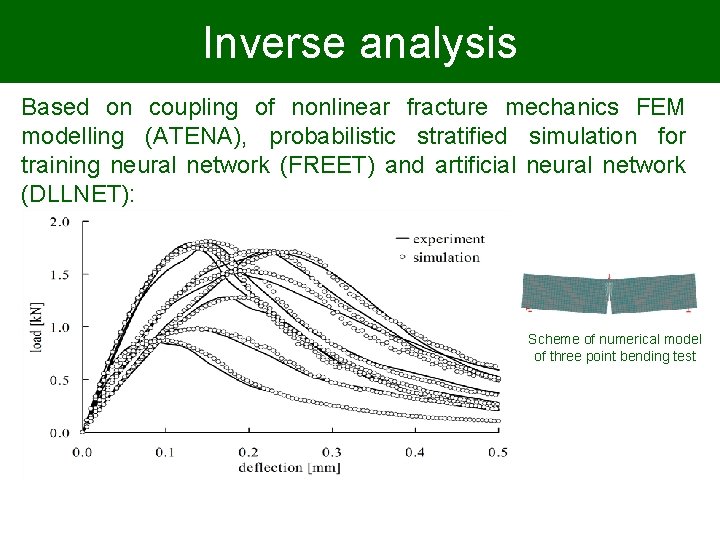
Inverse analysis Based on coupling of nonlinear fracture mechanics FEM modelling (ATENA), probabilistic stratified simulation for training neural network (FREET) and artificial neural network (DLLNET): Scheme of numerical model of three point bending test 8/18
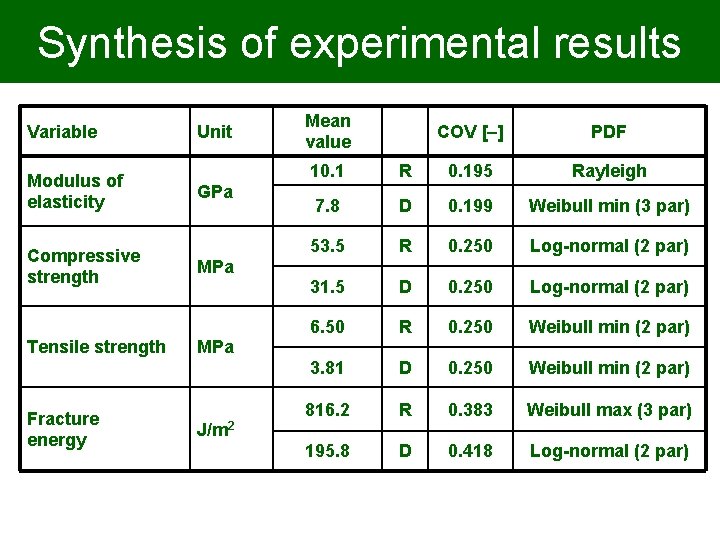
Synthesis of experimental results Variable Modulus of elasticity Compressive strength Tensile strength Fracture energy Unit GPa Mean value COV [–] PDF 10. 1 R 0. 195 Rayleigh 7. 8 D 0. 199 Weibull min (3 par) 53. 5 R 0. 250 Log-normal (2 par) 31. 5 D 0. 250 Log-normal (2 par) 6. 50 R 0. 250 Weibull min (2 par) 3. 81 D 0. 250 Weibull min (2 par) 816. 2 R 0. 383 Weibull max (3 par) 195. 8 D 0. 418 Log-normal (2 par) MPa J/m 2 9/18
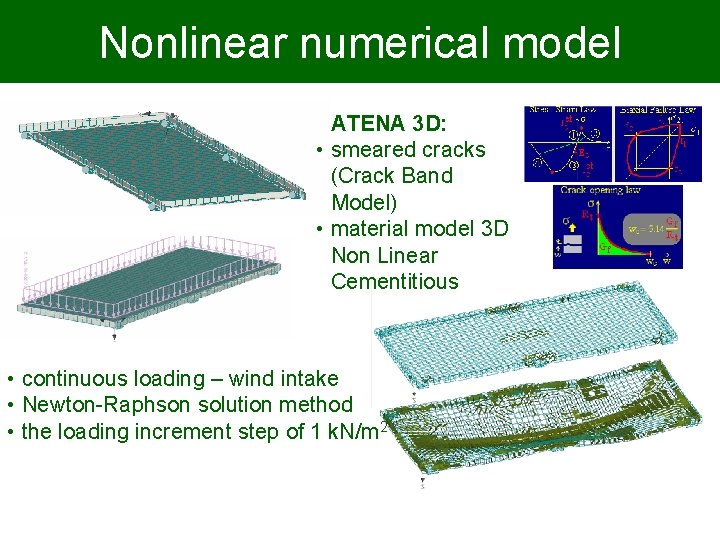
Nonlinear numerical model ATENA 3 D: • smeared cracks (Crack Band Model) • material model 3 D Non Linear Cementitious • continuous loading – wind intake • Newton-Raphson solution method • the loading increment step of 1 k. N/m 2 12/18
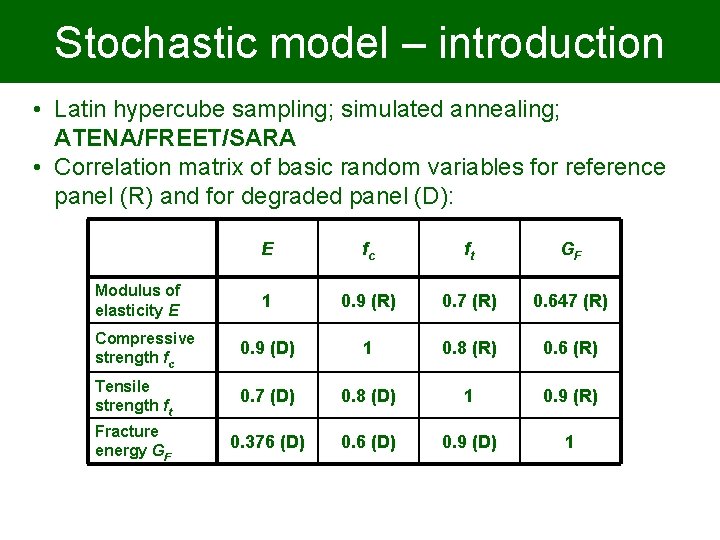
Stochastic model – introduction • Latin hypercube sampling; simulated annealing; ATENA/FREET/SARA • Correlation matrix of basic random variables for reference panel (R) and for degraded panel (D): E fc ft GF 1 0. 9 (R) 0. 7 (R) 0. 647 (R) Compressive strength fc 0. 9 (D) 1 0. 8 (R) 0. 6 (R) Tensile strength ft 0. 7 (D) 0. 8 (D) 1 0. 9 (R) Fracture energy GF 0. 376 (D) 0. 9 (D) 1 Modulus of elasticity E 13/18
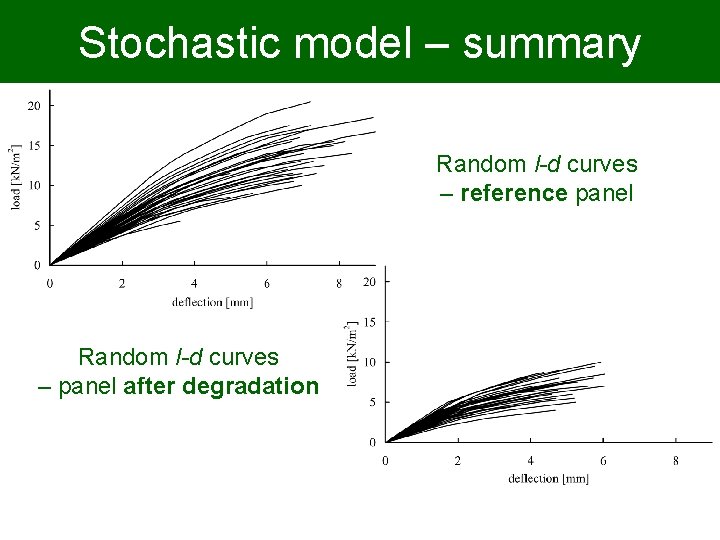
Stochastic model – summary Random l-d curves – reference panel Random l-d curves – panel after degradation 14/18
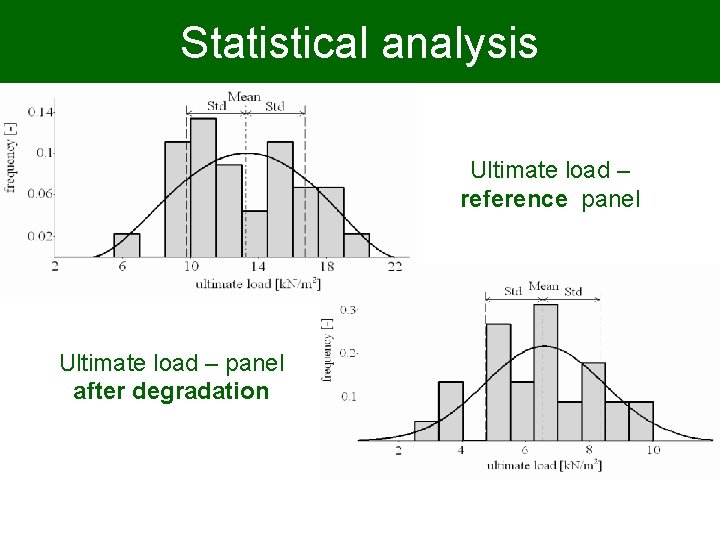
Statistical analysis Ultimate load – reference panel Ultimate load – panel after degradation 15/18
![Statistical and sensitivity analysis Results of statistical analysis: Mean value [k. N/m 2] COV](http://slidetodoc.com/presentation_image_h2/9652d6049060b76e6b43d6bcee858123/image-33.jpg "Statistical and sensitivity analysis Results of statistical analysis: Mean value [k. N/m 2] COV")
Statistical and sensitivity analysis Results of statistical analysis: Mean value [k. N/m 2] COV [%] Reference panel 13. 23 26. 5 Degraded panel 6. 52 27. 6 Ultimate load Results of sensitivity analysis: Parameter Spearman’s correlation coefficient: Reference panel Degraded panel Modulus of elasticity 0. 82 0. 73 Compressive strength 0. 79 0. 85 Tensile strength 0. 95 0. 99 Fracture energy 0. 95 0. 91 16/18
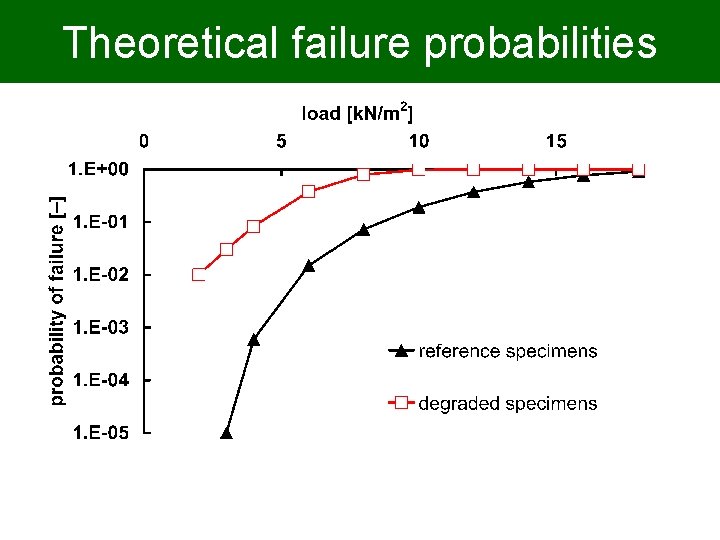
Theoretical failure probabilities 17/18
Conclusions • Efficient techniques of both nonlinear analysis and stochastic simulation methods were combined bridging: • • theory and praxis reliability and nonlinear computation • Software tools (SARA=ATENA+FREET) for the assessment of real behavior of concrete structures • A wide range of applicability both practical and theoretical - gives an opportunity for further intensive development • Procedure can be applied for any problem of quasibrittle modeling of concrete structures 25/25 2/18
- Slides: 35