
Reliable Transmission Spring 2000 Computer Networks 1 Acknowledgements
Reliable Transmission Spring 2000 Computer Networks 1
Acknowledgements and Timeouts • ACK – Control frame sent back to peers saying that it successfully received an earlier frame • If no ack without reasonable time, timeout and retransmit packet • Automatic Repeat Request - ARQ Spring 2000 Computer Networks 2
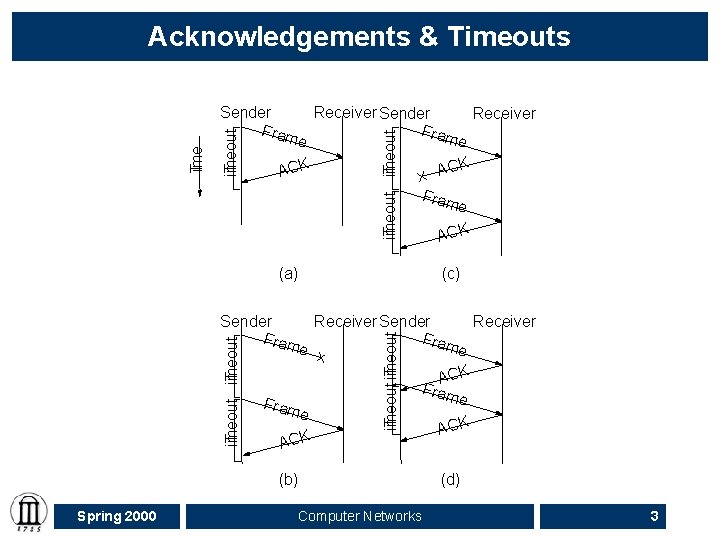
Sender Receiver Fram e e ACK imeout T T ime Acknowledgements & Timeouts Fram (a) e ACK (c) imeout T Sender Receiver Fram e e ACK Fram e ACK K AC (b) Spring 2000 (d) Computer Networks 3
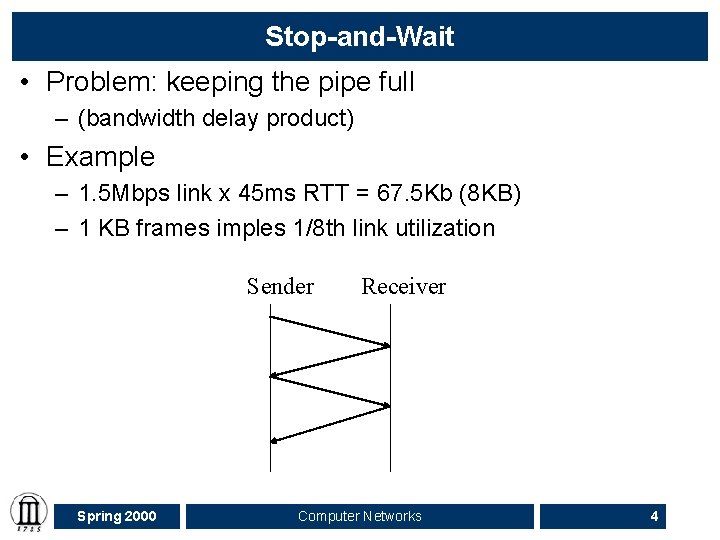
Stop-and-Wait • Problem: keeping the pipe full – (bandwidth delay product) • Example – 1. 5 Mbps link x 45 ms RTT = 67. 5 Kb (8 KB) – 1 KB frames imples 1/8 th link utilization Sender Spring 2000 Receiver Computer Networks 4
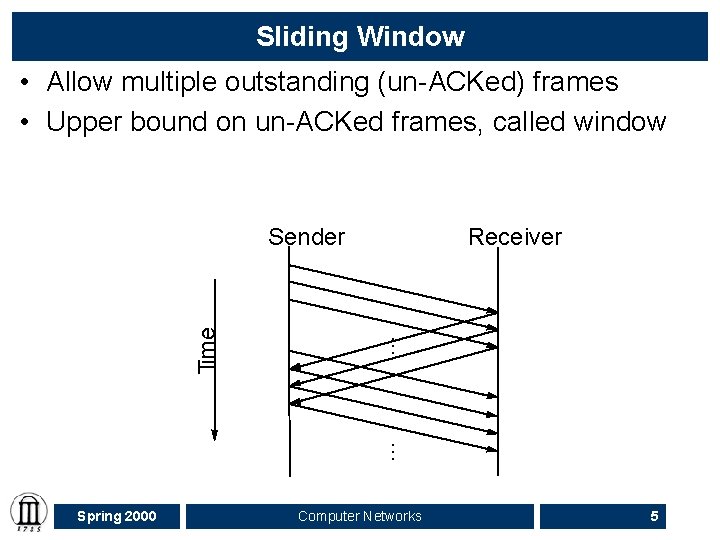
Sliding Window • Allow multiple outstanding (un-ACKed) frames • Upper bound on un-ACKed frames, called window … Receiver … Time Sender Spring 2000 Computer Networks 5
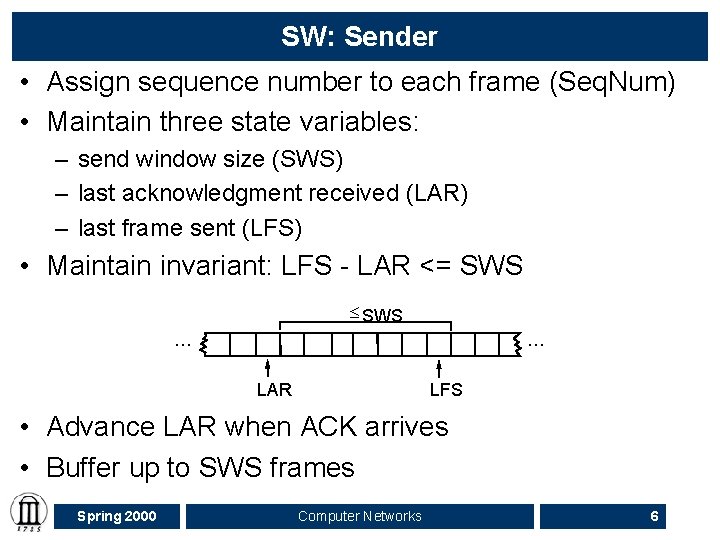
SW: Sender • Assign sequence number to each frame (Seq. Num) • Maintain three state variables: – send window size (SWS) – last acknowledgment received (LAR) – last frame sent (LFS) • Maintain invariant: LFS - LAR <= SWS £ SWS … … LAR LFS • Advance LAR when ACK arrives • Buffer up to SWS frames Spring 2000 Computer Networks 6
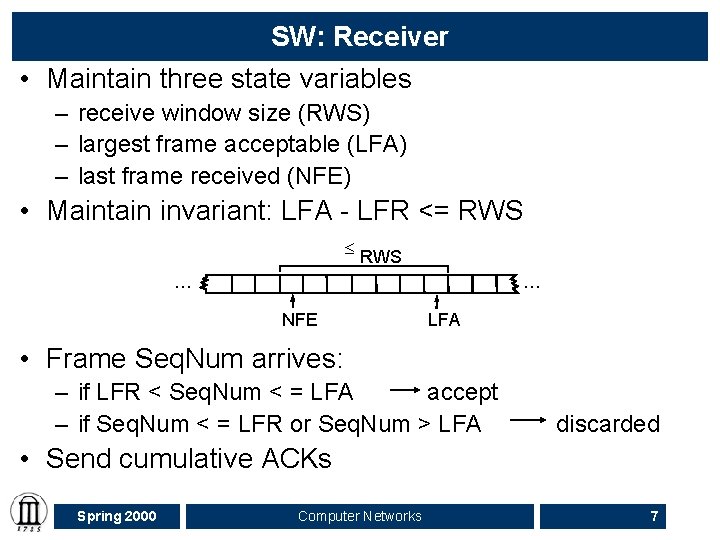
SW: Receiver • Maintain three state variables – receive window size (RWS) – largest frame acceptable (LFA) – last frame received (NFE) • Maintain invariant: LFA - LFR <= RWS £ RWS … … NFE LFA • Frame Seq. Num arrives: – if LFR < Seq. Num < = LFA accept – if Seq. Num < = LFR or Seq. Num > LFA discarded • Send cumulative ACKs Spring 2000 Computer Networks 7
Sequence Number Space • Seq. Num field is finite; sequence numbers wrap around • Sequence number space must be larger then number of outstanding frames • SWS <= Max. Seq. Num-1 is not sufficient – – – suppose 3 -bit Seq. Num field (0. . 7) SWS=RWS=7 sender transmit frames 0. . 6 arrive successfully, but ACKs lost sender retransmits 0. . 6 receiver expecting 7, 0. . 5, but receives second incarnation of 0. . 5 • SWS < (Max. Seq. Num+1)/2 is correct rule • Intuitively, Seq. Num “slides” between two halves of sequence number space Spring 2000 Computer Networks 8
Concurrent Logical Channels • Multiplex 8 logical channels over a single link • Run stop-and-wait on each logical channel • Maintain three state bits per channel – channel busy – current sequence number out – next sequence number in • Header: 3 -bit channel num, 1 -bit sequence num – 4 -bits total – same as sliding window protocol • Separates reliability from order Spring 2000 Computer Networks 9

Shared Access Networks Bus (Ethernet) Token ring (FDDI) Wireless (802. 11) Spring 2000 Computer Networks 10
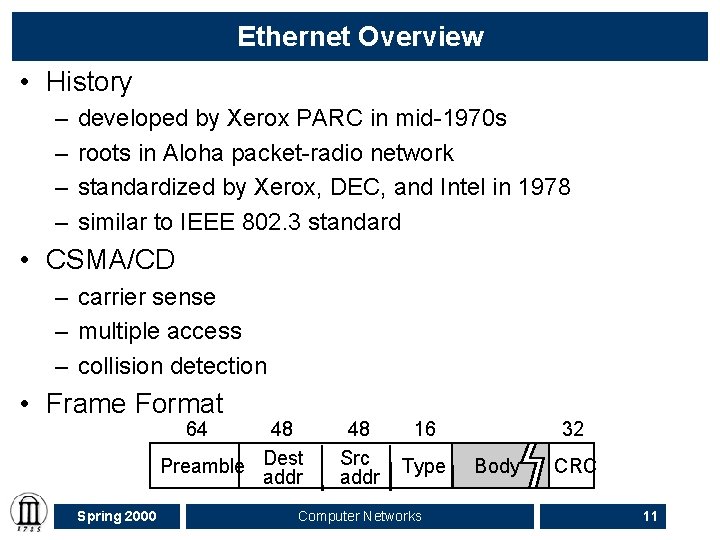
Ethernet Overview • History – – developed by Xerox PARC in mid-1970 s roots in Aloha packet-radio network standardized by Xerox, DEC, and Intel in 1978 similar to IEEE 802. 3 standard • CSMA/CD – carrier sense – multiple access – collision detection • Frame Format 64 48 Preamble Dest addr Spring 2000 48 Src addr 16 Type Computer Networks 32 Body CRC 11
Ethernet (cont) • Addresses – – unique, 48 -bit unicast address assigned to each adapter example: 8: 0: e 4: b 1: 2 broadcast: all 1 s multicast: first bit is 1 • Bandwidth: 10 Mbps, 100 Mbps, 1 Gbps • Length: 2500 m (500 m segments with 4 repeaters) • Problem: Distributed algorithm that provides fair access Spring 2000 Computer Networks 12
Transmit Algorithm • If line is idle… – send immediately – upper bound message size of 1500 bytes – must wait 9. 6 us between back-to-back frames • If line is busy… – wait until idle and transmit immediately – called 1 -persistent (special case of p-persistent) Spring 2000 Computer Networks 13
Algorithm (cont) • If collision… – jam for 32 bits, then stop transmitting frame – minimum frame is 64 bytes (header + 46 bytes of data) – delay and try again • 1 st time: 0 or 51. 2 us • 2 nd time: 0, 51. 2, or 102. 4 us • 3 rd time 51. 2, 102. 4, or 153. 6 us • nth time: k x 51. 2 us, for randomly selected k=0. . 2 n - 1 • give up after several tries (usually 16) • exponential backoff Spring 2000 Computer Networks 14
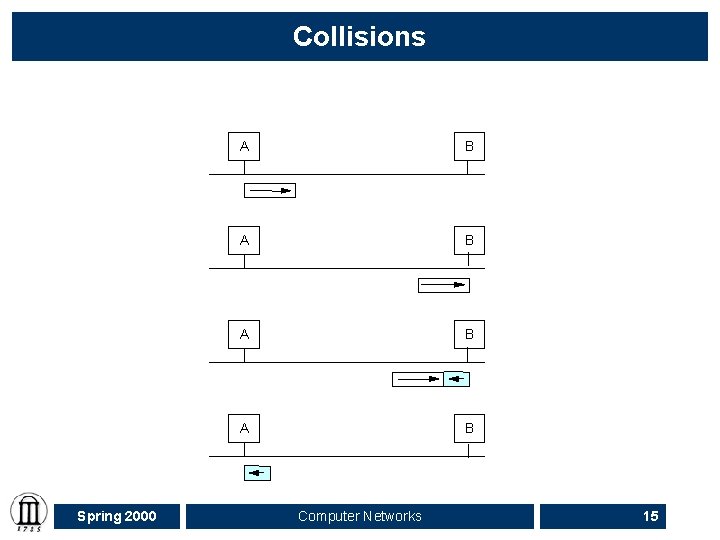
Collisions Spring 2000 A B A B Computer Networks 15
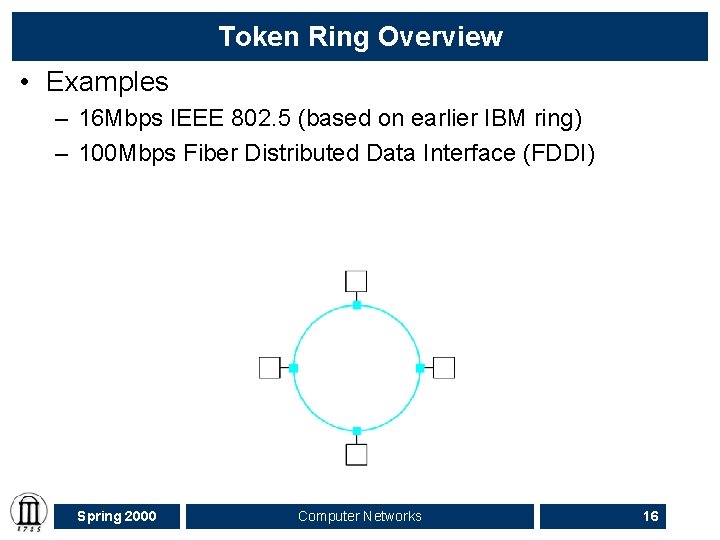
Token Ring Overview • Examples – 16 Mbps IEEE 802. 5 (based on earlier IBM ring) – 100 Mbps Fiber Distributed Data Interface (FDDI) Spring 2000 Computer Networks 16
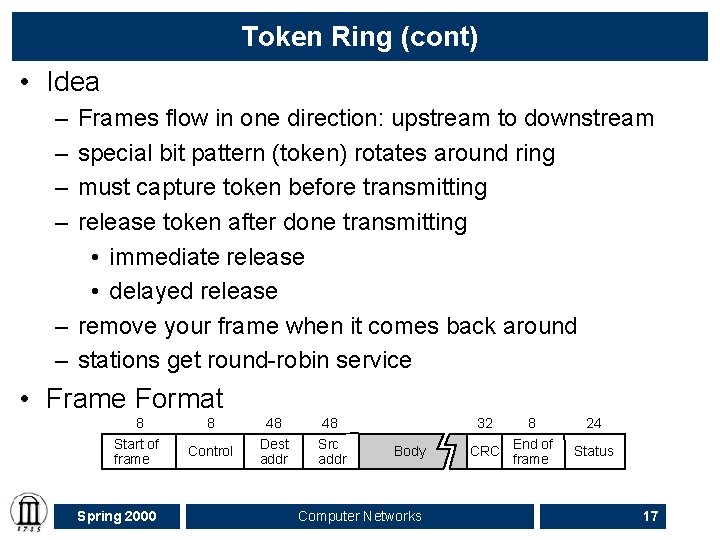
Token Ring (cont) • Idea – – Frames flow in one direction: upstream to downstream special bit pattern (token) rotates around ring must capture token before transmitting release token after done transmitting • immediate release • delayed release – remove your frame when it comes back around – stations get round-robin service • Frame Format 8 8 48 48 Start of frame Control Dest addr Src addr Spring 2000 32 Body Computer Networks 8 CRC End of frame 24 Status 17
Timed Token Algorithm • Token Holding Time (THT) – upper limit on how long a station can hold the token • Token Rotation Time (TRT) – how long it takes the token to traverse the ring. – TRT <= Active. Nodes x THT + Ring. Latency • Target Token Rotation Time (TTRT) – agreed-upon upper bound on TRT Spring 2000 Computer Networks 18
Algorithm (cont) • Each node measures TRT between successive tokens – if measured-TRT > TTRT: token is late so don’t send – if measured-TRT < TTRT: token is early so OK to send • Two classes of traffic – synchronous: can always send – asynchronous: can send only if token is early • Worse case: 2 x. TTRT between seeing token • Back-to-back 2 x. TTRT rotations not possible Spring 2000 Computer Networks 19
Token Maintenance • Lost Token – no token when initializing ring – bit error corrupts token pattern – node holding token crashes • Generating a Token (and agreeing on TTRT) – – execute when join ring or suspect a failure send a claim frame that includes the node’s TTRT bid when receive claim frame, update the bid and forward if your claim frame makes it all the way around the ring: • your bid was the lowest • everyone knows TTRT • you insert new token Spring 2000 Computer Networks 20
Maintenance (cont) • Monitoring for a Valid Token – should periodically see valid transmission (frame or token) – maximum gap = ring latency + max frame < = 2. 5 ms – set timer at 2. 5 ms and send claim frame if it fires Spring 2000 Computer Networks 21
- Slides: 21