
Reliable State Machines Dr Gary R Burke California

Reliable State Machines Dr. Gary R Burke California Institute of Technology Jet Propulsion Laboratory 10/14/2005 Caltech 1
outline • Background – JPL MER example • JPL FPGA/ASIC Process – Procedure – Guidelines • State machines – Traditional – Highly Reliable – Comparison 10/14/2005 Caltech 2

10/14/2005 Caltech 3

10/14/2005 Caltech 4
10/14/2005 Caltech 5
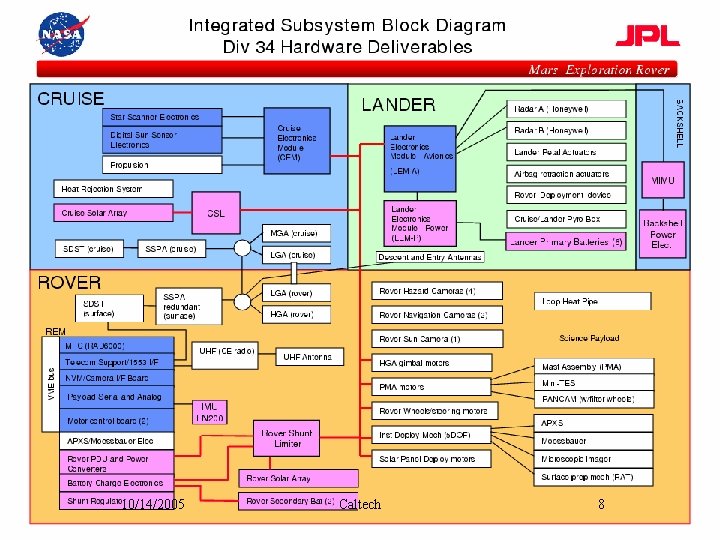
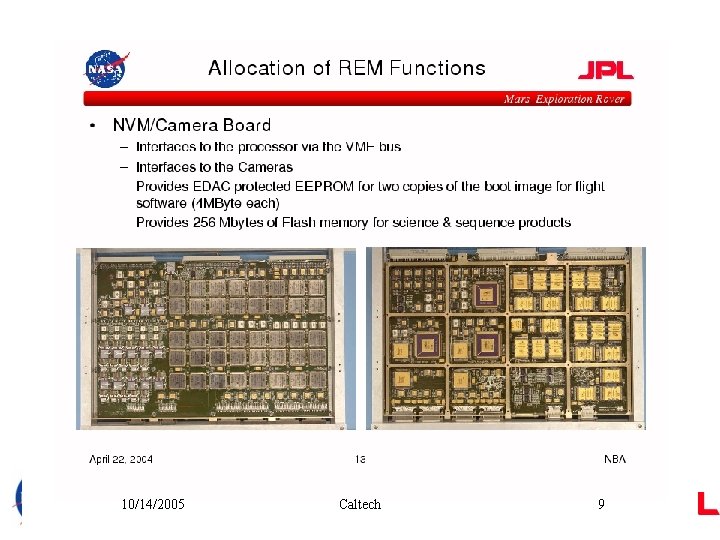
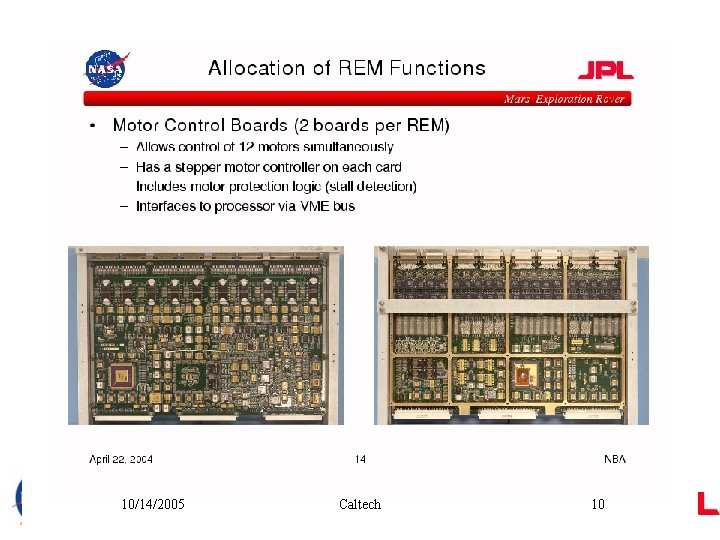
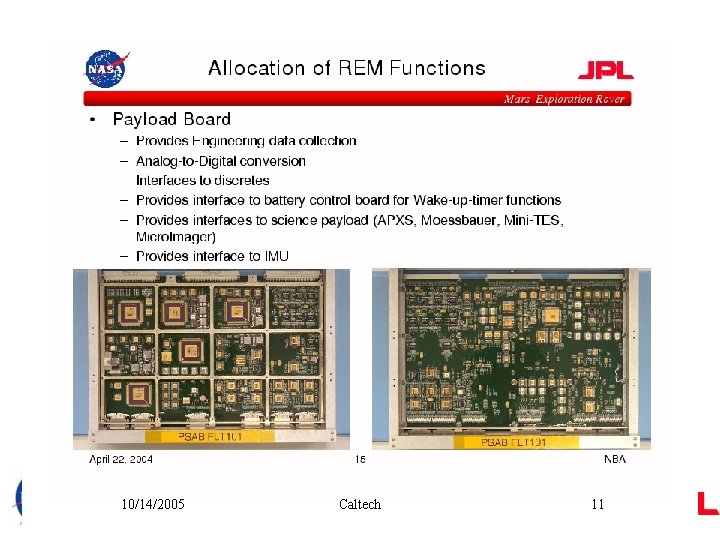
MER Mission example • Large number of FPGAs • Mostly fuse programmable – but at least one RAM programmable FPGA • Several ASICs • Many standard parts eg Microprocessor, RAM chips. 10/14/2005 Caltech 6
10/14/2005 Caltech 7
10/14/2005 Caltech 8
10/14/2005 Caltech 9
10/14/2005 Caltech 10
10/14/2005 Caltech 11
10/14/2005 Caltech 12
10/14/2005 Caltech 13
FPGA/ASIC Process • JPL needs to ensure design process is sound • A bug in an FPGA/ASIC can halt a billion dollar mission • Tight schedules can result in inadequate testing • Inadequate version control can result in the wrong code • First Pass success important for ASIC design 10/14/2005 Caltech 14
FPGA/ASIC Process • • To ensure a quality product: Requirements are correct and do not change Specification is complete Design will meet the specification and requirements • Testing has covered all possible cases 10/14/2005 Caltech 15
FPGA/ASIC Process • Peer reviews by experts to check the design and design approach • Formal Reviews to ensure design process is adequate, and to sign off on the design • Documentation for review and archiving • Check-lists to ensure all problems are fixed 10/14/2005 Caltech 16
FPGA/ASIC Process • Configuration Management to ensure correct versions are used • Verification Matrix – which documents all testing • Checking tools e. g. Lint, DRC; all errors, and warnings documented 10/14/2005 Caltech 17
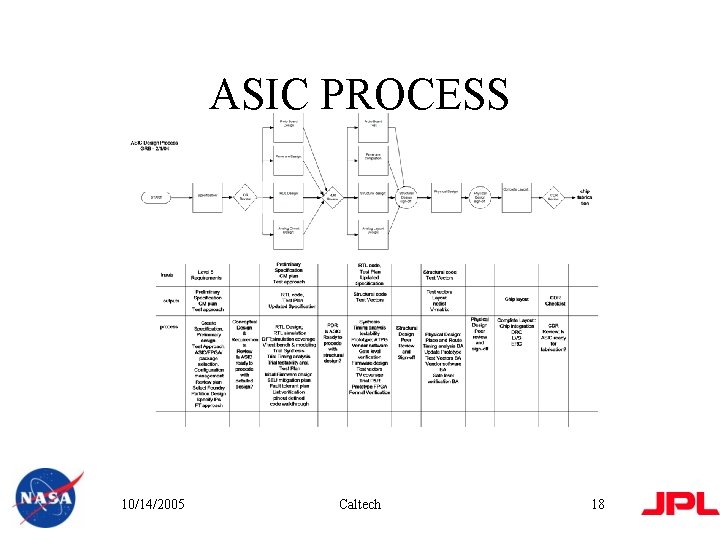
ASIC PROCESS 10/14/2005 Caltech 18
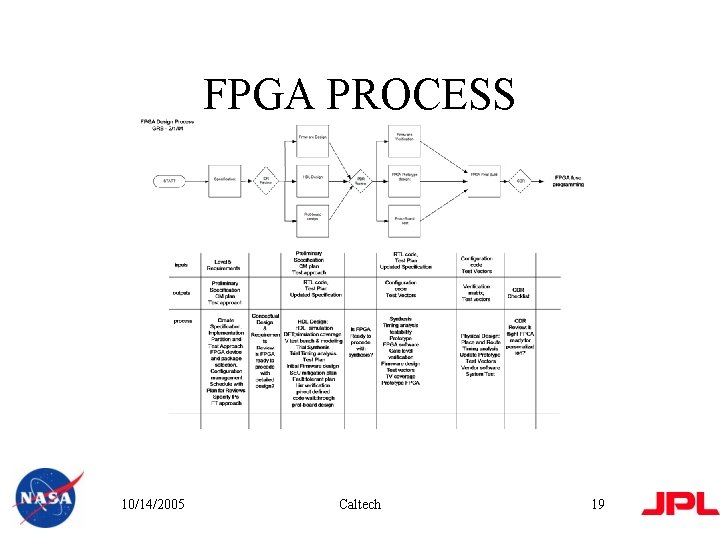
FPGA PROCESS 10/14/2005 Caltech 19
Guidelines • Define set of rules for HDL design • Reduce ambiguity • Clarify design to be easily checked and reviewed • Implement most reliable design techniques 10/14/2005 Caltech 20
Fault Tolerant State Machines • The state machine needs to be tolerant of single event upsets • State machine should not hang • State machine should always be in a defined state • No asynchronous inputs to state machine • Default state must be specified 10/14/2005 Caltech 21
State Machines • A state machine is a sequential machine that when built into an FPGA or ASIC controls the sequencing of actions in the digital logic • The current state of a machine is held in a state register which is updated on a clock • The next value of the state register (next state) is derived from the current state and the inputs • Outputs from the state machine are decoded from the state register and can also be combined with the inputs 10/14/2005 Caltech 22
State-Machine (SM) Encoding • Each distinct state of the SM is represented by a unique code • The allocation of these binary codes to states is the Encoding • The simplest encoding is Binary • In Binary encoding each state is given the next available binary number in sequence. 10/14/2005 Caltech 23
Other SM Encoding • 1 -hot encoding – The number of bits in the code is equal to the number of states. Each encoded state has just 1 bit in the encoded word set to a 1 (the rest are 0) – The advantage is that when optimized for non-reliable use, the amount of logic needed is less than Binary encoding, and it can be faster. One bit change with a SEU will result in a bad code which can be detected. – The disadvantage is the increased number of bits results in more flip/flops and therefore more targets for SEUs. The SEU advantage is lost when the 1 -hot encoding is optimized. 10/14/2005 Caltech 24
Other SM Encoding- cont • Grey-code – Similar to binary encoding, except the codes are chosen so that in the main state-machine sequence only 1 bit changes at a time – No major advantage over binary with this code. Decoded outputs from the state register can make use of the nature of the encoding to simplify producing a glitch free output. 10/14/2005 Caltech 25
Other SM Encoding- cont • H 2 -code – This variation on Binary encoding uses one extra bit to ensure all codes are separated by a Hamming distance of 2. That is, it will take 2 changes in the state register to reach another known state. – The advantage is that it has less bits and so less SEU targets than 1 -hot, but retains the fault tolerance of the un-optimized 1 -hot encoding. 10/14/2005 Caltech 26
Other SM Encoding- cont • H 3 -code – This extension on H 2 encoding uses additional bits to ensure all codes are separated by a Hamming distance of 3. That is, it will take 3 changes in the state register to reach another known state. – The advantage is that the SM can be designed such that a single change in the state register has no effect on the state. – The disadvantage is that it requires more logic to implement 10/14/2005 Caltech 27
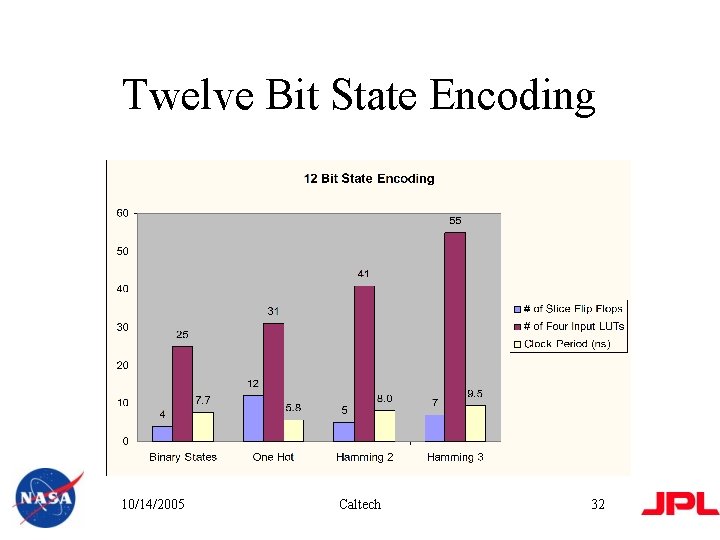
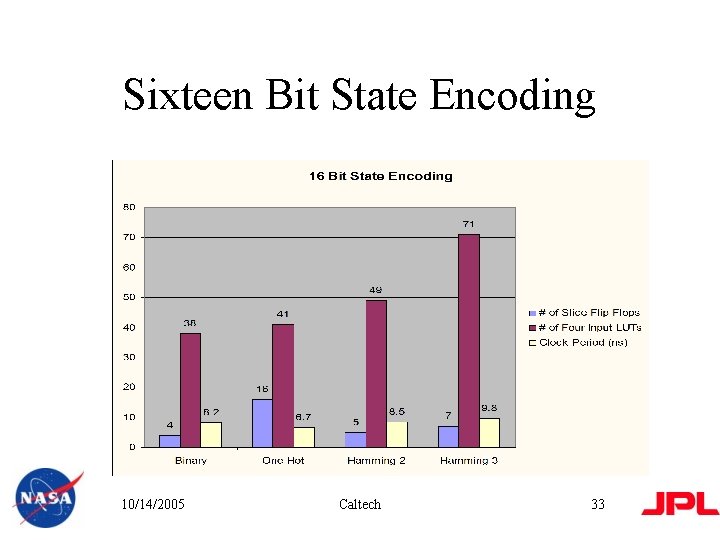
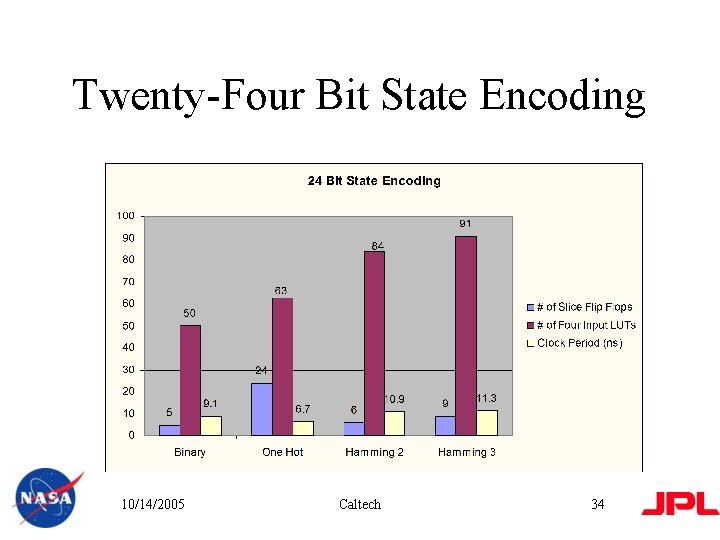
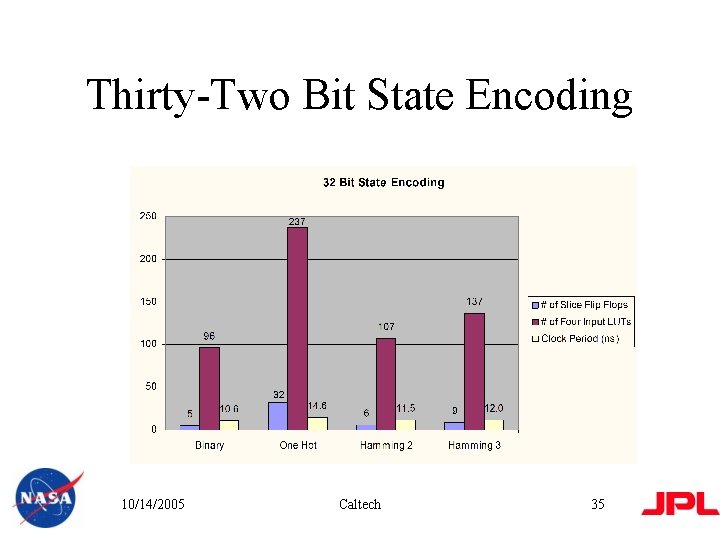
Synthesis • To check the overhead of each of the state machines, they were individually synthesized • Finite state machine optimization is turned off • A clock frequency of 50 MHz is used • Target device is a Xilinx Spartan 2, speed grade 6 • Error injection circuitry is not included 10/14/2005 Caltech 28
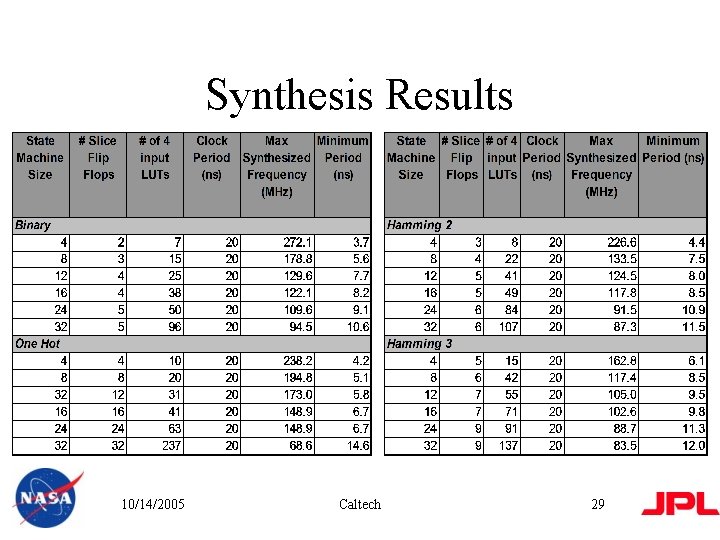
Synthesis Results 10/14/2005 Caltech 29
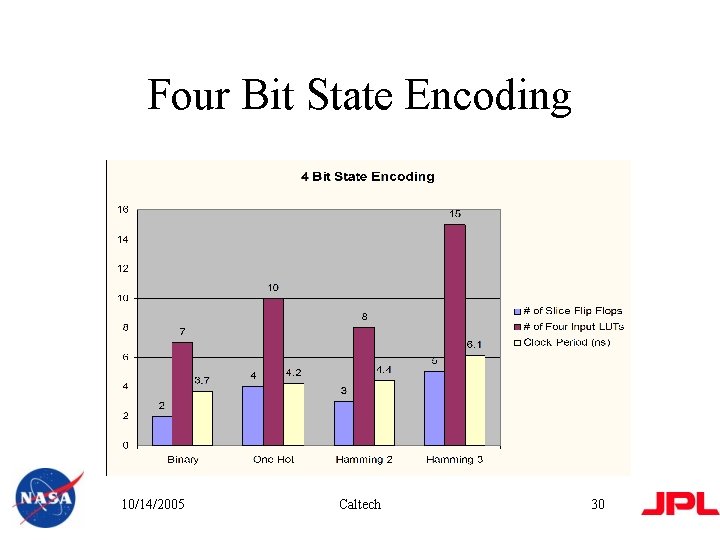
Four Bit State Encoding 10/14/2005 Caltech 30
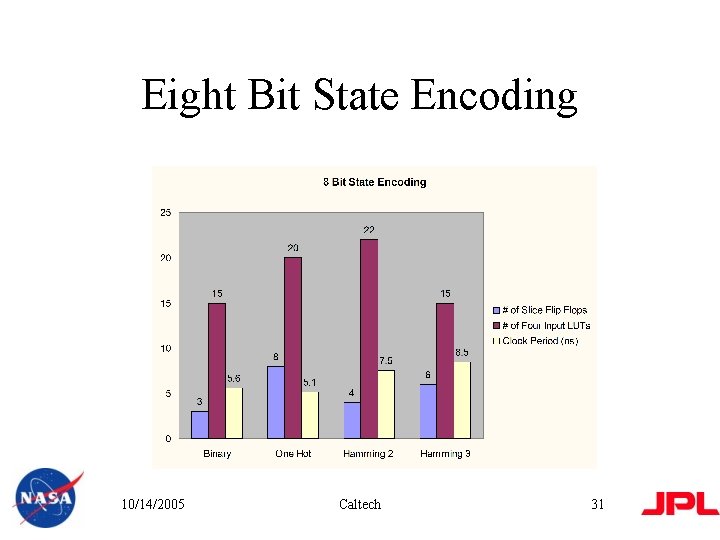
Eight Bit State Encoding 10/14/2005 Caltech 31
Twelve Bit State Encoding 10/14/2005 Caltech 32
Sixteen Bit State Encoding 10/14/2005 Caltech 33
Twenty-Four Bit State Encoding 10/14/2005 Caltech 34
Thirty-Two Bit State Encoding 10/14/2005 Caltech 35
Fault Injection Test • A test circuit is generated with an example of each state machine executing the same task, plus a reference state machine • The task chosen requires a 16 -state machine, to detect a 16 -bit pattern in a serial input stream • An error generator injects faults into all state machines except the reference state machine 10/14/2005 Caltech 36
Error Injection Test Continued • The outputs of each state machine are compared to the reference output • A set of counters tallies the comparison outputs • 2 types of failure are logged for each state machine: – Failure to detect pattern – False detection of pattern (false-positive) 10/14/2005 Caltech 37
Error Injection Test Continued • Non-key patterns are 1 -bit different from the key pattern, to increase the likelihood of a false match • Error rate can vary, set to 1: 199 clocks in example • Errors are weighted by distributing them pseudo-randomly over 16 bits. A state machine with a word size of n, receives n/16 of the total faults • Synchronous fault injection is before the state register • Asynchronous fault injection is after the state register • All results are from actual implementation of the test circuits in a Spartan 2 FPGA 10/14/2005 Caltech 38
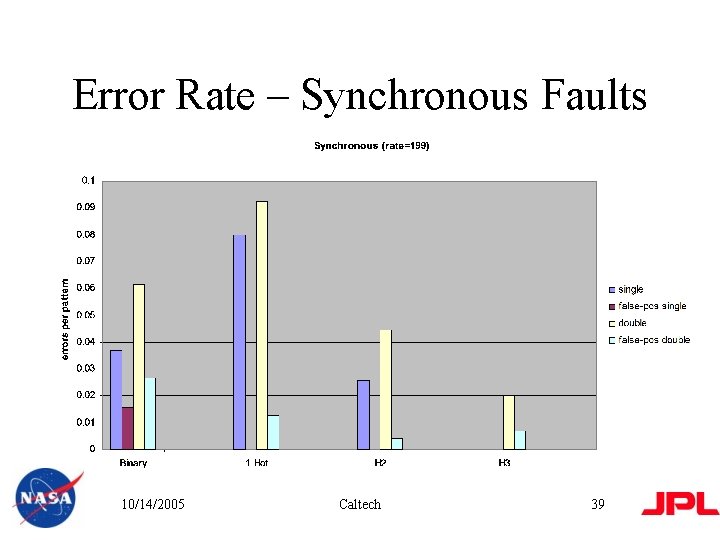
Error Rate – Synchronous Faults 10/14/2005 Caltech 39
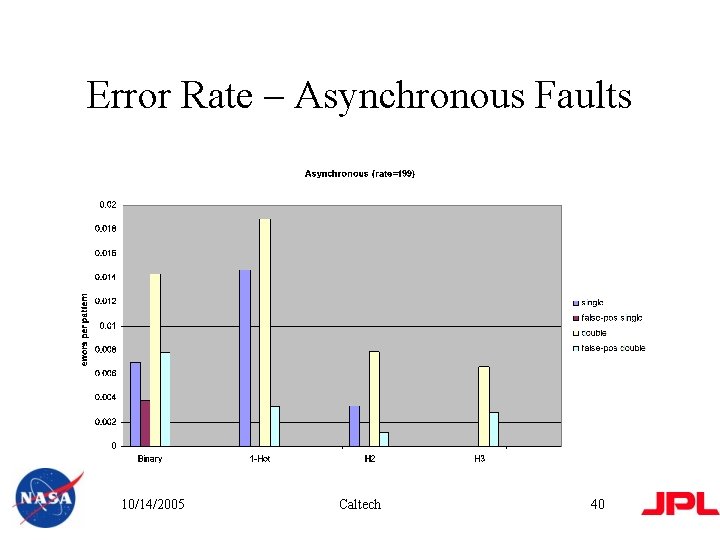
Error Rate – Asynchronous Faults 10/14/2005 Caltech 40
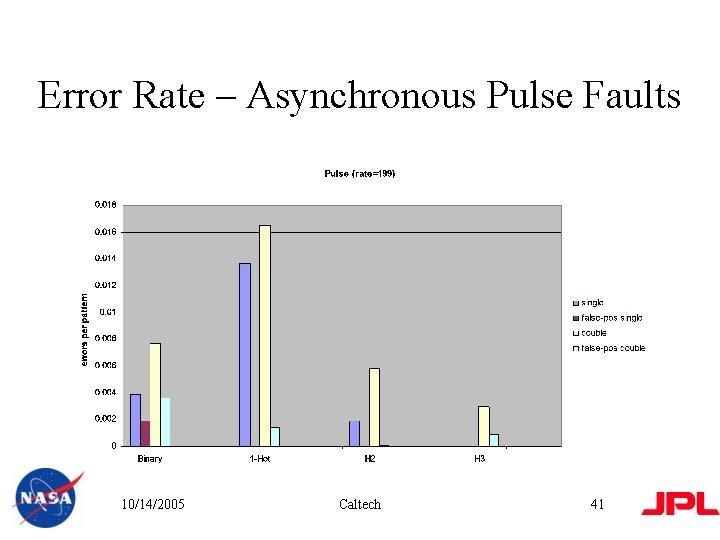
Error Rate – Asynchronous Pulse Faults 10/14/2005 Caltech 41
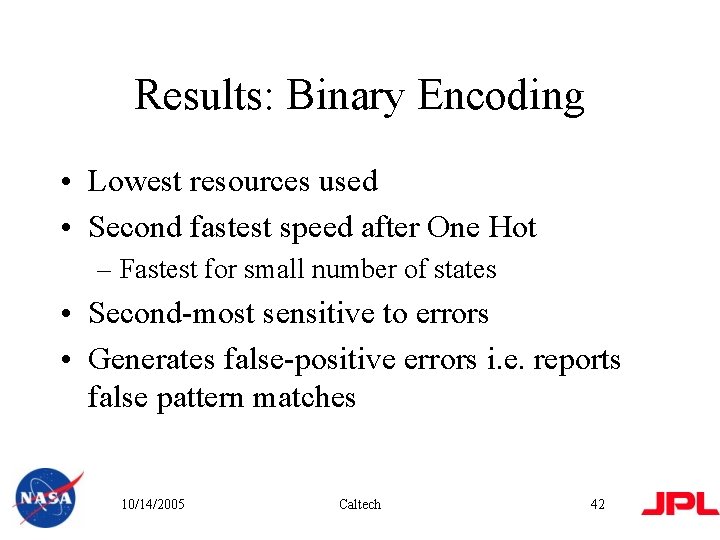
Results: Binary Encoding • Lowest resources used • Second fastest speed after One Hot – Fastest for small number of states • Second-most sensitive to errors • Generates false-positive errors i. e. reports false pattern matches 10/14/2005 Caltech 42
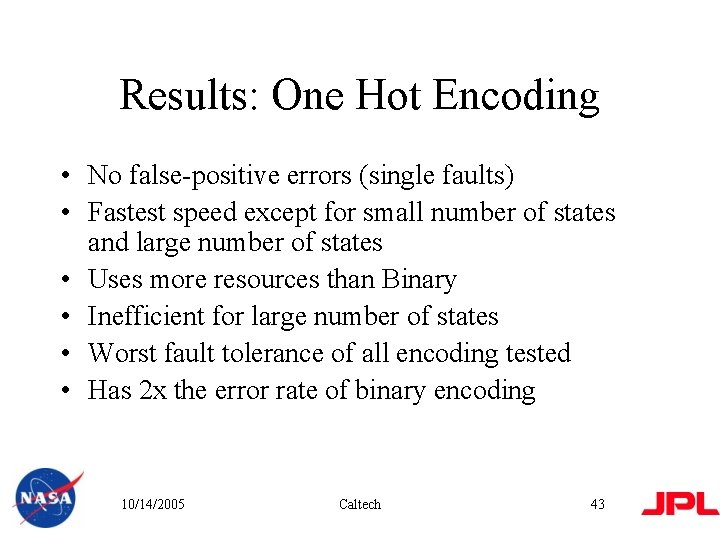
Results: One Hot Encoding • No false-positive errors (single faults) • Fastest speed except for small number of states and large number of states • Uses more resources than Binary • Inefficient for large number of states • Worst fault tolerance of all encoding tested • Has 2 x the error rate of binary encoding 10/14/2005 Caltech 43
Results: Hamming Distance of 2 (H 2) Encoding • No false-positive errors (single faults) • Better Fault Tolerance than Binary • More resources needed than One Hot, except for large number of states 10/14/2005 Caltech 44
Results: Hamming Distance of 3 (H 3) Encoding • Zero single-fault errors – Immune to synchronous and asynchronous errors • Lowest double-fault errors • Most resources used (*) ~2 x binary encoding • Slowest speed (*) Except for large number of states 10/14/2005 Caltech 45
- Slides: 45