
Reliable Precise H 2 O Measurement in Catalytic
Reliable Precise H 2 O Measurement in Catalytic Reformer Hydrogen Recycle Streams Slide 1 09/03/2015 G. Engelhart Rapid
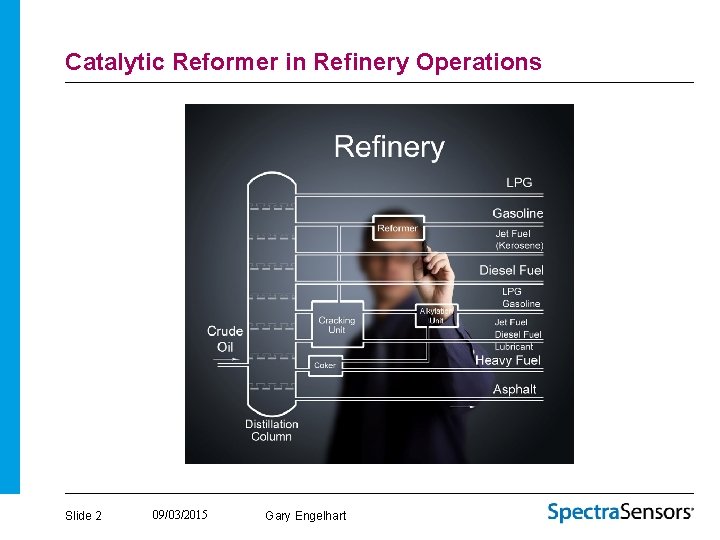
Catalytic Reformer in Refinery Operations Slide 2 09/03/2015 Gary Engelhart
Catalytic Reforming Units Catalytic reforming units are categorized by the type of catalyst regeneration procedure they employ. There are three main types; • Semi-regenerative catalytic reformers (SRR) • Continuous catalyst regeneration reformers (CCR) • Cyclic catalytic reformers • Semi-regenerative reformers are the type in most widespread service, representing 60% of worldwide capacity • Continuous catalytic reformers are the next most common with 28% of worldwide capacity • Cyclic catalytic reformers are approximately 12% of worldwide capacity Slide 3 09/03/2015 G. Engelhart
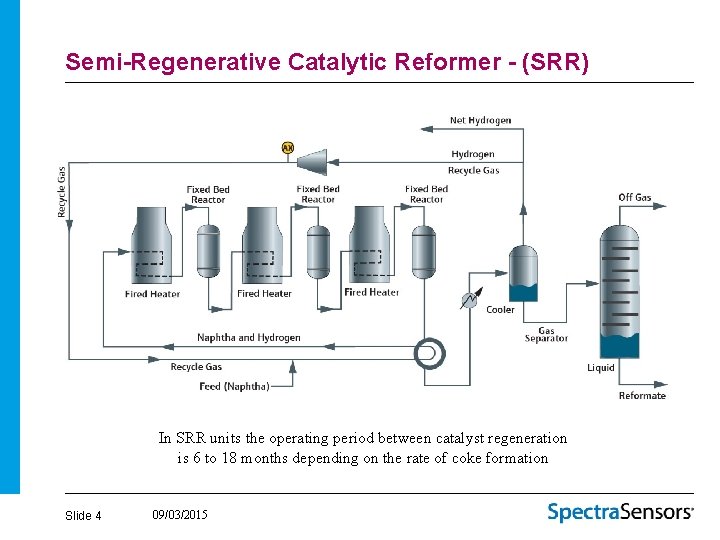
Semi-Regenerative Catalytic Reformer - (SRR) In SRR units the operating period between catalyst regeneration is 6 to 18 months depending on the rate of coke formation Slide 4 09/03/2015
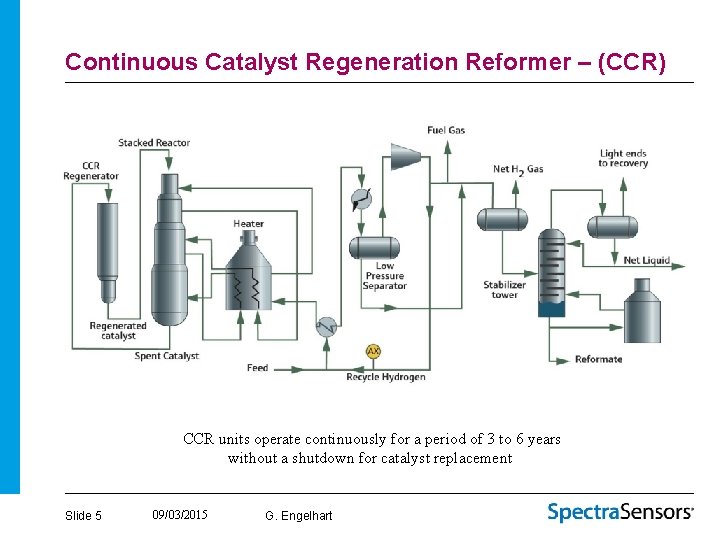
Continuous Catalyst Regeneration Reformer – (CCR) CCR units operate continuously for a period of 3 to 6 years without a shutdown for catalyst replacement Slide 5 09/03/2015 G. Engelhart
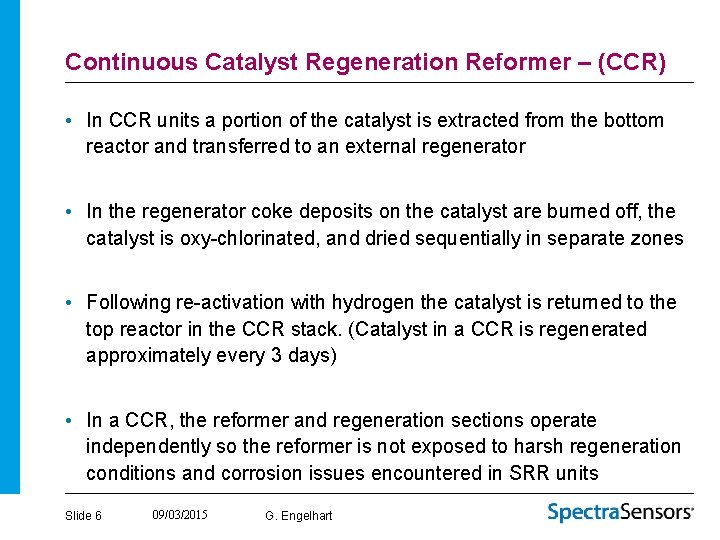
Continuous Catalyst Regeneration Reformer – (CCR) • In CCR units a portion of the catalyst is extracted from the bottom reactor and transferred to an external regenerator • In the regenerator coke deposits on the catalyst are burned off, the catalyst is oxy-chlorinated, and dried sequentially in separate zones • Following re-activation with hydrogen the catalyst is returned to the top reactor in the CCR stack. (Catalyst in a CCR is regenerated approximately every 3 days) • In a CCR, the reformer and regeneration sections operate independently so the reformer is not exposed to harsh regeneration conditions and corrosion issues encountered in SRR units Slide 6 09/03/2015 G. Engelhart
Composition / Function of Catalyst • A bimetallic platinum / rhenium catalyst on a chloride alumina support (Pt/Re/Al 2 O 3 -Cl) is typically employed in a SRR • The metallic catalyst components catalyze hydrogenation and dehydrogenation reactions • H 2 O and a chloride compound are injected to chlorinate the alumina and maintain acid sites needed to perform hydrocracking, isomerization and cyclization conversion reactions • Refineries control H 2 O levels in catalytic reformer units to avoid an excessive amount which will strip chloride from Al 2 O 3 reducing catalyst activity and yield of high octane reformate Slide 7 09/03/2015 G. Engelhart
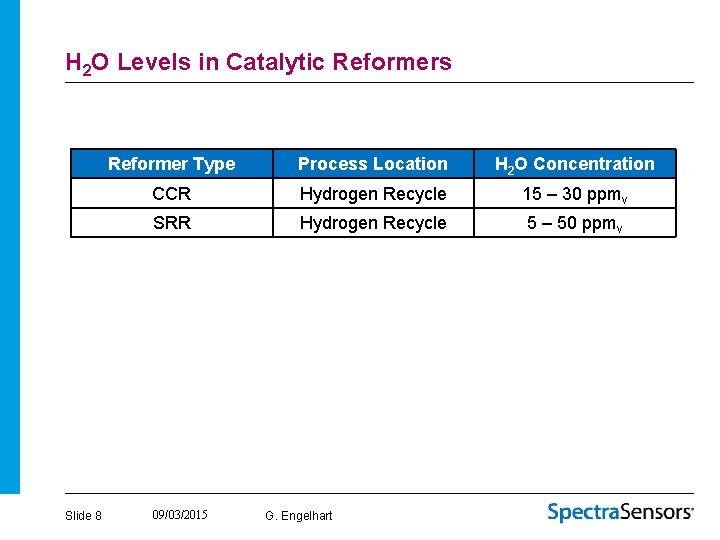
H 2 O Levels in Catalytic Reformers Slide 8 Reformer Type Process Location H 2 O Concentration CCR Hydrogen Recycle 15 – 30 ppmv SRR Hydrogen Recycle 5 – 50 ppmv 09/03/2015 G. Engelhart
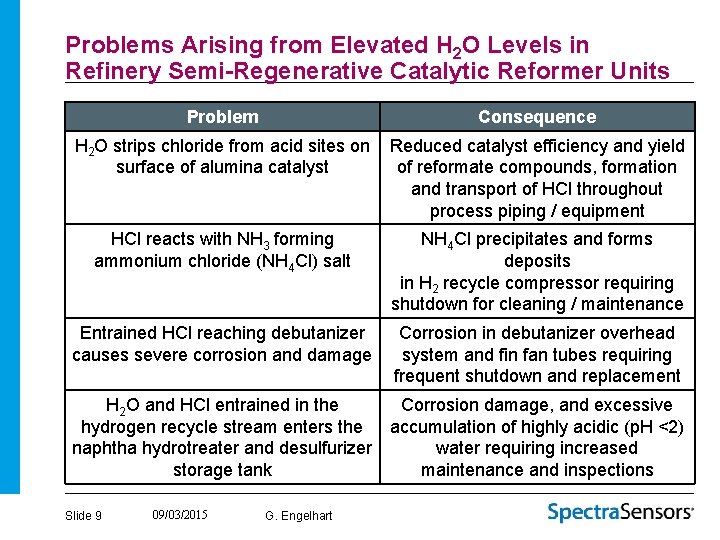
Problems Arising from Elevated H 2 O Levels in Refinery Semi-Regenerative Catalytic Reformer Units Problem Consequence H 2 O strips chloride from acid sites on surface of alumina catalyst Reduced catalyst efficiency and yield of reformate compounds, formation and transport of HCl throughout process piping / equipment HCl reacts with NH 3 forming ammonium chloride (NH 4 Cl) salt NH 4 Cl precipitates and forms deposits in H 2 recycle compressor requiring shutdown for cleaning / maintenance Entrained HCl reaching debutanizer causes severe corrosion and damage Corrosion in debutanizer overhead system and fin fan tubes requiring frequent shutdown and replacement H 2 O and HCl entrained in the Corrosion damage, and excessive hydrogen recycle stream enters the accumulation of highly acidic (p. H <2) naphtha hydrotreater and desulfurizer water requiring increased storage tank maintenance and inspections Slide 9 09/03/2015 G. Engelhart
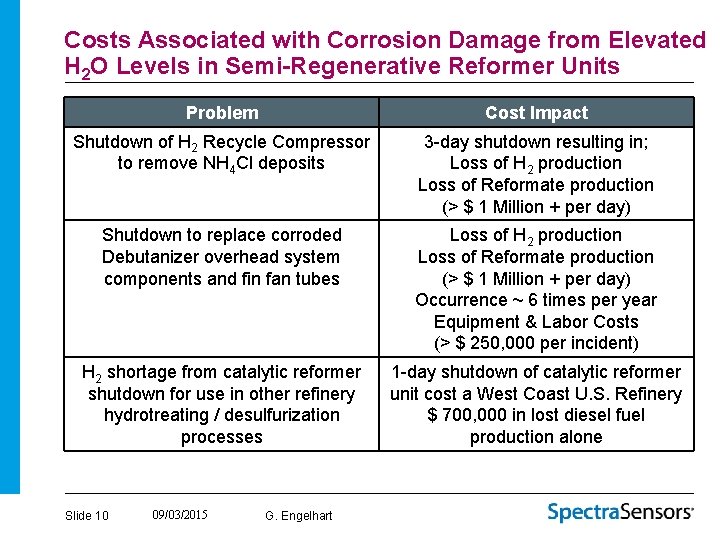
Costs Associated with Corrosion Damage from Elevated H 2 O Levels in Semi-Regenerative Reformer Units Problem Cost Impact Shutdown of H 2 Recycle Compressor to remove NH 4 Cl deposits 3 -day shutdown resulting in; Loss of H 2 production Loss of Reformate production (> $ 1 Million + per day) Shutdown to replace corroded Debutanizer overhead system components and fin fan tubes Loss of H 2 production Loss of Reformate production (> $ 1 Million + per day) Occurrence ~ 6 times per year Equipment & Labor Costs (> $ 250, 000 per incident) H 2 shortage from catalytic reformer shutdown for use in other refinery hydrotreating / desulfurization processes 1 -day shutdown of catalytic reformer unit cost a West Coast U. S. Refinery $ 700, 000 in lost diesel fuel production alone Slide 10 09/03/2015 G. Engelhart
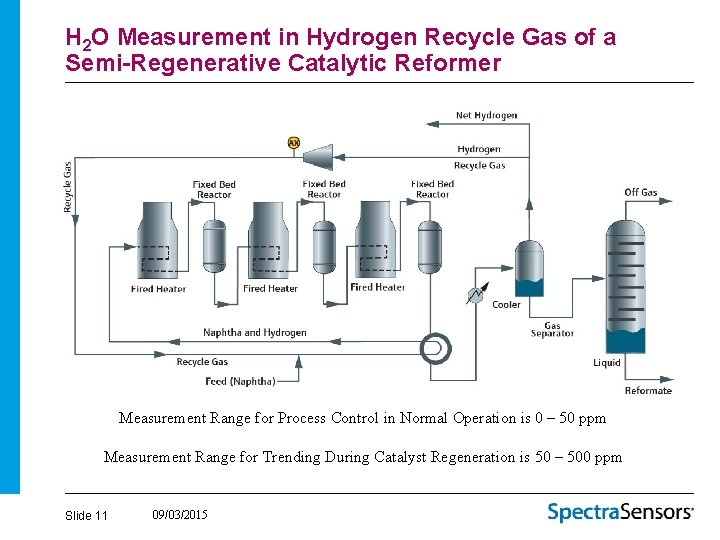
H 2 O Measurement in Hydrogen Recycle Gas of a Semi-Regenerative Catalytic Reformer Measurement Range for Process Control in Normal Operation is 0 – 50 ppm Measurement Range for Trending During Catalyst Regeneration is 50 – 500 ppm Slide 11 09/03/2015
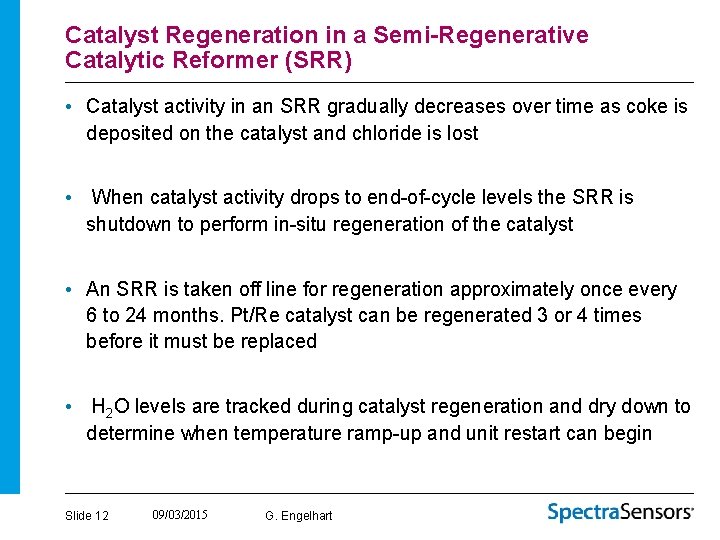
Catalyst Regeneration in a Semi-Regenerative Catalytic Reformer (SRR) • Catalyst activity in an SRR gradually decreases over time as coke is deposited on the catalyst and chloride is lost • When catalyst activity drops to end-of-cycle levels the SRR is shutdown to perform in-situ regeneration of the catalyst • An SRR is taken off line for regeneration approximately once every 6 to 24 months. Pt/Re catalyst can be regenerated 3 or 4 times before it must be replaced • H 2 O levels are tracked during catalyst regeneration and dry down to determine when temperature ramp-up and unit restart can begin Slide 12 09/03/2015 G. Engelhart
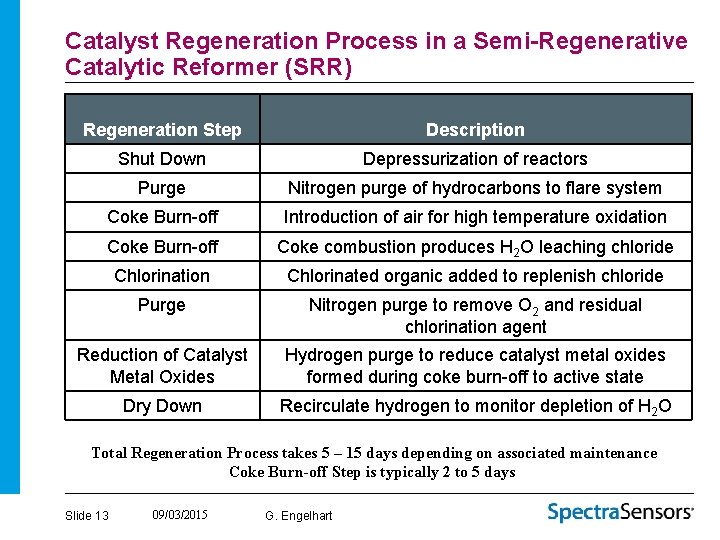
Catalyst Regeneration Process in a Semi-Regenerative Catalytic Reformer (SRR) Regeneration Step Description Shut Down Depressurization of reactors Purge Nitrogen purge of hydrocarbons to flare system Coke Burn-off Introduction of air for high temperature oxidation Coke Burn-off Coke combustion produces H 2 O leaching chloride Chlorination Chlorinated organic added to replenish chloride Purge Nitrogen purge to remove O 2 and residual chlorination agent Reduction of Catalyst Metal Oxides Hydrogen purge to reduce catalyst metal oxides formed during coke burn-off to active state Dry Down Recirculate hydrogen to monitor depletion of H 2 O Total Regeneration Process takes 5 – 15 days depending on associated maintenance Coke Burn-off Step is typically 2 to 5 days Slide 13 09/03/2015 G. Engelhart
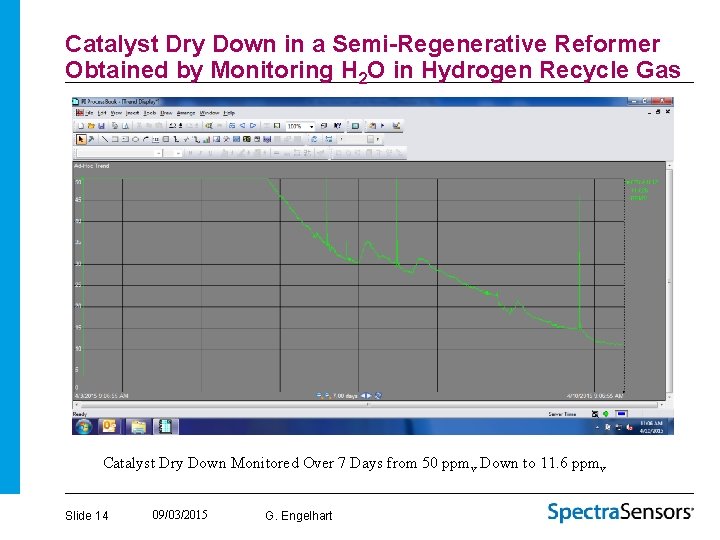
Catalyst Dry Down in a Semi-Regenerative Reformer Obtained by Monitoring H 2 O in Hydrogen Recycle Gas Catalyst Dry Down Monitored Over 7 Days from 50 ppmv Down to 11. 6 ppmv Slide 14 09/03/2015 G. Engelhart
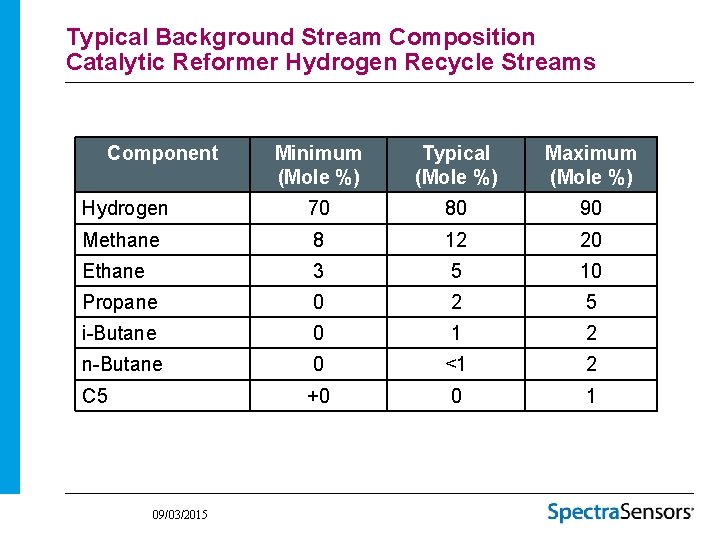
Typical Background Stream Composition Catalytic Reformer Hydrogen Recycle Streams Component Minimum (Mole %) Typical (Mole %) Maximum (Mole %) Hydrogen 70 80 90 Methane 8 12 20 Ethane 3 5 10 Propane 0 2 5 i-Butane 0 1 2 n-Butane 0 <1 2 C 5 +0 0 1 09/03/2015
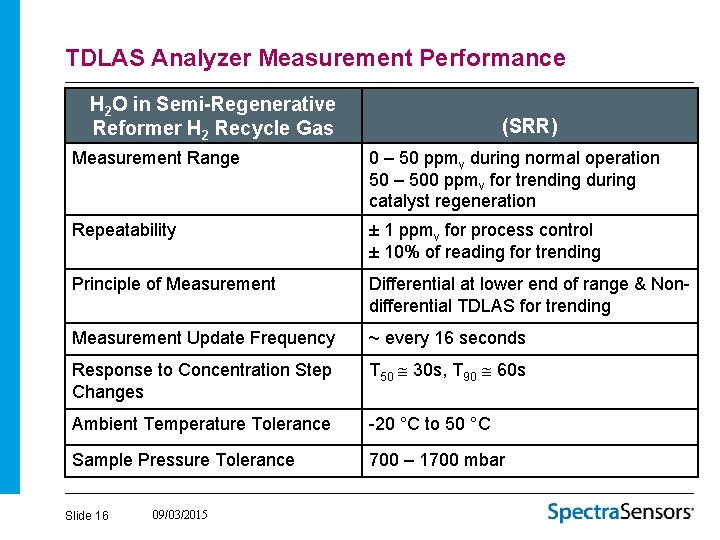
TDLAS Analyzer Measurement Performance H 2 O in Semi-Regenerative Reformer H 2 Recycle Gas (SRR) Measurement Range 0 – 50 ppmv during normal operation 50 – 500 ppmv for trending during catalyst regeneration Repeatability ± 1 ppmv for process control ± 10% of reading for trending Principle of Measurement Differential at lower end of range & Nondifferential TDLAS for trending Measurement Update Frequency ~ every 16 seconds Response to Concentration Step Changes T 50 30 s, T 90 60 s Ambient Temperature Tolerance -20 °C to 50 °C Sample Pressure Tolerance 700 – 1700 mbar Slide 16 09/03/2015
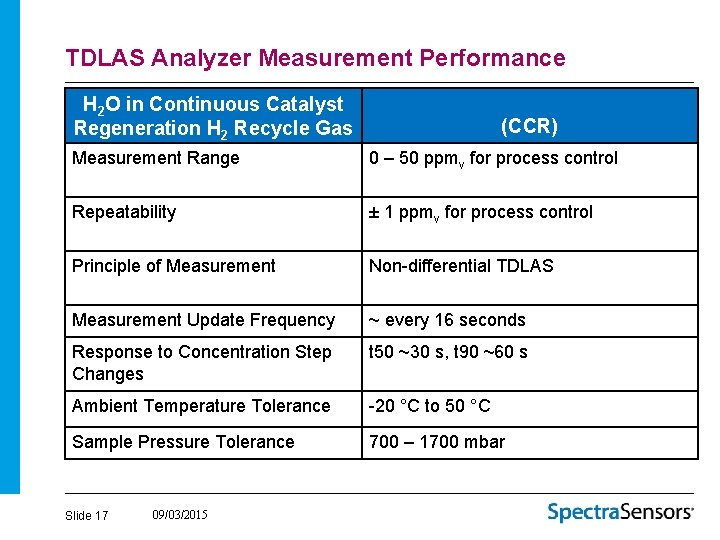
TDLAS Analyzer Measurement Performance H 2 O in Continuous Catalyst Regeneration H 2 Recycle Gas (CCR) Measurement Range 0 – 50 ppmv for process control Repeatability ± 1 ppmv for process control Principle of Measurement Non-differential TDLAS Measurement Update Frequency ~ every 16 seconds Response to Concentration Step Changes t 50 ~30 s, t 90 ~60 s Ambient Temperature Tolerance -20 °C to 50 °C Sample Pressure Tolerance 700 – 1700 mbar Slide 17 09/03/2015
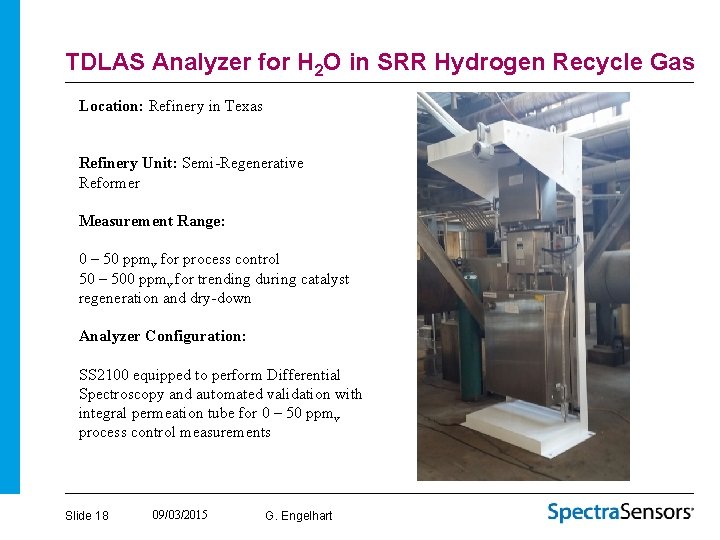
TDLAS Analyzer for H 2 O in SRR Hydrogen Recycle Gas Location: Refinery in Texas Refinery Unit: Semi-Regenerative Reformer Measurement Range: 0 – 50 ppmv for process control 50 – 500 ppmv for trending during catalyst regeneration and dry-down Analyzer Configuration: SS 2100 equipped to perform Differential Spectroscopy and automated validation with integral permeation tube for 0 – 50 ppmv process control measurements Slide 18 09/03/2015 G. Engelhart
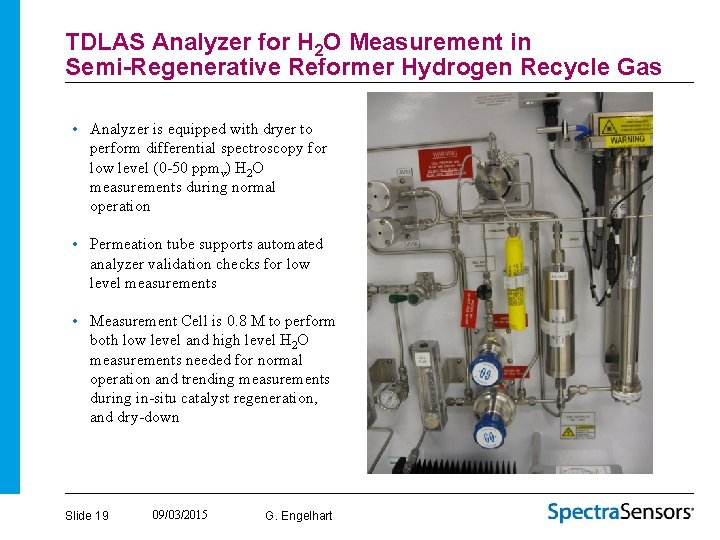
TDLAS Analyzer for H 2 O Measurement in Semi-Regenerative Reformer Hydrogen Recycle Gas • Analyzer is equipped with dryer to perform differential spectroscopy for low level (0 -50 ppmv) H 2 O measurements during normal operation • Permeation tube supports automated analyzer validation checks for low level measurements • Measurement Cell is 0. 8 M to perform both low level and high level H 2 O measurements needed for normal operation and trending measurements during in-situ catalyst regeneration, and dry-down Slide 19 09/03/2015 G. Engelhart
Permeation Tube Option for Automated Validation • An optional permeation tube is available to perform automated validation checks which is useful in an SRR in two ways 1. Chloride and H 2 O are continuously injected to maintain metallic and acidic functions of the reforming catalyst. Consequently the H 2 O concentration present in the H 2 recycle gas varies over time. Performing automated validation checks ensures the analyzer is operating properly and H 2 O measurements are accurate to adjust chloride and H 2 O levels in the process. 2. Following catalyst regeneration as catalyst dry-down approaches the target H 2 O concentration end-point for restarting the SRR, automated validation checks ensure measurements are accurate before and after the restart Slide 20 09/03/2015 G. Engelhart
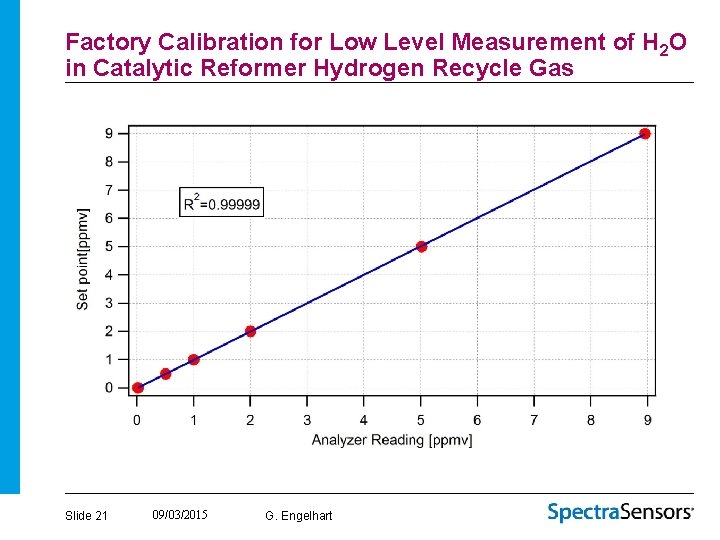
Factory Calibration for Low Level Measurement of H 2 O in Catalytic Reformer Hydrogen Recycle Gas Slide 21 09/03/2015 G. Engelhart
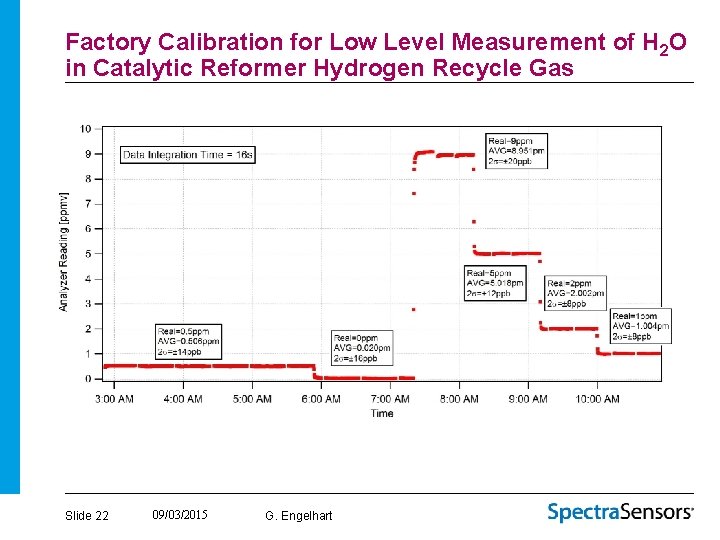
Factory Calibration for Low Level Measurement of H 2 O in Catalytic Reformer Hydrogen Recycle Gas Slide 22 09/03/2015 G. Engelhart
Other H 2 O Measurement Technologies Refineries have used two types of devices for H 2 O measurement in catalytic reformer hydrogen recycle streams • Aluminum Oxide (Al 2 O 3) electrochemical sensors • Quartz Crystal Microbalances (QCM) Both of these devices have a number of deficiencies when employed in harsh process gas applications such as catalytic reformer hydrogen recycle streams Slide 23 09/03/2015 G. Engelhart
On-Stream Factor (Analyzer Availability) • American Petroleum Institute – Recommended Practice 555 for Process Analyzers (ANSI/API RP 555 -2001) Section 1. 3. c states; “On-stream factor: A goal of 95% or greater onstream factor of on-line availability is generally desired. Analyzers exhibiting less than 95% are generally not considered reliable by operations and closed-loop control applications. On-stream factor is the total time the analyzer is operating reliably, relative to process operations. ” Slide 24 09/03/2015 G. Engelhart
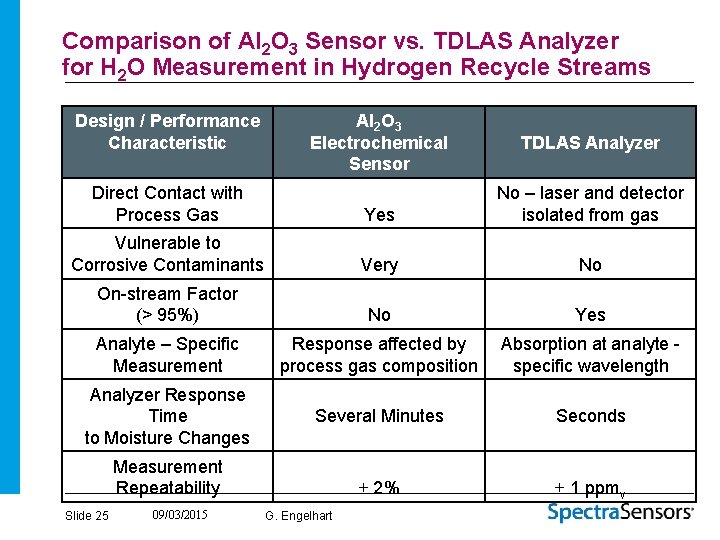
Comparison of Al 2 O 3 Sensor vs. TDLAS Analyzer for H 2 O Measurement in Hydrogen Recycle Streams Design / Performance Characteristic Al 2 O 3 Electrochemical Sensor TDLAS Analyzer Direct Contact with Process Gas Yes No – laser and detector isolated from gas Vulnerable to Corrosive Contaminants Very No On-stream Factor (> 95%) No Yes Analyte – Specific Measurement Response affected by process gas composition Absorption at analyte specific wavelength Analyzer Response Time to Moisture Changes Several Minutes Seconds 2% 1 ppmv Measurement Repeatability Slide 25 09/03/2015 G. Engelhart
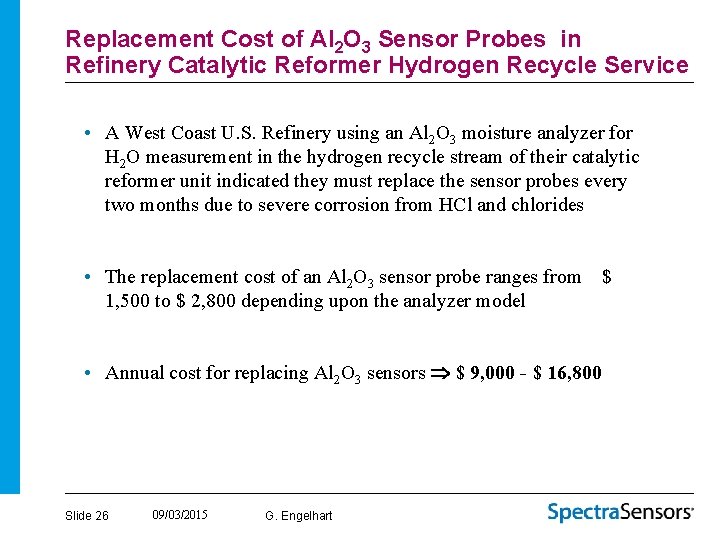
Replacement Cost of Al 2 O 3 Sensor Probes in Refinery Catalytic Reformer Hydrogen Recycle Service • A West Coast U. S. Refinery using an Al 2 O 3 moisture analyzer for H 2 O measurement in the hydrogen recycle stream of their catalytic reformer unit indicated they must replace the sensor probes every two months due to severe corrosion from HCl and chlorides • The replacement cost of an Al 2 O 3 sensor probe ranges from $ 1, 500 to $ 2, 800 depending upon the analyzer model • Annual cost for replacing Al 2 O 3 sensors $ 9, 000 - $ 16, 800 Slide 26 09/03/2015 G. Engelhart
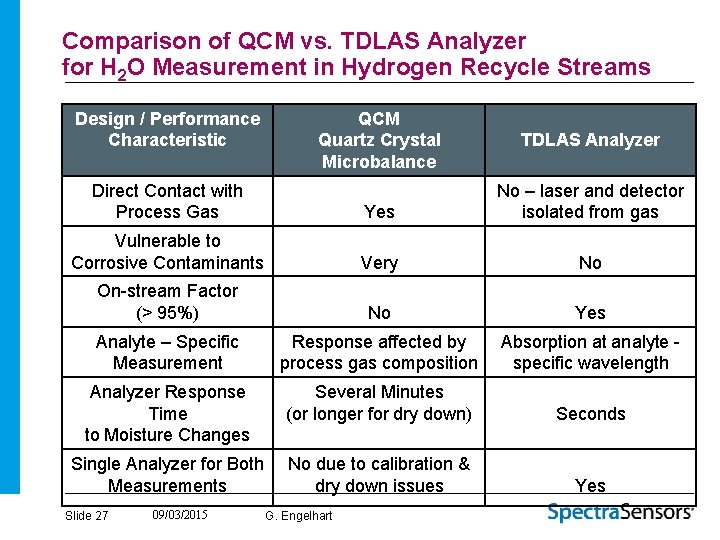
Comparison of QCM vs. TDLAS Analyzer for H 2 O Measurement in Hydrogen Recycle Streams Design / Performance Characteristic QCM Quartz Crystal Microbalance TDLAS Analyzer Direct Contact with Process Gas Yes No – laser and detector isolated from gas Vulnerable to Corrosive Contaminants Very No On-stream Factor (> 95%) No Yes Analyte – Specific Measurement Response affected by process gas composition Absorption at analyte specific wavelength Analyzer Response Time to Moisture Changes Several Minutes (or longer for dry down) Seconds Single Analyzer for Both Measurements No due to calibration & dry down issues Yes Slide 27 09/03/2015 G. Engelhart
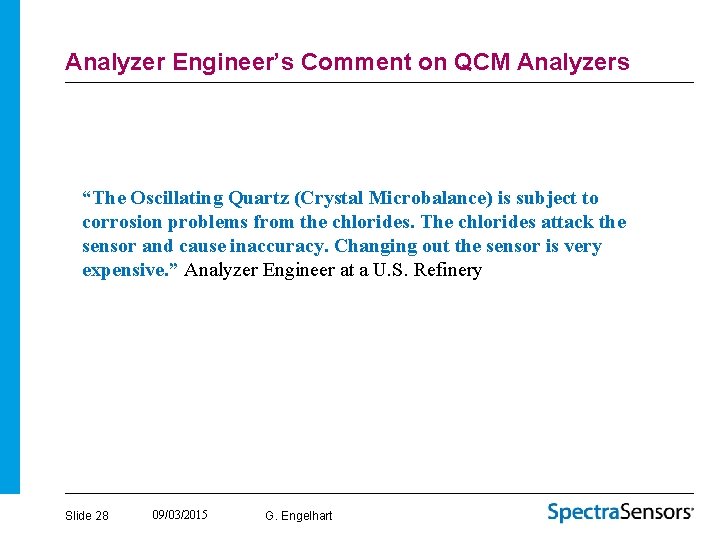
Analyzer Engineer’s Comment on QCM Analyzers “The Oscillating Quartz (Crystal Microbalance) is subject to corrosion problems from the chlorides. The chlorides attack the sensor and cause inaccuracy. Changing out the sensor is very expensive. ” Analyzer Engineer at a U. S. Refinery Slide 28 09/03/2015 G. Engelhart
Summary - I Spectra. Sensors TDLAS Analyzers have proven effective for H 2 O measurements in catalytic reformer hydrogen recycle streams for the following reasons: • Selective and specific H 2 O measurement by non-contact laser spectroscopy is more accurate than Al 2 O 3 sensors and Quartz Crystal Microbalances which can’t always distinguish between H 2 O and other compounds in the gas stream • Laser and detector are isolated and protected from HCl, H 2 S and other contaminants, avoiding corrosion problems encountered with Al 2 O 3 sensors and Quartz Crystal Microbalances that reduce their on-stream factor (analyzer availability) to < 95% Slide 29 09/03/2015 G. Engelhart
Summary - II • A single TDLAS analyzer can perform low level monitoring (0 – 50 ppmv) during normal operation and higher level trending measurements (up to 1, 000 ppmv) during catalyst regeneration and dry-down in a Semi-Regenerative Reformer (SRR) • Optional permeation tube supports automated daily validation checks to verify analyzer is operating properly and providing accurate measurements for controlling H 2 O levels during normal process operation and before and after catalyst dry-down and unit restart • TDLAS analyzers withstand the corrosive conditions in an SRR better than other technologies resulting in significantly lower OPEX and technician labor costs Slide 30 09/03/2015 G. Engelhart
Thank You for Your Attention Slide 31 09/03/2015 G. Engelhart
- Slides: 31