
Reliability testing of VCSELs Transceivers and ASICs History
Reliability testing of VCSELs, Transceivers and ASICs. History, status and plans Opto Mini-Workshop, CERN 21/3/14 Tony Weidberg Opto mini workshop March '14 1
Outline • VCSEL failures in ATLAS – Reminder TL failures – Controlled experiments to determine cause of damage – Outstanding mysteries • TL and AOC VCSELs • Plans for future reliability testing – VCSEL – Transceiver – ASICs Tony Weidberg Opto mini workshop March '14 2

Failure Rates in ATLAS Operation Tony Weidberg Opto mini workshop March '14 3
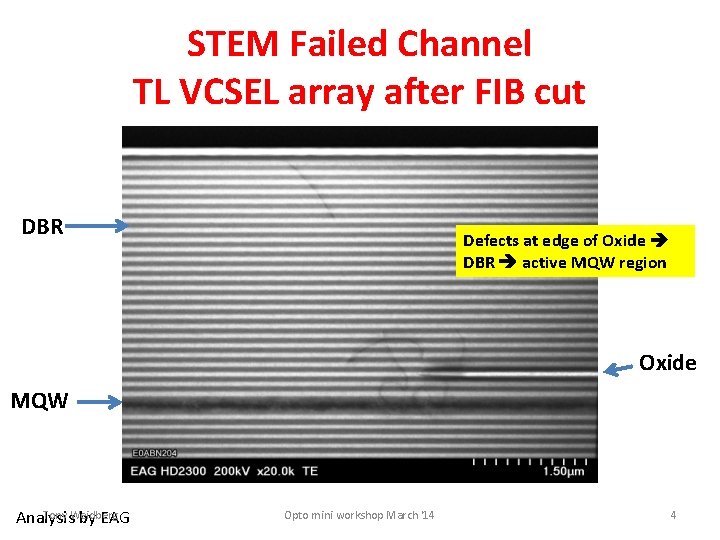
STEM Failed Channel TL VCSEL array after FIB cut DBR Defects at edge of Oxide DBR active MQW region Oxide MQW Tony Weidberg Analysis by EAG Opto mini workshop March '14 4

More Controlled Tests • Aged VCSEL array in 70 C/85% RH with regular power measurements and EL imaging. • Stopped as soon as significant decrease in power detected. • EL image shows 4% of area is dark. • Subsequent TEM analysis (next slides). Tony Weidberg Opto mini workshop March '14 5
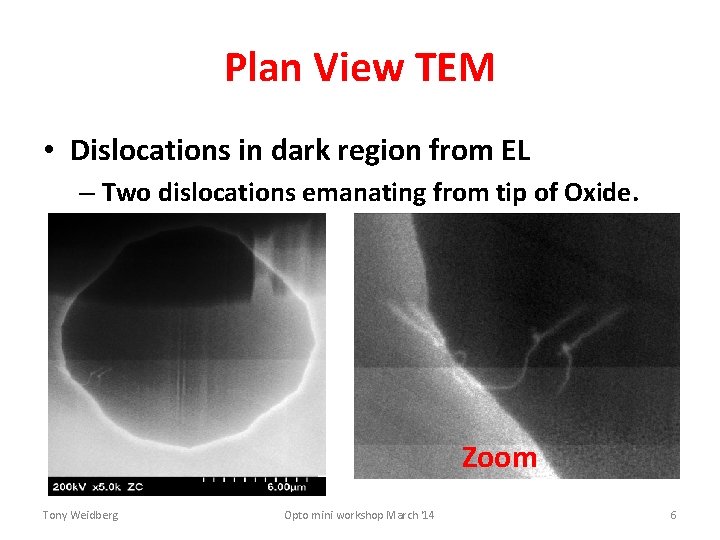
Plan View TEM • Dislocations in dark region from EL – Two dislocations emanating from tip of Oxide. Zoom Tony Weidberg Opto mini workshop March '14 6
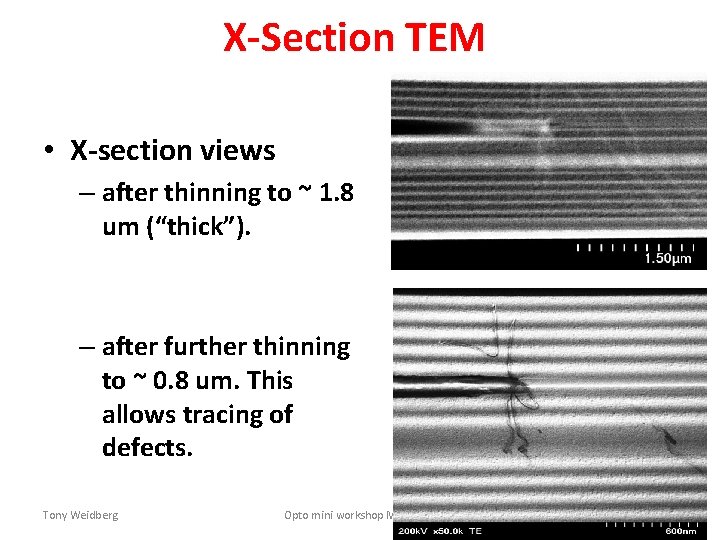
X-Section TEM • X-section views – after thinning to ~ 1. 8 um (“thick”). – after further thinning to ~ 0. 8 um. This allows tracing of defects. Tony Weidberg Opto mini workshop March '14 7
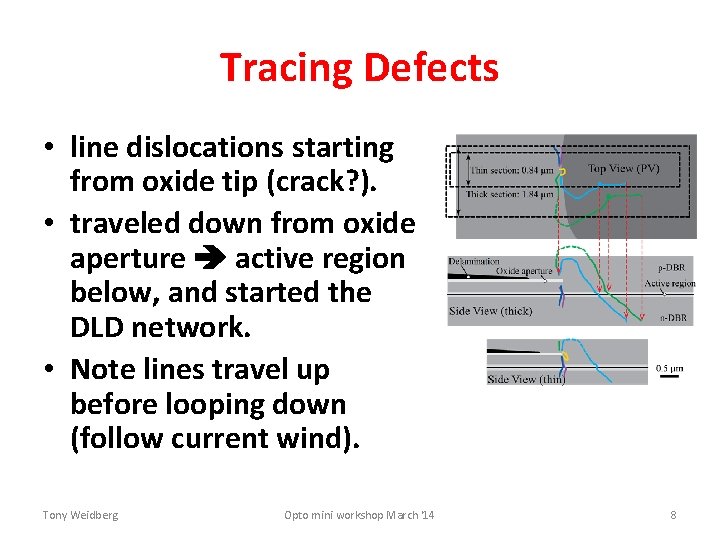
Tracing Defects • line dislocations starting from oxide tip (crack? ). • traveled down from oxide aperture active region below, and started the DLD network. • Note lines travel up before looping down (follow current wind). Tony Weidberg Opto mini workshop March '14 8
Remaining Mysteries -1 • Compare lifetime data from TL VCSELs in ATLAS USA-15 with accelerated ageing tests (ULM). – MTTF in USA-15 is lower than predicted by model fitting ULM data by factor 4 to 6. – Null hypothesis that ULM and USA-15 data described by common parameters for the acceleration model excluded at 90%. • Compare controlled experiment in SR 1 with USA-15. – 4 TL arrays operated in SR 1 for more than 500 days. – Only 1 channel died. – Inconsistent with observed MTTF in USA-15, null hypothesis of same MTTF in SR 1 as USA-15, gives p-value 8. 3 10 -6. Tony Weidberg Opto mini workshop March '14 9
Remaining Mysteries - 2 • Decrease in power for AOC arrays in USA-15 • Measure power using current in p-i-n diode on detector. – Note we do expect significant decrease in responsivity from radiation damage. – See similar decrease for all barrel layers see slide – incompatible with radiation damage? Tony Weidberg Opto mini workshop March '14 10
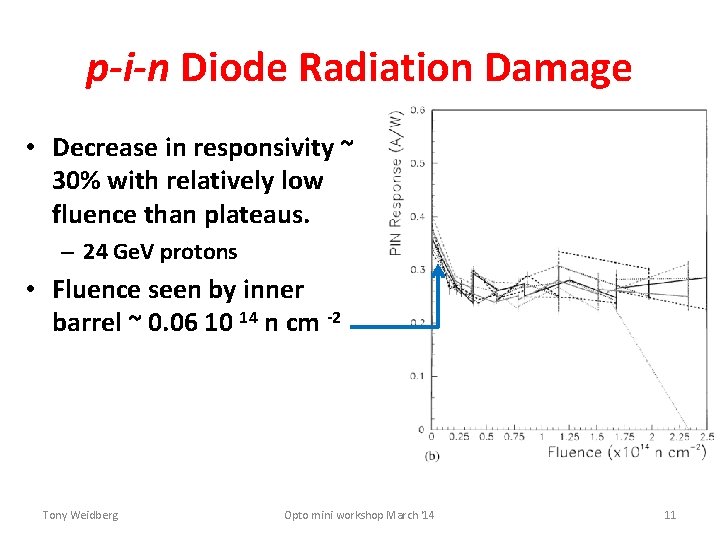
p-i-n Diode Radiation Damage • Decrease in responsivity ~ 30% with relatively low fluence than plateaus. – 24 Ge. V protons • Fluence seen by inner barrel ~ 0. 06 10 14 n cm -2 Tony Weidberg Opto mini workshop March '14 11
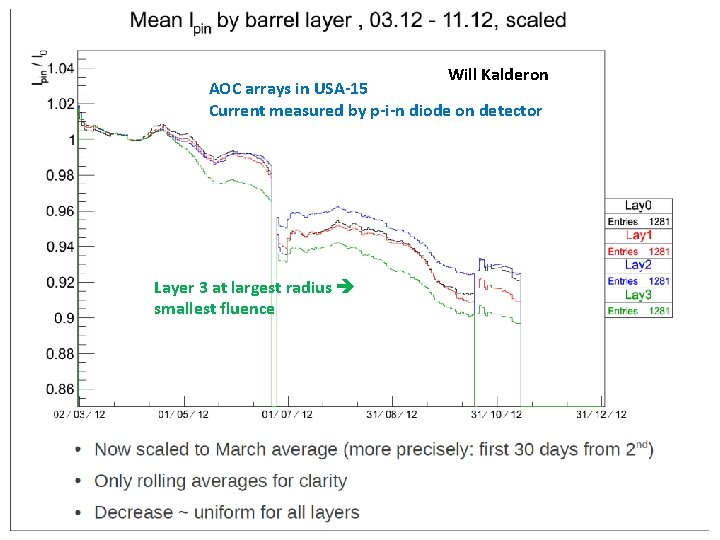
Will Kalderon AOC arrays in USA-15 Current measured by p-i-n diode on detector Layer 3 at largest radius smallest fluence Tony Weidberg Opto mini workshop March '14 12
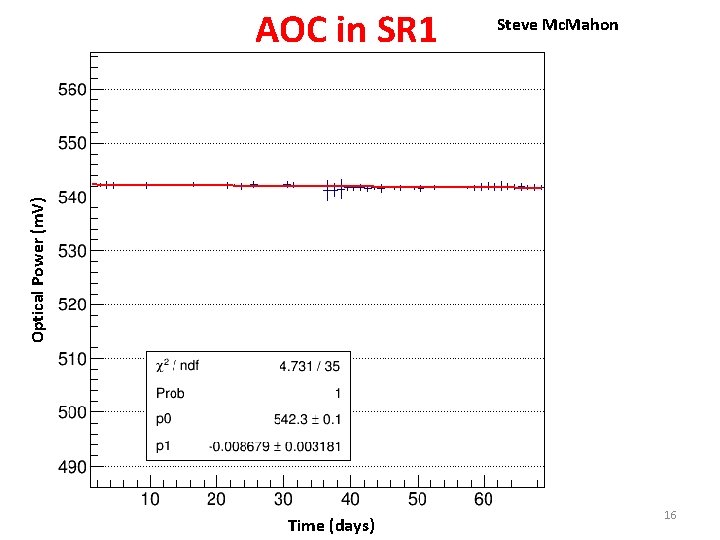
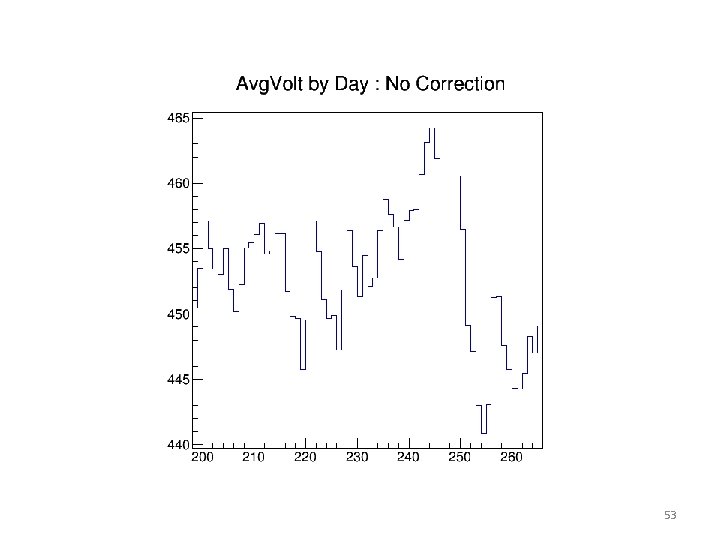
Remaining Mysteries - 3 • Long term monitoring of optical power for AOC TXs in SR 1 using LAPD (measure power from all 12 channels). • Do not reproduce decrease of 10%/year seen in USA-15 slides. Tony Weidberg Opto mini workshop March '14 13
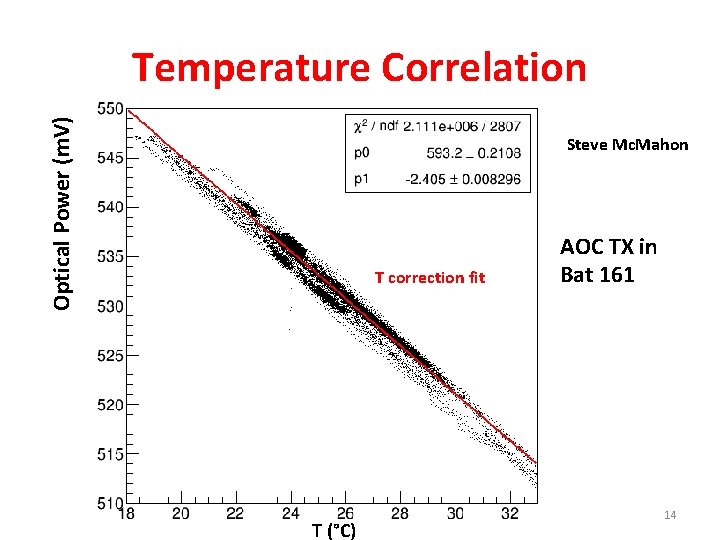
Optical Power (m. V) Temperature Correlation Steve Mc. Mahon T correction fit T (°C) AOC TX in Bat 161 14

AOC TX in Bat 161 Steve Mc. Mahon Optical Power (m. V) AOC TX DT>1 in a day (hence missing days) Time (days) 15
Steve Mc. Mahon Optical Power (m. V) AOC in SR 1 Time (days) 16

VCSEL Testing Plans • Standard damp heat tests – 1000 hours, 85 C/85% RH. – Drive current 10 m. A dc – Measure optical power continuously. – Aim for much higher statistics than we have done in the past learn about infant mortality and random failure rates as well as lifetime. – So far we have tested 2 VCSELs, would like to do 200 devices? • Have equipment to do batches of 80 devices. Valencia Feb 2014 Tony Weidberg 17
Transceiver Tests • Monitor link performance while operating at elevated temperatures. • Look for evidence of degradation using – Eye diagrams – BER scans Valencia Feb 2014 Tony Weidberg 18
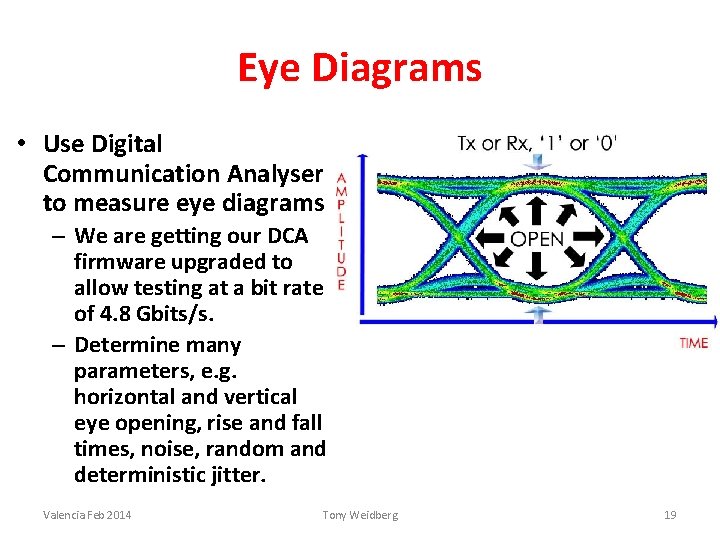
Eye Diagrams • Use Digital Communication Analyser to measure eye diagrams – We are getting our DCA firmware upgraded to allow testing at a bit rate of 4. 8 Gbits/s. – Determine many parameters, e. g. horizontal and vertical eye opening, rise and fall times, noise, random and deterministic jitter. Valencia Feb 2014 Tony Weidberg 19
Equipment for BER Scan • FPGA – Generates PSRB data – Measures BER • Loopback test, e. g. transceiver VTRx to receiver VTRx. • Computer controlled optical attenuator to allow scan of BER vs OMA. Has a 10% and 90% tap to allow for power measurement during BER scan. • Optical switch to allow many channels to be measured. • We are getting a copy of CERN VL system so we can use their firmware and software. Valencia Feb 2014 Tony Weidberg 20
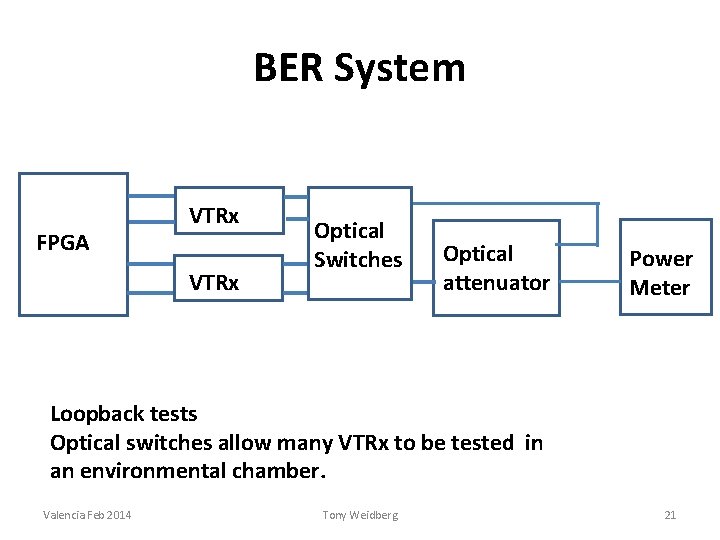
BER System FPGA VTRx Optical Switches Optical attenuator Power Meter Loopback tests Optical switches allow many VTRx to be tested in an environmental chamber. Valencia Feb 2014 Tony Weidberg 21
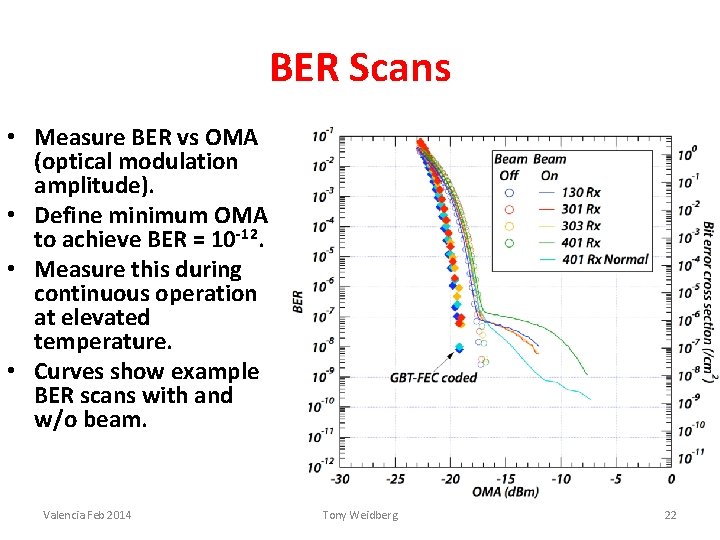
BER Scans • Measure BER vs OMA (optical modulation amplitude). • Define minimum OMA to achieve BER = 10 -12. • Measure this during continuous operation at elevated temperature. • Curves show example BER scans with and w/o beam. Valencia Feb 2014 Tony Weidberg 22
Chip Reliability • • What is there to worry about? Failure Mechanisms Statistical analysis Po. F Plans for testing GBTx (similar study for ABC 130). 23
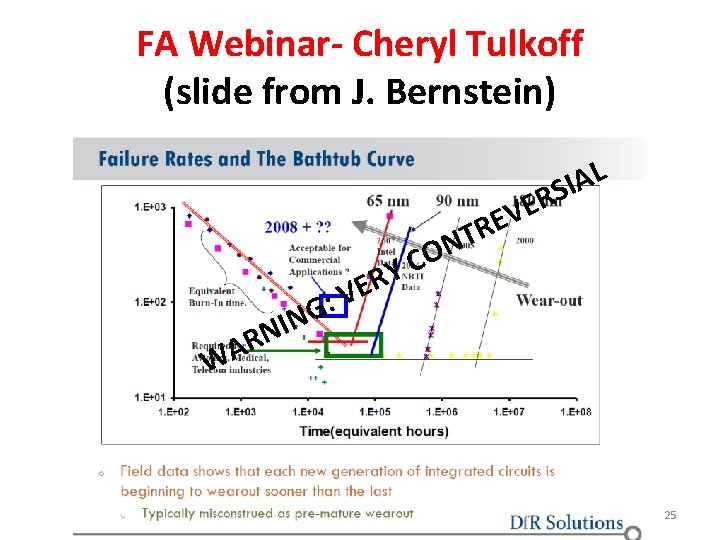
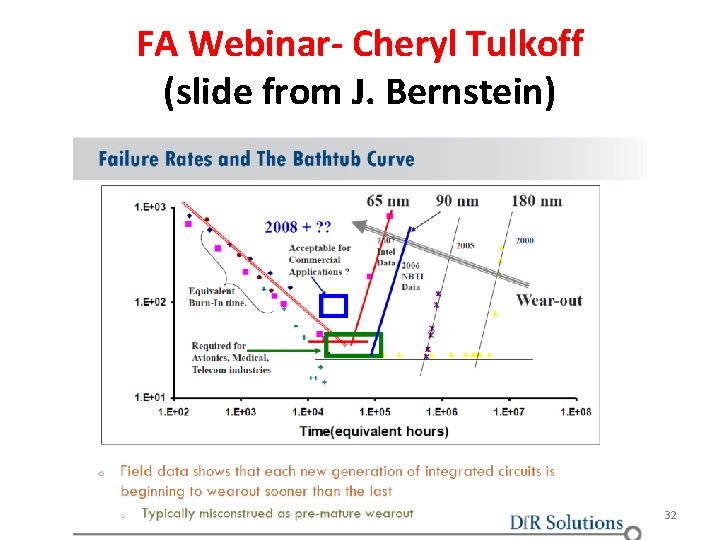
Why worry? • Traditionally failures in HEP not dominated by ASIC reliability – Connectors, solder, wire bonds, cracks in tracks and vias, capacitors, power supplies – Non-ideal scaling in DSM processes • Aggressive designs target optimal performance • Voltage decreases insufficient to compensate density increase higher T lower reliability. 24
FA Webinar- Cheryl Tulkoff (slide from J. Bernstein) R T N O C Y W R E V : ING L A I S R EVE N R A 25
ASIC Reliability • Lifetime tests at different T ( low and high) and elevated V • Fit model parameters extrapolate MTTF to use case (see backup slides for details). • Start with ATLAS pixel FE-I 4 • Test GBTx when large numbers available Tony Weidberg Opto mini workshop March '14 26
Summary & Outlook • “If you think safety is expensive, try having an accident” • Plenty of painful experience in ATLAS must perform rigorous testing before production. • Still trying to understand VCSEL failures in ATLAS • Plan rigorous campaign to understand reliability for phase II upgrades for ATLAS/CMS – VCSELs – Transceivers – ASICs Tony Weidberg Opto mini workshop March '14 27
BACKUP SLIDES Tony Weidberg Opto mini workshop March '14 28
Chip Reliability AUW: ITK Opto-electronics, Electrical Services and DCS: 14/5/13 Steve Mc. Mahon & Tony Weidberg 29
Chip Reliability • • What is there to worry about? Failure Mechanisms Statistical analysis Po. F Plans for testing GBTx (similar study for ABC 130). 30
Why worry? • Traditionally failures in HEP not dominated by ASIC reliability – Connectors, solder, wire bonds, cracks in tracks and vias, capacitors, power supplies – Non-ideal scaling in DSM processes • Aggressive designs target optimal performance • Voltage decreases insufficient to compensate density increase higher T lower reliability. 31
FA Webinar- Cheryl Tulkoff (slide from J. Bernstein) 32
Physics of Failure (Po. F) • Assumption of single dominant damage mechanism can lead to wrong extrapolation of lifetimes from accelerated tests. • Po. F aims to understand different failure mechanisms – Fit model parameters to data for each damage mechanism – Combine results to predict reliability at operating conditions – Health warning: competing models for some damage mechanisms can give very different extrapolations to operating conditions. 33
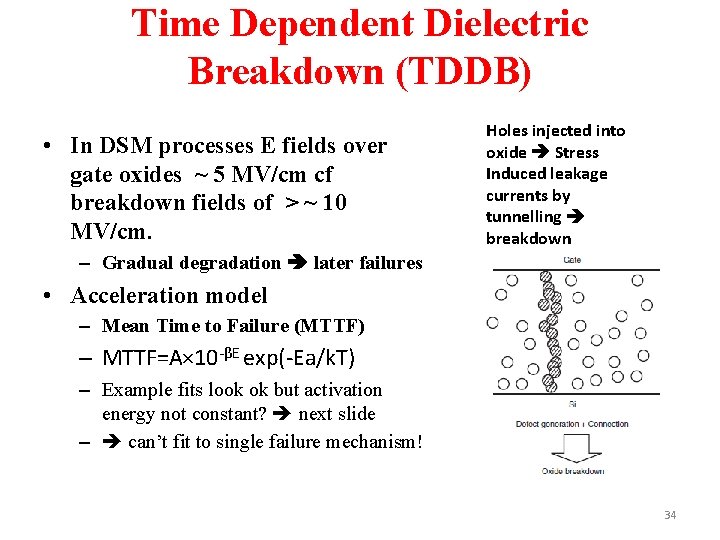
Time Dependent Dielectric Breakdown (TDDB) • In DSM processes E fields over gate oxides ~ 5 MV/cm cf breakdown fields of > ~ 10 MV/cm. Holes injected into oxide Stress Induced leakage currents by tunnelling breakdown – Gradual degradation later failures • Acceleration model – Mean Time to Failure (MTTF) – MTTF=A× 10 -βE exp(-Ea/k. T) – Example fits look ok but activation energy not constant? next slide – can’t fit to single failure mechanism! 34
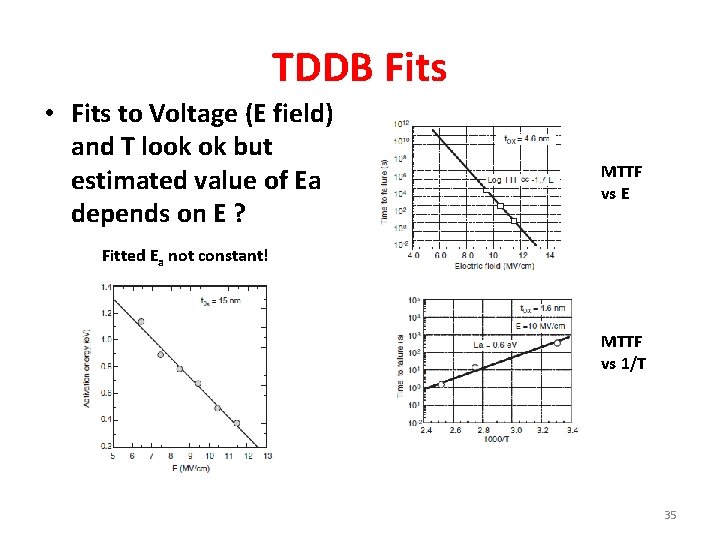
TDDB Fits • Fits to Voltage (E field) and T look ok but estimated value of Ea depends on E ? MTTF vs E Fitted Ea not constant! MTTF vs 1/T 35
Hot Carrier Injection (HCI) • Non-ideal scaling larger E fields “hot” carriers can overcome barrier between Si and gate oxide – Trapped charges lead to changes in VTh and gm – Eventually lead to failure – t = c (Isub)-m – T dependence because at low T electron mfp longer acquire more energy in E field impact ionization. 36
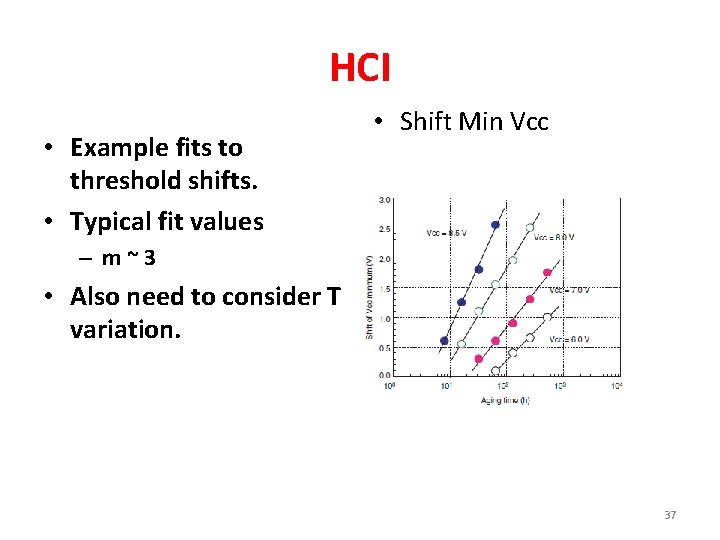
HCI • Example fits to threshold shifts. • Typical fit values • Shift Min Vcc – m~3 • Also need to consider T variation. 37
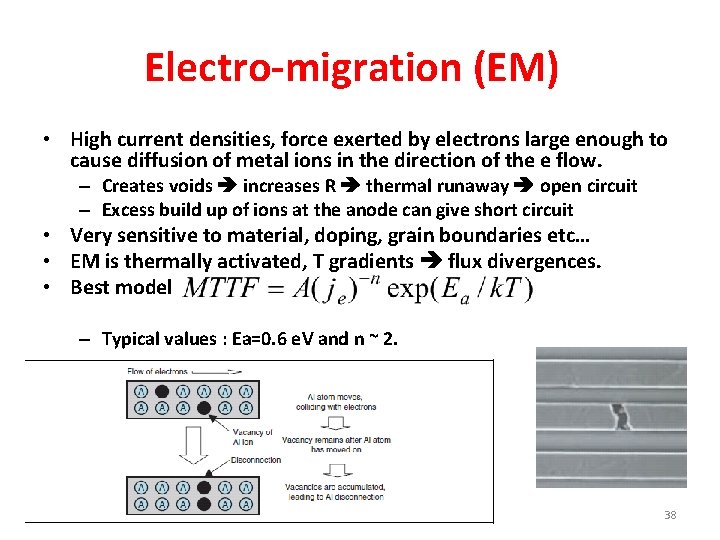
Electro-migration (EM) • High current densities, force exerted by electrons large enough to cause diffusion of metal ions in the direction of the e flow. – Creates voids increases R thermal runaway open circuit – Excess build up of ions at the anode can give short circuit • Very sensitive to material, doping, grain boundaries etc… • EM is thermally activated, T gradients flux divergences. • Best model – Typical values : Ea=0. 6 e. V and n ~ 2. 38
Other Mechanisms • NBTI (Negative Bias Temperature Instability) – Degradation (Vth/Gm shift) occurring due to negative biased BT (bias temperature) stress in PMOS FETs • Stress migration – CTE mismatch can cause stress even with no current. • Assembly & packaging 39
Combining Failure Rates • Common method is just to assume exponential distributions – Total failure rate: – But we know that failure distributions aren’t exponential ! • Failure distributions better modelled by Weibull or lognormal distributions. • Finally we don’t actually want MTTF we need MTT 01 (1% failure) or MTT 10 (10% failure). – Need to combine distributions correctly from different failure mechanisms. – Determine MTT 0 X numerically 40
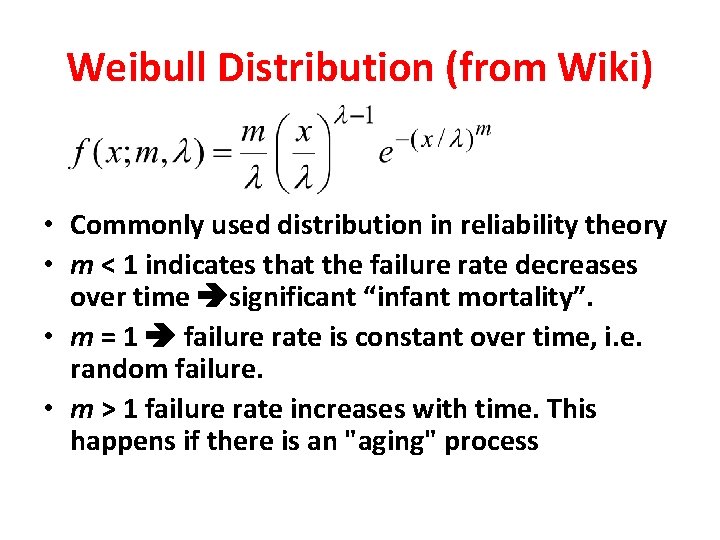
Weibull Distribution (from Wiki) • Commonly used distribution in reliability theory • m < 1 indicates that the failure rate decreases over time significant “infant mortality”. • m = 1 failure rate is constant over time, i. e. random failure. • m > 1 failure rate increases with time. This happens if there is an "aging" process
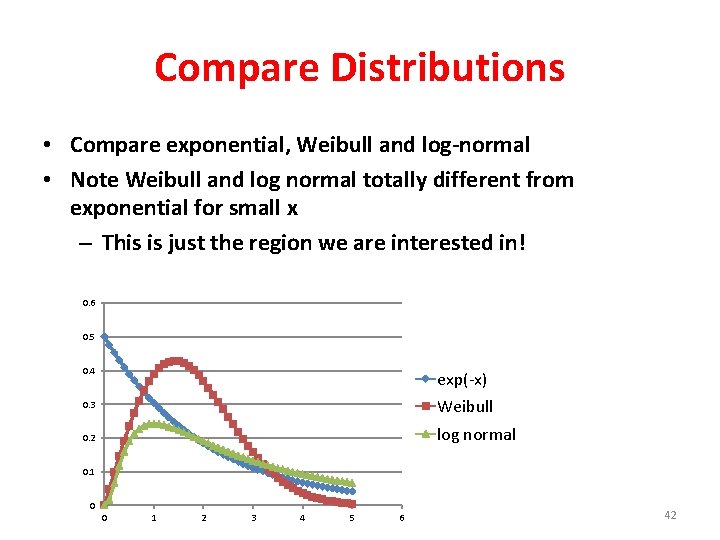
Compare Distributions • Compare exponential, Weibull and log-normal • Note Weibull and log normal totally different from exponential for small x – This is just the region we are interested in! 0. 6 0. 5 0. 4 exp(-x) 0. 3 Weibull 0. 2 log normal 0. 1 0 0 1 2 3 4 5 6 42
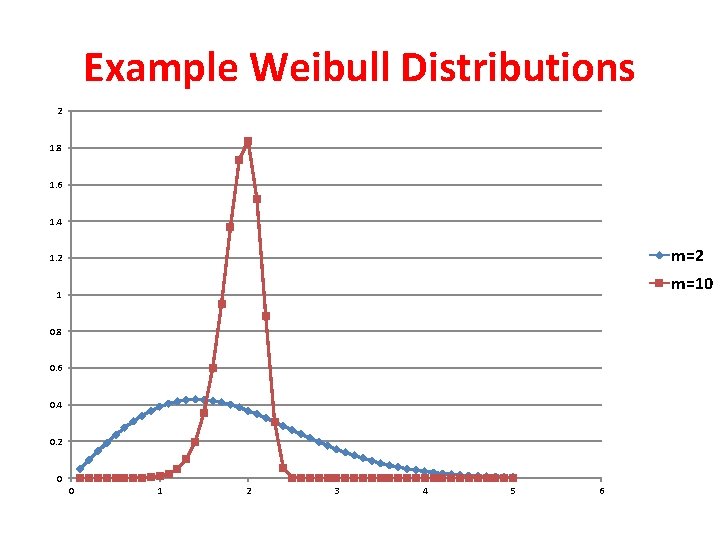
Example Weibull Distributions 2 1. 8 1. 6 1. 4 m=2 1. 2 m=10 1 0. 8 0. 6 0. 4 0. 2 0 0 1 2 3 4 5 6
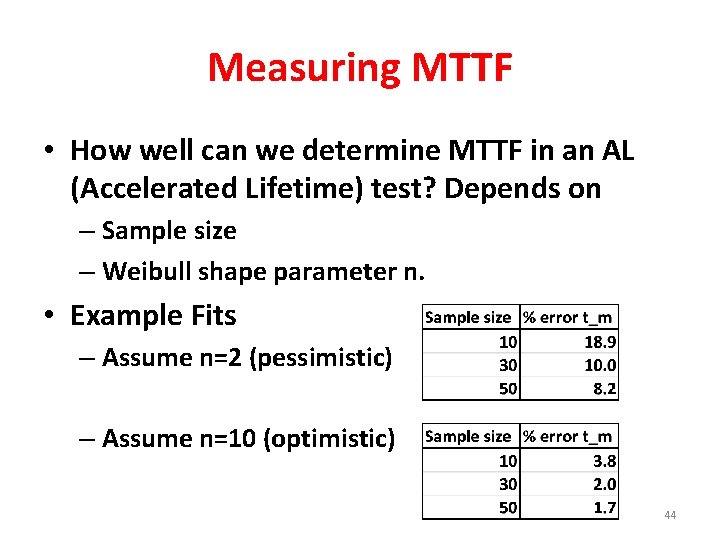
Measuring MTTF • How well can we determine MTTF in an AL (Accelerated Lifetime) test? Depends on – Sample size – Weibull shape parameter n. • Example Fits – Assume n=2 (pessimistic) – Assume n=10 (optimistic) 44
Determining Model Parameters • Brute force: Run ALT for matrix of different T and V and fit data to get model parameters. – Too many tests too slow/expensive. • Smarter approach – High T/High V TDDB • Vary T Ea, vary V exponent c – Low T/High V HCI • Vary T Ea 2, vary V g 2 – High T/low V EM dominates • Vary T Ea 3 45
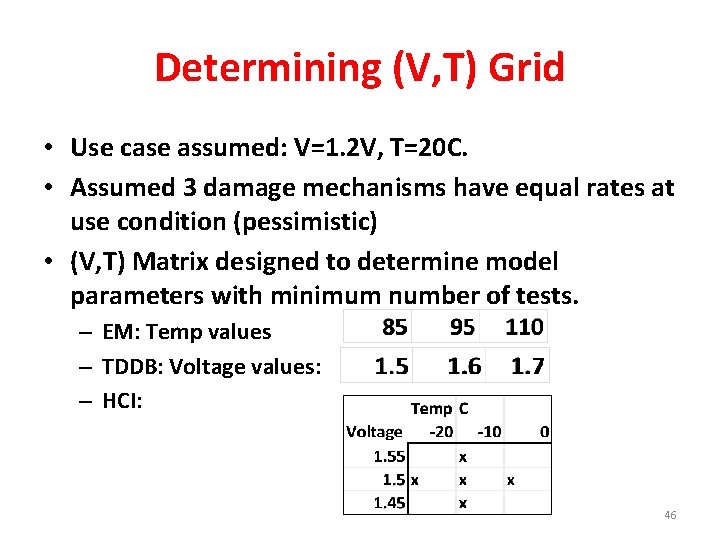
Determining (V, T) Grid • Use case assumed: V=1. 2 V, T=20 C. • Assumed 3 damage mechanisms have equal rates at use condition (pessimistic) • (V, T) Matrix designed to determine model parameters with minimum number of tests. – EM: Temp values – TDDB: Voltage values: – HCI: 46
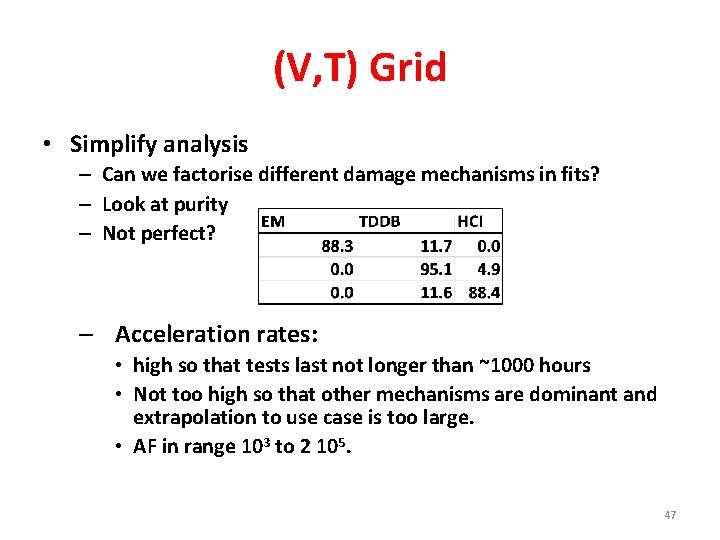
(V, T) Grid • Simplify analysis – Can we factorise different damage mechanisms in fits? – Look at purity – Not perfect? – Acceleration rates: • high so that tests last not longer than ~1000 hours • Not too high so that other mechanisms are dominant and extrapolation to use case is too large. • AF in range 103 to 2 105. 47
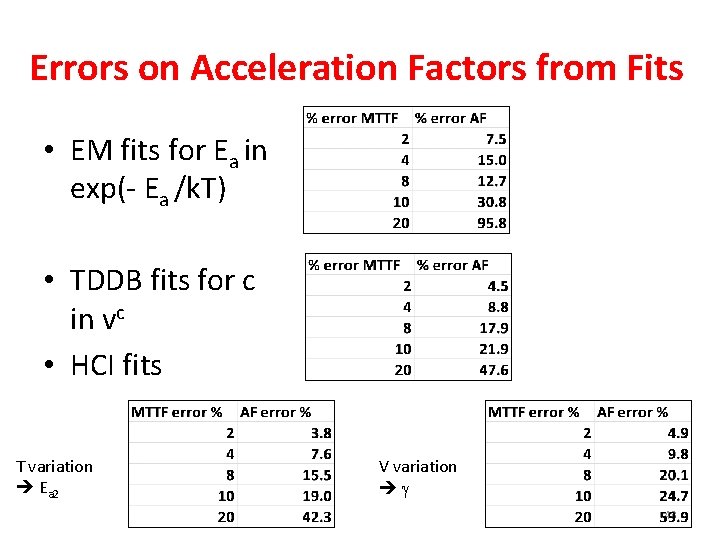
Errors on Acceleration Factors from Fits • EM fits for Ea in exp(- Ea /k. T) • TDDB fits for c in vc • HCI fits T variation Ea 2 V variation g 48
Next Steps • Global Fits: – Use all (V, T) data in one fit – Build reliability model plot predicted cumulative failure rates at some reference point. – Predict MTT 10 and MTT 01 failure – Note: eventually this type of information will be used to decide whether we need redundancy. 49
Practical issues • Can we use this (V, T) range (TBD with Paulo). • Need minimum 11 grid points and between 10 and 30 chips per point. • Also need to do quick tests with fewer chips to determine centres of the grids. – Check that MTTF is in reasonable range (1 to 1000 hours). • Number of chips required in range 150 to 400. • Use several environmental chambers – Combine tests at same T but different V conditions need between 3 and 7 environmental chambers depending if all tests are done in parallel or some in series. – Hope to find new collaborators … 50
References • Bernstein, Physics of Failure Based Handbook of Microelectronic Systems, RIAC. • Srinivasaan et al, The impact of Technology Scaling on Lifetime Reliability, DSN-04. • Semiconductor Reliability Handbook, www. renesas-electoronics. com 51
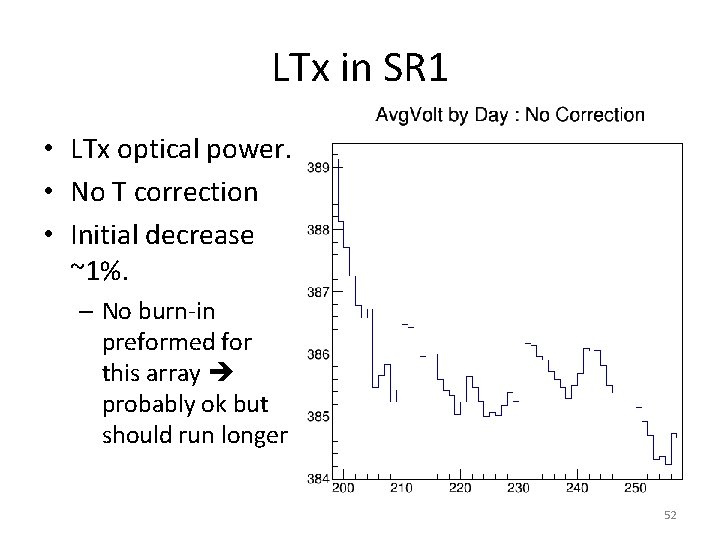
LTx in SR 1 • LTx optical power. • No T correction • Initial decrease ~1%. – No burn-in preformed for this array probably ok but should run longer 52
53
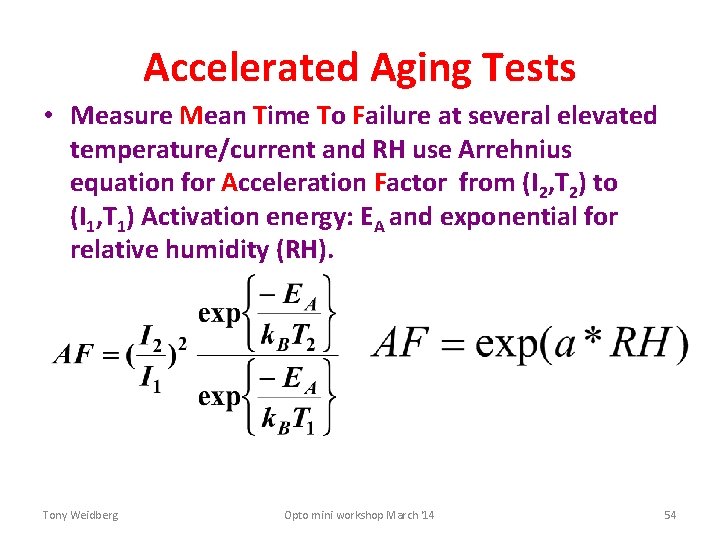
Accelerated Aging Tests • Measure Mean Time To Failure at several elevated temperature/current and RH use Arrehnius equation for Acceleration Factor from (I 2, T 2) to (I 1, T 1) Activation energy: EA and exponential for relative humidity (RH). Tony Weidberg Opto mini workshop March '14 54
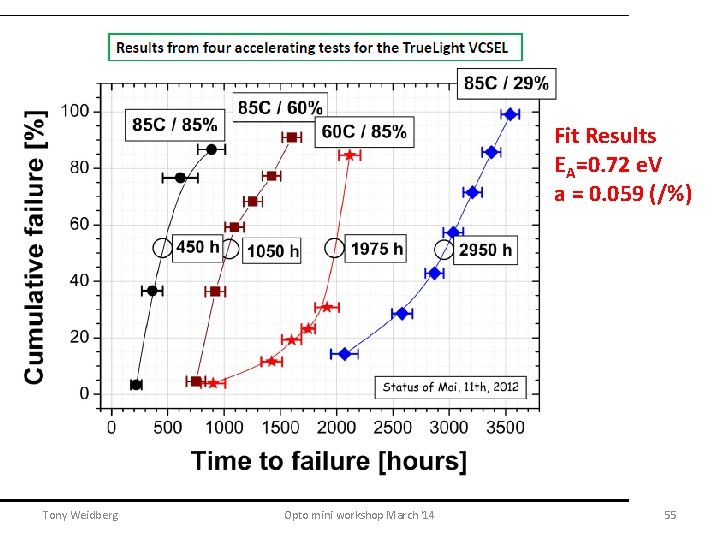
Fit Results EA=0. 72 e. V a = 0. 059 (/%) Tony Weidberg Opto mini workshop March '14 55
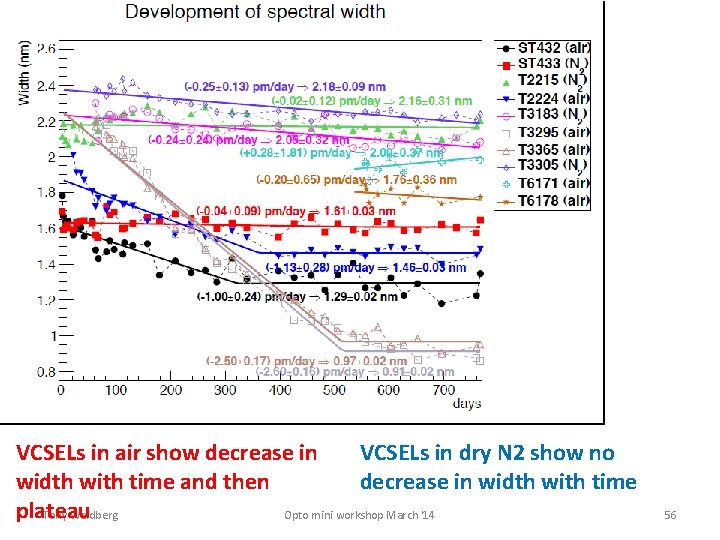
VCSELs in air show decrease in VCSELs in dry N 2 show no width with time and then decrease in width with time plateau Tony Weidberg Opto mini workshop March '14 56
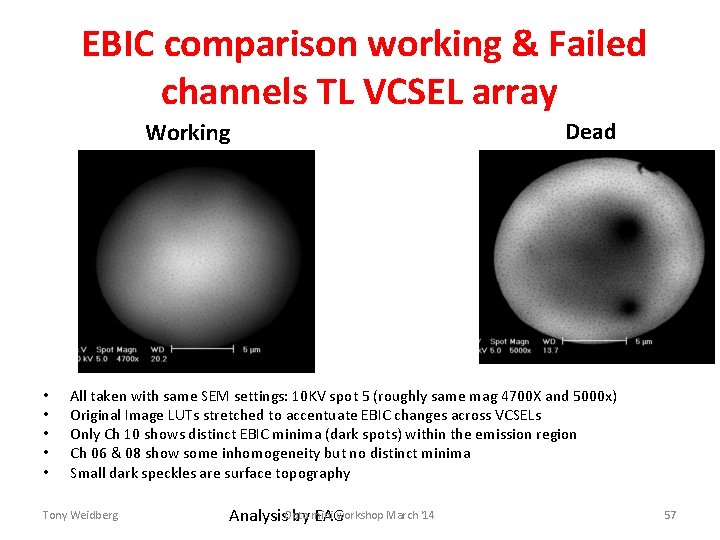
EBIC comparison working & Failed channels TL VCSEL array Working • • • Dead All taken with same SEM settings: 10 KV spot 5 (roughly same mag 4700 X and 5000 x) Original Image LUTs stretched to accentuate EBIC changes across VCSELs Only Ch 10 shows distinct EBIC minima (dark spots) within the emission region Ch 06 & 08 show some inhomogeneity but no distinct minima Small dark speckles are surface topography Tony Weidberg Analysis. Opto by mini EAGworkshop March '14 57
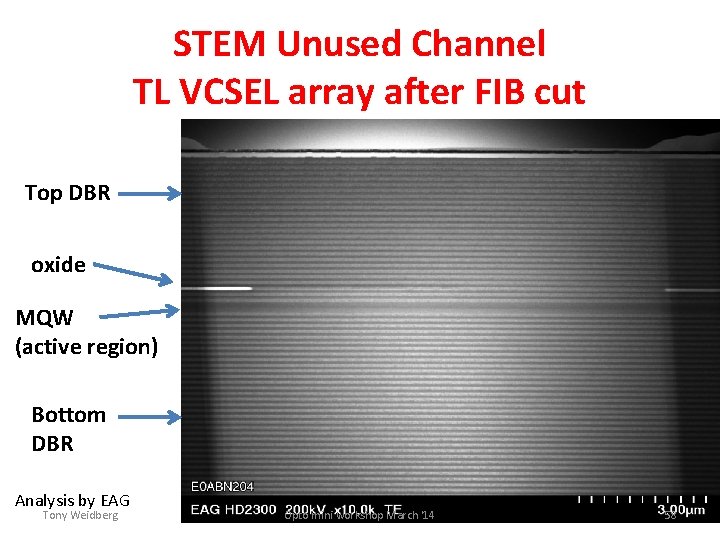
STEM Unused Channel TL VCSEL array after FIB cut Top DBR oxide MQW (active region) Bottom DBR Analysis by EAG Tony Weidberg Opto mini workshop March '14 58
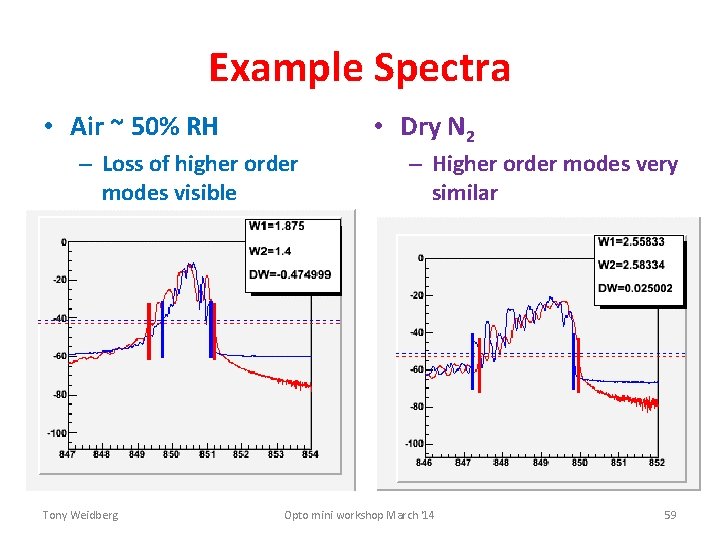
Example Spectra • Air ~ 50% RH • Dry N 2 – Loss of higher order modes visible Tony Weidberg – Higher order modes very similar Opto mini workshop March '14 59
- Slides: 59