
Reliability SMJ 4812 Project Mgmt and Maintenance Eng
Reliability SMJ 4812 Project Mgmt and Maintenance Eng.
Definition of Reliability “Probability that a system or product will perform in a satisfactory manner for a given period of time when used under specified operating condition”
Reliability - 4 main elements 1. 2. probability – numerical representation - number of times that an event occurs (success) divided by total number trials Satisfactory performance – criteria established which describe what is considered to be satisfactory system operation
3. 4. Specifed time – measure against which degree of system performance can be related - used to predict probability of an item surviving without failure for a designated period of time Specified operating conditions expect a system to function - environmental factors, humidity, vibration, shock, temperature cycle, operational profile, etc.
LIFE CYCLE CURVE n n n typical life history curve for infinite no of items – ‘bathtub curve comparison of failure rate with time 3 distinct phase – debugging , chance failure and wear-out phase
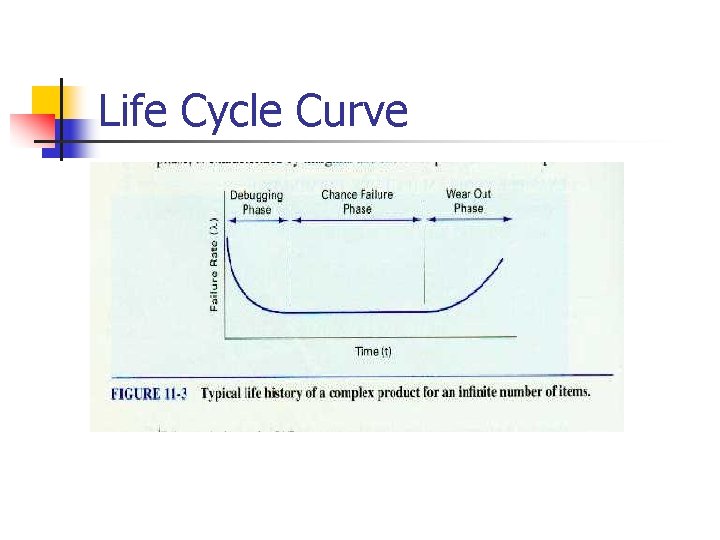
Life Cycle Curve
Debugging (Infant mortality) Phase n n n rapid decrease in failure rate Weibull distribution with shape parameter < 1 is used to describe the occurrences of failure Usually covered by warranty period
Chance failure phase n n Constant failure rate – failure occur in random manner Exponential and also Weibull with =1 can be used to describe this phase
Wear-out phase n n n Sharp rise in failure rate – fatigue, corrosion (old age) Normal distribution is one that best describes this phase Also can use Weibull with shape parameter >1
Maintainability n n n Pertains to the ease, accuracy, safety and economy in the performance of maintenance actions Ability of an item to be maintained Maintainability is a design parameter, maintenance is a result of design
Measures of Maintainability MTBM – mean time between maintenance, include preventive and corrective maintenance MTBR – mean time between replacement, generate spare part requirement - mean active maintenance time ct – mean corrective maintenance time or mean time to repair pt – mean preventive maintenance time
n n n Frequency of maintenance for a given time is highly dependent on the reliability of that item Reliability frequency of maintenance Unreliable system require extensive maintenance
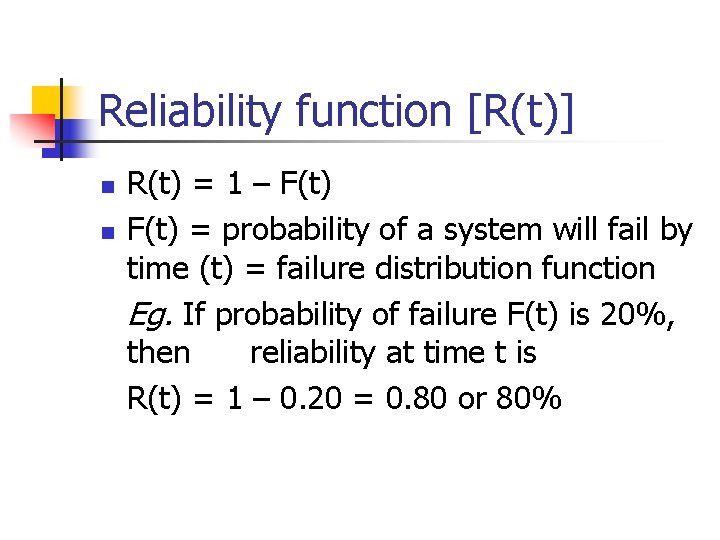
Reliability function [R(t)] n n R(t) = 1 – F(t) = probability of a system will fail by time (t) = failure distribution function Eg. If probability of failure F(t) is 20%, then reliability at time t is R(t) = 1 – 0. 20 = 0. 80 or 80%
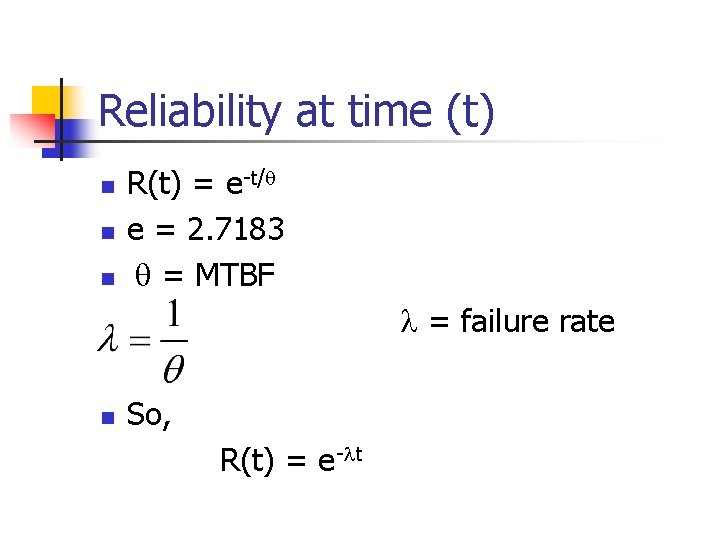
Reliability at time (t) n n n R(t) = e-t/ e = 2. 7183 = MTBF = failure rate n So, R(t) = e- t
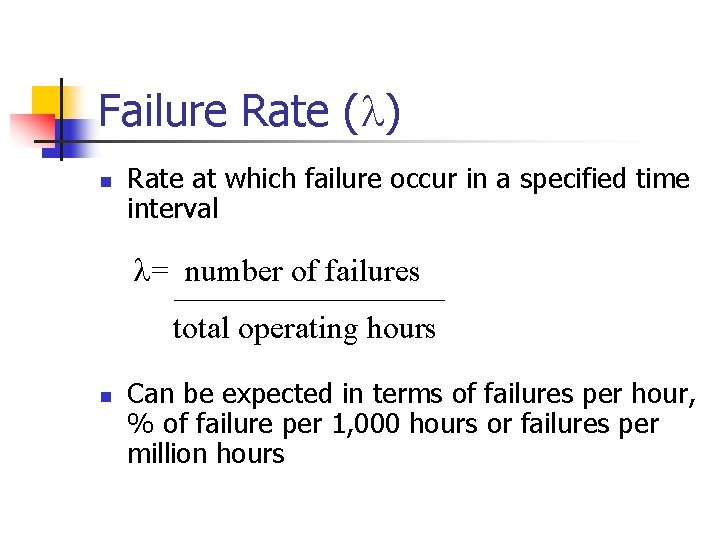
Failure Rate ( ) n Rate at which failure occur in a specified time interval = number of failures total operating hours n Can be expected in terms of failures per hour, % of failure per 1, 000 hours or failures per million hours
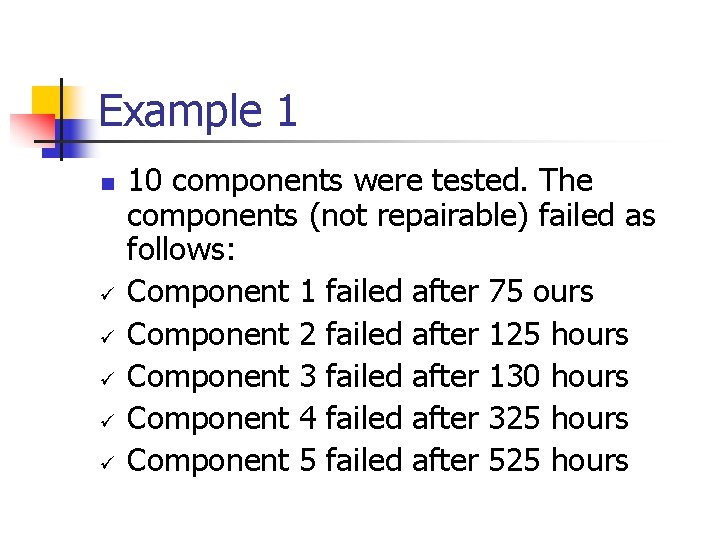
Example 1 n ü ü ü 10 components were tested. The components (not repairable) failed as follows: Component 1 failed after 75 ours Component 2 failed after 125 hours Component 3 failed after 130 hours Component 4 failed after 325 hours Component 5 failed after 525 hours
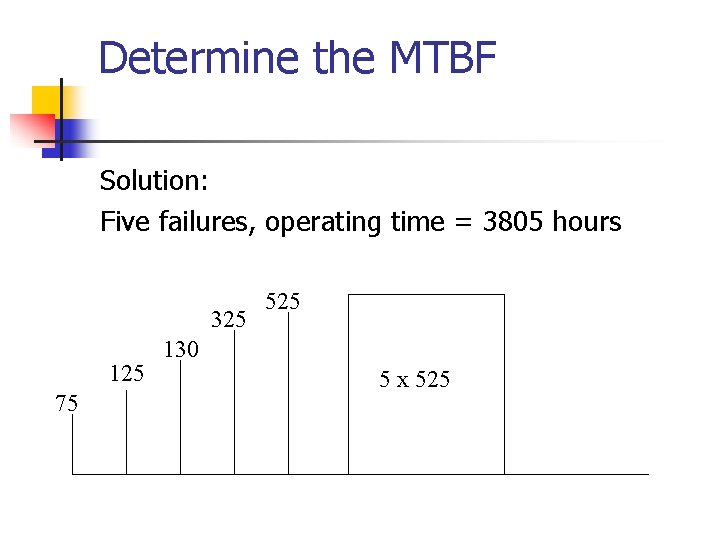
Determine the MTBF Solution: Five failures, operating time = 3805 hours 325 125 75 525 130 5 x 525
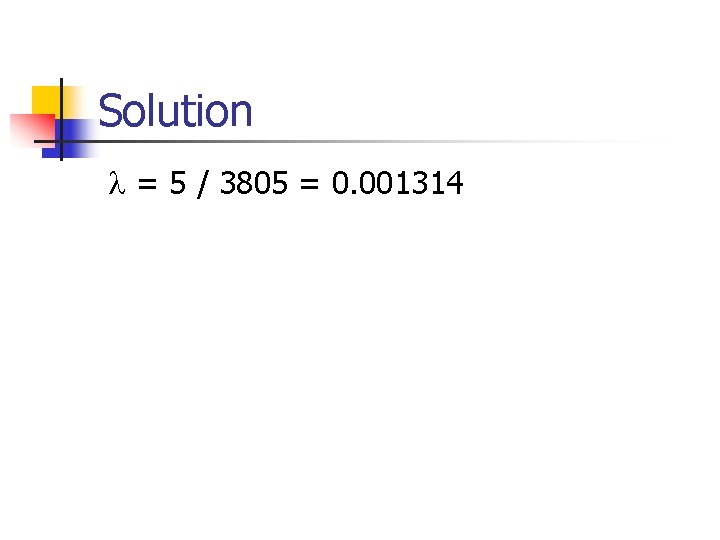
Solution = 5 / 3805 = 0. 001314
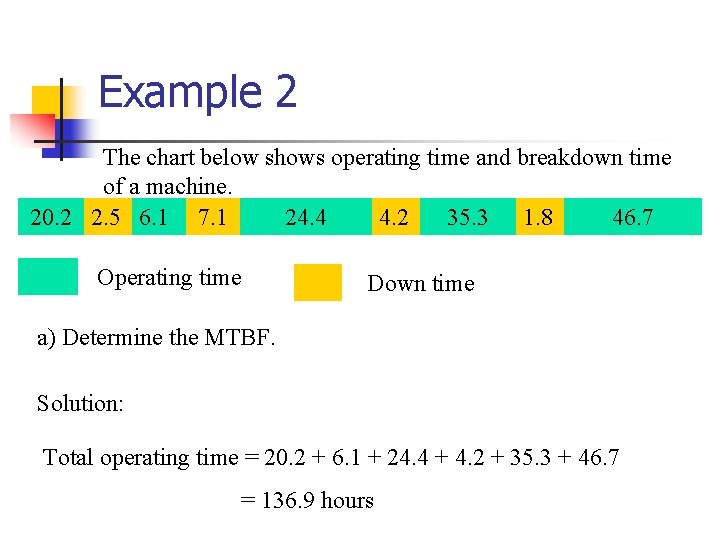
Example 2 The chart below shows operating time and breakdown time of a machine. 20. 2 2. 5 6. 1 7. 1 24. 4 4. 2 35. 3 1. 8 46. 7 Operating time Down time a) Determine the MTBF. Solution: Total operating time = 20. 2 + 6. 1 + 24. 4 + 4. 2 + 35. 3 + 46. 7 = 136. 9 hours
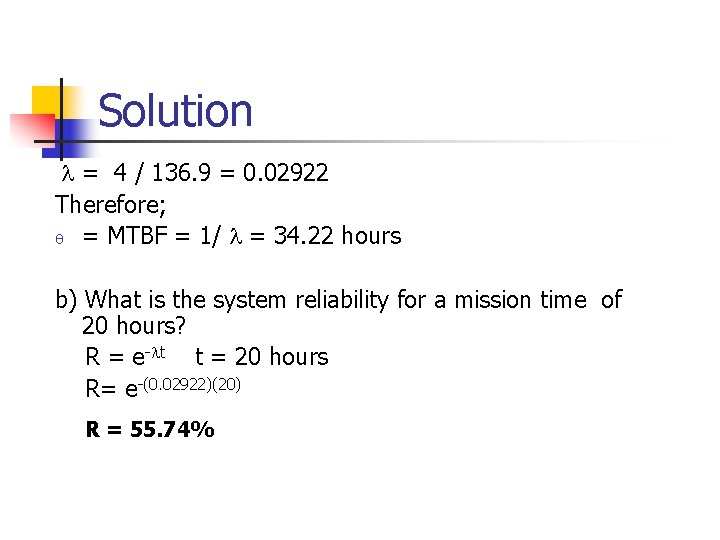
Solution = 4 / 136. 9 = 0. 02922 Therefore; = MTBF = 1/ = 34. 22 hours b) What is the system reliability for a mission time of 20 hours? R = e- t t = 20 hours R= e-(0. 02922)(20) R = 55. 74%
Reliability Component Relationship n Application in series network, parallel and combination of both
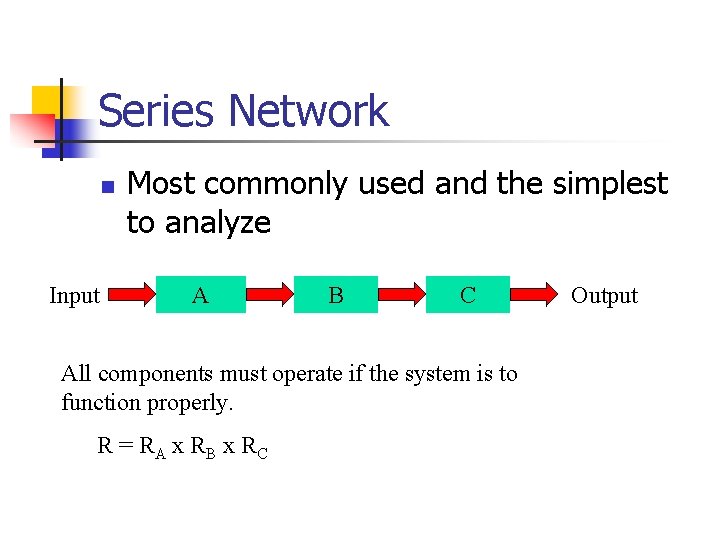
Series Network n Input Most commonly used and the simplest to analyze A B C All components must operate if the system is to function properly. R = R A x RB x RC Output
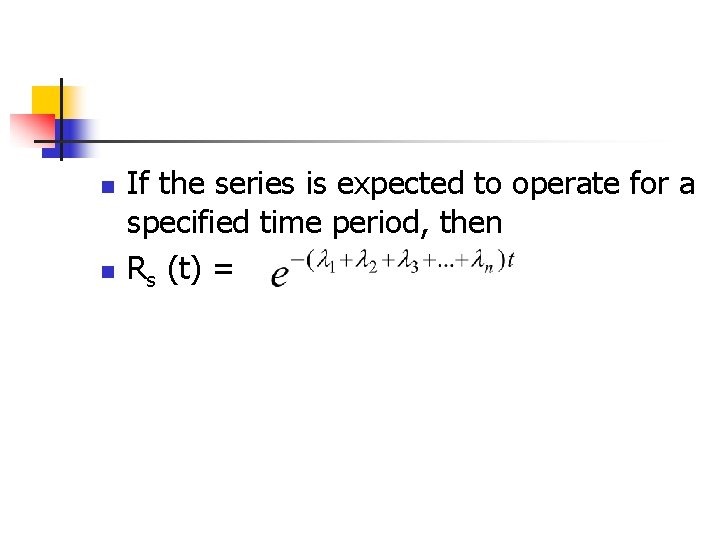
n n If the series is expected to operate for a specified time period, then Rs (t) =
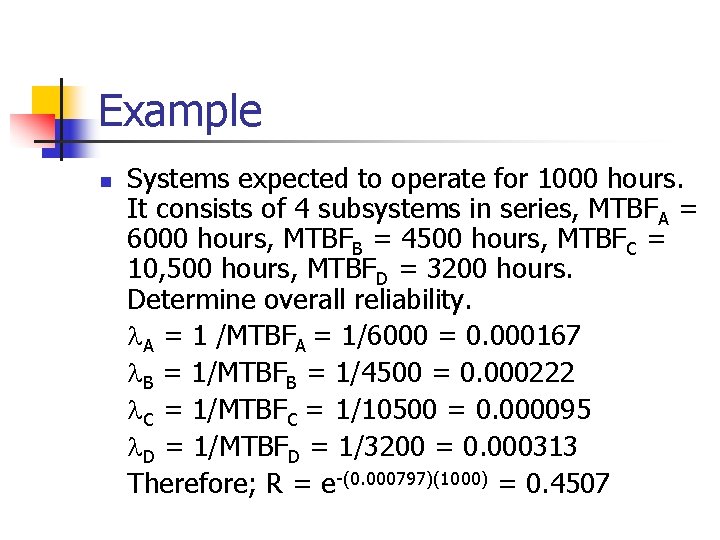
Example n Systems expected to operate for 1000 hours. It consists of 4 subsystems in series, MTBFA = 6000 hours, MTBFB = 4500 hours, MTBFC = 10, 500 hours, MTBFD = 3200 hours. Determine overall reliability. A = 1 /MTBFA = 1/6000 = 0. 000167 B = 1/MTBFB = 1/4500 = 0. 000222 C = 1/MTBFC = 1/10500 = 0. 000095 D = 1/MTBFD = 1/3200 = 0. 000313 Therefore; R = e-(0. 000797)(1000) = 0. 4507
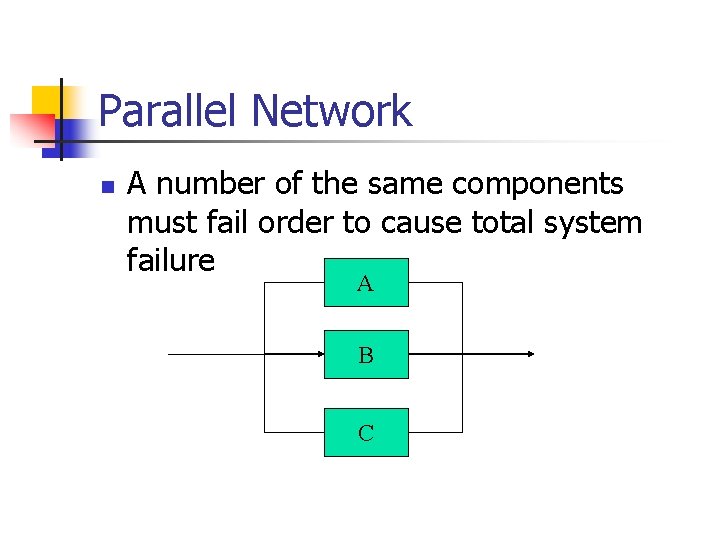
Parallel Network n A number of the same components must fail order to cause total system failure A B C
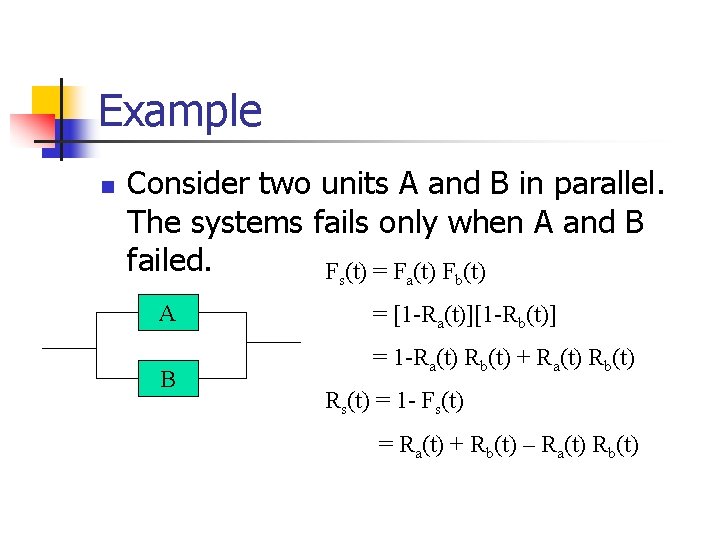
Example n Consider two units A and B in parallel. The systems fails only when A and B failed. Fs(t) = Fa(t) Fb(t) A B = [1 -Ra(t)][1 -Rb(t)] = 1 -Ra(t) Rb(t) + Ra(t) Rb(t) Rs(t) = 1 - Fs(t) = Ra(t) + Rb(t) – Ra(t) Rb(t)
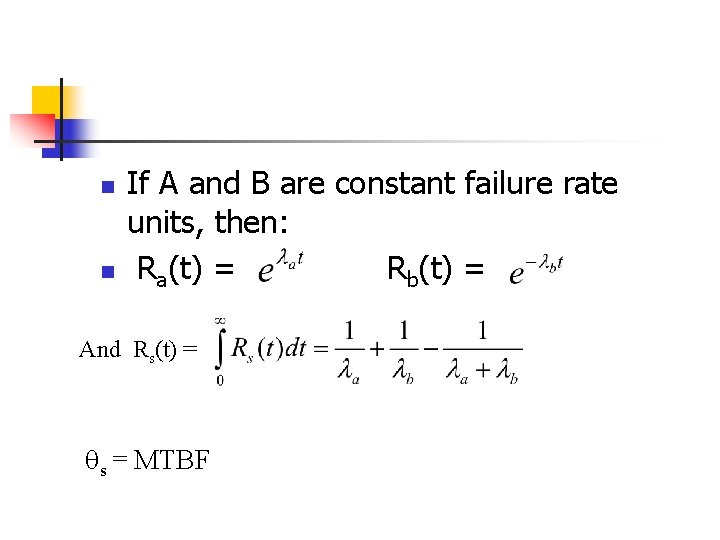
n n If A and B are constant failure rate units, then: Ra(t) = Rb(t) = And Rs(t) = s = MTBF
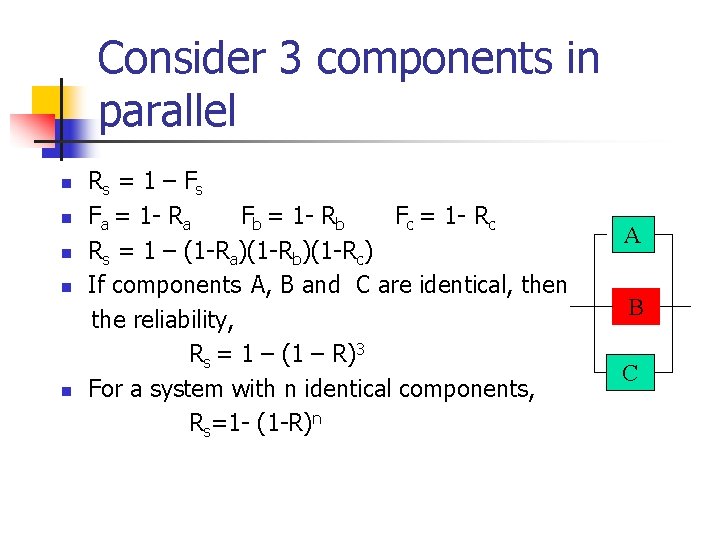
Consider 3 components in parallel n n n Rs = 1 – F s Fa = 1 - Ra Fb = 1 - Rb Fc = 1 - Rc Rs = 1 – (1 -Ra)(1 -Rb)(1 -Rc) If components A, B and C are identical, then the reliability, Rs = 1 – (1 – R)3 For a system with n identical components, Rs=1 - (1 -R)n A B C
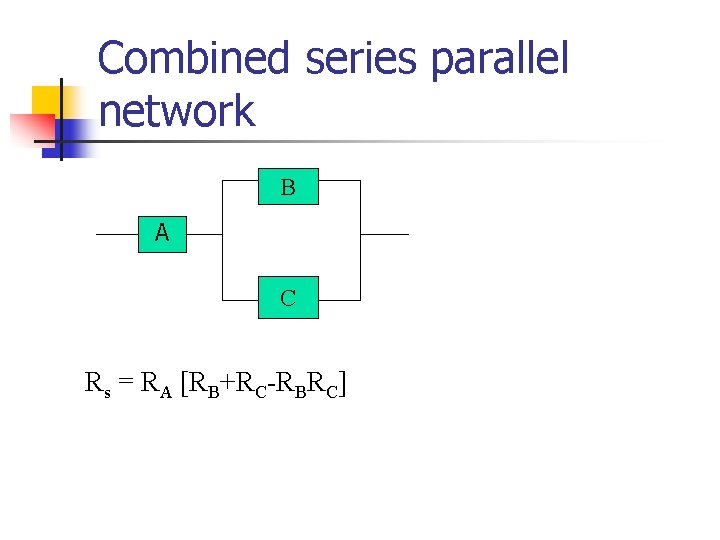
Combined series parallel network B A C Rs = RA [RB+RC-RBRC]
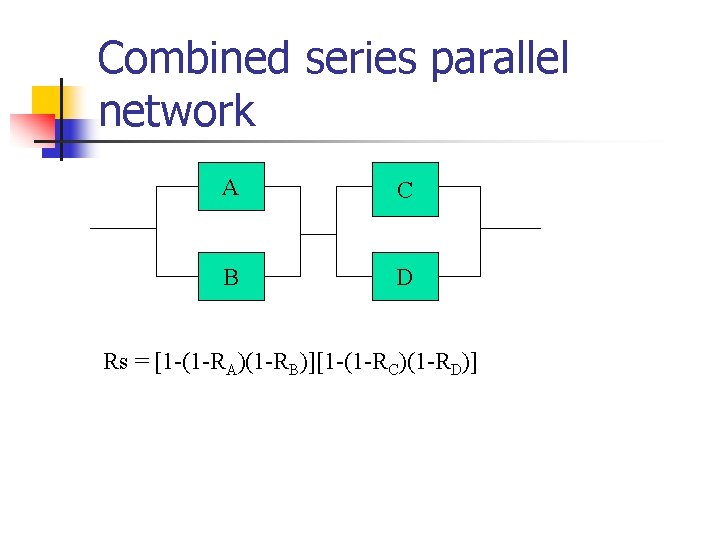
Combined series parallel network A C B D Rs = [1 -(1 -RA)(1 -RB)][1 -(1 -RC)(1 -RD)]
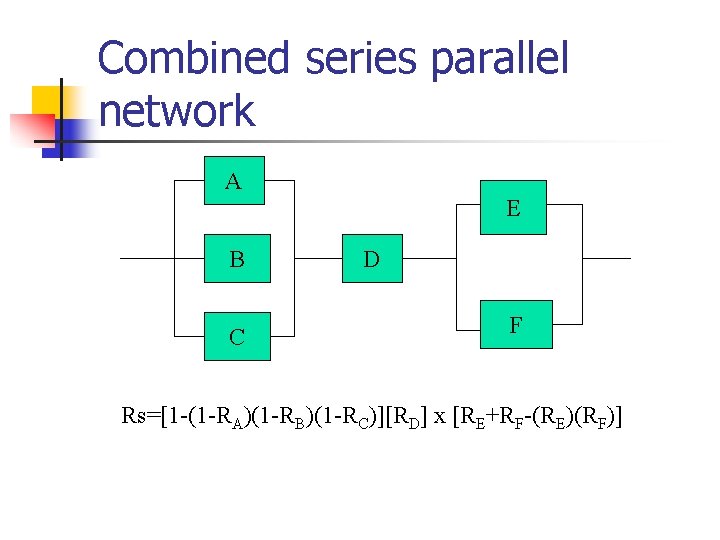
Combined series parallel network A E B C D F Rs=[1 -(1 -RA)(1 -RB)(1 -RC)][RD] x [RE+RF-(RE)(RF)]
Combined series parallel network n n For combined series-parallel network, first evaluate the parallel elements to obtain unit reliability Overall system reliability is determined by finding the product of all series reliability
- Slides: 32