
Reliability Representation System Reliability Block Diagram Systems are

Reliability Representation System

Reliability Block Diagram �Systems are composed of components �RBD is a method of evaluating the reliability of the system by the establishing following relationship �Series �Parallel �Combination of both �These structure helps in understanding logic relationship WWW. KAASHIVINFOTECH. COM

Series configuration 1 2 n �Failure of any one component in the block will lead to the failure of the entire system �Rs - system reliability �E 1 - event where component 1 does not fail �E 2 - event where component 2 does not fail �R 1 - reliability of component 1 �R 2 – reliability of component 2 WWW. KAASHIVINFOTECH. COM
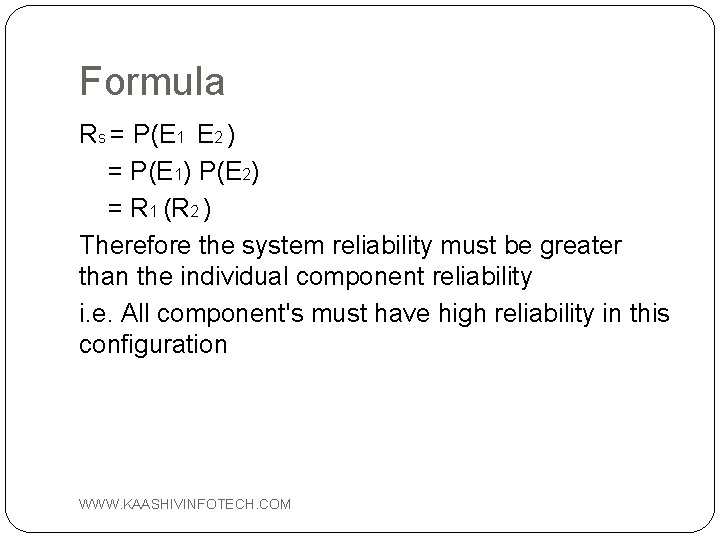
Formula Rs = P(E 1 E 2 ) = P(E 1) P(E 2) = R 1 (R 2 ) Therefore the system reliability must be greater than the individual component reliability i. e. All component's must have high reliability in this configuration WWW. KAASHIVINFOTECH. COM
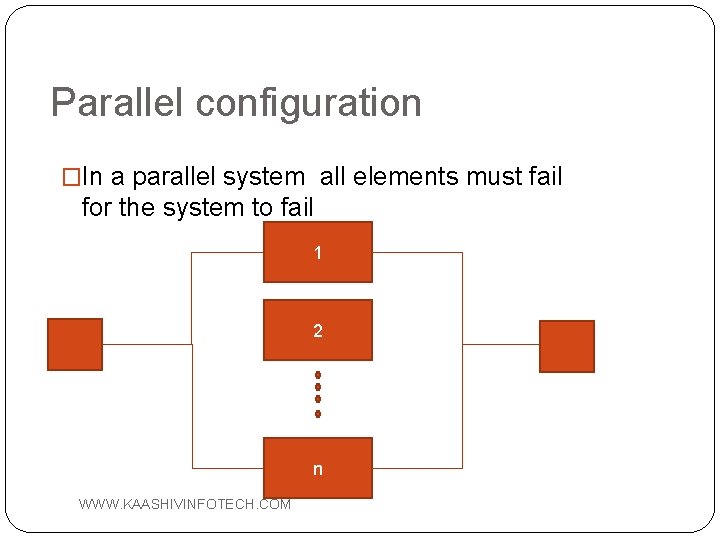
Parallel configuration �In a parallel system all elements must fail for the system to fail 1 2 n WWW. KAASHIVINFOTECH. COM
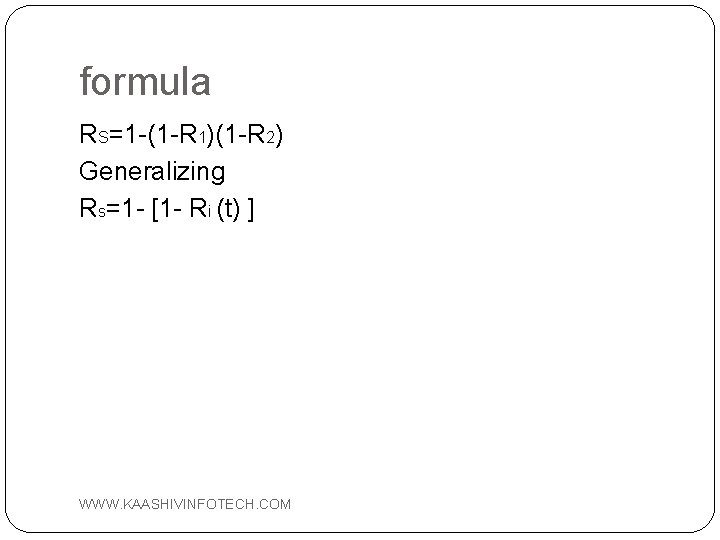
formula RS=1 -(1 -R 1)(1 -R 2) Generalizing Rs=1 - [1 - Ri (t) ] WWW. KAASHIVINFOTECH. COM
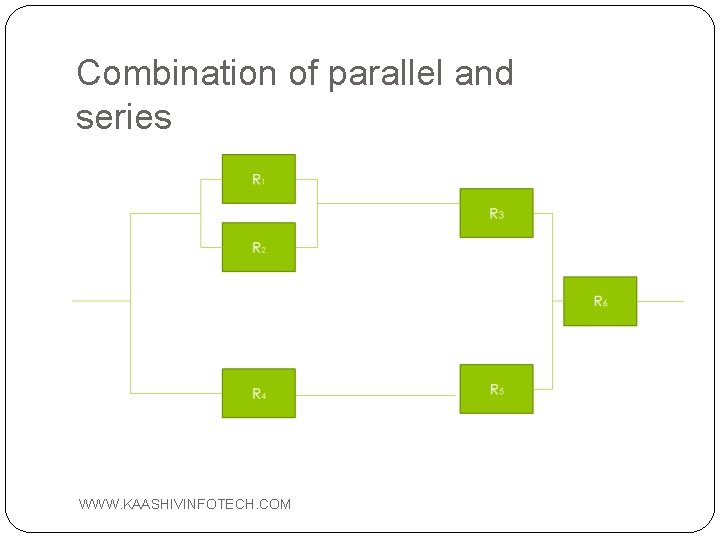
Combination of parallel and series WWW. KAASHIVINFOTECH. COM
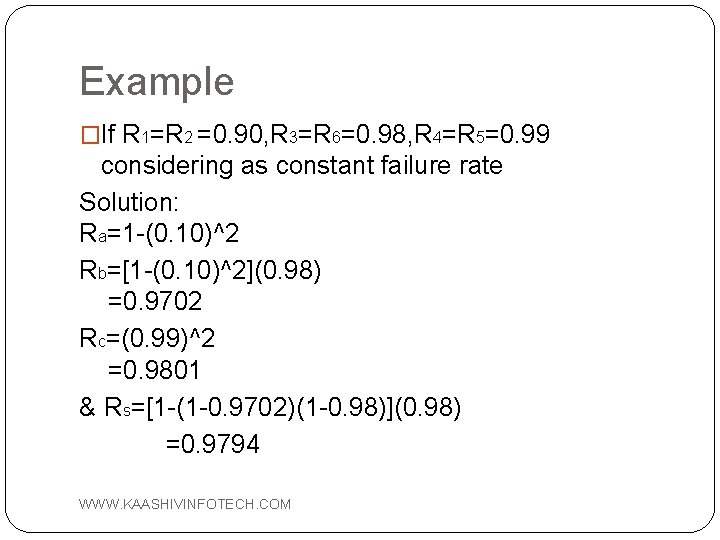
Example �If R 1=R 2 =0. 90, R 3=R 6=0. 98, R 4=R 5=0. 99 considering as constant failure rate Solution: Ra=1 -(0. 10)^2 Rb=[1 -(0. 10)^2](0. 98) =0. 9702 Rc=(0. 99)^2 =0. 9801 & Rs=[1 -(1 -0. 9702)(1 -0. 98)](0. 98) =0. 9794 WWW. KAASHIVINFOTECH. COM
FAULT TREE ANALYSIS �An undesired event is defined �The event is resolved into its immediate causes �This resolution of events continues until basic causes are identified �A logical diagram called a fault tree is constructed showing the logical event relationships WWW. KAASHIVINFOTECH. COM
ELEMENTS �FTA is a deductive analysis approach for resolving an undesired event into its causes �FTA is a backward looking analysis, looking backward at the causes of a given event �Specific stepwise logic is used in the process �Specific logic symbols are used to to illustrate the event relationships �A logic diagram is constructed showing the event relationships. WWW. KAASHIVINFOTECH. COM
USES �FTA is used to resolve the causes of system failure �FTA is used to quantify system failure probability �FTA is used to evaluate potential upgrades to a system �FTA is used to optimize resources in assuring system safety �FTA is used to resolve causes of an incident �FTA is used to model system failures in risk assessments WWW. KAASHIVINFOTECH. COM
FOUR STEPS 1. Define the undesired event to be analyzed (the focus of the FTA) 2. Define the boundary of the system (the scope of the FTA) 3. Define the basic causal events to be considered (the resolution of the FTA) 4. Define the initial state of the system WWW. KAASHIVINFOTECH. COM
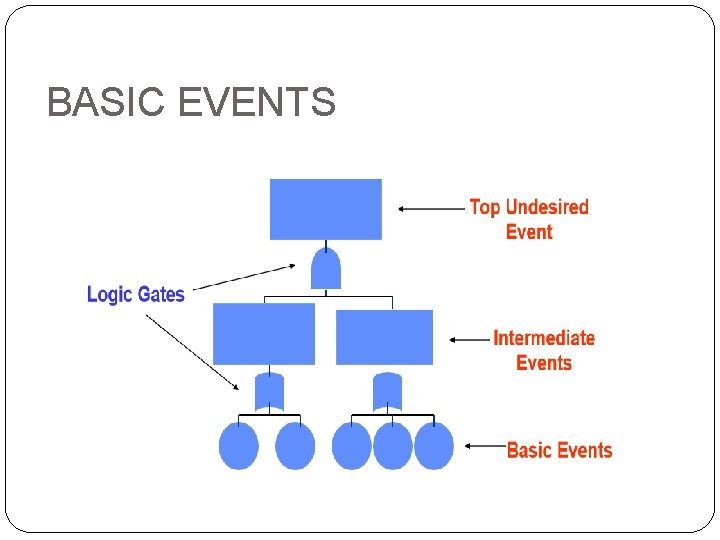
BASIC EVENTS WWW. KAASHIVINFOTECH. COM
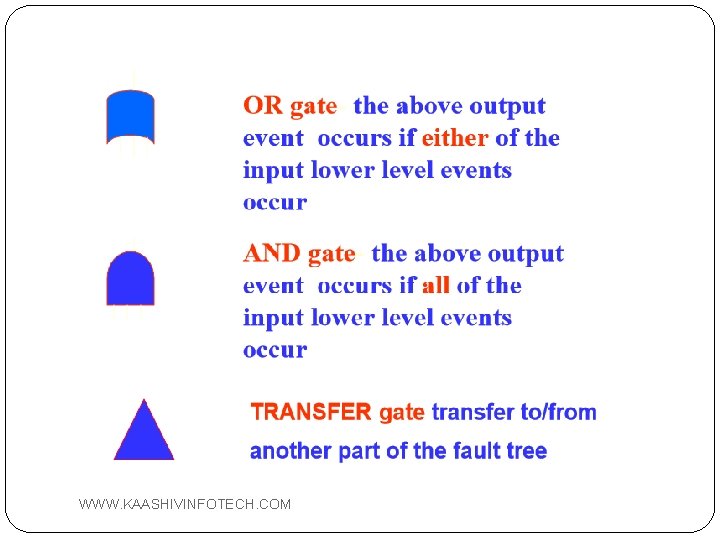
BASIC GATES WWW. KAASHIVINFOTECH. COM
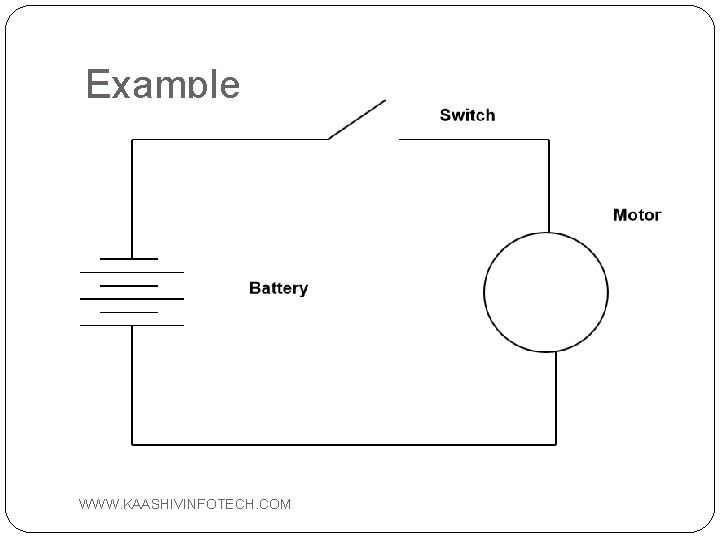
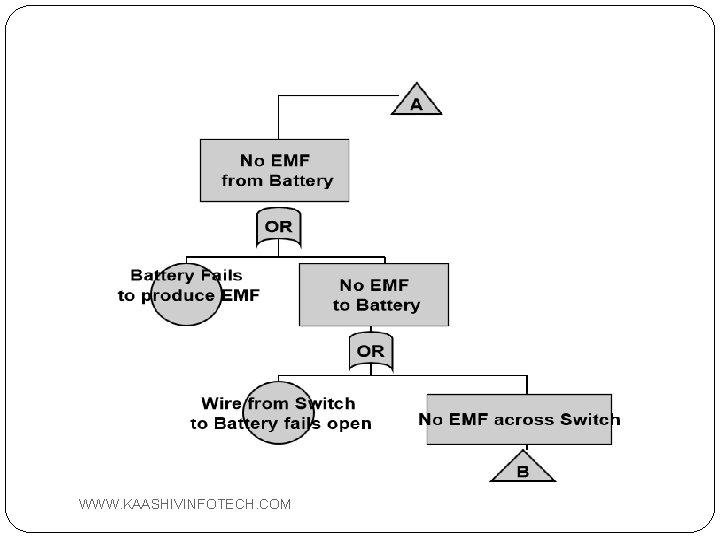
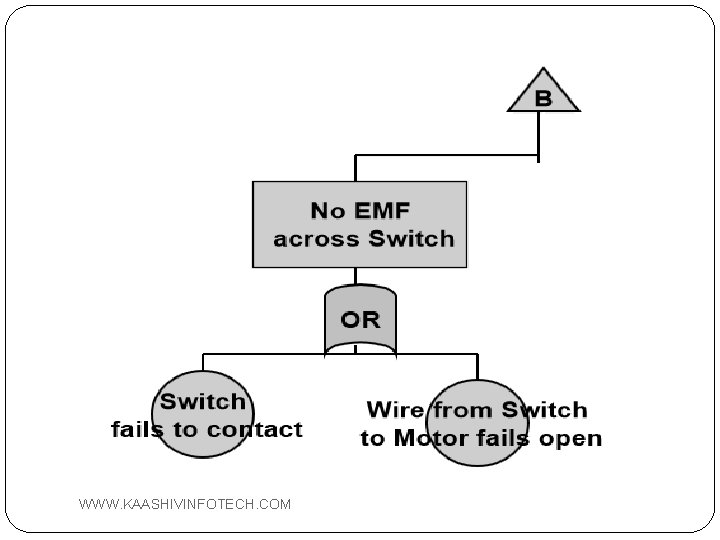
Example WWW. KAASHIVINFOTECH. COM
Specifications �Undesired top event: Motor does not start when switch is closed �Boundary of the FT: The circuit containing the motor, battery, and switch �Resolution of the FT: The basic components in the circuit excluding the wiring �Initial State of System: Switch open, normal operating conditions WWW. KAASHIVINFOTECH. COM
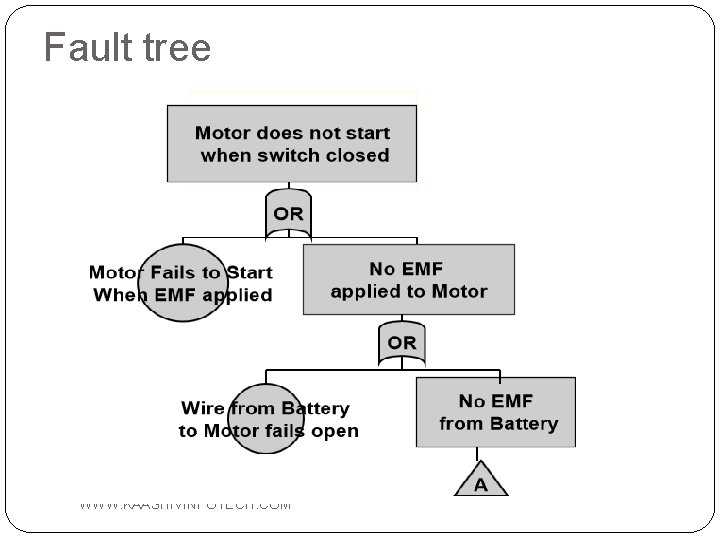
Fault tree WWW. KAASHIVINFOTECH. COM
WWW. KAASHIVINFOTECH. COM
WWW. KAASHIVINFOTECH. COM
The Top Event of the Fault Tree �The top event should describe WHAT the event is and WHEN it happens �The top event is the specific event to be resolved into its basic causes EX: 1. Fuel Supply System Fails to Shutoff after the fueling phase 2. Launch Vehicle Fails to Ignite at Launch WWW. KAASHIVINFOTECH. COM
OR gate �The OR Gate represents the logical union of the inputs: the output occurs if any of the inputs occur �The OR gate is used when an event is resolved into more specific causes or scenarios �The OR gate is used when a component failure is resolved into an inherent failure or a command failure �The OR gate is used when an event is described in terms of equivalent, more specific events WWW. KAASHIVINFOTECH. COM
AND gate �The AND Gate represents the logical intersection of the inputs, the output occurs if all of the inputs occur �The OR gate is used when an event is resolved into combinations of events that need to occur �The AND gate is used when a redundant system is resolved into multiple subsystems that need to fail �The AND gate is used when a system failure is resolved into conditions and events needed to occur WWW. KAASHIVINFOTECH. COM
Developing FTA 1. Define the top event as a rectangle 2. Determine the immediate necessary and sufficient events which result in the top event 3. Draw the appropriate gate to describe the logic for the intermediate events resulting in the top event 4. Treat each intermediate event as an intermediate level top event 5. Determine the immediate, necessary and sufficient causes for each intermediate event 6. Determine the appropriate gate and continue the process WWW. KAASHIVINFOTECH. COM
Key attributes �Top Event-What specific event is being analyzed? �Boundary-What is inside and outside the analysis? �Resolution-What are the primary causes to be resolved to? �Initial State-What is assumed for the initial conditions and states? WWW. KAASHIVINFOTECH. COM
FAULT VS FAILURE • The intermediate events in a fault tree are called faults • The basic events, or primary events , are called failures if they represent failures of components • It is important is to clearly define each event as a fault or failure so it can be further resolved or be identified as a basic cause *Write the statements that are entered in the event boxes as faults; state precisely what the fault is and the conditions under which it occurs. Do not mix successes with faults* WWW. KAASHIVINFOTECH. COM
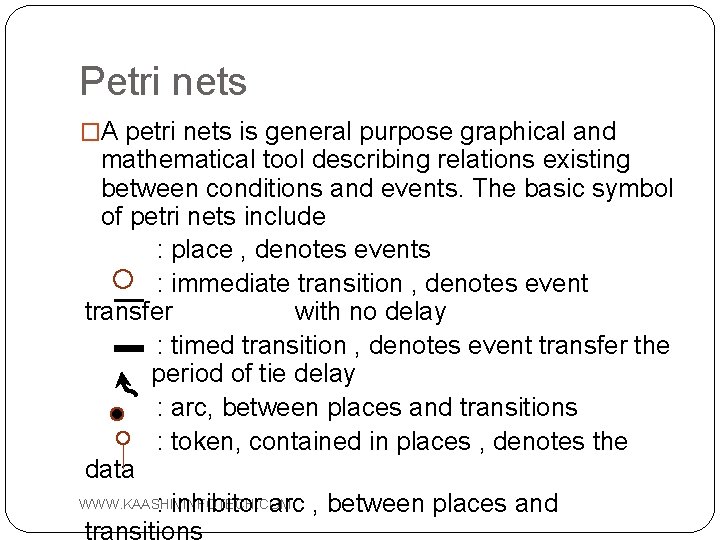
Petri nets �A petri nets is general purpose graphical and mathematical tool describing relations existing between conditions and events. The basic symbol of petri nets include : place , denotes events : immediate transition , denotes event transfer with no delay : timed transition , denotes event transfer the period of tie delay : arc, between places and transitions : token, contained in places , denotes the data WWW. KAASHIVINFOTECH. COM : inhibitor arc , between places and
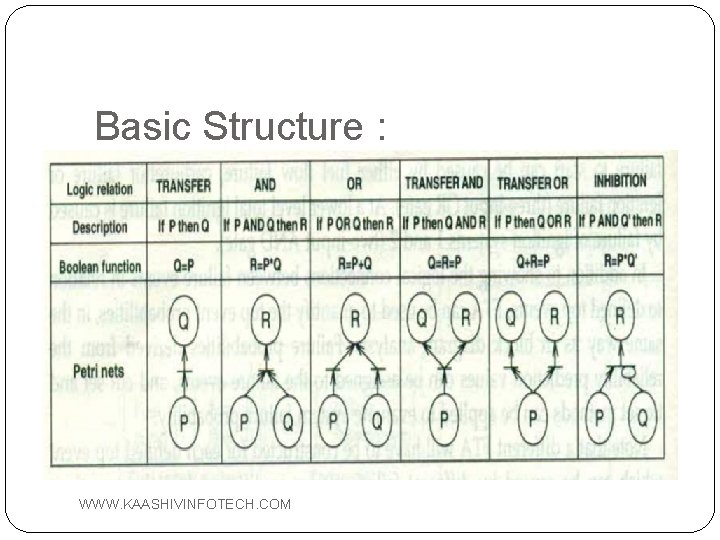
Basic Structure : WWW. KAASHIVINFOTECH. COM
�The transition is said to fire if input places satisfy an enabled condition. Transition firing will remove one token from each of its input places and put one token into all of its output places. There are two types of input place for the transition namely specified type and conditional type. The former one has single output arc whereas the latter one has multiples. Tokens in the specified type place have only one outgoing destination I, e if the input places holds a token the transition fires and gives the output places a token. However tokens in conditional type place have more than one outgoing paths that may lead the WWW. KAASHIVINFOTECH. COM system to different situations.
� There are three types of transitions that are classified based on time. Transition with no time delay are called immediate transitions while those need a certain time delay are called timed transition. The third type is called a stochastic transition. It is used for modeling a process with random time. Owing to variety of logical relations that can be represented with petri nets, it is powerful tool for modeling system. Petri nets an be used not only for simulation, reliability analysis, and failure monitoring, but also for dynamic behavior observation. This greatly helps fault tracing and failure state analysis. Moreover, the use if petri nets can improve the dialogue bet analysis and designer of a system. WWW. KAASHIVINFOTECH. COM
Minimum cut sets To identify the minimum cut sets in a petri net the matrix method is used, as follows 1. Put down the number of the input places in the row if the output place is connected by multi arcs from transition. This accounts for OR models 2. If the output place is connected by one arc from a transition then numbers of the input places should be put down in a column. This accounts for the and models WWW. KAASHIVINFOTECH. COM
3. The common entry located in rows is the entry shared by each row 4. Starting from the top event down to the basic event s until all the places are replaced by basic events , the matrix is thus formed, called the basic event matrix, the column vector of the matrix constitute cut sets 5. Remove the super sets from the basics event matrix and the remaining column vector become the minimum cut sets WWW. KAASHIVINFOTECH. COM
�Minimum cut sets can be derived in an opposite, bottom up , direction , that is from basics places to the top place. Transition with T=0 are called immediate transition. If the petri nets is immediate transition , i. e. the token transfer between places do not take time, then can be absorbed to a simplified form called the equivalent petri net. After absorption, all the remaining place are basic events. The equivalent petri nets exactly constitutes the minimum cut sets, i. e. the input of each transition represents a minimum cut sets WWW. KAASHIVINFOTECH. COM
Monte Carlo simulation �In a Monte Carlo simulation, a logical model of the system being analyzed is repeatedly evaluated, each run using different values of the distributed parameters �The selection of parameters values is made randomly but with probabilities governed by the relevant distribute functions WWW. KAASHIVINFOTECH. COM
�Monte carlo simulation can be used for system reliability and availability modeling , using suitable computer programs. Since Monte carlo simulation involves no complex mathematical analysis, it is an attractive alternative approach. it is relatively easy way to model complex systems , and the input algorithm are easy to understand �One problem in this methods is that its expensive use of compute time WWW. KAASHIVINFOTECH. COM
�Since the simulation of probabilistic events generates variable results, in effect simulating the variability of real life, it is usually necessary to perform a number of runs in order to obtain estimates of mean and variance of the output parameters of interest such as availability number of repairs arising and facility utilization on the other hand , the effect of variation can be assessed. WWW. KAASHIVINFOTECH. COM
Design analysis methods �Design analysis methods have been developed to highlight critical aspects and to focus attention on possible shortfalls �Design analyses are sometimes considered tedious and expensive �In most case the analyses will show that nearly all aspects of the design are satisfactory, and much more effort will have been expended in showing this than in highlighting a few deficiencies �The tedium and expense can be greatly reduced by good planning and preparation and by the use of computerized methods , . WWW. KAASHIVINFOTECH. COM
The main reliability design analysis technique described 1. Quality function deployment 2. Reliability prediction 3. Load-strength analysis 4. Failure modes, effects and critically analysis 5. Fault tree analysis 6. Hazard and operability study 7. Parts materials and process review 8. Others, including human aspects manufacturing, maintenance, etc. . WWW. KAASHIVINFOTECH. COM
Quality function development �QFD is a bad transition of a good reliability technique for getting the voice of the customer into the design process so the product the customer desires. in particular , it is applicable to soft issues that are difficult to specify �This method helps to pinpoint what to do, the best way to accomplish the objective the best order for achieving the design objective and staffing asserts to complete the task WWW. KAASHIVINFOTECH. COM

�It is a major up front effort to learn and understand the customer’s requirement and the approach that will satisfy their objectives �The methodology is used as a team approach to solving problems and satisfying customers , beginning with a listing WWW. KAASHIVINFOTECH. COM
Failure Mode and Effect Analysis(FMEA) �Failure mode and effect analysis is the study of potential failures that might occur in any part of a system to determine the probable operation success. �When criticality analysis is added for sophisticated studies the method is known as FMECA. �The basic thrust of the analysis tool is to prevent failures using a simple and cost effective analysis that draws on the collective information of the team to find problem and resolve them before they occur WWW. KAASHIVINFOTECH. COM
� The analysis is known as a bottom-up (inductive) approach to finding each potential mode of failure that might occur for every component of a system. it also used for determining the probable effect on the system operation of each failure mode and , in turn on probable operational success � FMEA can be performed from different viewpoints such as safety, mission success, repair costs, failure modes, reliability reputation � FMEA is most productive when performed during the design process to eliminate potential failures it can also be performed on existing systems WWW. KAASHIVINFOTECH. COM
�The analysis can be conducted in the design room or on the shop floor and it is an excellent tool for sharing the experience to make the team aware of details that are known to one person but seldom shared with the team. WWW. KAASHIVINFOTECH. COM
Accelerated testing �A test method of increasing loads to quickly produce age to failure data with only a few data points are then scaled to reflect normal loads �The benefits of this testing is to save time and money while quantifying the relationship between stress and performance along with identifying design at low cost �It is used to correlate with real life conditions �It is useful method for solving old, nagging problems within a production process WWW. KAASHIVINFOTECH. COM
�Accelerated testing shortens the test tie as the tests are conducted at higher stress levels to expediting the failure tie to be days instead of month or years �Challenges faced by designer : 1. Long test time to complete life testing of product 2. Constraints on timelines 3. Cost as function of time 4. Reliability growth WWW. KAASHIVINFOTECH. COM
�Care has to be taken that the stress or the agent of failure does not results in failure in another failure mode than the one being evaluated �Acceleration rate must be uniform WWW. KAASHIVINFOTECH. COM

Types of ALT Ø Qualitative Accelerated Testing �HALT �HASS Ø Quantitative Accelerated Testing �SSALT �CISALT WWW. KAASHIVINFOTECH. COM
Highly Accelerated Testing(HALT) �To identify potential failure modes or uncover defects of a product. �Test the component to failure under highly stressed conditions. �Study the failure modes and analyze to the root cause. �Fix the root cause to make the product more robust. �Does not help in predicting the life of the product. WWW. KAASHIVINFOTECH. COM
Highly Accelerated Stress Screening (HASS) �Used to monitor the production process. �All products are subjected to the same stresses during HALT but, at a lower level. �It identifies process related defects. WWW. KAASHIVINFOTECH. COM

Quantitative Accelerated Testing �Planned/Controlled accelerated testing from which TTF under normal usage conditions can be derived. �Models to be used for a specific agent of failure have been postulated. �Accelerated Factor(AF)=TTFnormal/TTFstress �AF is used to derive the normal TTF from accelerated TTF. �Quantitative ALT helps predict the life of the product. WWW. KAASHIVINFOTECH. COM
Improving the process �Continuous improvement nearly always leads to reduced costs , higher producitvity, and higher reliability �Methods that are available for process development are as follows q Simple charts q Control charts q Multi-vari charts q Statistical methods q Quality circles q Zero defects WWW. KAASHIVINFOTECH. COM
Simple charts �A variety of simple charting techniques can be used to help to identify and solve process variability problems. �the pareto chart is often is used as starting point to identify most important problems and most likely causes. �Measles chart is used when problems are distributed over an area �The cause and effect diagram also called fishbone or ishikawa diagram can be used to structure and record problem solving and process improvement efforts. The main WWW. KAASHIVINFOTECH. COM problem is indicated on the horizontal line and
Control charts While using control charts it is monitored continually to find trends that might indicate special causes of variation. trends can be continually run high or low or it can be a cyclic pattern. A continuous high or low trend indicates a need for process or measurement adjustment. A cyclic trend might be caused by temperature fluctuation, process drifts between settings change of materials etc… WWW. KAASHIVINFOTECH. COM
Multi-vari charts �A multi-vari chart is a graphical method for identifying the major causes of variation in a process. Multi vari charts can be used for process development and for problem solving, and they can be very effective in reducing the number of variables to include in a statistical experiment. WWW. KAASHIVINFOTECH. COM
Multi-vari charts show whether the major causes of variation are spatial, cyclic or temporal. A parameter being monitored is measured in different position s at different points in the production cycle at different times. The results are plotted against two measurement locations, e. g. diameter at each end of the shaft, plotted against batch number from setup. It shows that batch to batch variation is the most significant cause, with a significant pattern of end to end variation(taper). WWW. KAASHIVINFOTECH. COM
Statistical Methods This method for analysis of variation can be used effectively for variation reduction in production process. They should be used for process improvement, in the same way as for product and process initial design. If a particular process has been the subject of such experiments during development, then the results can be used to guide studies for further experiments. It is also used to identify the major causes of variation, prior to setting up statistical experiments. This way the number of variables to be investigated can be reduced leading to cost WWW. KAASHIVINFOTECH. COM savings.
Quality Circles It is the most widely used method world wide. A quality circle team consisting of operators is formed. This manage themselves, select leaders and members, and address the problems. They also suggest improvement if it under their control or they recommend it to the management. The quality circle are taught to use analytical techniques to help identify problems and generate solutions. These are called the seven tools of quality. WWW. KAASHIVINFOTECH. COM
The Seven tools of quality are 1. Brainstorm, to identify and prioritize problems 2. Data collection 3. Data analysis methods, including measles chart, trend charts and regression analysis 4. Pareto chart 5. Histogram 6. Cause and Effect diagram 7. Statistical Process Control(SPC) chart WWW. KAASHIVINFOTECH. COM
Failure Reporting Analysis and Corrective Action System(FRACAS) �Failure reporting and analysis is an important part of the QA function. The system must provide for 1. Reporting of all production test and inspection failures with sufficient detail to enable investigation and corrective action to be taken 2. Reporting the results of investigation and action 3. Analysis of failures pattern and trends, and reporting on these 4. Continuos improvement by removal of causes WWW. KAASHIVINFOTECH. COM
� The data system must be computerized for economy and accuracy modern ATE sometimes includes direct test data recordings and inputting to the central system by networking the data analysis must provide pareto analysis , probability plots and trend analysis for management � Production defect data reporting and analysis must be very quick to be effective. Trends should be analyzed daily , or weekly atmost, particularly for high rates of production , to enable timely corrective action to be taken. The data analysis system also necessary for indicating areas for priority action, using the pareto principle of concentrating action on the few problem area that contribute to the most to the quality cost. For this purpose longer term analysis is necessary WWW. KAASHIVINFOTECH. COM
�Defective component should not be scrapped immediately, but should be labeled and stored for the period , say one or two months , so that they are available for more detail investigation if necessary. �Production defect data should not be analyzed in isolation by people whose task is primarily the data management. the people involved must participate to ensure that the data interpreted by those involved and that practical results are derived. the quality circle approach provides very effectively for this WWW. KAASHIVINFOTECH. COM
� Production defect data are important for highlighting possible in service reliability problems. Many in-service failure modes manifest themselves during production inspection and testing. For ex, if a component or process generates failure on the final functional test, and these are connected before delivery , it is possible that the failure mechanism exist in product which pass test and are shipped. Metal surface protection and soldering processes present such risks. Therefore production defects should always be analyzed to determine the likely effects on reliability , external failure cost and all internal WWW. KAASHIVINFOTECH. COM production quality cost.

Thank you WWW. KAASHIVINFOTECH. COM
- Slides: 62