
Reliability Maxeon Solar Cell Vs Conventional Solar Cell
Reliability
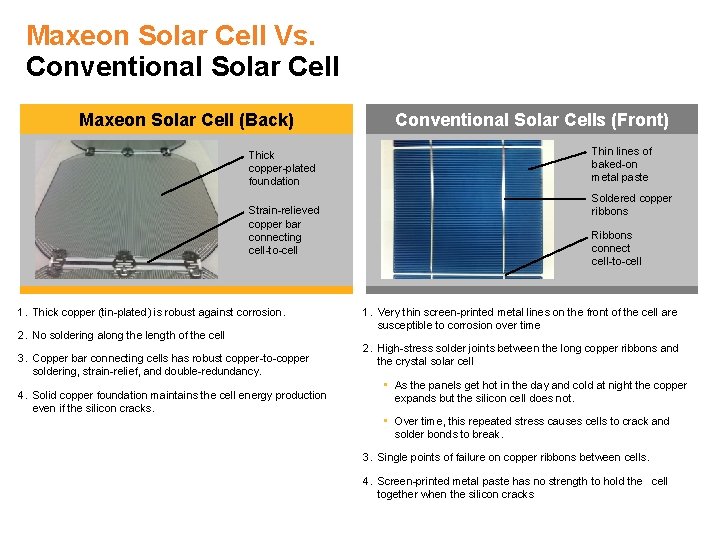
Maxeon Solar Cell Vs. Conventional Solar Cell Maxeon Solar Cell (Back) Thick copper-plated foundation Strain-relieved copper bar connecting cell-to-cell 1. Thick copper (tin-plated) is robust against corrosion. 2. No soldering along the length of the cell 3. Copper bar connecting cells has robust copper-to-copper soldering, strain-relief, and double-redundancy. 4. Solid copper foundation maintains the cell energy production even if the silicon cracks. Conventional Solar Cells (Front) Thin lines of baked-on metal paste Soldered copper ribbons Ribbons connect cell-to-cell 1. Very thin screen-printed metal lines on the front of the cell are susceptible to corrosion over time 2. High-stress solder joints between the long copper ribbons and the crystal solar cell • As the panels get hot in the day and cold at night the copper expands but the silicon cell does not. • Over time, this repeated stress causes cells to crack and solder bonds to break. 3. Single points of failure on copper ribbons between cells. 4. Screen-printed metal paste has no strength to hold the cell together when the silicon cracks
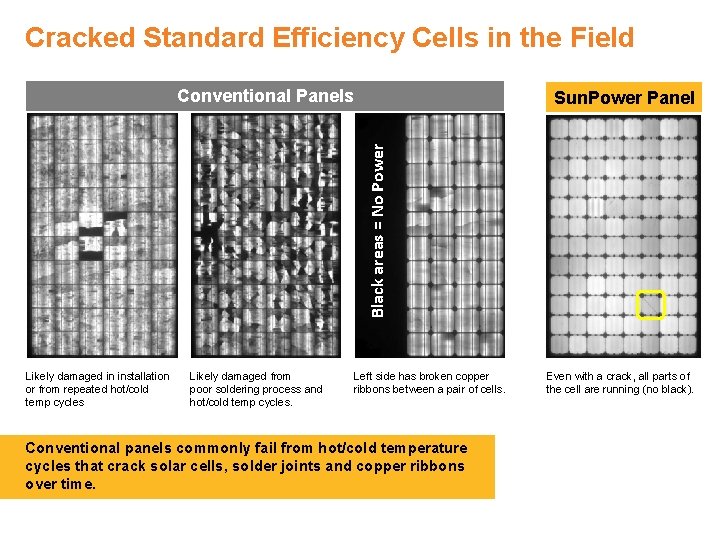
Cracked Standard Efficiency Cells in the Field Conventional Panels Black areas = No Power Sun. Power Panel Likely damaged in installation or from repeated hot/cold temp cycles Likely damaged from poor soldering process and hot/cold temp cycles. Left side has broken copper ribbons between a pair of cells. Conventional panels commonly fail from hot/cold temperature cycles that crack solar cells, solder joints and copper ribbons over time. Even with a crack, all parts of the cell are running (no black).
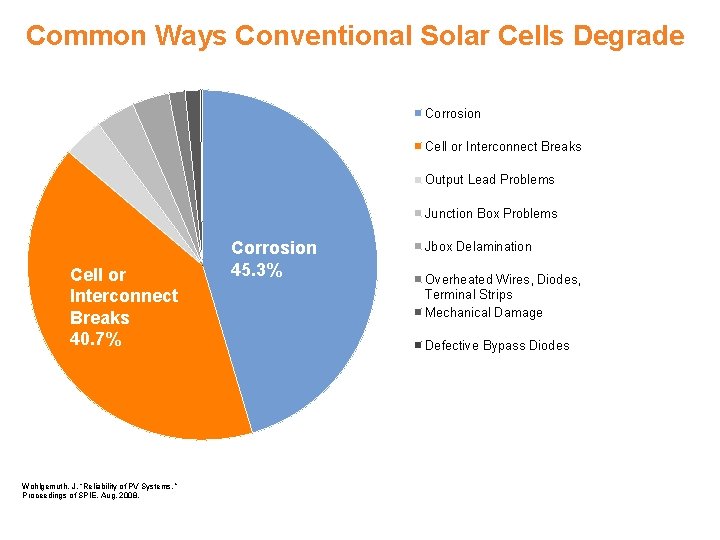
Common Ways Conventional Solar Cells Degrade Corrosion Cell or Interconnect Breaks Output Lead Problems Junction Box Problems Cell or Interconnect Breaks 40. 7% Wohlgemuth, J. “Reliability of PV Systems. ” Proceedings of SPIE, Aug, 2008. Corrosion 45. 3% Jbox Delamination Overheated Wires, Diodes, Terminal Strips Mechanical Damage Defective Bypass Diodes
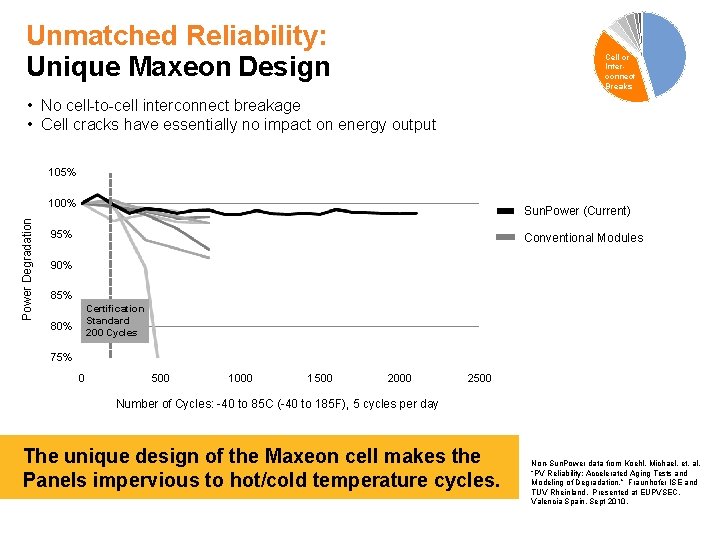
Unmatched Reliability: Unique Maxeon Design Cell or Interconnect Breaks • No cell-to-cell interconnect breakage • Cell cracks have essentially no impact on energy output 105% Power Degradation 100% Sun. Power (Current) 95% Conventional Modules 90% 85% Certification Standard 200 Cycles 80% 75% 0 500 1000 1500 2000 2500 Number of Cycles: -40 to 85 C (-40 to 185 F), 5 cycles per day The unique design of the Maxeon cell makes the Panels impervious to hot/cold temperature cycles. Non-Sun. Power data from Koehl, Michael, et. al. “PV Reliability: Accelerated Aging Tests and Modeling of Degradation. ” Fraunhofer ISE and TUV Rheinland. Presented at EUPVSEC, Valencia Spain, Sept 2010.
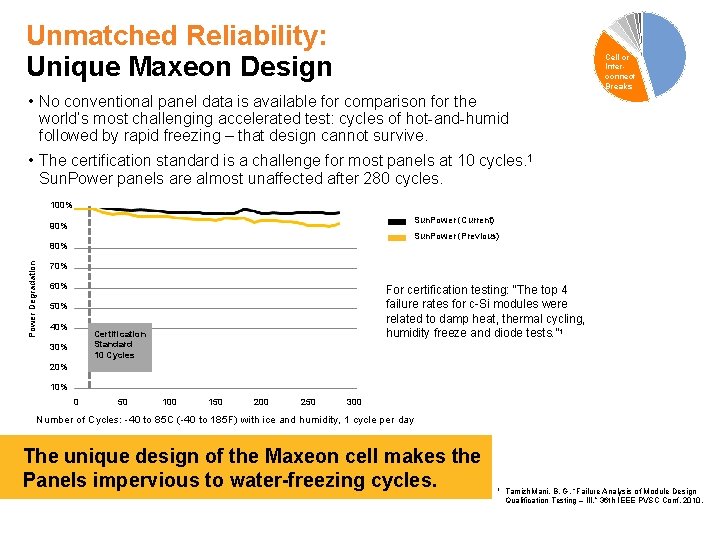
Unmatched Reliability: Unique Maxeon Design Cell or Interconnect Breaks • No conventional panel data is available for comparison for the world’s most challenging accelerated test: cycles of hot-and-humid followed by rapid freezing – that design cannot survive. • The certification standard is a challenge for most panels at 10 cycles. 1 Sun. Power panels are almost unaffected after 280 cycles. 100% Sun. Power (Current) 90% Sun. Power (Previous) Power Degradation 80% 70% 60% For certification testing: “The top 4 failure rates for c-Si modules were related to damp heat, thermal cycling, humidity freeze and diode tests. ” 1 50% 40% Certification Standard 10 Cycles 30% 20% 10% 0 50 100 150 200 250 300 Number of Cycles: -40 to 85 C (-40 to 185 F) with ice and humidity, 1 cycle per day The unique design of the Maxeon cell makes the Panels impervious to water-freezing cycles. 1 Tamizh. Mani, B. G. “Failure Analysis of Module Design Qualification Testing – III, ” 36 th IEEE PVSC Conf, 2010.
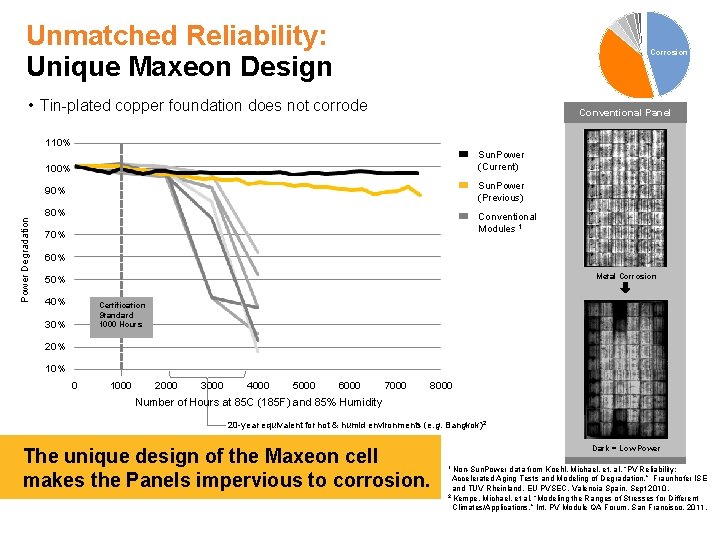
Unmatched Reliability: Unique Maxeon Design Corrosion • Tin-plated copper foundation does not corrode Conventional Panel 110% Sun. Power (Current) 100% Sun. Power (Previous) Power Degradation 90% 80% Conventional Modules 1 70% 60% Metal Corrosion 50% 40% Certification Standard 1000 Hours 30% 20% 10% 0 1000 2000 3000 4000 5000 6000 7000 8000 Number of Hours at 85 C (185 F) and 85% Humidity 20 -year equivalent for hot & humid environments (e. g. Bangkok)2 The unique design of the Maxeon cell makes the Panels impervious to corrosion. Dark = Low Power Non-Sun. Power data from Koehl, Michael, et. al. “PV Reliability: Accelerated Aging Tests and Modeling of Degradation. ” Fraunhofer ISE and TUV Rheinland. EU PVSEC, Valencia Spain, Sept 2010. 2 Kempe, Michael, et al. “Modeling the Ranges of Stresses for Different Climates/Applications, ” Int. PV Module QA Forum, San Francisco, 2011. 1
Third-Party Reliability Testing • Atlas, a subsidiary of Ametek, has been the leader in durability testing of materials for more than 90 years, and developed the “Atlas 25+ PV Durability Testing. ” • 3 panels tested per manufacturer: Salt Spray Corrosion, Humidity-Freeze cycling, Solar-Thermal Humidity-Freeze Cycling • Sun. Power earned the top rating, with an average power drop of 0% across all panels 1 • Fraunhofer is Europe’s largest organization for applied research, with a staff of more than 20, 000 people and an annual research budget exceeding $2 billion. It is world-renowned for its expertise in solar power technology. • In 2012, Fraunhofer selected Sun. Power and 4 other top manufacturers’ panels to rank based on their reliability • Test results are anonymous to participants, but the conventional panels were selected from the top six crystalline silicon module manufacturers: Sun. Tech, Yingli, Trina, Canadian Solar, Sharp, Hanwha Solar. One. • 20 panels per manufacturer were purchased directly by Fraunhofer from distributors and installers • The PDVI Test Protocol included: Temperature cycling, Humidity-Freeze cycling, Damp Heat exposure with +/-600 V, Ultra-violet light exposure, static and dynamic mechanical load testing • Sun. Power panels came out #1, with an average power drop of 1. 3% across all panels 2 • The average power drop of all the conventional panels was 5. 3% … 4 x higher 1 • Sun. Power’s most degraded panel dropped by 2. 3% power, while the Conventional panels showed a much wider variation, with as much as 92% degradation. 2 Altas 25+ Durability test report. Jan 2013. Stress-tested power drops were -1. 5%, +2. 3%, -0. 5%, relative to the non-stresstested control panel. Fraunhofer PV Module Durability Initiative. Participants Report. January 2013.
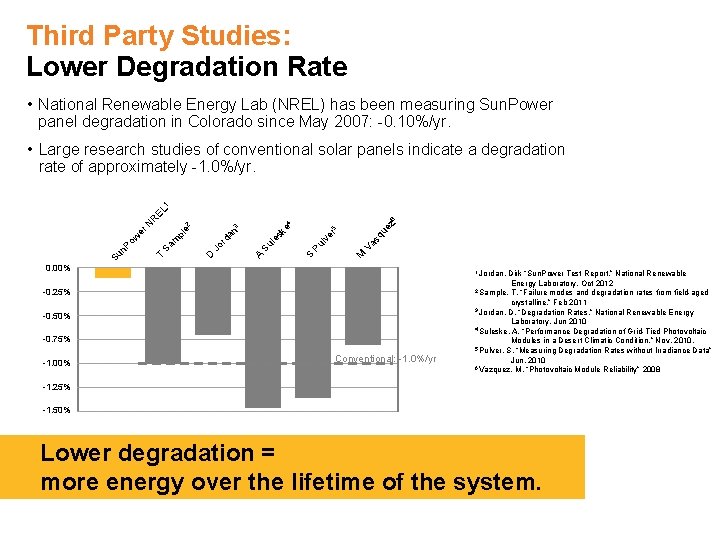
Third Party Studies: Lower Degradation Rate • National Renewable Energy Lab (NREL) has been measuring Sun. Power panel degradation in Colorado since May 2007: -0. 10%/yr. ez 6 sq u Va M S Pu lv er 5 sk e 4 A Su le n 3 da Jo r D m Sa T Su n. P o w er pl e 2 N R EL 1 • Large research studies of conventional solar panels indicate a degradation rate of approximately -1. 0%/yr. 0. 00% 1 Jordan, -0. 25% -0. 50% -0. 75% -1. 00% Conventional: -1. 0%/yr Dirk “Sun. Power Test Report, ” National Renewable Energy Laboratory, Oct 2012 2 Sample, T. “Failure modes and degradation rates from field-aged crystalline, ” Feb 2011 3 Jordan, D. “Degradation Rates, ” National Renewable Energy Laboratory, Jun 2010 4 Suleske, A. “Performance Degradation of Grid-Tied Photovoltaic Modules in a Desert Climatic Condition, ” Nov, 2010. 5 Pulver, S. “Measuring Degradation Rates without Irradiance Data” Jun, 2010 6 Vazquez, M. “Photovoltaic Module Reliability” 2008 -1. 25% -1. 50% Lower degradation = more energy over the lifetime of the system.
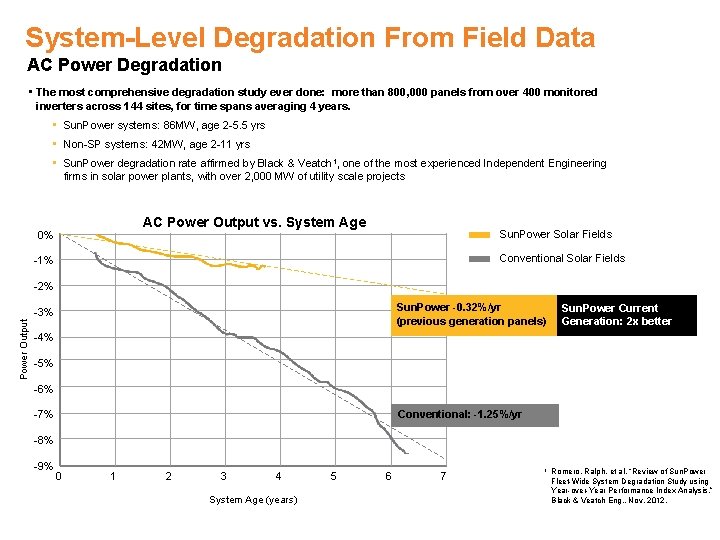
System-Level Degradation From Field Data AC Power Degradation • The most comprehensive degradation study ever done: more than 800, 000 panels from over 400 monitored inverters across 144 sites, for time spans averaging 4 years. • Sun. Power systems: 86 MW, age 2 -5. 5 yrs • Non-SP systems: 42 MW, age 2 -11 yrs • Sun. Power degradation rate affirmed by Black & Veatch 1, one of the most experienced Independent Engineering firms in solar power plants, with over 2, 000 MW of utility scale projects AC Power Output vs. System Age 0% Sun. Power Solar Fields Conventional Solar Fields -1% -2% Sun. Power -0. 32%/yr (previous generation panels) Power Output -3% Sun. Power Current Generation: 2 x better -4% -5% -6% Conventional: -1. 25%/yr -7% -8% -9% 0 1 2 3 4 System Age (years) 5 6 7 1 Romero, Ralph, et al. “Review of Sun. Power Fleet-Wide System Degradation Study using Year-over-Year Performance Index Analysis, ” Black & Veatch Eng. , Nov. 2012.
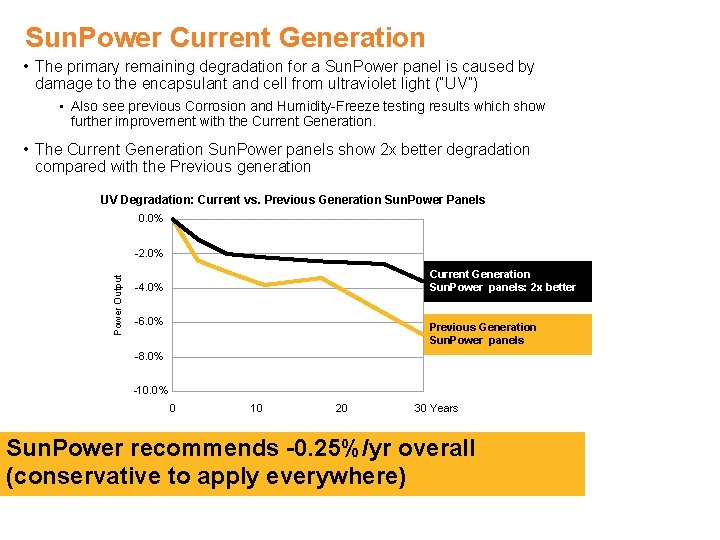
Sun. Power Current Generation • The primary remaining degradation for a Sun. Power panel is caused by damage to the encapsulant and cell from ultraviolet light (“UV”) • Also see previous Corrosion and Humidity-Freeze testing results which show further improvement with the Current Generation. • The Current Generation Sun. Power panels show 2 x better degradation compared with the Previous generation UV Degradation: Current vs. Previous Generation Sun. Power Panels 0. 0% Power Output -2. 0% Current Generation Sun. Power panels: 2 x better -4. 0% -6. 0% Previous Generation Sun. Power panels -8. 0% -10. 0% 0 10 20 30 Years Sun. Power recommends -0. 25%/yr overall (conservative to apply everywhere)
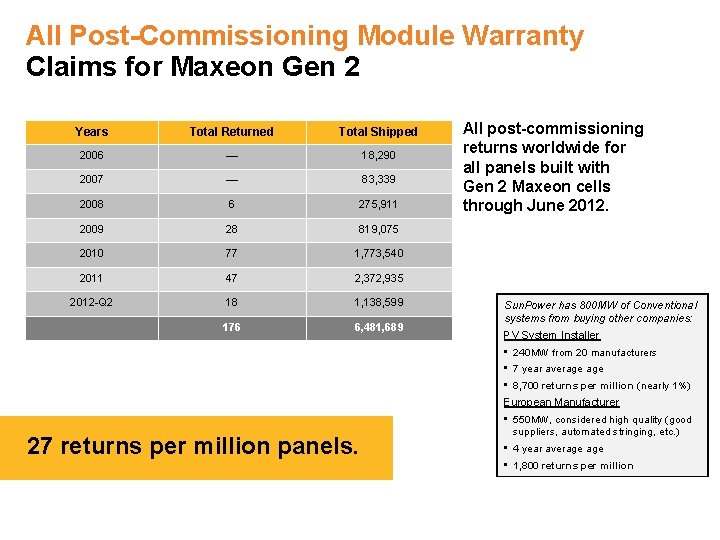
All Post-Commissioning Module Warranty Claims for Maxeon Gen 2 Years Total Returned Total Shipped 2006 — 18, 290 2007 — 83, 339 2008 6 275, 911 2009 28 819, 075 2010 77 1, 773, 540 2011 47 2, 372, 935 2012 -Q 2 18 1, 138, 599 176 6, 481, 689 All post-commissioning returns worldwide for all panels built with Gen 2 Maxeon cells through June 2012. Sun. Power has 800 MW of Conventional systems from buying other companies: PV System Installer • 240 MW from 20 manufacturers • 7 year average • 8, 700 returns per million (nearly 1%) European Manufacturer 27 returns per million panels. • 550 MW, considered high quality (good suppliers, automated stringing, etc. ) • 4 year average • 1, 800 returns per million
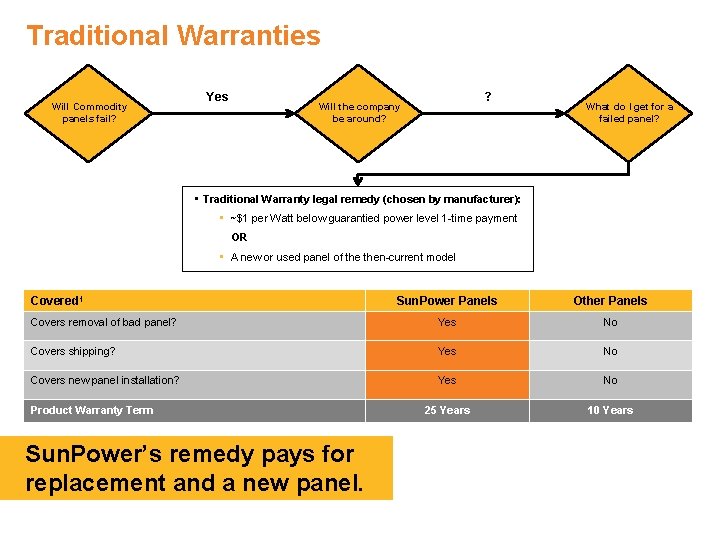
Traditional Warranties Will Commodity panels fail? Yes ? Will the company be around? What do I get for a failed panel? • Traditional Warranty legal remedy (chosen by manufacturer): • ~$1 per Watt below guarantied power level 1 -time payment OR • A new or used panel of then-current model Covered 1 Sun. Power Panels Other Panels Covers removal of bad panel? Yes No Covers shipping? Yes No Covers new panel installation? Yes No 25 Years 10 Years Product Warranty Term Sun. Power’s remedy pays for replacement and a new panel.
- Slides: 13