
Reliability Evaluation of Smart Grid including the Impact
Reliability Evaluation of Smart Grid including the Impact of Cyberphysical Interactions Chanan Singh Regents Professor Department of Electrical and Computer Engineering Texas A&M University College Station, TX 77843, USA DLP : Bangkok, Dec 14, 2017
Introduction q Modern power systems are integration of § Physical part, or primary part consisting of current carrying components for power delivery and § Cyber part or secondary part consisting of monitoring, computing, communication and protection systems. q Human interface - power systems are not fully automated.
Introduction q Complexity is increasing with more monitoring, control and communications functions. q Sources of failure: § physical components ( power/current carrying), § failures in cyber network – hard and soft, § human failures. q Contemporary power system reliability methods have focused almost entirely on the failure of physical components.
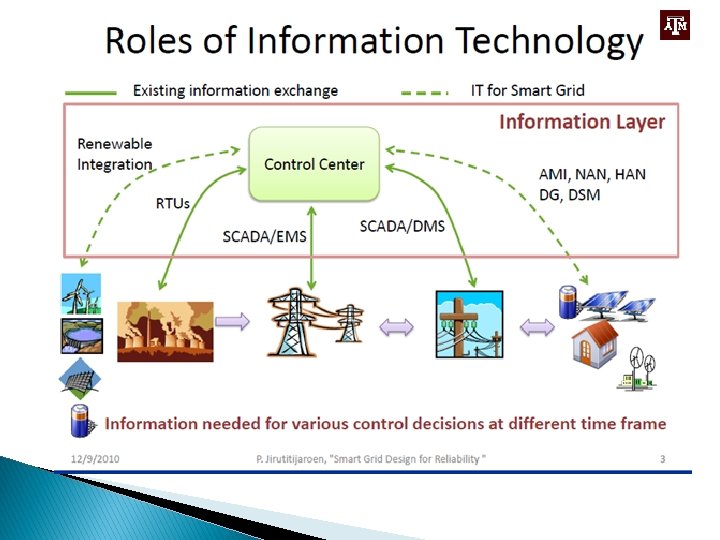
Emerging Power Systems Power systems of the future are emerging to be different. q Two major factors contributing to this change: § Large penetration of renewable energy sources § Increasing complexity of cyber part. q Installation of hardware for interactive relationship between the supplier and consumer will add to complexity and interdependency between the cyber and physical parts. q Complexity and interdependency will introduce more sources of problems and make reliability analysis more challenging but also more essential. q
Cyber-Physical Reliability vs Security Cyber Security: Studies deliberate cyber attack scenarios, consequences, and prevention or mitigation strategies. Cyber Reliability: Studies intrinsic failure modes of cyber related components and their impact on power system reliability. Ultimately both impact the reliability of power supply but the two may require different modeling and methodology.
Need for Reliability Analysis � Think before you act. � Analyze before you construct or implement. � Analysis at the planning and design stage leads to cost effective decisions that assure appropriate levels of reliability.
Analysis: Rule based vs Model Based � Rule based or deterministic indicators of reliability reflect postulated conditions. � Not directly indicative of electric system reliability and not responsive to most parameters which influence system reliability performance. � Therefore are of limited value for choosing between planning alternatives and rational decision making. � Their implementation is, however, simple and requires little data.
Rule Based vs Model Based Ø Model based probabilistic indicators directly reflect the uncertainty which is inherent in the power system reliability problem. Ø Have the capability of reflecting the various parameters which can impact system reliability. Ø Therefore, probabilistic indices permit quantitative evaluation of system alternatives through direct consideration of parameters which influence reliability. Ø This capability accounts for the increasing popularity and use of probabilistic indices.
Current Techniques: Dimensions of Their Development � System coverage: What part of the system is modeled. � Solution approaches: ◦ What models are used and ◦ the mathematical methods employed for their solution.
Level of System Coverage � Generating capacity reliability evaluation(HL 1): basic objective is to determine adequacy of generation to meet demand with a given probability. § Single area: Transmission assumed capable of transporting power from generation to load. Conceptually all generation and load in an area assumed connected to one bus. § Multi-area: Inter-area tie line constraints are considered. Intra-area constraints considered only indirectly.
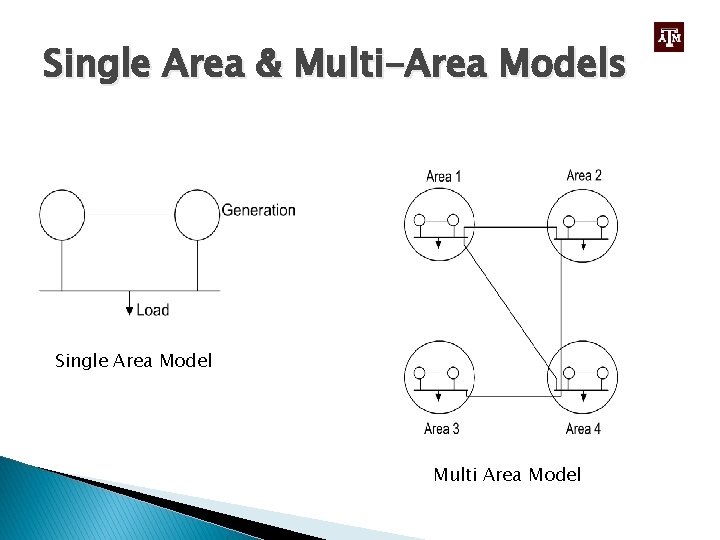
Single Area & Multi-Area Models Single Area Model Multi Area Model
Level of System Coverage Composite system reliability evaluation(HL 2): joint treatment of generation and bulk transmission. § Constraints imposed by the capacity and impedance of transmission lines are considered. § Voltage constraints may also be considered q q Distribution system reliability(HL 3): given the reliability at distribution substation, determine the reliability at customer level. Special topics: reliability of protection systems and their impact on system reliability.
Composite System & Distribution System Composite System Model Distribution System
Solution Approaches in Power System Reliability Evaluation � Analytical methods: mostly used in single, multi-area and distribution system models. � Monte Carlo simulation; mostly used in multi -area and composite system models. � Intelligent search techniques: still in development stage for either increasing the efficiency of analytical or simulation or providing an alternative to Monte Carlo simulation.
Solution Approaches � Hybrid: mixing of different approaches for increased flexibility and strength. � Two of assumptions running through the developed models and methods : ◦ independence of components. ◦ cyber part is perfectly reliable and always functions as it should.
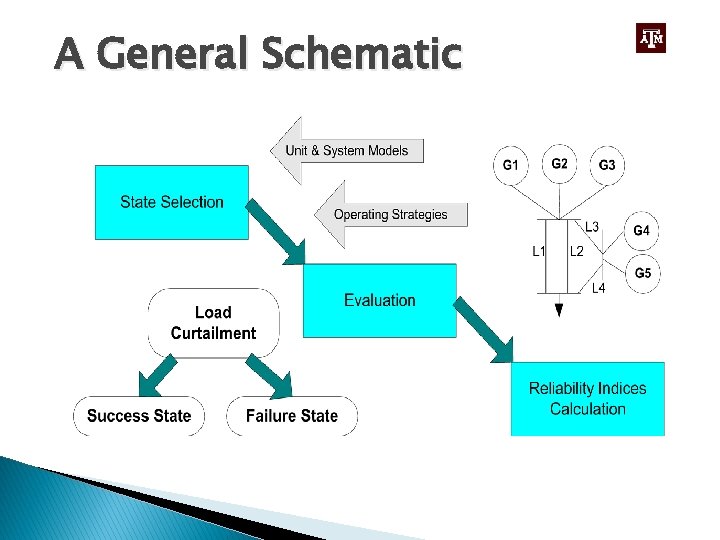
A General Schematic
System Models System model complexity depend upon the intended application. For single area studies the model is fairly simple unless operating considerations are included. For multi-area studies the system model is more complex. Presently composite level represents the highest level of complexity. § Even at this level, complicating issues like the impact of protective relay malfunctions is generally excluded. § Load is assumed forecast and its responsiveness to market conditions and type of generation available is not modeled in detail.
State Identification and Selection � Not possible to consider all system states because of dimensionality issue. � Analytical methods try to meet challenge of dimensionality by state merging, truncation and implicit enumeration. � Monte Carlo simulation meets this challenge by sampling. � Recently emerging intelligent search techniques, focus is on identifying dominant failure states.
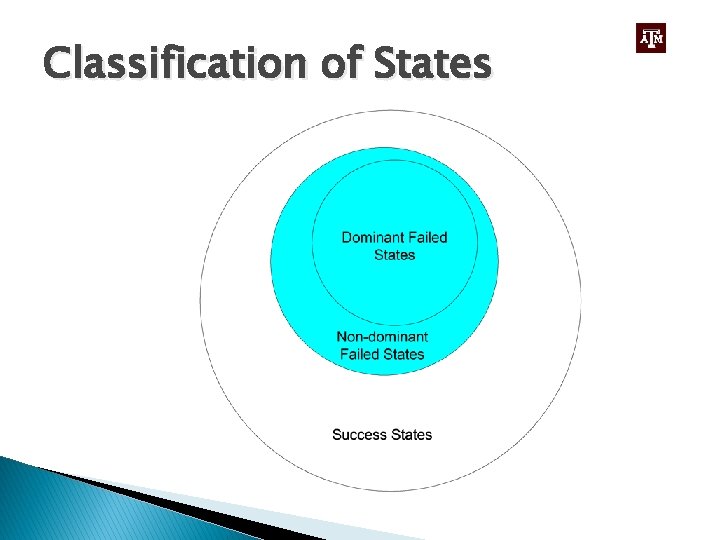
Classification of States
State Evaluation � In any method, the selected state needs to be evaluated to determine if the objectives of the system are satisfied. � This may be simple addition or subtraction. � This may need a transportation type model. � Or more time consuming DC or AC power flow model.
Monte Carlo Simulation � Non-sequential or sampling. � Sequential simulation.
Non-sequential Simulation � Sample component states proportional to their probabilities. � Construct system states from component states. � Evaluate system states. � Estimate indices.
Sequential Monte Carlo Simulation - Creating possible system history � Step 1: Set the initial state of all components as UP and set the simulation time t = 0. � Step 2: For each component, draw a random decimal number between 0 and 1 and using random number and transition rate determine the time to next transition of each component.
Creating possible system history � Step 3: Find the minimum time to transition, change the state of the corresponding component q, and update the total time. � Step 4: Change the qth component’s state accordingly. � Step 5: Perform a network power flow analysis to assess system operation states. Update system-wide reliability indices. � Repeat steps 2– 5 until convergence is achieved
Observations Two parts of a power system: Current carrying part and cyber part. q To this day, power system reliability methods have focused primarily on current carrying part. q Dimensionality and complexity are two major challenges in power system reliability analysis. q Dimensionality arises from a large number of components and combination of possible states. q Complexity arises from complex interrelationship between components and modification of system behavior by operating strategies. q
Observations q Capacity and admittance of components distinguish power system from some other systems and increase complexity. q Demarcation of power system into hierarchical levels has been beneficial for guiding the development of reliability methods. q But it has also narrowed its focus leading to ignoring interfaces outside this framework.
Future of Power Systems � Power systems of the future will be different from past. � Two major factors contributing to this change: § Large penetration of renewable energy sources § Smartization of grid backed by federal government. q Installation of hardware for interactive relationship between the supplier and consumer will add to complexity and interdependency between the cyber and physical parts. q Complexity and interdependency will introduce more sources of problems and make reliability analysis more challenging.
Possible Approaches to Reliability Modeling for Future Power Systems � Complexity and dimensionality make reliability analysis of the entire system in a single step computationally intractable. � Even for the current carrying part alone, it is not computationally efficient to model all the components distinctly and simultaneously. � Some consolidation at the subsystem level is generally necessary. � Also it is necessary to move sequentially in analysis.
Categories of Impact of Cyber Failures � Local impact � Degradation impact � Catastrophic impact
Modeling Local Effects of Cyber Failures � More interested in continuity of signals rather than capacity of links � Analytical methods like cut-sets or Monte Carlo could be used.
Degradation Effects of Cyber Failures � Degrade the ability of system for optimal use of current carrying part. � More serious than the local effects � Perhaps still could use continuity criterion making state evaluation less time consuming.

An Example of Local and Degradation Effects © 2017 M. Sadegh Modarresi 33

Example of Smart Homes Helping Smart Grid Functionality � Creating Spinning Reserve in Day Ahead Market � Using In Ground Swimming Pools

How to Gain Flexibility? Case of the reserve market � Through conventional power plants scheduling ◦ Advantage: Almost a firm capacity ◦ Disadvantage: �Deliverability �Constraint on the unit capacity � By using the flexibility of the demand itself ◦ Advantage: Geographical diversity ◦ Disadvantage: �How much is firm capacity? �Customer’s comfort © 2017 M. Sadegh Modarresi 35

Flexibility Through Residential Demand Why swimming pool pumps was chosen by us? Comfort Privacy © 2017 M. Sadegh Modarresi 36

Capacity They Can Provide: 1 -2 k. W Per Pump 4 -14 Hours Daily 1020 = ≈1 Million pool pumps in TX ≈1. 5 GW flexible capacity © 2017 M. Sadegh Modarresi 37

Benefits for the Customers: � Time is important for everyone. � The optimal hours a pool needs to be filtered changes daily as a function of: �Weather temperature �Usage of the pool �Sunlight � Giving up the control will enhance the comfort of pool owners. © 2017 M. Sadegh Modarresi 38

Benefits for the Aggregator: � Providing a part of their ancillary service mandate using pools. � Potentially participate in the spinning reserve market. � Energy arbitrage. � Capital investment? Benefits gained from this investment? © 2017 M. Sadegh Modarresi 39

Inputs, Medium and Outcomes: Customers Aggregator ISO © 2017 M. Sadegh Modarresi 40
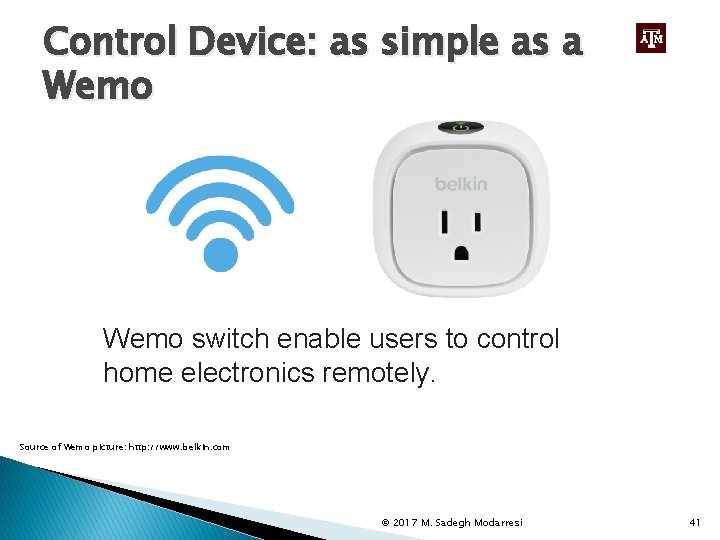
Control Device: as simple as a Wemo switch enable users to control home electronics remotely. Source of Wemo picture: http: //www. belkin. com © 2017 M. Sadegh Modarresi 41
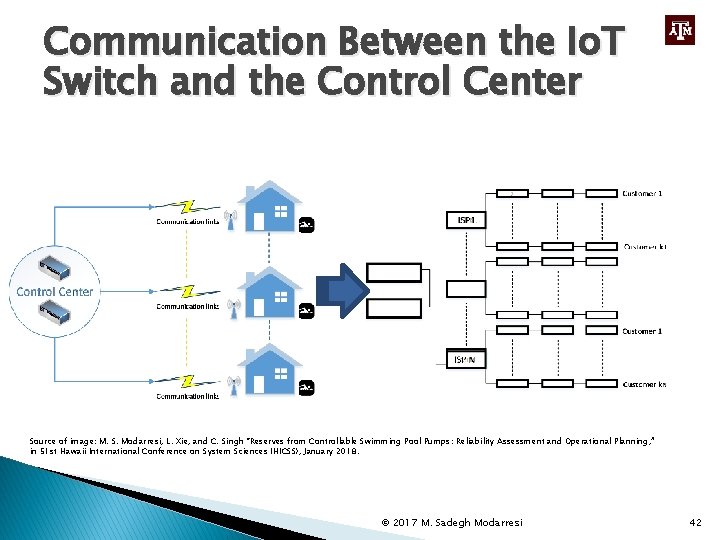
Communication Between the Io. T Switch and the Control Center Source of image: M. S. Modarresi, L. Xie, and C. Singh “Reserves from Controllable Swimming Pool Pumps: Reliability Assessment and Operational Planning, ” in 51 st Hawaii International Conference on System Sciences (HICSS), January 2018. © 2017 M. Sadegh Modarresi 42
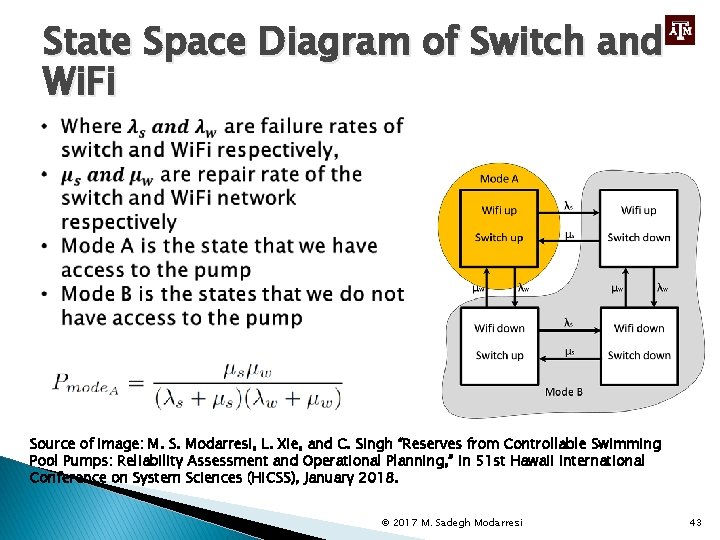
State Space Diagram of Switch and Wi. Fi Source of image: M. S. Modarresi, L. Xie, and C. Singh “Reserves from Controllable Swimming Pool Pumps: Reliability Assessment and Operational Planning, ” in 51 st Hawaii International Conference on System Sciences (HICSS), January 2018. © 2017 M. Sadegh Modarresi 43
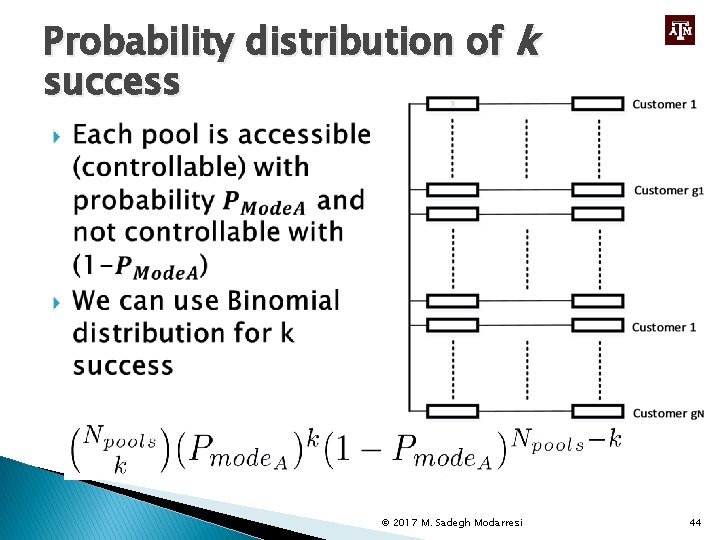
Probability distribution of k success © 2017 M. Sadegh Modarresi 44
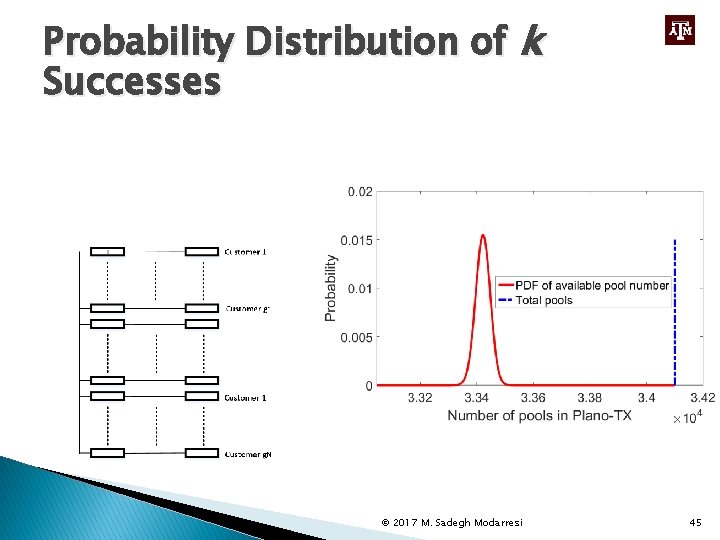
Probability Distribution of k Successes © 2017 M. Sadegh Modarresi 45
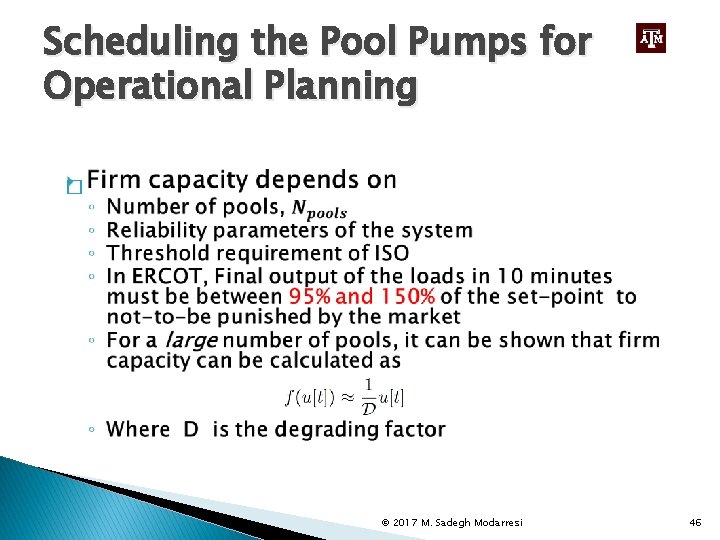
Scheduling the Pool Pumps for Operational Planning � © 2017 M. Sadegh Modarresi 46
Catastrophic Effects �Stronger interaction between cyber and physical part and analysis is more complex. �In some situations the problem could be simplified by analyzing the cyber part and representing this through a relationship matrix.
Cyber- Physical Interaction �The concepts and approaches will be explained using an example of a substation. �The problems, however, extend across the entire grid.
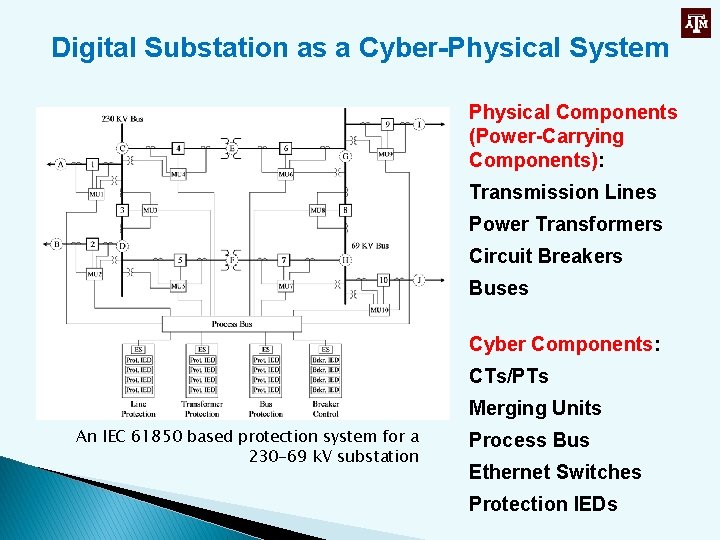
Digital Substation as a Cyber-Physical System Physical Components (Power-Carrying Components): Transmission Lines Power Transformers Circuit Breakers Buses Cyber Components: CTs/PTs Merging Units An IEC 61850 based protection system for a 230 -69 k. V substation Process Bus Ethernet Switches Protection IEDs
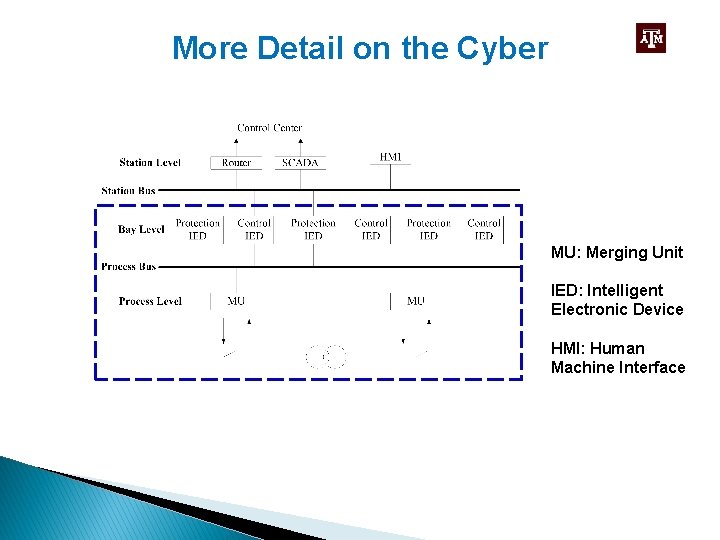
More Detail on the Cyber MU: Merging Unit IED: Intelligent Electronic Device HMI: Human Machine Interface
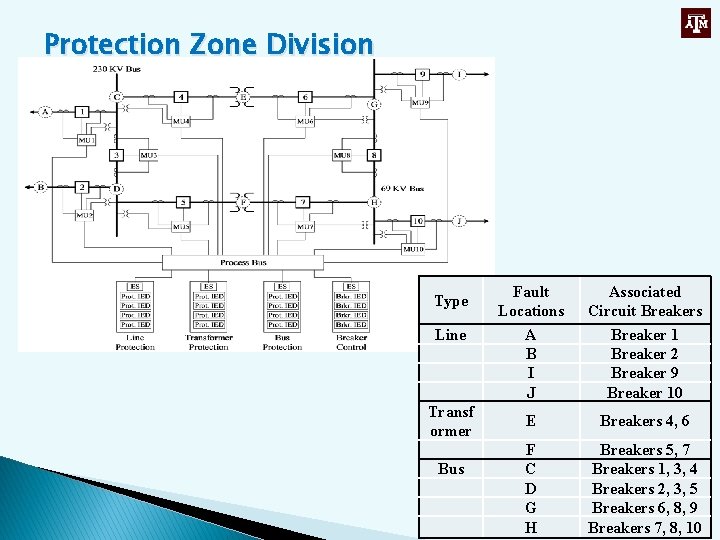
Protection Zone Division Line Fault Locations A B I J Associated Circuit Breakers Breaker 1 Breaker 2 Breaker 9 Breaker 10 Transf ormer E Breakers 4, 6 F C D G H Breakers 5, 7 Breakers 1, 3, 4 Breakers 2, 3, 5 Breakers 6, 8, 9 Breakers 7, 8, 10 Type Bus
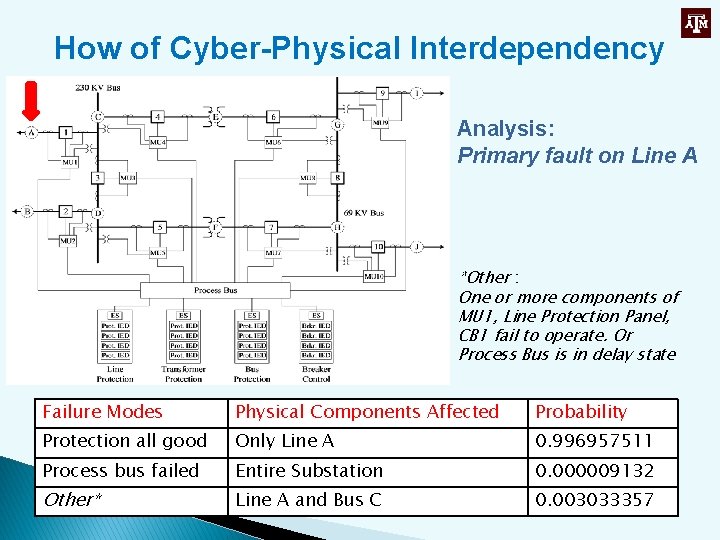
How of Cyber-Physical Interdependency Analysis: Primary fault on Line A *Other : One or more components of MU 1, Line Protection Panel, CB 1 fail to operate. Or Process Bus is in delay state Failure Modes Physical Components Affected Probability Protection all good Only Line A 0. 996957511 Process bus failed Entire Substation 0. 000009132 Other* Line A and Bus C 0. 003033357
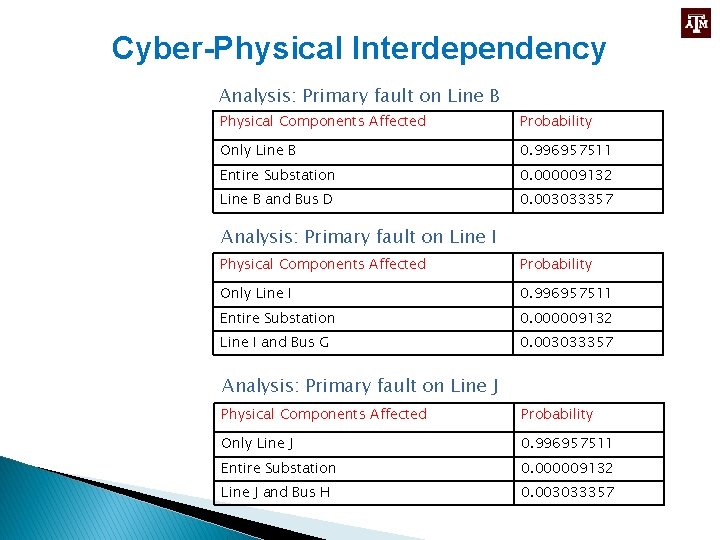
Cyber-Physical Interdependency Analysis: Primary fault on Line B Physical Components Affected Probability Only Line B 0. 996957511 Entire Substation 0. 000009132 Line B and Bus D 0. 003033357 Analysis: Primary fault on Line I Physical Components Affected Probability Only Line I 0. 996957511 Entire Substation 0. 000009132 Line I and Bus G 0. 003033357 Analysis: Primary fault on Line J Physical Components Affected Probability Only Line J 0. 996957511 Entire Substation 0. 000009132 Line J and Bus H 0. 003033357
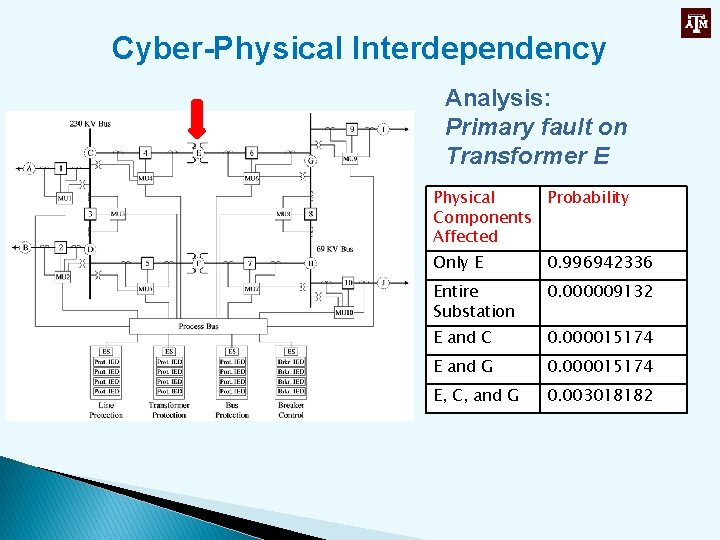
Cyber-Physical Interdependency Analysis: Primary fault on Transformer E Physical Probability Components Affected Only E 0. 996942336 Entire Substation 0. 000009132 E and C 0. 000015174 E and G 0. 000015174 E, C, and G 0. 003018182
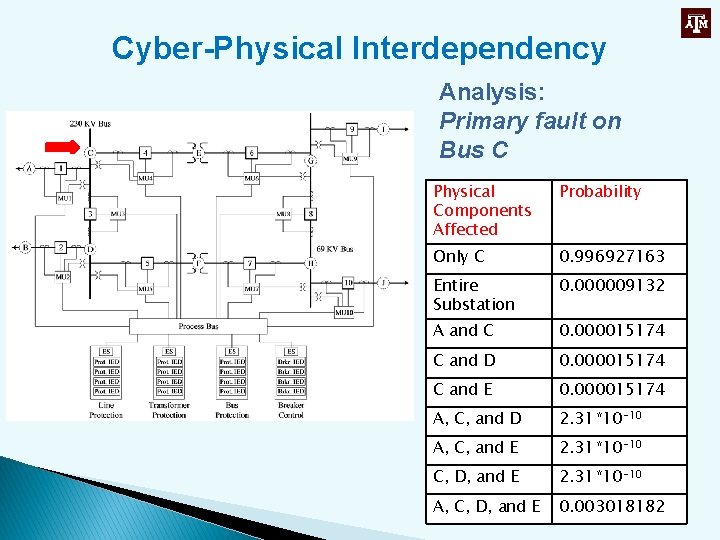
Cyber-Physical Interdependency Analysis: Primary fault on Bus C Physical Components Affected Probability Only C 0. 996927163 Entire Substation 0. 000009132 A and C 0. 000015174 C and D 0. 000015174 C and E 0. 000015174 A, C, and D 2. 31*10 -10 A, C, and E 2. 31*10 -10 C, D, and E 2. 31*10 -10 A, C, D, and E 0. 003018182
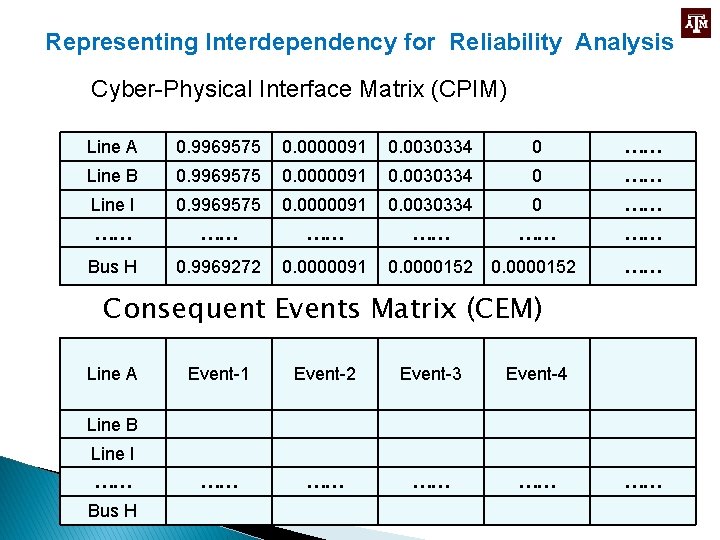
Representing Interdependency for Reliability Analysis Cyber-Physical Interface Matrix (CPIM) Line A 0. 9969575 0. 0000091 0. 0030334 0 …… Line B 0. 9969575 0. 0000091 0. 0030334 0 …… Line I 0. 9969575 0. 0000091 0. 0030334 0 …… …… Bus H 0. 9969272 0. 0000091 0. 0000152 …… Consequent Events Matrix (CEM) Line A Event-1 Event-2 Event-3 Event-4 …… …… Line B Line I …… Bus H ……
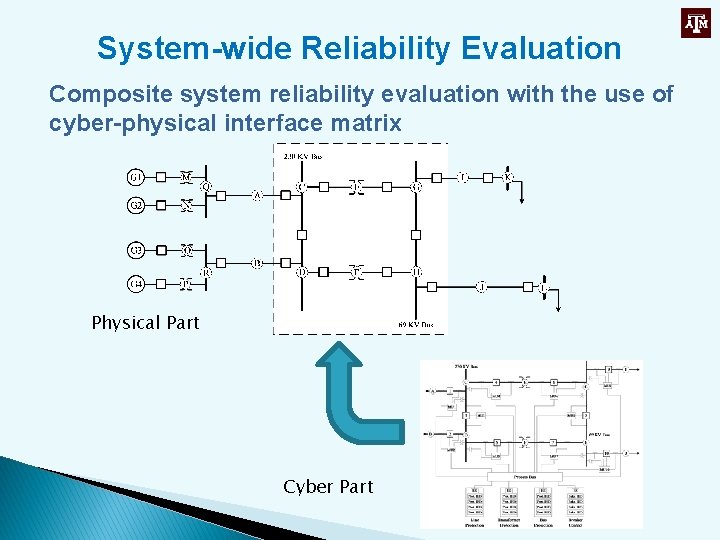
System-wide Reliability Evaluation Composite system reliability evaluation with the use of cyber-physical interface matrix Physical Part Cyber Part
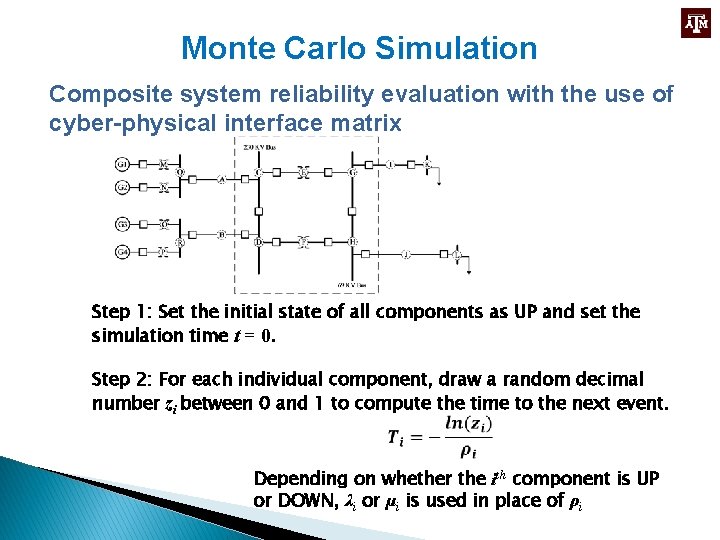
Monte Carlo Simulation Composite system reliability evaluation with the use of cyber-physical interface matrix Step 1: Set the initial state of all components as UP and set the simulation time t = 0. Step 2: For each individual component, draw a random decimal number zi between 0 and 1 to compute the time to the next event. Depending on whether the ith component is UP or DOWN, λi or µi is used in place of ρi
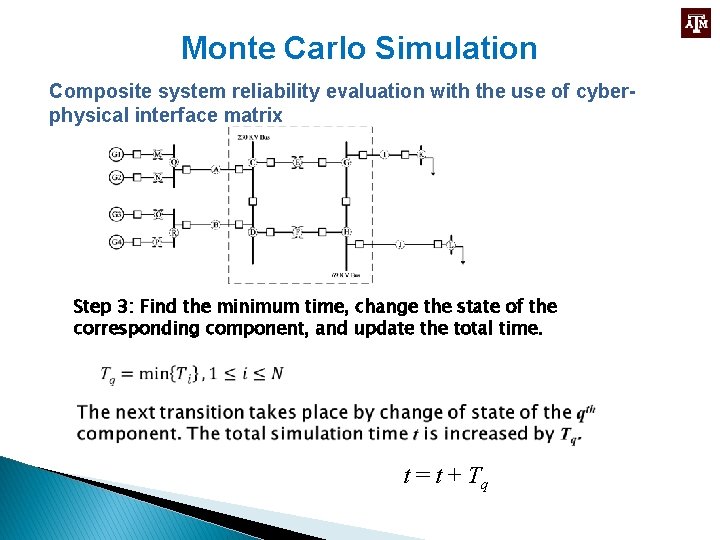
Monte Carlo Simulation Composite system reliability evaluation with the use of cyberphysical interface matrix Step 3: Find the minimum time, change the state of the corresponding component, and update the total time. t = t + Tq
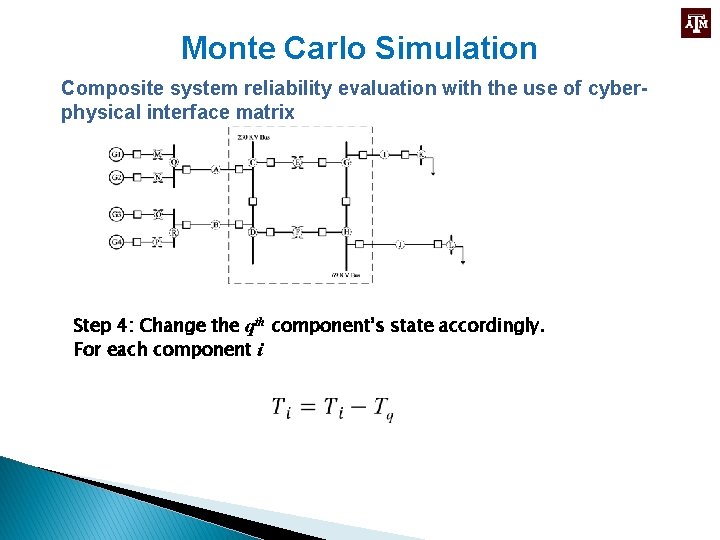
Monte Carlo Simulation Composite system reliability evaluation with the use of cyberphysical interface matrix Step 4: Change the qth component’s state accordingly. For each component i
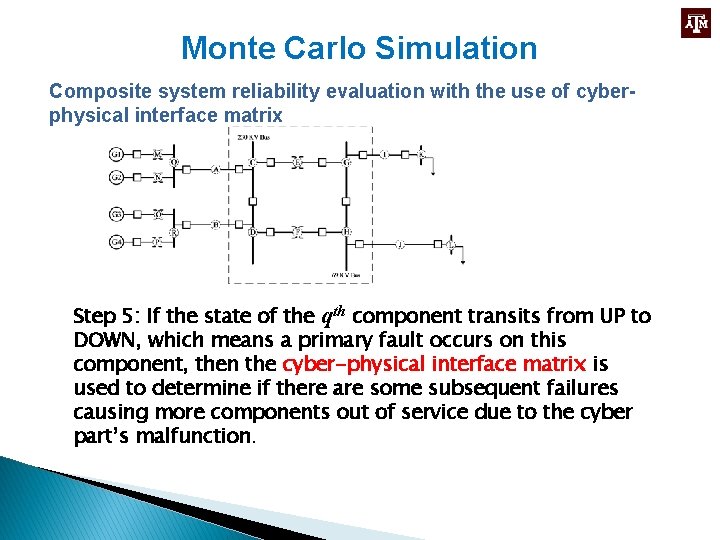
Monte Carlo Simulation Composite system reliability evaluation with the use of cyberphysical interface matrix Step 5: If the state of the qth component transits from UP to DOWN, which means a primary fault occurs on this component, then the cyber-physical interface matrix is used to determine if there are some subsequent failures causing more components out of service due to the cyber part’s malfunction.
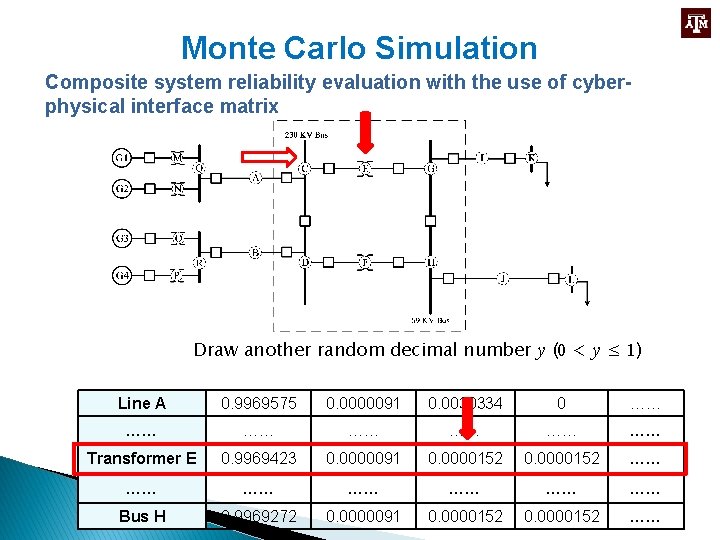
Monte Carlo Simulation Composite system reliability evaluation with the use of cyberphysical interface matrix Draw another random decimal number y (0 < y ≤ 1) Line A 0. 9969575 0. 0000091 0. 0030334 0 …… …… Transformer E 0. 9969423 0. 0000091 0. 0000152 …… …… Bus H 0. 9969272 0. 0000091 0. 0000152 ……
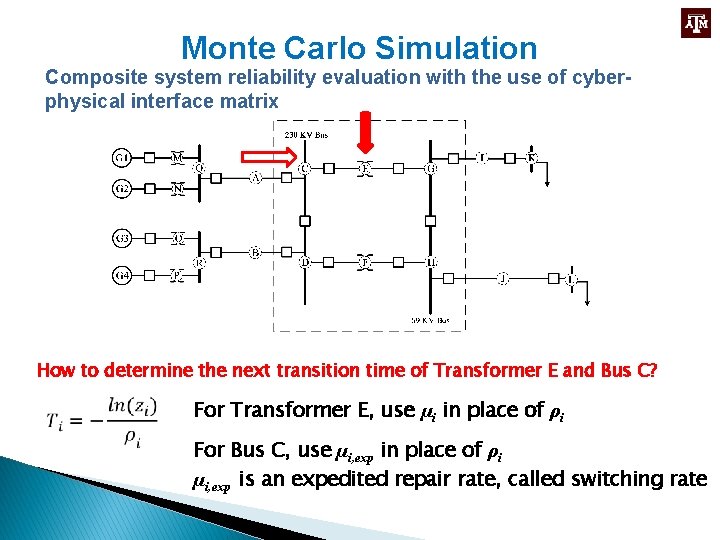
Monte Carlo Simulation Composite system reliability evaluation with the use of cyberphysical interface matrix How to determine the next transition time of Transformer E and Bus C? For Transformer E, use µi in place of ρi For Bus C, use µi, exp in place of ρi µi, exp is an expedited repair rate, called switching rate
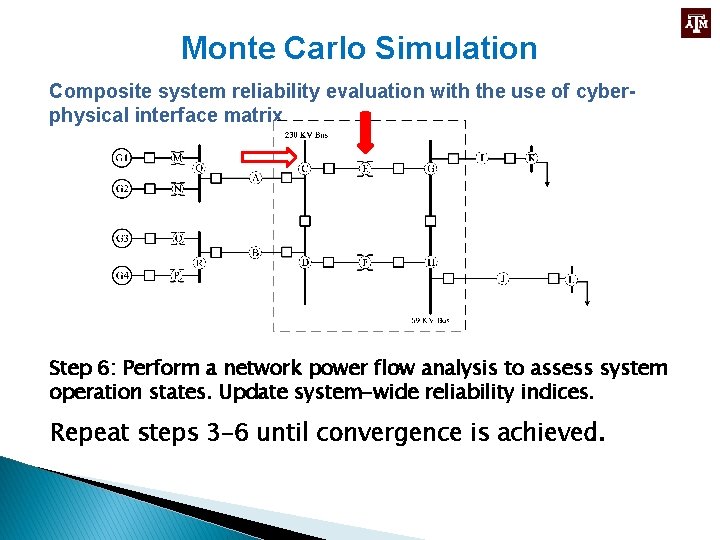
Monte Carlo Simulation Composite system reliability evaluation with the use of cyberphysical interface matrix Step 6: Perform a network power flow analysis to assess system operation states. Update system-wide reliability indices. Repeat steps 3– 6 until convergence is achieved.
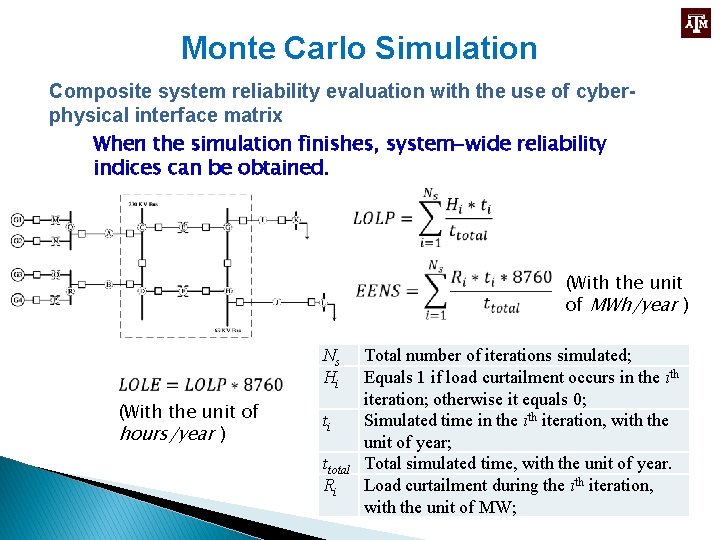
Monte Carlo Simulation Composite system reliability evaluation with the use of cyberphysical interface matrix When the simulation finishes, system-wide reliability indices can be obtained. (With the unit of MWh/year ) Ns Hi (With the unit of hours/year ) ti ttotal Ri Total number of iterations simulated; Equals 1 if load curtailment occurs in the ith iteration; otherwise it equals 0; Simulated time in the ith iteration, with the unit of year; Total simulated time, with the unit of year. Load curtailment during the ith iteration, with the unit of MW;
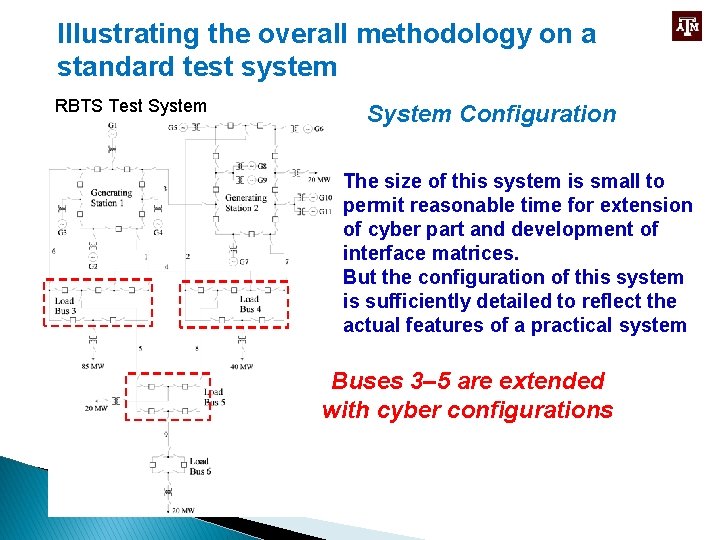
Illustrating the overall methodology on a standard test system RBTS Test System Configuration The size of this system is small to permit reasonable time for extension of cyber part and development of interface matrices. But the configuration of this system is sufficiently detailed to reflect the actual features of a practical system Buses 3– 5 are extended with cyber configurations
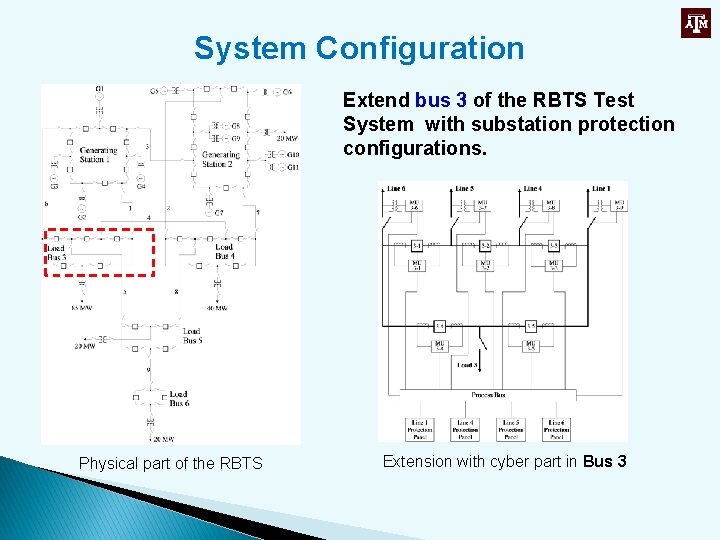
System Configuration Extend bus 3 of the RBTS Test System with substation protection configurations. Physical part of the RBTS Extension with cyber part in Bus 3
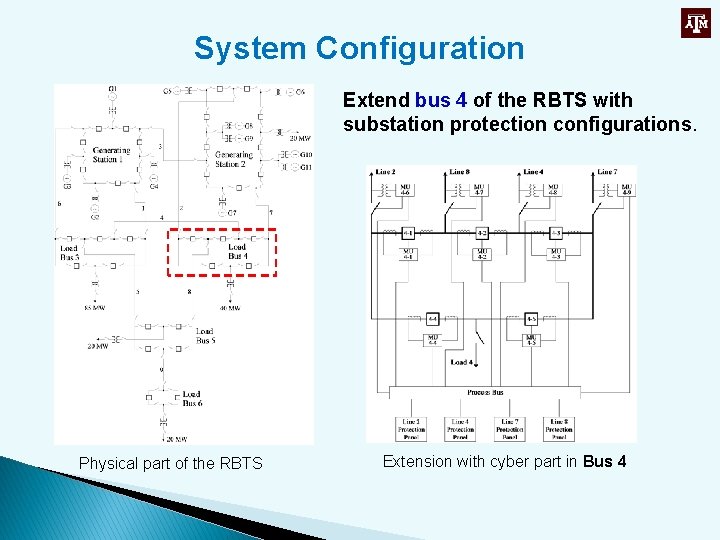
System Configuration Extend bus 4 of the RBTS with substation protection configurations. Physical part of the RBTS Extension with cyber part in Bus 4
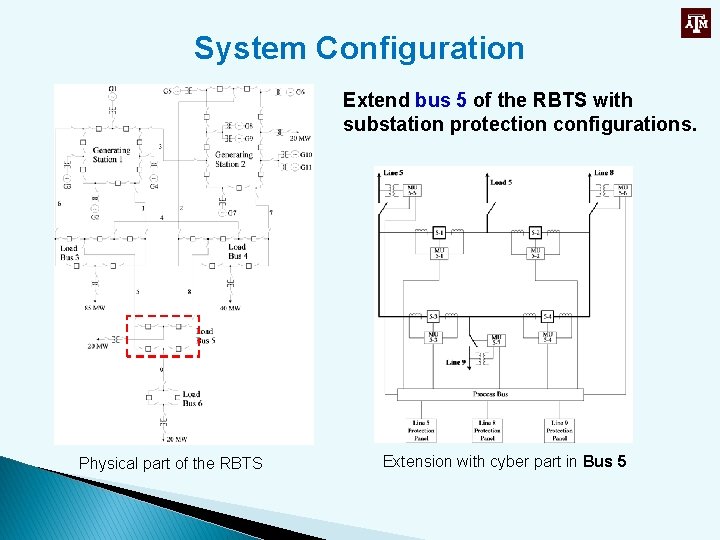
System Configuration Extend bus 5 of the RBTS with substation protection configurations. Physical part of the RBTS Extension with cyber part in Bus 5
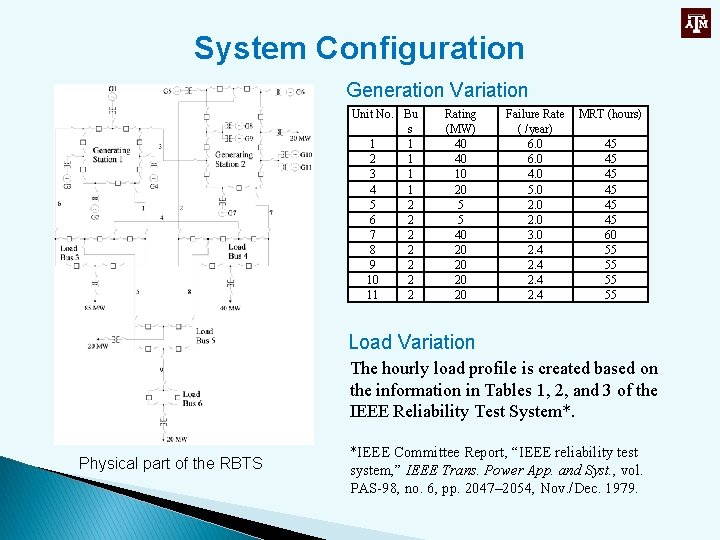
System Configuration Generation Variation Unit No. Bu s 1 1 2 1 3 1 4 1 5 2 6 2 7 2 8 2 9 2 10 2 11 2 Rating (MW) 40 40 10 20 5 5 40 20 20 Failure Rate ( /year) 6. 0 4. 0 5. 0 2. 0 3. 0 2. 4 MRT (hours) 45 45 45 60 55 55 Load Variation The hourly load profile is created based on the information in Tables 1, 2, and 3 of the IEEE Reliability Test System*. Physical part of the RBTS *IEEE Committee Report, “IEEE reliability test system, ” IEEE Trans. Power App. and Syst. , vol. PAS-98, no. 6, pp. 2047– 2054, Nov. /Dec. 1979.
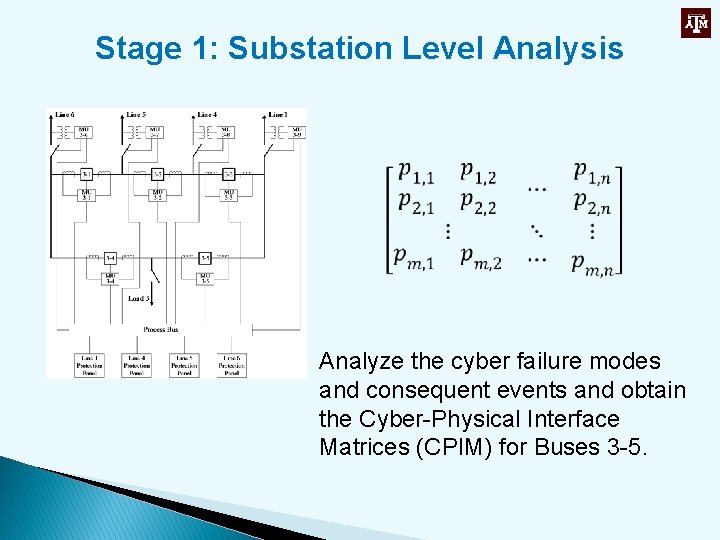
Stage 1: Substation Level Analysis Analyze the cyber failure modes and consequent events and obtain the Cyber-Physical Interface Matrices (CPIM) for Buses 3 -5.
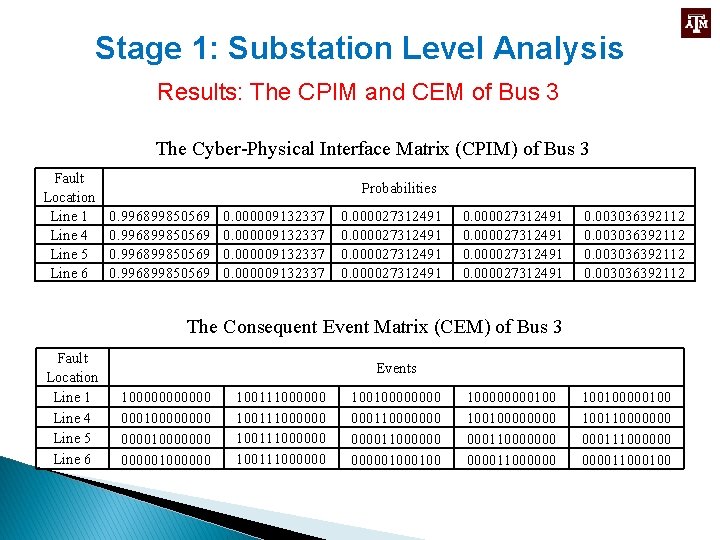
Stage 1: Substation Level Analysis Results: The CPIM and CEM of Bus 3 The Cyber-Physical Interface Matrix (CPIM) of Bus 3 Fault Location Line 1 Line 4 Line 5 Line 6 Probabilities 0. 996899850569 0. 000009132337 0. 000027312491 0. 003036392112 The Consequent Event Matrix (CEM) of Bus 3 Fault Location Line 1 Line 4 Line 5 Line 6 Events 1000000 00010000100000001000000 100111000000 10010000 00011000000011000000100 10000100 10010000 00011000000011000000 100100000100 100110000000 00011100000011000100
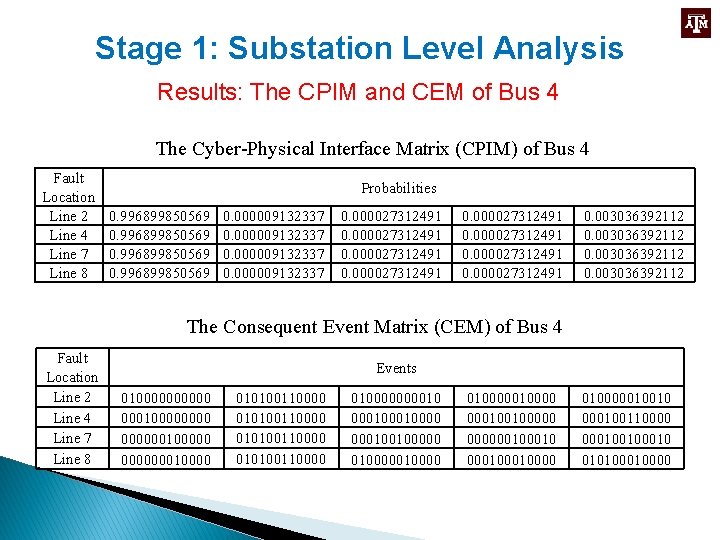
Stage 1: Substation Level Analysis Results: The CPIM and CEM of Bus 4 The Cyber-Physical Interface Matrix (CPIM) of Bus 4 Fault Location Line 2 Line 4 Line 7 Line 8 Probabilities 0. 996899850569 0. 000009132337 0. 000027312491 0. 003036392112 The Consequent Event Matrix (CEM) of Bus 4 Fault Location Line 2 Line 4 Line 7 Line 8 Events 0100000 00010000001000000010000 010100110000 01000010000 00010010000010000 000100100000010 00010000010010 000100110000 00010010 01010000
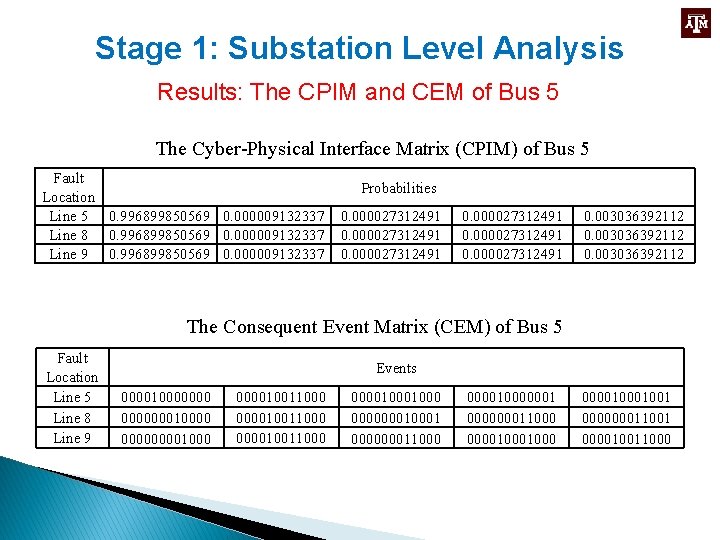
Stage 1: Substation Level Analysis Results: The CPIM and CEM of Bus 5 The Cyber-Physical Interface Matrix (CPIM) of Bus 5 Fault Location Line 5 0. 996899850569 0. 000009132337 Line 8 0. 996899850569 0. 000009132337 Line 9 0. 996899850569 0. 000009132337 Probabilities 0. 000027312491 0. 003036392112 The Consequent Event Matrix (CEM) of Bus 5 Fault Location Line 5 Line 8 Line 9 Events 000010000000100001000 000010011000 00001000 000000011000 000010000001 000000011000 000010001001 000000011001 000010011000
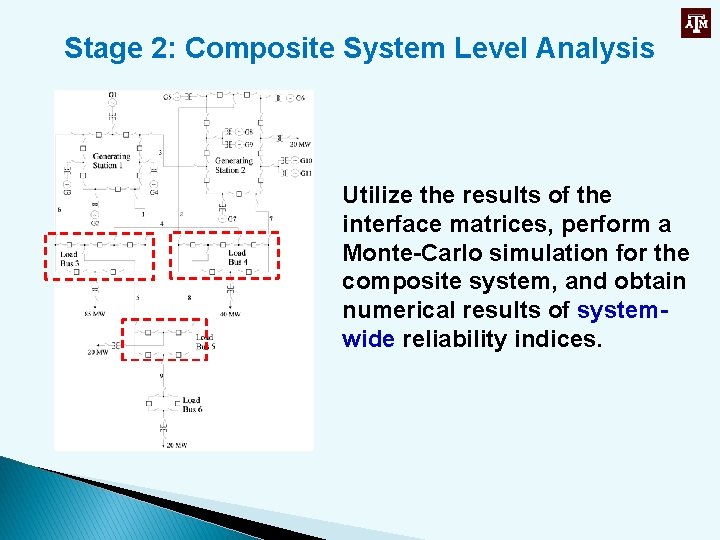
Stage 2: Composite System Level Analysis Utilize the results of the interface matrices, perform a Monte-Carlo simulation for the composite system, and obtain numerical results of systemwide reliability indices.
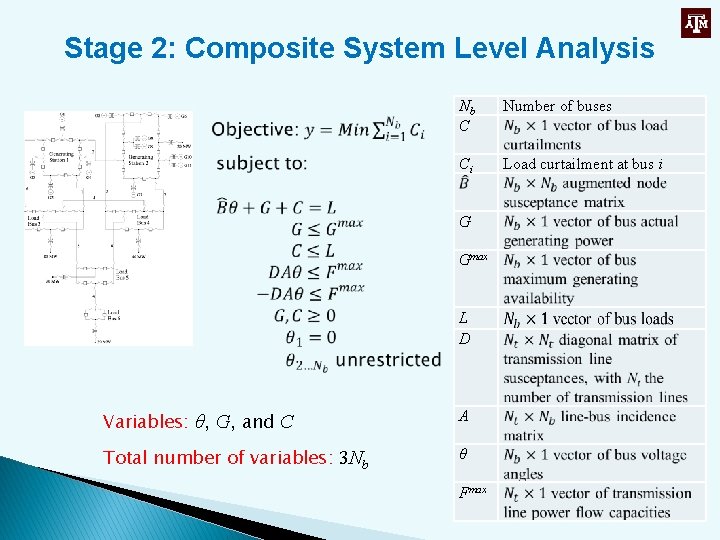
Stage 2: Composite System Level Analysis Nb C Number of buses Ci Load curtailment at bus i G Gmax L D Variables: θ, G, and C A Total number of variables: 3 Nb θ Fmax
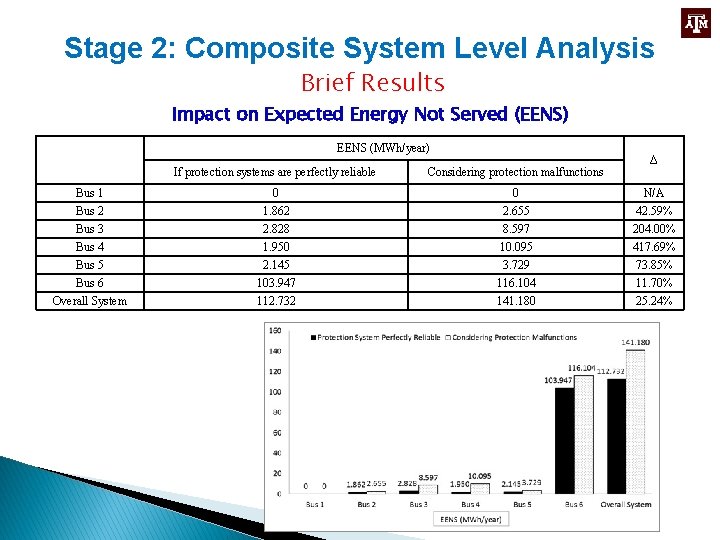
Stage 2: Composite System Level Analysis Brief Results Impact on Expected Energy Not Served (EENS) EENS (MWh/year) Bus 1 Bus 2 Bus 3 Bus 4 Bus 5 Bus 6 Overall System If protection systems are perfectly reliable Considering protection malfunctions 0 1. 862 2. 828 1. 950 2. 145 103. 947 112. 732 0 2. 655 8. 597 10. 095 3. 729 116. 104 141. 180 Δ N/A 42. 59% 204. 00% 417. 69% 73. 85% 11. 70% 25. 24%
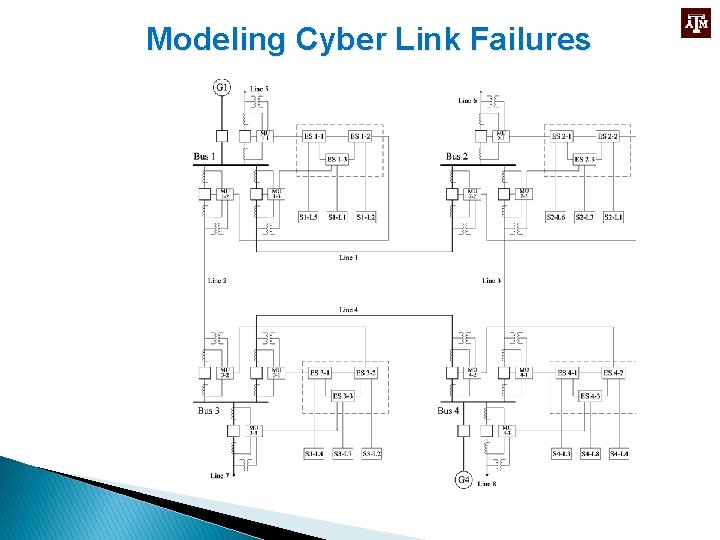
Modeling Cyber Link Failures
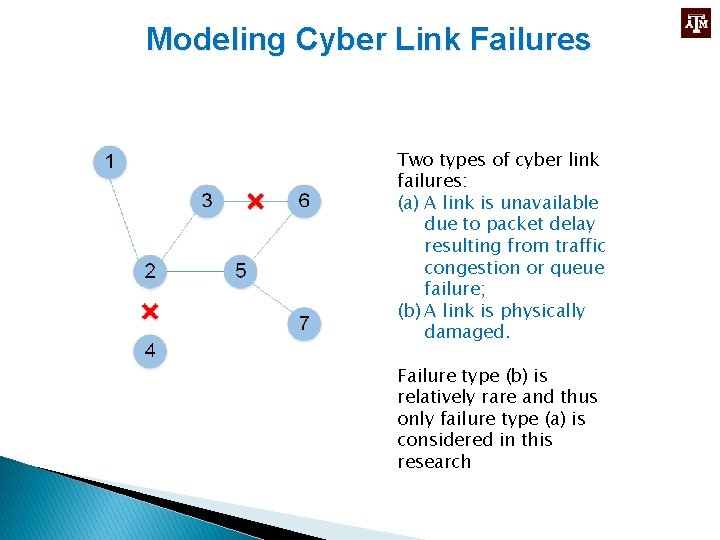
Modeling Cyber Link Failures Two types of cyber link failures: (a) A link is unavailable due to packet delay resulting from traffic congestion or queue failure; (b) A link is physically damaged. Failure type (b) is relatively rare and thus only failure type (a) is considered in this research
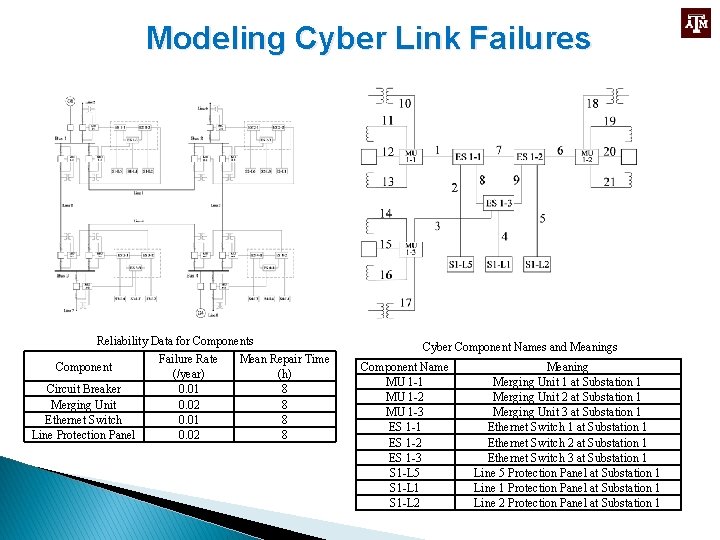
Modeling Cyber Link Failures Reliability Data for Components Component Circuit Breaker Merging Unit Ethernet Switch Line Protection Panel Failure Rate (/year) 0. 01 0. 02 Mean Repair Time (h) 8 8 Cyber Component Names and Meanings Component Name MU 1 -1 MU 1 -2 MU 1 -3 ES 1 -1 ES 1 -2 ES 1 -3 S 1 -L 5 S 1 -L 1 S 1 -L 2 Meaning Merging Unit 1 at Substation 1 Merging Unit 2 at Substation 1 Merging Unit 3 at Substation 1 Ethernet Switch 1 at Substation 1 Ethernet Switch 2 at Substation 1 Ethernet Switch 3 at Substation 1 Line 5 Protection Panel at Substation 1 Line 1 Protection Panel at Substation 1 Line 2 Protection Panel at Substation 1
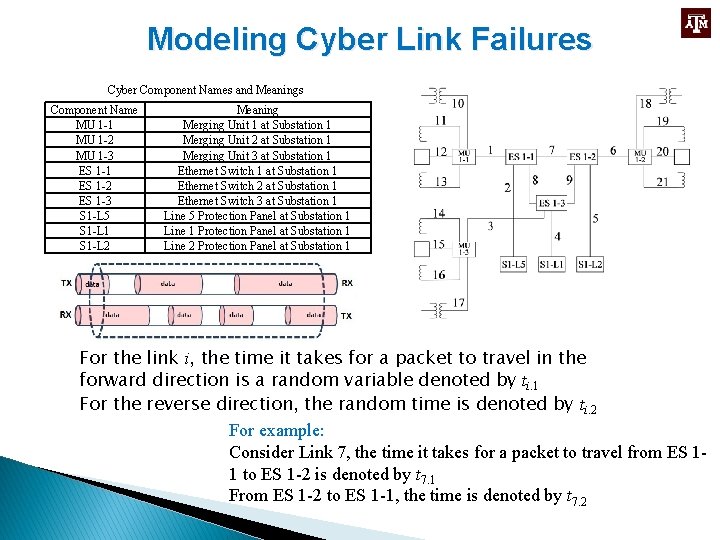
Modeling Cyber Link Failures Cyber Component Names and Meanings Component Name MU 1 -1 MU 1 -2 MU 1 -3 ES 1 -1 ES 1 -2 ES 1 -3 S 1 -L 5 S 1 -L 1 S 1 -L 2 Meaning Merging Unit 1 at Substation 1 Merging Unit 2 at Substation 1 Merging Unit 3 at Substation 1 Ethernet Switch 1 at Substation 1 Ethernet Switch 2 at Substation 1 Ethernet Switch 3 at Substation 1 Line 5 Protection Panel at Substation 1 Line 1 Protection Panel at Substation 1 Line 2 Protection Panel at Substation 1 For the link i, the time it takes for a packet to travel in the forward direction is a random variable denoted by ti. 1 For the reverse direction, the random time is denoted by ti. 2 For example: Consider Link 7, the time it takes for a packet to travel from ES 11 to ES 1 -2 is denoted by t 7. 1 From ES 1 -2 to ES 1 -1, the time is denoted by t 7. 2
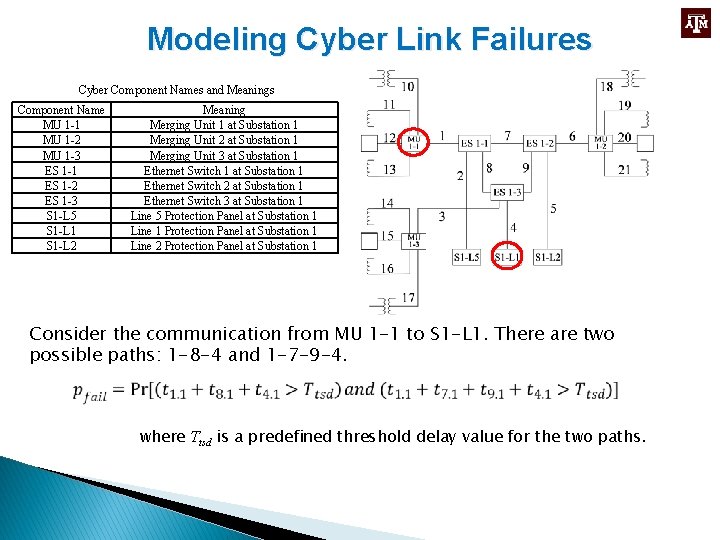
Modeling Cyber Link Failures Cyber Component Names and Meanings Component Name MU 1 -1 MU 1 -2 MU 1 -3 ES 1 -1 ES 1 -2 ES 1 -3 S 1 -L 5 S 1 -L 1 S 1 -L 2 Meaning Merging Unit 1 at Substation 1 Merging Unit 2 at Substation 1 Merging Unit 3 at Substation 1 Ethernet Switch 1 at Substation 1 Ethernet Switch 2 at Substation 1 Ethernet Switch 3 at Substation 1 Line 5 Protection Panel at Substation 1 Line 1 Protection Panel at Substation 1 Line 2 Protection Panel at Substation 1 Consider the communication from MU 1 -1 to S 1 -L 1. There are two possible paths: 1 -8 -4 and 1 -7 -9 -4. where Ttsd is a predefined threshold delay value for the two paths.
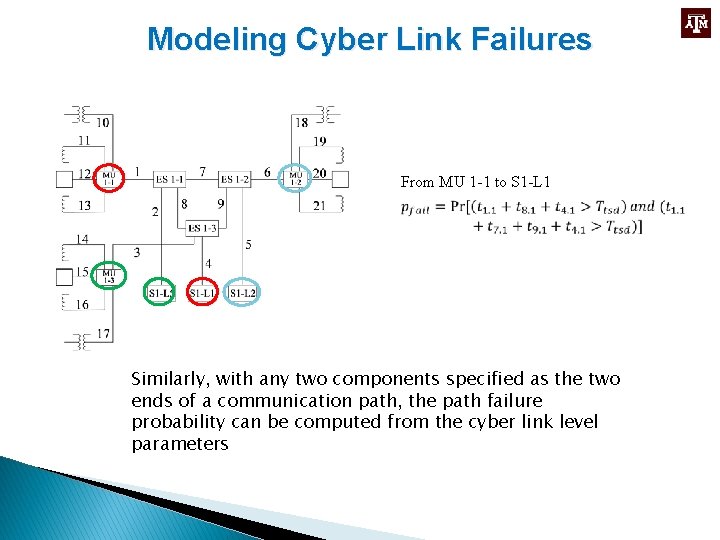
Modeling Cyber Link Failures From MU 1 -1 to S 1 -L 1 Similarly, with any two components specified as the two ends of a communication path, the path failure probability can be computed from the cyber link level parameters
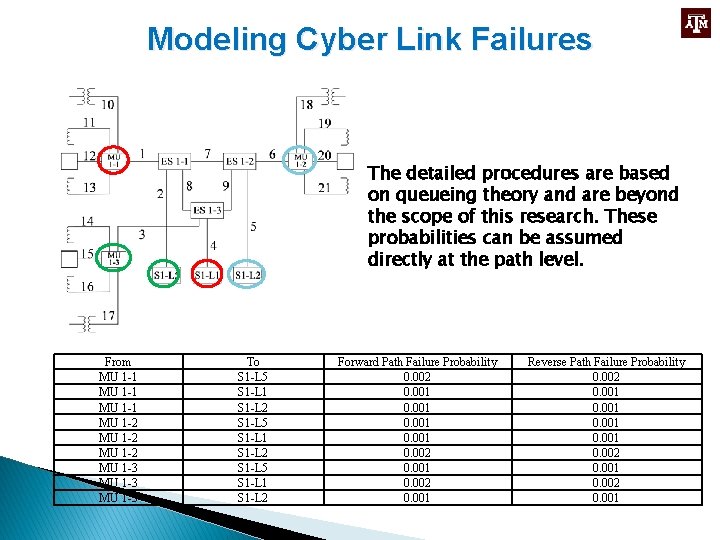
Modeling Cyber Link Failures The detailed procedures are based on queueing theory and are beyond the scope of this research. These probabilities can be assumed directly at the path level. From MU 1 -1 MU 1 -2 MU 1 -3 To S 1 -L 5 S 1 -L 1 S 1 -L 2 Forward Path Failure Probability 0. 002 0. 001 Reverse Path Failure Probability 0. 002 0. 001
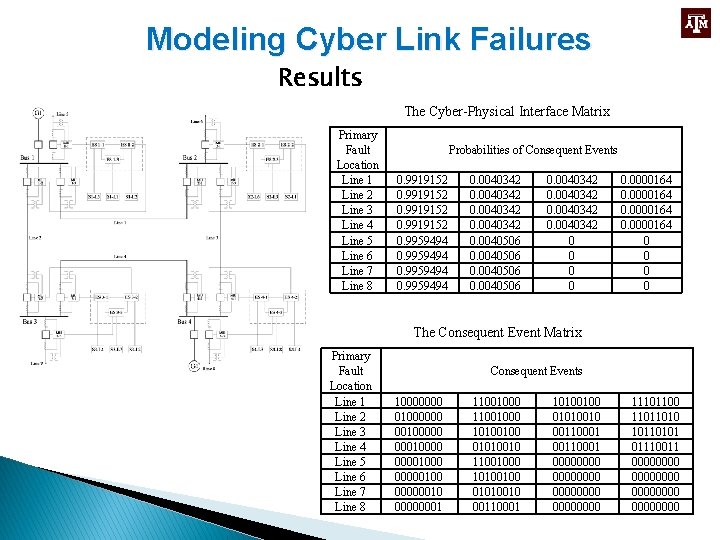
Modeling Cyber Link Failures Results The Cyber-Physical Interface Matrix Primary Fault Location Line 1 Line 2 Line 3 Line 4 Line 5 Line 6 Line 7 Line 8 Probabilities of Consequent Events 0. 9919152 0. 9959494 0. 0040342 0. 0040506 0. 0040342 0 0 0. 0000164 0 0 The Consequent Event Matrix Primary Fault Location Line 1 Line 2 Line 3 Line 4 Line 5 Line 6 Line 7 Line 8 Consequent Events 10000000 01000000 00100000 000100001000 00000100 00000010 00000001 11001000 10100100 01010010 00110001 00000000 11101100 110110101 01110011 00000000
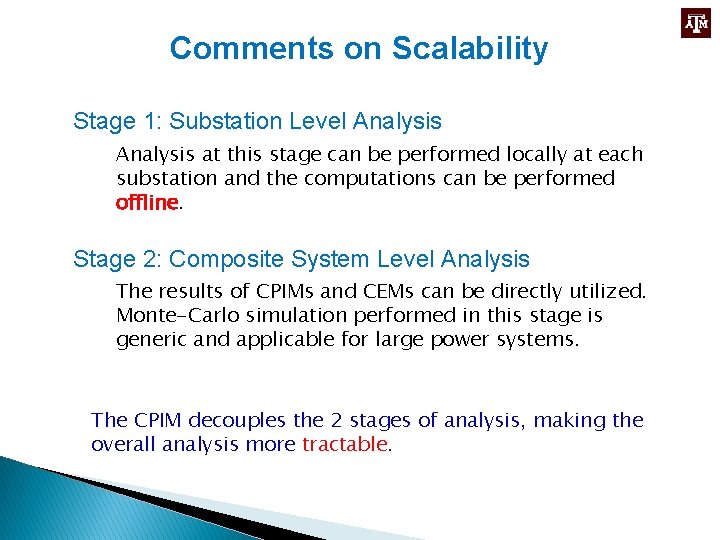
Comments on Scalability Stage 1: Substation Level Analysis at this stage can be performed locally at each substation and the computations can be performed offline. Stage 2: Composite System Level Analysis The results of CPIMs and CEMs can be directly utilized. Monte-Carlo simulation performed in this stage is generic and applicable for large power systems. The CPIM decouples the 2 stages of analysis, making the overall analysis more tractable.
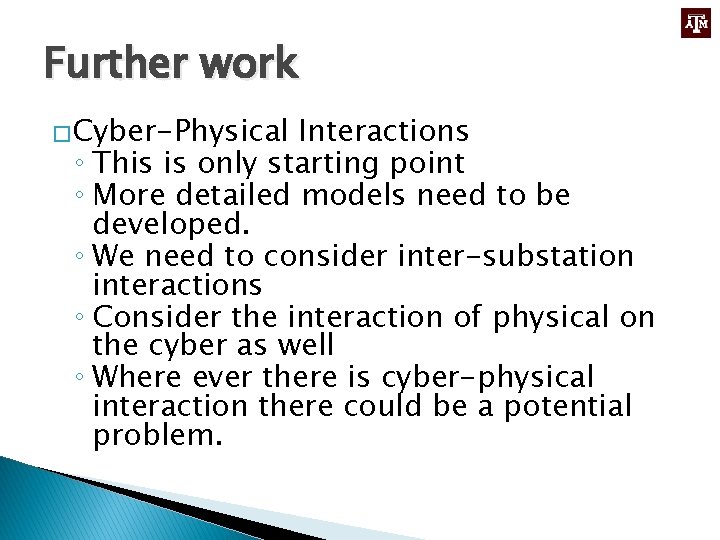
Further work �Cyber-Physical Interactions ◦ This is only starting point ◦ More detailed models need to be developed. ◦ We need to consider inter-substation interactions ◦ Consider the interaction of physical on the cyber as well ◦ Where ever there is cyber-physical interaction there could be a potential problem.
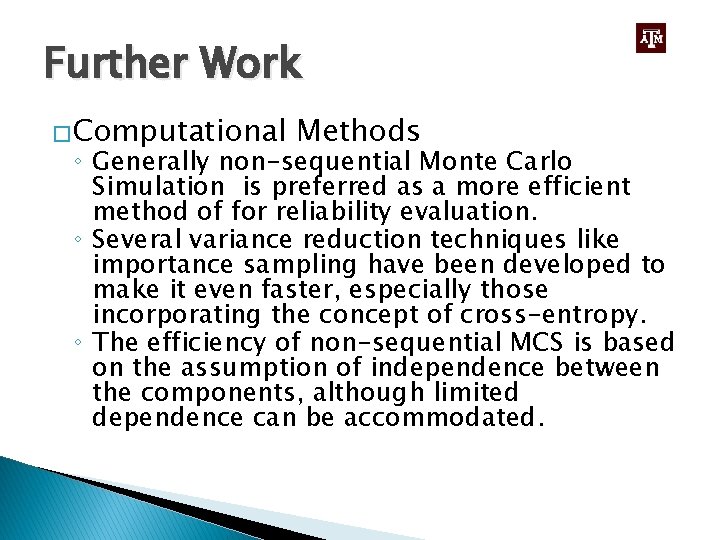
Further Work �Computational Methods ◦ Generally non-sequential Monte Carlo Simulation is preferred as a more efficient method of for reliability evaluation. ◦ Several variance reduction techniques like importance sampling have been developed to make it even faster, especially those incorporating the concept of cross-entropy. ◦ The efficiency of non-sequential MCS is based on the assumption of independence between the components, although limited dependence can be accommodated.
Test System � IEEE RTS – Reliability Test System has served as a resource for the researchers and developers to test their algorithms and compare their results with others. � Additional information about distribution has since been added. � This test system does not have information on the related cyber part. � A taskforce under the Reliability, Risk and Probability Applications Subcommittee (RRPA) is investigating adding configurations and data on the cyber part.
Further work ◦ Because of interdependence introduced by cyber part it becomes difficult to use non-sequential MC and the associated variance reduction techniques. So we have used sequential MCS. ◦ We have also proposed a nonsequential MCS technique to solve this problem but more work is needed in this direction.
References for this Presentation 1. C. Singh, A. Sprintson, “Reliability Assurance of Cyber. Physical Power Systems”, IEEE PES General Meeting, July 2010. 2. Yan Zhang, Alex Sprintson, and Chanan Singh, “An Integrative Approach to Reliability Analysis of an IEC 61850 Digital Substation“, IEEE PES General Meeting, July 2012. 3. H. Lei, C. Singh, and A. Sprintson, “Reliability modeling and analysis of IEC 61850 based substation protection systems, ” IEEE Transactions on Smart Grid, vol. 5, no. 5, pp. 2194– 2202, September 2014. 4. H. Lei and C. Singh, “Power system reliability evaluation considering cyber-malfunctions in substations, ” Electric Power Systems Research, vol. 129, pp. 160 -169, December 2015. 5. M. S. Modarresi, L. Xie, and C. Singh “Reserves from Controllable Swimming Pool Pumps: Reliability Assessment and Operational Planning, ” in 51 st Hawaii International Conference on System Sciences (HICSS), January 2018

Questions? Presenter’s email: � singh@ece. tamu. edu
- Slides: 92