
Reliability Discussion DUNE G Haller hallerslac stanford edu

Reliability Discussion DUNE G. Haller (haller@slac. stanford. edu SLAC TID-AIR Technology and Innovation Directorate Advanced Instrumentation for Research Division
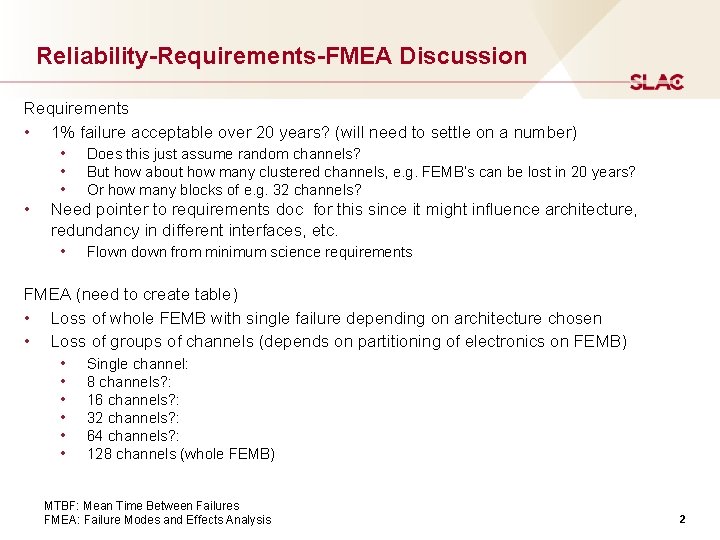
Reliability-Requirements-FMEA Discussion Requirements • 1% failure acceptable over 20 years? (will need to settle on a number) • • Does this just assume random channels? But how about how many clustered channels, e. g. FEMB’s can be lost in 20 years? Or how many blocks of e. g. 32 channels? Need pointer to requirements doc for this since it might influence architecture, redundancy in different interfaces, etc. • Flown down from minimum science requirements FMEA (need to create table) • Loss of whole FEMB with single failure depending on architecture chosen • Loss of groups of channels (depends on partitioning of electronics on FEMB) • • • Single channel: 8 channels? : 16 channels? : 32 channels? : 64 channels? : 128 channels (whole FEMB) MTBF: Mean Time Between Failures FMEA: Failure Modes and Effects Analysis 2
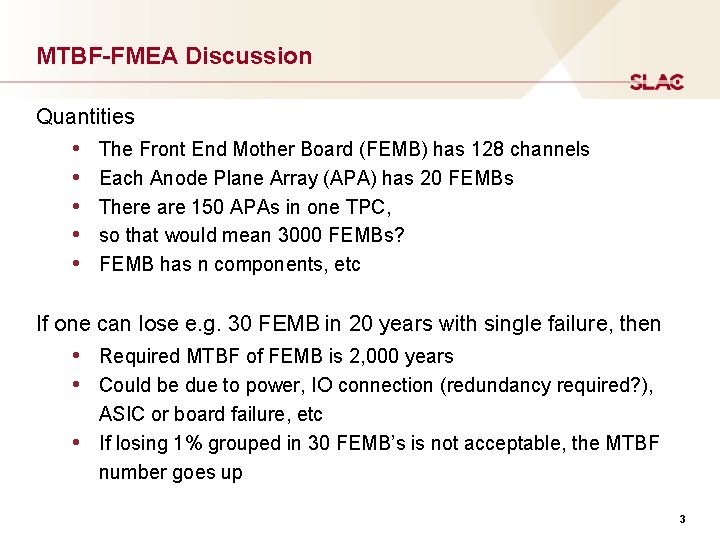
MTBF-FMEA Discussion Quantities • • • The Front End Mother Board (FEMB) has 128 channels Each Anode Plane Array (APA) has 20 FEMBs There are 150 APAs in one TPC, so that would mean 3000 FEMBs? FEMB has n components, etc If one can lose e. g. 30 FEMB in 20 years with single failure, then • Required MTBF of FEMB is 2, 000 years • Could be due to power, IO connection (redundancy required? ), • ASIC or board failure, etc If losing 1% grouped in 30 FEMB’s is not acceptable, the MTBF number goes up 3
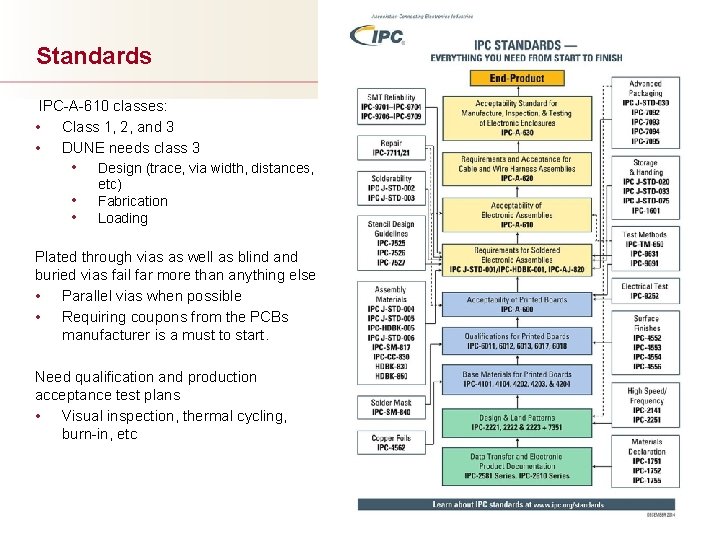
Standards IPC-A-610 classes: • Class 1, 2, and 3 • DUNE needs class 3 • • • Design (trace, via width, distances, etc) Fabrication Loading Plated through vias as well as blind and buried vias fail far more than anything else. • Parallel vias when possible • Requiring coupons from the PCBs manufacturer is a must to start. Need qualification and production acceptance test plans • Visual inspection, thermal cycling, burn-in, etc 4
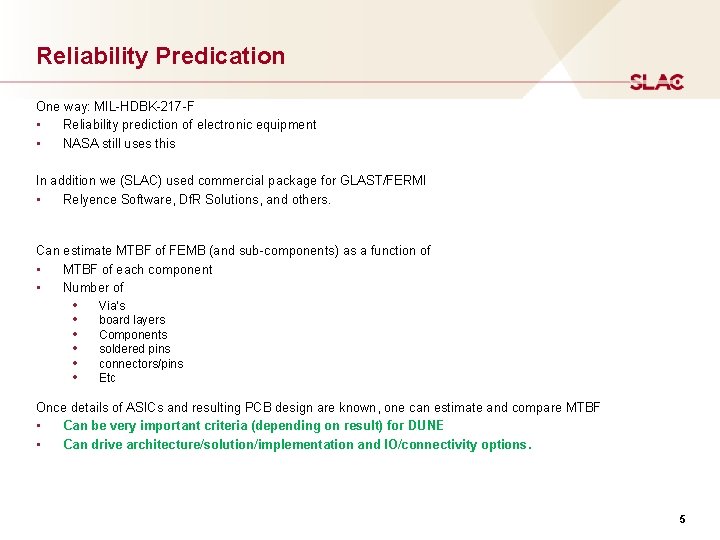
Reliability Predication One way: MIL-HDBK-217 -F • Reliability prediction of electronic equipment • NASA still uses this In addition we (SLAC) used commercial package for GLAST/FERMI • Relyence Software, Df. R Solutions, and others. Can estimate MTBF of FEMB (and sub-components) as a function of • MTBF of each component • Number of • • • Via’s board layers Components soldered pins connectors/pins Etc Once details of ASICs and resulting PCB design are known, one can estimate and compare MTBF • Can be very important criteria (depending on result) for DUNE • Can drive architecture/solution/implementation and IO/connectivity options. 5
Example GLAST/FERMI Space-based Instrument No option to fix anything in hardware, ever SLAC: Analysis, design, fabrication, testing, installation, commissioning of most of the electronics including overall system design and engineering. • Also has 14, 000 ASICs on board Only one of the requirements • No single failure can bring performance below science requirements (5 years requirement, 10 year goal) MTBF and FMEA to analyze failures and effects performed • Did drive electronics architecture and implementation But obvious motherhood statement • Less wires, connector pins, traces, vias, solder connections is better (under consideration of FMEA) Successful result up to now: 9 years in space, no issues Lots of requirements, procedures, and processes 6
- Slides: 6