
Reliability Analysis of HighRise Buildings under Wind Loads
Reliability Analysis of High-Rise Buildings under Wind Loads Ming-Yi Liu Yu-Jie Li Department of Civil Engineering, Chung Yuan Christian University, Taiwan
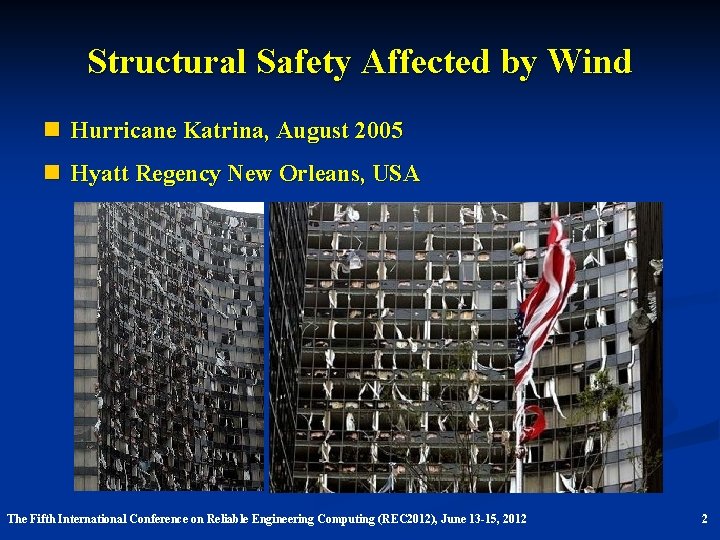
Structural Safety Affected by Wind n Hurricane Katrina, August 2005 n Hyatt Regency New Orleans, USA The Fifth International Conference on Reliable Engineering Computing (REC 2012), June 13 -15, 2012 2
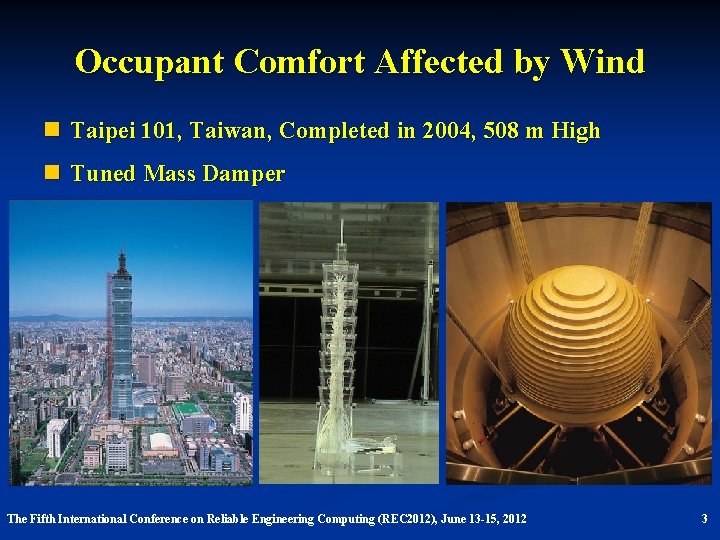
Occupant Comfort Affected by Wind n Taipei 101, Taiwan, Completed in 2004, 508 m High n Tuned Mass Damper The Fifth International Conference on Reliable Engineering Computing (REC 2012), June 13 -15, 2012 3
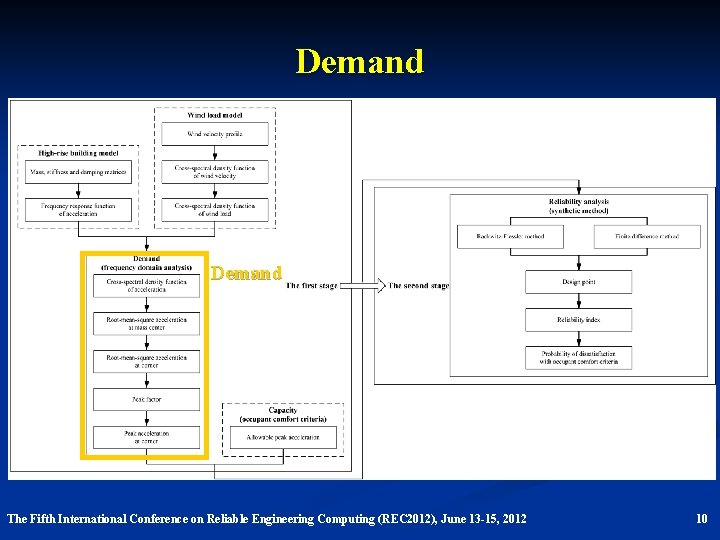
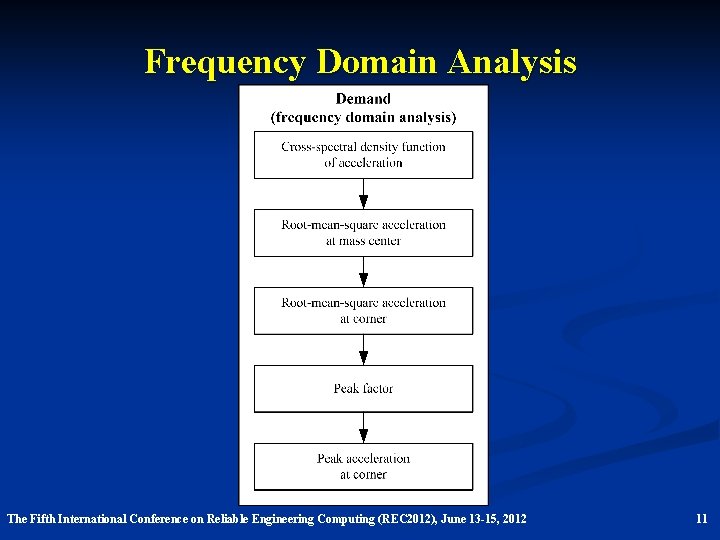
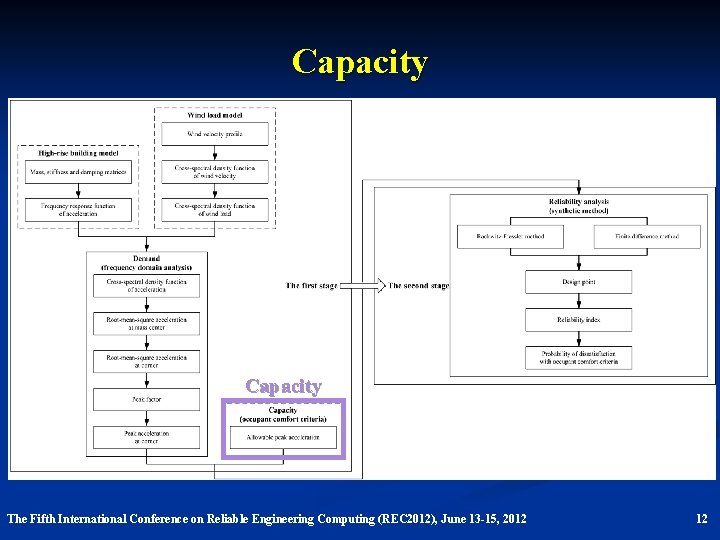
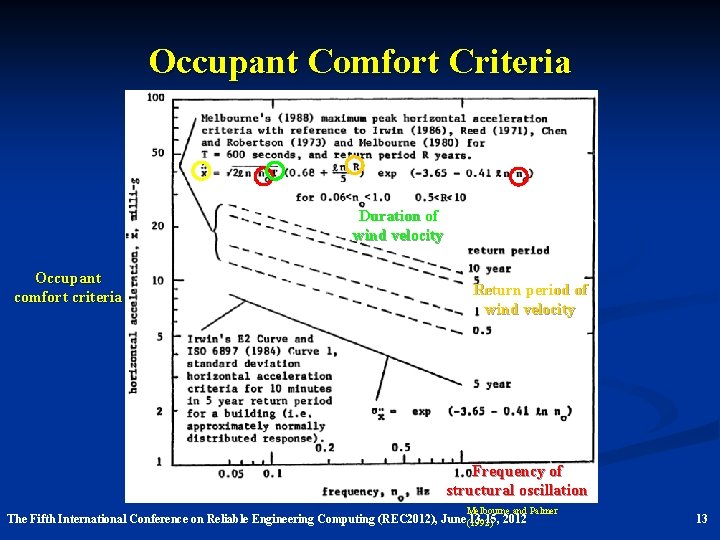
Objectives n The objective of this paper is to conduct the reliability analysis of high-rise buildings under wind loads. Numerical examples are provided to capture the dynamic effects of structures with eccentricity between the elastic and mass centers. The framework of this research consists of two stages n The first stage includes two parts: the deterministic analysis of windinduced acceleration for a variety of attack angles, i. e. , the demand, and the determination of allowable acceleration based on the occupant comfort criteria for wind-excited buildings, i. e. , the capacity n According to the results obtained in the first stage, the reliability analysis is conducted in the second stage, which can predict the probability of dissatisfaction with occupant comfort criteria for a variety of probability distributions of the structural eccentricity The Fifth International Conference on Reliable Engineering Computing (REC 2012), June 13 -15, 2012 4
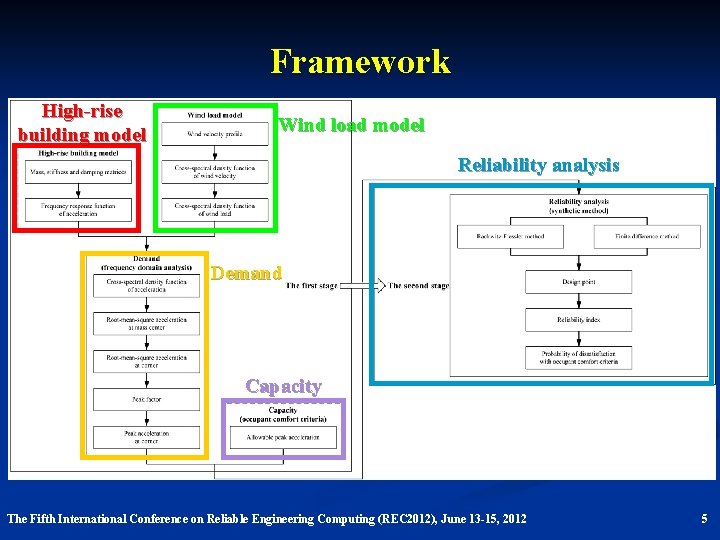
Framework High-rise building model Wind load model Reliability analysis Demand Capacity The Fifth International Conference on Reliable Engineering Computing (REC 2012), June 13 -15, 2012 5
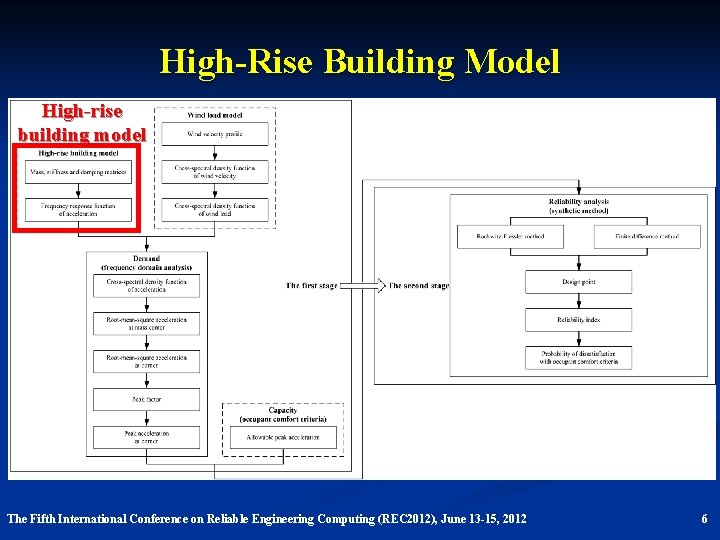
High-Rise Building Model High-rise building model The Fifth International Conference on Reliable Engineering Computing (REC 2012), June 13 -15, 2012 6
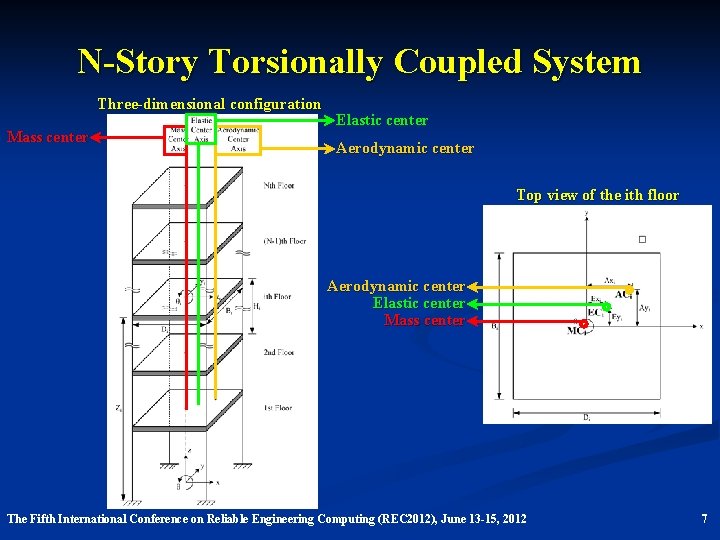
N-Story Torsionally Coupled System Three-dimensional configuration Mass center Elastic center Aerodynamic center Top view of the ith floor Aerodynamic center Elastic center Mass center The Fifth International Conference on Reliable Engineering Computing (REC 2012), June 13 -15, 2012 7

Wind Load Model Wind load model The Fifth International Conference on Reliable Engineering Computing (REC 2012), June 13 -15, 2012 8
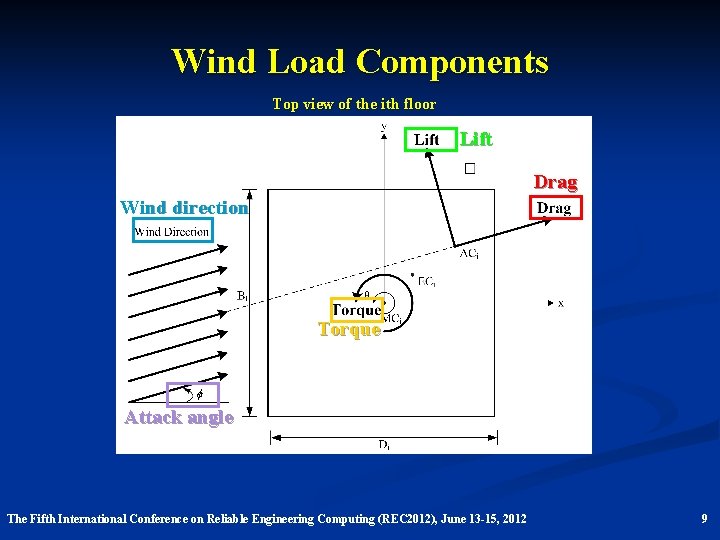
Wind Load Components Top view of the ith floor Lift Drag Wind direction Torque Attack angle The Fifth International Conference on Reliable Engineering Computing (REC 2012), June 13 -15, 2012 9
Demand The Fifth International Conference on Reliable Engineering Computing (REC 2012), June 13 -15, 2012 10
Frequency Domain Analysis The Fifth International Conference on Reliable Engineering Computing (REC 2012), June 13 -15, 2012 11
Capacity The Fifth International Conference on Reliable Engineering Computing (REC 2012), June 13 -15, 2012 12
Occupant Comfort Criteria Duration of wind velocity Occupant comfort criteria Return period of wind velocity Frequency of structural oscillation Melbourne and Palmer The Fifth International Conference on Reliable Engineering Computing (REC 2012), June (1992) 13 -15, 2012 13
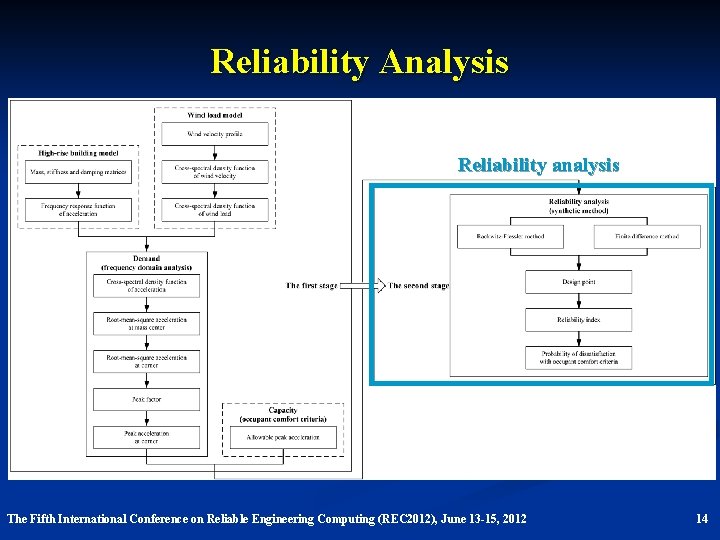
Reliability Analysis Reliability analysis The Fifth International Conference on Reliable Engineering Computing (REC 2012), June 13 -15, 2012 14
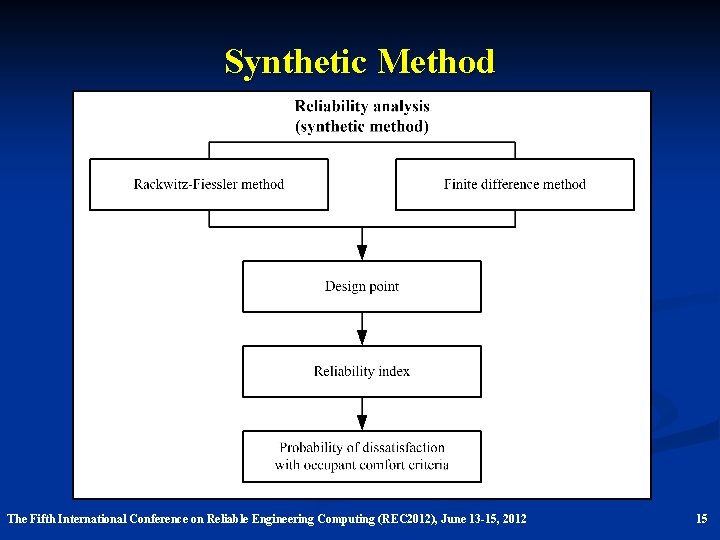
Synthetic Method The Fifth International Conference on Reliable Engineering Computing (REC 2012), June 13 -15, 2012 15
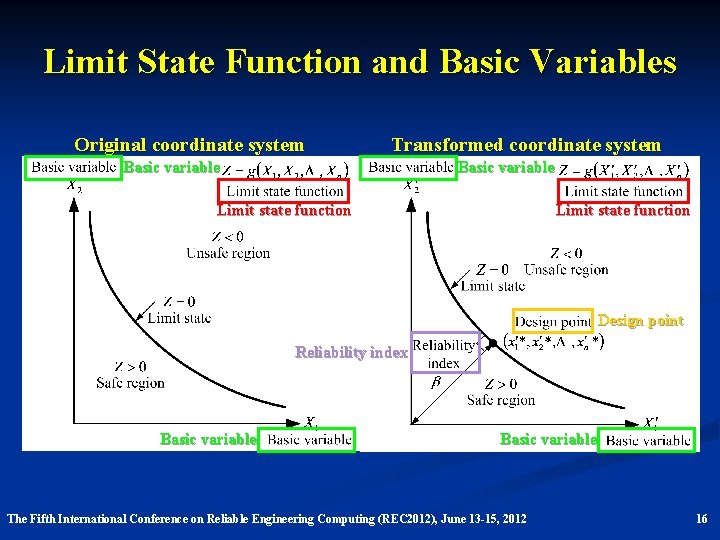
Limit State Function and Basic Variables Original coordinate system Transformed coordinate system Basic variable Limit state function Design point Reliability index Basic variable The Fifth International Conference on Reliable Engineering Computing (REC 2012), June 13 -15, 2012 16
Numerical Examples n Two numerical examples, i. e. , the torsionally uncoupled and coupled systems (40 -story buildings), are provided to conduct the reliability analysis of high-rise buildings under wind loads for a variety of attack angles n Four types of parameters: the high-rise building model, wind load model, occupant comfort criteria and reliability analysis, are considered in this study n All parameters of the two numerical examples are the same except the eccentricity between the elastic and mass centers n Three types of probability distributions: the normal, lognormal and type I extreme value distributions, are used to model the uncertainties of the eccentricity between the elastic and mass centers The Fifth International Conference on Reliable Engineering Computing (REC 2012), June 13 -15, 2012 17
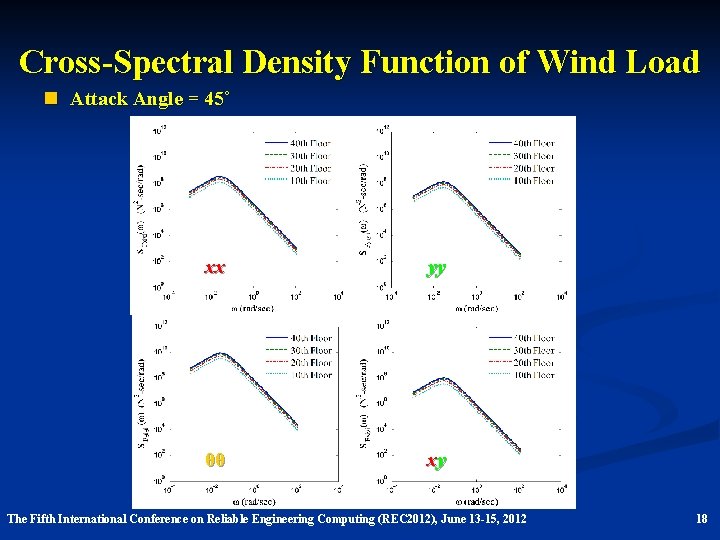
Cross-Spectral Density Function of Wind Load n Attack Angle = 45˚ xx yy θθ xy The Fifth International Conference on Reliable Engineering Computing (REC 2012), June 13 -15, 2012 18
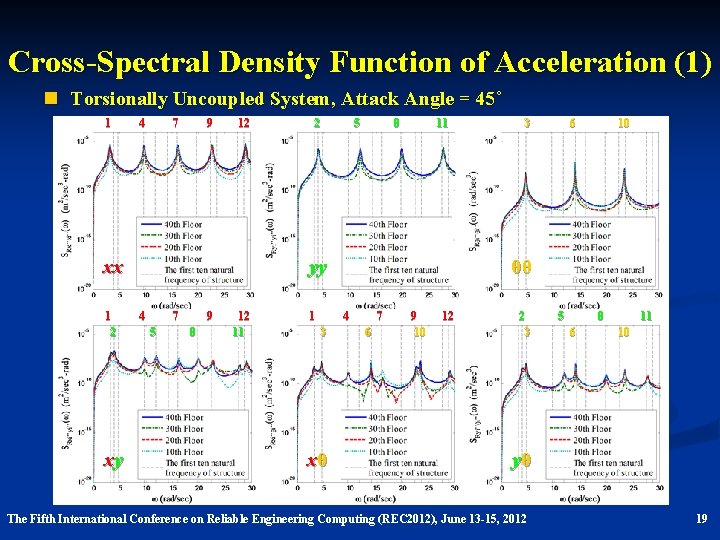
Cross-Spectral Density Function of Acceleration (1) n Torsionally Uncoupled System, Attack Angle = 45˚ 1 4 7 9 12 xx 1 2 xy 2 5 8 11 yy 4 7 5 9 8 12 11 1 xθ 6 10 θθ 4 3 3 7 6 9 10 12 2 3 5 8 6 11 10 yθ The Fifth International Conference on Reliable Engineering Computing (REC 2012), June 13 -15, 2012 19
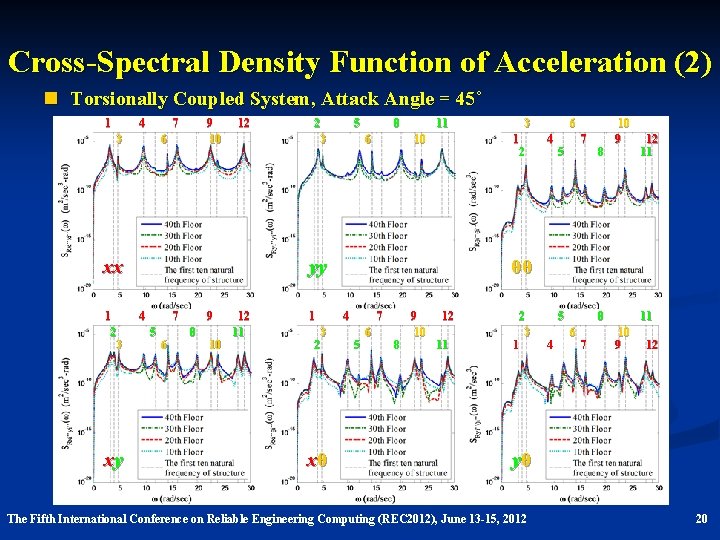
Cross-Spectral Density Function of Acceleration (2) n Torsionally Coupled System, Attack Angle = 45˚ 1 4 7 3 9 10 6 12 xx 1 2 3 xy 2 3 5 8 6 11 10 1 2 yy 4 7 5 6 9 8 10 12 11 1 3 2 xθ 3 6 4 7 5 8 10 9 12 11 θθ 4 7 5 6 8 9 10 12 11 2 3 1 5 4 8 6 7 11 10 9 12 yθ The Fifth International Conference on Reliable Engineering Computing (REC 2012), June 13 -15, 2012 20
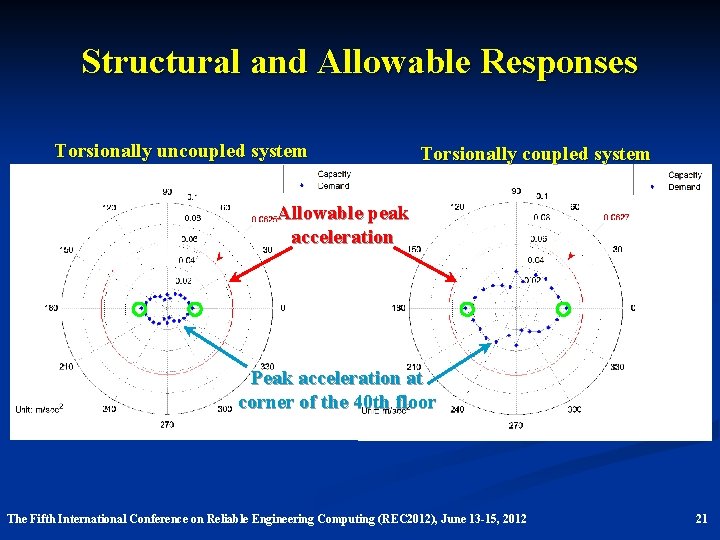
Structural and Allowable Responses Torsionally uncoupled system Torsionally coupled system Allowable peak acceleration Peak acceleration at corner of the 40 th floor The Fifth International Conference on Reliable Engineering Computing (REC 2012), June 13 -15, 2012 21
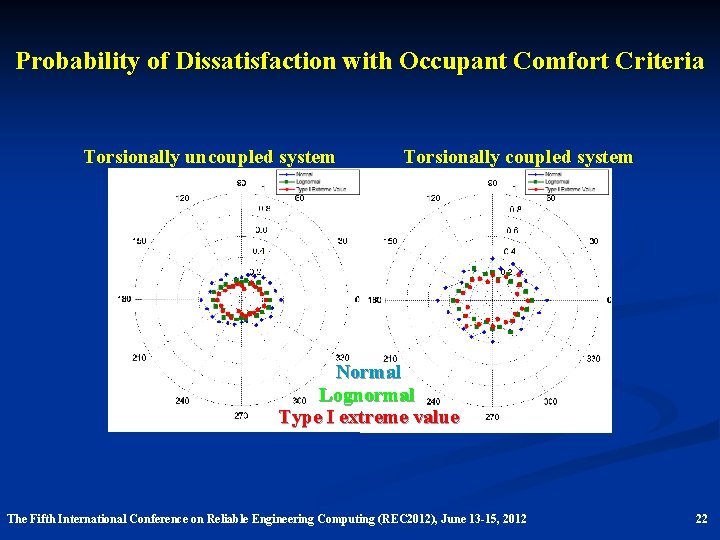
Probability of Dissatisfaction with Occupant Comfort Criteria Torsionally uncoupled system Torsionally coupled system Normal Lognormal Type I extreme value The Fifth International Conference on Reliable Engineering Computing (REC 2012), June 13 -15, 2012 22
Conclusions n The objective of this paper is to conduct the reliability analysis of high-rise buildings under wind loads. Two numerical examples, i. e. , the torsionally uncoupled and coupled systems, are provided to capture the dynamic effects of structures with eccentricity between the elastic and mass centers. The framework of this research consists of two stages n In the first stage, the occupant comfort criteria are satisfied in the two numerical examples from the viewpoint of deterministic approaches. The peak acceleration of the torsionally coupled system is relatively higher than that of the torsionally uncoupled system for each attack angle due to the coupled mode effects n In the second stage, compared to the lognormal and type I extreme value distributions, the normal distribution can be used to more conservatively simulate the uncertainties of the eccentricity between the elastic and mass centers in the two numerical examples from the viewpoint of probabilistic approaches. The probability of the torsionally coupled system is relatively higher than that of the torsionally uncoupled system for each attack angle due to the coupled mode effects The Fifth International Conference on Reliable Engineering Computing (REC 2012), June 13 -15, 2012 23
Thank You Very Much The Fifth International Conference on Reliable Engineering Computing (REC 2012), June 13 -15, 2012 24
- Slides: 24