
Relevance of cluster formation in heavy ion collisions

- Slides: 48
Relevance of cluster formation in heavy ion collisions and the fragmentation code FRIGA Cold nuclei and hot matter Y. Leifels, A. Le Fevre GSI Helmholtzzentrum für Schwerionenforschung, Darmstadt J. Aichelin, C. Hartnack SUBATECH, CNRS, University of Nantes CBM Symposium 3. 10. 2018
Outline § § Heavy ion reactions between 0. 1 - 10 AGev Introduction to transport models Characteristic observables Relevant quantities and comparison to experimental data § § § Equation of state of nuclear matter Dependencies to other input parameters Importance of cluster formation § FRIGA § § Introduction Benchmarking BQMD + FRIGA Benchmarking IQMD + FRIGA Hyper nuclei § Summary and Outlook Yvonne Leifels - CBM Symposium 2018 2
Phase diagram of QCD matter How to explore nuclear matter under extreme conditions? SI S 1 8 Liquid gas coexistence § heavy ion collisions tool to explore characteristics of compressed nuclear matter in the laboratory § need microscopic transport models to interpret the data Yvonne Leifels - CBM Symposium 2018 3
Microscopic models – two approaches physical input: mean field (potential), σinmed, spectral functions transport code observables “technical input”: discretization, averaging (coarse graining), Pauli blocking, etc. Code comparison project: H. Wolter, M. Colonna, J. Xu et al. Yvonne Leifels - CBM Symposium 2018 5
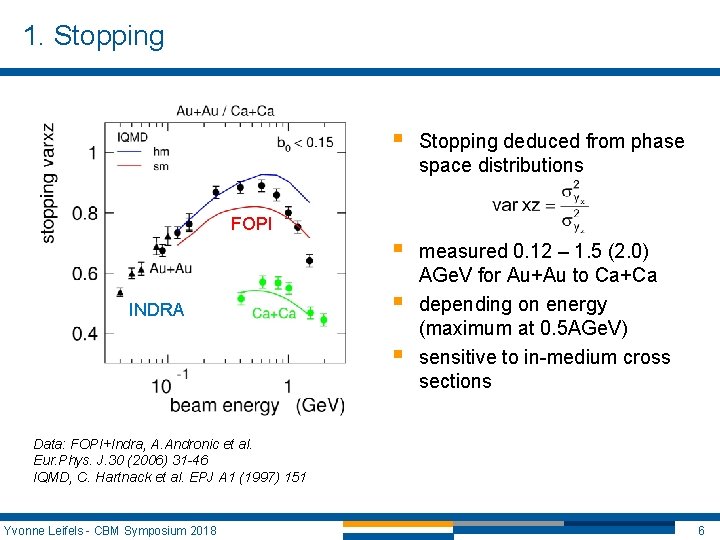
1. Stopping FOPI INDRA § Stopping deduced from phase space distributions § measured 0. 12 – 1. 5 (2. 0) AGe. V for Au+Au to Ca+Ca depending on energy (maximum at 0. 5 AGe. V) sensitive to in-medium cross sections § § Data: FOPI+Indra, A. Andronic et al. Eur. Phys. J. 30 (2006) 31 -46 IQMD, C. Hartnack et al. EPJ A 1 (1997) 151 Yvonne Leifels - CBM Symposium 2018 6
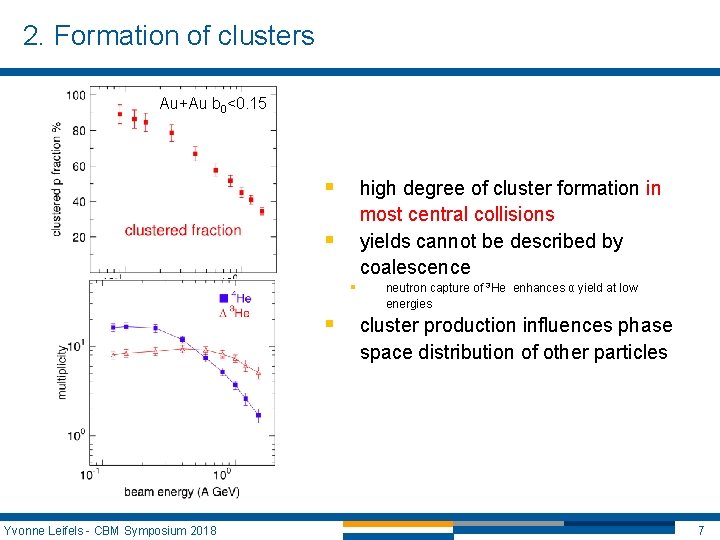
2. Formation of clusters Au+Au b 0<0. 15 § high degree of cluster formation in most central collisions yields cannot be described by coalescence § § § Yvonne Leifels - CBM Symposium 2018 neutron capture of 3 He enhances α yield at low energies cluster production influences phase space distribution of other particles 7
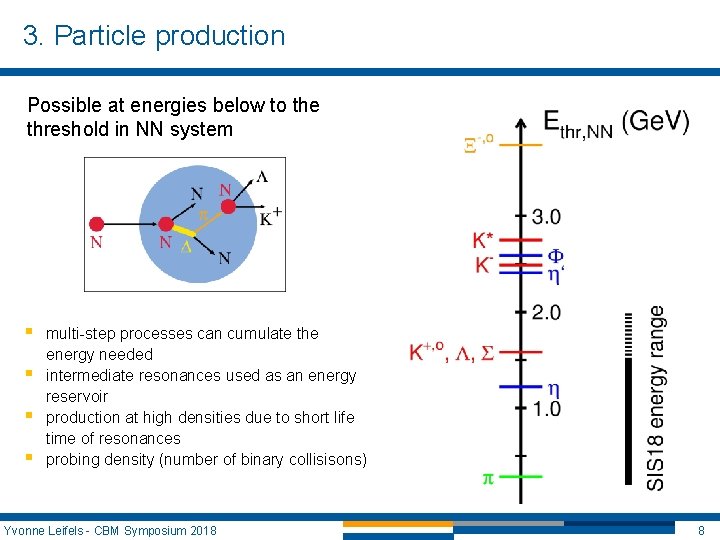
3. Particle production Possible at energies below to the threshold in NN system § § multi-step processes can cumulate the energy needed intermediate resonances used as an energy reservoir production at high densities due to short life time of resonances probing density (number of binary collisisons) Yvonne Leifels - CBM Symposium 2018 8
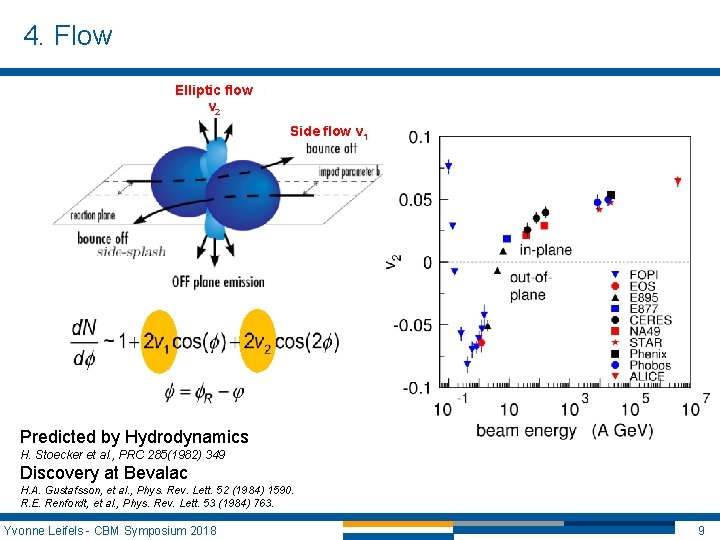
4. Flow Elliptic flow v 2 Side flow v 1 side flow elliptic flow Predicted by Hydrodynamics rapidity: H. Stoecker et al. , PRC 285(1982) 349 Discovery at Bevalac H. A. Gustafsson, et al. , Phys. Rev. Lett. 52 (1984) 1590. R. E. Renfordt, et al. , Phys. Rev. Lett. 53 (1984) 763. Yvonne Leifels - CBM Symposium 2018 9
Comparing experimental results to model predictions… Yield information on § nuclear matter equation of state Fuchs and Wolter, EPJA 30 (2006) § momentum dependence § symmetry energy § in-medium cross sections § § scattering and production in-medium characteristics of particles § effective masses/potentials, spectral functions § decay widths Convincing conclusions on basic nuclear properties imply a successful simulation: § of a full set of experimental observables § with the same code § using the same physical and technical Neutron matter δ=1 Symmetry energy Symmetric matter δ=0 parameters. Yvonne Leifels - CBM Symposium 2018 10
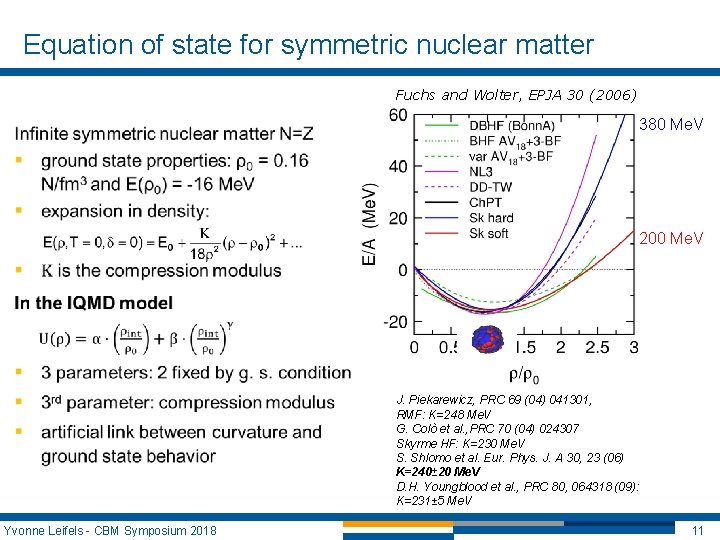
Equation of state for symmetric nuclear matter Fuchs and Wolter, EPJA 30 (2006) 380 Me. V 200 Me. V J. Piekarewicz, PRC 69 (04) 041301, RMF: K=248 Me. V G. Colò et al. , PRC 70 (04) 024307 Skyrme HF: K=230 Me. V S. Shlomo et al. Eur. Phys. J. A 30, 23 (06) K=240± 20 Me. V D. H. Youngblood et al. , PRC 80, 064318 (09): K=231± 5 Me. V Yvonne Leifels - CBM Symposium 2018 11
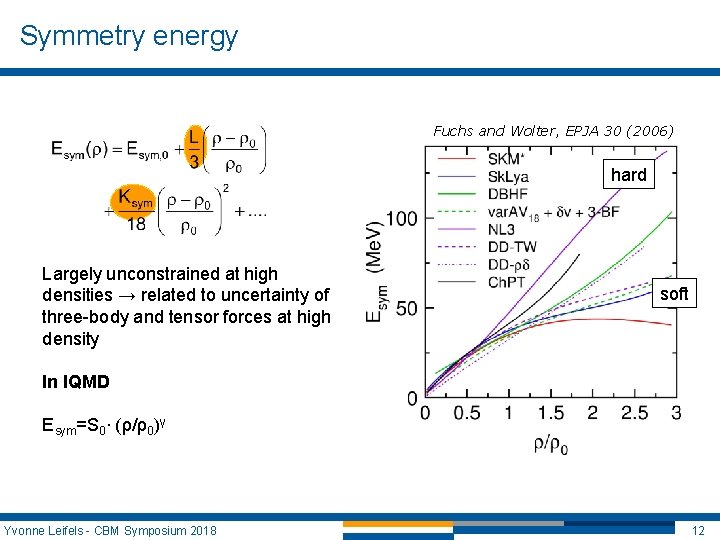
Symmetry energy Fuchs and Wolter, EPJA 30 (2006) hard Largely unconstrained at high densities → related to uncertainty of three-body and tensor forces at high density soft In IQMD Esym=S 0∙ (ρ/ρ0)γ Yvonne Leifels - CBM Symposium 2018 12
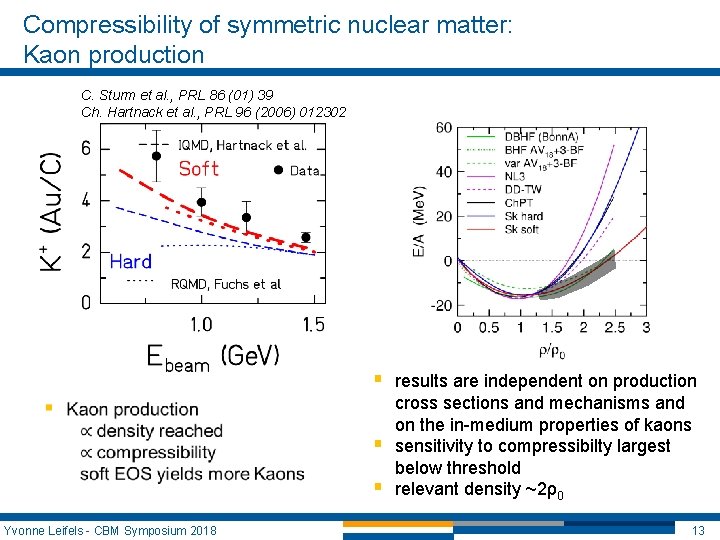
Compressibility of symmetric nuclear matter: Kaon production C. Sturm et al. , PRL 86 (01) 39 Ch. Hartnack et al. , PRL 96 (2006) 012302 § results are independent on production § § Yvonne Leifels - CBM Symposium 2018 cross sections and mechanisms and on the in-medium properties of kaons sensitivity to compressibilty largest below threshold relevant density ~2ρ0 13
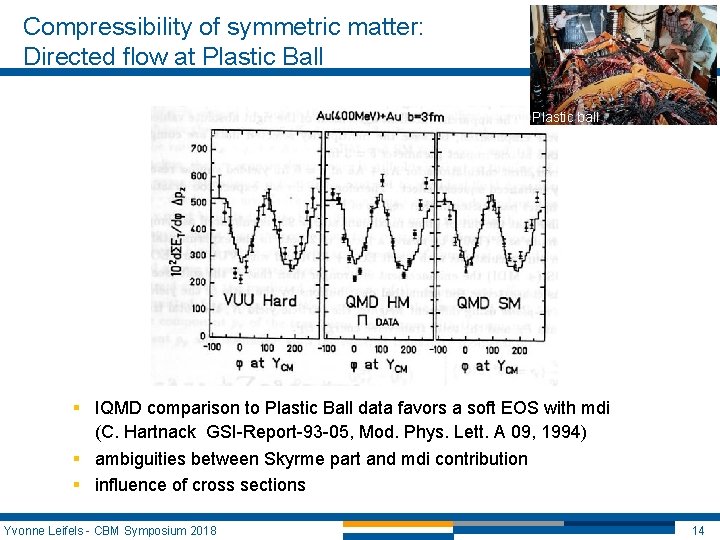
Compressibility of symmetric matter: Directed flow at Plastic Ball Plastic ball plastic ball § IQMD comparison to Plastic Ball data favors a soft EOS with mdi (C. Hartnack GSI-Report-93 -05, Mod. Phys. Lett. A 09, 1994) § ambiguities between Skyrme part and mdi contribution § influence of cross sections Yvonne Leifels - CBM Symposium 2018 14
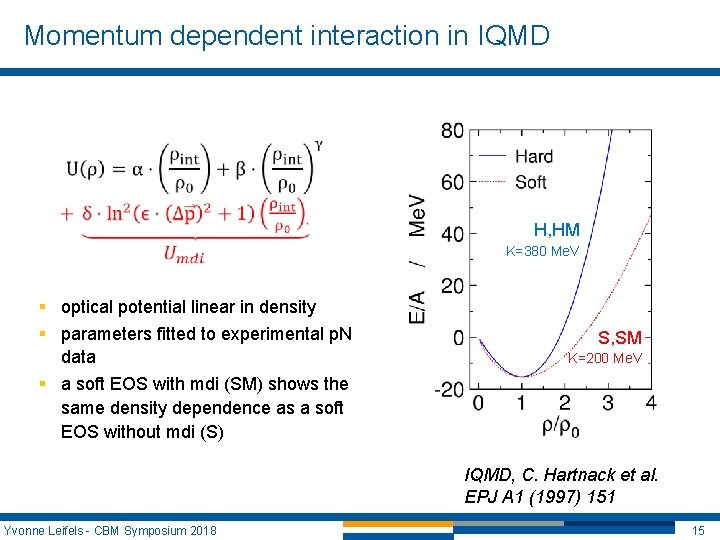
Momentum dependent interaction in IQMD H, HM Κ=380 Me. V § optical potential linear in density § parameters fitted to experimental p. N data § a soft EOS with mdi (SM) shows the same density dependence as a soft EOS without mdi (S) S, SM Κ=200 Me. V IQMD, C. Hartnack et al. EPJ A 1 (1997) 151 Yvonne Leifels - CBM Symposium 2018 15
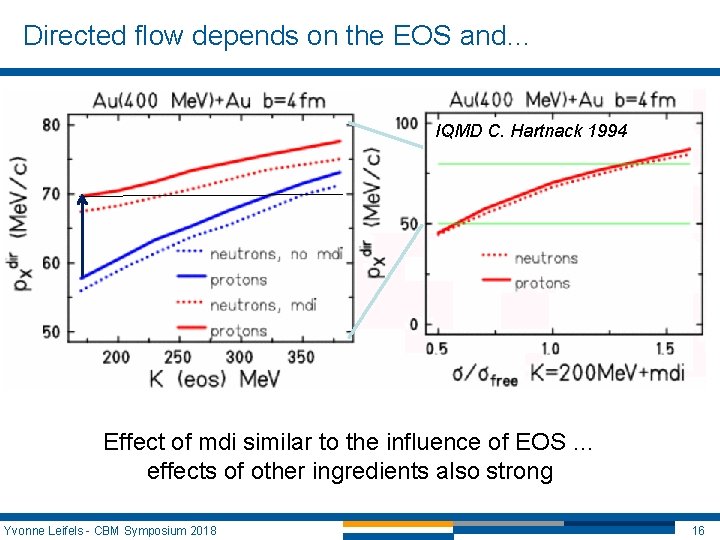
Directed flow depends on the EOS and… IQMD C. Hartnack 1994 Effect of mdi similar to the influence of EOS … effects of other ingredients also strong Yvonne Leifels - CBM Symposium 2018 16
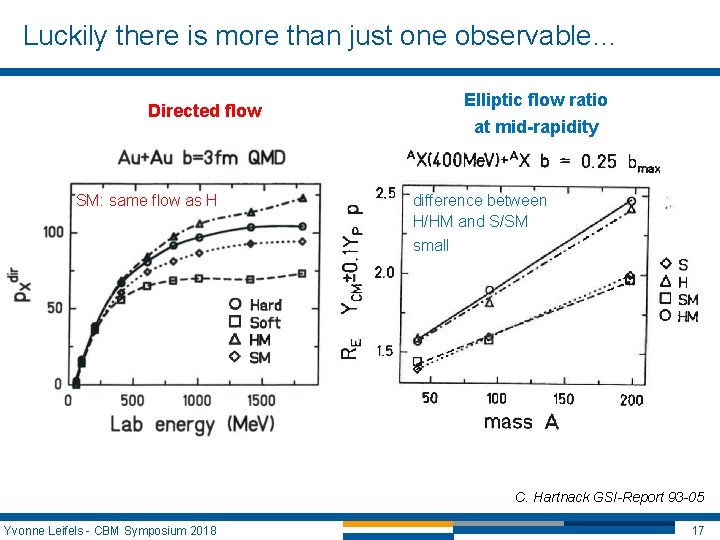
Luckily there is more than just one observable… Elliptic flow ratio at mid-rapidity Directed flow SM: same flow as H difference between H/HM and S/SM small C. Hartnack GSI-Report 93 -05 Yvonne Leifels - CBM Symposium 2018 17
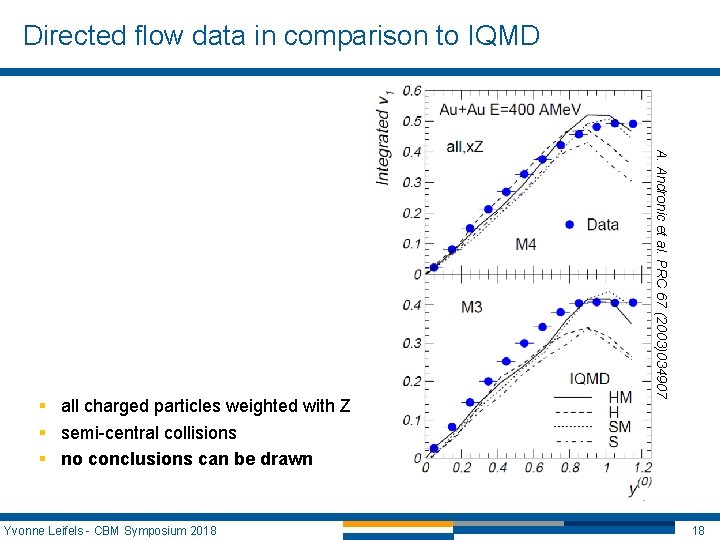
Directed flow data in comparison to IQMD Yvonne Leifels - CBM Symposium 2018 A. Andronic et al. PRC 67 (2003)034907 § all charged particles weighted with Z § semi-central collisions § no conclusions can be drawn 18
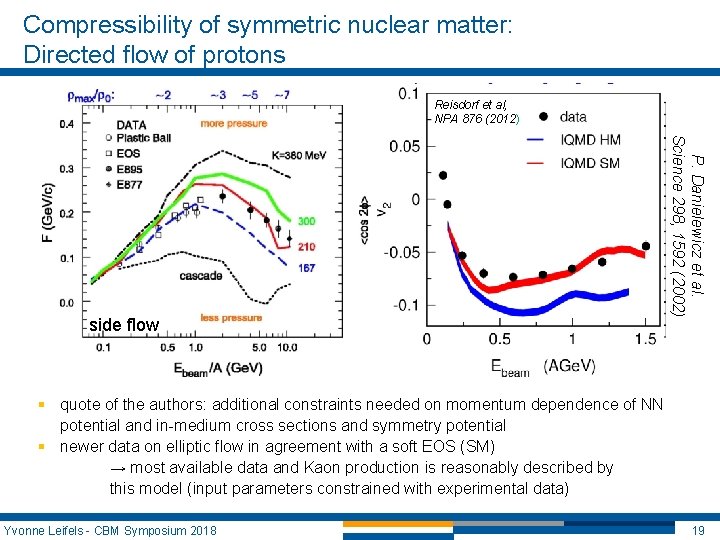
Compressibility of symmetric nuclear matter: Directed flow of protons Reisdorf et al, NPA 876 elliptic flow(2012) P. Danielewicz et al. Science 298, 1592 (2002) side flow § quote of the authors: additional constraints needed on momentum dependence of NN potential and in-medium cross sections and symmetry potential § newer data on elliptic flow in agreement with a soft EOS (SM) → most available data and Kaon production is reasonably described by this model (input parameters constrained with experimental data) Yvonne Leifels - CBM Symposium 2018 19
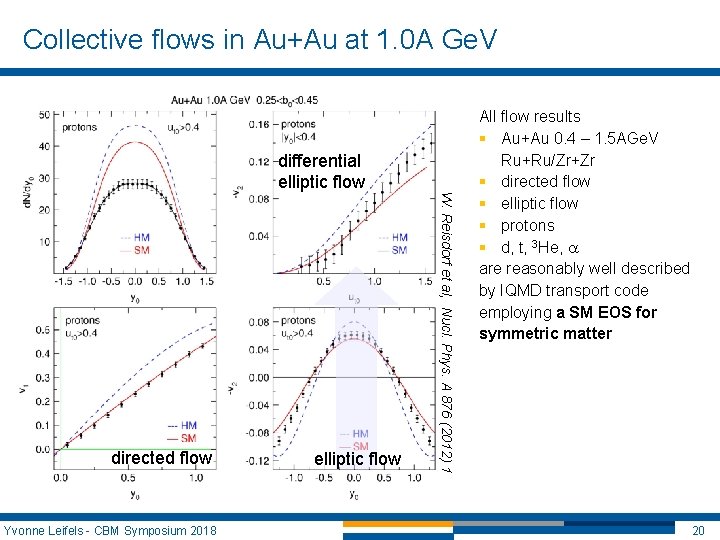
Collective flows in Au+Au at 1. 0 A Ge. V directed flow Yvonne Leifels - CBM Symposium 2018 elliptic flow W. Reisdorf et al, Nucl. Phys. A 876 (2012) 1 differential elliptic flow All flow results § Au+Au 0. 4 – 1. 5 AGe. V Ru+Ru/Zr+Zr § directed flow § elliptic flow § protons § d, t, 3 He, a are reasonably well described by IQMD transport code employing a SM EOS for symmetric matter 20
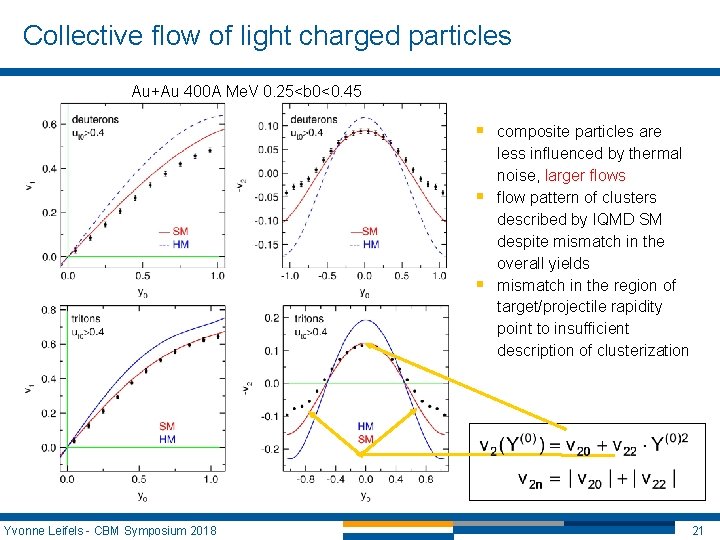
Collective flow of light charged particles Au+Au 400 A Me. V 0. 25<b 0<0. 45 § composite particles are § § Yvonne Leifels - CBM Symposium 2018 less influenced by thermal noise, larger flows flow pattern of clusters described by IQMD SM despite mismatch in the overall yields mismatch in the region of target/projectile rapidity point to insufficient description of clusterization 21
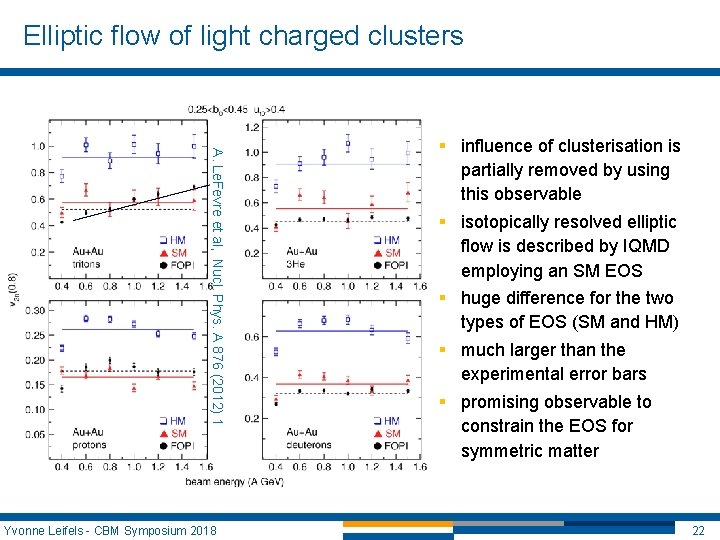
Elliptic flow of light charged clusters A. Le. Fevre et al, Nucl. Phys. A 876 (2012) 1 Yvonne Leifels - CBM Symposium 2018 § influence of clusterisation is partially removed by using this observable § isotopically resolved elliptic flow is described by IQMD employing an SM EOS § huge difference for the two types of EOS (SM and HM) § much larger than the experimental error bars § promising observable to constrain the EOS for symmetric matter 22
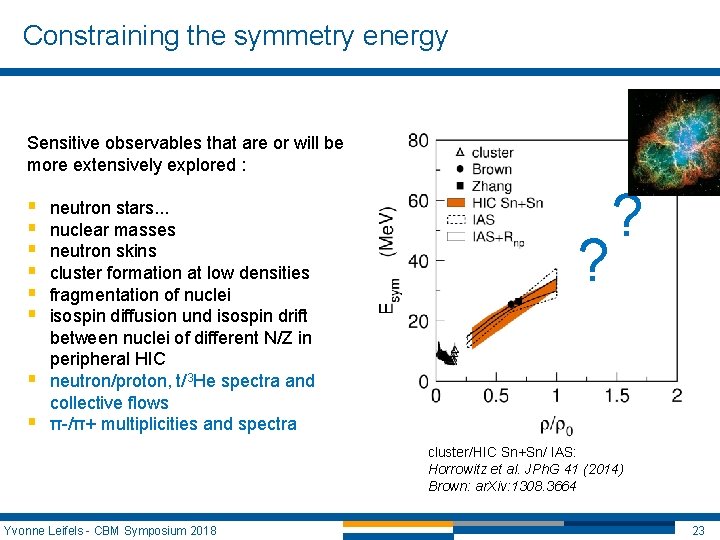
Constraining the symmetry energy Sensitive observables that are or will be more extensively explored : § § § § neutron stars. . . nuclear masses neutron skins cluster formation at low densities fragmentation of nuclei isospin diffusion und isospin drift between nuclei of different N/Z in peripheral HIC neutron/proton, t/3 He spectra and collective flows π-/π+ multiplicities and spectra ? ? cluster/HIC Sn+Sn/ IAS: Horrowitz et al. JPh. G 41 (2014) Brown: ar. Xiv: 1308. 3664 Yvonne Leifels - CBM Symposium 2018 23
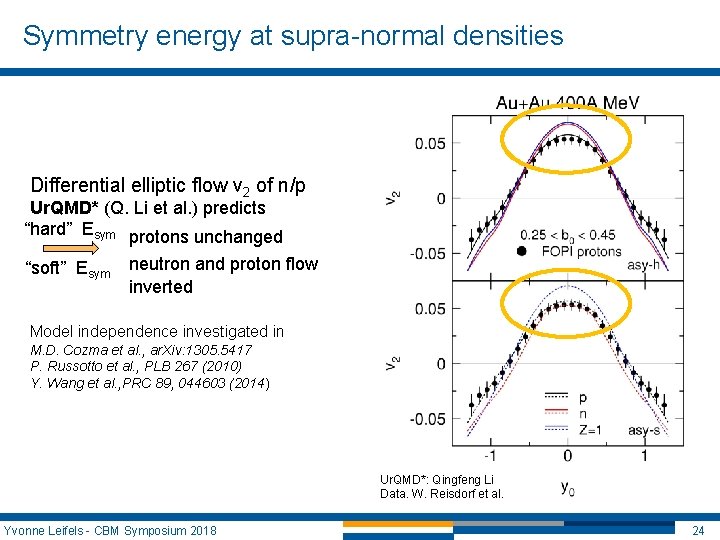
Symmetry energy at supra-normal densities Differential elliptic flow v 2 of n/p Ur. QMD* (Q. Li et al. ) predicts “hard” Esym protons unchanged “soft” Esym neutron and proton flow inverted Model independence investigated in M. D. Cozma et al. , ar. Xiv: 1305. 5417 P. Russotto et al. , PLB 267 (2010) Y. Wang et al. , PRC 89, 044603 (2014) Ur. QMD*: Qingfeng Li Data. W. Reisdorf et al. Yvonne Leifels - CBM Symposium 2018 24
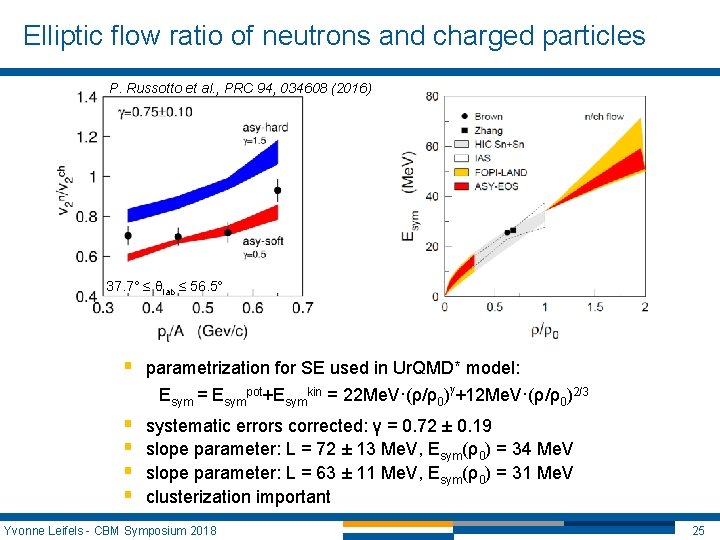
Elliptic flow ratio of neutrons and charged particles P. Russotto et al. , PRC 94, 034608 (2016) 37. 7° ≤ θlab ≤ 56. 5° § parametrization for SE used in Ur. QMD* model: Esym = Esympot+Esymkin = 22 Me. V·(ρ/ρ0)γ+12 Me. V·(ρ/ρ0)2/3 § § systematic errors corrected: γ = 0. 72 ± 0. 19 slope parameter: L = 72 ± 13 Me. V, Esym(ρ0) = 34 Me. V slope parameter: L = 63 ± 11 Me. V, Esym(ρ0) = 31 Me. V clusterization important Yvonne Leifels - CBM Symposium 2018 25
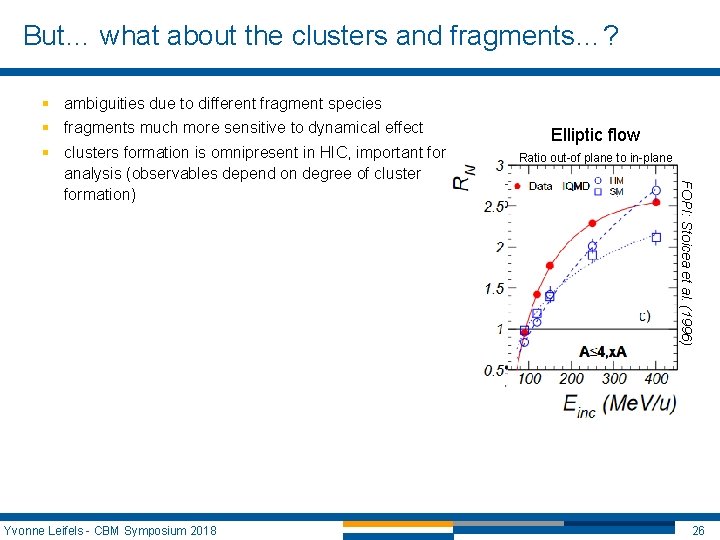
But… what about the clusters and fragments…? cluster production in HIC statistical dynamical (grand) canonical ensemble evolution of the reaction § often successful Elliptic flow Ratio out-of plane to in-plane FOPI: Stoicea et al. (1996) § ambiguities due to different fragment species § fragments much more sensitive to dynamical effect § clusters formation is omnipresent in HIC, important for analysis (observables depend on degree of cluster formation) • few body correlations, treat clusters as explicit degrees of freedom (AMD, p. BUU) • fluctuations and/or mean field + coalescence (BUU, . . MD) Yvonne Leifels - CBM Symposium 2018 26
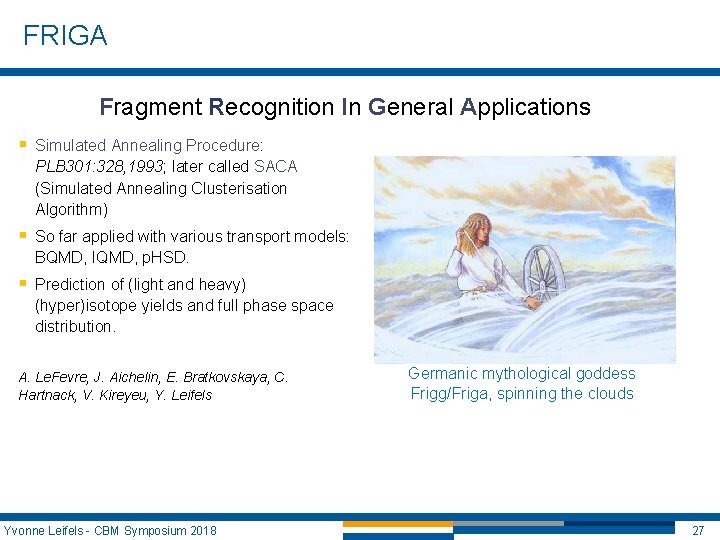
FRIGA Fragment Recognition In General Applications § Simulated Annealing Procedure: PLB 301: 328, 1993; later called SACA (Simulated Annealing Clusterisation Algorithm) § So far applied with various transport models: BQMD, IQMD, p. HSD. § Prediction of (light and heavy) (hyper)isotope yields and full phase space distribution. A. Le. Fevre, J. Aichelin, E. Bratkovskaya, C. Hartnack, V. Kireyeu, Y. Leifels Yvonne Leifels - CBM Symposium 2018 Germanic mythological goddess Frigg/Friga, spinning the clouds 27
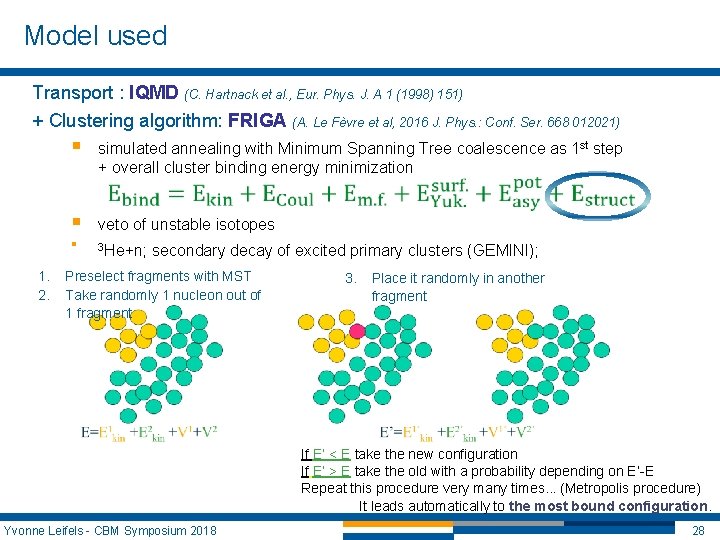
Model used Transport : IQMD (C. Hartnack et al. , Eur. Phys. J. A 1 (1998) 151) + Clustering algorithm: FRIGA (A. Le Fèvre et al, 2016 J. Phys. : Conf. Ser. 668 012021) § simulated annealing with Minimum Spanning Tree coalescence as 1 st step + overall cluster binding energy minimization § veto of unstable isotopes § 1. 2. 3 He+n; secondary decay of excited primary clusters (GEMINI); Preselect fragments with MST Take randomly 1 nucleon out of 1 fragment 3. Place it randomly in another fragment If E’ < E take the new configuration If E’ > E take the old with a probability depending on E’-E Repeat this procedure very many times. . . (Metropolis procedure) It leads automatically to the most bound configuration. Yvonne Leifels - CBM Symposium 2018 28
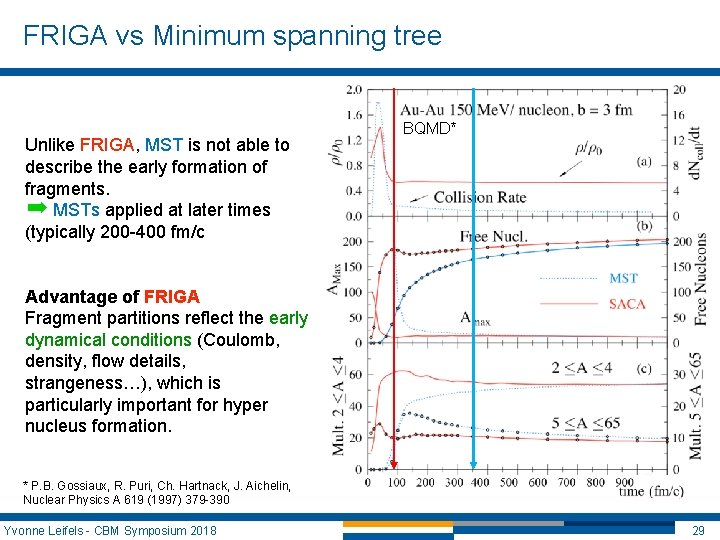
FRIGA vs Minimum spanning tree Unlike FRIGA, MST is not able to describe the early formation of fragments. ➡ MSTs applied at later times (typically 200 -400 fm/c BQMD* Advantage of FRIGA Fragment partitions reflect the early dynamical conditions (Coulomb, density, flow details, strangeness…), which is particularly important for hyper nucleus formation. * P. B. Gossiaux, R. Puri, Ch. Hartnack, J. Aichelin, Nuclear Physics A 619 (1997) 379 -390 Yvonne Leifels - CBM Symposium 2018 29
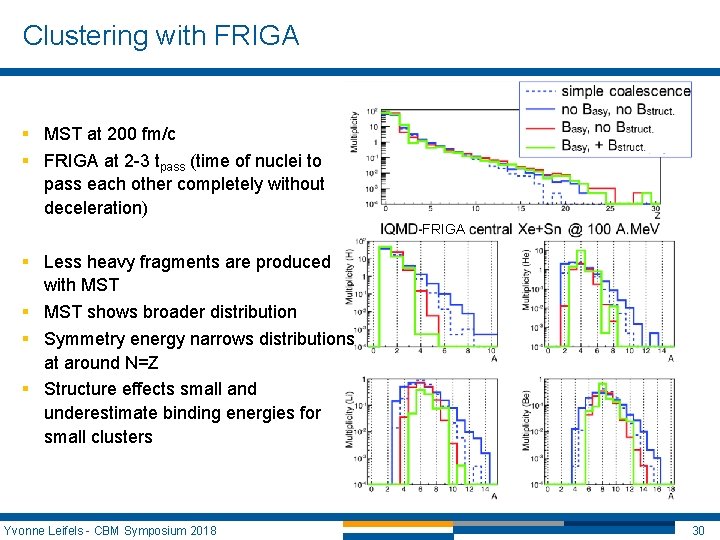
Clustering with FRIGA § MST at 200 fm/c § FRIGA at 2 -3 tpass (time of nuclei to pass each other completely without deceleration) FRIGA § Less heavy fragments are produced with MST § MST shows broader distribution § Symmetry energy narrows distributions at around N=Z § Structure effects small and underestimate binding energies for small clusters Yvonne Leifels - CBM Symposium 2018 30
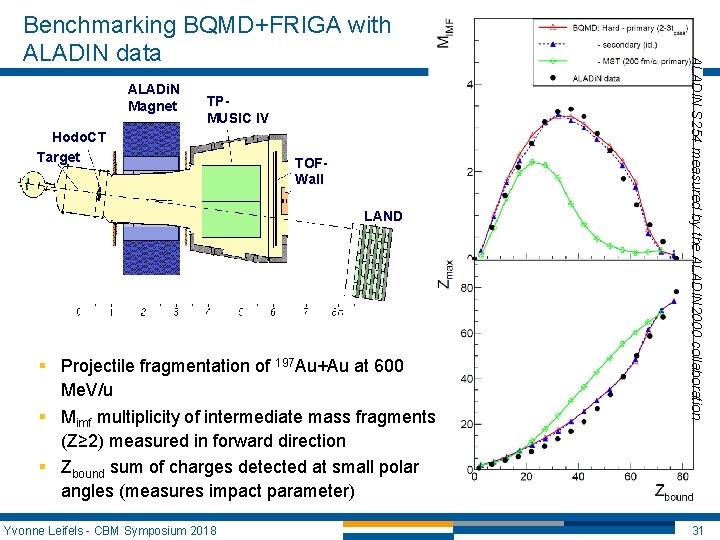
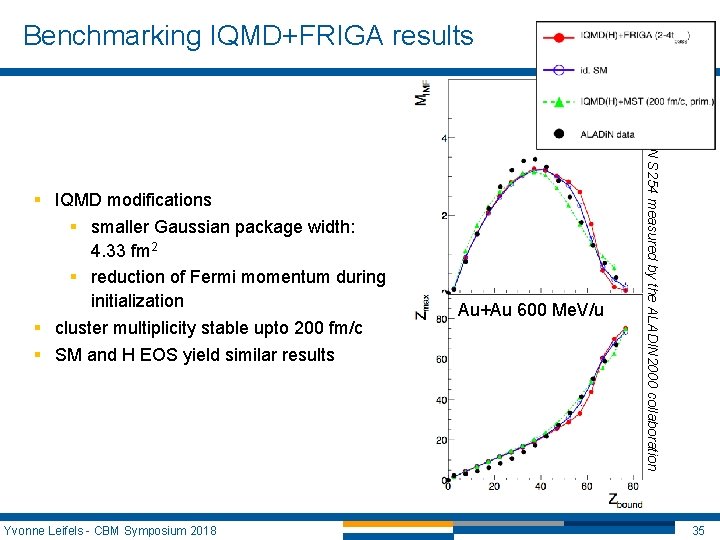
ALADi. N Magnet TPMUSIC IV Hodo. CT Target TOFWall LAND § Projectile fragmentation of 197 Au+Au at 600 Me. V/u § Mimf multiplicity of intermediate mass fragments (Z≥ 2) measured in forward direction § Zbound sum of charges detected at small polar angles (measures impact parameter) Yvonne Leifels - CBM Symposium 2018 ALADIN S 254 measured by the ALADIN 2000 collaboration Benchmarking BQMD+FRIGA with ALADIN data 31
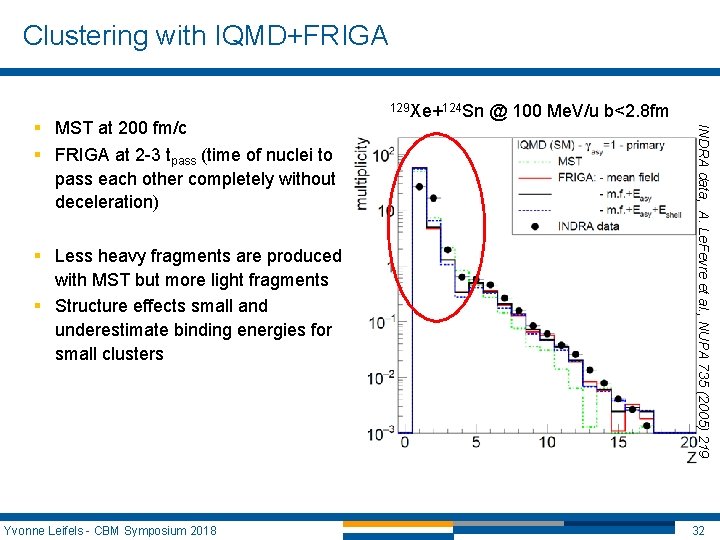
Clustering with IQMD+FRIGA § Less heavy fragments are produced with MST but more light fragments § Structure effects small and underestimate binding energies for small clusters Yvonne Leifels - CBM Symposium 2018 @ 100 Me. V/u b<2. 8 fm INDRA data, A. Le. Fevre et al. , NUPA 735 (2005) 219 § MST at 200 fm/c § FRIGA at 2 -3 tpass (time of nuclei to pass each other completely without deceleration) 129 Xe+124 Sn 32
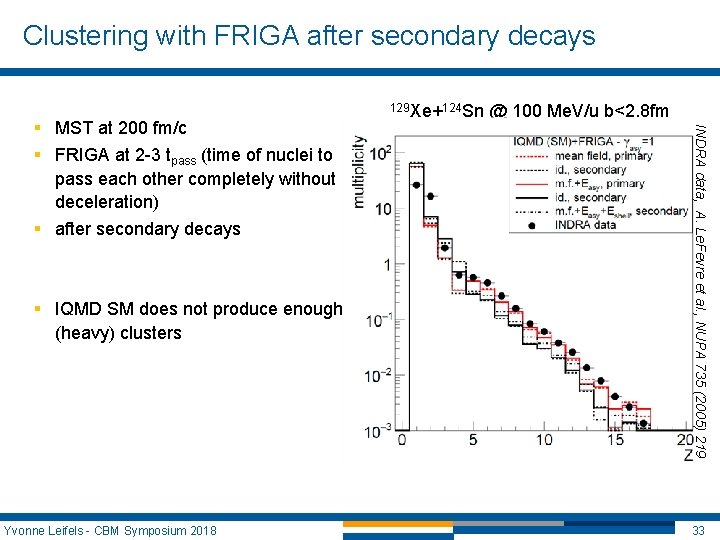
Clustering with FRIGA after secondary decays § IQMD SM does not produce enough (heavy) clusters Yvonne Leifels - CBM Symposium 2018 @ 100 Me. V/u b<2. 8 fm INDRA data, A. Le. Fevre et al. , NUPA 735 (2005) 219 § MST at 200 fm/c § FRIGA at 2 -3 tpass (time of nuclei to pass each other completely without deceleration) § after secondary decays 129 Xe+124 Sn 33
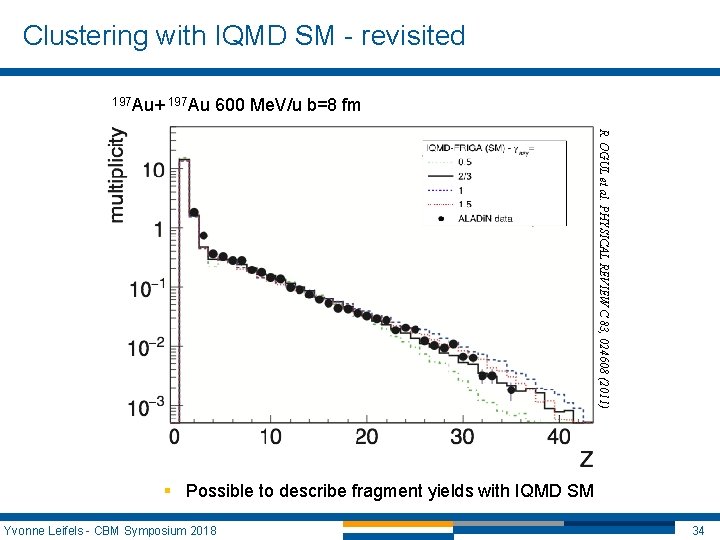
Clustering with IQMD SM - revisited 197 Au+ 197 Au 600 Me. V/u b=8 fm R. OGUL et al. PHYSICAL REVIEW C 83, 024608 (2011) § Possible to describe fragment yields with IQMD SM Yvonne Leifels - CBM Symposium 2018 34
Benchmarking IQMD+FRIGA results Yvonne Leifels - CBM Symposium 2018 Au+Au 600 Me. V/u ALADIN S 254 measured by the ALADIN 2000 collaboration § IQMD modifications § smaller Gaussian package width: 4. 33 fm 2 § reduction of Fermi momentum during initialization § cluster multiplicity stable upto 200 fm/c § SM and H EOS yield similar results 35
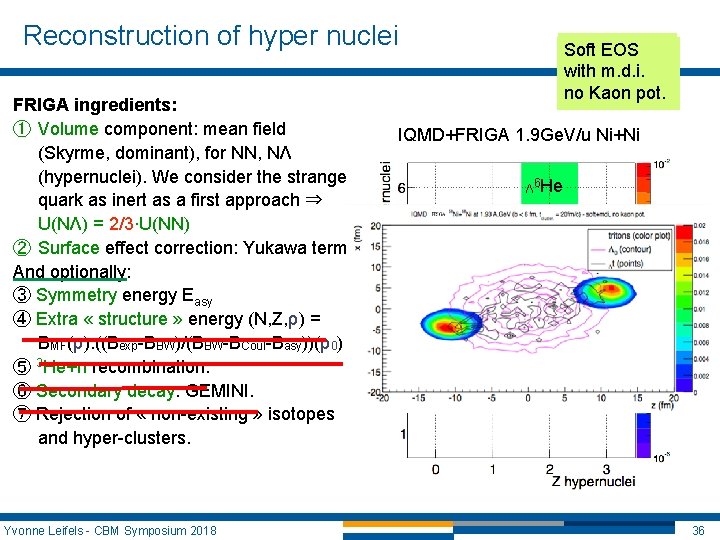
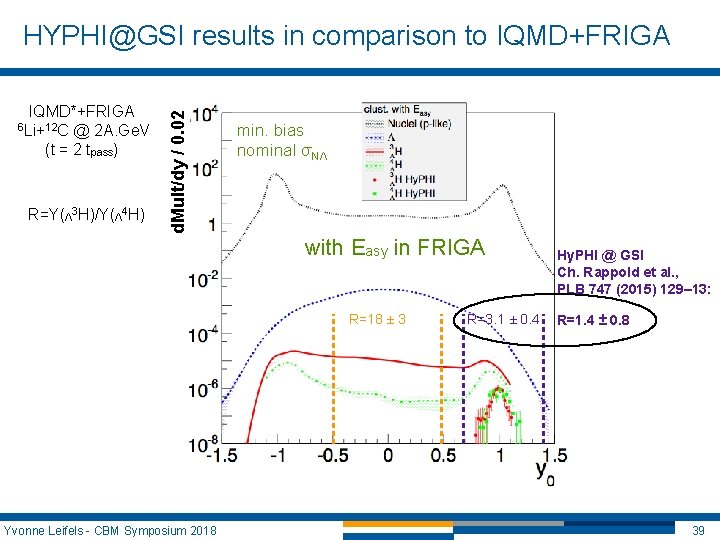
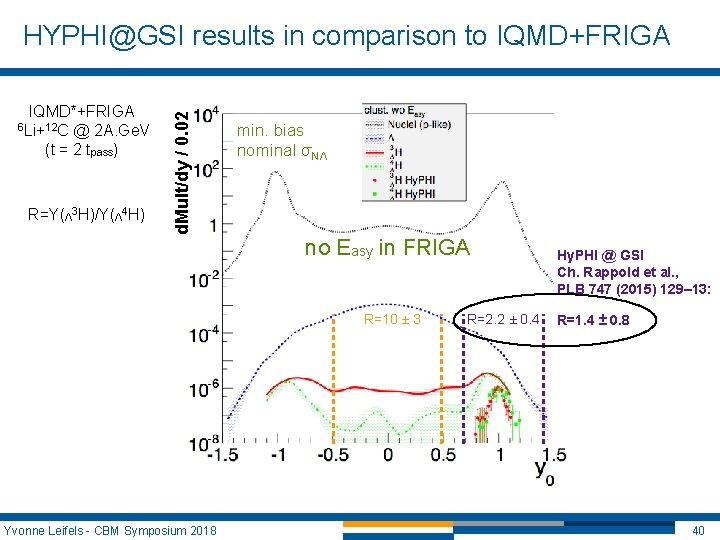
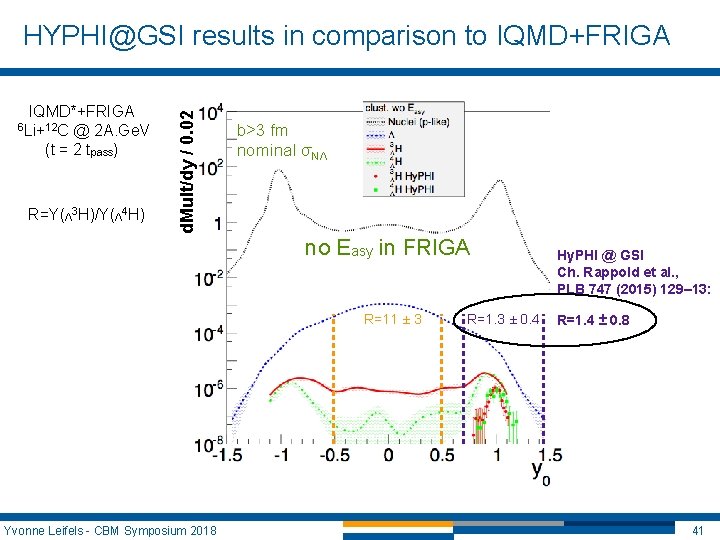
Reconstruction of hyper nuclei FRIGA ingredients: ① Volume component: mean field (Skyrme, dominant), for NN, NΛ (hypernuclei). We consider the strange quark as inert as a first approach ⇒ U(NΛ) = 2/3∙U(NN) ② Surface effect correction: Yukawa term. And optionally: ③ Symmetry energy Easy ④ Extra « structure » energy (N, Z, ρ) = BMF(ρ). ((Bexp-BBW)/(BBW-BCoul-Basy))(ρ0) ⑤ 3 He+n recombination. ⑥ Secondary decay: GEMINI. ⑦ Rejection of « non-existing » isotopes and hyper-clusters. Yvonne Leifels - CBM Symposium 2018 Soft EOS no m. d. i. with m. d. i. no no Kaon pot. with Kaonpot. IQMD+FRIGA 1. 9 Ge. V/u Ni+Ni 66 He Λ Λ He 55 He Λ Λ He 4 Λ 4 H Λ H 4 Λ 4 He Λ He 3 Λ 3 H Λ H n-Λ p-Λ 36
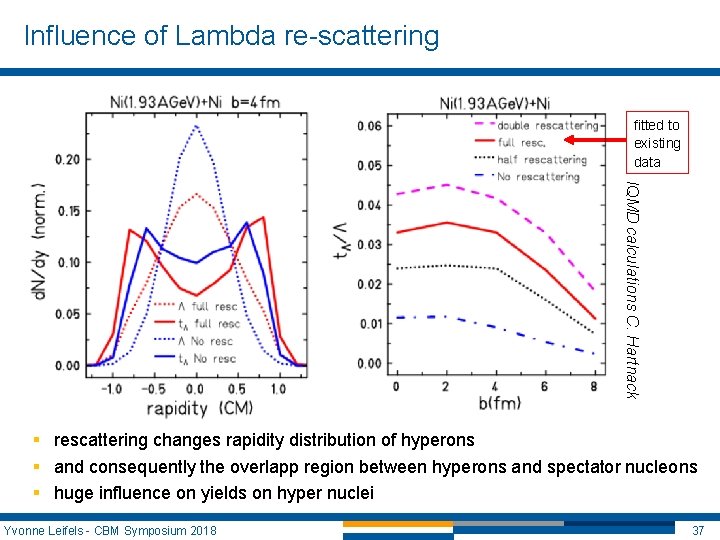
Influence of Lambda re-scattering fitted to existing data IQMD calculations C. Hartnack § rescattering changes rapidity distribution of hyperons § and consequently the overlapp region between hyperons and spectator nucleons § huge influence on yields on hyper nuclei Yvonne Leifels - CBM Symposium 2018 37
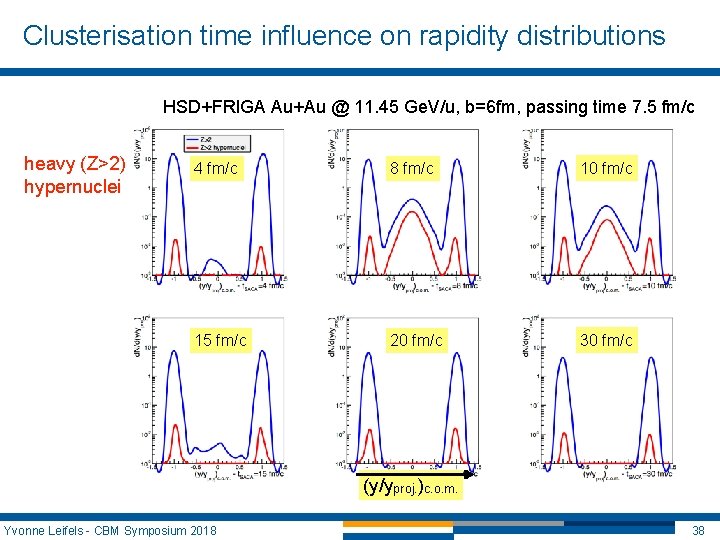
Clusterisation time influence on rapidity distributions HSD+FRIGA Au+Au @ 11. 45 Ge. V/u, b=6 fm, passing time 7. 5 fm/c heavy (Z>2) hypernuclei 4 fm/c 8 fm/c 10 fm/c 15 fm/c 20 fm/c 30 fm/c (y/yproj. )c. o. m. Yvonne Leifels - CBM Symposium 2018 38
IQMD*+FRIGA @ 2 A. Ge. V (t = 2 tpass) 6 Li+12 C R=Y(Λ 3 H)/Y(Λ 4 H) d. Mult/dy / 0. 02 HYPHI@GSI results in comparison to IQMD+FRIGA min. bias nominal σNΛ with Easy in FRIGA R=18 ± 3 Yvonne Leifels - CBM Symposium 2018 R=3. 1 ± 0. 4 Hy. PHI @ GSI Ch. Rappold et al. , PLB 747 (2015) 129– 13: R=1. 4 ± 0. 8 39
IQMD*+FRIGA @ 2 A. Ge. V (t = 2 tpass) 6 Li+12 C R=Y(Λ 3 H)/Y(Λ 4 H) d. Mult/dy / 0. 02 HYPHI@GSI results in comparison to IQMD+FRIGA min. bias nominal σNΛ no Easy in FRIGA R=10 ± 3 Yvonne Leifels - CBM Symposium 2018 R=2. 2 ± 0. 4 Hy. PHI @ GSI Ch. Rappold et al. , PLB 747 (2015) 129– 13: R=1. 4 ± 0. 8 40
IQMD*+FRIGA @ 2 A. Ge. V (t = 2 tpass) 6 Li+12 C R=Y(Λ 3 H)/Y(Λ 4 H) d. Mult/dy / 0. 02 HYPHI@GSI results in comparison to IQMD+FRIGA b>3 fm nominal σNΛ no Easy in FRIGA R=11 ± 3 Yvonne Leifels - CBM Symposium 2018 R=1. 3 ± 0. 4 Hy. PHI @ GSI Ch. Rappold et al. , PLB 747 (2015) 129– 13: R=1. 4 ± 0. 8 41
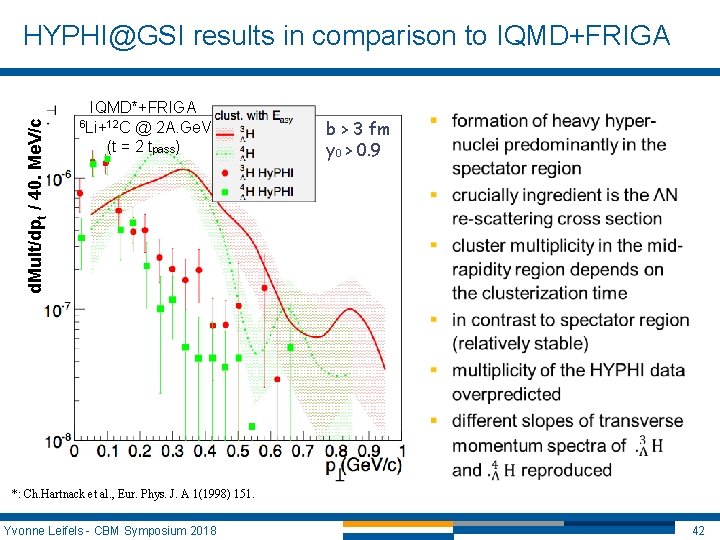
d. Mult/dpt / 40. Me. V/c HYPHI@GSI results in comparison to IQMD+FRIGA IQMD*+FRIGA @ 2 A. Ge. V (t = 2 tpass) 6 Li+12 C b > 3 fm y 0 > 0. 9 *: Ch. Hartnack et al. , Eur. Phys. J. A 1(1998) 151. Yvonne Leifels - CBM Symposium 2018 42
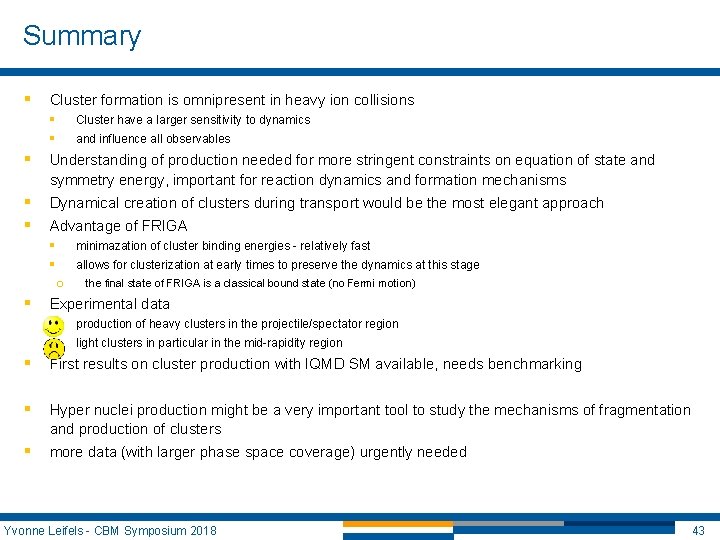
Summary § § Cluster formation is omnipresent in heavy ion collisions § Cluster have a larger sensitivity to dynamics § and influence all observables Understanding of production needed for more stringent constraints on equation of state and symmetry energy, important for reaction dynamics and formation mechanisms Dynamical creation of clusters during transport would be the most elegant approach Advantage of FRIGA § minimazation of cluster binding energies - relatively fast § allows for clusterization at early times to preserve the dynamics at this stage o § § the final state of FRIGA is a classical bound state (no Fermi motion) Experimental data § production of heavy clusters in the projectile/spectator region § light clusters in particular in the mid-rapidity region First results on cluster production with IQMD SM available, needs benchmarking § Hyper nuclei production might be a very important tool to study the mechanisms of fragmentation and production of clusters § more data (with larger phase space coverage) urgently needed Yvonne Leifels - CBM Symposium 2018 43
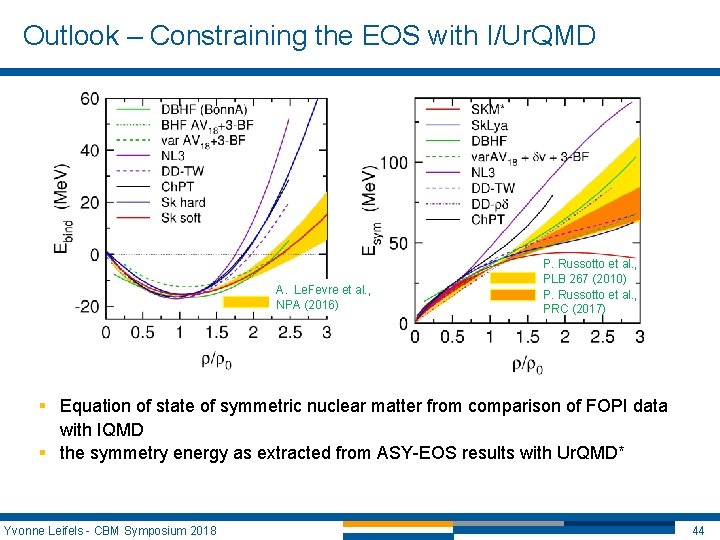
Outlook – Constraining the EOS with I/Ur. QMD A. Le. Fevre et al. , NPA (2016) P. Russotto et al. , PLB 267 (2010) P. Russotto et al. , PRC (2017) § Equation of state of symmetric nuclear matter from comparison of FOPI data with IQMD § the symmetry energy as extracted from ASY-EOS results with Ur. QMD* Yvonne Leifels - CBM Symposium 2018 44
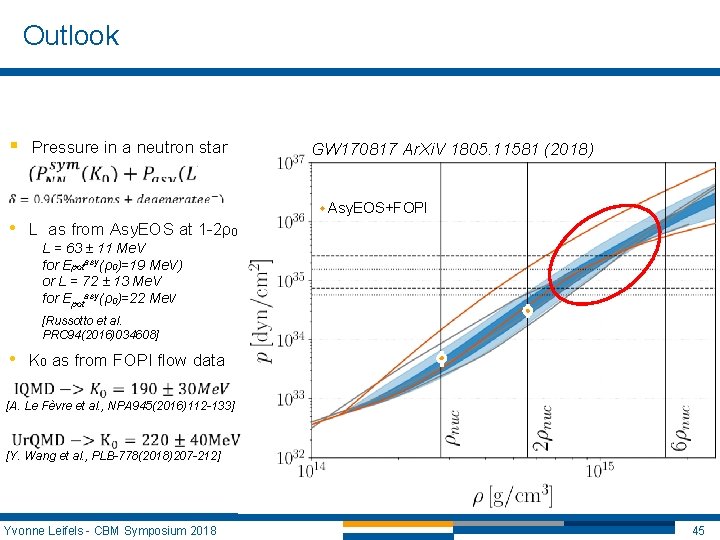
Outlook § Pressure in a neutron star GW 170817 Ar. Xi. V 1805. 11581 (2018) Asy. EOS+FOPI • L as from Asy. EOS at 1 -2ρ0 L = 63 ± 11 Me. V for Epotasy(ρ0)=19 Me. V) or L = 72 ± 13 Me. V for Epotasy(ρ0)=22 Me. V [Russotto et al. PRC 94(2016)034608] • K 0 as from FOPI flow data [A. Le Fèvre et al. , NPA 945(2016)112 -133] [Y. Wang et al. , PLB-778(2018)207 -212] Yvonne Leifels - CBM Symposium 2018 45
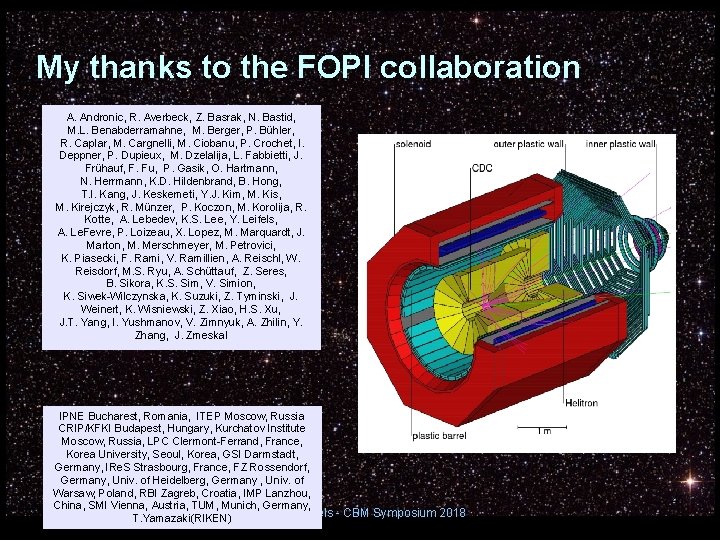
My thanks to the FOPI collaboration A. Andronic, R. Averbeck, Z. Basrak, N. Bastid, M. L. Benabderramahne, M. Berger, P. Bühler, R. Caplar, M. Cargnelli, M. Ciobanu, P. Crochet, I. Deppner, P. Dupieux, M. Dzelalija, L. Fabbietti, J. Frühauf, F. Fu, P. Gasik, O. Hartmann, N. Herrmann, K. D. Hildenbrand, B. Hong, T. I. Kang, J. Keskemeti, Y. J. Kim, M. Kis, M. Kirejczyk, R. Münzer, P. Koczon, M. Korolija, R. Kotte, A. Lebedev, K. S. Lee, Y. Leifels, A. Le. Fevre, P. Loizeau, X. Lopez, M. Marquardt, J. Marton, M. Merschmeyer, M. Petrovici, K. Piasecki, F. Rami, V. Ramillien, A. Reischl, W. Reisdorf, M. S. Ryu, A. Schüttauf, Z. Seres, B. Sikora, K. S. Sim, V. Simion, K. Siwek-Wilczynska, K. Suzuki, Z. Tyminski, J. Weinert, K. Wisniewski, Z. Xiao, H. S. Xu, J. T. Yang, I. Yushmanov, V. Zimnyuk, A. Zhilin, Y. Zhang, J. Zmeskal IPNE Bucharest, Romania, ITEP Moscow, Russia CRIP/KFKI Budapest, Hungary, Kurchatov Institute Moscow, Russia, LPC Clermont-Ferrand, France, Korea University, Seoul, Korea, GSI Darmstadt, Germany, IRe. S Strasbourg, France, FZ Rossendorf, Germany, Univ. of Heidelberg, Germany , Univ. of Warsaw, Poland, RBI Zagreb, Croatia, IMP Lanzhou, China, SMI Vienna, Austria, TUM, Munich, Germany, Yvonne Leifels - CBM Symposium 2018 T. Yamazaki(RIKEN) 46
and to the ASYEOS collaboration Lis authors of proposal 2009 List from the Proposal 47 Yvonne Leifels - CBM Symposium 2018
FAIR in 2025 THANK YOU FOR YOUR ATTENTION Yvonne Leifels - CBM Symposium 2018 48
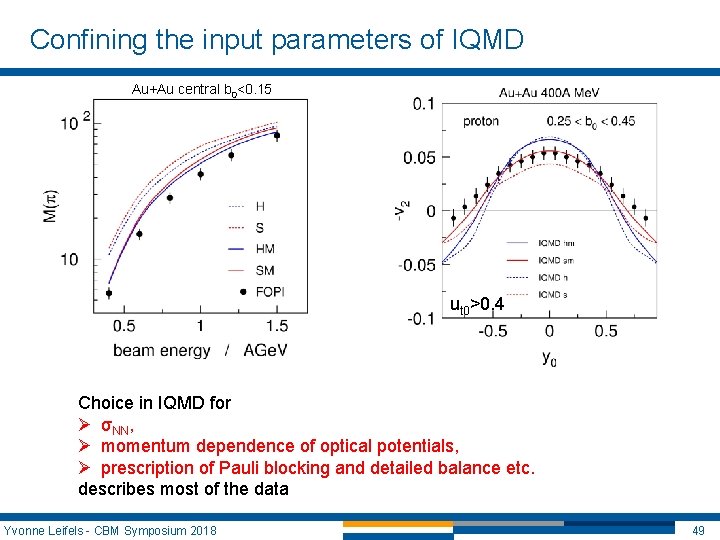
Confining the input parameters of IQMD Au+Au central b 0<0. 15 ut 0>0. 4 Choice in IQMD for Ø σNN, Ø momentum dependence of optical potentials, Ø prescription of Pauli blocking and detailed balance etc. describes most of the data Yvonne Leifels - CBM Symposium 2018 49