
Release retrospective Presentation subtitle is Open Sans Regular

Release retrospective Presentation subtitle is Open Sans Regular 14 pt, one line maximum 00 Month 0000 | Firstname Lastname © 2018 Pegasystems Inc. CONFIDENTIAL
Release retrospective vs Sprint retrospective Sprint re o r t e r e tro Releas The Release and Sprint retrospectives have many similarities including techniques and the ultimate goal of continuous improvement which is so important to Agile. However there are some differences … 2
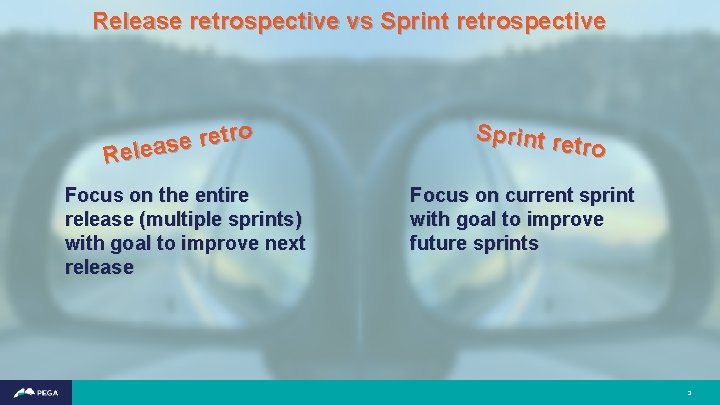
Release retrospective vs Sprint retrospective o r t e r e Releas Focus on the entire release (multiple sprints) with goal to improve next release Sprint re tro Focus on current sprint with goal to improve future sprints 3
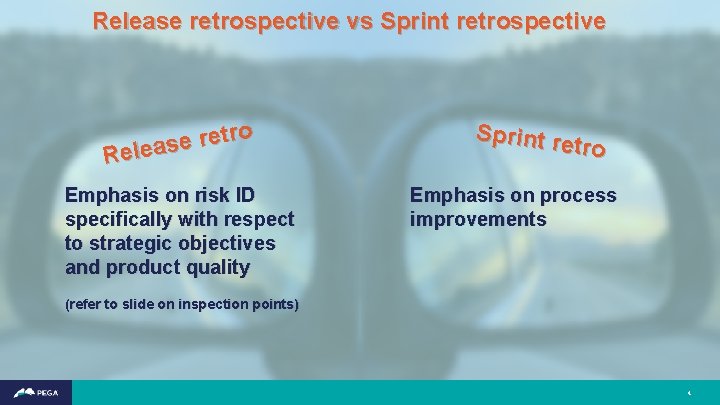
Release retrospective vs Sprint retrospective o r t e r e Releas Emphasis on risk ID specifically with respect to strategic objectives and product quality Sprint re tro Emphasis on process improvements (refer to slide on inspection points) 4
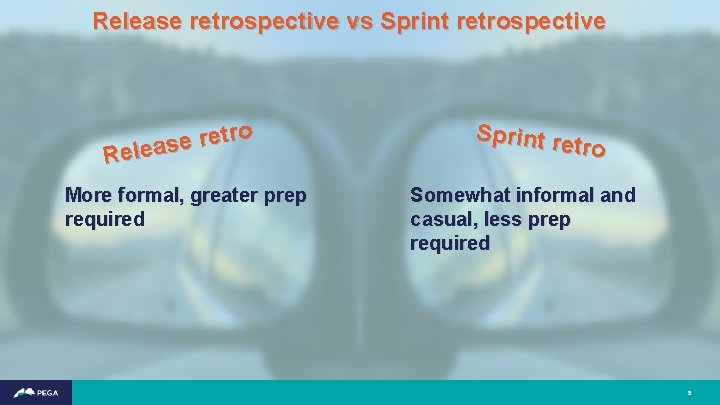
Release retrospective vs Sprint retrospective o r t e r e Releas More formal, greater prep required Sprint re tro Somewhat informal and casual, less prep required 5
Release retrospective vs Sprint retrospective o r t e r e Releas Fact and data driven Sprint re tro Emotional/feeling points may be addressed 6
Release retrospective vs Sprint retrospective o r t e r e Releas Broader participation team, management, & stakeholders Sprint re tro Limited participation team only 7
Release retrospective vs Sprint retrospective o r t e r e Releas Duration – typically, two hours depending on release length, format, and agenda Sprint re tro Duration – typically, one hour 8
Include the Sales Team in the Release Retrospective Ask yourself: How did the release align with what was expected after the Sales to Delivery Transition?
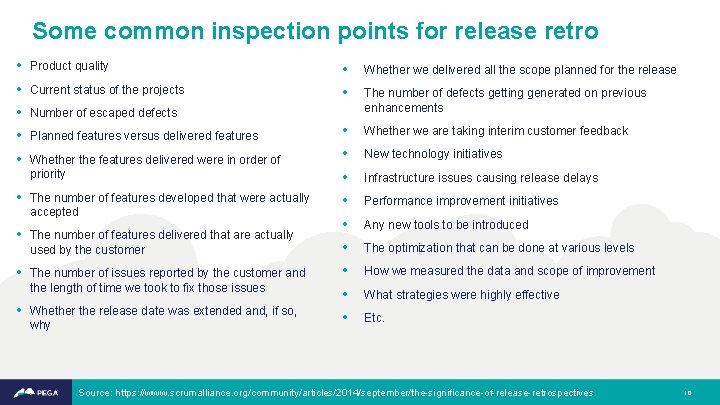
Some common inspection points for release retro • Product quality • Whether we delivered all the scope planned for the release • Current status of the projects • The number of defects getting generated on previous enhancements • Planned features versus delivered features • Whether we are taking interim customer feedback • Whether the features delivered were in order of • New technology initiatives • Infrastructure issues causing release delays • Performance improvement initiatives • Any new tools to be introduced • The optimization that can be done at various levels • How we measured the data and scope of improvement • What strategies were highly effective • Etc. • Number of escaped defects priority • The number of features developed that were actually accepted • The number of features delivered that are actually used by the customer • The number of issues reported by the customer and the length of time we took to fix those issues • Whether the release date was extended and, if so, why Source: https: //www. scrumalliance. org/community/articles/2014/september/the-significance-of-release-retrospectives 10
Overview and techniques for retrospectives For a general overview and some common techniques that are useful in running scrum retrospectives, please refer to: http: //pdn. pega. com/documents/scrum-basics-retrospectives 11
- Slides: 12